Bitcoin Is Entering A Window For A Santa Rally, Analyst Says

bitcoinistPublicado em 2025-12-22Última atualização em 2025-12-22

Resumo

Bitcoin is showing signs of a potential Santa rally, according to CryptoQuant analyst Axel Adler Jr. The market’s current “Regime Score” sits at +16.3, placing it in the upper neutral zone (+15 to +30), which historically has delivered average returns of +3.8% over 30 days. This suggests a tactical bullish setup without excessive optimism. Additionally, the derivatives market shows a skew toward short liquidations, creating mechanical upward pressure as forced buyers enter the market. However, Adler cautions that entering the formal Bull regime (above +30) has historically coincided with local tops. The current “bullish neutrality” offers a favorable window for upside, though a drop in the Regime Score below zero or a shift toward long liquidations would signal exhaustion. Bitcoin traded at $89,864 at the time of writing.

Bitcoin might be stumbling into a very seasonal setup, not because Santa is real, but because positioning and one of those composite “regime” dashboards are flashing the kind of “bullish, but not sweaty” signal traders love to cling to in late December.

CryptoQuant analyst Axel Adler Jr. put it bluntly on X on Monday: “BTC is entering a window for a Santa rally: the Regime Score is bullish but not overheated. Short liquidations are reinforcing the asymmetry in favor of buyers.”
That’s the headline claim. The longer version is basically: the market is in a zone that has historically had decent forward returns, and the derivatives plumbing is currently doing that annoying-but-useful thing where it mechanically pushes price higher when shorts get forced out.

Will Bitcoin See A ‘Santa Rally’ This Year?

In his Monday Substack post, Adler framed it as a tactical setup rather than some grand, end-of-year prophecy. “The BTC market is in the upper part of the Regime Score neutral zone, which has historically shown positive expected returns,” he wrote. Then he tightened the screw: “The current liquidation structure in the futures market indicates a predominance of short position closures, creating additional mechanical pressure in favor of buyers.”

So what’s this Regime Score thing, exactly? Adler describes it as a composite indicator that “combines taker imbalance, OI pressure, funding, ETF flows, exchange flows, and price trend into a single scale from −100 to +100.” The number matters less than the band it sits in. Right now, he says the score “stands at +16.3, corresponding to the upper part of the neutral zone (+15 to +30).”
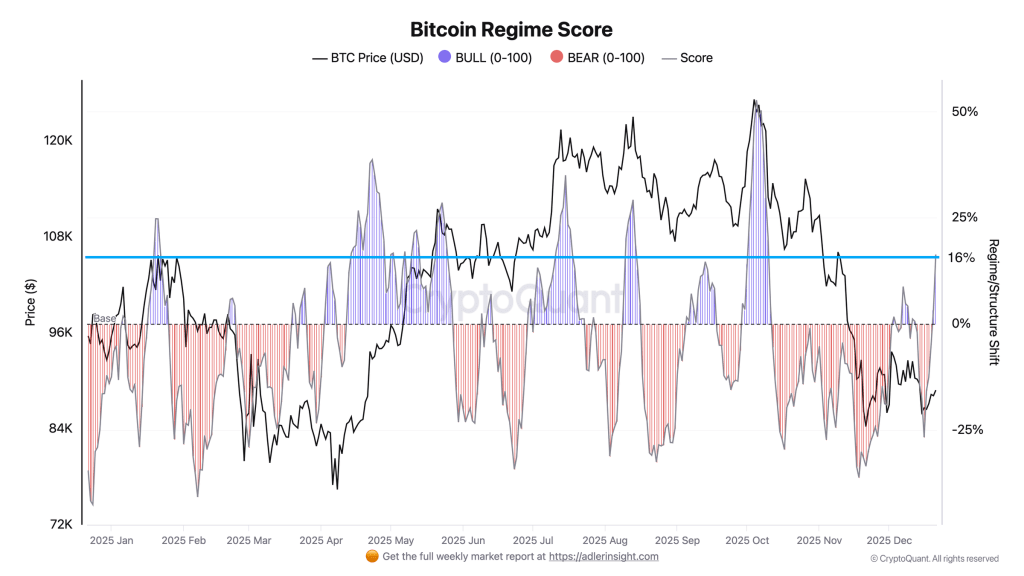
Bitcoin Regime Score | Source: Axel Adler Jr

And that particular subzone is doing the heavy lifting in his argument. “Backtesting for 2025 shows this subzone historically delivered average returns of +3.8% over 30 days,” Adler wrote, contrasting it with the weaker ranges below. He also pointed out that, “unlike the −15 to 0 subzone where expected returns were negative (−1.5% over 7d),” the +15 to +30 band tended to be a more forgiving place to put on risk.

It’s also worth noting how quickly the tape can flip, because his own charting suggests it already did. Adler says the indicator “has emerged from a recent bearish phase (score dropped to −27 a week ago) and is showing recovery.” That’s the kind of detail traders latch onto: not just where you are, but how fast you got there.

But here’s the funny part — the “most bullish” zone, in his backtest, wasn’t actually bullish for forward returns. He flags that “transition into the formal Bull regime (+30 and above) historically coincided with local tops” and that it “delivered negative average returns of −3.3% over 7 days.” In other words, if you wait for the indicator to scream “bull market,” you might be buying the exact moment everyone else is already leaning the same way.

Which is why Adler ends up with a pretty trader-ish conclusion: the current band might be the sweet spot because it’s optimistic without being euphoric.

“This means the current +15–30 zone may be optimal for tactical positions, while aggressive accumulation upon breaking +30 carries elevated risk,” he wrote.

Then there’s the derivatives side — the part that can turn a calm-looking market into a sudden wick up (or down) just because leverage is sitting in the wrong place. Adler’s liquidation dominance oscillator is currently negative, which he reads as a short liquidation skew. “The oscillator’s current value has dropped into negative territory (−11%), while the 30-day moving average remains positive (+10%). This divergence points to a recent surge in forced short position closures,” he wrote.

He doubles down with a second stat: “Long Liquidation Dominance stands at 44%, below the 50% baseline, confirming the predominance of short liquidations.” Put simply: more shorts are getting forced out than longs are getting wiped, and those forced closes are buys.
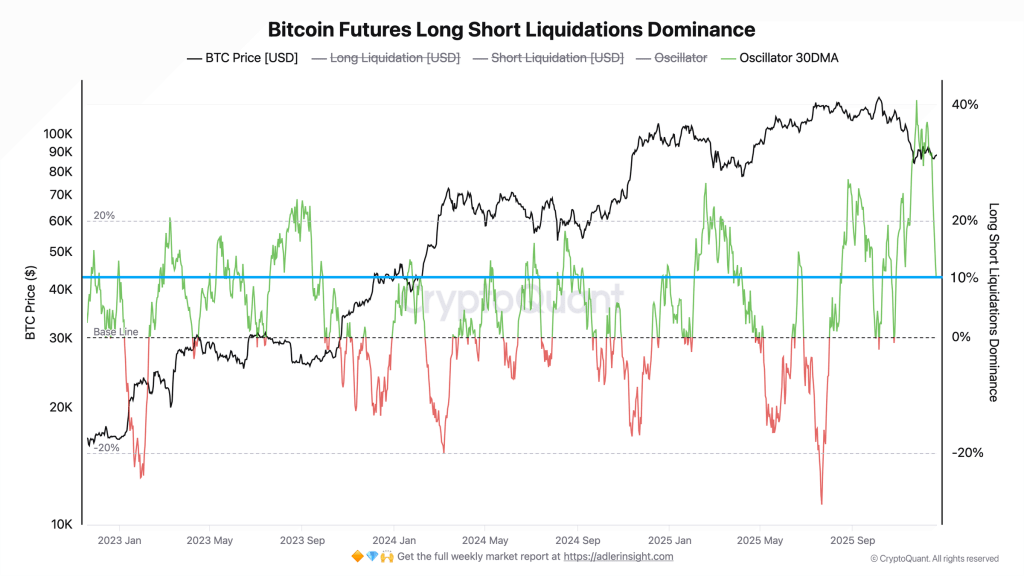
Bitcoin Futures Long Short- Liquidations Dominance | Source: Axel Adler Jr

And his takeaway is basically: this is tactical fuel. “The predominance of short liquidations creates tactical fuel for upside,” Adler wrote, adding that the setup “reinforces the positive signal from Regime Score: the market has not only entered a zone with historically positive expected returns but is also receiving additional support from derivatives structure.”

Still, this is Bitcoin, and these setups don’t last forever. Adler even lays out what would invalidate it, in pretty plain language. “A return of Regime Score below zero accompanied by a reversal of the liquidation oscillator into positive territory (rising long liquidations) would signal exhaustion of the current impulse,” he wrote. Translation: if longs start being the ones getting punished, that “asymmetry” flips.

For now, he’s calling it a “bullish neutrality” moment. Not full-blown melt-up territory, not the kind of reading that screams “local top” either. Just a window where, if the market wants to drift higher into year-end, the positioning doesn’t look like it’s going to fight it.

At press time, Bitcoin traded at $89,864.
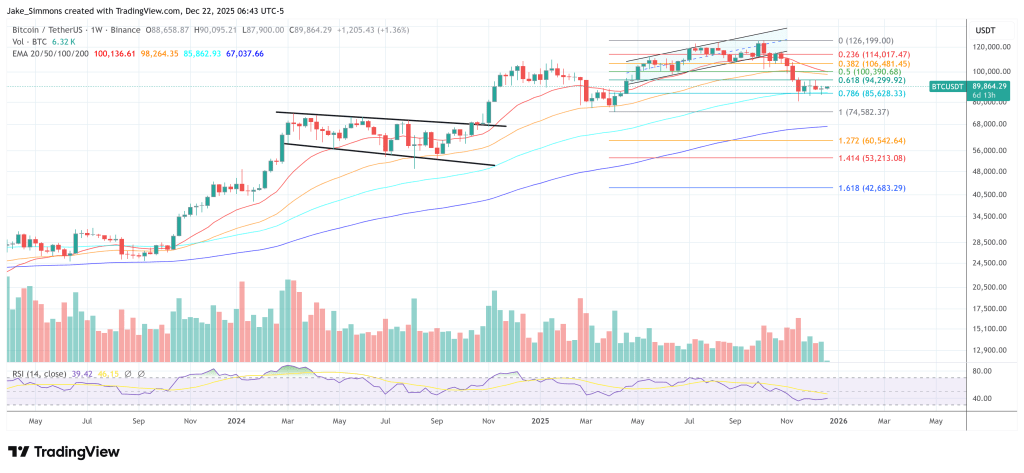
Bitcoin remains stuck between the 0.618 and 0.786 Fib, 1-week chart | Source: BTCUSDT on TradingView.com

Perguntas relacionadas

QWhat is the current Bitcoin Regime Score and what does it indicate according to Axel Adler Jr.?

AThe current Bitcoin Regime Score is +16.3, which is in the upper part of the neutral zone (+15 to +30). This zone has historically shown positive expected returns of +3.8% over 30 days, indicating a 'bullish, but not overheated' market condition that is optimal for tactical positions.

QHow does the liquidation structure in the futures market currently support a potential price increase?

AThe liquidation dominance oscillator is in negative territory (-11%), indicating a predominance of short position closures. With Long Liquidation Dominance at 44% (below the 50% baseline), this confirms that more shorts are being forced out than longs. These forced short liquidations create mechanical buying pressure, reinforcing the upside for buyers.

QAccording to the analyst, what would invalidate the current bullish tactical setup?

AThe setup would be invalidated by a return of the Regime Score below zero, accompanied by a reversal of the liquidation oscillator into positive territory. This would signal a shift where long liquidations are rising, indicating exhaustion of the current bullish impulse and a flip in market asymmetry.

QWhy does the analyst consider the current 'Bull' regime (score above +30) to be less ideal for entering positions?

AHistorical backtesting shows that a transition into the formal Bull regime (score of +30 and above) has often coincided with local tops and delivered negative average returns of -3.3% over 7 days. This suggests that entering at that point might mean buying when the market is already euphoric and due for a pullback.

QWhat is the overall market condition described by the analyst, and at what price was Bitcoin trading at press time?

AThe overall market condition is described as 'bullish neutrality' or a 'bullish, but not sweaty' signal. It is a tactical setup where the market is optimistic without being euphoric, providing a window for a year-end rally. At press time, Bitcoin was trading at $89,864.

Leituras Relacionadas

Understanding the New Economic Model of Tokenization

Understanding the New Token Economics Model The commercialization of AI applications is evolving from selling software and subscriptions to selling token call capacity. Tokens, the fundamental unit of information processing for large language models (LLMs), have become the basis for API billing and consumption. With call volumes exploding, tokens themselves are now being traded—procured, routed, split, and resold—forming a new intermediary market. This layer connects upstream LLM providers with downstream developers and enterprises, acting as a global wholesale-to-retail liquidity network. The rise of this business is fueled by a massive surge in China's daily token call volume—growing over a thousandfold from 100 billion in early 2024 to over 140 trillion by March 2026—and significant improvements in domestic LLM capabilities, which are now competitive globally. The core value of token distribution platforms extends beyond simple arbitrage. Key functions include aggregating multiple models (like GPT, Claude, and domestic models such as Kimi and DeepSeek) under a unified API, lowering network and payment barriers, and providing enterprise services like model selection, prompt engineering, and system integration. Profit models are diversifying: (1) resale margins; (2) technical premiums from proprietary inference acceleration (e.g., reducing costs to 1/10 of the industry standard); and (3) enterprise value-added services. High-consumption scenarios like marketing, short-form video, gaming, and e-commerce are primary drivers. Investment opportunities are seen in both companies with strong model capabilities (e.g., Alibaba, Tencent, MiniMax) and those with high-consumption client scenarios (e.g., marketing agencies with overseas reach). However, risks are significant: low entry barriers leading to intense competition, capital requirements and bad debt risks from advance payments, and dependency on policy changes from upstream LLM providers who control API pricing and access.

marsbitHá 32m

Understanding the New Economic Model of Tokenization

marsbitHá 32m

Farewell to the Copper Era: Understanding the Logic of the AI Silicon Photonics Industry Chain and Key US Stock Players

**Summary: The Era of Silicon Photonics and Key AI Infrastructure Stocks** The article delves into the transition from copper-based interconnects to silicon photonics (SiPh) as a critical enabler for next-generation AI data centers. It explains that copper faces fundamental physical limits—the bandwidth wall, density wall, and power wall—at high data rates (1.6T+), making a material shift essential. Silicon photonics, which integrates components like lasers, modulators, and detectors onto a silicon chip, offers a solution by leveraging mature CMOS manufacturing for cost-effective, high-volume production. A key challenge is that silicon itself is not an efficient light source, making Indium Phosphide (InP) lasers a critical and supply-constrained component. A major industry catalyst was NVIDIA's 2025 GTC announcement, declaring optical interconnects a "standard" from its Rubin platform onward, followed by strategic investments to secure the supply chain. The industry is structured in four key layers: 1. **Foundries:** TSMC leads with its COUPE platform, while Tower Semiconductor (specialized SiPh foundry) and GlobalFoundries are major players. 2. **Core Component Suppliers:** Lumentum is highlighted as the sole volume manufacturer of the crucial 200G/lane EML laser, with orders locked by NVIDIA through 2027. 3. **Module & System Manufacturers:** Coherent holds significant market share, with Chinese manufacturers like InnoLight also noted for scale. 4. **System Integrators:** NVIDIA, Broadcom, and Marvell dominate this layer, setting standards and integrating technology. The article identifies core public investment targets: **NVIDIA (NVDA)** as the ecosystem driver; **Broadcom (AVGO)** and **Marvell (MRVL)** in networking/switching chips; **Lumentum (LITE)** and **Coherent (COHR)** for critical components; and foundries **TSMC (TSM)** and **Tower Semiconductor (TSEM)**. Private companies Lightmatter and Ayar Labs are noted as key IPO candidates. The silicon photonics shift is driving a re-rating of company valuations, moving them from traditional telecom/industrial metrics to premium AI infrastructure multiples. The industry features high barriers to entry (e.g., multi-year lead times for InP laser capacity, complex 3D integration/thermal management, and lengthy customer qualification cycles), suggesting a "winner-takes-most" dynamic. Risks include dependence on hyperscaler capex cycles, potential technology disruption among competing optical approaches (LPO, CPO, OCS, Optical I/O), and a timeline where widespread CPO deployment may not occur until ~2028, with LPO serving as a transitional technology. The conclusion advises that betting on the overall industry trend may be safer than betting on any single company.

marsbitHá 1h

Farewell to the Copper Era: Understanding the Logic of the AI Silicon Photonics Industry Chain and Key US Stock Players

marsbitHá 1h

Trading

Spot
Futuros

Artigos em Destaque

Como comprar ACN

Bem-vindo à HTX.com!Tornámos a compra de AITECH CLOUD NETWORK (ACN) simples e conveniente.Segue o nosso guia passo a passo para iniciar a tua jornada no mundo das criptos.Passo 1: cria a tua conta HTXUtiliza o teu e-mail ou número de telefone para te inscreveres numa conta gratuita na HTX.Desfruta de um processo de inscrição sem complicações e desbloqueia todas as funcionalidades.Obter a minha contaPasso 2: vai para Comprar Cripto e escolhe o teu método de pagamentoCartão de crédito/débito: usa o teu visa ou mastercard para comprar AITECH CLOUD NETWORK (ACN) instantaneamente.Saldo: usa os fundos da tua conta HTX para transacionar sem problemas.Terceiros: adicionamos métodos de pagamento populares, como Google Pay e Apple Pay, para aumentar a conveniência.P2P: transaciona diretamente com outros utilizadores na HTX.Mercado de balcão (OTC): oferecemos serviços personalizados e taxas de câmbio competitivas para os traders.Passo 3: armazena teu AITECH CLOUD NETWORK (ACN)Depois de comprar o teu AITECH CLOUD NETWORK (ACN), armazena-o na tua conta HTX.Alternativamente, podes enviá-lo para outro lugar através de transferência blockchain ou usá-lo para transacionar outras criptomoedas.Passo 4: transaciona AITECH CLOUD NETWORK (ACN)Transaciona facilmente AITECH CLOUD NETWORK (ACN) no mercado à vista da HTX.Acede simplesmente à tua conta, seleciona o teu par de trading, executa as tuas transações e monitoriza em tempo real.Oferecemos uma experiência de fácil utilização tanto para principiantes como para traders experientes.

172 Visualizações TotaisPublicado em {updateTime}Atualizado em 2026.04.28

Como comprar ACN

O que é HPP

I. Introdução ao ProjetoConstruído como uma Layer 2 na Arbitrum e evoluindo o legado comprovado da Aergo, o HPP oferece a infraestrutura que as aplicações modernas de IA exigem — escalável, sem confiança e pronta para empresas.II. Informação sobre Criptomoeda1) Informação BásicaNome: House Party Protocol (HPP)III. Links RelacionadosWebsite Oficial:https://www.hpp.io/Whitepaper:https://www.hpp.io/assets/HPP%20Whitepaper_ENG_vF_20250725-Bb-xX5Yd.pdfExplorador de Blockchain:https://explorer.hpp.io/Redes Sociais:Twitter: https://x.com/aergo_ioMedium: https://medium.com/aergoTelegram: https://t.me/aergoofficial%22Nota: A introdução ao projeto provém dos materiais publicados ou fornecidos pela equipa oficial do projeto, que é apenas para referência e não constitui aconselhamento de investimento. A HTX não se responsabiliza por quaisquer perdas diretas ou indiretas resultantes.

178 Visualizações TotaisPublicado em {updateTime}Atualizado em 2026.04.29

O que é HPP

Como comprar HPP

Bem-vindo à HTX.com!Tornámos a compra de House Party Protocol (HPP) simples e conveniente.Segue o nosso guia passo a passo para iniciar a tua jornada no mundo das criptos.Passo 1: cria a tua conta HTXUtiliza o teu e-mail ou número de telefone para te inscreveres numa conta gratuita na HTX.Desfruta de um processo de inscrição sem complicações e desbloqueia todas as funcionalidades.Obter a minha contaPasso 2: vai para Comprar Cripto e escolhe o teu método de pagamentoCartão de crédito/débito: usa o teu visa ou mastercard para comprar House Party Protocol (HPP) instantaneamente.Saldo: usa os fundos da tua conta HTX para transacionar sem problemas.Terceiros: adicionamos métodos de pagamento populares, como Google Pay e Apple Pay, para aumentar a conveniência.P2P: transaciona diretamente com outros utilizadores na HTX.Mercado de balcão (OTC): oferecemos serviços personalizados e taxas de câmbio competitivas para os traders.Passo 3: armazena teu House Party Protocol (HPP)Depois de comprar o teu House Party Protocol (HPP), armazena-o na tua conta HTX.Alternativamente, podes enviá-lo para outro lugar através de transferência blockchain ou usá-lo para transacionar outras criptomoedas.Passo 4: transaciona House Party Protocol (HPP)Transaciona facilmente House Party Protocol (HPP) no mercado à vista da HTX.Acede simplesmente à tua conta, seleciona o teu par de trading, executa as tuas transações e monitoriza em tempo real.Oferecemos uma experiência de fácil utilização tanto para principiantes como para traders experientes.

169 Visualizações TotaisPublicado em {updateTime}Atualizado em 2026.04.29

Como comprar HPP

Discussões

Bem-vindo à Comunidade HTX. Aqui, pode manter-se informado sobre os mais recentes desenvolvimentos da plataforma e obter acesso a análises profissionais de mercado. As opiniões dos utilizadores sobre o preço de A (A) são apresentadas abaixo.

活动图片