Bitcoin Bear Market Triggers Crypto Layoffs, Yet Fuels Industry's Most Aggressive M&A Wave Ever

marsbitPublicado em 2026-06-26Última atualização em 2026-06-26

Resumo

A prolonged Bitcoin downturn is forcing crypto companies to lay off employees and automate operations, but has simultaneously triggered the industry's most aggressive wave of mergers and acquisitions (M&A). In the first half of 2026, crypto M&A deal value reached $93.7 billion, 26 times higher than the same period last year. This activity is primarily driven by traditional financial institutions—banks, payment processors, and asset managers—who are acquiring compliant crypto infrastructure like custody solutions, payment rails, and regulatory licenses instead of building them internally. Examples include Mastercard's acquisition of stablecoin firm BVNK and Franklin Templeton's launch of a dedicated crypto division via acquisition. This consolidation contrasts sharply with a shrinking crypto labor market, where active job openings have plummeted. Companies like Coinbase are restructuring to become "AI-native," leading to a sharp increase in roles requiring AI skills, while engineering and compliance positions now dominate hiring. Financially pressured crypto firms, such as Messari which was acquired at a fraction of its prior valuation, are becoming prime targets. Capital remains available but is highly selective, flowing overwhelmingly into businesses that bridge digital assets with traditional finance, such as tokenization platforms and regulated trading venues. The trend indicates a market where capital is rewarding compliant, utility-focused infrastructure while weaker m...

Author: Oluwapelumi Adejumo

Compiled by: Deep Chao TechFlow

Deep Chao's Guide: The ongoing decline of BTC is forcing crypto companies to conduct large-scale layoffs, but it is also spawning the most aggressive wave of mergers and acquisitions in the industry's history - with transaction volumes reaching $9.4 billion in the first half of 2026, 26 times the volume from the same period last year. Traditional financial institutions are no longer building their own infrastructure but are instead directly acquiring licenses, custody solutions, and payment rails. This divergence reveals the true direction of capital flow during a bear market.

Bitcoin's prolonged downturn is forcing cryptocurrency companies to cut staff, automate more tasks, and abandon expansion plans formulated during the last bull run. Simultaneously, it is creating one of the busiest periods for acquisitions in the sector's history.

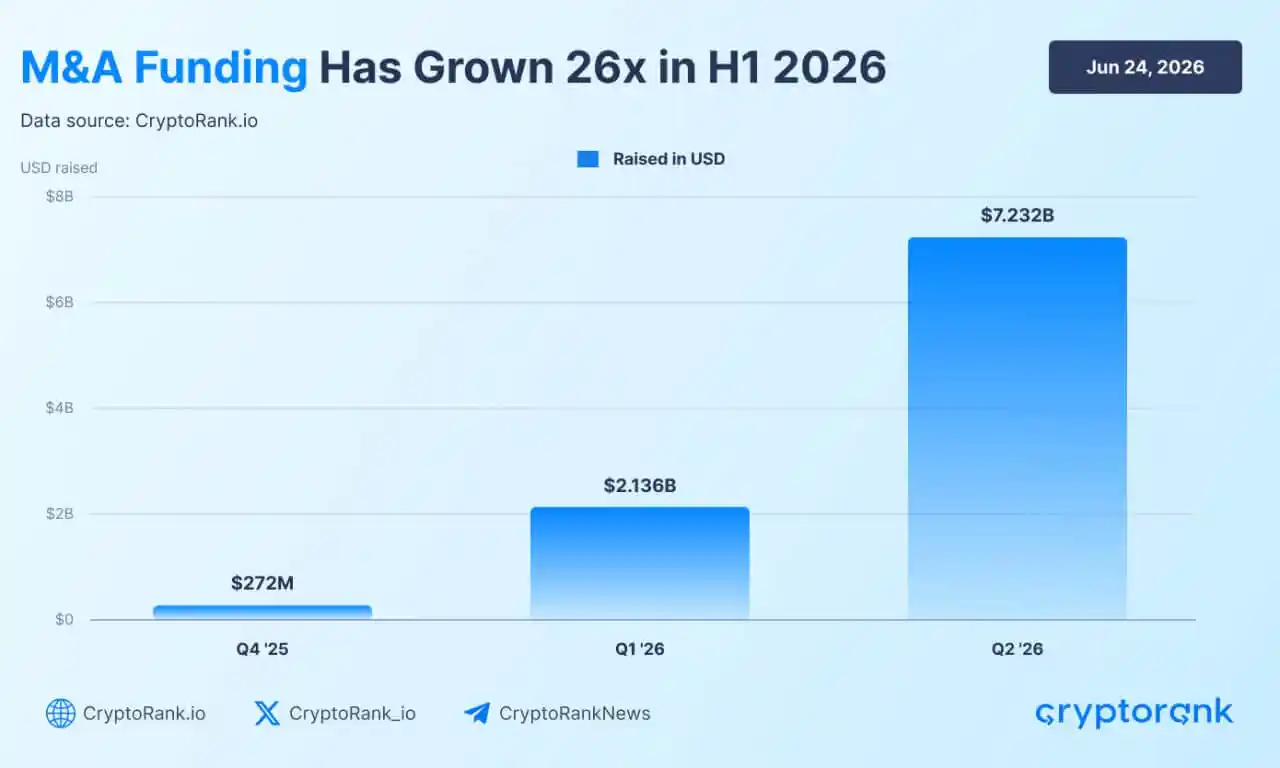
In the second quarter of 2026, cryptocurrency M&A deals reached $7.23 billion, up from $2.14 billion in the first quarter.

The total transaction value for the two quarters reached $9.37 billion. Data from CryptoRank shows that the overall growth in the first half of the year was 26 times higher than the same period last year, highlighting a dramatic acceleration in deal activity even as spot market conditions worsen.
This acceleration is occurring against a backdrop of Bitcoin trading near its lowest levels in nearly two years and continued layoffs at some of the industry's largest employers.

This divergence shows where capital is flowing during the downturn – companies are spending less on broad hiring and speculative growth.

Instead, traditional financial institutions, banks, card networks, trading firms, and well-funded crypto businesses are acquiring payment systems, regulatory licenses, custody businesses, and market infrastructure that could take years to build internally.

The result is a bear market that is weakening many crypto companies but not eliminating institutional demand for their technology.

Traditional Finance Drives Wave of Crypto Infrastructure Acquisitions

Traditional financial institutions are driving the wave of crypto acquisitions, opting to buy fully-fledged digital asset infrastructure rather than building compliance and technical systems from scratch.

Banks, payment processors, and fintech companies are actively targeting startups that already possess custody solutions, payment rails, and regulatory approvals.

This acquisition frenzy is largely driven by the stabilization of global policy. The European Union's Markets in Crypto-Assets (MiCA) framework establishes unified licensing standards, while ongoing stablecoin legislation in the US gives corporate giants the confidence to make long-term bets.

Legal and consulting experts point to this policy support as a primary catalyst. According to Architect Partners' Q1 Crypto M&A and Financing Report, banking and securities industries are fully embracing blockchain, repositioning the technology as a foundational layer for traditional financial markets.

Mastercard's $1.8 billion acquisition of stablecoin company BVNK is a prime example. This acquisition gave the card network immediate access to the technology and licenses needed to process stablecoin payments, bypassing years of internal development.

Other Wall Street giants are also securing strategic footholds through targeted investments. Intercontinental Exchange backed prediction platform Polymarket, Citadel Securities invested in brokerage services provider Alpaca, and Standard Chartered's venture arm funded market maker Keyrock.

Asset managers are also capturing institutional demand through direct acquisitions. Franklin Templeton, which manages $1.7 trillion in assets, recently launched a dedicated digital assets unit called Franklin Crypto.

This move was executed via the acquisition of 250 Digital, which absorbed the firm's investment team and previously managed liquid crypto strategies under CoinFund, to offer actively managed cryptocurrency products directly to Franklin Templeton's global client base.

Overall, private capital strongly favors businesses that connect blockchain to the wider financial system. First-quarter financing data reveals a clear investor preference for stablecoin utility—such as foreign exchange, corporate payments, and cross-border settlement—over speculative crypto-native projects.

In this environment, regulatory credentials have become a major competitive barrier. Acquisition targets with broker-dealer capabilities, federal banking charters, or registered investment advisor qualifications, including Alpaca, Anchorage, and Superstate, attract stronger buyer interest as they provide immediate operational legitimacy.

While traditional finance demonstrates its balance sheet strength, blockchain networks are quietly emerging as a new class of aggressive buyers.

Historically, Layer 1 and Layer 2 networks relied on independent developers to build applications on their chains. Now, faced with fierce competition for users, these networks are directly purchasing consumer-facing applications.

Polygon's recent acquisitions of Coinme and Sequence highlight this shift. By buying payment channels and wallet infrastructure, the blockchain is securing an end-to-end user experience and locking in transaction volume, suggesting that technical capability alone is insufficient to maintain market share.

Crypto Layoffs Deepen, AI and Compliance Reshape Workforce

The pace of corporate acquisitions starkly contrasts with the continued contraction of the digital asset labor market.

According to data compiled by Tiger Research for June 2026, the industry currently has only 2,932 active job openings globally.
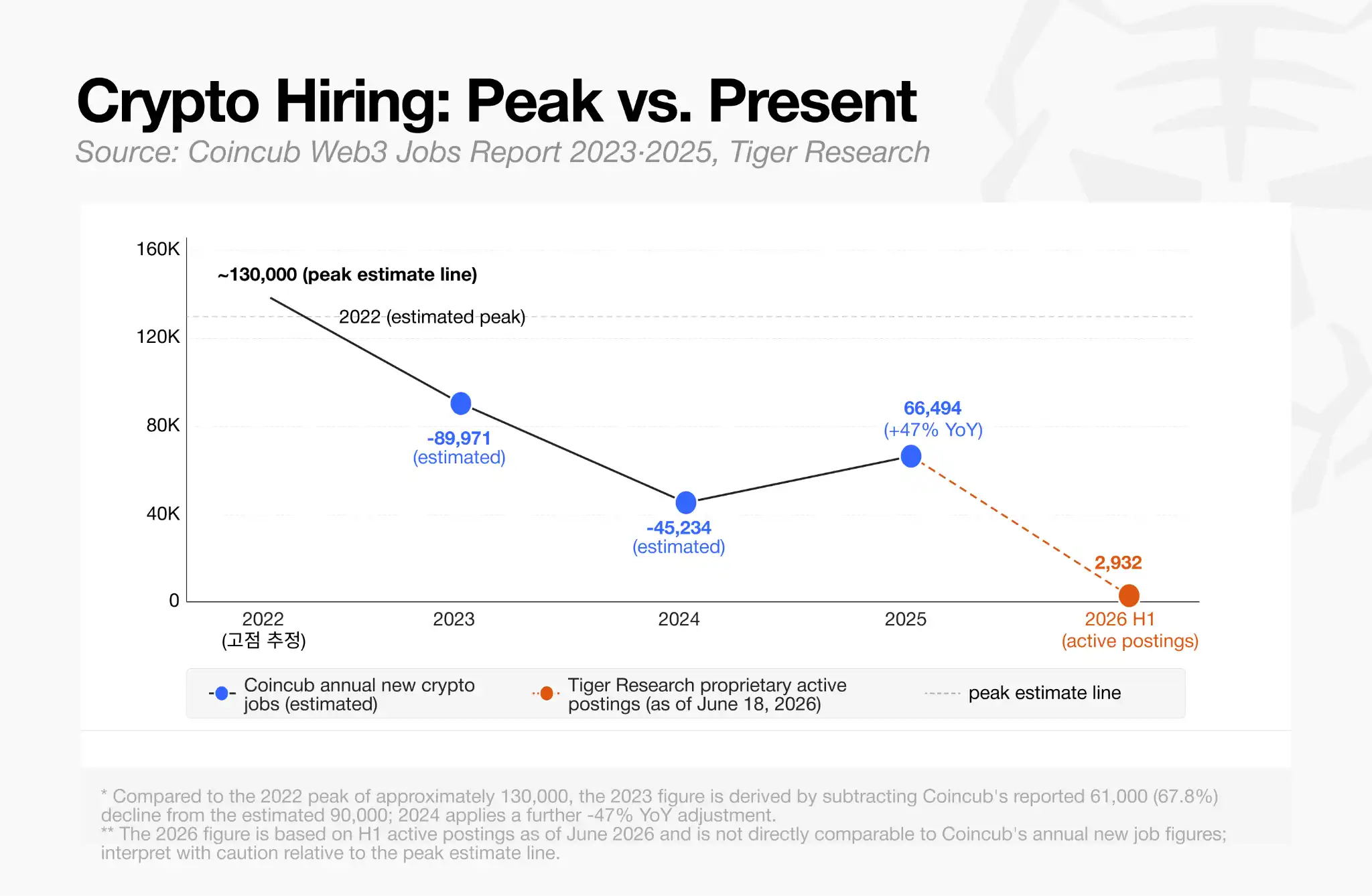
This figure pales in comparison to the aggressive hiring sprees of 2021 and early 2022, when trading platforms, DeFi protocols, and NFT markets were all expanding headcount simultaneously.

The employment shrinkage began during the market downturn of 2022 and accelerated after the FTX collapse, leading to roughly a 40% decline in job openings across North America and Europe. The market has not rebounded to previous highs.

Indeed, layoffs have been steadily continuing throughout the first half of this year. Major platforms including Gemini, Coinbase, Kraken, Algorand, Crypto.com, and most recently, the Ethereum Foundation, have initiated new rounds of job cuts.

Executives have attributed the cuts to low token valuations, broader macroeconomic pressures, and AI-driven operational efficiencies. Specifically, Coinbase framed its restructuring as a shift towards an "AI-native" operational model.

This technological pivot is evident in the hiring data: the proportion of crypto jobs requiring AI skills has more than doubled in a year, surging from 23% in early 2025 to over 53% by March 2026.
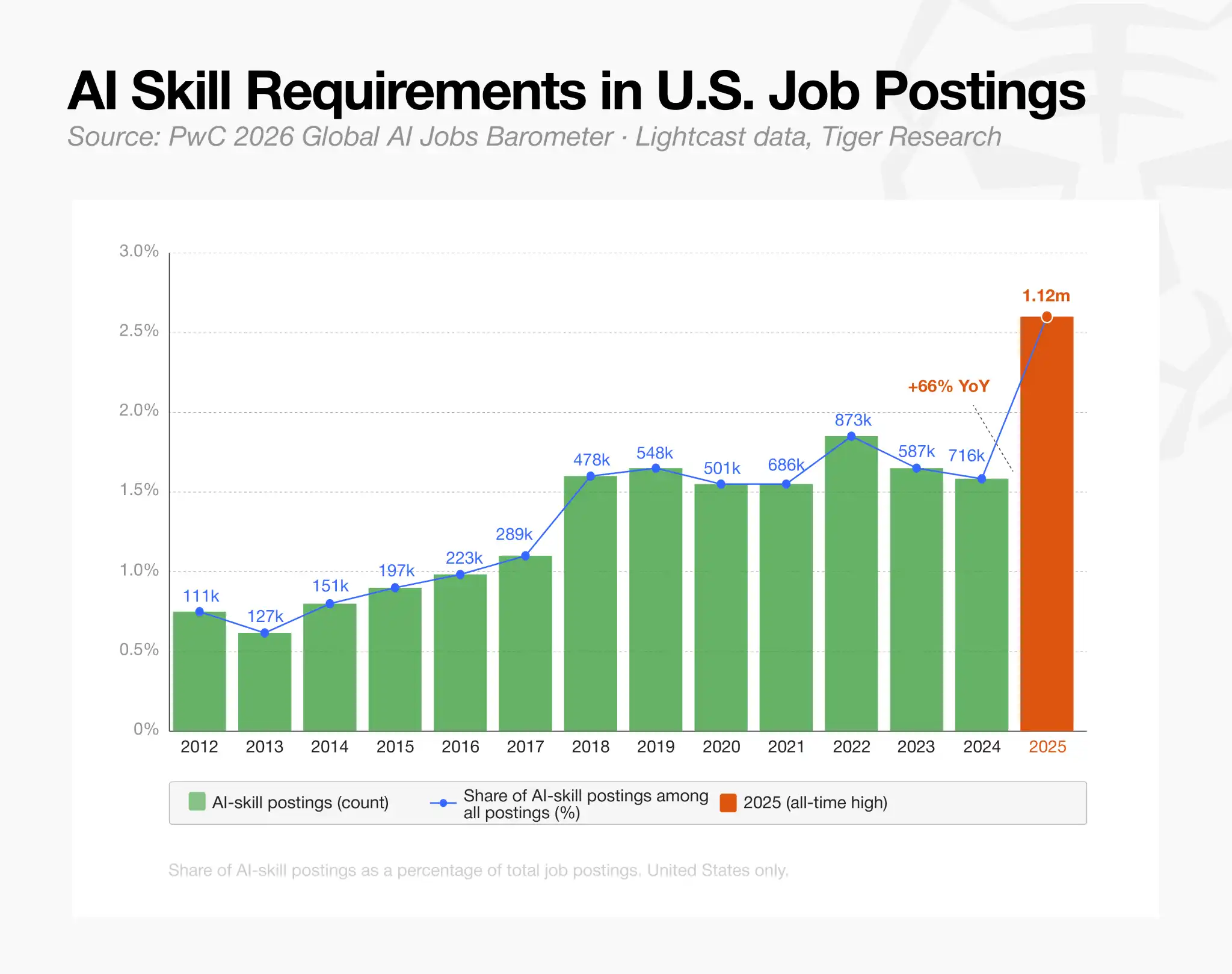
While overall hiring remains sluggish, the composition of the workforce is undergoing a fundamental change. Companies are not implementing a complete hiring freeze. Instead, they are actively narrowing their focus to technical and regulatory expertise.

According to Tiger Research, engineering roles constitute approximately 34% of active openings, while legal and compliance roles account for about 10%. This shift is more pronounced at centralized exchanges, where compliance positions make up 16% of vacancies—more than double the share for sales and business development roles.

This indicates these companies are prioritizing staffing needs to obtain licenses, manage risk, and maintain core infrastructure, while reducing spending on marketing and community growth.

Furthermore, the limited hiring that exists is highly concentrated among a few heavyweights rather than distributed across early-stage startups. Centralized exchanges generate nearly one-third of all open positions.

Stablecoin and payments divisions account for another significant portion, but this activity is highly concentrated. Tether and Ripple alone constitute over 80% of listings in that category.

Ultimately, the data paints a picture of targeted corporate restructuring and a defensive posture, not an industry-wide labor market recovery.

Distressed Crypto Companies Become Acquisition Targets

Blockworks' recent acquisition of Messari perfectly embodies the intersection of large-scale layoffs and accelerated consolidation.

The crypto analytics company Blockworks acquired the analytics provider for approximately $10 million, a significant markdown from its $300 million valuation following a 2022 funding round. Prior to the sale, the research firm underwent three separate rounds of layoffs starting in 2023.

Shortening runways and slow revenue growth are forcing smaller businesses to the negotiating table, enabling well-funded buyers to absorb specialized talent, proprietary data, and distribution channels for a fraction of their former private market valuations.

Industry analysts expect these financial pressures to soon ripple into digital asset treasury sectors. Throughout 2025, many public treasury entities successfully raised capital by trading at a premium relative to their crypto reserves.

Meanwhile, the M&A wave may also eventually encompass Decentralized Autonomous Organizations, thanks to maturing legal frameworks.

Recent legislative progress, such as Wyoming's Decentralized Unincorporated Nonprofit Association (DUNA) structure, provides DAOs with a recognized legal mechanism to hold off-chain assets and intellectual property.

With clearer governance and ownership, protocol treasuries are better positioned to acquire complementary software projects or specialized development teams.

However, compared to the traditional, compliance-driven corporate acquisitions dominating the current market cycle, these decentralized mergers remain highly experimental.

Capital Remains Available, But Has Become Discerning

Despite nearly $10 billion in crypto deal activity in the first half of 2026, capital allocation has become more discerning.

A notable exception to this strict institutional focus is the prediction markets sector. Event-betting platforms have secured significant funding commitments as they vie for mainstream dominance.

For context, Kalshi is reportedly negotiating a funding round that would value the federally regulated exchange at $40 billion, nearly double its previous $22 billion price tag. Polymarket has also absorbed substantial backing as competition for prediction market supremacy intensifies.

However, outside of predictions, the venture capital thesis has narrowed dramatically. Capital is overwhelmingly flowing to businesses acting as bridges between digital assets and the traditional financial system.

Tokenization firms and institutional trading venues secure large checks because they pitch sustainable, isolated revenue models: charging banks, brokerages, and asset managers fees for regulated services, rather than relying on fickle retail crypto traders. Superstate recently closed an $82.5 million funding round to expand its blockchain-based securities issuance, while Alpaca dominates in settling tokenized US stocks and ETFs.

This funding trajectory indicates investors are shifting bets from conceptual tokenization pilots to live, regulated financial products.

Notably, pure DeFi protocols and experimental base-layer blockchains are entirely absent from this quarter's major funding rounds.

This selective deployment of venture capital mirrors the broader M&A trend. Liquidity exists, but it is ring-fenced for startups with regulatory licenses, institutional distribution channels, and specific utility for traditional finance.

The bear market is effectively pruning the industry, forcing weaker models to consolidate or cut staff, while richly rewarding the infrastructure providers built to weather the crypto winter.

Criptomoedas em alta

Perguntas relacionadas

QWhat has been the impact of the prolonged Bitcoin downturn on the crypto industry, according to the article?

AThe prolonged Bitcoin downturn has forced crypto companies to conduct mass layoffs, automate more work, and abandon expansion plans from the previous bull market. However, it has simultaneously created one of the industry's busiest periods for mergers and acquisitions (M&A).

QHow does the scale of crypto M&A activity in the first half of 2026 compare to the previous year?

AThe total value of crypto M&A deals in the first half of 2026 reached $9.37 billion. According to CryptoRank, this represented a growth that was 26 times higher compared to the same period in the previous year.

QWhat is the primary driver behind the wave of crypto infrastructure acquisitions by traditional financial institutions?

AThe primary driver is the stabilization of global crypto policy, such as the EU's MiCA framework and ongoing stablecoin legislation in the US. This provides traditional banks and financial institutions the confidence to make long-term bets by purchasing ready-made digital asset infrastructure (like custody, payment rails, and regulatory licenses) instead of building it internally.

QHow is the composition of the crypto workforce changing during this period of layoffs, as highlighted in the article?

AThe composition is shifting towards a greater emphasis on technical and regulatory expertise. Engineering roles now make up about 34% of active job vacancies, while legal and compliance roles account for about 10%. There is also a significant increase in demand for AI skills, with over 53% of crypto job postings requiring them by March 2026.

QWhat type of companies are currently receiving the majority of venture capital funding, according to the article's analysis?

AVenture capital is overwhelmingly flowing to companies that act as bridges between digital assets and the traditional financial system. This includes tokenization firms and institutional trading venues with regulated, fee-based revenue models, rather than speculative crypto-native projects or pure DeFi protocols.

Leituras Relacionadas

Tiger Research: Three Strategies for Financial Institutions to Keep Up with the Tokenization Wave

Tiger Research's in-depth report analyzes the strategic choices for financial institutions entering the rapidly growing Real-World Asset (RWA) tokenization market. With the market projected to be worth $25-36 billion and a lack of complete regulatory frameworks in many jurisdictions, institutions face three options: waiting for domestic legislation, using regulatory sandboxes for limited experiments, or moving first into established overseas markets to gain a competitive edge. Tokenization is not magic; it requires meticulous preparation. Before entry, institutions must strategically plan across six core areas: choosing a jurisdiction, obtaining necessary licenses, defining the asset type, targeting the appropriate investor base, selecting settlement currencies, and designing operational requirements like custody and governance. The report outlines two main operational paths. The first is a direct jurisdictional path, establishing a legal presence in mature markets like Hong Kong, Singapore, or the U.S., often leveraging local licensed platforms to accelerate market entry. The second is a chain-native path, using platforms like Ondo or Plume that are built with regulatory compliance embedded, allowing for faster, more flexible market access without being tied to a specific jurisdiction. Ultimately, the report advises against waiting for perfect regulation. The preparation process can take 6-12 months and requires thorough legal review. Using the example of a mid-sized securities firm, it details steps from evaluating existing entities to final execution. The core message is that accumulating real-world operational experience is paramount, as the market is moving ahead and will not wait for latecomers.

Foresight NewsHá 43m

Tiger Research: Three Strategies for Financial Institutions to Keep Up with the Tokenization Wave

Foresight NewsHá 43m

Unitree's IPO Frenzy: The Real Mystery is How It Will Spend the 42 Billion Raised

Unitree, a Chinese robotics company, is set for a public listing after its IPO registration was approved by regulators. The company, which started with quadruped robots and has expanded into humanoids, plans to raise approximately 4.2 billion yuan through its offering. The article traces Unitree's rapid growth from its founding in 2016 to its current status. It highlights key milestones like the 2021 CCTV Spring Festival Gala performance, the 2023 launch of its affordable Go2 robot dog and the H1 humanoid robot, and a series of subsequent product launches. By 2025, the company reported revenue of 1.71 billion yuan, profitability, and sales exceeding 5,500 humanoid robots. As the first publicly-listed humanoid robot company on China's STAR Market, Unitree's main challenges are sustaining growth and deploying its newly raised capital effectively. The humanoid robot sector in China is crowded, with over 140 companies. Competitors include UBTech (focusing on industrial and consumer markets), Fourier, and international players like Tesla Optimus and 1X NEO. The article outlines three critical challenges for Unitree: establishing a strong second product line beyond its quadruped robots, maintaining its price advantage while ensuring quality, and successfully advancing its embodied AI capabilities through partnerships like the one with NVIDIA for the H2 Plus platform. Unitree's likely strategy involves a "developer tools + industry benchmarks" approach: using low-cost models like the R1 and G1 to build developer adoption and volume, leveraging high-end platforms for AI training, and securing pilot projects in sectors like logistics and manufacturing to build case studies. The company's future success hinges on converting its current momentum in shipments and pilot programs into sustainable, large-scale commercial contracts as the broader market evolves.

marsbitHá 2h

Unitree's IPO Frenzy: The Real Mystery is How It Will Spend the 42 Billion Raised

marsbitHá 2h

Trading

Spot

Artigos em Destaque

O que é DOGE M

Doge Matrix ($doge m): A Nova Raça de Criptomoeda Orientada pela Comunidade Introdução No panorama em constante evolução das criptomoedas, novos projetos surgem constantemente, cada um visando captar o interesse de investidores e entusiastas. Um dos mais recentes entrantes neste domínio é o Doge Matrix, representado pelo símbolo de ticker $doge m. Este projeto atraiu atenção graças às suas raízes na popular cultura de memes em torno do Dogecoin, estabelecendo o seu lugar dentro do espaço web3. Este artigo visa fornecer uma análise abrangente do Doge Matrix, cobrindo a sua visão geral, criador, investidores, funcionalidade, cronologia e aspetos notáveis. O que é o Doge Matrix ($doge m)? O Doge Matrix é um projeto de criptomoeda orientado pela comunidade que aparentemente se baseia no apelo generalizado do Dogecoin, uma moeda digital conhecida pelo seu mascote Shiba Inu e pelas suas origens em memes. Embora os objetivos gerais do Doge Matrix não estejam extensivamente definidos, caracteriza-se por um compromisso em aproveitar o envolvimento e o apoio da comunidade. Ao contrário das criptomoedas tradicionais que muitas vezes enfatizam a utilidade ou o valor intrínseco através de tecnologias subjacentes, o Doge Matrix posiciona-se dentro de um espaço que abraça o fenómeno cultural das criptomoedas, apelando particularmente àqueles que se identificam com a ética dos ativos baseados em memes. Aproveitando as forças da comunidade Dogecoin, o Doge Matrix opera como parte de um ecossistema mais amplo, convidando à participação e ao envolvimento de utilizadores que partilham um interesse pela criptomoeda e pelo espaço digital. Quem é o Criador do Doge Matrix ($doge m)? A identidade do criador do Doge Matrix permanece desconhecida. Esta falta de transparência não é uma ocorrência incomum no espaço das criptomoedas, onde alguns projetos são lançados sem revelar as identidades dos seus fundadores. A ausência de informação sobre a equipa fundadora pode levantar questões entre potenciais investidores sobre a responsabilidade e a direção do projeto. Quem são os Investidores do Doge Matrix ($doge m)? Atualmente, não há informações disponíveis publicamente que detalhem os investidores ou as fundações de investimento que apoiam o Doge Matrix. O projeto parece depender principalmente do apoio da comunidade em vez de investimento institucional. Este modelo alinha-se com a natureza orientada pela comunidade da iniciativa, promovendo um ambiente onde a direção do projeto é moldada pelos seus participantes em vez de ser ditada por um pequeno grupo de financiadores. Como Funciona o Doge Matrix ($doge m)? Os detalhes sobre os mecanismos operacionais do Doge Matrix são um tanto vagos, refletindo uma tendência mais ampla de projetos no espaço das moedas meme, onde funcionalidades inovadoras nem sempre são claramente articuladas. No entanto, o Doge Matrix parece ser projetado para aproveitar o ecossistema existente de criptomoedas, incentivando a participação dos utilizadores enquanto se liga às referências culturais familiares associadas ao Dogecoin. As suas características potencialmente únicas derivam das interações da comunidade em vez de avanços tecnológicos, enfatizando experiências partilhadas e colaboração entre os detentores de tokens. Embora as inovações exatas não tenham sido explicitamente delineadas, o projeto parece criar um espaço onde os membros da comunidade podem interagir, partilhar ideias e impulsionar o potencial do projeto para a frente. Cronologia do Doge Matrix ($doge m) Refletir sobre a cronologia do projeto revela eventos notáveis que definiram a sua jornada até agora: 25 de Novembro de 2024: O Doge Matrix alcançou o seu valor máximo histórico, marcando um marco significativo na sua história inicial. 1 de Janeiro de 2025: Por outro lado, o Doge Matrix atingiu o seu valor mínimo histórico, ilustrando a volatilidade frequentemente associada às criptomoedas, especialmente nas fases iniciais do ciclo de vida de um projeto. Em Curso: O projeto continua a ser ativamente negociado e apoiado pela sua comunidade, embora marcos ou objetivos futuros específicos ainda não tenham sido divulgados. Pontos Chave Sobre o Doge Matrix ($doge m) Foco na Comunidade No coração do Doge Matrix está um compromisso com o envolvimento da comunidade. O projeto prospera na premissa de colaboração e objetivos partilhados entre os seus membros, enfatizando a importância do esforço coletivo. Ao contrário de projetos centralizados que muitas vezes têm uma estrutura de liderança definida, o Doge Matrix apresenta atualmente uma abordagem mais fluida à governança, onde a voz de cada membro da comunidade importa. Volatilidade O mercado de criptomoedas é notório pela sua volatilidade, e o Doge Matrix não é exceção. A sua história de preços reflete flutuações significativas entre valores altos e baixos, o que é típico de muitas novas criptomoedas, mas sublinha os riscos associados ao investimento em tokens emergentes. Falta de Informação Detalhada Uma das características mais marcantes do Doge Matrix é a escassez de informação detalhada sobre os seus fundamentos tecnológicos e mecanismos operacionais. Esta ambiguidade exige que potenciais investidores realizem uma diligência prévia minuciosa antes de se envolverem com o projeto. Conclusão Em resumo, o Doge Matrix ($doge m) ilustra uma nova onda de projetos de criptomoeda que dependem fortemente do envolvimento da comunidade e da relevância cultural. Embora falte em certos pormenores—como liderança clara, objetivos definidos e funcionalidade detalhada—o projeto conseguiu gerar interesse dentro da comunidade cripto, aproveitando o apelo estabelecido da cultura de memes. Como em qualquer investimento no espaço das criptomoedas, compreender os riscos inerentes e realizar uma pesquisa abrangente é essencial para potenciais participantes. O Doge Matrix serve como um lembrete da natureza dinâmica, por vezes imprevisível, da indústria cripto, marcada por uma evolução constante e entusiasmo por iniciativas orientadas pela comunidade.

494 Visualizações TotaisPublicado em {updateTime}Atualizado em 2025.02.03

O que é DOGE M

O que é $M

Compreender o Mantis ($M): Uma Nova Era na Interoperabilidade entre Cadeias No panorama em constante evolução do Web3 e das criptomoedas, novos projetos esforçam-se por oferecer soluções inovadoras destinadas a melhorar a experiência do utilizador e expandir as possibilidades funcionais dentro do ecossistema financeiro descentralizado. Um desses projetos que está a ganhar atenção é o Mantis ($M), um protocolo pioneiro fundado nos princípios da interoperabilidade entre cadeias e liquidações baseadas em intenções. Este artigo explora os aspetos essenciais do Mantis, incluindo a sua funcionalidade central, criadores, apoio ao investimento, características inovadoras e marcos críticos. O que é o Mantis ($M)? O Mantis é descrito como um protocolo de liquidação de intenções multi-domínio que simplifica as interações entre cadeias, permitindo que os utilizadores executem transações financeiras complexas em várias plataformas de blockchain de forma contínua. O protocolo opera através de três camadas principais: Expressão de Intenção: Os utilizadores podem articular os seus objetivos de transação utilizando linguagem natural facilitada pelo DISE LLM, um modelo avançado de linguagem de IA. Por exemplo, um utilizador pode expressar o desejo de trocar Ethereum (ETH) por Solana (SOL) com uma tolerância de slippage específica de 1%. Execução: Esta camada utiliza uma rede de solucionadores que competem para satisfazer as intenções dos utilizadores. As transações são executadas utilizando mecanismos como Coincidência de Vontades (CoWs) e Leilões de Fluxo de Ordens (OFAs), que garantem que as exigências dos utilizadores sejam atendidas de forma otimizada. Liquidação: Aproveitando o protocolo de Comunicação Inter-Blockchain (IBC), o Mantis permite transações atómicas entre cadeias, permitindo que os utilizadores operem em várias cadeias suportadas, incluindo Ethereum, Solana e Cosmos. O Mantis é projetado para introduzir geração de rendimento nativa para ativos inativos, utilizando provas criptográficas para manter a integridade das transações ao longo de todo o processo. Criadores e Equipa de Desenvolvimento O Mantis foi concebido pela Composable Foundation, uma organização orientada para a pesquisa notável pela sua ênfase em soluções de interoperabilidade de blockchain. Esta fundação colabora com instituições académicas de prestígio, incluindo a Universidade de Harvard e a Universidade de Lisboa, contribuindo para extensos esforços de pesquisa e desenvolvimento que informam a arquitetura e funcionalidade do Mantis. O compromisso da Composable Foundation em fomentar a inovação no espaço da blockchain posiciona o Mantis como uma solução robusta para a crescente demanda por interoperabilidade entre várias redes de blockchain. Investidores e Apoio Embora detalhes específicos sobre investidores individuais não tenham sido divulgados publicamente, o Mantis conta com um apoio substancial de várias entidades, incluindo: Subsídios de ecossistemas de cadeias habilitadas para IBC, que apoiam o crescimento e integração do protocolo dentro dos ecossistemas de finanças descentralizadas. Parcerias estratégicas com fornecedores de infraestrutura que melhoram as capacidades de rede do Mantis e as estratégias de implementação. Financiamento através do tesouro da Composable Foundation, garantindo apoio financeiro sustentado para o desenvolvimento contínuo e custos operacionais. Esses esforços colaborativos refletem um consenso entre as partes interessadas sobre a importância de melhorar a funcionalidade entre cadeias e o potencial utilitário das inovações infraestruturais do Mantis. Inovações Chave O Mantis distingue-se através de várias inovações pioneiras que melhoram a sua funcionalidade e utilidade: Intenções Agnósticas em Relação à Cadeia: Os utilizadores podem iniciar transações a partir de qualquer cadeia suportada enquanto liquidam em outra. Esta flexibilidade empodera os utilizadores, promovendo uma maior interação entre diferentes plataformas. Interface Potenciada por IA: A integração do DISE LLM permite que os utilizadores realizem operações DeFi complexas utilizando linguagem natural, simplificando assim as interações e tornando a tecnologia blockchain acessível a um público mais amplo. Captura de MEV Inter-Domínio: O Mantis cria um mercado interno para valor máximo extraível (MEV) através de competições entre solucionadores. Esta abordagem inovadora permite uma maior eficiência e extração de valor em transações complexas. Camada de Liquidação Modular: O protocolo suporta vários métodos de verificação, incluindo provas de conhecimento nulo e rollups otimistas, proporcionando uma estrutura versátil que pode adaptar-se a tecnologias de blockchain emergentes. Cronologia Histórica O desenvolvimento do Mantis é marcado por vários marcos críticos que traçam a sua trajetória e crescimento: | Ano | Marco | |————|————————————————————————| | 2022 | Desenvolvimento do conceito inicial dentro da divisão de pesquisa da Composable Foundation. | | Q3 2024 | Lançamento da testnet com capacidades de ponte entre Solana e Ethereum. | | Q1 2025 | Evento de Geração de Token (TGE) antecipado juntamente com o lançamento da mainnet. | | Q2 2025 | Integração esperada do DISE LLM e expansão das capacidades entre cadeias. | | 2025 H2 | Apoio planeado para mais de 15 cadeias através de mais atualizações do IBC. | Esta cronologia delineia a evolução do Mantis, desde discussões conceituais até à implementação ativa e fases de crescimento futuro. Estratégia de Crescimento do Ecossistema A estratégia do Mantis para o crescimento do ecossistema inclui várias iniciativas destinadas a incentivar a participação dos utilizadores e o envolvimento dos desenvolvedores: Sistema de Créditos: Os utilizadores podem ganhar créditos do protocolo ao fornecer liquidez e participar em programas de referência. Esses créditos são resgatáveis por incentivos no futuro, promovendo uma comunidade de utilizadores robusta. Kit de Desenvolvimento de Software Modular (SDK): Este kit de ferramentas capacita os desenvolvedores a criar aplicações baseadas em modelos orientados por intenções utilizando a infraestrutura do Mantis, promovendo assim a inovação dentro do seu ecossistema. Modelo de Governança: À medida que o protocolo amadurece, os detentores de tokens $M terão voz na governança do protocolo, permitindo-lhes votar em atualizações e alterações propostas, aumentando assim o envolvimento da comunidade e a descentralização. O Mantis representa um avanço significativo no domínio da arquitetura entre cadeias. Ao integrar de forma contínua algoritmos avançados de IA com uma estrutura de liquidação robusta, o Mantis procura abordar os problemas de fragmentação dentro de ecossistemas multi-cadeia. A sua abordagem inovadora prioriza a melhoria das experiências dos utilizadores, enquanto adere aos princípios fundamentais de descentralização e segurança, estabelecendo um novo padrão para a futura interoperabilidade das tecnologias blockchain. À medida que o Mantis continua a sua jornada de crescimento e implementação, promete ser um projeto a observar de perto no competitivo panorama do Web3 e das finanças descentralizadas. Com o seu foco em ultrapassar fronteiras e elevar o envolvimento dos utilizadores, o Mantis está posicionado para ser uma parte integral dos desenvolvimentos futuros no espaço das criptomoedas.

92 Visualizações TotaisPublicado em {updateTime}Atualizado em 2025.03.18

O que é $M

Como comprar M

Bem-vindo à HTX.com!Tornámos a compra de MemeCore (M) simples e conveniente.Segue o nosso guia passo a passo para iniciar a tua jornada no mundo das criptos.Passo 1: cria a tua conta HTXUtiliza o teu e-mail ou número de telefone para te inscreveres numa conta gratuita na HTX.Desfruta de um processo de inscrição sem complicações e desbloqueia todas as funcionalidades.Obter a minha contaPasso 2: vai para Comprar Cripto e escolhe o teu método de pagamentoCartão de crédito/débito: usa o teu visa ou mastercard para comprar MemeCore (M) instantaneamente.Saldo: usa os fundos da tua conta HTX para transacionar sem problemas.Terceiros: adicionamos métodos de pagamento populares, como Google Pay e Apple Pay, para aumentar a conveniência.P2P: transaciona diretamente com outros utilizadores na HTX.Mercado de balcão (OTC): oferecemos serviços personalizados e taxas de câmbio competitivas para os traders.Passo 3: armazena teu MemeCore (M)Depois de comprar o teu MemeCore (M), armazena-o na tua conta HTX.Alternativamente, podes enviá-lo para outro lugar através de transferência blockchain ou usá-lo para transacionar outras criptomoedas.Passo 4: transaciona MemeCore (M)Transaciona facilmente MemeCore (M) no mercado à vista da HTX.Acede simplesmente à tua conta, seleciona o teu par de trading, executa as tuas transações e monitoriza em tempo real.Oferecemos uma experiência de fácil utilização tanto para principiantes como para traders experientes.

616 Visualizações TotaisPublicado em {updateTime}Atualizado em 2026.06.02

Como comprar M

Discussões

Bem-vindo à Comunidade HTX. Aqui, pode manter-se informado sobre os mais recentes desenvolvimentos da plataforma e obter acesso a análises profissionais de mercado. As opiniões dos utilizadores sobre o preço de M (M) são apresentadas abaixo.

活动图片