Behind NEAR's Doubling: Three Major Trends Fueling Its Price Surge

链捕手Publicado em 2026-05-26Última atualização em 2026-05-26

Resumo

NEAR's price has recently doubled, driven by three key catalysts. First, its strong AI narrative: co-founder Illia Polosukhin co-authored the foundational Transformer paper, and NEAR has integrated AI into its super-app, positioning it as decentralized AI infrastructure. Second, it has evolved into a privacy-focused chain, launching features like Confidential Payments to enable private cross-chain transfers, balancing privacy with usability for institutional and DeFi users. Third, its tokenomics are bolstered by a buyback mechanism: with full circulation achieved and inflation halved, fees from the NEAR Intents layer are used to repurchase NEAR tokens, reducing sell pressure. Combined with a recovering TVL exceeding $80 million, these factors are fueling NEAR's current market outperformance.

Author: Ma He, Foresight News

On May 25, the price of NEAR, the native token of the NEAR protocol, stands at $2.37. Since early May, NEAR has surged from a low of $1.24 to a high of $2.5, with its market capitalization returning above $3 billion. While mainstream crypto assets like Bitcoin have been fluctuating, NEAR has charted its own independent upward trajectory, emerging as one of the brightest performing tokens alongside others like ZEC, ONDO, and HYPE. What are the underlying reasons for this breakout?

The AI Narrative

NEAR co-founder Illia Polosukhin is a seasoned professional in the AI field. Illia is one of the eight co-authors of the seminal Transformer paper, alongside others like Ashish Vaswani and Noam Shazeer from Google Brain / Google Research. This paper introduced the Transformer architecture, which relies entirely on attention mechanisms, significantly improving parallel training efficiency and model scale. It is the foundational framework for all major contemporary large models like ChatGPT, Claude, and Gemini.

NEAR has made AI a core strategy from its early days. In February of this year, NEAR officially launched the Near.com super-app, integrating cross-chain swaps, privacy tools, and smart contract management into one platform with built-in AI capabilities, supporting autonomous agent application scenarios. In November 2023, Illia also formally assumed the role of NEAR Foundation CEO, focusing the strategy primarily around the AI narrative.

In May, Nvidia's earnings report spurred a broader recovery in the AI sector, with NEAR being viewed as a representative of decentralized AI infrastructure, alongside tokens like TAO.
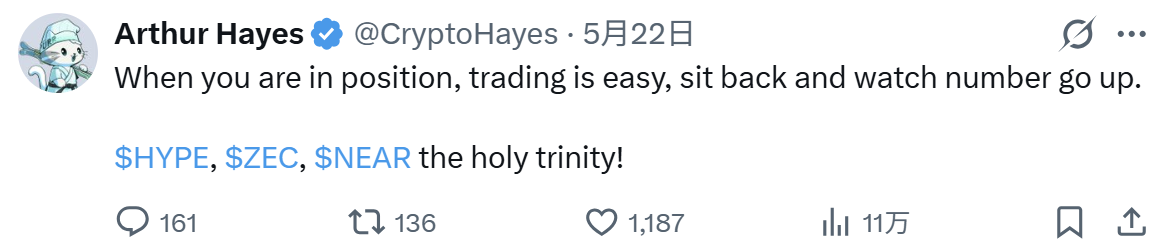
On May 22, BitMEX co-founder Arthur Hayes, in an article, grouped NEAR with HYPE and ZEC in a call for attention, directly igniting market sentiment.

Privacy-Focused Blockchain

Blockchain has long faced the privacy dilemma where 'transparency equals publicity.' The sharp rise of privacy coins like ZEC and XMR has refocused the industry's attention on the privacy sector, leading various protocols, including public blockchains, to start incorporating privacy features.

NEAR was founded in 2018. Its initial core positioning was not AI, but scalability. Its earliest progress primarily revolved around continuously optimizing sharding technology, making it one of the hot 'Ethereum killer' public blockchains at the time.
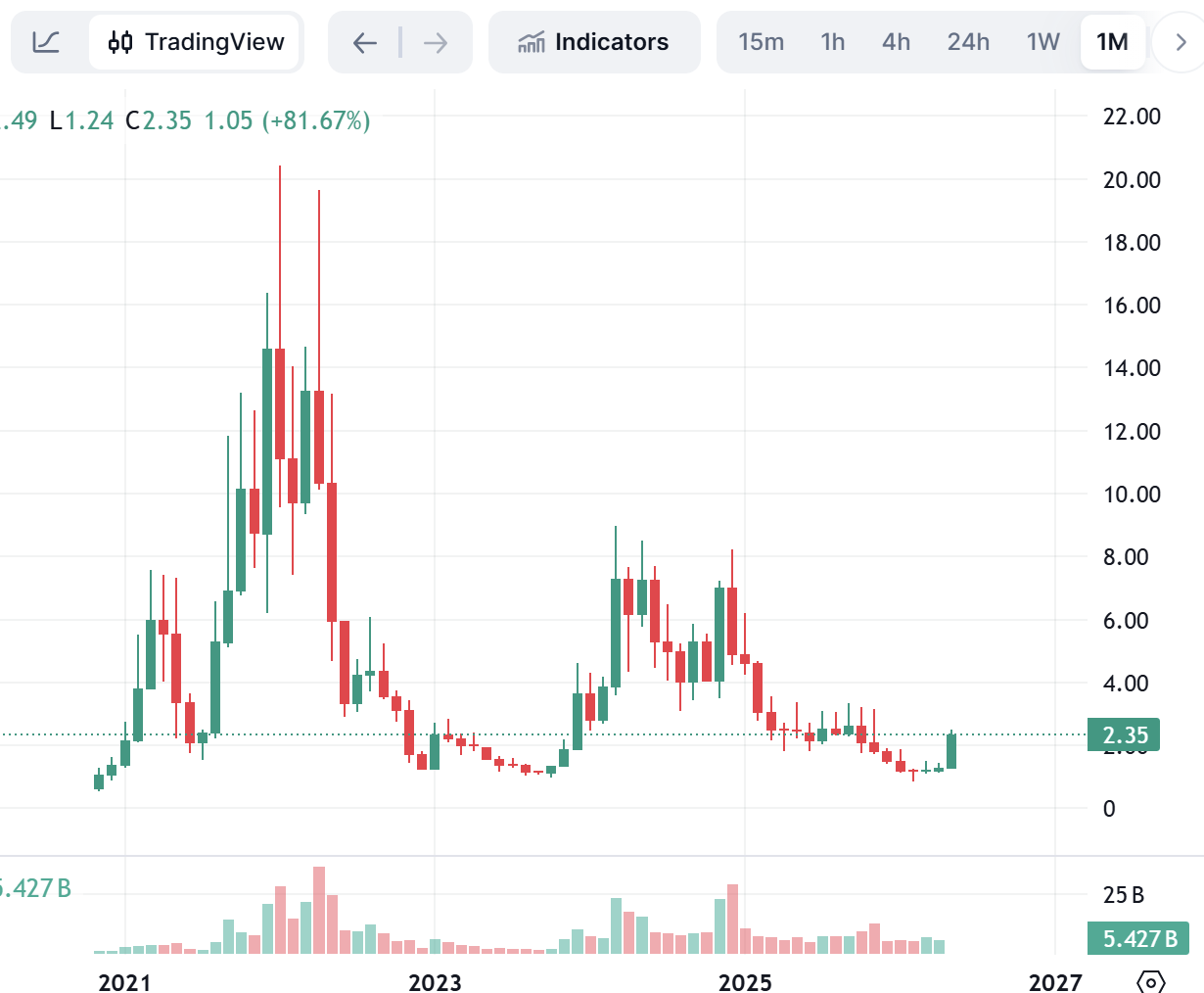
Because of this, NEAR's public sale on CoinList once crashed the latter's website. During the 2020-2021 bull cycle, NEAR soared from $0.5 to a peak of $20.59, becoming one of the most watched star tokens that year.

However, fast-forwarding to this cycle, the vast majority of older tokens and new VC-backed tokens have been shunned by the market. Therefore, even in this bull cycle, NEAR only reached a high of around $9 in 2024 before declining steadily, hitting a low of $0.84 in 2026.

With the official launch of NEAR Intents, privacy requirements have become critically important. Intents are core to cross-chain transactions, allowing users to execute actions simply by expressing intent. However, large on-chain transactions are vulnerable to MEV (Maximal Extractable Value) attacks when public, a significant drawback for institutions, large holders, and ordinary DeFi users alike.

The NEAR team began planning privacy as a crucial complement to Intents. In late May this year, the NEAR Intents team launched Confidential Payments and Confidential Intents features, supporting private cross-chain transfers for assets like ETH, BTC, SOL, and USDC across 35+ chains. The sender, amount, and path are all hidden, with only the result visible on the target chain, utilizing a private shard + TEE (Trusted Execution Environment) bridge at the underlying layer.
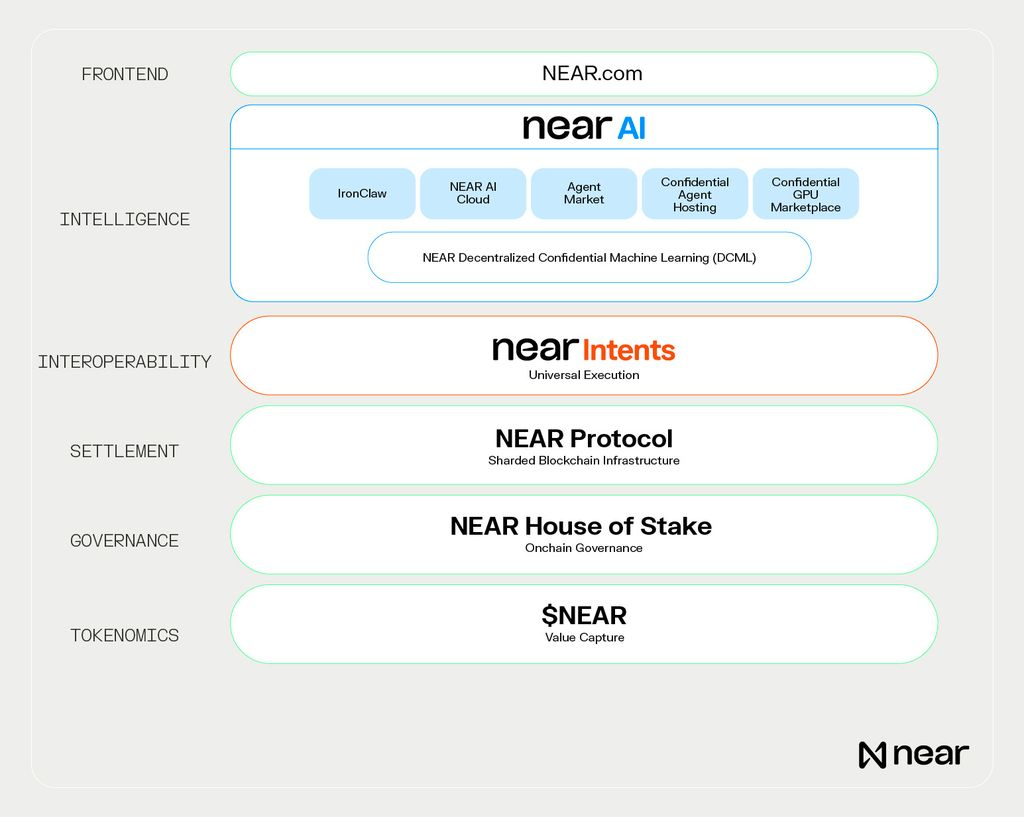
NEAR also opened a privacy mode, where user balances, transfers, and transaction activities are private by default. Whether for ordinary users, enterprise users, or AI agents executing complex strategies, this prevents data leakage. The Confidential Treasuries (Trezu) launched around the same time further supports private multi-signature wallets, payroll, and cross-chain payments, having already processed $68 million in confidential transactions.

Compared to pure privacy coins like Zcash, NEAR's balance between privacy, usability, and cross-chain functionality is more practical, directly addressing enterprise-level demand and driving a recovery in TVL and developer activity.

NEAR Intents Fee Buyback

In October 2025, NEAR completed the unlocking of its final batch of initial supply, bringing its circulating supply close to 100%.
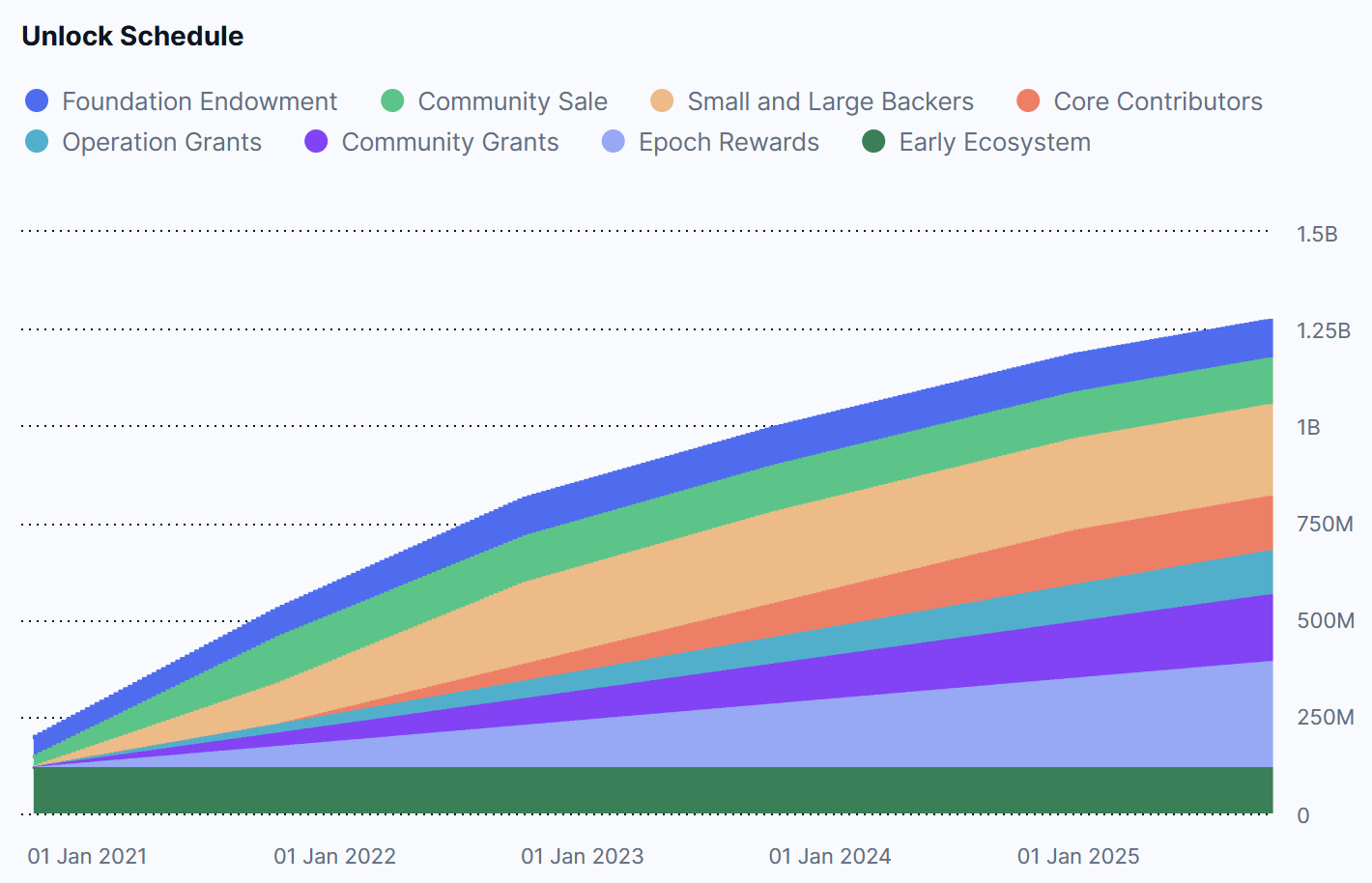
NEAR designed a dual mechanism of inflation + burning from its mainnet's early days: a maximum annual inflation of 5% (permanently halved to 2.5% via an upgrade in October 2025), with 90% going to validators as rewards and 10% entering the protocol treasury. Entering 2026, the project has no major unlock events or linear unlocks remaining, only the regular epoch reward emissions (approximately 5.4 million NEAR released in the last 30 days, about 0.4% of total supply).

In addition, the fee revenue generated by NEAR Intents is used to directly buy back NEAR tokens on the market, also creating significant buying pressure.

NEAR's intent-driven cross-chain transaction layer on the protocol allows users to simply express their desired outcome (e.g., swapping BTC for SOL), and it provides the optimal execution path, supporting multiple chains without the need for bridging/wrapped assets and featuring low fees.

NEAR Intents previously had two fee components: protocol fees and distribution fees (shared with third-party integrators). However, protocol fees now entirely go into the buyback path. The repurchased NEAR isn't necessarily burned immediately; instead, after being bought back, it is staked, locked, or removed from liquidity. It still counts towards the total supply but reduces circulating supply pressure while also earning staking rewards.
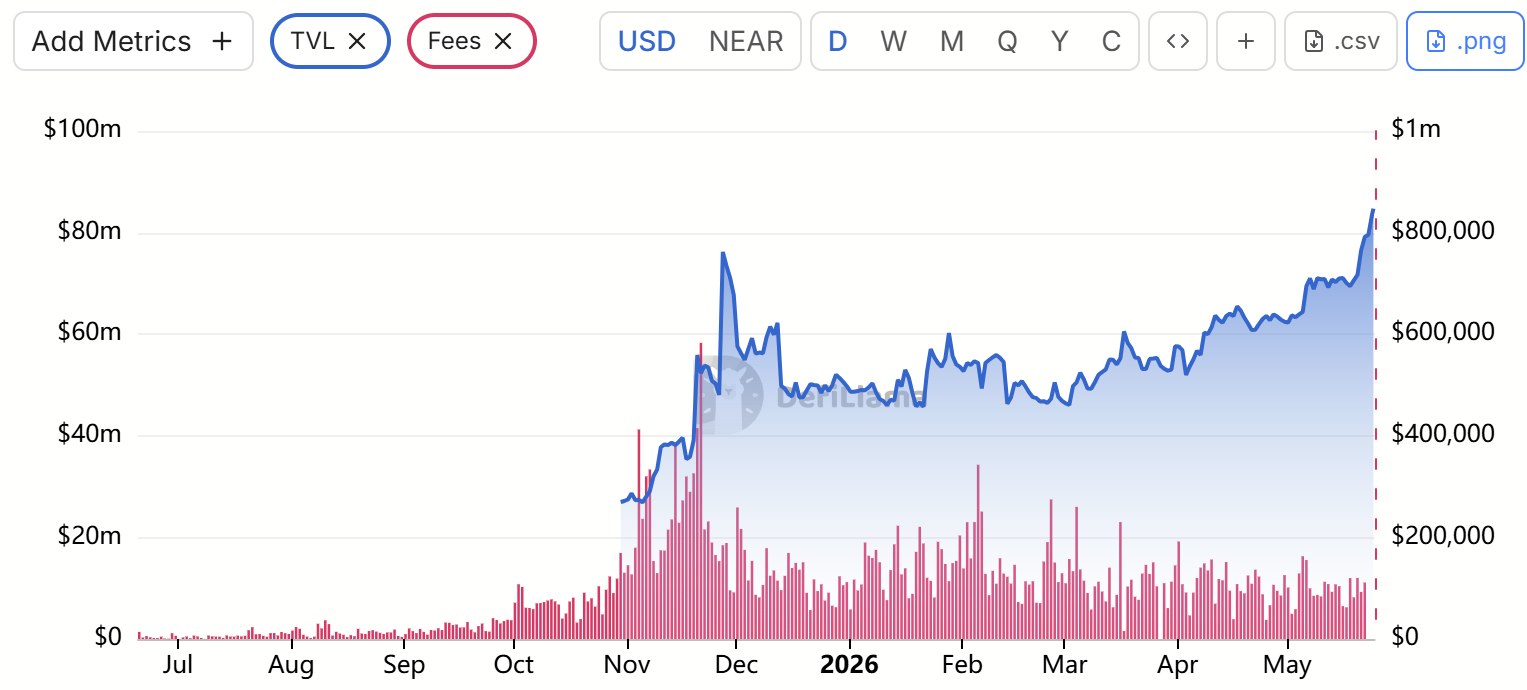
According to the latest data from defiLlama, the TVL of NEAR Intents has exceeded $80 million, with its daily generated fees fluctuating around $100,000, translating to a monthly buyback amount of approximately $3 million.

At the end of this month, its core development team, Near One, also announced the latest technical progress. The team plans to release dynamic resharding by the end of Q2 2026 to significantly enhance scalability. Additionally, the team will introduce NEAR's post-quantum secure signature scheme and perform upgrades in June this year, improving its resistance to quantum computing.


Perguntas relacionadas

QWhat are the three main catalysts driving NEAR's recent price surge according to the article?

AThe three main catalysts are: 1) AI Narrative, due to co-founder Illia Polosukhin's AI background and NEAR's strategic focus. 2) Privacy Public Chain, through features like Confidential Payments and Intents. 3) NEAR Intents fee buybacks, which reduce circulating supply.

QWho is Illia Polosukhin and what is his significance in the AI field?

AIllia Polosukhin is a co-founder of NEAR. He is one of the eight co-authors of the seminal Transformer paper, which introduced the Transformer architecture that forms the foundation of modern large language models like ChatGPT, Claude, and Gemini.

QWhat specific privacy features did NEAR Intents launch in May, and what problem do they solve?

AIn May, NEAR Intents launched Confidential Payments and Confidential Intents features. They solve the privacy problem for cross-chain transfers by hiding the sender, amount, and transaction path across 35+ chains, protecting users from MEV attacks and data leaks during large or complex transactions.

QHow does the NEAR Intents fee buyback mechanism work and what is its impact?

AFees generated by the NEAR Intents protocol are used to buy back NEAR tokens from the market. These bought-back tokens are then staked, locked, or removed from liquidity. This reduces selling pressure on the circulating supply and creates consistent buy-side demand, with current monthly buybacks estimated around $3 million.

QWhat are the key upcoming technical upgrades mentioned for NEAR in the article?

AThe key upcoming upgrades are: 1) Dynamic Resharding, to be released at the end of Q2 2026, which will significantly improve scalability. 2) A post-quantum secure signature scheme, planned for introduction and upgrade in June of this year, to enhance its resistance to quantum computing attacks.

Leituras Relacionadas

Base Under Pressure

**Title: The Pressure Mounts for Base** Base, the Ethereum Layer 2 scaling solution backed by Coinbase, is facing significant pressure and public scrutiny from its leadership following the launch of Robinhood Chain. Base co-founder Jesse Pollak recently acknowledged strategic missteps, admitting that the chain's past focus on social and creator tokens (e.g., through Farcaster, Zora) failed to deliver sustainable adoption. He has refocused on core infrastructure, handing leadership of the Base App back to Coinbase's Cobie. While Base remains a top L2 contender alongside OP Mainnet and Arbitrum, and boasts the highest TVL (nearly $12B), its weaknesses are being highlighted by the new competitor. Key criticisms include its slow progress on decentralization. Base has faced issues with its single sequencer causing block production halts, and L2BEAT is reportedly considering downgrading its decentralization rating from Stage 1 to Stage 0. This contrasts sharply with the rapid initial success of Robinhood Chain, whose DEX quickly entered the top five by volume. The leadership styles of the parent companies are also being compared: Robinhood's CEO actively engages with new projects, while a recent incident where Coinbase's Brian Armstrong briefly changed his profile picture—sparking and then crashing a related meme token—drew community ire and mockery. Pollak stated Base is working with Coinbase on tokenized stocks backed 1:1 by real equity, differentiating it from Robinhood's derivatives model. However, the article argues that Base's most urgent task is to address its long-standing technical and trust issues. With more traditional finance players likely to emulate Robinhood's path, Base must use this competitive pressure to solidify its position as long-term financial infrastructure.

Foresight NewsHá 14m

Base Under Pressure

Foresight NewsHá 14m

White House Concession Removes Ethical Hurdle, Clarity Act Races Against Final Window Before Recess?

On July 21st, industry sources reported that the Trump administration has agreed to include an ethics provision in the "Clarity Act" (Digital Asset Market Clarity Act of 2025). This concession addresses the long-standing conflict-of-interest concerns regarding government officials and the crypto industry, potentially removing the final major obstacle to the bill's progress. Additionally, Patrick Witt, the executive director of the White House's Digital Asset Advisory Committee, confirmed he will remain in his role to help finalize the bill, alleviating previous concerns about his potential departure. The Clarity Act aims to establish a unified federal regulatory framework for the U.S. digital asset market. Its core objective is to resolve regulatory ambiguity by defining different types of digital assets (digital commodities, investment contract assets, and permitted payment stablecoins) and clarifying the respective oversight roles of the SEC and CFTC. This would end the long-running jurisdictional dispute between the two agencies and provide clearer compliance paths for the industry. With the ethics issue moving toward resolution, the most urgent challenge now is time. The U.S. Congress is set to begin its August recess in mid-August, leaving only a few working weeks to finalize the text and advance the bill through the Senate. Industry advocates, like the Blockchain Association's Kristin Smith, stress that this is a critical moment. If negotiations conclude successfully in the coming weeks, the Clarity Act could pass a key hurdle before the recess; otherwise, it may face significant delays. If enacted, the Clarity Act could mark a historic turning point in crypto regulation. By providing a clearer and more predictable legal framework, it aims to reduce uncertainty for businesses, developers, and traditional financial institutions looking to enter the digital asset space, potentially setting a global benchmark for market structure regulation.

Odaily星球日报Há 20m

White House Concession Removes Ethical Hurdle, Clarity Act Races Against Final Window Before Recess?

Odaily星球日报Há 20m

AI Era, Industrial Revolution, and Future Civilization Interview — Zhang Dingwen: The Future Does Not Belong to Chasers

"AI Era, Industrial Revolution and Future Civilization: An Interview with Zhang Dingwen – The Future Does Not Belong to Those Who Chase" In this interview, entrepreneur Zhang Dingwen reflects on his entrepreneurial journey and philosophy, moving beyond discussions of financing or success to emphasize understanding the "era" itself. He argues that true entrepreneurs should not chase short-term trends ("winds"), but position themselves in the direction of long-term technological and societal evolution. Zhang shares key lessons from his early days, including the realization that user value does not automatically translate to commercial value. For him, the core of entrepreneurship is not building a company but constantly upgrading one's own "cognition" – the ability to interpret information, ask the right questions, and understand the underlying "causes" behind business outcomes, not just the effects. His thinking has evolved from a focus on creating good products to a strategic focus on building "entrances" – platforms that naturally connect users to digital services. He sees smart wearables, like watches, not merely as hardware but as potential future gateways combining technological, financial, social, and even fashion attributes to create sustained user relationships and ecosystems. Ultimately, Zhang's vision transcends individual products or companies. He discusses business competition in three stages: product, platform, and finally, "civilization" – where the greatest companies influence how society operates by defining new rules and ways of life. He believes the mission of a truly great enterprise is to solve problems of its time, build enduring trust, and contribute lasting value, leaving behind not just wealth but a positive impact on how the world works. The future, he concludes, belongs not to the fastest, but to those with the correct long-term direction and a commitment to continuous learning and evolution.

marsbitHá 31m

AI Era, Industrial Revolution, and Future Civilization Interview — Zhang Dingwen: The Future Does Not Belong to Chasers

marsbitHá 31m

Cryptocurrency & Stock Market Barometer丨Strategy Cash Reserves Increase to $3.23 Billion, Halting BTC Purchases; Vanguard and Other Asset Managers Increase Holdings in Strategy Stock (July 21)

Market Overview & Warnings: The article warns of high volatility in South Korean stocks and continued dependence on U.S. stocks on geopolitics. Chinese A-shares remain under pressure. It advises against using leverage in current equity markets. For crypto-linked stocks, most have limited growth except Robinhood, with caution advised. U.S. Stock Market: Bearish bets on U.S. stocks, particularly targeting AI-related companies, have reached record highs since 2010, signaling deep skepticism about the sustainability of the AI-driven rally. Tech and chip stocks led a market decline, with the Philadelphia Semiconductor Index potentially entering a bear market. Increased expectations for Federal Reserve interest rate hikes and geopolitical tensions contributed to the negative sentiment. Bitcoin Treasury Company Updates: * Strategy: Increased its cash reserves to $3.23 billion and paused Bitcoin purchases. Several major asset managers, including Vanguard Group and Capital Group, increased their holdings of Strategy (MSTR) stock. * Global corporate Bitcoin buying slowed significantly to just $1.33 million last week. * Other notable activity: Strive purchased 21 BTC; ORANGE JUICE raised $40 million for Bitcoin acquisitions; Bitcoin Japan Corp. raised $60 million, allocating $4.08 million for its first BTC purchase. Other Crypto Treasury Holdings: * Ethereum: BitMine increased its ETH holdings to 5.78 million, nearing its 5% of supply goal. Its total crypto assets, cash, and securities are valued at $11.5 billion. * Solana: No significant corporate treasury activity reported. * Altcoins: HypeStrat made no adjustments to its treasury; its mNAV ratio fell to a long-term low. (Note: This summary is for informational purposes only and does not constitute investment advice.)

marsbitHá 32m

Cryptocurrency & Stock Market Barometer丨Strategy Cash Reserves Increase to $3.23 Billion, Halting BTC Purchases; Vanguard and Other Asset Managers Increase Holdings in Strategy Stock (July 21)

marsbitHá 32m

Trading

Spot
活动图片