Bankless Co-founder: Why I Sold All My ETH

链捕手Publicado em 2026-05-27Última atualização em 2026-05-27

Resumo

Author David Hoffman, founder of Bankless, explains his decision to sell all his ETH, despite being a prominent figure in the Ethereum ecosystem. He clarifies that his move is not a bearish take on Ethereum itself, which he remains highly optimistic about as a network. His core argument is that the "ETH is money" thesis, which he helped popularize, has largely played out. Hoffman argues that ETH has achieved the market valuation it deserves based on Ethereum's current success and competitive position. He details several reasons for this view. First, the path for ETH to become global money required nearly flawless execution and sustained dominance across Ethereum's entire technical and social stack—a coordination challenge he now believes had a narrower window for success than anticipated. Second, market data shows a strong correlation between L1 chain activity/fees and the price of its native asset; Ethereum's fee dominance has been challenged by competitors like Solana. Third, the "strong version" of crypto (decentralized, native crypto economies) that ETH's monetary thesis relied upon has struggled to maintain a positive mainstream narrative and stable adoption beyond a brief period. Finally, Ethereum's architecture as a "giver"—providing secure block space and tokenization capabilities at cost to L2s and applications—means it doesn't capture premium value directly. Its rollup-centric roadmap further directs most profits to L2s and applications ("fat app theory"). In conc...

Author:David Hoffman

Translation:Jiahuan, ChainCatcher

If you missed the news last week, I sold my ETH.

For someone who has built a career, community, identity, and business around Ethereum, making this decision was not easy.

The reason behind the sale requires a more thorough explanation than fragmented tweets on Twitter.

The 'ETH is Money' thesis did not fail... it has simply been realized. Ethereum has earned the ETH price it deserves, and I believe ETH as an asset will not be revalued, either upwards or downwards.
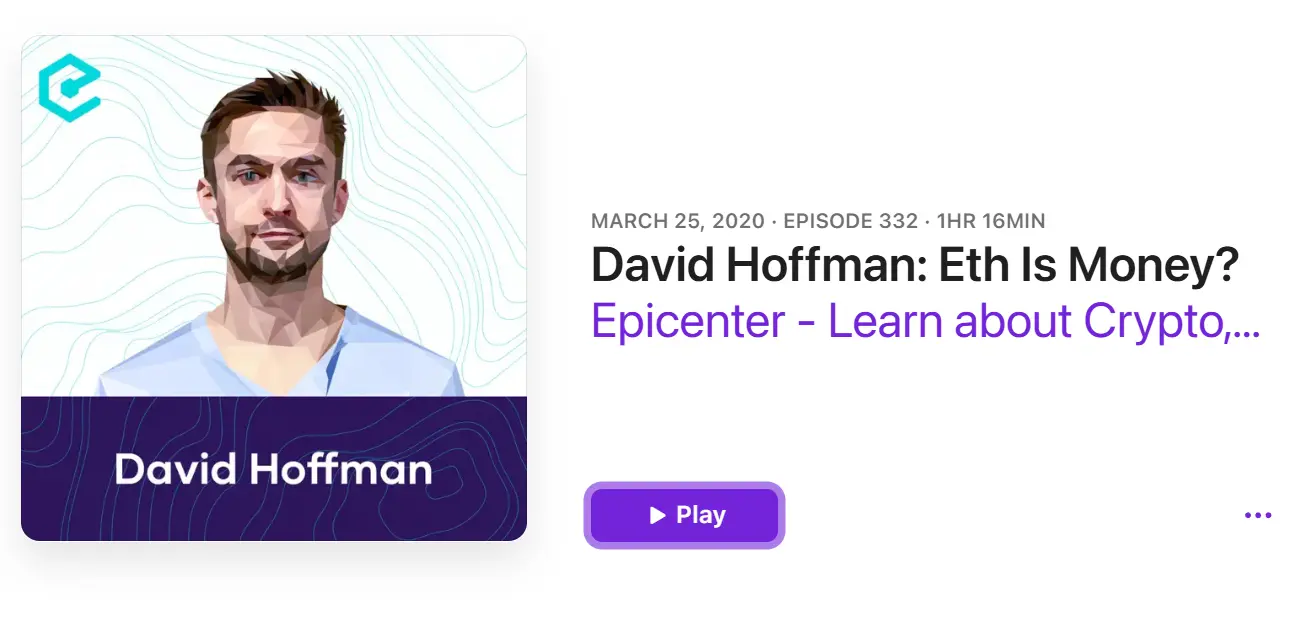
'ETH is Money' is the core narrative proposed by author David Hoffman in 2019 and long promoted through Bankless, advocating that ETH should become a global store of value. It was once one of Ethereum's most mainstream bullish logics.

Note: I am extremely bullish on Ethereum. I expect the Ethereum network to perform exceptionally well from here on out. However, I believe that only a tiny fraction of this success will be reflected in ETH.

The article text is as follows:

'ETH is Money' Has Always Been an Aspiration

Money is a coordination game, and coordination is very difficult.

The Ethereum project itself is a series of coordination challenges stacked upon multiple levels, and the 'ETH is Money' thesis demands that all these levels succeed, and succeed unequivocally.

ETH can only become money if and only if every layer of Ethereum's techno-social stack performs better than its competitors.

Given the ambition of the Ethereum project, achieving its most successful version was always a monumental challenge. Despite shortcomings, the Ethereum project has performed admirably, fully deserving its current market capitalization.

Nevertheless, the window of opportunity for $ETH to be 'revalued' by the market seems to be closing.

In a sense, ETH is money. But it is not the most successful version we collectively aspired to.

Ethereum is a Coordination Game

A Turing-complete blockchain is such a powerful idea that Ethereum's maximum potential is the entire crypto world. Everything.

The only obstacle to Ethereum achieving 100% absolute domination over everything is coordination.

Ethereum's leadership needs to be sufficiently decentralized; governance needs 'rough consensus' to create credible neutrality, maximizing Ethereum's adoption at the highest level.

Ethereum's leadership needs to respond quickly to market dynamics, operating like a startup facing an existential threat of marginalization.

Ethereum L2s need to be able to operate and make their own market choices independently from the base layer, but they also need to be economically bound and constrained by the broader Ethereum economy and brand.

Ethereum's roadmap needs to be executed in a specific order to maximize and maintain Ethereum's momentum and market dominance, thereby fully subduing competition and maximizing confidence in Ethereum and ETH.

Key technology R&D and engineering implementation need to be fast enough so that Ethereum can both prove its utility to the outside world and stay ahead of competitors.

The 'ETH is Money' thesis is about creating an extremely revolutionary and powerful financial asset that, by virtue of its unique properties as the premier global store of value, attracts individuals who would otherwise be indifferent.

Ethereum's brand and ETH's strength need to be so powerful that traditional large capital not only feels safe but actively includes ETH as a significant position in retirement portfolios due to the dominance of the Ethereum project.

For 'ETH is Money' to happen, everything upstream of ETH needs to function in an extremely perfect manner.

Ethereum is not Bitcoin; it chose the hard path. Bitcoin chose to strip everything from its blockchain to elevate BTC.

Ethereum chose to add everything to its blockchain to maximize the utility of its block space. Only by doing this in the best possible way before competitors can ETH attain its status as global money.

We've come a long way, and Ethereum has already achieved the maximum potential market share it deserves.

I fear the window to play this game has closed.

The Macro Environment May Never Allow It to Happen

Looking back over the past few years, I see that Ethereum needed to overcome numerous macro-environmental challenges.

1. L1 Asset Valuation is Inextricably Linked to Revenue

Say what you will about how hard it is to value smart contract chains based on fees and revenue, but fees and revenue are clearly how smart contract L1 assets increase their pricing power.

By 2026, we have ample data showing that all these factors are closely correlated: L1 activity, L1 fees, and the price appreciation of the L1 native asset.

In 2021, when ETH had the highest L1 revenue market share, it dominated.

In 2024, when SOL's L1 revenue market share surged across the industry, it dominated.

In 2026, NEAR is experiencing price revaluation alongside fundamental growth in its L1 revenue and NEAR burn.

You can also look at assets like BNB and TRX, perhaps the highest cumulative revenue projects ever. Their price charts look the way I once expected ETH's should—provided ETH could maintain its L1 fee dominance for longer than just that stretch in 2022.

2. The Strong Version of Crypto Didn't Work

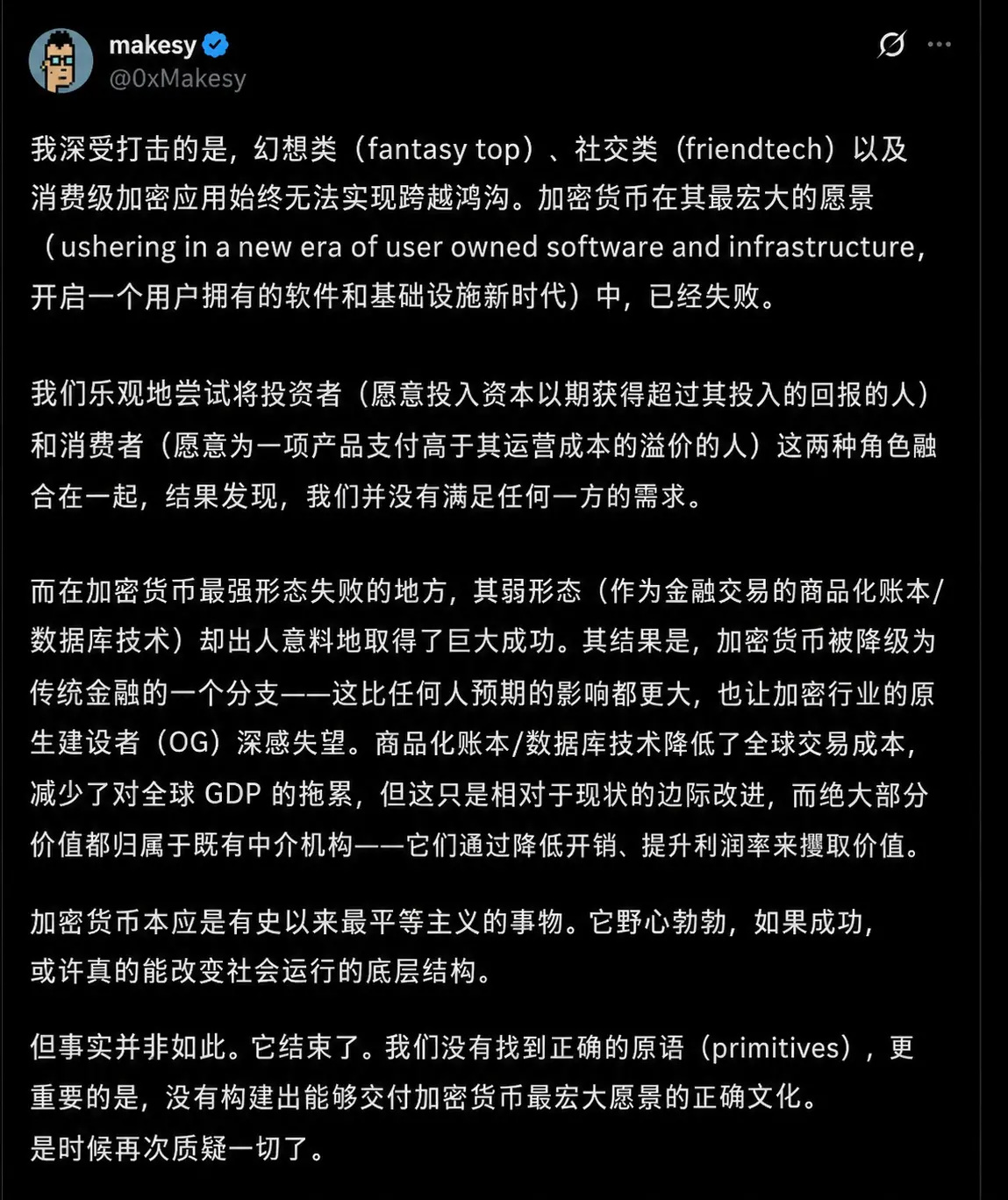
@0xMakesy put it well:

Ethereum represents the strong version of crypto, crypto for crypto's sake, self-sustaining and self-perpetuating. DeFi, NFTs, DAOs—we were rebels, building an alternative financial system of, by, and for the people, plugging imagination into the money system.

Simultaneously, there exists the weak version: efficient ledger infrastructure for financial institutions' backends. The weak version would fuel the strong version, converting demand for internet ledgers into inward-flowing capital streams toward crypto, toward Ethereum, ultimately converging on ETH.

Perhaps if Ethereum executed better, faster, stronger, and if crypto hadn't attracted such a massive cohort of speculative charlatans and value extractors, the industry could have won the influence and respect I always thought it deserved.

But the only period where crypto maintained a positive brand image with the general public was from late 2020 to early 2022. Outside this narrow window, crypto's reputation has been one of fraud, scams, get-rich-quick schemes, and uselessness to the average person.
'ETH is Money' Relies on 'Strong Crypto'

Right at the moment when everyone was forced online, ETH emerged as the internet's money. The world discovered crypto for the first time, and for that brief window, it was very cool.

Money is a coordination game, and a currency's Schelling Point (consensus focal point) is held together by belief. In 2021, the broader public believed in ETH: it was cool, disruptive, and populist. Bitcoin possessed the same properties and has retained them better than ETH post-2021.

This raises a disquieting possibility: the strong version of crypto may never have been a stable equilibrium point. COVID was an extremely distorted time for money, and perhaps 'ETH as Money' was only propped up by that distortion.

If that's the case, ETH becoming money always depended on the strong version of crypto working better than it has in reality.

3. Ethereum's Utility Also Benefits Other Monies

Is Bitcoin money? Is the Dollar money? Is Gold money? It doesn't matter—whatever is money will be tokenized on Ethereum.

In 2020, Nic Carter posited on Bankless that stablecoins would likely be parasitic to ETH as Ethereum's native unit. Back then, Ethereum had $3B in stablecoins. Today, that number is $163B, a 54x increase.

The utility Ethereum provides is helping to expand the monetary network of any asset that truly is money, which is why the US is so bullish on crypto for stablecoin adoption. Ethereum is helping the US maintain dollar hegemony, and leveraging this fact is explicit government policy.

Clearly, the positive spillover effects garnered by $ETH as money are far less potent than those seen by the US government in Ethereum's stablecoin ecosystem.

Ethereum is a Giver, Not a Taker

At its core, Ethereum is a giver, not a taker.

It provides the world's most secure block space to L2s at cost.

It tokenizes the world's assets at cost.

It secures billions in DeFi at cost.

Ethereum takes no markup on anything it does.

This is the nature of open-source software and the power of Ethereum. Ethereum provides its full suite of immensely valuable goods to the world at cost.

Ethereum is noble. Ethereum is good.

Ethereum is the world's most successful non-profit organization.

Naturally, incredible mass adoption will occur on Ethereum. It has been and will continue to be one of the most impactful open-source software projects ever built by humanity, and being a 'non-profit protocol' is one of its core features.

This is why ETH's path to becoming money depended on maintaining sustained and extremely high market dominance.

Ultimately, as block space becomes commoditized, fees will trend towards zero. So long as it's Ethereum that gets commoditized and not its competitors, Ethereum can maintain its margins and dominance.

Ultimately, the fat protocol theory (referring to the idea that the majority of economic value will be captured and monopolized by the foundational protocol (like Ethereum), not by the application layer built on top, as in traditional internet models) will give way to the fat application theory, and applications will swallow the remaining profits.

So long as they are Ethereum's applications and not a competitor's, that's fine for ETH.

It's hard to square 'ETH is Money' with 'Ethereum is a giver, not a taker.' Ethereum's architecture is intentionally designed to give everything back to its ecosystem and only take the minimum required to keep the network running.

Architecturally, ETH is not prioritized within Ethereum; this is a feature, not a bug. ETH could only become money if Ethereum won a battle it was architecturally refusing to fight.

This could have worked if Ethereum could have maintained incredible market dominance.

This Thesis Asks Too Much of Ethereum

'ETH is Money' requires everything about Ethereum to go right. The margin for error is much smaller than I originally thought. Ethereum's momentum in 2021 and 2022 made 'ETH is Money' seem like the default path.

In hindsight, Solana's rise in 2021 alongside rising anti-Ethereum sentiment was the first major sign that Ethereum and ETH's coordination game wasn't going as planned.

The Ethereum Foundation needed to decentralize and allow alternative power structures to emerge. But it also needed to respond to market forces with the urgency and drive of a startup facing an existential elimination threat.

L2 teams needed the freedom for self-determination, but also needed to operate under the larger protective brand of Ethereum and ETH. The technical synchronicity integration between Ethereum and its L2s needed to be executed much faster.

Smart contract chains are valued via fees; to break out of this mold, Ethereum needed to rewrite the rules with overwhelming success.

My Reason for Selling

It just didn't reach its maximum potential either.

Ethereum did a noble thing, choosing for itself the hardest, most ambitious, most ideologically pure path for its future.

It secured some incredible wins and failed to win others.

Ethereum has earned the market cap it deserves.

I am very bullish on the Ethereum network and its ecosystem—Ethereum is architected to maximize the success of its apps, L2s, and ecosystem. The fat application theory means Ethereum's apps take all the fees, and the rollup-centric roadmap means L2s take 97% of the profits.

As for ETH the asset, I have a hard time seeing it being structurally revalued, either up or down.

Therefore, my reason for selling ETH is not bearishness on ETH; it's that I believe the 'ETH is Money' thesis has been realized, and I wish to allocate capital to other opportunities in the market that I'm bullish on.


Perguntas relacionadas

QAccording to David Hoffman, what is the core reason he sold his ETH, and why doesn't he see significant revaluation potential for it?

AHe believes the 'ETH is money' thesis has played out and has been fully priced into ETH's current market capitalization. He sold not because he is bearish on ETH, but because he sees little potential for the asset to be significantly revalued (either upward or downward) from its current level, as its success as a global store of value depended on a perfect execution by the Ethereum project that he now considers improbable. He wants to reallocate funds to other opportunities.

QWhat key characteristics of Ethereum's architecture make it a 'giver, not a taker,' and why does Hoffman argue this works against ETH becoming money?

AEthereum provides critical value—like secure block space for L2s, tokenization of global assets, and security for DeFi—'at cost,' without charging a premium. Its open-source, non-profit nature is its strength but means it is architected to give back nearly all value to its ecosystem. For ETH to become money, Ethereum would need to maintain extreme market dominance and 'win a battle it is architeturally architected to not participate in'—namely, capturing and monetizing value for the native asset itself.

QHoffman mentions the relationship between L1 assets and their revenue/fees. How does this observed pattern conflict with the 'ETH is money' thesis?

AThe data shows a strong correlation between L1 activity/fees/revenue and the price appreciation of that L1's native asset (e.g., ETH in 2021, SOL in 2024, NEAR in 2026). The 'ETH is money' thesis aimed to transcend this fee-based valuation model, positioning ETH as a global store of value regardless of network fees. However, the market continues to value smart contract L1s based on their revenue capture, and ETH has not maintained the overwhelming fee dominance needed to break this pattern and validate the 'money' narrative.

QWhat does Hoffman mean by 'strong version' versus 'weak version' of cryptocurrency, and why is the former's failure problematic for ETH?

AThe 'strong version' is cryptocurrency for its own sake—a self-sustaining, alternative financial system (DeFi, NFTs, DAOs). The 'weak version' is cryptocurrency as efficient ledger infrastructure for traditional finance. The 'ETH is money' thesis relied on the success and mainstream appeal of the 'strong version' to create a powerful social consensus. However, crypto's public brand has largely been associated with scams and speculation, not positive utility. This failure of the 'strong version' to achieve a stable, respected position undermines the social coordination needed for ETH to become widely accepted as money.

QHow does the concept of 'coordination' present a fundamental challenge for Ethereum and the 'ETH is money' narrative?

AMoney is a coordination game, and for ETH to become the dominant global money, Ethereum needed to win a series of complex, stacked coordination challenges perfectly. This included: decentralized yet decisive leadership, perfectly synchronized L2s, flawless technical execution to stay ahead of competitors, and creating a brand powerful enough to attract major traditional capital. Hoffman argues that the window for Ethereum to achieve this level of flawless coordination and market dominance, which was necessary for ETH to break free from being valued as a fee-generating L1, has likely closed.

Leituras Relacionadas

From Issuer to Infrastructure Owner: Circle's Arc Strategy and the Fatal Gap in the GENIUS Act

Circle raised $222 million for its proprietary Layer-1 blockchain, Arc, positioning itself not just as a stablecoin issuer but as the owner of the settlement infrastructure USDC relies on. This move, backed by investors like BlackRock and Apollo, highlights a significant structural conflict unaddressed by the GENIUS Act of 2025. While the act focuses on stablecoin reserves and issuer oversight, it remains silent on the market structure implications of an issuer controlling the underlying network—a scenario akin to a currency issuer also owning the payment rails. Traditionally, financial regulations separate issuers from settlement infrastructure to ensure neutrality. With Arc, Circle gains control over transaction ordering, fees, and network rules, potentially favoring USDC over competitors. The article argues that this creates a permanent structural temptation, even if no abuse occurs. The solution lies in applying established market infrastructure principles: mandating neutral transaction ordering, transparent fee schedules, and governance separated from Circle’s commercial interests. The current pre-mainnet phase offers a critical window for regulators to establish these rules before Arc becomes entrenched. Once operational, enforcing changes would be costly and disruptive. The core question remains: should a regulated stablecoin issuer be allowed to own the settlement network its competitors must use? The GENIUS Act doesn’t answer this, but Circle’s Arc strategy makes it urgent.

marsbitHá 1h

From Issuer to Infrastructure Owner: Circle's Arc Strategy and the Fatal Gap in the GENIUS Act

marsbitHá 1h

What Are the Key Variables Determining the AI Bull Market?

Title: What Determines the AI Bull Market? Key Variables Revealed Despite rising oil prices above $100/barrel, persistent inflation, and fragile Fed rate cut expectations—a traditionally hostile environment for high-valuation tech stocks—the AI sector continues to drive the market to new highs. According to analysts, the current AI boom is in a phase of "rational fervor": while bubbles exist, they are not yet out of control. The crucial shift is the emergence of Agentic AI, which is evolving from an assisting tool (Copilot) to an autonomous execution tool (Autopilot), creating a clearer commercial path from investment to revenue. This shift accelerates Token consumption and inference computing demand while boosting revenue forecasts for leading firms. The market is now rewarding capital expenditure as it transforms from a burden into a competitive moat, supporting hardware chains like GPUs, optical modules, and storage. However, valuations have already priced in growth expectations for 2027-2028. The forward P/E ratio for the "Magnificent Seven" tech giants is about 35x, compared to 25x for the rest of the S&P 500. This premium implies AI adoption must occur 5 to 8 times faster than past technological revolutions—a scenario with little room for error. The sustainability of the AI bull market hinges on three key variables: 1. **Short-term liquidity shocks**: Risks include sustained high oil prices, resurgent inflation, rising interest rates, and potential unwinding of the yen carry trade. The critical question is whether the upward revision speed of Annual Recurring Revenue (ARR) can outpace the rise in interest rates. 2. **Mid-term industry realization**: Can the actual pace of AI adoption and commercialization match the current lofty valuations? Historically, general-purpose technology revolutions follow a non-linear path with periods of acceleration and deceleration. 3. **Long-term structural constraints**: These include energy and power grid limitations, employment displacement and consumer purchasing power, social acceptance and potential backlash, and potential hardware technology breakthroughs that could disrupt current supply chains. While the long-term prospects for AI remain optimistic with potential for significant productivity gains, the stock market's pricing depends not just on the vision but on the actual speed of realization amid these growing constraints. The direction is clear, but the pace of execution will determine whether the bubble remains controlled or spirals out of control.

marsbitHá 1h

What Are the Key Variables Determining the AI Bull Market?

marsbitHá 1h

The AI Industrial Revolution: Where Are We Now?

This article explores the current stage of the AI industrial revolution, arguing we are still merely attaching new tools to old workflows rather than fundamentally redesigning production. The author compares this to the early Industrial Revolution, where factories simply replaced waterwheels with steam engines without changing their core structure. Similarly, today we embed AI chat windows into existing software but leave organizational processes unchanged. While massive investment floods into AI infrastructure (data centers, chips), akin to railway manias of the past, the real transformation lies in "dismantling the old workshop"—reorganizing companies around AI. Examples include Notion's use of hundreds of AI Agents and Y Combinator's experiments with self-improving AI systems that operate autonomously. The author notes a critical gap: while China has vast AI user growth, few companies have rebuilt core workflows. AI is beginning to impact entry-level jobs, and early adopters are gaining a compounding advantage. The conclusion is that the pivotal moment will not be the invention of better models, but when organizations decide to tear down old structures and rebuild around AI, shifting the bottleneck from human coordination to computing power. The future workplace and job titles are yet to be defined, but the imperative is to move away from legacy processes and position oneself where the new "railway" is being built.

marsbitHá 1h

The AI Industrial Revolution: Where Are We Now?

marsbitHá 1h

Trading

Spot
Futuros

Artigos em Destaque

O que é ETH 2.0

ETH 2.0: Uma Nova Era para o Ethereum Introdução ETH 2.0, amplamente conhecido como Ethereum 2.0, marca uma atualização monumental à blockchain do Ethereum. Esta transição não é meramente uma mudança estética; visa melhorar fundamentalmente a escalabilidade, segurança e sustentabilidade da rede. Com uma mudança do mecanismo de consenso em Proof of Work (PoW), intensivo em energia, para um Proof of Stake (PoS) mais eficiente, o ETH 2.0 promete uma abordagem transformadora ao ecossistema blockchain. O que é ETH 2.0? ETH 2.0 é um conjunto de atualizações distintas e interconectadas focadas na otimização das capacidades e desempenho do Ethereum. Esta reformulação foi projetada para abordar desafios críticos que o mecanismo atual do Ethereum enfrentou, particularmente em relação à velocidade das transações e à congestão da rede. Objetivos do ETH 2.0 Os principais objetivos do ETH 2.0 giram em torno da melhoria de três aspectos centrais: Escalabilidade: Com o objetivo de melhorar significativamente o número de transações que a rede pode manejar por segundo, o ETH 2.0 procura ultrapassar a limitação atual de aproximadamente 15 transações por segundo, alcançando potencialmente milhares. Segurança: Medidas de segurança melhoradas são integrais ao ETH 2.0, especialmente através da resistência aprimorada contra ciberataques e da preservação do ethos descentralizado do Ethereum. Sustentabilidade: O novo mecanismo PoS foi projetado não apenas para melhorar a eficiência, mas também para reduzir drasticamente o consumo de energia, alinhando a estrutura operacional do Ethereum com considerações ambientais. Quem é o Criador do ETH 2.0? A criação do ETH 2.0 pode ser atribuída à Ethereum Foundation. Esta organização sem fins lucrativos, que desempenha um papel crucial no apoio ao desenvolvimento do Ethereum, é liderada pelo co-fundador notável Vitalik Buterin. A sua visão de um Ethereum mais escalável e sustentável tem sido a força motriz por trás desta atualização, envolvendo contribuições de uma comunidade global de desenvolvedores e entusiastas dedicados a melhorar o protocolo. Quem são os Investidores do ETH 2.0? Embora os detalhes sobre os investidores do ETH 2.0 não tenham sido tornados públicos, é sabido que a Ethereum Foundation recebe apoio de várias organizações e indivíduos no espaço da blockchain e tecnologia. Esses parceiros incluem firmas de capital de risco, empresas de tecnologia e organizações filantrópicas que compartilham um interesse mútuo em apoiar o desenvolvimento de tecnologias descentralizadas e infraestrutura de blockchain. Como Funciona o ETH 2.0? ETH 2.0 é notável por introduzir uma série de características chave que o diferenciam do seu predecessor. Proof of Stake (PoS) A transição para um mecanismo de consenso PoS é uma das mudanças de destaque do ETH 2.0. Ao contrário do PoW, que depende da mineração intensiva em energia para a verificação de transações, o PoS permite que os utilizadores validem transações e criem novos blocos de acordo com a quantidade de ETH que apostam na rede. Isso leva a uma maior eficiência energética, reduzindo o consumo em aproximadamente 99,95%, tornando o Ethereum 2.0 uma alternativa consideravelmente mais ecológica. Shard Chains As shard chains são outra inovação crítica do ETH 2.0. Estas cadeias menores operam em paralelo com a cadeia principal do Ethereum, permitindo que várias transações sejam processadas simultaneamente. Esta abordagem melhora a capacidade geral da rede, abordando preocupações de escalabilidade que têm atormentado o Ethereum. Beacon Chain No coração do ETH 2.0 está a Beacon Chain, que coordena a rede e gere o protocolo PoS. Ela atua como uma espécie de organizador: supervisiona os validadores, garante que as shards permaneçam conectadas à rede e monitora a saúde geral do ecossistema blockchain. Linha do Tempo do ETH 2.0 A jornada do ETH 2.0 tem sido marcada por vários marcos chave que traçam a evolução desta atualização significativa: Dezembro de 2020: O lançamento da Beacon Chain marcou a introdução do PoS, preparando o caminho para a migração para o ETH 2.0. Setembro de 2022: A conclusão de “The Merge” representa um momento crucial em que a rede Ethereum fez a transição com sucesso de um quadro PoW para um PoS, anunciando uma nova era para o Ethereum. 2023: O lançamento esperado das shard chains visa melhorar ainda mais a escalabilidade da rede Ethereum, solidificando o ETH 2.0 como uma plataforma robusta para aplicações e serviços descentralizados. Características Chave e Benefícios Escalabilidade Melhorada Uma das vantagens mais significativas do ETH 2.0 é a sua escalabilidade melhorada. A combinação de PoS e shard chains permite que a rede expanda a sua capacidade, permitindo que acomode um volume de transações muito maior em comparação com o sistema legado. Eficiência Energética A implementação do PoS representa um enorme passo em direção à eficiência energética na tecnologia blockchain. Ao reduzir drasticamente o consumo de energia, o ETH 2.0 não só reduz os custos operacionais, mas também se alinha mais estreitamente com os objetivos globais de sustentabilidade. Segurança Aprimorada Os mecanismos atualizados do ETH 2.0 contribuem para uma segurança melhorada em toda a rede. O uso do PoS, juntamente com medidas de controle inovadoras estabelecidas através das shard chains e da Beacon Chain, assegura um maior grau de proteção contra potenciais ameaças. Custos Mais Baixos para os Utilizadores À medida que a escalabilidade melhora, os efeitos sobre os custos de transação também serão evidentes. Aumentada a capacidade e reduzida a congestão, espera-se que isso se traduza em taxas mais baixas para os utilizadores, tornando o Ethereum mais acessível para transações do dia a dia. Conclusão ETH 2.0 marca uma evolução significativa no ecossistema da blockchain do Ethereum. Ao abordar questões fundamentais como a escalabilidade, o consumo de energia, a eficiência das transações e a segurança geral, a importância desta atualização não pode ser subestimada. A transição para o Proof of Stake, a introdução das shard chains e o trabalho fundamental da Beacon Chain são indicativos de um futuro em que o Ethereum pode atender à crescente demanda do mercado descentralizado. Em uma indústria movida pela inovação e progresso, o ETH 2.0 representa um testemunho das capacidades da tecnologia blockchain em pavimentar o caminho para uma economia digital mais sustentável e eficiente.

100 Visualizações TotaisPublicado em {updateTime}Atualizado em 2024.12.03

O que é ETH 2.0

O que é ETH 3.0

ETH3.0 e $eth 3.0: Uma Análise Profunda do Futuro do Ethereum Introdução No ambiente em rápida evolução da criptomoeda e da tecnologia blockchain, o ETH3.0, frequentemente denotado como $eth 3.0, emergiu como um tema de considerável interesse e especulação. O termo abrange dois conceitos principais que merecem esclarecimento: Ethereum 3.0: Esta representa uma potencial atualização futura destinada a aumentar as capacidades da atual blockchain do Ethereum, focando especialmente na melhoria da escalabilidade e desempenho. ETH3.0 Meme Token: Este distinto projeto de criptomoeda procura aproveitar a blockchain do Ethereum na criação de um ecossistema centrado em memes, promovendo o envolvimento na comunidade de criptomoedas. Compreender esses aspectos do ETH3.0 é essencial não apenas para entusiastas de criptomoedas, mas também para aqueles que observam as tendências tecnológicas mais amplas no espaço digital. O que é ETH3.0? Ethereum 3.0 Ethereum 3.0 é promovido como uma atualização proposta para a rede Ethereum já estabelecida, que tem sido a espinha dorsal de muitas aplicações descentralizadas (dApps) e contratos inteligentes desde a sua criação. As melhorias vislumbradas concentram-se principalmente na escalabilidade—integrando tecnologias avançadas como sharding e provas de conhecimento zero (zk-proofs). Essas inovações tecnológicas visam facilitar um número sem precedentes de transações por segundo (TPS), potencialmente alcançando milhões, abordando assim uma das limitações mais significativas enfrentadas pela tecnologia blockchain atual. A melhoria não é meramente técnica, mas também estratégica; visa preparar a rede Ethereum para uma adoção generalizada e utilidade em um futuro marcado por uma maior demanda por soluções descentralizadas. ETH3.0 Meme Token Em contraste com o Ethereum 3.0, o ETH3.0 Meme Token aventura-se por um domínio mais leve e divertido, combinando a cultura dos memes da internet com a dinâmica das criptomoedas. Este projeto permite que os usuários comprem, vendam e negociem memes na blockchain do Ethereum, proporcionando uma plataforma que fomenta o envolvimento da comunidade através da criatividade e interesses compartilhados. O ETH3.0 Meme Token visa demonstrar como a tecnologia blockchain pode interseccionar com a cultura digital, criando casos de uso que são tanto divertidos quanto financeiramente viáveis. Quem é o Criador do ETH3.0? Ethereum 3.0 A iniciativa em direção ao Ethereum 3.0 é impulsionada principalmente por um consórcio de desenvolvedores e pesquisadores dentro da comunidade Ethereum, notavelmente incluindo Justin Drake. Conhecido por suas percepções e contribuições para a evolução do Ethereum, Drake tem sido uma figura proeminente nas discussões sobre a transição do Ethereum para uma nova camada de consenso, referida como “Beam Chain”. Esta abordagem colaborativa ao desenvolvimento significa que o Ethereum 3.0 não é fruto de um único criador, mas sim uma manifestação da engenhosidade coletiva focada no avanço da tecnologia blockchain. ETH3.0 Meme Token Os detalhes sobre o criador do ETH3.0 Meme Token são atualmente indetectáveis. A natureza dos tokens de meme frequentemente leva a uma estrutura mais descentralizada e impulsionada pela comunidade, o que poderia explicar a falta de atribuição específica. Isso alinha-se com a ethos da comunidade de criptomoedas mais ampla, onde a inovação geralmente surge de esforços colaborativos em vez de esforços individuais. Quem são os Investidores do ETH3.0? Ethereum 3.0 O apoio ao Ethereum 3.0 provém principalmente da Fundação Ethereum, juntamente com uma comunidade entusiástica de desenvolvedores e investidores. Esta associação fundacional proporciona um grau significativo de legitimidade e melhora as perspectivas de uma implementação bem-sucedida, uma vez que aproveita a confiança e credibilidade construída ao longo de anos de operações de rede. Em um clima em rápida mudança no mundo das criptomoedas, o apoio da comunidade desempenha um papel crucial no impulso ao desenvolvimento e adoção, posicionando o Ethereum 3.0 como um sério candidato a futuros avanços na blockchain. ETH3.0 Meme Token Embora as fontes atualmente disponíveis não forneçam informações explícitas sobre as fundações ou organizações de investimento que apoiam o ETH3.0 Meme Token, é indicativo do modelo típico de financiamento para tokens de meme, que frequentemente depende de apoio base e engajamento da comunidade. Os investidores em tais projetos costumam consistir em indivíduos motivados pelo potencial de inovação impulsionada pela comunidade e pelo espírito de cooperação encontrado dentro da comunidade cripto. Como Funciona o ETH3.0? Ethereum 3.0 As características distintivas do Ethereum 3.0 residem em sua proposta de implementação de sharding e tecnologia zk-proof. Sharding é um método de partição da blockchain em partes menores e gerenciáveis ou “shards”, que podem processar transações simultaneamente em vez de sequencialmente. Esta descentralização do processamento ajuda a prevenir congestionamentos e garante que a rede permaneça responsiva mesmo sob carga pesada. A tecnologia de prova de conhecimento zero (zk-proof) contribui com outra camada de sofisticação ao permitir a validação de transações sem revelar os dados subjacentes envolvidos. Este aspecto não apenas melhora a privacidade, mas também aumenta a eficiência geral da rede. Há também conversas sobre a incorporação de uma Máquina Virtual Ethereum de conhecimento zero (zkEVM) nesta atualização, amplificando ainda mais as capacidades e utilidade da rede. ETH3.0 Meme Token O ETH3.0 Meme Token distingue-se ao capitalizar sobre a popularidade da cultura dos memes. Estabelece um mercado para que os usuários participem da negociação de memes, não apenas para entretenimento, mas também para potencial ganho econômico. Ao integrar recursos como staking, provisão de liquidez e mecanismos de governança, o projeto fomenta um ambiente que incentiva a interação e participação da comunidade. Ao oferecer uma mistura única de entretenimento e oportunidade econômica, o ETH3.0 Meme Token visa atrair um público diversificado, variando de entusiastas de criptomoedas a conhecedores casuais de memes. Cronologia do ETH3.0 Ethereum 3.0 11 de novembro de 2024: Justin Drake sugere a próxima atualização do ETH 3.0, centrada nas melhorias de escalabilidade. Este anúncio sinaliza o início de discussões formais sobre a futura arquitetura do Ethereum. 12 de novembro de 2024: A proposta antecipada para Ethereum 3.0 deve ser revelada no Devcon em Bangkok, preparando o cenário para um feedback mais amplo da comunidade e potenciais próximos passos no desenvolvimento. ETH3.0 Meme Token 21 de março de 2024: O ETH3.0 Meme Token é oficialmente listado no CoinMarketCap, marcando sua entrada no domínio público das criptomoedas e aumentando a visibilidade de seu ecossistema baseado em memes. Pontos Chave Em conclusão, Ethereum 3.0 representa uma evolução significativa dentro da rede Ethereum, focando em superar limitações quanto à escalabilidade e desempenho através de tecnologias avançadas. As atualizações propostas refletem uma abordagem proativa às futuras demandas e usabilidade. Por outro lado, o ETH3.0 Meme Token encapsula a essência da cultura impulsionada pela comunidade no espaço das criptomoedas, aproveitando a cultura dos memes para criar plataformas envolventes que incentivam a criatividade e participação dos usuários. Compreender os distintos propósitos e funcionalidades do ETH3.0 e $eth 3.0 é fundamental para qualquer pessoa interessada nos desenvolvimentos contínuos dentro do espaço cripto. Com ambas as iniciativas a pavimentar caminhos únicos, elas sublinham coletivamente a natureza dinâmica e multifacetada da inovação em blockchain.

100 Visualizações TotaisPublicado em {updateTime}Atualizado em 2024.12.03

O que é ETH 3.0

Como comprar ETH

Bem-vindo à HTX.com!Tornámos a compra de Ethereum (ETH) simples e conveniente.Segue o nosso guia passo a passo para iniciar a tua jornada no mundo das criptos.Passo 1: cria a tua conta HTXUtiliza o teu e-mail ou número de telefone para te inscreveres numa conta gratuita na HTX.Desfruta de um processo de inscrição sem complicações e desbloqueia todas as funcionalidades.Obter a minha contaPasso 2: vai para Comprar Cripto e escolhe o teu método de pagamentoCartão de crédito/débito: usa o teu visa ou mastercard para comprar Ethereum (ETH) instantaneamente.Saldo: usa os fundos da tua conta HTX para transacionar sem problemas.Terceiros: adicionamos métodos de pagamento populares, como Google Pay e Apple Pay, para aumentar a conveniência.P2P: transaciona diretamente com outros utilizadores na HTX.Mercado de balcão (OTC): oferecemos serviços personalizados e taxas de câmbio competitivas para os traders.Passo 3: armazena teu Ethereum (ETH)Depois de comprar o teu Ethereum (ETH), armazena-o na tua conta HTX.Alternativamente, podes enviá-lo para outro lugar através de transferência blockchain ou usá-lo para transacionar outras criptomoedas.Passo 4: transaciona Ethereum (ETH)Transaciona facilmente Ethereum (ETH) no mercado à vista da HTX.Acede simplesmente à tua conta, seleciona o teu par de trading, executa as tuas transações e monitoriza em tempo real.Oferecemos uma experiência de fácil utilização tanto para principiantes como para traders experientes.

3.1k Visualizações TotaisPublicado em {updateTime}Atualizado em 2025.03.21

Como comprar ETH

Discussões

Bem-vindo à Comunidade HTX. Aqui, pode manter-se informado sobre os mais recentes desenvolvimentos da plataforma e obter acesso a análises profissionais de mercado. As opiniões dos utilizadores sobre o preço de ETH (ETH) são apresentadas abaixo.

活动图片