At What Oil Price Would Systemic Market Risk Be Triggered?

marsbitPublicado em 2026-04-03Última atualização em 2026-04-03

Resumo

Based on a UBS analysis, the key threshold for systemic risk in global markets is identified as $150 per barrel of oil. The report warns that breaching this level would trigger a dangerous negative feedback loop: soaring oil prices → resurgent inflation → tighter monetary policy → deteriorating financial conditions → collapsing demand → market panic. The impact of an oil shock is not linear but highly dependent on the initial economic vulnerability. In the current environment of high interest rates and weak growth, the damage from rising oil prices is significantly amplified. For instance, with a 40% baseline US recession probability, oil at $150 per barrel could cause an economic downturn nearly five times more severe than under milder conditions. UBS outlines two scenarios: in an ideal steady state, the US economy might withstand oil prices up to $200 per barrel. However, in a realistic risk scenario where financial markets react negatively, the critical threshold drops sharply to $150. At this level, three systemic pressures emerge: macroeconomic stagflation risks as central banks halt or reverse rate cuts; market-wide sell-offs due to compressed valuations and wider credit spreads; and a simultaneous slump in corporate profits and household consumption. The report cautions that markets are currently underestimating this nonlinear, cliff-like risk. While prices between $100-$130 may cause sector-specific stress, $150 represents a breaking point where localized damage tr...

Author: Bu Shuqing

Source: Wall Street News

As geopolitical conflicts in the Middle East continue to escalate, every rise in international oil prices is testing the limits of the global market's endurance. UBS has drawn a clear red line in its latest research report: $150 per barrel.

According to the Wind Trading Desk, a recent global macro research report from UBS analysts pointed out that once international oil prices break through $150 per barrel and sustain at that level, the US and global markets will face significant systemic risks, with the probability of recession and severe market adjustments greatly increasing.

The bank emphasized that the danger of this critical point lies in its potential to trigger a complete negative cycle: "high oil prices → rebounding inflation → tightening policies → deteriorating financial conditions → collapsing demand → market panic."

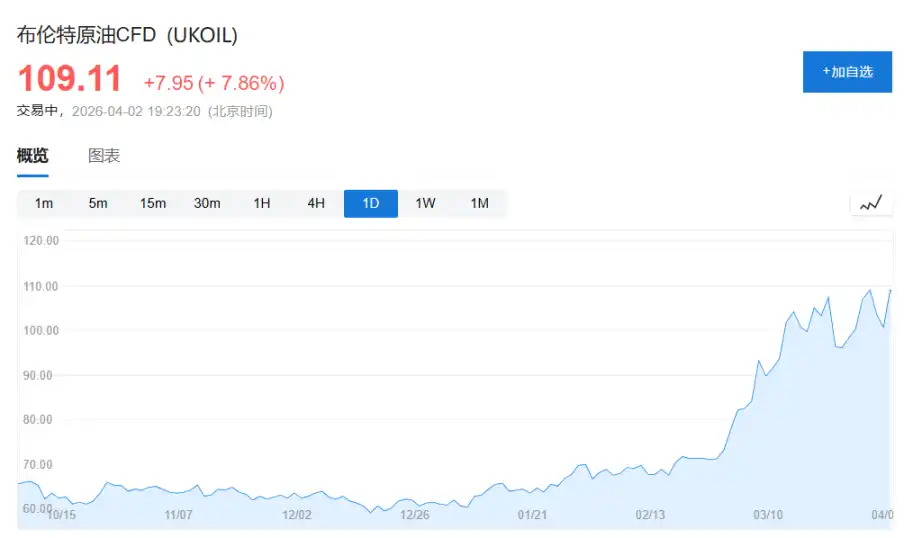
At the time of writing, the international benchmark Brent crude surged nearly 8%, once again approaching the $110 mark. UBS warned that the current market's pricing of oil price risks remains biased towards linear extrapolation, severely underestimating the cliff-like risks near $150 per barrel. Under the shadow of high oil prices, the market has little safety margin left. Protecting against risk and avoiding highly sensitive assets is more important than chasing returns.
Impact Depends on Initial Vulnerability

The UBS report challenges the market's long-held linear perception that "every $10 increase in oil prices drags the economy by a fixed proportion," pointing out that the destructive power of an energy shock highly depends on the initial economic state.

The current global economy is in an environment of high interest rates, weak recovery, and tight credit conditions, with an already elevated baseline probability of recession. This significantly amplifies the transmission effects of an oil price shock.

UBS constructed a three-dimensional analytical framework, using the US composite recession probability, the magnitude of the oil price increase, and the degree of cyclical economic downturn as the three dimensions. The calculation results clearly reveal the nonlinear nature of the risk:

  • When the recession probability is 20% and oil prices are at $100 per barrel, the cyclical economic downturn is only 0.28 standard deviations, indicating a mild impact;
  • If the recession probability rises to 40% while oil prices remain at $100 per barrel, the downturn magnitude expands to 0.81 standard deviations, nearly three times the baseline;
  • And when the recession probability is 40% and oil prices break through $150 per barrel, the downturn magnitude soars to 1.4 standard deviations, with an impact intensity nearly five times the baseline.

This means that the more fragile the economy, the more致命 (fatal) the blow from high oil prices. In the current environment, oil prices rising from $100 to $150 does not mean a 50% increase in pressure, but an accumulation of risk several times over.

$150: The Critical Divide Under Two Scenarios

Based on a pre-Middle East conflict US recession probability of around 30%, UBS provided critical values under two key scenarios. The gap between them reveals the core role of financial market reactions.

In an ideal steady-state scenario, if financial markets are stable with no additional risk发酵 (fermenting), the US economy could theoretically withstand oil prices rising to about $200 per barrel before substantially entering a recession. However, in a realistic risk scenario, once the stock market experiences a significant correction due to high oil prices and risk appetite deteriorates rapidly, the recession临界点 (critical point) would directly drop to $150 per barrel.

UBS pointed out that once $150 per barrel is reached, the world will face三重 (three layers) of systemic pressure:

  • Macro level: Inflation surges for the second time, forcing central banks to interrupt or even reverse interest rate cut cycles, quickly sliding the economy towards stagflation;
  • Market level: Stock market earnings expectations are revised downward, valuations contract, high-yield bond credit spreads widen, and liquidity tightening triggers cross-asset sell-offs;
  • Entity level: Soaring corporate costs squeeze profits, household purchasing power declines, consumption and investment cool down simultaneously, forming a共振下跌 (resonant decline) of the economy and markets.

The report also cited historical comparisons, noting that larger oil price shocks before 2000 had less impact due to stronger initial economic resilience,反而小于 (instead less than) the impact during the 1990 Gulf War period. Today, with the global high-interest-rate environment still present, the financial system is more sensitive to cost increases, and the intensity of a $150 per barrel shock would only be more severe.

Nonlinear Risk: The Blind Spot in Market Pricing

The UBS report specifically warned that the current market's pricing of oil price risks is systematically underestimated, particularly neglecting the threshold effect near $150 per barrel.

According to UBS research, the $100 to $130 per barrel range mostly involves shocks to局部行业 (local industries), pressuring sectors like aviation, logistics, and chemicals, but the overall market remains controllable. Once oil prices stabilize above $150 per barrel, the risk will spread from局部 (local) to全局 (global), escalating from an industry-level issue to a systemic financial risk.

This nonlinear risk manifests on three levels:

  • First, risk transmission accelerates, as high oil prices quickly penetrate the buffers of corporate profits, household consumption, and government finances;
  • Second, policy space compresses, as rising inflation traps central banks in the dilemma of "fighting inflation vs. stabilizing growth," preventing them from promptly supporting the market;
  • Third, confidence collapses rapidly, with significant market corrections and暴露 (exposure) of credit risks叠加 (overlapping), forming a negative feedback loop of "decline → deleveraging → further decline."


Perguntas relacionadas

QAccording to UBS, at what oil price level would the US and global markets face significant systemic risk?

A150 dollars per barrel.

QWhat negative feedback loop would be triggered if oil prices exceed 150 dollars per barrel?

AThe loop is: High oil prices → rebounding inflation → tightening of monetary policy → deteriorating financial conditions → collapsing demand → market panic.

QWhat is the key factor that determines the destructive power of an oil price shock, as stated in the UBS report?

AThe initial state of the economy, with the impact being highly dependent on the initial economic vulnerability.

QUnder the realistic risk scenario, what is the critical oil price point that would push the US economy into a recession, considering financial market reactions?

A150 dollars per barrel.

QWhat are the three systemic pressures the global economy would face once oil prices hit 150 dollars per barrel?

A1. Macro level: Inflation surges again, forcing central banks to halt or reverse rate cuts, pushing the economy towards stagflation. 2. Market level: Downward revisions to corporate earnings, valuation contractions, widening credit spreads for high-yield bonds, and cross-asset sell-offs due to tightening liquidity. 3. Entity level: Soaring corporate costs, squeezed profits, reduced household purchasing power, and a cooling of consumption and investment, leading to a共振下跌 (resonant decline) of the economy and markets.

Leituras Relacionadas

Annual Salary of Millions Competing for Electricians, Meta Rushes to Open Its Own Technical School

The AI boom is facing an unexpected bottleneck: a severe shortage of skilled construction workers and electricians. As tech giants like Meta, OpenAI, and Alphabet race to build massive data centers—such as OpenAI's $16 billion "Stargate" project—they are hitting a critical labor wall. The U.S. needs an estimated 130,000 more electricians, 240,000 construction workers, and 150,000 supervisors by 2030 for AI infrastructure alone, but tens of thousands of electrician jobs go unfilled each year. While AI companies offer high premiums, with electricians earning up to $280,000 annually, worker scarcity still causes massive losses—delays on a single project can cost $14.2 million per month. The complexity of building AI data centers, which require immense power (equivalent to powering hundreds of thousands of homes), sophisticated electrical systems, and advanced liquid cooling solutions, demands highly skilled technicians who are in short supply. To combat this, companies are investing heavily in training. Meta has committed $115 million to a free training school offering tuition, housing, and stipends, targeting 5,000 new workers. OpenAI is partnering with unions to secure skilled labor. These efforts are paying off, with a significant rise in Gen Z interest in trade schools over college. However, the power demands are staggering. AI data centers are driving a rapid surge in electricity consumption, projected to account for up to 12% of U.S. power use by 2028 and raising costs for consumers. Furthermore, the construction boom is project-based, leading to a potential future glut of trained workers once building peaks, which could depress wages industry-wide. The race for AI supremacy now depends as much on skilled hands as on advanced chips.

marsbitHá 30m

Annual Salary of Millions Competing for Electricians, Meta Rushes to Open Its Own Technical School

marsbitHá 30m

OpenAI No Longer Sells Its Most Expensive Model for Profit

OpenAI is shifting its business strategy away from promoting its most expensive, flagship models for every task. Recent price cuts—80% for GPT-5.6 Luna and 20% for Terra—signal a deeper change: the company now actively advises users that many tasks don't require the most powerful model. Instead, OpenAI recommends a tiered approach: use the high-end GPT-5.6 Sol for complex planning and analysis, then delegate execution to cheaper models like Luna. This mirrors moves by Anthropic, which recently launched Claude Opus 5 at half the price of its top model, Fable 5. Both companies are de-emphasizing flagship models as primary revenue drivers, using them instead for brand prestige and technological showcases. The industry is entering a "mass-market" phase, similar to automotive, where high-volume, cost-effective models handle daily operations and drive scale. OpenAI's price reductions are partly enabled by AI models themselves optimizing underlying code and infrastructure, creating a self-reinforcing cycle of efficiency gains and cost reduction. Competition is shifting from "who is smartest" to "who offers the best value." The goal is no longer selling individual models but fostering widespread API adoption and ecosystem lock-in. By making AI calls cheap and ubiquitous, companies like OpenAI aim to become the indispensable, utility-like infrastructure powering automated workflows—the "water and electricity" of software, quietly embedded everywhere.

marsbitHá 30m

OpenAI No Longer Sells Its Most Expensive Model for Profit

marsbitHá 30m

Will the Fed Definitely Raise Interest Rates in September? How Will Crypto and U.S. Stocks Withstand the Pressure?

The market's expectation for a September Fed rate hike surged dramatically in early August, jumping from under 50% to over 80% within a week. This shift followed a contentious July FOMC meeting, where a 9-3 vote to hold rates revealed growing dissent from hawkish members advocating for an immediate hike to combat persistent inflation. The primary catalyst for this repricing is rising oil prices, driven by renewed geopolitical tensions around the Strait of Hormuz, which threaten global supply. Energy costs directly influence inflation metrics, making the upcoming July CPI report (due August 12th) a critical data point. If it shows inflation reaccelerating, the probability of a September hike will solidify. For Bitcoin and crypto assets, this is typically bearish news. Bitcoin continues to behave as a high-beta, liquidity-sensitive risk asset. A rate hike raises the opportunity cost of holding non-yielding assets and could drive capital toward money markets, pressuring crypto prices in the short term. However, historical patterns suggest that if a hike is perceived as the end of a tightening cycle rather than the start, any negative price impact may be brief. U.S. stocks, particularly crypto-linked equities like Coinbase and growth-oriented tech stocks, are also vulnerable. Higher rates increase discount rates in valuation models, putting pressure on high-multiple companies. This coincides with a pivotal tech earnings season where investor focus has shifted from massive AI capital expenditure to tangible revenue and cash flow generation. Companies with negative cash flow and weak growth narratives could face heightened volatility if borrowing costs rise in September. In summary, a September Fed hike has evolved into a mainstream market scenario. Key factors to watch are oil prices, the July CPI report, and Fed communications, which will determine the final decision and its impact on volatile crypto and equity markets.

marsbitHá 41m

Will the Fed Definitely Raise Interest Rates in September? How Will Crypto and U.S. Stocks Withstand the Pressure?

marsbitHá 41m

Trading

Spot
活动图片




