The other shoe has finally dropped. The official arXiv blog has announced that as of July 1, the platform has formally separated from Cornell University, beginning a new chapter as an independent non-profit organization.
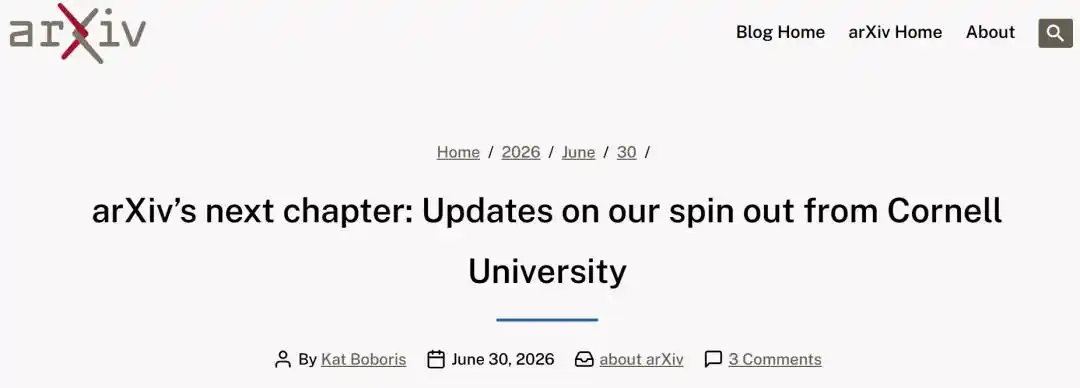
Announcement address: https://blog.arxiv.org/2026/06/30/arxivs-next-chapter/
The official name of the new organization is arXiv, Inc., registered under Delaware law as a non-profit, non-stock corporation and granted 501(c)(3) tax-exempt status by the IRS.
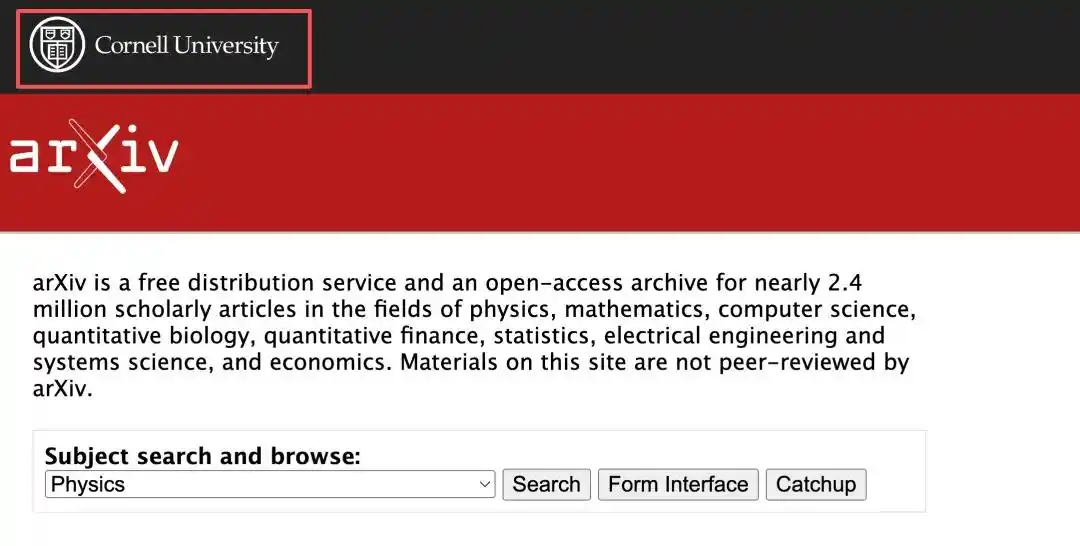
The "Cornell University" logo, which had accompanied users for over two decades on the page header, is now history.
Not only that, but the familiar arXiv red has also turned to black.
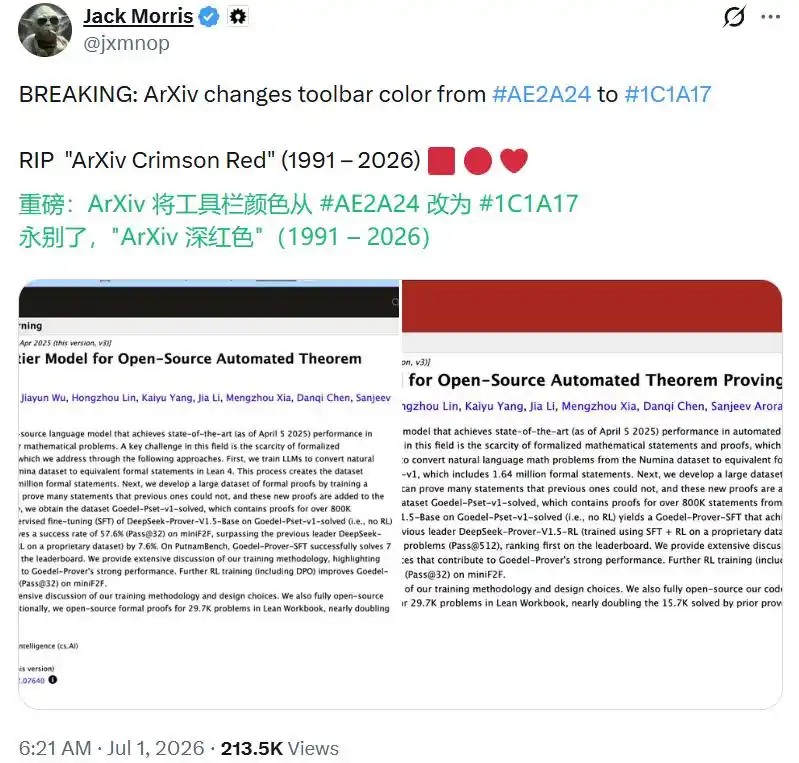
Of course, the functionality remains unchanged. The papers are still there, search still works, and submission portals remain open. The arXiv team specifically noted in the announcement, "For the next few months, arXiv's authors, readers, and the communities that depend on us will experience almost no change." This statement is aimed at users worried about sudden fees or major overhauls. For related concerns, see our previous report "arXiv Faces Major Change: To Break Away from Cornell University, Hiring CEO. Netizens: Can We Still Access for Free in the Future?"

The New Organizational Structure: From University Unit → Self-Governance
Within the Cornell system, arXiv was overseen by Cornell Tech Dean Greg Morrisett, with execution led by Computer Science Professor Ramin Zabih as Executive Director. After independence, this structure will be replaced by a formal corporate governance framework.
According to arXiv's published FAQ, the new organization will be governed by a Board of Directors with up to 12 members. The Simons Foundation and Cornell University, as two "Founding Members," jointly led the initial establishment work, including appointing the initial board, securing tax-exempt status, and signing a series of legal agreements. These two institutions will serve as "Members" for up to five years, and their representatives may continue to serve on the board thereafter.
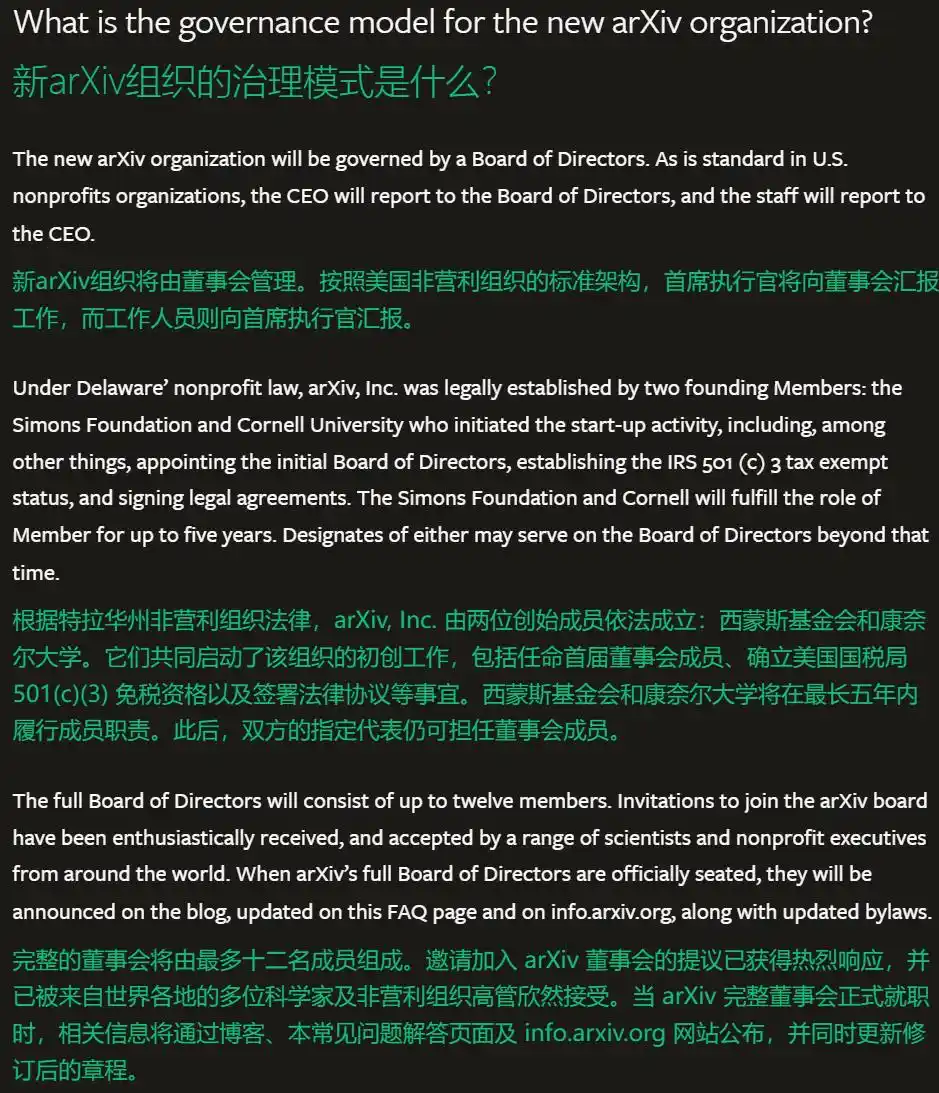
Regarding the CEO position: Cornell Computer Science Professor Ramin Zabih will serve as Interim CEO during the transition period and assist the future permanent CEO with the handover.

The hiring process is currently nearing its conclusion. The previously widely discussed salary package of approximately $300,000 remains valid. Notably, arXiv's headquarters address will temporarily remain unchanged, with New York-based staff continuing to work from the Tata Innovation Center at Cornell Tech. All 26 employees have transitioned to the new company with the organization.
What is arXiv? Why Does It Deserve So Much Attention?
If you work in physics, mathematics, or computer science research, arXiv is a webpage opened almost daily. If you work in AI, it has practically become the default paper platform.
In short, arXiv is a "preprint" server: before a paper is formally peer-reviewed and published in a journal, scholars can first upload their manuscripts here for free, allowing global peers to see them immediately.
This model has fundamentally changed the speed of academic knowledge dissemination. Traditional academic journals often take months or even years from submission to publication, while arXiv reduces this time to days or even hours.
arXiv was born in 1991, founded by physicist Paul Ginsparg from Los Alamos National Laboratory.

Initially, it was just an automated script meant to replace messy email lists, expected to receive about 100 papers per year. But the first month saw nearly a hundred submissions flood in. Early endorsement by string theory master Ed Witten helped it quickly gain recognition in the academic community. In 2001, Ginsparg returned to his alma mater Cornell University to teach, and arXiv settled in the university's library, beginning its 25-year Cornell era.
Its value to the AI community is particularly irreplaceable.
Almost all seminal papers that shaped the contemporary AI landscape first debuted on arXiv. The attention mechanism (Attention), the Transformer architecture, BERT, the GPT series, diffusion models... these names represent not just papers, but the very foundations of the entire industry. The DeepSeek series of papers that shocked the global AI community also premiered on arXiv. Compared to the often months- or years-long review cycles of traditional academic publishing, arXiv's rapid turnaround mechanism has significantly accelerated progress in these fast-evolving fields.
More importantly, arXiv is free for everyone, no institutional subscription needed, no paywalls to climb. Scientists conducting research in Eastern Europe, Southeast Asia, or Africa are, to some extent, on the same starting line as scholars at MIT.
As of June 2026, arXiv has cumulatively archived over 3.09 million papers, covering eight subject areas including physics, mathematics, computer science, quantitative biology, quantitative finance, statistics, electrical engineering and systems science, and economics. The platform has provided over 3.7 billion downloads to date. Behind these numbers lies an infrastructure serving a global community of over tens of millions of monthly active users.
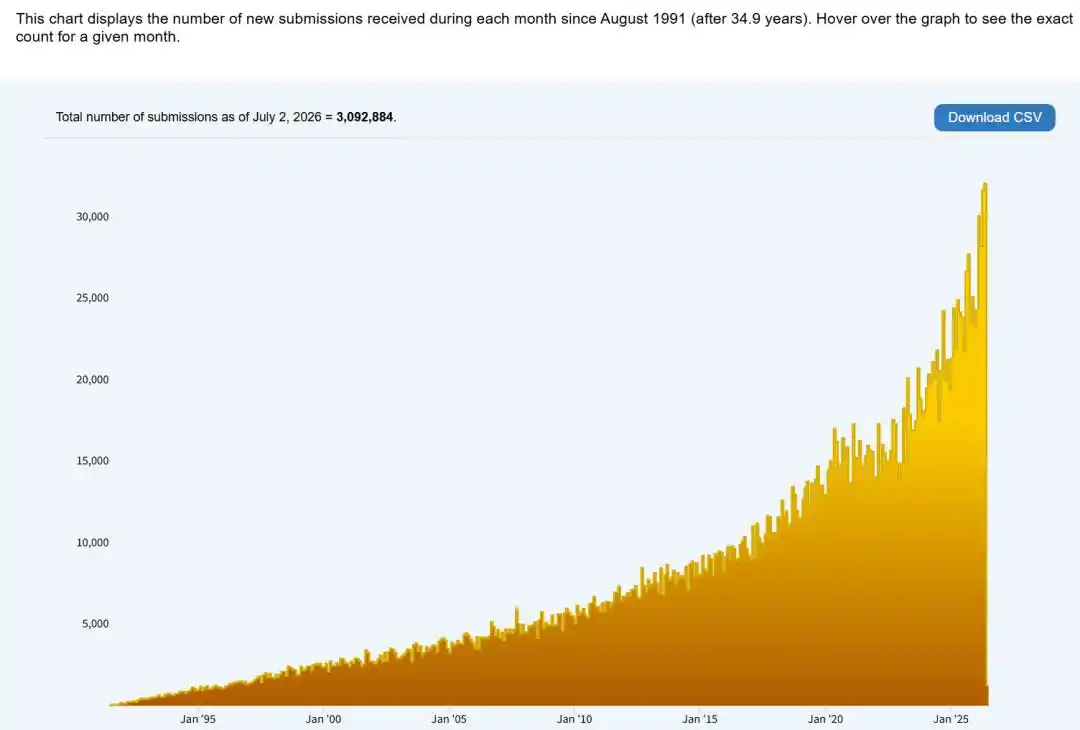
Statistics on paper submissions since August 1991
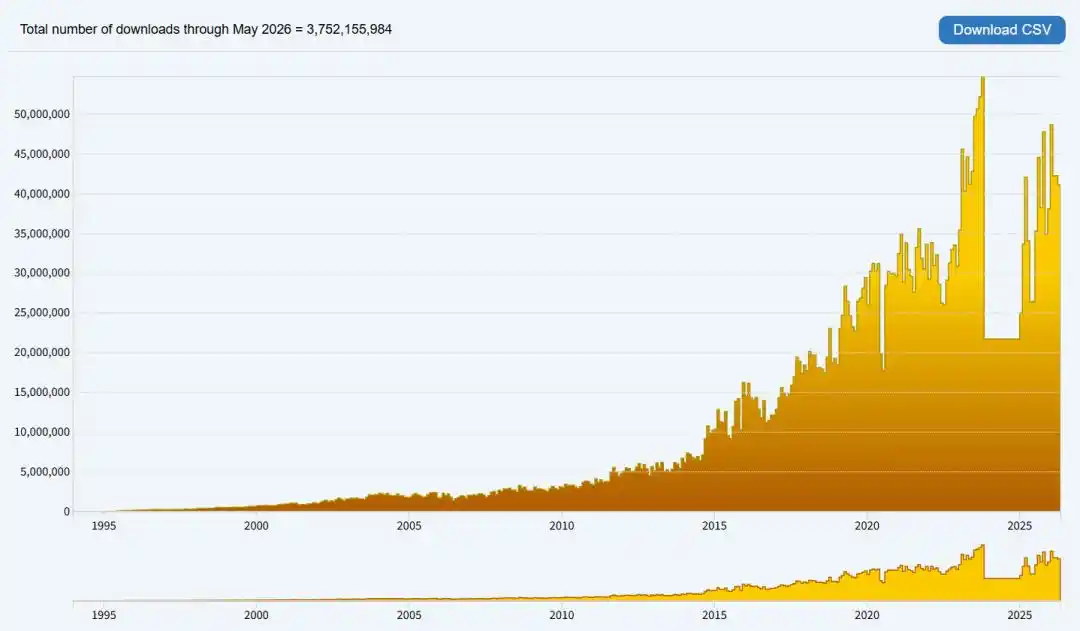
Statistics on paper download numbers
Why Go Independent Now? The Dual Pressures of Finances and AI
The decision to become independent was not impulsive. Internal discussions at arXiv have been ongoing for years, but real momentum coalesced in the last two years.
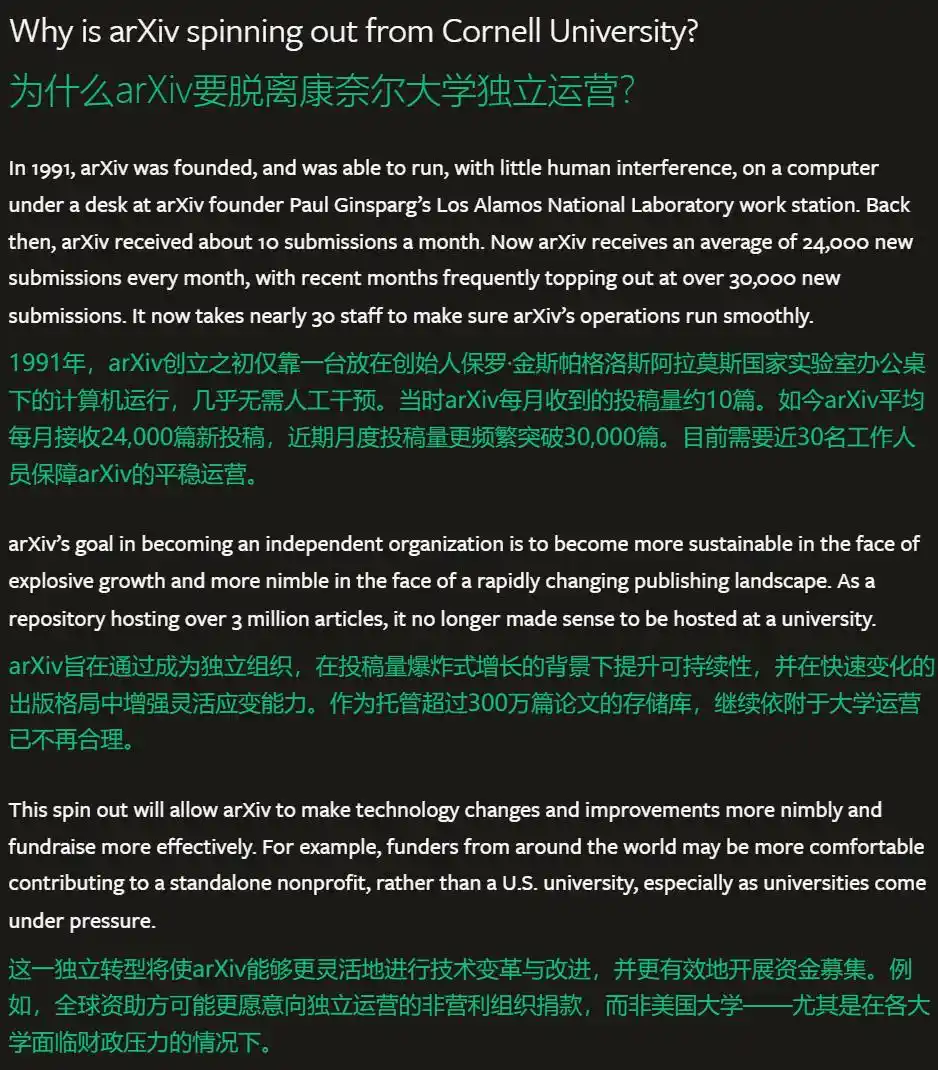
First, the financial issue.
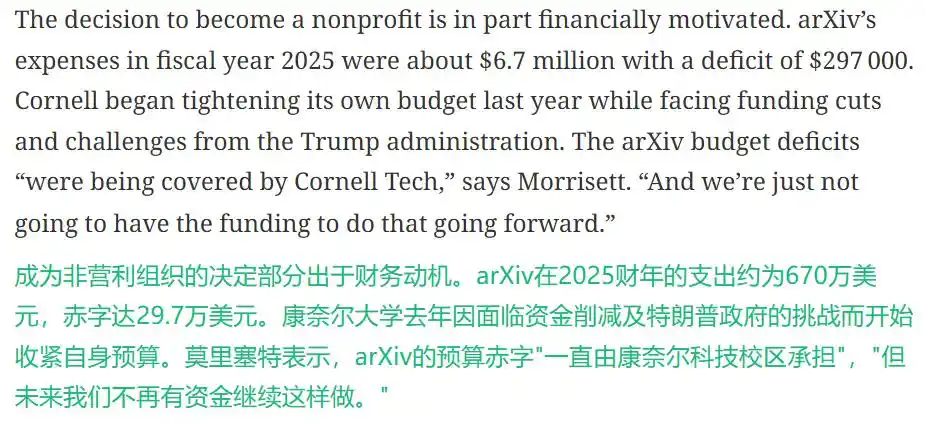
arXiv's expenditures in fiscal year 2025 were approximately $6.7 million, resulting in a deficit of $297,000. Facing pressures from federal funding cuts and budget tightening, Cornell University could no longer sustain covering these deficits.
Independent operation means broader financing channels. Some institutions in Europe and Asia were previously reluctant to write checks directly to Cornell University, but their attitude would be markedly different if the recipient were an independent non-profit organization directly serving the scientific community.
Second, the flexibility of the system. The university's personnel system has its inherent pace (salary caps, hiring cycles, procurement processes), which sometimes posed visible hindrances for arXiv needing to respond quickly to technological waves. Morrisett once stated bluntly: "We need to hire more flexibly and offer more competitive salaries than the university allows."
Then comes the new variable brought by AI.
Since 2023, AI-generated content has flooded academic platforms, and arXiv is no exception. The number of low-quality or entirely AI-written paper submissions has increased dramatically. The platform relies on hundreds of professional volunteer moderators to process submissions, but facing tens of thousands of papers monthly, this system is under pressure.
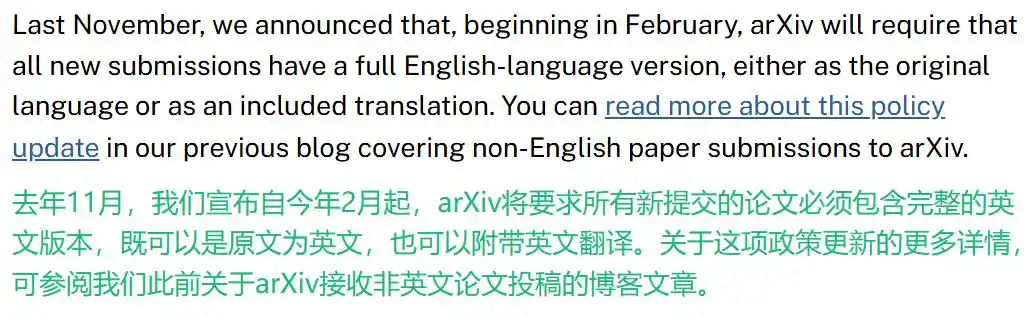
In February 2026, arXiv introduced a new policy to "only accept papers containing an English version" to reduce the difficulty of multilingual moderation. In founder Ginsparg's view, the problem is more fundamental: "If LLM-generated computer science papers already exceed the quality of an average graduate student, how will the world cope three months from now?"
Can It Remain Free, What Will the CEO Do?
For most users, the most pressing question is only one: Will it remain free to use in the future?
arXiv's answer is clear: "arXiv remains committed to being free for readers and submitters. We are dedicated to providing global scientists with equitable access to new ideas and discoveries." However, regarding whether paid features might be introduced in the future, the official statement has not given a clear indication.
The general sentiment in academia is "cautiously optimistic and continuing to watch." Some researchers on social media recalled cases of former non-profit platforms gradually commercializing, expressing underlying concerns. Others in the field countered, saying arXiv's revenue structure (a combination of member institutions, foundations, and individual donations) is relatively healthy and that it has already raised funds sufficient to cover operational needs for the next three years.
As for the soon-to-arrive first CEO, the challenge list is long: complete the modernization migration of the codebase from Perl to Python; establish a moderation mechanism capable of handling the wave of AI submissions; expand the donor base to reduce reliance on a few major foundations; and reposition arXiv's brand image before the international academic community. The pricing for this position is not unreasonable within the circle of non-profit tech organization management in New York.
arXiv's independence marks a shift in identity from "an affiliated project of a university" to "global academic infrastructure." This shift itself will not change any of its functions, but it will change its position in the world.
Reference Links
https://news.cornell.edu/stories/2026/06/digital-research-repository-arxiv-start-new-chapter-nonprofit
https://info.arxiv.org/about/spinout_faq.html
https://blog.arxiv.org/2026/01/13/non-english-paper-submission-guidelines/
https://physicstoday.aip.org/news/arxiv-sets-out-on-its-own
This article is from the WeChat public account "Almost Human" (ID: almosthuman2014), author: Reading Papers.