ArkInvest Allocates $32.7M to Robinhood as Bitcoin Hyper Pumps

bitcoinistPublicado em 2026-02-03Última atualização em 2026-02-03

Resumo

Ark Invest has acquired $32.7 million worth of Robinhood (HOOD) shares, signaling a strategic bet on increased retail market participation, which historically precedes crypto activity surges. This influx could cause Bitcoin network congestion, driving interest in scalability solutions. Bitcoin Hyper ($HYPER) is highlighted as a key infrastructure project merging Solana's speed with Bitcoin's security via the Solana Virtual Machine, enabling fast, low-cost transactions. With over $32 million raised in its presale and immediate staking options, it aims to attract developers and handle high-frequency BTC use cases, positioning itself as a solution to upcoming liquidity and scalability challenges.

Ark Invest’s latest filing reveals a chunky $32.7M acquisition of Robinhood (HOOD) shares.

On the surface, it’s an equity play, but dig deeper, and it looks like a derivative bet on the resurgence of crypto market participation. Historically, Robinhood’s volume spikes act as a canary in the coal mine for retail capital, typically preceding major on-chain activity by 3-5 weeks.

The timing feels deliberate. As the Federal Reserve signals potential rate pauses, risk-on assets are re-pricing. But buying HOOD is just the surface trade. The inevitable second-order effect of a retail influx? Massive Bitcoin network congestion. When millions of new users try to move $BTC, fees don’t just rise; they skyrocket, making the base layer practically unusable for anyone moving less than six figures.

That bottleneck is exactly why institutional eyes are drifting toward infrastructure that can handle the coming liquidity shock. While Wall Street buys exchange stocks, on-chain capital is positioning into scalability protocols.

Specifically, smart money appears to be front-running the congestion narrative by accumulating Bitcoin Hyper ($HYPER), the first protocol to weld the Solana Virtual Machine (SVM) directly onto a Bitcoin Layer 2.

Buy $HYPER here.

Solving the Velocity Problem: Bitcoin Meets SVM Speed

The thesis here is simple mechanics. Bitcoin is secure but slow; Solana is fast but has faced centralization headaches. By fusing these architectures, Bitcoin Hyper ($HYPER) attempts a ‘best of both worlds’ environment to solve the trilemma plaguing current Layer 2s.

Most existing Bitcoin L2s still feel sluggish compared to modern DeFi standards. Bitcoin Hyper bypasses the lag by using the Solana Virtual Machine (SVM) for execution. The result? Sub-second transaction finality and costs that are fractions of a cent, all while anchoring state to the Bitcoin L1.
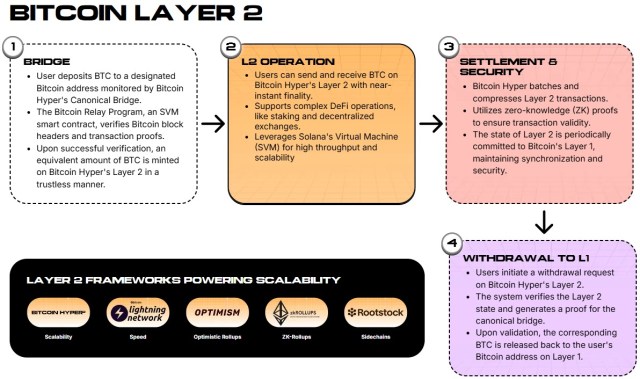
That matters because it finally unlocks high-frequency use cases for $BTC, think gaming, real-time payments, and complex DeFi swaps, that were previously impossible (or just too expensive) on the base layer.

Developers are eyeing the Rust-based environment too. The protocol offers a Developer SDK and API in Rust, meaning the massive pool of Solana devs can port their dApps to the Bitcoin ecosystem without rewriting their codebase. This isn’t just about building a chain; it’s about importing an entire developer economy.

You can buy $HYPER here.

Presale Data Signals Institutional Accumulation

The market’s appetite for high-performance infrastructure shows up in the hard numbers. According to the official presale page, Bitcoin Hyper ($HYPER) has raised over $32M, a figure that frankly outpaces most comparable infrastructure rounds this cycle. The token sits at $0.013675, a valuation that looks modest relative to the utility proposition.

The incentives seem structured to keep that liquidity sticky. Staking opens immediately after the Token Generation Event (TGE), with a 7-day vesting period for presale participants. That lock-up mechanism helps prevent immediate sell-offs, aiming to create a stable floor at launch.

For investors watching Ark Invest buy the ‘shovels’ (Robinhood), Bitcoin Hyper represents the ‘ground’ where the actual digging happens.

Visit the official $HYPER presale here.

The content provided in this article is for informational purposes only and does not constitute financial advice. Cryptocurrency investments, including presales and stocks like Robinhood, carry high risks. Always conduct your own due diligence before investing.


Perguntas relacionadas

QWhat is the significance of Ark Invest's $32.7M acquisition of Robinhood shares according to the article?

AThe article suggests that while it appears to be an equity play on the surface, it is actually a derivative bet on the resurgence of crypto market participation. Historically, Robinhood's trading volume spikes act as an early indicator (a 'canary in the coal mine') for retail capital entering the market, typically preceding major on-chain activity by 3-5 weeks.

QWhat problem does the Bitcoin Hyper ($HYPER) protocol aim to solve?

ABitcoin Hyper aims to solve the blockchain trilemma for Bitcoin Layer 2s by combining the security of Bitcoin with the speed of Solana. It welds the Solana Virtual Machine (SVM) directly onto a Bitcoin L2 to provide sub-second transaction finality and extremely low costs, thereby solving the 'velocity problem' and enabling high-frequency use cases like gaming and real-time payments on Bitcoin.

QHow does the article connect a potential influx of retail users to Bitcoin network congestion?

AThe article states that an influx of retail users, signaled by increased activity on platforms like Robinhood, leads to massive Bitcoin network congestion. When millions of new users try to move BTC, transaction fees don't just rise but 'skyrocket,' making the base layer practically unusable for transactions under six figures.

QWhat advantage does Bitcoin Hyper's Rust-based development environment provide?

ABy offering a Developer SDK and API in Rust, Bitcoin Hyper allows the massive existing pool of Solana developers to easily port their decentralized applications (dApps) to the Bitcoin ecosystem without having to rewrite their entire codebase, effectively importing an entire developer economy.

QWhat does the presale data for Bitcoin Hyper ($HYPER) indicate, as mentioned in the article?

AThe presale data indicates strong institutional accumulation, having raised over $32 million, which the article states outpaces most comparable infrastructure rounds in the current market cycle. The token's valuation is considered modest relative to its utility, and its staking and vesting mechanisms are designed to create liquidity stability post-launch.

Leituras Relacionadas

$292 Million KelpDAO Cross-Chain Bridge Hack: Who Should Foot the Bill?

On April 18, 2026, an attacker stole 116,500 rsETH (worth ~$292M) from KelpDAO’s cross-chain bridge in 46 minutes—the largest DeFi exploit of 2026. The stolen assets were deposited into Aave V3 as collateral, causing $177–200M in bad debt and triggering a cascade of losses across nine DeFi protocols. Aave’s TVL dropped by ~$6B overnight. This legal analysis argues that KelpDAO and LayerZero Labs share concurrent liability, with fault apportioned 60%/40%. KelpDAO negligently configured its bridge with a 1-of-1 decentralized verifier network (DVN)—a single point of failure—despite LayerZero’s explicit recommendation of a 2-of-3 setup. LayerZero, which operated the compromised DVN, failed to secure its RPC infrastructure against a known poisoning attack vector. Both protocols’ terms of service cap liability at $200 (KelpDAO) or $50 (LayerZero), but these limits are likely unenforceable due to unconscionability, gross negligence exceptions, and potential securities law invalidation (if rsETH is deemed a security under the Howey test). Aave’s governance also faces fiduciary duty claims for raising rsETH’s loan-to-value ratio to 93%—far above competitors’ 72–75%—without adequately assessing bridge risks, amplifying the systemic fallout. Practical recovery targets include LayerZero Labs (a registered Canadian entity), KelpDAO’s founders, auditors, and identifiable Aave governance delegates. The incident underscores escalating legal risks for DeFi protocols, infrastructure providers, and governance participants.

marsbitHá 52m

$292 Million KelpDAO Cross-Chain Bridge Hack: Who Should Foot the Bill?

marsbitHá 52m

Insider Trading in War: 5 People Involved, the Highest Earner Was Arrested

On April 24, the U.S. Department of Justice arrested U.S. Army Special Forces Staff Sergeant Gannon Ken Van Dyke for insider trading related to the capture of Venezuelan President Nicolás Maduro on January 3. Van Dyke allegedly profited over $400,000 by placing bets on a prediction market, Polymarket, using insider knowledge of the covert operation. According to the indictment, Van Dyke registered an account (0x31a5) on December 26 and made a series of bets predicting Maduro’s capture and U.S. military involvement in Venezuela. He withdrew most of his funds on the day of the operation and attempted to obscure his tracks by transferring assets through crypto and brokerage accounts. This case marks the first time the DOJ has prosecuted insider trading on Polymarket. PolyBeats had previously identified five suspicious accounts, including Van Dyke’s—the highest earner—in January. The other accounts, with profits ranging from $34,000 to $145,000, remain under unofficial scrutiny but have not been charged. Their lower profits, indirect access to information, and unclear legal boundaries may complicate prosecution. Polymarket has since strengthened its market integrity rules, explicitly prohibiting trading based on confidential or insider information. Van Dyke’s arrest, nearly four months after his trades, signals increased regulatory attention and the persistent traceability of blockchain-based transactions.

marsbitHá 53m

Insider Trading in War: 5 People Involved, the Highest Earner Was Arrested

marsbitHá 53m

Bitwise: Bullish on Bitcoin's Performance in the Second Half of the Year, AI and Regulation Will Spark a New Altcoin Season

Bitwise CIO Matt Hougan and Research Lead Ryan Rasmussen express strong bullish sentiment on Bitcoin's long-term prospects, suggesting that its $1 million price target may be too conservative. They argue Bitcoin serves a dual role: as digital gold and a potential global settlement asset, especially amid declining trust in traditional monetary systems. Despite a weak Q1 2026 where nearly all crypto assets and prices saw double-digit declines, the analysts remain optimistic due to strong forward-looking catalysts, including institutional adoption via Bitcoin ETFs from major firms like Morgan Stanley and Goldman Sachs. Geopolitical instability, such as Iran’s mention of using Bitcoin for international payments, increases the value of Bitcoin’s “out-of-the-money call option” as a non-political, global settlement currency. This enhances its appeal beyond a mere store of value. . Additionally, Hougan highlights that a clearer regulatory token framework under current SEC leadership, combined with AI efficiency gains and high-performance blockchains, could fuel a new “altseason” by late 2026. This may lead to a wave of legitimate, value-capturing token projects, unlike the earlier ICO boom. . Bitwise also announced an Avalanche ETF, citing its unique architecture and rapid growth in real-world asset (RWA) tokenization, which has surged 10x to nearly $30 billion in two years. The firm believes Layer 1 blockchains are still early in their growth cycle, with significant potential ahead.

marsbitHá 1h

Bitwise: Bullish on Bitcoin's Performance in the Second Half of the Year, AI and Regulation Will Spark a New Altcoin Season

marsbitHá 1h

Trading

Spot
Futuros
活动图片