Are Rising U.S. Stocks Getting More Dangerous? Goldman Sachs: Downside Protection Mechanisms Have Almost Failed

marsbitPublicado em 2026-06-01Última atualização em 2026-06-01

Resumo

The US stock market rally is showing signs of becoming increasingly precarious as key downside protection mechanisms fail, according to Goldman Sachs. Derivatives strategist Brian Garrett notes that the S&P 500 options volatility skew has plunged to an 18-month low, indicating the market now prices an 8% probability for both a 10% drop and a 10% rise—a sign of "skew failure." Concurrently, Goldman's Panic Index hit a two-year low, reflecting minimal demand for tail-risk hedging. This complacency emerges amid a relentless market surge, with the S&P 500 setting new records frequently in 2024. Garrett highlights three major concerns: extreme concentration in the top ten stocks (40% of index weight), heavy reliance on AI-themed performance, and a price pattern eerily similar to the 1998-1999 period. Despite pervasive media pessimism, this fear is absent in options pricing. Downside hedge costs are historically low. Goldman suggests tactical trades: buying RSP outperformance options versus the SPX for a broadening rally, purchasing VIX calls for protection, and going long on Bitcoin ETF volatility. Hedge funds have been net buyers for two weeks, with sector rotation into financials and out of industrials. Notably, the global single-stock leveraged/ inverse ETF AUM has doubled to over $60 billion in two months, underscoring growing speculative activity.

The market's fear of downside risk has nearly vanished, and a core pricing mechanism in the options market is failing.

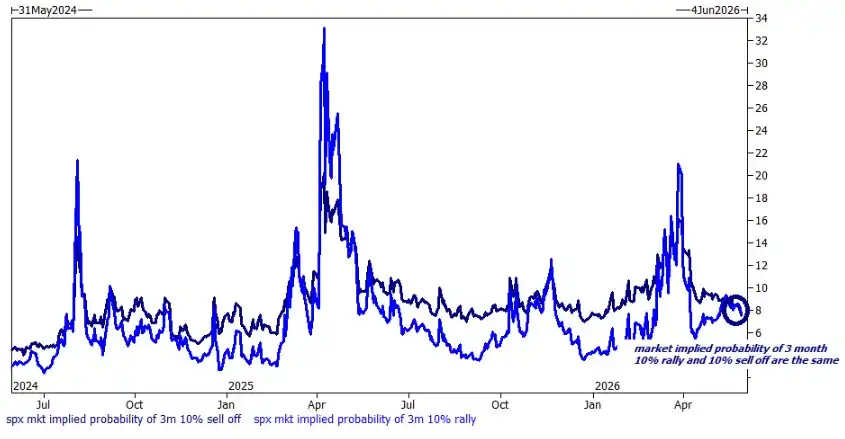
In a latest weekend report, Goldman Sachs derivatives strategist Brian Garrett pointed out that the volatility skew of S&P 500 options has fallen to an 18-month low. The market is pricing a roughly 8% probability for both a 10% decline and a 10% rise—a phenomenon directly characterized by Goldman's volatility team as 'Skew Failure.'

At the same time, the Goldman Sachs Panic Index closed in single digits, hitting a two-year low, indicating that market demand for hedging against tail risks has fallen to extremely low levels.
This signal appears against the backdrop of the U.S. stock market's continued surge. The S&P 500 has been hitting record highs on average every five trading days this year, and Micron's stock price surpassed $1,000 for the first time after hours on Sunday.

Garrett admitted that internal team discussions have evolved from 'Make it stop' in March to 'This is still going up?' in May. However, his own stance is shifting from cautious optimism to increasing pessimism, and he clearly listed several bearish reasons.

Three Bearish Signals Emerge, Cracks Appear Between Market Sentiment and Fundamentals

Garrett listed three major concerns in the current market.

First, market leadership is extremely narrow. The top ten weighted stocks in the S&P 500 now account for 40% of the index's weight, and the last four record highs occurred when overall market breadth was negative—a phenomenon that has never occurred before.

Second, thematic concentration is extremely high. Year-to-date, the S&P 500 excluding AI-related stocks has lagged the overall index by 700 basis points.

Third, price action is highly similar to history. Garrett noted that the 2026 price pattern closely resembles that of late 1998 to 1999.

Although bearish voices are flooding media headlines and social media, Garrett emphasized that this concern is not reflected in the pricing of the options market—at least, the fear of downside risk is almost nowhere to be seen.

Skew Failure: Downside Hedging Costs Fall to Historic Lows

Goldman's volatility team provided three key observations from the options market.

First, the S&P 500 volatility skew has fallen to an 18-month low. This move is driven by two forces: the put wing is unusually cheap, while the call wing is relatively expensive.

Second, the Goldman Sachs Panic Index closed in single digits last Friday, hitting a two-year low. This index synthesizes the two-year percentile rankings of VVIX, VIX, Skew, and at-the-money volatility.

Third, and most crucially: the market prices the probability of a 10% decline and a 10% rise as exactly the same, both around 8%. This means the options market no longer assigns extra premium to downside risk; the protective function of Skew has effectively failed.

Garrett pointed out that the direct implication of the above phenomena is: for investors looking to hedge correlation risk, the current hedging cost is extremely low.

Low-Cost Hedging Paired with Right-Tail Positioning

Based on the above assessment, Garrett provided several specific trade recommendations.

For investors bullish on market style rotation, expecting the rally to shift from concentration to dispersion, Goldman recommends buying RSP (Invesco S&P 500 Equal Weight ETF) outperformance options relative to SPX, with a 1-month 100% outperformance option costing about 145 basis points. It also recommends buying VIX call options as a hedging tool, noting that the term structure for August and beyond is extremely flat, with VVIX at 86.

For investors seeking simple downside protection, Garrett suggests directly buying S&P 500 put options—given the extremely low put skew, the payout structure is quite attractive.

Additionally, Goldman recommends going long Bitcoin ETF volatility with delta-neutral hedging. Garrett noted that Bitcoin has historically performed like a 'leveraged Nasdaq,' but its current pricing is at a two-year low and about 10 volatility points lower than SMH.

Fund Flows: Hedge Funds Net Buyers for Two Consecutive Weeks, Single-Stock ETF Assets Double

According to Goldman's latest Prime Brokerage data, hedge funds have been net buyers for two consecutive weeks, at the fastest pace this year, mainly reflected in long additions and macro short covering.

Significant sector rotation is evident: Financials (down 6% YTD) saw net buying, while Industrials (up 11.5% YTD) saw net selling.

On the futures side, end-user positioning has rebounded to near 2024 highs. Goldman's team specifically noted that levered ETFs are mechanically expanding their balance sheet size; CTA strategies are currently positioned near neutral, but systematic strategies show clear asymmetry towards the left tail—buying about $12 billion in a flat 1-month scenario versus selling about $100 billion in a down 1-month scenario.

Notably, global leveraged and inverse single-stock ETF assets under management have surpassed $60 billion, doubling in two months. The size of this niche market can no longer be ignored.

Perguntas relacionadas

QAccording to Goldman Sachs, what is currently malfunctioning in the equity options market and what does it indicate?

AGoldman Sachs states that the volatility skew (Skew) for S&P 500 options is malfunctioning, having dropped to an 18-month low. This indicates that the market is pricing the probability of a 10% decline and a 10% rise as virtually identical (both around 8%), meaning the protective mechanism against downside risk has nearly failed.

QWhat are the three major concerns or bearish signals listed by Goldman's Brian Garrett regarding the current market?

AThe three concerns are: 1) Extremely narrow market leadership, where the top 10 stocks account for 40% of the S&P 500 weight and recent highs occurred with negative market breadth. 2) High thematic concentration, with the S&P 500 ex-AI significantly underperforming the full index. 3) Price action that is highly similar to the 1998-1999 period.

QWhat is the Goldman Sachs Panic Index, and what level did it recently reach?

AThe Goldman Sachs Panic Index is a composite index that incorporates the 2-year percentile rankings of the VVIX, VIX, Skew, and at-the-money volatility. It recently closed in single digits, hitting a two-year low, signaling extremely low demand for hedging tail risks.

QWhat specific trading recommendations did Goldman Sachs provide based on its market analysis?

ARecommendations include: 1) Buying RSP (Invesco S&P 500 Equal Weight ETF) outperform options vs. SPX for investors betting on a market rotation. 2) Buying VIX call options for hedging. 3) Buying S&P 500 put options for direct downside protection. 4) Going long Bitcoin ETF volatility with delta-neutral hedging.

QWhat notable trend was observed in hedge fund activity and single-stock ETFs according to Goldman's prime brokerage data?

AHedge funds have been net buyers for two consecutive weeks at the fastest pace this year, driven by long additions and macro short covering. Meanwhile, the assets under management (AUM) for global leveraged and inverse single-stock ETFs surpassed $60 billion, doubling in two months.

Leituras Relacionadas

HYPE Spot ETF Continuously Accumulates 1% in 14 Days: Is the $75 New High Just the Starting Point?

Hyperliquid (HYPE) has surged to a new all-time high of $75 amid strong institutional and ETF-driven buying pressure. The article highlights several key bullish factors. First, the HYPE spot ETFs from 21Shares and Bitwise have seen 14 consecutive days of net inflows, totaling over $136 million and absorbing nearly 1% of HYPE's market cap—a faster initial pace than BTC or ETH ETFs. This ETF demand provides a solid price floor. Second, the protocol's own Assistance Fund (AF) mechanism, which uses 99% of fees to buy back and burn HYPE, has already removed over $1.1 billion worth of tokens, creating a dual support system alongside ETF inflows. This combined buying power is expected to counter potential selling pressure from upcoming team token unlocks. Institutionally, venture firm a16z is now considered one of the largest external holders of HYPE, with multiple addresses accumulating millions of tokens. Galaxy Digital is also actively buying. Analysts and firms like Bitwise and Grayscale are framing HYPE not as a mere meme coin but as a "second-generation" crypto with real value capture and infrastructure potential. Furthermore, Hyperliquid Strategies (PURR), a publicly traded company holding a large HYPE treasury, is set to join the Russell 3000 Index, potentially unlocking further passive investment flows. The ongoing feud between prominent backers like Arthur Hayes (pro-HYPE) and Kyle Samani (pro-SOL) underscores the intense market debate, with Hayes famously betting HYPE will outperform all top-ten crypto assets this year.

Odaily星球日报Há 9m

HYPE Spot ETF Continuously Accumulates 1% in 14 Days: Is the $75 New High Just the Starting Point?

Odaily星球日报Há 9m

ETH Bull and Bear Views Compilation: Can Ethereum's Value Flow Back to ETH?

Titled "ETH Bull and Bear Views: Can Ethereum's Value Flow Back to ETH?", this article synthesizes the current heated debate around Ethereum's native token, ETH, following Bankless co-founder David Hoffman's decision to sell his entire ETH holdings. The **bullish case**, represented by figures like Tom Lee (BitMine CEO) and Raoul Pal, argues that ETH's core thesis remains intact. They contend Ethereum is the essential, secure, and neutral foundational layer for future finance—encompassing stablecoins, RWA, DeFi, L2s, and Agentic AI. Bulls bet on ETH's long-term revaluation as institutional adoption of on-chain finance grows, with significant buying activity from entities like BitMine and Consensys cited as evidence. Conversely, the **bearish perspective**, led by Hoffman and analysts like Markus Thielen, questions ETH's value capture mechanism. They acknowledge Ethereum's network success but argue that the value created by L2s, DeFi, and applications does not sufficiently accrue to the ETH token itself. Bears point to ETH's prolonged underperformance versus the broader crypto market, lack of traditional cash flows, weakening "ultrasound money" narrative, and apparent institutional retreat (e.g., Harvard Management Company exiting its ETH ETF position) as key concerns. The debate highlights a pivotal shift: ETH is no longer just a community belief asset. The central question is whether ETH can transition from being a "**used infrastructure**" to a "**continuously bought and held core asset**" as more value enters the Ethereum ecosystem. The market is now critically examining the direct link between network growth and ETH's value.

marsbitHá 56m

ETH Bull and Bear Views Compilation: Can Ethereum's Value Flow Back to ETH?

marsbitHá 56m

Crypto is dead, Perps are forever

The crypto industry is shifting from a focus on creating native assets (like altcoins and protocol tokens) to becoming a "global asset pipeline." Native cryptocurrencies, except for Bitcoin, are seen as failing in their value storage and utility promises, with demand driven largely by speculation. Attention and liquidity are now moving toward real-world assets (RWAs) like U.S. stocks, bonds, gold, and oil traded on-chain via perpetual contracts (Perps). Stablecoins like USDT and USDC set the precedent, proving blockchain's core strength is efficient global settlement and transfer, not inventing new monetary systems. Meanwhile, assets like Ethereum and many DeFi tokens struggle as their narratives weaken against tangible traditional assets and the rapid real-world progress of AI. Perpetual contracts have emerged as a pivotal innovation. They simplify trading by offering pure price exposure to any asset, bypassing complexities of ownership, custody, and traditional market hours. Projects like Hyperliquid gained traction by combining CEX-like efficiency with on-chain transparency, capitalizing on post-FTX distrust, macroeconomic volatility, and the surge in demand for 24/7 stock trading. In conclusion, while the era of speculative native "crypto assets" may be over, perpetual contracts persist as the industry's most potent financial instrument—transforming all assets into globally accessible, constantly tradable instruments centered on price speculation.

marsbitHá 1h

Crypto is dead, Perps are forever

marsbitHá 1h

Trading

Spot
Futuros

Artigos em Destaque

Como comprar CORE

Bem-vindo à HTX.com!Tornámos a compra de CORE (CORE) simples e conveniente.Segue o nosso guia passo a passo para iniciar a tua jornada no mundo das criptos.Passo 1: cria a tua conta HTXUtiliza o teu e-mail ou número de telefone para te inscreveres numa conta gratuita na HTX.Desfruta de um processo de inscrição sem complicações e desbloqueia todas as funcionalidades.Obter a minha contaPasso 2: vai para Comprar Cripto e escolhe o teu método de pagamentoCartão de crédito/débito: usa o teu visa ou mastercard para comprar CORE (CORE) instantaneamente.Saldo: usa os fundos da tua conta HTX para transacionar sem problemas.Terceiros: adicionamos métodos de pagamento populares, como Google Pay e Apple Pay, para aumentar a conveniência.P2P: transaciona diretamente com outros utilizadores na HTX.Mercado de balcão (OTC): oferecemos serviços personalizados e taxas de câmbio competitivas para os traders.Passo 3: armazena teu CORE (CORE)Depois de comprar o teu CORE (CORE), armazena-o na tua conta HTX.Alternativamente, podes enviá-lo para outro lugar através de transferência blockchain ou usá-lo para transacionar outras criptomoedas.Passo 4: transaciona CORE (CORE)Transaciona facilmente CORE (CORE) no mercado à vista da HTX.Acede simplesmente à tua conta, seleciona o teu par de trading, executa as tuas transações e monitoriza em tempo real.Oferecemos uma experiência de fácil utilização tanto para principiantes como para traders experientes.

304 Visualizações TotaisPublicado em {updateTime}Atualizado em 2026.06.02

Como comprar CORE

Discussões

Bem-vindo à Comunidade HTX. Aqui, pode manter-se informado sobre os mais recentes desenvolvimentos da plataforma e obter acesso a análises profissionais de mercado. As opiniões dos utilizadores sobre o preço de CORE (CORE) são apresentadas abaixo.

活动图片