Anthropic's Seventy-Two-Hour Identity Crisis

marsbitPublicado em 2026-02-27Última atualização em 2026-02-27

Resumo

Over a critical 72-hour period, AI company Anthropic faced a severe identity crisis as it navigated intense pressure from the U.S. Pentagon, public accusations from Elon Musk, and a major shift in its own safety policies. The Pentagon issued an ultimatum: lift restrictions on military use of its AI model Claude—including for autonomous weapons and domestic surveillance—by Friday at 5:01 PM, or lose a $200 million contract and face potential blacklisting. Simultaneously, Anthropic released its Responsible Scaling Policy (RSP) 3.0, removing its core commitment to pause training if safety couldn't be assured. Elon Musk publicly accused Anthropic of large-scale training data theft, referencing a $1.5 billion settlement over copyrighted material. The company also accused three Chinese AI firms of “industrial-scale distillation attacks” via its public API, framing it as a national security threat—a move widely seen as hypocritical. Amid a $380 billion valuation and rapid growth, Anthropic’s founding narrative—building powerful AI more responsibly than competitors—began to unravel. Its balancing act between safety branding and commercial and government pressures reached a breaking point. The company’s identity, once defined by its ethical differentiation, now appears to be converging with the rest of the industry.

Written by: Ada, Shenchao TechFlow

February 24th, Tuesday. Washington, The Pentagon.

Anthropic CEO Dario Amodei sat across from Defense Secretary Pete Hegseth. According to multiple media outlets including NPR and CNN citing informed sources, the atmosphere of the meeting was "polite," but the content was anything but.

Hegseth gave him an ultimatum: By 5:01 PM on Friday, lift the restrictions on the military use of Claude, allowing the Pentagon to use it for "all lawful purposes," including autonomous weapons targeting and domestic mass surveillance.

Otherwise, cancel the $200 million contract. Initiate the Defense Production Act for compulsory requisition. Designate Anthropic as a "supply chain risk," which is equivalent to blacklisting it alongside hostile entities like Russia and China.

On the same day, Anthropic released the third version of its "Responsible Scaling Policy" (RSP 3.0), quietly deleting the company's most core commitment since its founding: if safety measures cannot be guaranteed to be in place, do not train more powerful models.

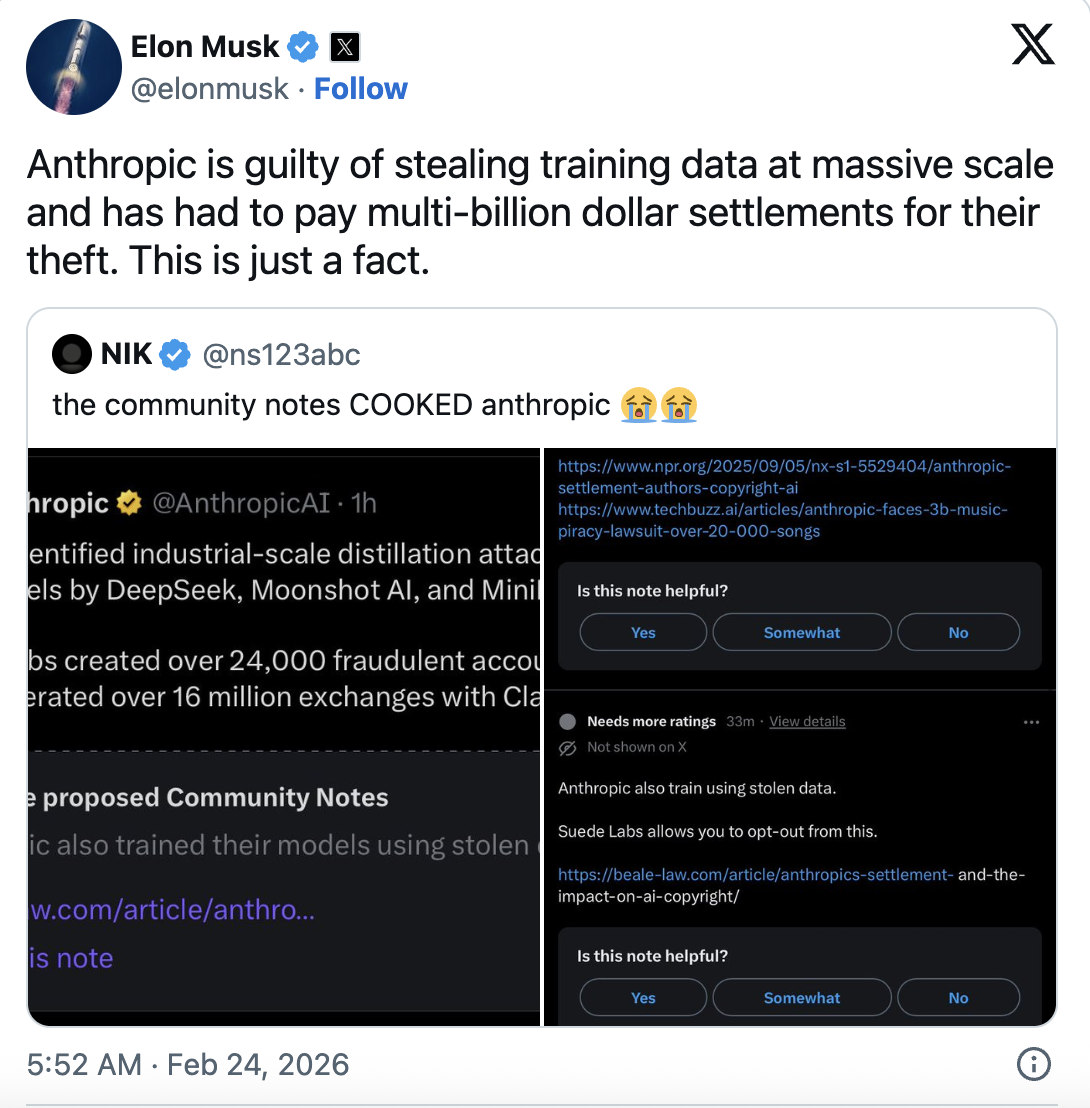
Also on the same day, Elon Musk posted on X: "Anthropic massively stole training data. This is a fact." Simultaneously, a Community Note on X added a report that Anthropic paid a $1.5 billion settlement for using pirated books to train Claude.

Within seventy-two hours, this AI company that claims to have a "soul" simultaneously played three roles: safety martyr, intellectual property thief, and Pentagon turncoat.

Which one is real?

Perhaps all of them.

The Pentagon's "Comply or Get Out"

The first layer of the story is simple.

Anthropic was the first AI company to gain classified-level access from the U.S. Department of Defense. The contract, with a ceiling of $200 million, was secured last summer. OpenAI, Google, and xAI subsequently secured contracts of similar scale.

According to Al Jazeera, Claude was used in a U.S. military operation this past January. The report stated the operation involved the kidnapping of Venezuelan President Maduro.

But Anthropic drew two red lines: no support for fully autonomous weapons targeting, and no support for mass surveillance of U.S. citizens. Anthropic believes AI's reliability is insufficient for weapon control, and there are currently no laws or regulations governing the use of AI in mass surveillance.

The Pentagon wasn't buying it.

White House AI advisor David Sacks publicly accused Anthropic on X last October of "using fear as a weapon, engaging in regulatory capture."

Competitors have already knelt. OpenAI, Google, and xAI have all agreed to let the military use their AI for "all lawful scenarios." Musk's Grok was just approved for entry into classified systems this week.

Anthropic is the last one standing.

As of publication, Anthropic stated in its latest announcement that it does not intend to concede. But the Friday 5:01 PM deadline is looming.

An anonymous former liaison between the Justice Department and the Defense Department expressed confusion to CNN: "How can you simultaneously declare a company a 'supply chain risk' and force that company to work for your military?"

Good question, but it's not within the Pentagon's consideration. They care that if Anthropic doesn't comply, they will resort to compulsory measures, or, Anthropic becomes a Washington outcast.

"Distillation Attack": A Slap-in-the-Face Accusation

On February 23rd, Anthropic published a fiercely worded blog post accusing three Chinese AI companies of carrying out an "industrial-scale distillation attack" on Claude.

The defendants are DeepSeek, Moonshot AI, and MiniMax.

Anthropic accused them of using 24,000 fake accounts to initiate over 16 million interactions with Claude, specifically extracting its core capabilities in agent reasoning, tool use, and programming.

Anthropic framed this as a national security threat, claiming that distilled models are "unlikely to retain safety guardrails" and could be used by authoritarian governments for cyber attacks, disinformation, and mass surveillance.

The narrative was perfect, the timing was perfect.

It came just after the Trump administration had recently relaxed chip export controls to China, just when Anthropic needed ammunition for its lobbying stance on chip export controls.

But Musk fired a shot: "Anthropic massively stole training data and paid billions in settlements for it. This is a fact."
Tory Green, co-founder of AI infrastructure company IO.Net, stated: "You train your models on data from the entire web, and when others learn from you using your public API, it's called a 'distillation attack'?"

Anthropic calls distillation an "attack," but it's commonplace in the AI industry. OpenAI uses it to compress GPT-4, Google uses it to optimize Gemini, even Anthropic itself does it. The only difference is, this time they were the ones being distilled.

As Singapore's Nanyang Technological University AI professor Erik Cambria told CNBC: "The boundary between legitimate use and malicious exploitation is often blurry."

Even more ironic, Anthropic just paid a $1.5 billion settlement for using pirated books to train Claude. It trains its models on data from the entire web, then accuses others of learning from it using its public API. This isn't double standards, it's triple standards.

Anthropic wanted to play the victim, but got exposed as the defendant.

Dismantling the Safety Commitment: RSP 3.0

On the same day as the Pentagon standoff and the Silicon Valley spat, Anthropic released the third version of its Responsible Scaling Policy.

Anthropic Chief Scientist Jared Kaplan told media in an interview: "We felt that stopping AI model training doesn't help anyone. In the context of rapid AI development, unilaterally making commitments... while competitors are full steam ahead, it doesn't make sense."

In other words, others aren't playing by the rules, so we're dropping the act too.

The core of RSP 1.0 and 2.0 was a hard commitment to pause training if model capabilities exceeded the coverage of safety measures. This commitment gave Anthropic a unique reputation in the AI safety community.

But 3.0 deleted it.

It was replaced with a more "flexible" framework, separating safety measures Anthropic can implement itself from safety recommendations requiring industry-wide collaboration into two tracks. A risk report is issued every 3-6 months. External experts review it.

Sounds responsible?

Independent reviewer Chris Painter from the non-profit METR, after seeing an early draft of the policy, stated: "This indicates Anthropic believes it needs to enter 'triage mode' because methods for assessing and mitigating risk can't keep up with the pace of capability growth. This is more evidence that society is unprepared for AI's potential catastrophic risks."

According to TIME, Anthropic spent nearly a year internally debating this rewrite, with CEO Amodei and the board unanimously approving it. The official line is that the original policy was designed to drive industry consensus, but the industry simply didn't follow. The Trump administration has taken a laissez-faire approach to AI development, even attempting to repeal state-level regulations. Federal AI law is a distant prospect. While a global governance framework seemed possible in 2023, three years later, that door has clearly closed.

An anonymous researcher long focused on AI governance put it more bluntly: "The RSP was Anthropic's most valuable brand asset. Deleting the training pause commitment is like an organic food company quietly tearing the 'organic' label off its packaging and then telling you their testing is now more transparent."

Identity Fracture Under a $380 Billion Valuation

In early February, Anthropic completed a $30 billion financing round at a $380 billion valuation, with Amazon as the anchor investor. Since its founding, it has achieved $14 billion in annualized revenue. Over the past three years, this figure has grown more than 10x each year.

Simultaneously, the Pentagon threatens to blacklist it. Musk publicly accuses it of data theft. Its own core safety commitment is deleted. Anthropic's AI safety lead, Mrinank Sharma, resigned and wrote on X: "The world is in danger."

Contradiction?

Perhaps contradiction is in Anthropic's DNA.

The company was founded by former OpenAI executives because they were concerned OpenAI was moving too fast on safety. Then they built a company themselves, building more powerful models at an even faster pace, while telling the world how dangerous these models are.

The business model can be summarized in one sentence: we are more afraid of AI than anyone else, so you should pay us to build it.

This narrative worked perfectly in 2023-2024. AI safety was a hot word in Washington, and Anthropic was the most popular lobbyist.

In 2026, the wind has changed.

"Woke AI" has become an attack label, state-level AI regulation bills are being blocked by the White House, and the California SB 53 supported by Anthropic was signed into law, but the federal level is a wasteland.

Anthropic's safety card is sliding from a "differentiating advantage" to a "political liability."

Anthropic is performing a complex balancing act. It needs to be "safe" enough to maintain its brand, yet "flexible" enough to avoid being abandoned by the market and the government. The problem is, the tolerance space on both ends is shrinking.

How Much is the Safety Narrative Still Worth?

Look at all three events together, and the picture becomes clear.

Accusing Chinese companies of distilling Claude is to strengthen the lobbying narrative for chip export controls. Deleting the safety pause commitment is to avoid falling behind in the arms race. Refusing the Pentagon's autonomous weapons demand is to preserve the last layer of moral clothing.

Each step has its logic, but the steps contradict each other.

You can't simultaneously claim that Chinese companies "distilling" your model threatens national security, while deleting the commitment that prevents your own model from going out of control. If the model is truly that dangerous, you should be more cautious, not more aggressive.

Unless you are Anthropic.

In the AI industry, identity is not defined by your statements, but by your balance sheet. Anthropic's "safety" narrative is essentially a brand premium.

In the early days of the AI arms race, this premium was valuable. Investors were willing to pay a higher valuation for "responsible AI," the government was willing to give the green light to "trustworthy AI," and customers were willing to pay for "safer AI."

But in 2026, this premium is evaporating.

Anthropic now faces not a multiple-choice question of "whether to compromise," but a sequencing problem of "who to compromise with first." Compromise with the Pentagon, brand damaged. Compromise with competitors, safety承诺废弃 (safety commitment废弃 - commitment abandoned). Compromise with investors, both have to give.

At 5:01 PM on Friday, Anthropic will deliver its answer.

But whatever the answer is, one thing is already certain: the Anthropic that once stood on "we're not like OpenAI" is becoming like everyone else.

The endpoint of an identity crisis is often the disappearance of identity.

Perguntas relacionadas

QWhat was the ultimatum given to Anthropic by the Pentagon, and what were the consequences of non-compliance?

AThe Pentagon gave Anthropic an ultimatum to remove restrictions on Claude's military use, allowing it to be used for 'all legitimate purposes,' including autonomous weapons targeting and domestic mass surveillance, by Friday at 5:01 PM. Failure to comply would result in the cancellation of a $200 million contract, the initiation of the Defense Production Act to force conscription, and the company being labeled a 'supply chain risk,' effectively blacklisting it alongside hostile entities like Russia and China.

QWhat significant change did Anthropic make to its Responsible Scaling Policy (RSP) 3.0, and why was it controversial?

AAnthropic removed the core commitment from its Responsible Scaling Policy (RSP) 3.0 that promised to halt training more powerful models if safety measures could not be guaranteed. This was controversial because it abandoned a foundational principle that had defined the company's identity and was seen as a move to prioritize competition over safety, especially as industry rivals advanced without similar restraints.

QWhat accusation did Elon Musk make against Anthropic, and how did it relate to the company's own claims about 'distillation attacks'?

AElon Musk accused Anthropic of 'massive theft of training data,' referencing reports that the company paid $1.5 billion in settlements for using pirated books to train Claude. This accusation undermined Anthropic's own claims of being a victim of 'industrial-scale distillation attacks' by Chinese AI firms, highlighting hypocrisy as Anthropic used scraped data for training while condemning others for learning from its public API.

QHow did Anthropic's business model and narrative shift between 2023 and 2026, according to the article?

AAnthropic's business model initially relied on a narrative of being more cautious and responsible than competitors like OpenAI, arguing that AI was dangerous and required safety measures. By 2026, this narrative became a political liability as regulatory momentum stalled and competition intensified. The company began compromising its safety promises to remain competitive, shifting from a 'differentiated advantage' to a potential 'political negative asset.'

QWhat broader implication does the article suggest about Anthropic's identity crisis and the AI industry?

AThe article suggests that Anthropic's identity crisis reflects a broader industry trend where ethical commitments are compromised under commercial and governmental pressures. Anthropic's attempts to balance safety branding with market demands led to contradictory actions, ultimately eroding its unique identity. The conclusion is that in the AI arms race, corporate identity defined by safety narratives is increasingly replaced by pragmatic alignment with power and profit, leading to a loss of distinctiveness.

Leituras Relacionadas

Has the 'Digital Gold' Narrative for BTC Failed?

**Title: Has the "Digital Gold" Narrative for Bitcoin Failed?** The article argues that Bitcoin's "digital gold" narrative remains valid despite a recent sharp price decline (from a peak near $126k in Oct 2025 to briefly under $61k in Feb 2026). It presents a long-term investment framework based on three core points: **1. Viewing Bitcoin as an Asset:** Bitcoin is presented as a superior potential store of value compared to gold. Key arguments are its absolute scarcity (21 million cap), superior portability, and transparent auditability via its public ledger. While acknowledging its current use in early, volatile stages (~3-4% global adoption), the author draws parallels to the early, disruptive phases of the internet and e-commerce. **2. Understanding the Recent Downturn:** The current ~50% correction is framed as a predictable, consensus-driven cycle following its post-halving peak (the 2024 halving preceded the Oct 2025 high). A crucial factor is a historic "changing of hands": the influx of new institutional buyers via ETFs allowed early, low-cost holders (miners, OG believers) to take profits. The author notes that while severe, Bitcoin's historical drawdowns (e.g., 93% in 2011, 77% in 2021-22) have been progressively smaller, suggesting maturing holder structure and decreasing volatility over time. **3. The Long-Term Perspective:** The long-term thesis hinges on Bitcoin capturing a portion of gold's market value. With Bitcoin's market cap at ~$1.4 trillion (at $70k) versus gold's ~$20 trillion, significant upside potential exists if the "digital gold" narrative is partially realized. However, the author strongly cautions that short-term risks remain, the bottom is unpredictable, and high volatility is inherent. The real risk is not Bitcoin failing but poor personal position management (over-leverage, wrong capital) and a lack of deep understanding, which can force investors out during severe downturns. The conclusion uses Amazon's 95% crash post-2000 dot-com bubble and subsequent 42x recovery as an analogy. The ultimate question is not if Bitcoin's price will rise, but if an investor's strategy and conviction can withstand the volatility to see the long-term play out. The recent divergence (gold up, Bitcoin down) is posed not as a narrative failure, but as potential evidence of this ongoing, painful transition from a speculative asset to a mainstream allocation.

marsbitHá 5h

Has the 'Digital Gold' Narrative for BTC Failed?

marsbitHá 5h

Has BTC's 'Digital Gold' Narrative Failed?

The article discusses Bitcoin's "digital gold" narrative, its recent price drop, and long-term outlook through the perspective of "Jason". It argues the narrative is not a failure but that Bitcoin represents a superior, new asset class due to its fixed supply (21 million), portability, and auditability. The piece compares its current ~3-4% global adoption rate to early internet/e-commerce, suggesting significant growth potential. Regarding the 2025-2026 price decline (from ~$126k to briefly under $61k), the author views it as a predictable, consensus-driven sell-off within Bitcoin's ~4-year cycle post-halving, exacerbated by a major "handover" from early, low-cost holders to new institutional buyers via ETFs. A key observation is that historical peak-to-trough drawdowns have lessened over time (e.g., 93% in 2011 to ~50% in 2026), indicating maturing volatility as holder structure changes. For the long term, the author uses a simple framework: Bitcoin's total market cap (~$1.4T at $70k) is only about 7% of gold's (~$20T). Even capturing 30-50% of gold's value would imply substantial upside. However, the article strongly cautions against viewing this as investment advice, emphasizing extreme volatility and the critical importance of risk management, position sizing, and deep fundamental understanding to survive severe drawdowns. It concludes by drawing a parallel to Amazon's 95% crash in 2000 and subsequent 42x recovery, stressing that the key is surviving market cycles to realize long-term potential.

链捕手Há 5h

Has BTC's 'Digital Gold' Narrative Failed?

链捕手Há 5h

From Code to Cognition: A Ten-Thousand-Word Guide to the Evolution of the Robot Brain

"From Code to Cognition: The Evolution of Robot Brains" The journey of robotic intelligence has shifted dramatically from manually coded systems to AI-driven brains. For decades, robots relied on layered software stacks—perception, state estimation, planning, control—each handcrafted. While predictable, they lacked adaptability. The 2010s saw deep learning revolutionize perception (e.g., object detection) and control (via reinforcement learning), but learned skills remained narrow. The arrival of Large Language Models (LLMs) marked a turning point. LLMs acted as high-level planners, interpreting natural language instructions and generating sequences of actions for traditional robotic systems to execute. However, true integration came with Visual-Language-Action (VLA) models, which fused vision, language, and motion prediction into a single network. Pioneered by models like RT-2 and open-source projects like OpenVLA, VLAs enable robots to reason and act directly from visual input and commands. The most advanced humanoid robots now employ a "dual-brain" architecture: a slow-thinking, large VLA (System 2) for reasoning and planning, and a fast-reacting, small network (System 1) for high-frequency motion control, sometimes with an even lower-level System 0 for balance. This split balances cognition with the physics of real-time movement. Computation is split between onboard hardware (e.g., NVIDIA Jetson) for safety-critical control loops and cloud/edge servers for non-critical tasks like learning and interfaces. A crucial driver is the open-source ecosystem—models like GR00T and OpenVLA allow startups to build upon pre-trained brains and fine-tune them with their own data, accelerating development. Despite progress, current systems struggle with recovery from errors, sample inefficiency, and long-horizon tasks. This has spurred the rise of **World Models**—neural networks that predict the consequences of actions. By simulating possible futures before acting (like NVIDIA Cosmos or Meta V-JEPA), robots can plan, recover, and generalize better. This represents the next frontier: shifting intelligence from learned reactions to an internal model of physics and cause-and-effect. The field is rapidly evolving. While not yet at its "ChatGPT moment," the convergence of cheaper hardware, scalable simulation, and world models points toward robots that are increasingly capable, adaptive, and useful. The question is shifting from "what can robots do?" to "what *should* they do?"

marsbitHá 5h

From Code to Cognition: A Ten-Thousand-Word Guide to the Evolution of the Robot Brain

marsbitHá 5h

Trading

Spot
Futuros

Artigos em Destaque

O que é $S$

Compreender o SPERO: Uma Visão Abrangente Introdução ao SPERO À medida que o panorama da inovação continua a evoluir, o surgimento de tecnologias web3 e projetos de criptomoeda desempenha um papel fundamental na formação do futuro digital. Um projeto que tem atraído atenção neste campo dinâmico é o SPERO, denotado como SPERO,$$s$. Este artigo tem como objetivo reunir e apresentar informações detalhadas sobre o SPERO, para ajudar entusiastas e investidores a compreender as suas bases, objetivos e inovações nos domínios web3 e cripto. O que é o SPERO,$$s$? O SPERO,$$s$ é um projeto único dentro do espaço cripto que procura aproveitar os princípios da descentralização e da tecnologia blockchain para criar um ecossistema que promove o envolvimento, a utilidade e a inclusão financeira. O projeto é concebido para facilitar interações peer-to-peer de novas maneiras, proporcionando aos utilizadores soluções e serviços financeiros inovadores. No seu núcleo, o SPERO,$$s$ visa capacitar indivíduos ao fornecer ferramentas e plataformas que melhoram a experiência do utilizador no espaço das criptomoedas. Isso inclui a possibilidade de métodos de transação mais flexíveis, a promoção de iniciativas impulsionadas pela comunidade e a criação de caminhos para oportunidades financeiras através de aplicações descentralizadas (dApps). A visão subjacente do SPERO,$$s$ gira em torno da inclusão, visando fechar lacunas dentro das finanças tradicionais enquanto aproveita os benefícios da tecnologia blockchain. Quem é o Criador do SPERO,$$s$? A identidade do criador do SPERO,$$s$ permanece algo obscura, uma vez que existem recursos publicamente disponíveis limitados que fornecem informações detalhadas sobre o(s) seu(s) fundador(es). Esta falta de transparência pode resultar do compromisso do projeto com a descentralização—uma ética que muitos projetos web3 partilham, priorizando contribuições coletivas em vez de reconhecimento individual. Ao centrar as discussões em torno da comunidade e dos seus objetivos coletivos, o SPERO,$$s$ incorpora a essência do empoderamento sem destacar indivíduos específicos. Assim, compreender a ética e a missão do SPERO é mais importante do que identificar um criador singular. Quem são os Investidores do SPERO,$$s$? O SPERO,$$s$ é apoiado por uma diversidade de investidores que vão desde capitalistas de risco a investidores-anjo dedicados a promover a inovação no setor cripto. O foco desses investidores geralmente alinha-se com a missão do SPERO—priorizando projetos que prometem avanço tecnológico social, inclusão financeira e governança descentralizada. Essas fundações de investidores estão tipicamente interessadas em projetos que não apenas oferecem produtos inovadores, mas que também contribuem positivamente para a comunidade blockchain e os seus ecossistemas. O apoio desses investidores reforça o SPERO,$$s$ como um concorrente notável no domínio em rápida evolução dos projetos cripto. Como Funciona o SPERO,$$s$? O SPERO,$$s$ emprega uma estrutura multifacetada que o distingue de projetos de criptomoeda convencionais. Aqui estão algumas das características-chave que sublinham a sua singularidade e inovação: Governança Descentralizada: O SPERO,$$s$ integra modelos de governança descentralizada, capacitando os utilizadores a participar ativamente nos processos de tomada de decisão sobre o futuro do projeto. Esta abordagem promove um sentido de propriedade e responsabilidade entre os membros da comunidade. Utilidade do Token: O SPERO,$$s$ utiliza o seu próprio token de criptomoeda, concebido para servir várias funções dentro do ecossistema. Esses tokens permitem transações, recompensas e a facilitação de serviços oferecidos na plataforma, melhorando o envolvimento e a utilidade gerais. Arquitetura em Camadas: A arquitetura técnica do SPERO,$$s$ suporta modularidade e escalabilidade, permitindo a integração contínua de funcionalidades e aplicações adicionais à medida que o projeto evolui. Esta adaptabilidade é fundamental para manter a relevância no panorama cripto em constante mudança. Envolvimento da Comunidade: O projeto enfatiza iniciativas impulsionadas pela comunidade, empregando mecanismos que incentivam a colaboração e o feedback. Ao nutrir uma comunidade forte, o SPERO,$$s$ pode melhor atender às necessidades dos utilizadores e adaptar-se às tendências do mercado. Foco na Inclusão: Ao oferecer taxas de transação baixas e interfaces amigáveis, o SPERO,$$s$ visa atrair uma base de utilizadores diversificada, incluindo indivíduos que anteriormente podem não ter participado no espaço cripto. Este compromisso com a inclusão alinha-se com a sua missão abrangente de empoderamento através da acessibilidade. Cronologia do SPERO,$$s$ Compreender a história de um projeto fornece insights cruciais sobre a sua trajetória de desenvolvimento e marcos. Abaixo está uma cronologia sugerida que mapeia eventos significativos na evolução do SPERO,$$s$: Fase de Conceituação e Ideação: As ideias iniciais que formam a base do SPERO,$$s$ foram concebidas, alinhando-se de perto com os princípios de descentralização e foco na comunidade dentro da indústria blockchain. Lançamento do Whitepaper do Projeto: Após a fase conceitual, um whitepaper abrangente detalhando a visão, os objetivos e a infraestrutura tecnológica do SPERO,$$s$ foi lançado para atrair o interesse e o feedback da comunidade. Construção da Comunidade e Primeiros Envolvimentos: Esforços ativos de divulgação foram feitos para construir uma comunidade de primeiros adotantes e investidores potenciais, facilitando discussões em torno dos objetivos do projeto e angariando apoio. Evento de Geração de Tokens: O SPERO,$$s$ realizou um evento de geração de tokens (TGE) para distribuir os seus tokens nativos a apoiantes iniciais e estabelecer liquidez inicial dentro do ecossistema. Lançamento da dApp Inicial: A primeira aplicação descentralizada (dApp) associada ao SPERO,$$s$ foi lançada, permitindo que os utilizadores interagissem com as funcionalidades principais da plataforma. Desenvolvimento Contínuo e Parcerias: Atualizações e melhorias contínuas nas ofertas do projeto, incluindo parcerias estratégicas com outros players no espaço blockchain, moldaram o SPERO,$$s$ em um jogador competitivo e em evolução no mercado cripto. Conclusão O SPERO,$$s$ é um testemunho do potencial do web3 e das criptomoedas para revolucionar os sistemas financeiros e capacitar indivíduos. Com um compromisso com a governança descentralizada, o envolvimento da comunidade e funcionalidades inovadoras, abre caminho para um panorama financeiro mais inclusivo. Como em qualquer investimento no espaço cripto em rápida evolução, potenciais investidores e utilizadores são incentivados a pesquisar minuciosamente e a envolver-se de forma ponderada com os desenvolvimentos em curso dentro do SPERO,$$s$. O projeto demonstra o espírito inovador da indústria cripto, convidando a uma exploração mais aprofundada das suas inúmeras possibilidades. Embora a jornada do SPERO,$$s$ ainda esteja a desenrolar-se, os seus princípios fundamentais podem, de facto, influenciar o futuro de como interagimos com a tecnologia, as finanças e uns com os outros em ecossistemas digitais interconectados.

69 Visualizações TotaisPublicado em {updateTime}Atualizado em 2024.12.17

O que é $S$

O que é AGENT S

Agent S: O Futuro da Interação Autónoma no Web3 Introdução No panorama em constante evolução do Web3 e das criptomoedas, as inovações estão constantemente a redefinir a forma como os indivíduos interagem com plataformas digitais. Um projeto pioneiro, o Agent S, promete revolucionar a interação humano-computador através do seu framework aberto e agente. Ao abrir caminho para interações autónomas, o Agent S visa simplificar tarefas complexas, oferecendo aplicações transformadoras em inteligência artificial (IA). Esta exploração detalhada irá aprofundar-se nas complexidades do projeto, nas suas características únicas e nas implicações para o domínio das criptomoedas. O que é o Agent S? O Agent S é um framework aberto e agente, especificamente concebido para abordar três desafios fundamentais na automação de tarefas computacionais: Aquisição de Conhecimento Específico de Domínio: O framework aprende inteligentemente a partir de várias fontes de conhecimento externas e experiências internas. Esta abordagem dupla capacita-o a construir um rico repositório de conhecimento específico de domínio, melhorando o seu desempenho na execução de tarefas. Planeamento ao Longo de Longos Horizontes de Tarefas: O Agent S emprega planeamento hierárquico aumentado por experiência, uma abordagem estratégica que facilita a decomposição e execução eficientes de tarefas intrincadas. Esta característica melhora significativamente a sua capacidade de gerir múltiplas subtarefas de forma eficiente e eficaz. Gestão de Interfaces Dinâmicas e Não Uniformes: O projeto introduz a Interface Agente-Computador (ACI), uma solução inovadora que melhora a interação entre agentes e utilizadores. Utilizando Modelos de Linguagem Multimodais de Grande Escala (MLLMs), o Agent S pode navegar e manipular diversas interfaces gráficas de utilizador de forma fluida. Através destas características pioneiras, o Agent S fornece um framework robusto que aborda as complexidades envolvidas na automação da interação humana com máquinas, preparando o terreno para uma infinidade de aplicações em IA e além. Quem é o Criador do Agent S? Embora o conceito de Agent S seja fundamentalmente inovador, informações específicas sobre o seu criador permanecem elusivas. O criador é atualmente desconhecido, o que destaca ou o estágio nascente do projeto ou a escolha estratégica de manter os membros fundadores em anonimato. Independentemente da anonimidade, o foco permanece nas capacidades e no potencial do framework. Quem são os Investidores do Agent S? Como o Agent S é relativamente novo no ecossistema criptográfico, informações detalhadas sobre os seus investidores e financiadores não estão explicitamente documentadas. A falta de informações disponíveis publicamente sobre as fundações de investimento ou organizações que apoiam o projeto levanta questões sobre a sua estrutura de financiamento e roteiro de desenvolvimento. Compreender o apoio é crucial para avaliar a sustentabilidade do projeto e o seu impacto potencial no mercado. Como Funciona o Agent S? No núcleo do Agent S reside uma tecnologia de ponta que lhe permite funcionar eficazmente em diversos ambientes. O seu modelo operacional é construído em torno de várias características-chave: Interação Humano-Computador Semelhante: O framework oferece planeamento avançado em IA, esforçando-se para tornar as interações com computadores mais intuitivas. Ao imitar o comportamento humano na execução de tarefas, promete elevar as experiências dos utilizadores. Memória Narrativa: Utilizada para aproveitar experiências de alto nível, o Agent S utiliza memória narrativa para acompanhar os históricos de tarefas, melhorando assim os seus processos de tomada de decisão. Memória Episódica: Esta característica fornece aos utilizadores orientações passo a passo, permitindo que o framework ofereça suporte contextual à medida que as tarefas se desenrolam. Suporte para OpenACI: Com a capacidade de funcionar localmente, o Agent S permite que os utilizadores mantenham o controlo sobre as suas interações e fluxos de trabalho, alinhando-se com a ética descentralizada do Web3. Fácil Integração com APIs Externas: A sua versatilidade e compatibilidade com várias plataformas de IA garantem que o Agent S possa integrar-se perfeitamente em ecossistemas tecnológicos existentes, tornando-o uma escolha apelativa para desenvolvedores e organizações. Estas funcionalidades contribuem coletivamente para a posição única do Agent S no espaço cripto, à medida que automatiza tarefas complexas e em múltiplos passos com mínima intervenção humana. À medida que o projeto evolui, as suas potenciais aplicações no Web3 podem redefinir a forma como as interações digitais se desenrolam. Cronologia do Agent S O desenvolvimento e os marcos do Agent S podem ser encapsulados numa cronologia que destaca os seus eventos significativos: 27 de Setembro de 2024: O conceito de Agent S foi lançado num artigo de pesquisa abrangente intitulado “Um Framework Agente Aberto que Usa Computadores como um Humano”, mostrando a base para o projeto. 10 de Outubro de 2024: O artigo de pesquisa foi disponibilizado publicamente no arXiv, oferecendo uma exploração aprofundada do framework e da sua avaliação de desempenho com base no benchmark OSWorld. 12 de Outubro de 2024: Uma apresentação em vídeo foi lançada, proporcionando uma visão visual das capacidades e características do Agent S, envolvendo ainda mais potenciais utilizadores e investidores. Estes marcos na cronologia não apenas ilustram o progresso do Agent S, mas também indicam o seu compromisso com a transparência e o envolvimento da comunidade. Pontos-Chave Sobre o Agent S À medida que o framework Agent S continua a evoluir, várias características-chave destacam-se, sublinhando a sua natureza inovadora e potencial: Framework Inovador: Concebido para proporcionar um uso intuitivo de computadores semelhante à interação humana, o Agent S traz uma abordagem nova à automação de tarefas. Interação Autónoma: A capacidade de interagir autonomamente com computadores através de GUI significa um avanço em direção a soluções computacionais mais inteligentes e eficientes. Automação de Tarefas Complexas: Com a sua metodologia robusta, pode automatizar tarefas complexas e em múltiplos passos, tornando os processos mais rápidos e menos propensos a erros. Melhoria Contínua: Os mecanismos de aprendizagem permitem que o Agent S melhore a partir de experiências passadas, aprimorando continuamente o seu desempenho e eficácia. Versatilidade: A sua adaptabilidade em diferentes ambientes operacionais, como OSWorld e WindowsAgentArena, garante que pode servir uma ampla gama de aplicações. À medida que o Agent S se posiciona no panorama do Web3 e das criptomoedas, o seu potencial para melhorar as capacidades de interação e automatizar processos significa um avanço significativo nas tecnologias de IA. Através do seu framework inovador, o Agent S exemplifica o futuro das interações digitais, prometendo uma experiência mais fluida e eficiente para os utilizadores em diversas indústrias. Conclusão O Agent S representa um ousado avanço na união da IA e do Web3, com a capacidade de redefinir a forma como interagimos com a tecnologia. Embora ainda esteja nas suas fases iniciais, as possibilidades para a sua aplicação são vastas e cativantes. Através do seu framework abrangente que aborda desafios críticos, o Agent S visa trazer interações autónomas para o primeiro plano da experiência digital. À medida que avançamos mais profundamente nos domínios das criptomoedas e da descentralização, projetos como o Agent S desempenharão, sem dúvida, um papel crucial na formação do futuro da tecnologia e da colaboração humano-computador.

671 Visualizações TotaisPublicado em {updateTime}Atualizado em 2025.01.14

O que é AGENT S

Como comprar S

Bem-vindo à HTX.com!Tornámos a compra de Sonic (S) simples e conveniente.Segue o nosso guia passo a passo para iniciar a tua jornada no mundo das criptos.Passo 1: cria a tua conta HTXUtiliza o teu e-mail ou número de telefone para te inscreveres numa conta gratuita na HTX.Desfruta de um processo de inscrição sem complicações e desbloqueia todas as funcionalidades.Obter a minha contaPasso 2: vai para Comprar Cripto e escolhe o teu método de pagamentoCartão de crédito/débito: usa o teu visa ou mastercard para comprar Sonic (S) instantaneamente.Saldo: usa os fundos da tua conta HTX para transacionar sem problemas.Terceiros: adicionamos métodos de pagamento populares, como Google Pay e Apple Pay, para aumentar a conveniência.P2P: transaciona diretamente com outros utilizadores na HTX.Mercado de balcão (OTC): oferecemos serviços personalizados e taxas de câmbio competitivas para os traders.Passo 3: armazena teu Sonic (S)Depois de comprar o teu Sonic (S), armazena-o na tua conta HTX.Alternativamente, podes enviá-lo para outro lugar através de transferência blockchain ou usá-lo para transacionar outras criptomoedas.Passo 4: transaciona Sonic (S)Transaciona facilmente Sonic (S) no mercado à vista da HTX.Acede simplesmente à tua conta, seleciona o teu par de trading, executa as tuas transações e monitoriza em tempo real.Oferecemos uma experiência de fácil utilização tanto para principiantes como para traders experientes.

1.2k Visualizações TotaisPublicado em {updateTime}Atualizado em 2026.06.02

Como comprar S

Discussões

Bem-vindo à Comunidade HTX. Aqui, pode manter-se informado sobre os mais recentes desenvolvimentos da plataforma e obter acesso a análises profissionais de mercado. As opiniões dos utilizadores sobre o preço de S (S) são apresentadas abaixo.

活动图片