Anthropic Tests "Lobster" Conway: Supports Independent UI, Webhook Activation, and Custom Extension Standards

marsbitPublicado em 2026-04-02Última atualização em 2026-04-02

Resumo

Anthropic is actively developing "Conway," a persistent agent solution designed to provide Claude with an always-on, independently running intelligent environment. It features a standalone UI instance, operating as a traditional chat interface and more of a dedicated workspace. Conway can directly control browsers, connect to external services, and integrate Claude Code for deeper code execution and task handling. It supports Webhook-based invocation, enabling external services or events to trigger automated workflows. Additionally, Conway will support for extensions through the upcoming CNW ZIP standard, allowing developers to build custom tools, UI tabs, and context handlers, similar to an app store ecosystem. This enhancement aims to transform Claude from a reactive conversational tool into a proactive, multi-step task assistant, positioning it as a strong competitor in the AI agent space and advancing the trend toward always-on AI capabilities.

Anthropic is actively developing a persistent agent solution named Conway, aimed at creating an always-on, independently running intelligent environment for Claude.

According to related information, Conway will feature an independent UI instance, moving beyond the traditional chat interface to operate as a standalone agent workspace. It will be capable of directly controlling browsers, connecting external connectors, and integrating Claude Code functionality (potentially involving Epitax-related features), enabling deeper code execution and task handling. Simultaneously, Conway supports invocation via Webhooks, allowing external services or events to trigger agent workflows, thereby boosting automated response capabilities.
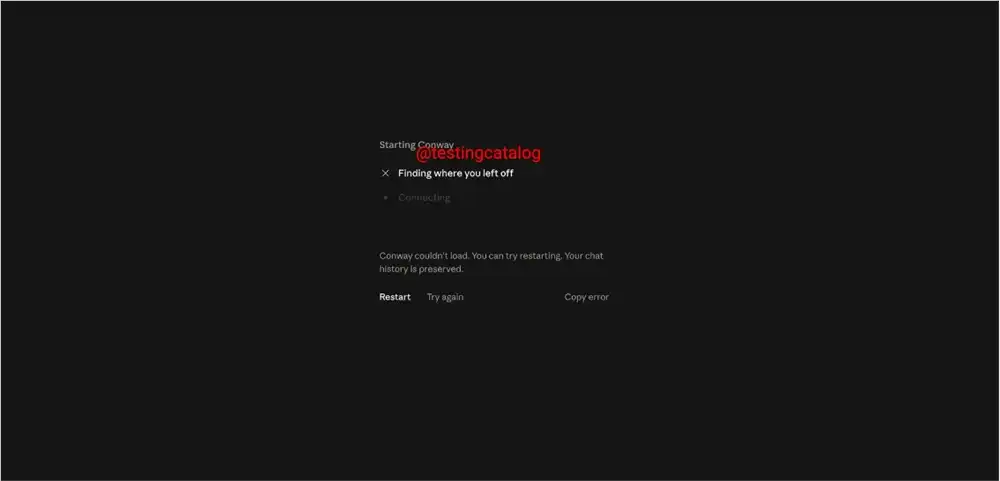
Additionally, Conway will support an extension system. Anthropic is set to launch the CNW ZIP standard, which developers can use to easily build custom tools, UI tabs, and context handlers, forming an ecosystem expansion capability similar to an "app store." This will significantly enhance Claude's flexibility and scalability in handling complex tasks.
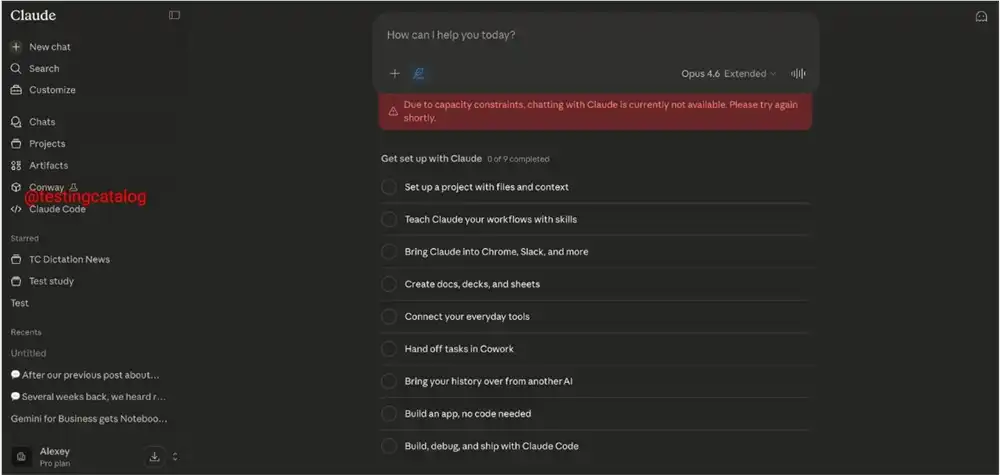
The emergence of Conway is seen as a key strategic move by Anthropic in the AI agent domain, aiming to transform Claude from a passive conversational tool into a persistent assistant capable of continuous operation and autonomous execution of multi-step tasks. It not only supports browser automation and event triggering but also strengthens code generation, execution, and problem-solving capabilities through native integration of Claude Code.

Industry observers believe that Conway has the potential to become a strong competitor to rivals like OpenClaw, driving the advancement of AI agents toward an "always-on" direction. The era where Claude can truly "show its prowess" may be just around the corner.

Perguntas relacionadas

QWhat is the name of the persistent agent solution being developed by Anthropic for Claude?

AThe persistent agent solution being developed by Anthropic for Claude is named Conway.

QHow does Conway differ from a traditional chat interface?

AConway differs by being an independent UI instance that operates as a standalone agent workspace, capable of directly controlling the browser, connecting to external connectors, and integrating Claude Code functionality.

QWhat method does Conway support to allow external services or events to trigger its work?

AConway supports being invoked via Webhook, which allows external services or events to trigger the agent's work and enhance automated response capabilities.

QWhat is the name of the extension standard that will allow developers to build custom tools for Conway?

AThe extension standard that developers can use to build custom tools, UI tabs, and context handlers for Conway is called the CNW ZIP standard.

QHow is Conway expected to transform the role of Claude according to the article?

AConway is expected to transform Claude from a passive conversational tool into a persistent assistant that can run continuously and autonomously execute multi-step tasks, moving towards an 'always-on' AI agent direction.

Leituras Relacionadas

A Hair Dryer Blows Away $34,000 from Polymarket

A hairdryer was used to manipulate a temperature sensor at Paris Charles de Gaulle Airport (LFPG) on April 6 and 15, 2026, causing short-lived artificial temperature spikes. These false readings were used to exploit a prediction market on Polymarket, where users bet on Paris’s daily maximum temperature. The attacker targeted low-probability high-temperature outcomes, which settled as "Yes" based on the corrupted data, netting a total of $34,000 in profit. The attacker’s a newly created anonymous account funded just two days before the first incident. After the successful manipulations, the funds were quickly moved through mixers and decentralized exchanges to avoid tracing. French meteorological experts and authorities confirmed the anomalies were inconsistent with actual weather conditions and nearby station data, pointing to physical intervention. Legal action was initiated for "disrupting automated data processing systems," which carries severe penalties under French law. Polymarket’s market rules relied solely on a single, publicly accessible sensor and did not account for subsequent data revisions, making the system vulnerable to such physical oracle attacks. In response, Polymarket silently switched its data source to Paris-Le Bourget Airport (LFPB) without public explanation or refunding the exploited funds. The incident highlights the risks of single-point data dependencies in prediction markets and the low-cost, high-reward potential of real-world manipulation.

marsbitHá 9m

A Hair Dryer Blows Away $34,000 from Polymarket

marsbitHá 9m

In-Depth Report on the On-Chain Lending Market: When Off-Chain Credit Meets On-Chain Liquidation

The on-chain lending market has evolved from a peripheral DeFi niche into core financial infrastructure. As of early 2026, total value locked (TVL) in on-chain lending protocols has reached $64.3 billion, accounting for 53.54% of total DeFi TVL, making it the largest and most mature vertical within decentralized finance. Aave dominates the sector with approximately $32.9 billion in TVL, commanding nearly half of the market—a leadership position that is unlikely to be challenged in the foreseeable future. However, the path of on-chain lending forward is not without risk. Liquidation cascades, credit defaults, and cross-chain vulnerabilities remain systemic threats hanging over the industry. At the same time, a deeper structural transformation is underway: on-chain lending is shifting from a “leverage tool for crypto-native users” to a “compliant gateway for institutional capital”. The scale of RWA (Real World Asset) lending has surpassed $18.5 billion, with U.S. Treasuries and government securities increasingly serving as core collateral. Institutional capital inflows are reshaping both the user base and risk appetite of the sector. This report systematically analyzes the evolution of on-chain lending definitions, competitive dynamics, core risks, and future trends, providing a comprehensive industry outlook for investors and trade practitioners. Key findings suggest that the “one dominant player with several strong challengers” structure will persist in the short term, while fixed-rate lending, compliant collateral, and institutional credit underwriting will define the next phase of competition. For investors focused on DeFi infrastructure, three key opportunity tracks stand out, namely, the Aave ecosystem (Morpho, Spark), RWA lending protocols (Ondo, Maple) and fixed-rate innovation (Notional, Pendle).

HTX LearnHá 1h

In-Depth Report on the On-Chain Lending Market: When Off-Chain Credit Meets On-Chain Liquidation

HTX LearnHá 1h

Trading

Spot
Futuros
活动图片