Author: Hotcoin Research
I. Introduction
The fourth quarter of 2025 witnessed a concentrated launch period for altcoin ETFs in the U.S. market, with multiple single-asset spot ETFs approved and listed successively, forming a rare "batch issuance" situation previously unseen in the crypto market. The successful launch of Bitcoin (BTC) and Ethereum (ETH) spot ETFs not only opened the door for institutional investors to allocate crypto assets compliantly but also established a clear approval paradigm and product pathway at the institutional level, directly catalyzing the concentrated filing and accelerated advancement of altcoin ETFs.
With the U.S. Securities and Exchange Commission (SEC) continuously adjusting its approval mechanism for crypto ETFs, and asset management firms and market participants actively positioning themselves, the fourth quarter of 2025 became a critical time window for the intensive launch of altcoin ETFs. ETFs for assets like XRP, SOL, DOGE, LTC, HBAR, and LINK gradually went live on exchanges, while the next wave of altcoin ETFs, including those for AVAX and AAVE, is also accelerating. The rapid expansion of altcoin ETFs not only reflects a significant acceleration in the institutionalization process of the crypto market but also marks a transition in the structure of crypto asset products from "single core asset dominance" to a more diverse and layered mature stage.
Against this backdrop, this article will systematically review the overall development context of current altcoin ETFs, focusing on the demonstration effect of Bitcoin and Ethereum ETFs, the batch listing frenzy of altcoin ETFs, and potential targets under application. It will further analyze specific data such as fund flows, trading activity, assets under management (AUM), and price performance of the listed altcoin ETFs. On this basis, it will explore the opportunities and risks faced by altcoin ETFs and provide an outlook on future trends, striving to offer a structured, logically rigorous, and valuable industry insight for both retail and institutional investors, helping them clarify judgments and make prudent decisions in this emerging sector.
II. Overview of Altcoin ETFs
1. The Demonstration Effect of Bitcoin and Ethereum ETFs
In recent years, the most critical marker of crypto assets entering the traditional financial system was the approval of Bitcoin (BTC) and Ethereum (ETH) spot ETFs in the United States. The debut of Bitcoin ETFs attracted massive institutional capital in the short term, significantly boosting market participation; Ethereum ETFs followed closely, enabling more institutions and retail investors to gain access to crypto asset investments through compliant channels.
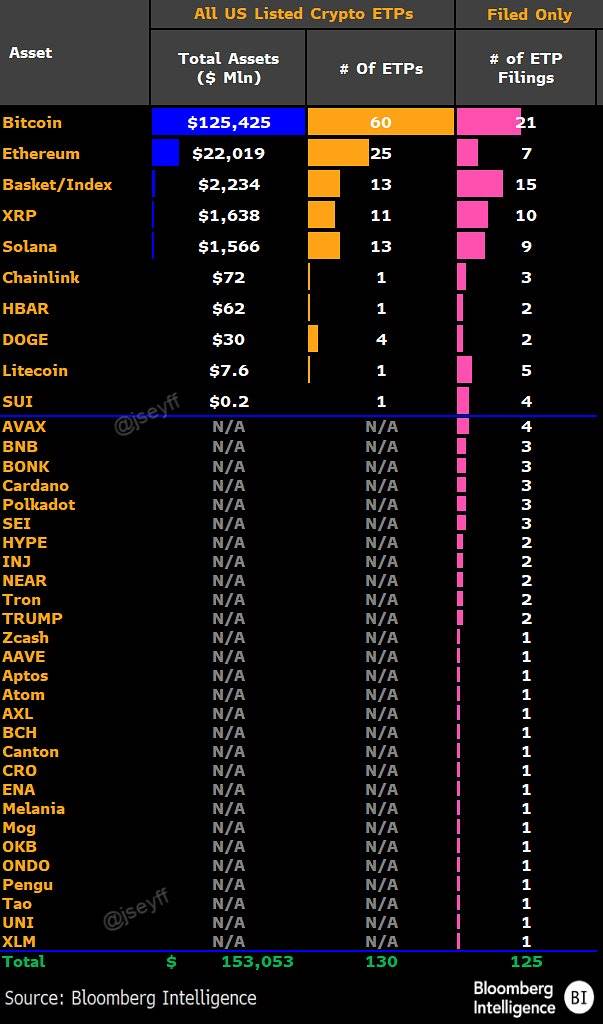
This gate-opening effect greatly altered the market structure: investors' risk tolerance increased, institutional motivation to allocate digital assets strengthened, asset management companies began actively expanding product boundaries, and regulators gradually accumulated review practices and approval confidence. Against this backdrop, a wave of applications for various altcoin ETFs quickly formed, with numerous asset management institutions布局ing single-currency/multi-currency ETF products for XRP, DOGE, LTC, HBAR, SUI, LINK, etc.
Source:https://x.com/Minh_BNB10000/status/1999307817430462471?s=20
Another driving force was the gradual adjustment in regulatory policy by the U.S. Securities and Exchange Commission (SEC). In September 2025, the SEC officially approved the revised "Generic Listing Standards for Shares of Commodity Trusts," providing clearer entry standards for crypto asset ETFs and shortening the approval time. This meant that crypto assets meeting basic conditions no longer required lengthy case-by-case reviews (the original ~240-day approval cycle was shortened to ~60-75 days). This was an important institutional foundation for the batch application and concentrated listing wave of altcoin ETFs.
Furthermore, a key opportunity was the regulatory gap triggered by the U.S. government shutdown in November 2025—under specific legal provisions (such as Section 8(a) of the 1933 Securities Act), some fund registration statements could automatically become effective without delay clauses, indirectly creating a "tacit approval channel" for rapid listing. These factors collectively spurred the recent wave of concentrated listings in the altcoin ETF space.
2. The Batch Listing Frenzy of Altcoin ETFs
Since the second half of 2025, the approval and listing pace of U.S. altcoin ETFs has noticeably accelerated, exhibiting characteristics of "queuing for listing + progressive batch approvals."
-
Solana ETF: In October 2025, the Solana (SOL) ETF successfully passed review and began trading on exchanges like the NYSE. This marked the launch of the first true altcoin spot ETF in the U.S.
-
Hedera ETF: In the same month, multiple application documents for Hedera (HBAR) ETFs were submitted and entered review. ETF registration statements for HBAR by institutions like Canary Capital were also revised, with HBAR ETFs expected to be approved and listed in the following weeks.
-
XRP ETF: In November 2025, the XRP ETF became the second altcoin spot ETF to be approved and launched rapidly. XRP ETFs launched by Canary Capital, Grayscale, 21Shares, etc., were successively listed on exchanges like NYSE Arca and attracted significant fund inflows in a short time.
-
DOGE ETF: In November 2025, the DOGE (Dogecoin) ETF was approved for listing by the SEC, representing regulatory cautious recognition of a Meme coin.
-
LTC ETF: The veteran altcoin LTC (Litecoin) ETF was also approved in November. Although ETF fund inflows were relatively small, it laid the foundation for more applications for older altcoin ETFs.
-
LINK ETF: Following XRP, SOL, DOGE, LTC, etc., the LINK (Chainlink) ETF officially "broke the ice" and listed in early December. The LINK ETF attracted tens of millions of dollars on its first day, indicating investor interest in ETFs for on-chain infrastructure assets with ecological foundations and practical utility.
-
SUI ETF: On December 5th, the U.S. Securities and Exchange Commission (SEC) approved the first 2x leveraged SUI ETF (TXXS), issued by 21Shares and listed on Nasdaq.
3. Altcoin ETFs Under Application
Beyond the listed altcoin ETFs, a large number of potential products are in the SEC's review queue, whose filing activity also constitutes a core driver of market attention in the next phase.
High-profile assets under review include:
-
AVAX ETF: Avalanche, as a major smart contract chain, has compliance and market foundations and has entered the fast-track approval process,有望成为下一个获批对象之一 (poised to be one of the next approved).
-
BNB ETF: BNB-related ETF applications are primarily pushed by asset management institutions like VanEck, REX Shares, and Osprey Funds and have entered the SEC review channel, representing that BNB有望成为在美国获批的首个币安生态类ETF产品 (is expected to become the first Binance ecosystem ETF product approved in the U.S.).
-
Other potential assets: such as ADA (Cardano), DOT (Polkadot), INJ (Injective), SEI, APTOS, AAVE, etc., have also had ETF filing documents enter the regulatory queue. Bloomberg Intelligence analyst James Seyffart pointed out that the SEC currently has a backlog of dozens of asset-class ETF applications, with a significant proportion being altcoins.
-
Multi-Coin ETFs: Some institutions are also attempting strategic布局 of "multi-coin portfolio ETFs," staking yield versions of ETFs, and even Memecoin thematic ETFs. If approved, these innovative products would further expand the boundaries of compliant altcoin investment.
Overall, in the next 6-12 months, the approval节奏 for U.S. altcoin ETFs is expected to remain high-density. The already listed XRP, SOL, DOGE, LTC, HBAR, and LINK ETFs are just the "first batch," with more applied-for assets queuing up, forming a systematic market development trend.
III. Data Performance Review of Listed Altcoin ETFs
The debut of altcoin spot ETFs became a major focus in the crypto market. Although overall market sentiment was weak for mainstream assets, some altcoin ETFs still attracted considerable attention from funds.
1. XRP Spot ETF
Source:https://sosovalue.com/assets/etf
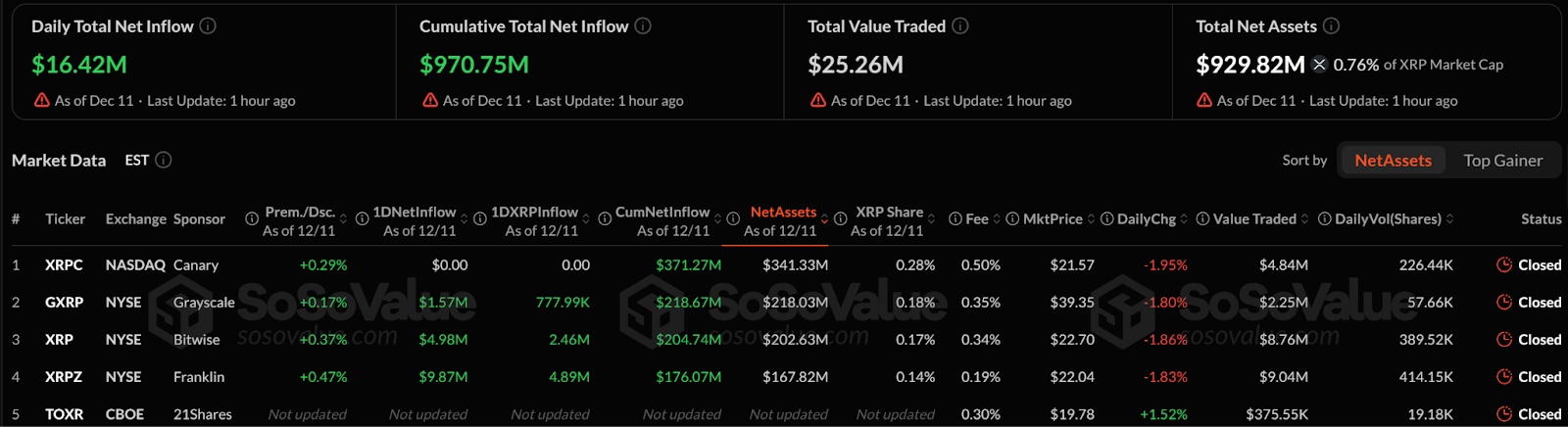
XRP spot ETFs have been launched by multiple asset management institutions, including Canary Capital, Grayscale, Franklin Templeton, and Bitwise. It is one of the标的 with the most issuers and active institutional participation among altcoin ETFs.
The XRP ETF demonstrated strong fund attraction post-listing, with cumulative net inflows of approximately $970 million since launch. All XRP funds combined have assets under management (AUM) exceeding $929 million. Since its launch on November 13th, it recorded net inflows for multiple consecutive trading days, with cumulative inflows of about $756 million over nearly 11 trading days.
The XRP ETF is currently one of the most popular altcoin ETF标的,凭借多家机构发行、强劲的资金流入和较大的 AUM 规模 (relying on multiple institutional issuers, strong fund inflows, and large AUM size), it has become the "preferred entry point" for institutional allocation to altcoins.
2. SOL Spot ETF
Source:https://sosovalue.com/assets/etf
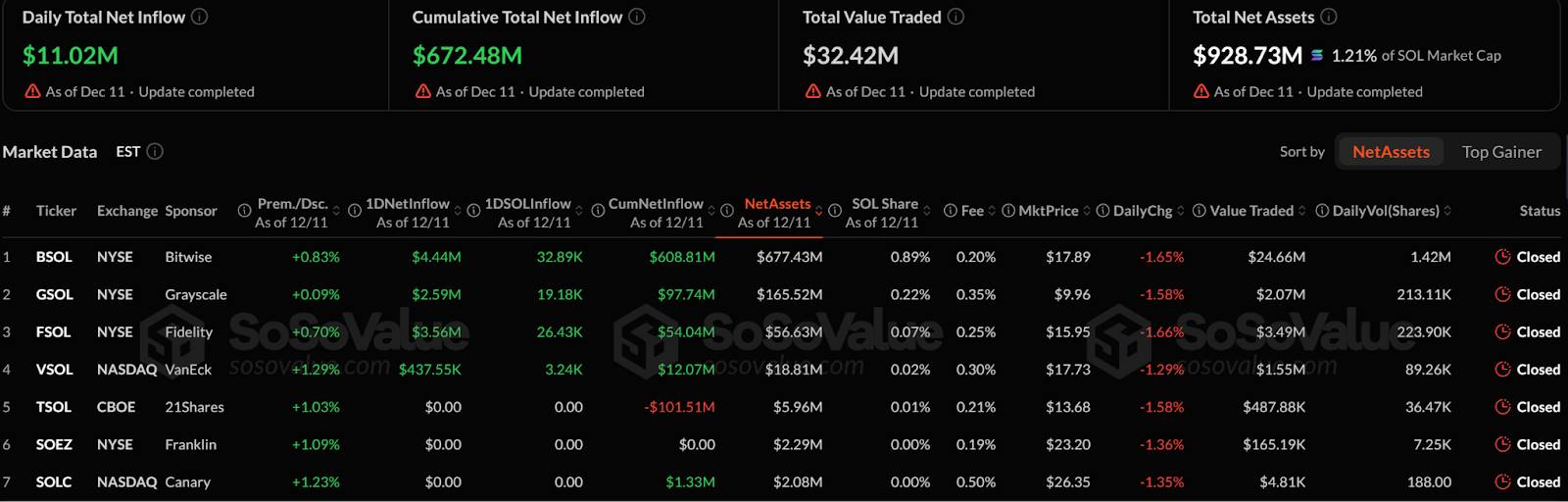
The launch of the Solana ETF was jointly promoted by several asset management institutions. The Solana ETF has seen cumulative net inflows of approximately $672 million since listing, with a total AUM of about $928 million. This means the Solana ETF's "scale" is among the largest in the altcoin product category and is also a representative of good sustained fund absorption.
However, unlike XRP, Solana ETF fund inflows have shown more of a phased investment characteristic: significant capital entered on the first day, followed by a steadier, rather than explosive, pace of capital entry in subsequent weeks. This suggests investors may value long-term configuration more than short-term arbitrage trading.
The performance of the Solana ETF shows the potential of altcoin ETFs in attracting institutional fund allocation and also reflects the market's "patient positioning" feature. Its ETF scale leads similar assets, but the disconnect between price and fund flow also indicates that short-term volatility risks still exist.
3. HBAR Spot ETF

Source:https://sosovalue.com/assets/etf
The Hedera (HBAR) ETF has also entered the trading market and gained some attention. The较早诞生的 (earlier-born) Hedera ETF gathered net inflows of around $82 million, becoming a medium-sized altcoin product. Compared to XRP and SOL, HBAR's fund volume is relatively smaller.
The HBAR ETF showed characteristics of consecutive weekly net inflows, with relatively sustained fund flow. Even though the weekly scale was not large, there were no large-scale outflows. This stability is closely related to its ecological foundation and practical application scenarios, but the price方面仍受整体加密市场走弱影响 (was still affected by the overall weak crypto market), with the HBAR price dropping nearly 20% since the ETF launch.
4. LTC Spot ETF

Source:https://sosovalue.com/assets/etf
LTC (Litecoin), as one of the earliest altcoins, its spot ETF was successfully brought to market by institutions like Canary Capital in late October 2025, making it one of the first batch of approved altcoin ETF products. Despite its prominent historical status and high trading activity, its post-ETF launch fund attraction and market attention were significantly lower than top alternative coin ETFs like XRP and SOL.
According to SoSoValue data, as of mid-November 2025, the LTC ETF (often abbreviated as LTCC) had cumulative net inflows of approximately $7.67 million. There were even days with zero net inflows. Compared to the hundreds of millions of dollars level inflows of XRP ETF and the tens of millions to hundreds of millions scale of SOL ETF, LTC's fund absorption was明显不足 (clearly insufficient) and did not become a core标的 in investors' altcoin ETF allocation system.
5. DOGE Spot ETF
Source:https://sosovalue.com/assets/etf
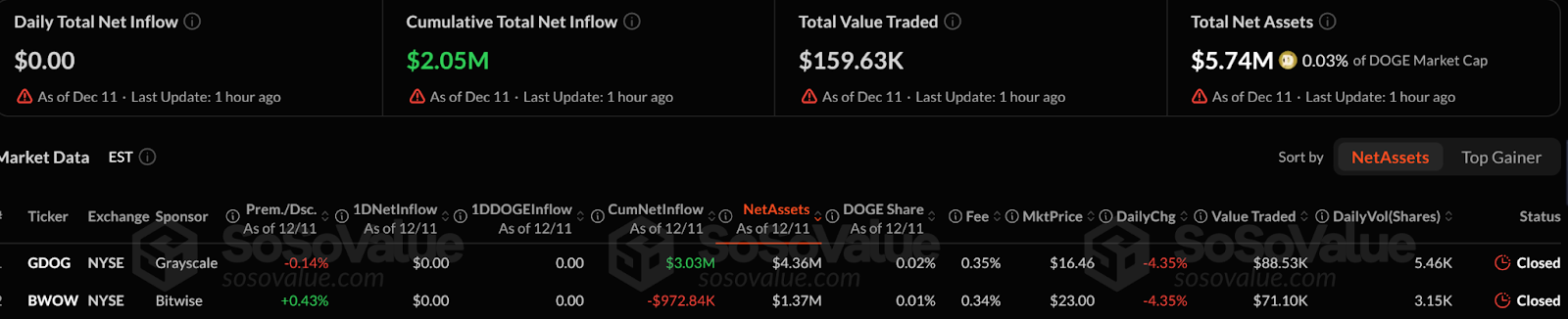
DOGE (Dogecoin) is one of the most iconic Meme coins, long regarded as a community sentiment-driven asset in the market. With the SEC's approval in November 2025 for institutions like Rex-Osprey to list the DOGE ETF as a trading product, this marked DOGE becoming one of the most symbolic projects among the first batch of Meme coin ETFs.
According to the latest SoSoValue data, the DOGE spot ETF has historical cumulative net inflows of approximately $2.05 million to date, indicating extremely limited fund allocation. In terms of trading activity, DOGE ETF turnover is also generally cold. Although the first-day turnover reached several million dollars, the overall trading structure is uneven, often accompanied by sparse fund movement. Such trading performance suggests institutional funds are unwilling to deeply allocate in the DOGE ETF.
6. LINK Spot ETF

Source:https://sosovalue.com/assets/etf
The first U.S. spot ETF supporting LINK (Chainlink), the Grayscale Chainlink Trust ETF (ticker GLNK), officially listed on the New York Stock Exchange (NYSE) on December 2, 2024, Eastern Time. The LINK ETF has seen approximately $52 million in net inflows since going live, with an AUM of $76 million. Part of its fund attraction stems from Chainlink's practical utility in the blockchain data infrastructure field, leading some long-term institutional investors to give its ETF strategic allocation.
Price-wise, LINK itself is still affected by broad market movements recently, but ETF fund allocation may provide a relatively stable underlying demand for future prices.
7. Summary of Listed Altcoin ETF Performance
From the performance of the various ETFs above, the U.S. altcoin spot ETF market shows clear "differentiated development":
-
Major funds are primarily聚集在 (concentrated on) XRP and Solana ETFs. These two types of ETFs have numerous issuers, fast capital accumulation, and large AUM sizes, making them the core focus of the altcoin ETF market.
-
Medium-sized asset ETFs like HBAR and LINK show stable performance, achieving a relative balance between ecological value and institutional recognition, but still struggle to compete with top assets.
-
LTC and DOGE ETFs show marginalization, with small fund scales, low trading activity, and lacking clear price support, resulting in insufficient market attention.
-
Overall market price performance普遍承压 (was generally under pressure) after the altcoin ETFs went live, indicating that market sentiment and macro factors still significantly impact prices, and the fund attraction of ETFs did not immediately translate into price increases.
Overall, although altcoin ETFs have not yet reached the market depth and scale of BTC/ETH ETFs, they have shown trends of细分配置 (segmented allocation), long-term fund inflows, and increased institutional participation, forming the雏形 (embryonic form) of a new era of "institutionalized investment" in the altcoin market.
IV. Opportunity and Risk Analysis of Altcoin ETFs
With the intensive approval and successive listing of U.S. altcoin spot ETFs, the market is entering a new stage of institutionalized investment. Although the current scale is far from that of Bitcoin and Ethereum ETFs, its development potential and demonstration effect cannot be ignored.
1. From Institutionalization to Differentiation: Structural Opportunities of Altcoin ETFs
1) Realization of Institutional Dividends: The success of Bitcoin and Ethereum spot ETFs opened compliant channels for altcoin products. The SEC's revision of generic ETF listing standards in 2025, along with institutional mechanisms like the "fast track" and Section 8(a) of the 1933 Securities Act, enabled altcoin ETFs to enter exchange markets more efficiently—this change shortened approval paths and increased product diversity, overall reducing institutional entry barriers.
2) Opportunity for Institutional Fund Reallocation: Market data from November 2025 showed that although Bitcoin and Ethereum spot ETFs experienced large-scale outflows, altcoin ETFs bucked the trend by absorbing approximately $1.3 billion, with funds mainly flowing to XRP and Solana-related products, indicating institutions' short-term willingness to重新审视 (re-examine) altcoin allocation. More importantly, this fund flow was not driven by单一市场情绪 (single market sentiment) but reflected institutions' selective pursuit of specific assets' fundamentals, compliance, and ecological value. For example:
-
XRP ETF gained attention due to its cross-border payment application logic and relatively clear regulatory path;
-
Solana ETF, combined with yield-generating structures like staking收益 (staking收益 staking yields), is expected to attract institutional funds seeking long-term allocation.
This phenomenon of funds flowing out of BTC/ETH and转向 (turning to) altcoin ETFs not only indicates分散 (dispersion) of enthusiasm for single-asset allocation but also reflects that the perception of "altcoins as long-term value investment标的" is beginning to be gradually accepted at the institutional level.
3) ETF as a Compliant Window Attracting Retail and Institutions: Altcoin ETFs provide a simplified path for ordinary investors to access on-chain assets: no need to manage wallets and private keys personally, no reliance on centralized exchanges, and risks are more controllable than self-custody. For institutional investors, ETFs are a mature compliant entry tool that can be incorporated into traditional investment frameworks like pension funds, hedge funds, and wealth management product portfolios, thereby expanding the capital base.
The existence of ETFs also increases industry visibility and transparency, making altcoin investment no longer reliant solely on decentralized trading and OTC liquidity but having traditional financial vehicles that can be纳入投资组合 (incorporated into investment portfolios).
2. Core Risks: Market, Regulatory, and Technical Challenges Coexist
Despite emerging opportunities, altcoin ETFs still face many risks, stemming from both their own asset characteristics and the macro and regulatory environment.
1) Regulatory Environment Remains Uncertain: Although the approval mechanism has improved, the U.S. SEC maintains a highly cautious overall attitude towards altcoin ETFs. The legal定位 (positioning) of regulatory subjects, classification standards, and potentially changing compliance requirements in the future can all affect the continuous operation and liquidity of ETFs. The SEC's ongoing focus on the identity definition of certain assets (e.g., whether they are securities vs. commodities) remains a review priority, and any policy回调 (rollback) or judicial ruling could lead to product adjustments or suspension of listing. Furthermore, despite the accelerated approval wave, the rapid "default effective" mechanism also raises market concerns, potentially meaning some products仍需补充合规优化 (still need supplementary compliance optimization) after listing, which creates uncertainty with potential impacts on price volatility and fund allocation.
2) Market Depth and Liquidity Risks Are Apparent: Compared to the deep and chaotic trading depth of BTC or ETH, the market liquidity of many altcoins remains weak. Large-scale ETF inflows could cause significant market impact, and during market adjustments, ETF redemption pressure could exacerbate liquidity紧张 (tightness). For example, although the Solana ETF has strong fund attraction momentum, it faces SOL price decline pressure, and prices failed to rise同步上扬 (synchronously) with fund inflows, indicating that altcoin pricing is not solely driven by capital flows but is also deeply influenced by market sentiment and liquidity conditions. Additionally, for more marginal altcoins like DOGE and LTC, whose ETF fund attraction ability is weak, their market depth is similarly insufficient to support rapid entry and exit of large institutional funds, which could lead to greater slippage risks during sharp market fluctuations.
3) Market Saturation and Product Competition Risks: As the number of altcoin ETFs surges, capital may be "分散" (dispersed) among different products, making it difficult for individual ETFs to enhance their fund scale, thereby weakening their price driving force and market attention. It has been observed that over a hundred crypto ETF filings have been submitted to the SEC, with altcoins continuously increasing, which dilutes investor attention to some extent. If market supply becomes excessive and "ETF fee wars" become常态 (commonplace), it might lead to attracting funds by lowering fees at the expense of product quality and investment value, which is不利 (unfavorable) for long-term holders.
4) High Volatility and Price Risk: Altcoin assets are inherently more volatile than BTC/ETH, meaning even though ETFs provide a compliant entry, prices can still fluctuate剧烈波动 (violently). Just as some altcoin ETF prices didn't持续走高 (continue rising) after launch, fund inflows do not guarantee price increases. The market may experience significant drawdowns due to macro sentiment, liquidity tightening, liquidation events, etc., posing challenges for investors with lower risk tolerance. Especially in products with high retail participation, altcoin ETFs are more susceptible to the impact of market sentiment fluctuations, and this irrational behavior could be amplified.
5) Technical and Operational Risks: As financial products, ETFs rely on exchange custody, clearing mechanisms, and underlying asset security. The smart contract risks of altcoins, exchange custody risks, and zombie order book risks (widening bid-ask spreads due to insufficient trading activity) can all bring technical risks to ETF operation. For smaller altcoins, assets are prone to the "trading island effect"; once ETF growth slows, these risks can quickly materialize.
V. Altcoin ETF Trend Outlook and Conclusion
Looking ahead, the development of altcoin ETFs will continue to profoundly impact the crypto asset market landscape. As institutional dividends are gradually realized, the regulatory environment becomes clearer, and institutional fund allocation interest grows, this细分赛道 (niche track) is entering a critical stage from萌芽 (sprouting) to maturity.
-
From an institutional perspective, the U.S. Securities and Exchange Commission (SEC) has made significant adjustments to crypto ETF approval rules, introducing generic listing standards and大幅缩短 (greatly shortening) approval time from originally hundreds of days to about 75 days,有望为 (is expected to bring) altcoin ETFs higher review efficiency and predictability. This institutional optimization not only improves regulatory signals but also paves the way for more asset classes like SOL, XRP, LTC, HBAR, etc., to enter the ETF market, pushing the industry from case-by-case approval towards规模化落地 (large-scale implementation). Therefore, it is highly likely that we will see more and more altcoin ETFs receiving listing approval and trading in the coming quarters.
-
In terms of market sentiment, industry participants and analysis institutions generally expect the approval probability of altcoin ETFs to be high. Bloomberg ETF analysts pointed out that the approval probability for spot ETFs of mainstream altcoins like Solana, XRP, and LTC is assessed at over 90%, with some analysts even believing approval for some products is almost "a done deal" and有望在未来几个月内逐步落地 (expected to gradually land in the coming months). This cautious optimism reflects regulators' recognition of compliance, trading transparency, and market maturity, helping to draw more institutions and long-term funds into this领域 (field).
-
On the international front, the development trend of altcoin ETFs is also advancing simultaneously in multiple markets. Canada, Europe, and Asian markets already have crypto ETFs or similar products, with unique product designs and regulatory frameworks. They not only provide institutional and operational references for the U.S. market but also促使全球资本 (prompt global capital) to form complementary and comparative effects when allocating digital assets across markets. For example, support for crypto asset index ETFs in France, Germany, etc., and altcoin option/futures tools launched by some Asian exchanges will provide U.S. investors with broader data and strategy references.
-
Within the market, a "分层配置"策略趋势 ("layered allocation" strategy trend) is also forming: head assets like XRP, SOL, ETH, and BTC remain the core of institutional and compliant allocation, while small and medium-sized altcoin (e.g., DOT, ADA, AVAX, INJ, etc.) ETFs may become choices for investors seeking high risk and high return. As the number of products increases, investors will focus more on ecological value, liquidity, and long-term fundamentals when constructing portfolios, rather than just chasing short-term hotspots.
It is important to note that although the overall trend is positive, altcoin ETFs are still accompanied by cyclical and structural risks. Subtle changes in regulatory policy, market liquidity fluctuations, and the impact of the macroeconomic environment on risk asset pricing can all lead to differentiated asset performance. This means investors must focus on risk management and dynamic adjustment when布局ing (positioning in) ETF products, paying attention to key factors like policy changes, market sentiment, and fund flows.
In summary, altcoin ETFs are an inevitable product of the integration of traditional finance and the crypto market, and their continued advancement aligns with the trend of market demand differentiation and regulatory adaptation. It is expected that by the first half of 2026, with accumulated regulatory experience and further optimized approval processes, dozens to上百个 (over a hundred) altcoin ETF products submitted by more than ten asset management companies will陆续落地 (land successively), forming a more mature, diverse, and layered valuable ETF ecosystem. For ordinary investors, this not only provides compliant and convenient investment channels but also pushes the entire crypto market into a new stage coexisting with institutionalization, decentralization, and professionalism. The tide of altcoin ETFs has already begun; future investment opportunities and risks coexist, and the key lies in how to participate rationally and position structurally.
About Us
Hotcoin Research, as the core investment research institution of Hotcoin Exchange, is committed to transforming professional analysis into your practical tool. We analyze market dynamics through "Weekly Insights" and "In-Depth Reports"; with the exclusive column "Hotcoin严选" (Hotcoin Strict Selection) (AI + expert double screening), we help you identify potential assets and reduce trial-and-error costs. Every week, our researchers also interact with you face-to-face through live streams, interpreting hot topics and predicting trends. We believe that warm companionship and professional guidance can help more investors navigate cycles and seize the value opportunities of Web3.
Risk Warning
The cryptocurrency market is highly volatile, and investment itself carries risks. We strongly advise investors to invest based on a full understanding of these risks and within a strict risk management framework to ensure fund safety.