AI Lobster Ranking, XXX Takes an Overwhelming First Place; Governments Compete to Issue Token Subsidies; Airdrop Hunters Have Started Delivering for Meituan

比推Publicado em 2026-03-10Última atualização em 2026-03-10

Resumo

This article summarizes recent discussions in the cryptocurrency space based on content from the X platform. Key topics include: - An "AI Lobster Ranking" where the top performer significantly outpaces the others, with the combined scores of the second to sixth places being less than one-tenth of the first. - Major Chinese municipalities are introducing token subsidies to encourage development, drawing comparisons to past electricity subsidies and sparking mixed reactions about the government's strategy. - Elon Musk's X platform is reportedly preparing to launch "Xmoney," featuring an 8% annual yield, which could disrupt the crypto exchange landscape if fully implemented. - "Airdrop hunters" (people seeking crypto rewards) are expressing anxiety about the increasing difficulty of profiting in the Web3 space, with some humorously mentioning turning to alternative jobs like working for Meituan (a delivery platform). - A list of controversial Key Opinion Leaders (KOLs) is being circulated, questioning their credibility. The content is presented as community discussion and explicitly states it does not constitute investment advice.

Dear readers, hello~

What have the KOLs in the crypto circle been talking about in the past 24 hours?

Note: The following content is compiled from the X platform and represents personal opinions. It does not represent the stance of this platform and is not investment advice.

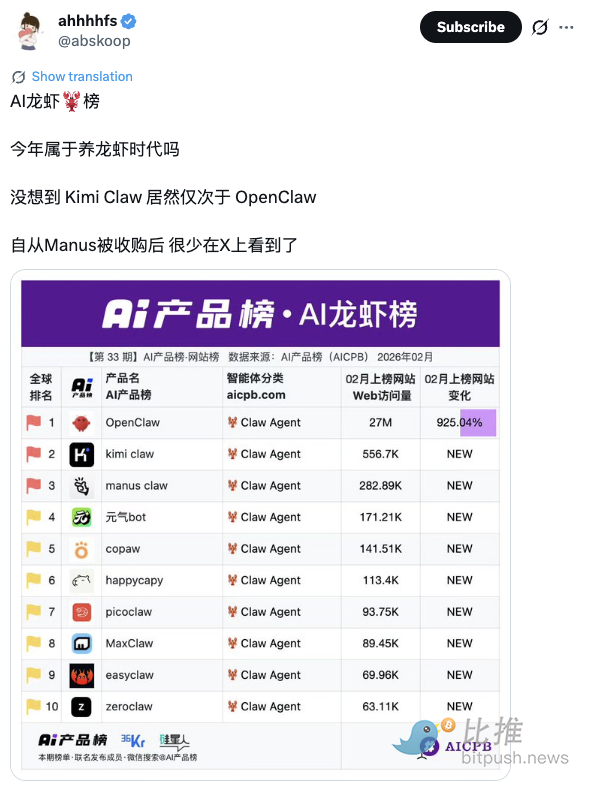
AI Lobster Ranking, the Combined Total of Second to Sixth Place is Less Than One-Tenth of First Place
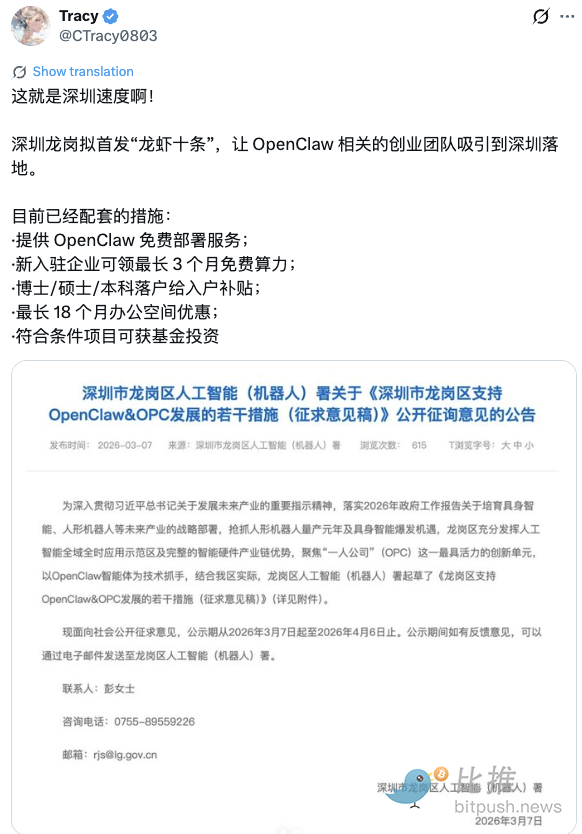
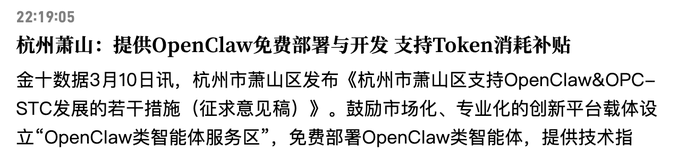
Major Chinese Cities are Rolling Out Token Subsidies!
Popular Replies:

Tried using qclaw, even for very minor tasks it asks for almost all file permissions on the computer, that's terrifying.

Back then they subsidized electricity, now they subsidize tokens.

The government is a bit FOMO too, they have to act first and see the results later.

Musk's Xmoney is About to Launch

Popular Replies:

An 8% annual yield is very tempting. If all the features are realized, the crypto space will really be turned upside down.

The KOLs from exchanges are terrified. Don't be afraid, competition makes you more valuable.

If foreigners can't use it, then it's not even better than U卡 (likely a reference to a crypto card).

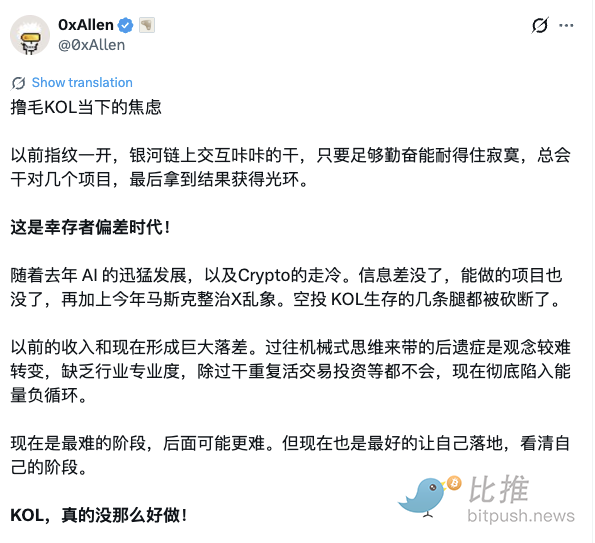
The Current Anxiety of Airdrop-Hunting KOLs

Popular Replies:

My crypto journey just started, why is everyone saying it's over? WEB2 was hard,没想到 getting into WEB3 is also this hard. Who exactly is making money?

Hard, doesn't mean it's over.
It will just become more正规 (regulated/formal) in the future.

I'm already preparing to go run美团 (Meituan deliveries).

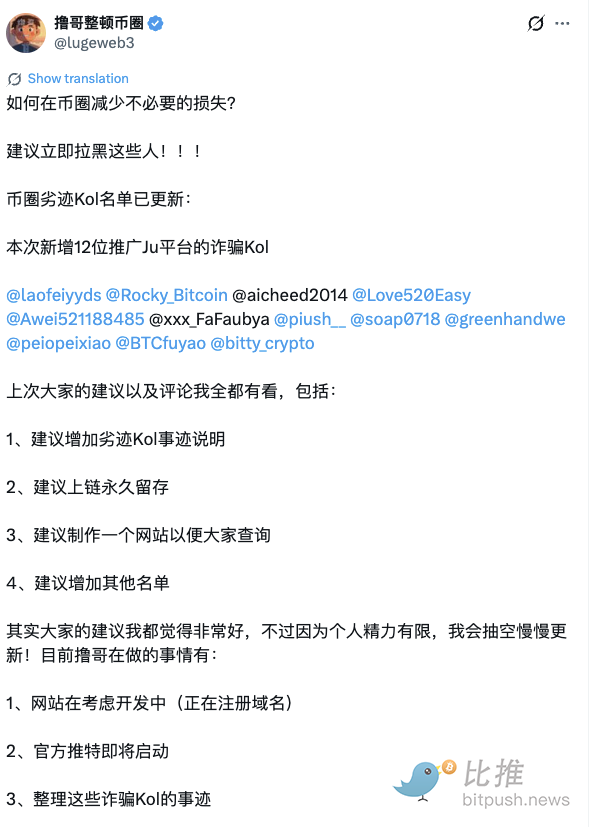
List of KOLs with Bad Records... Do You Agree?


Twitter:https://twitter.com/BitpushNewsCN

Bitpush TG Discussion Group:https://t.me/BitPushCommunity

Bitpush TG Subscription: https://t.me/bitpush

Original article link:https://www.bitpush.news/articles/7618594

Perguntas relacionadas

QWhat is the AI Lobster List mentioned in the article, and which project ranked first?

AThe AI Lobster List is a ranking of AI-related projects or tokens discussed in the crypto community. The article states that the first-ranked project had such a dominant lead that the combined scores of the second to sixth places were less than one-tenth of its total.

QWhat are some Chinese cities doing regarding token subsidies according to the article?

ASome major Chinese cities are introducing token subsidies as incentives, similar to how electricity was subsidized in the past, to promote adoption or development in the crypto or tech sectors.

QWhat is Xmoney, and who is launching it?

AXmoney is an upcoming financial product or token reportedly being launched by Elon Musk, offering features like an 8% annual yield, which could significantly impact the crypto landscape.

QWhat concerns are 'Airdrop Hunters' or crypto KOLs expressing in the current market?

AAirdrop hunters and crypto KOLs are expressing anxiety about the increasing difficulty of profiting from airdrops, with some even considering alternative jobs like working for Meituan (a delivery service) due to market challenges.

QWhat is the 'List of Misbehaving KOLs' referenced in the article?

AThe article mentions a 'List of Misbehaving KOLs,' which appears to be a community-generated list identifying key opinion leaders in crypto who have engaged in unethical or problematic behavior, though it does not specify exact names or criteria.
Leituras Relacionadas

Breaking: OpenAI Undergoes Major Reorganization, President Brockman Assumes Command

OpenAI has announced a major internal reorganization just months before its anticipated IPO. The company is merging its three flagship product lines—ChatGPT, Codex, and the API platform—into a single, unified product organization. The most significant leadership change involves co-founder and President Greg Brockman moving from a background technical role to take full, permanent control over all product strategy. This follows the indefinite medical leave of AGI Deployment CEO Fidji Simo. Additionally, ChatGPT's longtime lead, Nick Turley, has been reassigned to enterprise products, with former Instagram executive Ashley Alexander taking over consumer offerings. The consolidation, internally framed as a strategic move towards an "Agentic Future," aims to break down internal silos and create a cohesive "Super App." This planned desktop application would integrate ChatGPT's conversational abilities, Codex's coding power, and a rumored internal web browser named "Atlas" to autonomously perform complex user tasks. The reorganization occurs amid significant internal and external pressures. OpenAI has recently seen a wave of high-profile departures, including Sora co-lead Bill Peebles and other senior technical leaders, leading to concerns about a thinning executive bench. Externally, rival Anthropic recently secured funding at a staggering $900 billion valuation, surpassing OpenAI's own. Google's upcoming I/O developer conference also poses a competitive threat. Analysts suggest the dramatic restructure is a pre-IPO move to present a clearer, more focused narrative to Wall Street—streamlining operations and demonstrating decisive leadership under Brockman to counter internal turbulence and intense market competition.

marsbitHá 59m

Breaking: OpenAI Undergoes Major Reorganization, President Brockman Assumes Command

marsbitHá 59m

Two Survival Structures of Market Makers and Arbitrageurs

Market makers and arbitrageurs represent two distinct survival structures in high-frequency trading. Market makers primarily use limit orders (makers) to profit from the bid-ask spread, enjoying high capital efficiency (nominally 100%) but bearing inventory risk. This "inventory risk" arises from passive, fragmented, and discontinuous order fills in the limit order book (LOB). This risk, while a potential cost, can also contribute to excess profit if managed within control boundaries, allowing for mean reversion. Market makers essentially sell "time" (uncertainty over execution timing) to the market for price control and low fees. In contrast, cross-exchange arbitrageurs typically use market orders (takers) to exploit price differences or funding rates, resulting in lower nominal capital efficiency (requiring capital on both exchanges) and higher transaction costs. Their risk exposure stems from asymmetries in exchange rules (e.g., minimum order sizes), execution latency, and infrastructure risks (e.g., ADL, oracle drift). These exposures are active, exogenous gaps that primarily erode profits rather than contribute to them. Arbitrageurs essentially sell "space" (capital sunk across venues) for localized, immediate certainty. Both strategies engage in a trade-off between execution friction and residual risk. Optimal systems allow for temporary, controlled risk exposure rather than enforcing zero exposure at all costs. Their evolution converges towards hybrid models: arbitrageurs may use maker orders to reduce costs, while market makers may use taker orders or hedges for risk management. Ultimately, both use different forms of risk exposure—market makers exposing inventory, arbitrageurs immobilizing capital—to extract marginal, hard-won certainty from the market.

链捕手Há 59m

Two Survival Structures of Market Makers and Arbitrageurs

链捕手Há 59m

Who Will Define the Rules of the AI Era? Anthropic Discusses the 2028 US-China AI Landscape

This article, based on Anthropic's analysis, outlines the intensifying systemic competition between the U.S./allies and China for AI leadership by 2028. It argues that access to advanced computing power ("compute") is the critical bottleneck, where the U.S. currently holds a significant advantage through chip export controls and allied innovation. However, China's AI labs remain competitive by exploiting policy loopholes—via chip smuggling, overseas data center access, and "model distillation" attacks to copy U.S. model capabilities—keeping them close to the frontier. The piece presents two contrasting scenarios for 2028. In the first, decisive U.S. action to tighten compute controls and curb distillation locks in a 12-24 month AI capability lead, cementing democratic influence over global AI norms, security, and economic infrastructure. In the second, policy inaction allows China to achieve near-parity through continued access to U.S. technology, enabling Beijing to promote its AI stack globally and integrate advanced AI into its military and governance systems, altering the strategic balance. Anthropic contends that maintaining a decisive U.S. lead is essential for shaping safe AI development and governance. The core recommendation is for U.S. policymakers to urgently close compute and model access loopholes while promoting global adoption of the U.S. AI technology stack to secure a lasting strategic advantage.

marsbitHá 3h

Who Will Define the Rules of the AI Era? Anthropic Discusses the 2028 US-China AI Landscape

marsbitHá 3h

Trading

Spot
Futuros
活动图片