Agentic Workflows for Crypto Research

insights.glassnodePublicado em 2026-04-01Última atualização em 2026-04-01

Resumo

AI coding agents are transforming crypto research by automating data analysis through natural language. This article demonstrates using an agent (like Claude Code) with the Glassnode CLI to test a hypothesis: whether extreme Bitcoin exchange inflows predict 7-day price drawdowns. The agent autonomously discovers metrics, fetches data, performs statistical analysis, and generates insights. Results show a moderate association—spike days saw ~1.9% greater drawdowns—though the sample is small. A follow-up prompt produces visualizations for validation. The workflow allows rapid iteration and is applicable to various research questions using Glassnode data, requiring only an API key and an AI agent.

AI coding agents are changing the way analysts and researchers interact with data. Instead of writing scripts line by line, you provide a hypothesis or research question to an AI agent and – it writes the code, fetches the data, runs the analysis, and returns results.

In this article we present a step-by-step real-world example: Asking an AI agent to download data via the Glassnode CLI, run a statistical analysis, and generate publication-ready charts, all from natural-language prompts.

What you will need

  1. Access to an AI agent

We use Claude Code in this walkthrough, but any agent able to execute Python and shell commands will work, including ChatGPT's Codex, Cursor, Github Copilot, Google Gemini CLI, OpenClaw, or similar tools.

  1. The Glassnode CLI (gn)

A command-line interface for the Glassnode API. Install it and configure your API key by following the Glassnode CLI docs. An API key is required.

The prompt

We will evaluate the following hypothesis: Extreme BTC exchange inflow events are predictive of 7-day forward drawdowns. To do that, we will instruct Claude Code using the following prompt:

Using the Glassnode CLI, download BTC daily exchange inflows and closing price for the last year. Analyze whether inflow spikes (days with inflows > 2 standard deviations above the mean) predict drawdowns in the following 7 days. Show me a summary with statistics and results.

That's it. One sentence describing the question, and another sentence defining the methodology. The agent takes it from there.
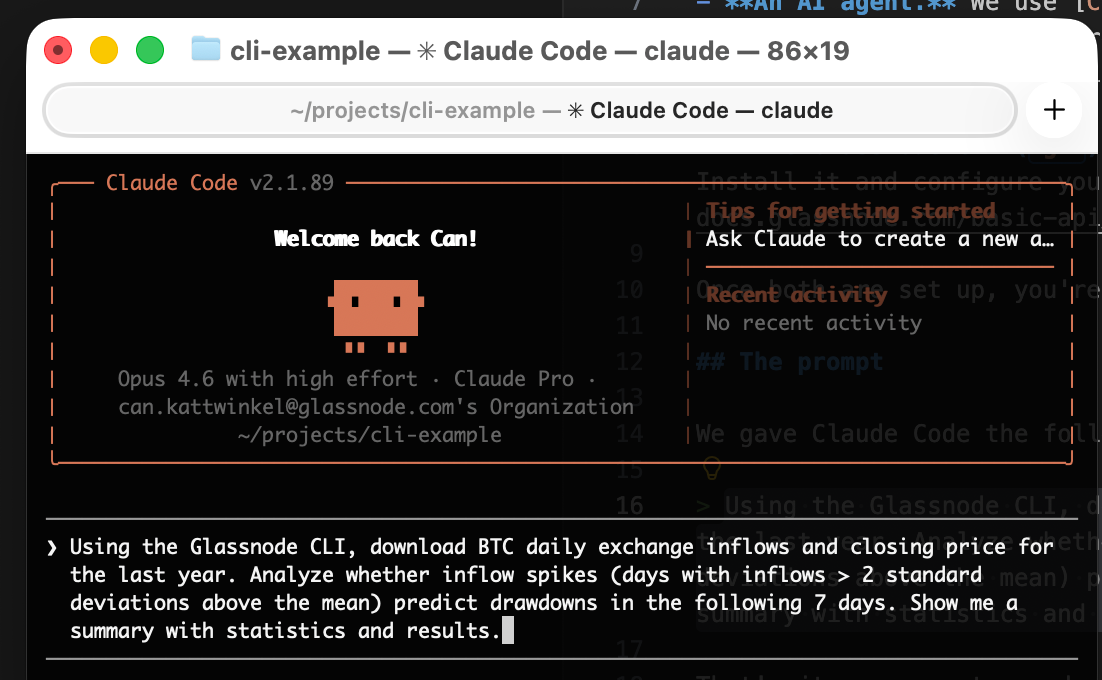
A simple prompt for the AI agent

What the agent does

Behind the scenes, the agent executes a sequence of steps:

  1. Discovers the right metrics by running gn metric list and gn metric describe to find the correct metric paths and valid parameters.
  2. Downloads the data via gn metric get, saving CSV files for both exchange inflows (transactions/transfers_volume_to_exchanges_sum) and closing price (market/price_usd_close).
  3. Writes and runs a Python analysis that computes the spike threshold, identifies spike days, calculates forward 7-day max drawdowns, and compares spike days to normal days.

The agent comes back with a readable summary:
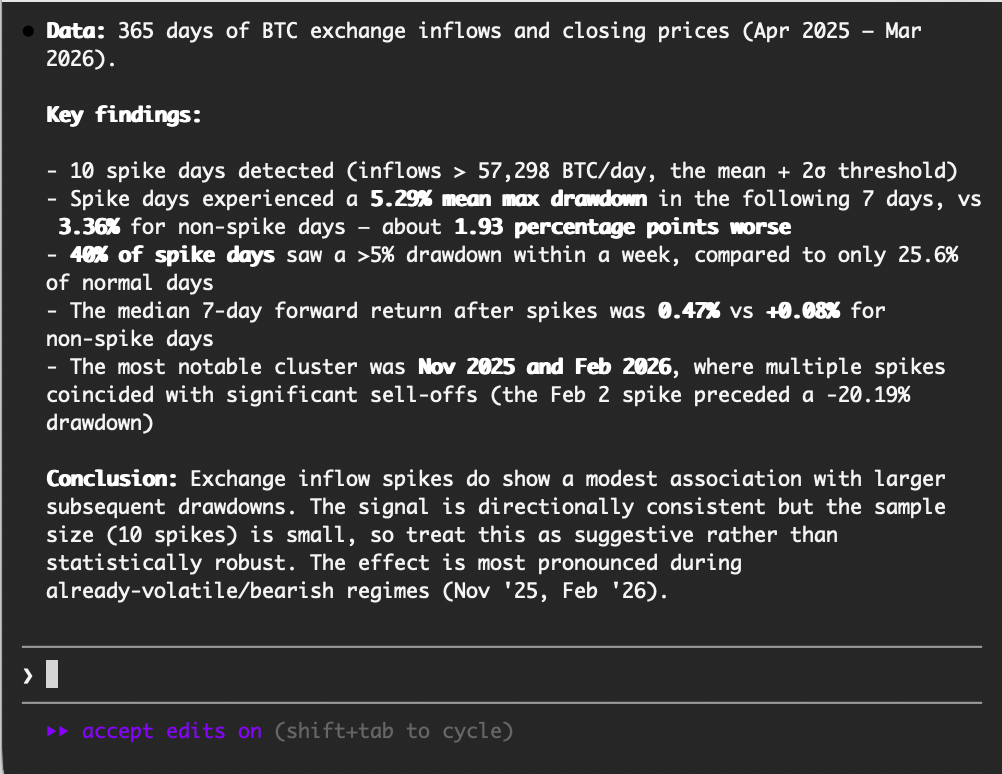
While this is just an illustrative example, our experiment does reveal a moderate association between exchange inflow spikes and subsequent drawdowns. Spike days see roughly 1.9 percentage points more drawdown on average. That said, with only 10 spike days in the sample and the effect concentrated in two volatile periods, the signal is suggestive rather than statistically robust. A rigorous backtest would need to account for overlapping windows, control for volatility regimes, use point-in-time data, and validate out-of-sample.

Visualizing the results

Visualizing the data is a good way to validate whether the numbers hold up. In this process, a simple follow-up prompt is enough:

Create a visualization that shows the data as a timeseries.

From here, you can keep iterating: adjust the chart, refine the analysis, or take the research in a different direction, all through natural language conversation.
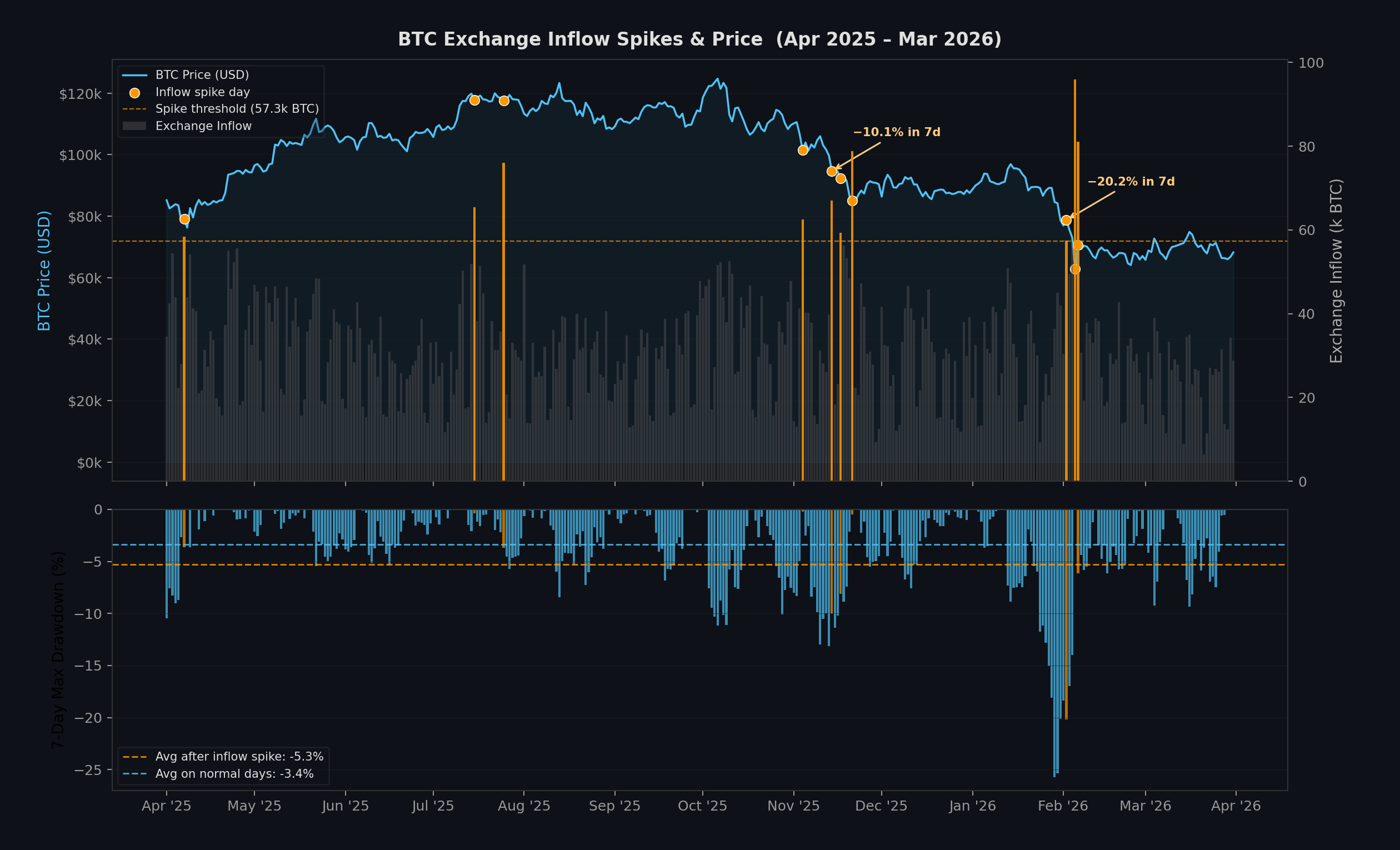
The AI-generated visualisation of Glassnode data

Get started with AI Crypto Research on Glassnode Data

The Glassnode CLI requires an API key, available to Glassnode Professional subscribers.

  1. Install the Glassnode CLI and configure your API key. See documentation
  2. Open your preferred AI coding agent (Claude Code, Codex, Cursor, Gemini CLI, OpenClaw, etc.)
  3. Start prompting. Try questions such as:
    • "Download ETH staking deposits for the last 6 months and plot the trend"
    • "Compare BTC and ETH exchange netflows over the last 90 days"
    • "Find which metric has the highest correlation with BTC 30-day returns"

The Glassnode CLI allows agents to discover and retrieve metric data without requiring manual API lookup or writing boilerplate code. Combined with an AI coding agent, the Glassnode CLI turns a research question into results in minutes.


Perguntas relacionadas

QWhat is the main advantage of using AI coding agents for crypto research as described in the article?

AThe main advantage is that AI coding agents automate the entire research workflow, allowing analysts to provide a natural-language hypothesis or research question, and the agent handles writing the code, fetching data, running analysis, and returning results, significantly speeding up the process.

QWhich specific AI agent is used in the walkthrough example for analyzing BTC exchange inflows?

AThe walkthrough uses Claude Code, but it notes that any AI agent capable of executing Python and shell commands, such as ChatGPT's Codex, Cursor, GitHub Copilot, Google Gemini CLI, or OpenClaw, would work.

QWhat hypothesis is tested in the example prompt given to the AI agent?

AThe hypothesis tested is: 'Extreme BTC exchange inflow events (days with inflows > 2 standard deviations above the mean) are predictive of 7-day forward drawdowns.'

QWhat are the key steps the AI agent performs behind the scenes after receiving the prompt?

AThe agent discovers the right metrics using Glassnode CLI commands, downloads the data (exchange inflows and closing price), writes and runs a Python analysis to compute spike thresholds and drawdowns, and returns a statistical comparison and summary.

QWhat is required to use the Glassnode CLI for AI-assisted research as mentioned in the article?

ATo use the Glassnode CLI, you need an API key, which is available to Glassnode Professional subscribers, and you must install and configure the CLI tool following the documentation.

Leituras Relacionadas

a16z: AI's 'Amnesia', Can Continuous Learning Cure It?

The article "a16z: AI's 'Amnesia' – Can Continual Learning Cure It?" explores the limitations of current large language models (LLMs), which, like the protagonist in the film *Memento*, are trapped in a perpetual present—unable to form new memories after training. While methods like in-context learning (ICL), retrieval-augmented generation (RAG), and external scaffolding (e.g., chat history, prompts) provide temporary solutions, they fail to enable true internalization of new knowledge. The authors argue that compression—the core of learning during training—is halted at deployment, preventing models from generalizing, discovering novel solutions (e.g., mathematical proofs), or handling adversarial scenarios. The piece introduces *continual learning* as a critical research direction to address this, categorizing approaches into three paths: 1. **Context**: Scaling external memory via longer context windows, multi-agent systems, and smarter retrieval. 2. **Modules**: Using pluggable adapters or external memory layers for specialization without full retraining. 3. **Weights**: Enabling parameter updates through sparse training, test-time training, meta-learning, distillation, and reinforcement learning from feedback. Challenges include catastrophic forgetting, safety risks, and auditability, but overcoming these could unlock models that learn iteratively from experience. The conclusion emphasizes that while context-based methods are effective, true breakthroughs require models to compress new information into weights post-deployment, moving from mere retrieval to genuine learning.

marsbitHá 2h

a16z: AI's 'Amnesia', Can Continuous Learning Cure It?

marsbitHá 2h

Can a Hair Dryer Earn $34,000? Deciphering the Reflexivity Paradox in Prediction Markets

An individual manipulated a weather sensor at Paris Charles de Gaulle Airport with a portable heat source, causing a Polymarket weather market to settle at 22°C and earning $34,000. This incident highlights a fundamental issue in prediction markets: when a market aims to reflect reality, it also incentivizes participants to influence that reality. Prediction markets operate on two layers: platform rules (what outcome counts as a win) and data sources (what actually happened). While most focus on rules, the real vulnerability lies in the data source. If reality is recorded through a specific source, influencing that source directly affects market settlement. The article categorizes markets by their vulnerability: 1. **Single-point physical data sources** (e.g., weather stations): Easily manipulated through physical interference. 2. **Insider information markets** (e.g., MrBeast video details): Insiders like team members use non-public information to trade. Kalshi fined a剪辑师 $20,000 for insider trading. 3. **Actor-manipulated markets** (e.g., Andrew Tate’s tweet counts): The subject of the market can control the outcome. Evidence suggests Tate’sociated accounts coordinated to profit. 4. **Individual-action markets** (e.g., WNBA disruptions): A single person can execute an event to profit from their pre-placed bets. Kalshi and Polymarket handle these issues differently. Kalshi enforces strict KYC, publicly penalizes insider trading, and reports to regulators. Polymarket, with its anonymous wallet-based system, has historically been more permissive, arguing that insider information improves market accuracy. However, it cooperated with authorities in the "Van Dyke case," where a user traded on classified government information. The core paradox is reflexivity: prediction markets are designed to discover truth, but their financial incentives can distort reality. The more valuable a prediction becomes, the more likely participants are to influence the event itself. The market ceases to be a mirror of reality and instead shapes it.

marsbitHá 3h

Can a Hair Dryer Earn $34,000? Deciphering the Reflexivity Paradox in Prediction Markets

marsbitHá 3h

Trading

Spot
Futuros
活动图片