After Polymarket and Kalshi, Are There Any Dark Horses Left in the Prediction Market?

marsbitPublicado em 2026-05-21Última atualização em 2026-05-21

Resumo

The prediction market, once a niche crypto experiment, has evolved into a mainstream financial and information market, moving beyond a sole reliance on political events. The 2024 US election showcased platforms like Polymarket and Kalshi, but sustained post-election volume from sports, tech, and economics proved long-term demand. By 2026, a duopoly controls ~97.5% of volume: Polymarket leverages on-chain trading, USDC settlement, and media integrations, while Kalshi uses CFTC compliance to access mainstream finance via partners like Robinhood. New challengers are emerging in specific niches: short-cycle trading (@trylimitless), media-native markets (@MyriadMarkets), social platform integration (@kash_bot), and infrastructure layers (@azuroprotocol, @theclearingco). Key 2026 drivers include AI agents executing over 30% of on-chain trades, media platforms embedding odds as engaging content, and sports becoming the dominant sustained vertical. Core challenges remain: contested volume metrics, state-level regulatory friction classifying markets as gambling, and token airdrop speculation inflating activity. The future lies not with generic clones, but with platforms possessing deep vertical focus, clear distribution advantages, and viable regulatory or on-chain liquidity strategies.

Editor's Note: Prediction markets are evolving from a niche crypto application to a more mainstream financial and information market.

The 2024 US election brought Polymarket and Kalshi into the public eye, but what truly changed the industry narrative was that trading volume did not rapidly disappear after the election. Markets in sports, technology, and economics absorbed the traffic, proving that the long-term demand for prediction markets is not solely driven by political events.

This article outlines the core landscape of prediction markets in 2026: on one side, a duopoly formed by Polymarket and Kalshi, with the former expanding its influence through on-chain trading, USDC settlement, and media distribution, and the latter entering mainstream financial scenarios through CFTC compliance qualifications and channels like Robinhood. On the other side, a group of new platforms are seeking opportunities in short-cycle trading, sports prediction, media embedding, on-chain native metrics, and the infrastructure layer.

What's more noteworthy is that the competition in prediction markets is no longer just about trading volume; it's a comprehensive contest involving liquidity, distribution capabilities, and regulatory pathways. Meanwhile, issues like wash trading, disputes over trading volume statistics, expectations for token airdrops, and state-level regulatory pressure indicate that this sector is still in a highly uncertain stage.

Prediction markets are no longer just DeFi experiments. They are becoming a new asset class where financial trading, media content, and algorithmic strategies intersect. The platforms that truly have a chance to break through in the future may not be generalized replicas, but rather those with clear vertical scenarios and distribution advantages.

The following is the original text:

Two platforms that were barely known in 2022 settled a notional trading volume last year that exceeded New Zealand's GDP.

In 2025, the combined trading volume of Kalshi and Polymarket reached $44 billion. In May 2026, Kalshi raised $1 billion in funding at a valuation of $22 billion. The Intercontinental Exchange (ICE), parent company of the New York Stock Exchange, pledged a $2 billion investment in Polymarket at a $9 billion valuation. AI Agents are already executing over 30% of on-chain trades. Meanwhile, a group of new teams are building vertical-specific platforms on Base, Solana, Hyperliquid, and Arweave—they are all betting on one judgment: these two giants cannot monopolize all categories.

This is likely the most comprehensive overview of the prediction market builder ecosystem available today.

Numbers That Rewrote the Narrative

2024 was the validation moment for prediction markets. The single market of the US Presidential election alone brought $3.3 billion in trading volume to Polymarket. During the campaign, almost all major financial news desks began reporting prediction market odds. Bloomberg, Politico, and FiveThirtyEight cited this data in their analyses.

But what happened after November 5th surprised many: trading volume did not drop back to its previous baseline. Sports markets absorbed that traffic.

By the end of 2025, sports markets accounted for 85% of Kalshi's trading volume and 39% of Polymarket's. Tech & Science markets grew 1,637% year-over-year, and Economic markets grew 905%. Political markets—the vertical once assumed to be the core driver of prediction markets—grew by only 43%.

Prediction markets found their long-term engine, and it wasn't elections.

The Duopoly Landscape
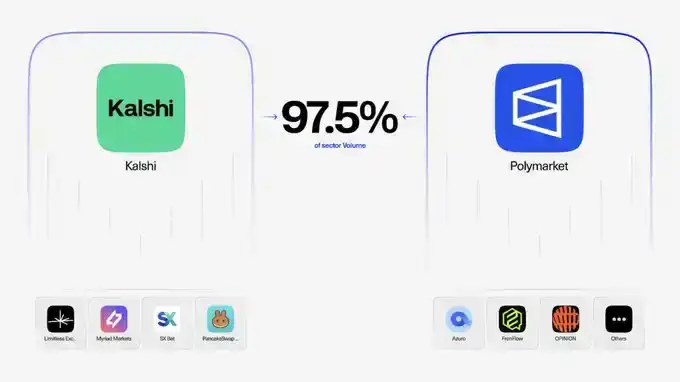
Polymarket runs on Polygon, settles in USDC, and intentionally charges no fees on most markets to prioritize building trading volume. In October 2025, ICE invested $2 billion in a strategic investment at a post-money valuation of approximately $9 billion. In June 2025, X announced Polymarket as its official prediction market partner. In February 2026, Substack natively integrated Polymarket's live odds data; within weeks, one-fifth of the top 250 revenue-generating publications on Substack began using this data. The platform's CMO also confirmed that the POLY token and an airdrop are forthcoming. Upon full functionality launch, its projected annualized fee revenue is expected to exceed $200 million.

Kalshi, on the other hand, obtained a Designated Contract Market designation from the CFTC, becoming the first event contract platform with such credentials, and turned this into a distribution moat. It was this compliant status that enabled Kalshi to enter Robinhood. In 2025 alone, Robinhood facilitated over 4 billion event contract trades. In January 2025, Kalshi launched markets related to the Super Bowl. In less than 12 months, sports markets skyrocketed from roughly 10% to over 85% of its trading volume. In May 2026, Kalshi raised $1 billion at a $22 billion valuation, led by Coatue with participation from Sequoia, a16z, Paradigm, Morgan Stanley, and ARK. At the time of funding, Kalshi had approximately 2 million monthly active users, annualized trading volume of about $178 billion, and annualized revenue of about $1.5 billion.

In 2025, these two companies collectively controlled about 97.5% of the total trading volume in the prediction market industry.

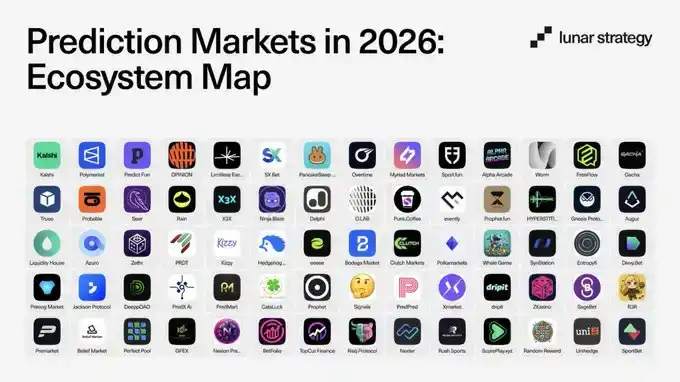
Ecosystem Map
The Challengers
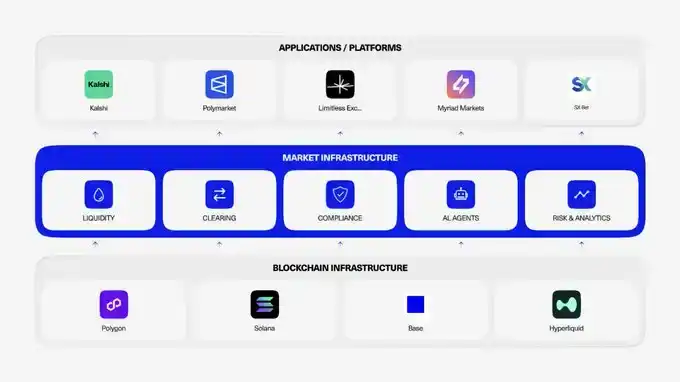
Beyond the duopoly, over a dozen teams are building new prediction market platforms. Each targets a specific gap.

@trylimitless is deployed on Base, focusing on short-cycle markets including 15-minute, hourly, and daily markets, targeting cryptocurrency and stock traders seeking fast settlement. The project raised $10 million from 1confirmation, Coinbase Ventures, F-Prime, DCG, and Arrington, among others. In Q1 2026, its monthly trading volume reached $1.1 billion. The fully diluted valuation of the $LMTS token once reached $800 million after launch.

@MyriadMarkets runs on the Abstract chain and integrates with Linea, Celo, and BNB. It bets on "media-native" prediction markets. Its first distribution partnership occurred in December 2025, embedding prediction features into Trust Wallet. It currently has over 430,000 users who have completed more than 1.7 million predictions. The project was founded by the team behind Decrypt and Rug Radio.

KASH embeds into X via @kash_bot, allowing users to create and trade prediction markets within quote posts. In February 2026, KASH raised $2 million from Big Brain Holdings, Spartan, Coinbase Ventures, Animoca, and the Sui Foundation, among others. Its core belief: whoever can enter the scenarios where users already spend their time via the shortest path will win prediction markets.

@DriftProtocol is built atop Drift Protocol's $500 million Solana liquidity pool. It supports over 30 collateral assets, allows cross-collateral positions, and offers FUEL rewards.

@HedgehogMarket targets on-chain native metrics, such as Base fees, funding rates, validator performance, while also offering general binary options on Solana and Eclipse. The platform supports permissionless market creation, with peak TVL once reaching around $20 million.

@HyperliquidX's HIP-4 went live on May 2, 2026, co-designed by John Wang, Head of Crypto at Kalshi. This mechanism uses USDH exclusively as collateral, employs a CLOB order book model, and charges no opening fees. The first market, deployed officially by Hyperliquid, revolves around BTC outcomes, achieving $6 million in trading volume on its first day. Currently, @Outcomexyz is the primary frontend for HIP-4, contributing 10x the trading volume of any other interface.

@azuroprotocol is more like infrastructure than a frontend product for general users. It provides a sports prediction market layer for other teams, using a Liquidity Tree pool design. The project has raised $11 million from Delphi Digital, Gnosis, and Arrington Capital, among others.

@Overtime_io runs on Optimism, Arbitrum, and Base. All protocol revenue flows to $OVER token buybacks.

@RobinhoodApp is powered by Kalshi's backend, facilitating over 2 billion event contract trades in Q3 2025 alone.

The infrastructure layer is also heating up. In August 2025, @theclearingco raised a $15 million seed round from investors including Union Square Ventures, Haun Ventures, Coinbase Ventures, and Variant. The company was founded by former executives from Polymarket and Kalshi. Capital flowing to the clearinghouse layer usually signals that an asset class is maturing.

Core Drivers in 2026

Regulated platforms are exploring on-chain tracks. Kalshi tokenizing markets and deploying to Solana, Polymarket advancing US CFTC compliance through the acquisition of QCEX, and Hyperliquid's HIP-4 being co-designed by Kalshi—all these moves point in the same direction: a global liquidity layer at the base, overlaid with regulatory shells for different regions.

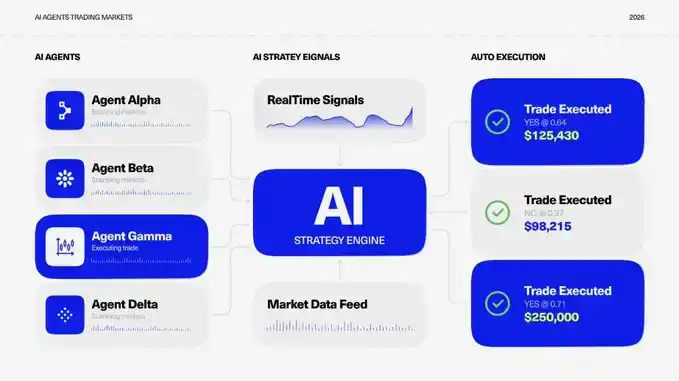
AI Agents have become a non-negligible part of prediction market activity. According to analytics platform LayerHub, over 30% of wallets on Polymarket are running AI Agents. Olas's Polystrat Agent executed over 4,200 trades in its first month, with single-position returns as high as 376%. Elastics also raised $2 million, aiming to build a natural language trading interface.

Whether platform teams initially designed for it or not, prediction markets are becoming algorithmic trading venues.
Media platforms are treating prediction odds as high-engagement content. X's official partnership deal, Substack's native integration, and Google Finance displaying live odds essentially serve the same purpose: turning financial questions into media events that can be discussed collectively, thereby driving organic user acquisition.

Sports is the most sustainable vertical. The 2024 US election brought the first wave of users; sports kept them. Any new platform raising funds in 2026 without a sports strategy is either building deep infrastructure or making a highly concentrated bet on a specific niche.

The Real Challenges

Three risks are worth pointing out directly.

First, trading volume metrics themselves are controversial. An analysis published by Paradigm in December 2025 noted that Polymarket's NegRisk architecture causes most third-party data tracking tools to double-count. CertiK estimated that wash trading accounted for peaks near 60% of some Polymarket trading volume in 2024. Therefore, the $44 billion figure is better used as a directional reference rather than strictly audited, accurate data.

Second, state-level legal friction is real. As of January 2026, there were over 19 related federal lawsuits. In March 2026, Ohio ruled that Kalshi's sports products constituted gambling. Attorneys General in Wisconsin and Arizona have also taken action against both major platforms. Federal tailwinds from the CFTC coexist with strong headwinds at the state level, and this tension won't disappear soon.

Third, token speculation is driving platform activity. A significant portion of trading volume in 2025 and early 2026 was related to market expectations for the POLY airdrop. Any platform touting impressive trading volume numbers without disclosing this context is misleading readers.

Conclusion

In 2024, prediction markets completed the leap from "interesting DeFi experiment" to a financial asset class. By 2025, they began building institutional-grade pipelines: strategic investments from exchange parent companies, CFTC-related settlements, Robinhood integration, and seed funding for clearinghouse layers.

In 2026, the real question for this sector has become: Who else has a chance to win besides Kalshi and Polymarket?

The current answer: Teams that go deep in verticals, possess clear distribution advantages, and can find paths for regulatory protection or on-chain liquidity density.

The opportunity for generalized replicas is over. Other paths, however, remain open.

If you are also building in this space and want to find the right growth architecture for your vertical, let's talk.


Perguntas relacionadas

QWhat are the two dominant platforms in the prediction market as of 2026, and what are their key competitive advantages?

AAs of 2026, the two dominant platforms in the prediction market are Polymarket and Kalshi, forming a duopoly. Polymarket's key advantages include its on-chain infrastructure on Polygon, USDC settlement, zero-fee models for many markets, and strong media partnerships (e.g., with X and Substack) for distribution and visibility. Kalshi's core advantage is its CFTC designation as a Designated Contract Market, which provides regulatory compliance and enabled its integration into mainstream financial platforms like Robinhood, significantly expanding its user base.

QAccording to the article, what has become the most significant long-term driver for prediction markets, replacing political events?

AThe most significant long-term driver for prediction markets, as identified in the article, is sports. While the 2024 US Presidential election brought initial attention and users, sports markets successfully retained and grew that user base. By the end of 2025, sports markets accounted for 85% of Kalshi's trading volume and 39% of Polymarket's. This shift demonstrates that sustainable demand for prediction markets extends far beyond political cycles.

QWhat are some of the key vertical strategies or niches that new prediction market platforms are pursuing to challenge the duopoly?

ANew prediction market platforms are pursuing several vertical niches to challenge the dominant duopoly. These include: platforms focusing on short-cycle markets (like @trylimitless for minute/hour/day trades), media-native integrations (like @MyriadMarkets embedding predictions into content platforms), social-native trading via bots (like KASH on X), on-chain native metrics (like @HedgehogMarket for blockchain data), and dedicated infrastructure layers for sports betting (like @azuroprotocol).

QWhat major risks or challenges does the prediction market industry face according to the article?

AThe article highlights three major risks: 1) Controversy over trading volume metrics, with concerns about double-counting and wash trading potentially inflating reported figures. 2) Persistent legal friction at the state level, with multiple lawsuits and state-level rulings challenging the legality of certain prediction markets as gambling. 3) The influence of token speculation, where a significant portion of trading activity is driven by anticipation of token airdrops (like POLY), which may not represent genuine, sustainable user engagement.

QWhat is the article's conclusion about the future opportunity for new players in the prediction market space?

AThe article concludes that the opportunity for generic copycat platforms is over. Future success for new players lies in building platforms with deep specialization in a specific vertical (e.g., sports, finance), possessing clear distribution advantages (e.g., media integration, social embedding), and finding a viable path through regulatory hurdles or by leveraging on-chain liquidity density. The competition has evolved into a multi-dimensional battle involving liquidity, distribution, and regulatory strategy.

Leituras Relacionadas

USDC Begins Nested Issuance, Coinbase Launches Custom Stablecoin Branding Service

Coinbase has launched its "Custom Stablecoins" platform, enabling businesses to offer branded stablecoins. The first client is Flipcash, a social payments app, which has introduced USDF. USDF is a Solana-based stablecoin, pegged 1:1 to USDC, and is designed to serve as a stable pricing and settlement unit for Flipcash's user-created community currencies. This move shifts the focus of stablecoins from being standalone assets or investment products to becoming embedded payment and settlement components within broader applications. For businesses like Flipcash, the core need is not to become a stablecoin issuer, but to integrate stable, reliable digital cash functionality—handling pricing, payments, and settlements—without managing the complex underlying infrastructure of issuance, reserves, on-chain contracts, fiat on-ramps, and compliance. Coinbase's platform provides this infrastructure as a service, positioning the exchange as a stablecoin infrastructure provider. While USDC remains the foundational reserve asset, the branded token (e.g., USDF) offers applications a tailored, user-facing financial tool. This development highlights a potential path for stablecoins to become ubiquitous backend utilities in social, gaming, and e-commerce applications, though it also brings significant regulatory and operational complexities associated with handling real user funds.

链捕手Há 16m

USDC Begins Nested Issuance, Coinbase Launches Custom Stablecoin Branding Service

链捕手Há 16m

Detained for 37 Days: The First Wave of People Who Got Rich from 'AI Gateways' Are Starting to Go to Jail

A prominent AI proxy service operator was reportedly detained for 37 days and is now on bail pending trial, highlighting the legal risks in China's booming but unregulated AI intermediary market. These services act as "AI scalpers," providing domestic users with access to restricted overseas models (like OpenAI, Claude) by bundling APIs, handling payments, and bypassing network blocks, all for a fee. Their controversial profitability stems from practices like bulk-registering accounts to resell free credits, exploiting refund policies, overcharging for tokens, substituting cheaper models, and illegally selling user conversation data. Major figures, including cryptocurrency entrepreneurs, are now entering this space. Legally, these operations face severe risks. Their core model often involves unauthorized API access and operating without required telecom licenses, potentially constituting illegal business operations. They fail to meet data security obligations for the vast amounts of user data they process, risking charges for failing to fulfill network security duties. Crucially, the unauthorized collection and sale of user data, which can include personal and commercial secrets, easily meets the threshold for the crime of infringing on personal information. The case underscores a critical juncture for the AI industry. While proxies lower access barriers, they expose user data to unsecured middlemen and undermine the business models of AI developers, forcing them to divert resources to security and distorting market value perceptions. The article argues that the industry's sustainable future depends on building trust, protecting data, and fostering compliant competition, moving away from its current "wild growth" phase.

marsbitHá 42m

Detained for 37 Days: The First Wave of People Who Got Rich from 'AI Gateways' Are Starting to Go to Jail

marsbitHá 42m

Putting Markets On-Chain: Canton Network Quietly Becomes the New Backbone of Institutional Finance

**Title: Letting the Market Itself Go On-Chain: Canton Network Quietly Becomes the New Backbone for Institutional Finance** **Summary:** The Canton Network, a blockchain platform designed for institutional finance, is gaining significant traction. A key sign of its maturity was Visa's recent entry as a super-validator, a proposal approved in just three days—highlighting prior, extensive collaboration between traditional finance and crypto. Unlike public chains like Ethereum that prioritize transparency and asset onboarding, Canton focuses on enabling confidential, compliant business operations for regulated institutions. Its core design features built-in **data visibility control**, meaning transaction details are only shared between direct counterparties. This privacy is fundamental, allowing competing institutions (like banks Goldman Sachs, JPMorgan, and BNP Paribas, all validators) to interact on the same network without exposing sensitive positions or strategies. Developed by Wall Street veterans at Digital Asset, Canton has taken a slow, deliberate approach to onboard real financial activity. It now handles over **$9 trillion monthly** in transaction volume, primarily from real-world institutional use cases like **tokenized repo agreements**, Treasury settlements, and collateral mobility. Major live applications include **JPM Coin** for institutional payments and **DTCC's tokenized U.S. Treasuries** project. Canton's native token, **CC**, is framed as a "network utility asset" with zero pre-mine or VC allocations. Its value is intended to be driven by the volume of real financial activity on the network. Looking ahead, Canton aims to become the invisible foundational layer for global finance—enabling atomic settlement (where payment and asset delivery occur simultaneously), 24/7 capital flows, and the native issuance and settlement of various asset classes, from corporate bonds to potentially equities. The main challenges are no longer technical but involve navigating fragmented global regulations and integrating with legacy financial systems.

marsbitHá 1h

Putting Markets On-Chain: Canton Network Quietly Becomes the New Backbone of Institutional Finance

marsbitHá 1h

It's Bankless That Needs Ethereum, Not Ethereum That Needs Bankless

Titled "Bankless Needs Ethereum, Not the Other Way Around," this article analyzes the significant recent news involving Bankless, a prominent crypto media outlet. Bankless co-founder David Hoffman announced the sale of all his ETH holdings, while the company also reportedly underwent major layoffs, with its founders parting ways. The news, likened to a high-profile defection, initially sent shockwaves through the Ethereum community, given Bankless's historical role as a key evangelist and "semi-official" narrative builder for Ethereum. For years, through its podcasts and writings, Bankless championed core Ethereum ideas like "ultrasound money" and the blockchain's role as a new financial settlement layer, acting as a crucial community hub and belief system during its growth phase. However, the article argues this development is not necessarily negative for Ethereum. It suggests Bankless's "first mission"—serving as Ethereum's passionate, inward-facing "propaganda department"—has largely been completed. As Ethereum matures and moves towards mainstream, institutional adoption, the narrative baton has shifted. Today, the value propositions of ETH are increasingly communicated to traditional finance by asset managers like BlackRock and VanEck, public companies adding ETH to their treasuries, and established financial figures. This represents a natural evolution towards a more decentralized, professional, and institutionally-focused narrative network. Therefore, while Bankless's retreat marks the end of an era, it signifies Ethereum's growing resilience and its reduced reliance on any single entity for belief, as its story is now carried forward by a broader and more mature ecosystem of advocates.

链捕手Há 1h

It's Bankless That Needs Ethereum, Not Ethereum That Needs Bankless

链捕手Há 1h

Trading

Spot
Futuros

Artigos em Destaque

Como comprar T

Bem-vindo à HTX.com!Tornámos a compra de Threshold Network Token (T) simples e conveniente.Segue o nosso guia passo a passo para iniciar a tua jornada no mundo das criptos.Passo 1: cria a tua conta HTXUtiliza o teu e-mail ou número de telefone para te inscreveres numa conta gratuita na HTX.Desfruta de um processo de inscrição sem complicações e desbloqueia todas as funcionalidades.Obter a minha contaPasso 2: vai para Comprar Cripto e escolhe o teu método de pagamentoCartão de crédito/débito: usa o teu visa ou mastercard para comprar Threshold Network Token (T) instantaneamente.Saldo: usa os fundos da tua conta HTX para transacionar sem problemas.Terceiros: adicionamos métodos de pagamento populares, como Google Pay e Apple Pay, para aumentar a conveniência.P2P: transaciona diretamente com outros utilizadores na HTX.Mercado de balcão (OTC): oferecemos serviços personalizados e taxas de câmbio competitivas para os traders.Passo 3: armazena teu Threshold Network Token (T)Depois de comprar o teu Threshold Network Token (T), armazena-o na tua conta HTX.Alternativamente, podes enviá-lo para outro lugar através de transferência blockchain ou usá-lo para transacionar outras criptomoedas.Passo 4: transaciona Threshold Network Token (T)Transaciona facilmente Threshold Network Token (T) no mercado à vista da HTX.Acede simplesmente à tua conta, seleciona o teu par de trading, executa as tuas transações e monitoriza em tempo real.Oferecemos uma experiência de fácil utilização tanto para principiantes como para traders experientes.

411 Visualizações TotaisPublicado em {updateTime}Atualizado em 2025.03.21

Como comprar T

Discussões

Bem-vindo à Comunidade HTX. Aqui, pode manter-se informado sobre os mais recentes desenvolvimentos da plataforma e obter acesso a análises profissionais de mercado. As opiniões dos utilizadores sobre o preço de T (T) são apresentadas abaixo.

活动图片