Actually, the Crypto Winter Began in January 2025

marsbitPublicado em 2026-02-03Última atualização em 2026-02-03

Resumo

The crypto winter began in January 2025, though many only recently acknowledged it. Bitcoin and Ethereum have fallen 39% and 53% from their October 2025 peaks, with steeper declines for other assets. This is a full bear market, not a correction, driven by over-leverage and profit-taking. Positive developments like regulatory progress and institutional adoption have been ignored amid the downturn, typical of crypto winters where good news fails to lift prices. Historically, crypto winters last around 13 months. However, this one may be closer to ending than it appears, as it effectively started in January 2025. ETF and digital asset trust (DAT) inflows masked the reality for some assets. Bitcoin, Ethereum, and XRP saw milder declines (10–20%) due to institutional support, while assets like ADA, AVAX, SUI, and DOT fell 62–75% without such backing. Without $75 billion in ETF/DAT buying, Bitcoin’s drop would have been closer to 60%. The retail crypto market has been in winter since January 2025. Despite the gloom, fundamental strengths remain: regulatory clarity, institutional adoption, stablecoins, tokenization, and Wall Street embrace. These positive factors are stored energy that will fuel the next rally when sentiment shifts. Triggers could include strong economic growth, pro-crypto regulatory surprises, sovereign adoption of Bitcoin, or simply time. As with past winters, the end feels near—despair and frustration are common precursors to recovery. Spring is likely coming s...

Author:Matt Hougan, Chief Investment Officer of Bitwise

Compiled by: Hu Tao, ChainCatcher

We have been in a crypto winter since January 2025. It's likely that we are closer to the end of this winter than to its beginning.

We are in the midst of a full-blown crypto winter.

Crypto Twitter has only recently begun to realize this, but it is undeniable. Bitcoin is down 39% from its all-time high in October 2025, Ethereum is down 53%, and many other crypto assets have fallen even more.

This is not a "bull market correction" or a "slight dip." This is a full-blown, Leonardo DiCaprio-in-The-Revenant-(2012)-level crypto winter—caused by factors such as excessive leverage and widespread profit-taking by seasoned players.

Recognizing and accepting this is enlightening.

Why are crypto prices still falling despite positive news about adoption, regulation, and other areas? Because we are in the depths of a crypto winter.

Why is the new Fed Chair a Bitcoin supporter, yet the Crypto Fear & Greed Index is near historic highs? Because we are in a crypto winter.

Crypto investors who have lived through past winters (be it 2018 or 2022) should remember that at the deepest points of the winter, good news meant nothing. Wall Street hiring aggressively or Morgan Stanley increasing its crypto investments did not drive a crypto market rally. These factors might matter in the long run, but not now. The end of a crypto winter is not exciting; it is exhausting.

So, when will the winter end?

The good news is: We are closer to the end than you think.

The History of Crypto Winters

Crypto winters typically last about 13 months. For example, Bitcoin peaked in December 2017 and bottomed in December 2018. It peaked again in October 2021 and bottomed in November 2022.

By that measure, we are in for a tough time. After all, Bitcoin's peak was in October 2025. Are we really going to have to wait until next November to get back in?

I don't think so.

The more time I spend analyzing the current "winter," the more I realize it actually began in January 2025. It's just that ETF and Digital Asset Trust (DAT) flows masked the truth, preventing us from seeing it.

ETF and DAT Flows Masked the 2025 Winter

Take a closer look at this chart of the components of the Bitwise 10 Large Cap Crypto Index since January 1, 2025.
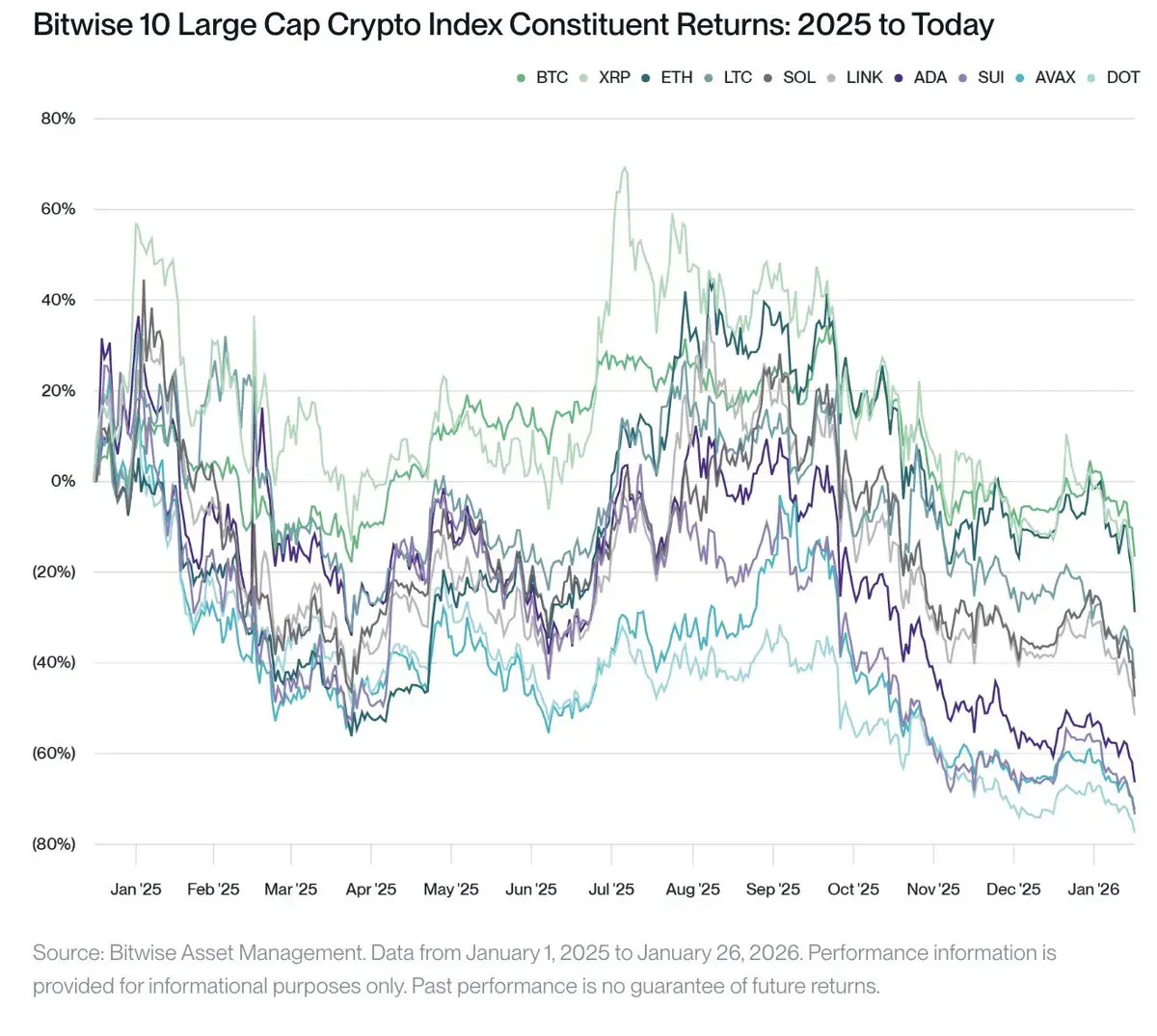
It is divided into three clear groups. The first group of assets (BTC, ETH, XRP) performed okay, down 10.3% to 19.9%. The second group (SOL, LTC, LINK) experienced a standard bear market, down 36.9% to 46.2%. But the third group (ADA, AVAX, SUI, DOT) was hit hard, with declines as high as 61.9% to 74.7%.

The fundamental difference between these three groups lies in the ability of institutional investors to invest in them. The first group benefited from strong ETF/DAT support throughout the year (or, in the case of XRP, from winning its lawsuit against the SEC); the second group had ETFs expected to be approved in 20251; and the third group never received such support.

Look at what happened to the third group, which relied solely on crypto-native channels for support!

The institutional support received by the first group was unprecedented. For example, during the period shown in the chart, ETFs and DATs bought 744,417 bitcoins, worth approximately $75 billion. Imagine where Bitcoin would be without that $75 billion in support? I estimate it would be down about 60%.

The retail crypto market has been in a severe winter since January 2025. Institutional investors merely masked this fact for certain assets.

The Darkest Hour Is Just Before the Dawn

What needs to be remembered now is that there is indeed a lot of good news in the crypto space. Regulatory progress is real. Institutional adoption is real. Stablecoins and tokenization are real. Wall Street's acceptance is real.

Good news tends to be ignored in bear markets, but it doesn't disappear. It is stored as potential energy. When the gloom lifts and market sentiment returns to normal, this stored energy will return with a vengeance.

What can lift the gloom? Strong economic growth triggering a wave of aggressive risk-on sentiment, positive surprises from the Clarity Act, signs of Bitcoin recognition by sovereign nations, or simply the passage of time.

As a veteran of multiple crypto winters, I can tell you that the feeling at the end of those winters felt very much like it does now: despair, frustration, and listlessness. But the current market correction has not fundamentally changed anything about crypto.

I believe we will bounce back strongly soon. After all, if it has felt like winter from January 2025 until now, spring must surely be just around the corner.

Perguntas relacionadas

QAccording to the article, when did the crypto winter actually begin?

AThe crypto winter actually began in January 2025.

QWhat was the primary factor that masked the true start of the crypto winter in 2025?

AThe massive inflows into ETFs and Digital Asset Trusts (DATs) masked the true start of the crypto winter.

QHow are the assets in the article's 'third group' characterized, and what was their performance?

AThe third group (ADA, AVAX, SUI, DOT) consists of assets that never received institutional support like ETFs. They were hit the hardest, with declines ranging from 61.9% to 74.7%.

QWhat does the author suggest is the typical duration of a crypto winter, and why does he believe the current one might be different?

AThe typical duration is about 13 months. The author believes the current winter is different because it effectively started in January 2025, not October 2025 (the peak), meaning we are likely closer to its end than the 13-month timeline from the peak would suggest.

QWhat does the author say happens to positive news and developments during a crypto winter?

APositive news is ignored during a crypto winter, but it doesn't disappear. It gets stored as potential energy and is then released powerfully when market sentiment returns to normal.

Leituras Relacionadas

Gensyn AI: Don't Let AI Repeat the Mistakes of the Internet

In recent months, the rapid growth of the AI industry has attracted significant talent from the crypto sector. A persistent question among researchers intersecting both fields is whether blockchain can become a foundational part of AI infrastructure. While many previous AI and Crypto projects focused on application layers (like AI Agents, on-chain reasoning, data markets, and compute rentals), few achieved viable commercial models. Gensyn differentiates itself by targeting the most critical and expensive layer of AI: model training. Gensyn aims to organize globally distributed GPU resources into an open AI training network. Developers can submit training tasks, nodes provide computational power, and the network verifies results while distributing incentives. The core issue addressed is not decentralization for its own sake, but the increasing centralization of compute power among tech giants. In the era of large models, access to GPUs (like the H100) has become a decisive bottleneck, dictating the pace of AI development. Major AI companies are heavily dependent on large cloud providers for compute resources. Gensyn's approach is significant for several reasons: 1) It operates at the core infrastructure layer (model training), the most resource-intensive and technically demanding part of the AI value chain. 2) It proposes a more open, collaborative model for compute, potentially increasing resource utilization by dynamically pooling idle GPUs, similar to early cloud computing logic. 3) Its technical moat lies in solving complex challenges like verifying training results, ensuring node honesty, and maintaining reliability in a distributed environment—making it more of a deep-tech infrastructure company. 4) It targets a validated, high-growth market with genuine demand, rather than pursuing blockchain integration without purpose. Ultimately, the boundaries between Crypto and AI are blurring. AI requires global resource coordination, incentive mechanisms, and collaborative systems—areas where crypto-native solutions excel. Gensyn represents a step toward making advanced training capabilities more accessible and collaborative, moving beyond a niche controlled by a few giants. If successful, it could evolve into a fundamental piece of AI infrastructure, where the most enduring value in the AI era is often created.

marsbitHá 11h

Gensyn AI: Don't Let AI Repeat the Mistakes of the Internet

marsbitHá 11h

Why is China's AI Developing So Fast? The Answer Lies Inside the Labs

A US researcher's visit to China's top AI labs reveals distinct cultural and organizational factors driving China's rapid AI development. While talent, data, and compute are similar to the West, Chinese labs excel through a pragmatic, execution-focused culture: less emphasis on individual stardom and conceptual debate, and more on teamwork, engineering optimization, and mastering the full tech stack. A key advantage is the integration of young students and researchers who approach model-building with fresh perspectives and low ego, prioritizing collective progress over personal credit. This contrasts with the US culture of self-promotion and "star scientist" narratives. Chinese labs also exhibit a strong "build, don't buy" mentality, preferring to develop core capabilities—like data pipelines and environments—in-house rather than relying on external services. The ecosystem feels more collaborative than tribal, with mutual respect among labs. While government support exists, its scale is unclear, and technical decisions appear driven by labs, not state mandates. Chinese companies across sectors, from platforms to consumer tech, are building their own foundational models to control their tech destiny, reflecting a broader cultural drive for technological sovereignty. Demand for AI is emerging, with spending patterns potentially mirroring cloud infrastructure more than traditional SaaS. Despite challenges like a less mature data industry and GPU shortages, Chinese labs are propelled by vast talent, rapid iteration, and deep integration with the open-source community. The competition is evolving beyond a pure model race into a contest of organizational execution, developer ecosystems, and industrial pragmatism.

marsbitHá 13h

Why is China's AI Developing So Fast? The Answer Lies Inside the Labs

marsbitHá 13h

3 Years, 5 Times: The Rebirth of a Century-Old Glass Factory

Corning, a 175-year-old glass company, is experiencing a dramatic revival as a key player in AI infrastructure, driven by surging demand for high-performance optical fiber in data centers. AI data centers require vastly more fiber than traditional ones—5 to 10 times as much per rack—to handle high-speed data transmission between GPUs. This structural demand shift, coupled with supply constraints from the lengthy expansion cycle for fiber preforms, has created a significant supply-demand gap. Nvidia has invested in Corning, along with Lumentum and Coherent, in a $4.5 billion total commitment to secure the optical supply chain for AI. Corning's competitive edge lies in its expertise in producing ultra-low-loss, high-density, and bend-resistant specialty fiber, which is critical for 800G+ and future 1.6T data rates. Its deep involvement in co-packaged optics (CPO) with partners like Nvidia further solidifies its position. While not the largest fiber manufacturer globally, Corning's revenue from enterprise/data center clients now exceeds 40% of its optical communications sales, and it has secured multi-year supply agreements with major hyperscalers including Meta and Nvidia. Financially, Corning's optical communications revenue has surged, doubling from $1.3 billion in 2023 to over $3 billion in 2025. Its stock price has risen nearly 6-fold since late 2023. Key future catalysts include the rollout of Nvidia's CPO products and the scale of undisclosed customer agreements. However, risks include high current valuations and potential disruption from next-generation technologies like hollow-core fiber. The company's long-term bet on light over electricity, maintained even through the telecom bubble crash, is now being validated by the AI boom.

marsbitHá 13h

3 Years, 5 Times: The Rebirth of a Century-Old Glass Factory

marsbitHá 13h

Trading

Spot
Futuros
活动图片

