Aave founder under scrutiny for $10M token purchase amid governance drama

cointelegraphPublicado em 2025-12-24Última atualização em 2025-12-24

Resumo

Aave founder Stani Kulechov faces criticism for purchasing $10 million worth of AAVE tokens, with allegations that the move was intended to increase his voting power in a key governance proposal. Critics, including DeFi strategist Robert Mullins, claim the purchase could be used to vote against token holders' interests, highlighting concerns about governance attacks and the concentration of voting power. The controversy arises amid a heated vote on reclaiming control of Aave's brand assets through a DAO structure. Critics argue the proposal was rushed and note that a small group of large holders controls over 58% of the voting power, raising questions about the fairness of token-based governance.

Aave founder Stani Kulechov is facing scrutiny over his recent $10 million purchase of AAVE tokens, with some in the crypto community claiming it was used to boost his voting power in a key governance proposal.

In a Wednesday post on X, Robert Mullins, a decentralized finance (DeFi) strategist and liquidity specialist, argued that the purchase was meant to increase Kulechov’s “voting power in anticipation to vote for a proposal directly against the token holders best interests.”

He added: “This is a clear example of tokens not being equipped to adequately disincentivize governance attacks.”

Prominent crypto user Sisyphus echoed those concerns, claiming that Kulechov might have sold “millions of dollars” worth of Aave (AAVE) tokens between 2021 and 2025, questioning the economic rationale behind the move.

The controversy comes as Aave token holders debate how governance power is exercised within one of DeFi’s largest protocols, with critics arguing that large token purchases can materially influence voting outcomes on high-stakes proposals. The dispute has reignited concerns about whether token-based governance adequately protects minority holders when founders or early insiders retain significant economic leverage.
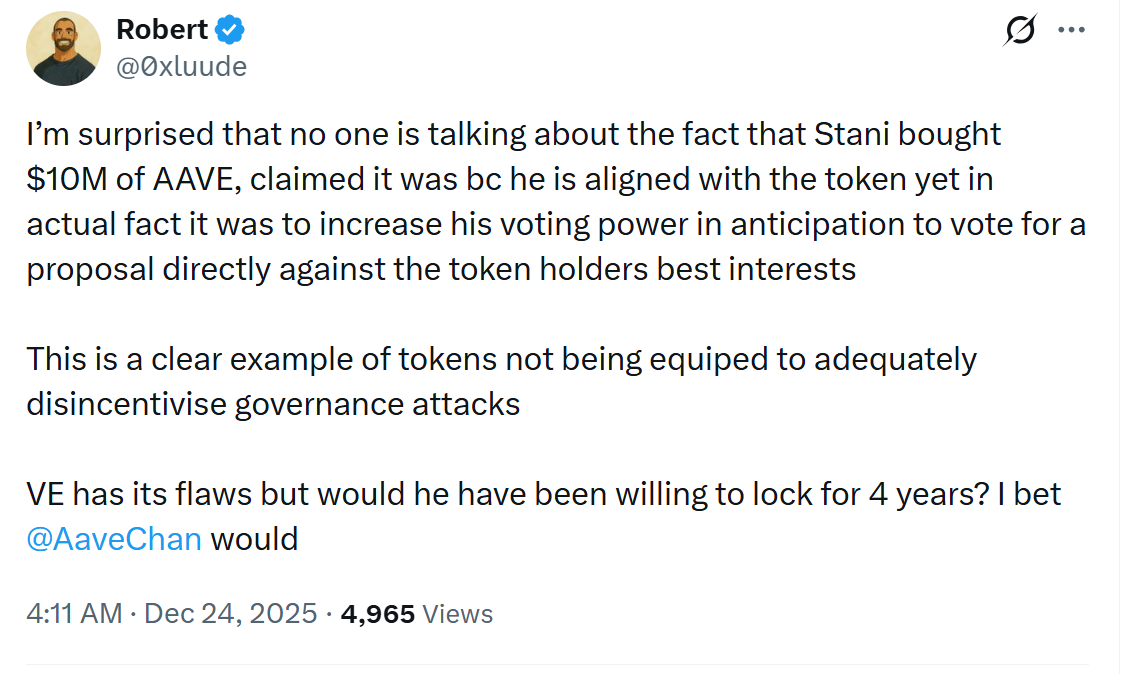
Robert Mullins questions Kulechov’s motive behind recent purchase. Source: Robert Mullins

Aave governance vote sparks backlash

As Cointelegraph reported, Aave’s governance vote has triggered a backlash after a proposal on reclaiming control of the protocol’s brand assets was pushed to a snapshot vote despite ongoing debate.

The proposal asks whether AAVE token holders should regain ownership of domains, social accounts and intellectual property through a DAO-controlled legal structure.

Several stakeholders disputed that decision, arguing that the proposal was escalated prematurely.

Former Aave Labs CTO Ernesto Boado, listed as the proposal’s author, said the vote escalated without his consent and broke community trust.

Related: Aave founder outlines 2026 ‘master plan’ after end to SEC probe

Voting power concentration in Aave DAO

Samuel McCulloch of USD.ai pointed out the concentration of voting power. In an X post, he described the Aave vote as “silly,” adding that a small group of large holders accounted for about half of the total voting weight.

Snapshot data from the Aave DAO shows that the top three voters alone control more than 58% of the entire vote. The top voter, 0xEA0C...6B5A, holds 27.06% of the voting power (333k AAVE), while the second-largest voter, aci.eth, controls 18.53% (228k AAVE).

Cointelegraph reached out to Kulechov for comment, but did not receive a response by publication.

Magazine: Bitcoin whale Metaplanet ‘underwater’ but eyeing more BTC: Asia Express

Criptomoedas em alta

Perguntas relacionadas

QWhy is Aave founder Stani Kulechov facing scrutiny for his recent token purchase?

AStani Kulechov is facing scrutiny because some in the crypto community claim his $10 million purchase of AAVE tokens was used to boost his voting power in a key governance proposal, potentially acting against token holders' best interests.

QWhat specific governance proposal has caused controversy in the Aave community?

AThe controversial proposal asks whether AAVE token holders should regain ownership of the protocol's brand assets, including domains, social accounts, and intellectual property, through a DAO-controlled legal structure.

QHow concentrated is the voting power in the Aave DAO according to the article?

AVoting power in Aave DAO is highly concentrated, with the top three voters controlling more than 58% of the total voting weight, and the top single voter holding 27.06% of the voting power.

QWhat criticism did Robert Mullins raise about Kulechov's token purchase?

ARobert Mullins argued that Kulechov's purchase was meant to increase his voting power to vote for a proposal that goes against token holders' best interests, calling it a clear example of tokens not being equipped to disincentivize governance attacks.

QWhat concern has this controversy reignited about token-based governance systems?

AThe controversy has reignited concerns about whether token-based governance adequately protects minority holders when founders or early insiders retain significant economic leverage and can influence voting outcomes through large token purchases.

Leituras Relacionadas

Global Stock Market's Storm Center: South Korea's Stock Market De-leveraging Is Largely Complete

Storm's Eye: South Korean Market De-leveraging Nears Completion The recent sharp correction in South Korean equities, with the KOSPI index dropping 32% from its June high, has been a key trigger for global tech stock volatility. The core driver was not a fundamental shift but a forced de-leveraging process within the market's unique structure, which is now largely complete. Two main leverage channels amplified the sell-off: 1. **Leveraged ETFs:** Their size, proportionally four times larger than in the U.S., peaked near $50 billion. Their mandatory daily rebalancing mechanism created a vicious cycle of "price drop → forced selling → further drop." Approximately 75% of this excess has been unwound, shrinking to $26 billion, with regulatory curbs now blocking new inflows. 2. **Hedge Fund Leverage:** Using swaps to magnify exposure, hedge funds saw their net long positioning fall by over 50% from peak levels. The most intense phase of this institutional de-leveraging is over. In contrast, **retail margin debt** poses minimal systemic risk. At 0.5% of market cap, it is far lower than in the U.S. or China, lacks automatic triggers, and is concentrated in smaller stocks. The conclusion: the high-leverage structures most prone to "chain-reaction selling" have been substantially cleared. The market is transitioning from a liquidity-driven crash to one priced more on fundamentals. The article argues that the AI trend—centered on Korean memory chips—remains intact. This episode represents a painful but necessary clearing of crowded trades, not the end of the AI revolution. For investors, the key question is conviction in the long-term AI direction; if the trend is real, current volatility is a cost of entry, not a terminal risk.

链捕手Há 25m

Global Stock Market's Storm Center: South Korea's Stock Market De-leveraging Is Largely Complete

链捕手Há 25m

The Eternal Fragments of Money: Third-Party Payment Has No First Principle

"The Enduring Fragments of Money: Third-Party Payments Lack a First Principle" Stripe is reportedly attempting to acquire PayPal, marking a significant shift reminiscent of PayPal's merger with the original X.com 30 years ago. The article analyzes Stripe's strategic challenges and the broader payments industry landscape. Despite its initial success with a developer-friendly API model, Stripe missed its optimal IPO window during the pandemic and has since seen its valuation decline. Its attempts to expand through acquisitions and new ventures, particularly in stablecoins (like its OUSD project) and Agent-focused payments (ACP/MPP protocols), have faced headwinds. The author argues that the payment industry remains highly fragmented and is ultimately an adjunct to the traditional banking system. This structure limits the potential for any single player, including Stripe, to achieve complete dominance. While stablecoins and the future rise of autonomous Agent economies present potential growth avenues, they are not yet mainstream and still require integration with the existing financial system. For now, Agent-based transactions are largely used for speculative "volume boosting" rather than substantive business applications. Stripe's current move to acquire PayPal is seen as an attempt to bolster its weak consumer-facing (C-side) business after its stablecoin-focused strategies faltered. Meanwhile, PayPal is described as structurally outdated, unable to revive itself through new products like Venmo or PYUSD. The future of payments may lie not in payments themselves but in value-added services like more efficient settlement networks. The author suggests that companies like Stripe and Circle, which are building their own blockchains (Tempo, Arc) and stablecoins, are positioning themselves to eventually profit from high-efficiency settlement systems. These new networks could potentially bypass some traditional banking layers. In conclusion, the article posits that third-party payment is a perpetually fragmented battlefield where scale alone cannot ensure victory. Players must find new models, focusing on efficiency to compete with the entrenched banking system. Stripe's acquisition of PayPal represents a bet on this uncertain future.

链捕手Há 48m

The Eternal Fragments of Money: Third-Party Payment Has No First Principle

链捕手Há 48m

Trading

Spot

Artigos em Destaque

Como comprar AAVE

Bem-vindo à HTX.com!Tornámos a compra de Aave Protocol (AAVE) simples e conveniente.Segue o nosso guia passo a passo para iniciar a tua jornada no mundo das criptos.Passo 1: cria a tua conta HTXUtiliza o teu e-mail ou número de telefone para te inscreveres numa conta gratuita na HTX.Desfruta de um processo de inscrição sem complicações e desbloqueia todas as funcionalidades.Obter a minha contaPasso 2: vai para Comprar Cripto e escolhe o teu método de pagamentoCartão de crédito/débito: usa o teu visa ou mastercard para comprar Aave Protocol (AAVE) instantaneamente.Saldo: usa os fundos da tua conta HTX para transacionar sem problemas.Terceiros: adicionamos métodos de pagamento populares, como Google Pay e Apple Pay, para aumentar a conveniência.P2P: transaciona diretamente com outros utilizadores na HTX.Mercado de balcão (OTC): oferecemos serviços personalizados e taxas de câmbio competitivas para os traders.Passo 3: armazena teu Aave Protocol (AAVE)Depois de comprar o teu Aave Protocol (AAVE), armazena-o na tua conta HTX.Alternativamente, podes enviá-lo para outro lugar através de transferência blockchain ou usá-lo para transacionar outras criptomoedas.Passo 4: transaciona Aave Protocol (AAVE)Transaciona facilmente Aave Protocol (AAVE) no mercado à vista da HTX.Acede simplesmente à tua conta, seleciona o teu par de trading, executa as tuas transações e monitoriza em tempo real.Oferecemos uma experiência de fácil utilização tanto para principiantes como para traders experientes.

441 Visualizações TotaisPublicado em {updateTime}Atualizado em 2026.06.02

Como comprar AAVE

Discussões

Bem-vindo à Comunidade HTX. Aqui, pode manter-se informado sobre os mais recentes desenvolvimentos da plataforma e obter acesso a análises profissionais de mercado. As opiniões dos utilizadores sobre o preço de AAVE (AAVE) são apresentadas abaixo.

活动图片