a16z: AI Makes Everyone 10x More Efficient, But No Company Becomes 10x More Valuable

marsbitPublicado em 2026-03-13Última atualização em 2026-03-13

Resumo

a16z investor George Sivulka argues that while AI has dramatically increased individual productivity by 10x, it hasn’t translated into a 10x increase in company value. The core issue is not the technology itself, but the failure to redesign organizations around it—much like factories in the 1890s initially replaced steam engines with electric motors but didn’t see real gains until they fully redesigned assembly lines decades later. Sivulka distinguishes between “Personal AI” (e.g., ChatGPT) and “Organizational AI,” outlining seven key dimensions where they differ: 1. **Coordination:** Personal AI creates chaos; Organizational AI coordinates teams and agents toward unified goals. 2. **Signal:** Personal AI generates noise and low-quality output; Organizational AI filters noise to find valuable signals. 3. **Bias:** Personal AI reinforces user bias; Organizational AI introduces objectivity and challenges assumptions. 4. **Edge Advantage:** Personal AI optimizes for general usage; Organizational AI leverages domain-specific expertise for competitive advantage. 5. **Outcome:** Personal AI saves time; Organizational AI drives revenue growth. 6. **Enablement:** Personal AI gives a tool; Organizational AI embeds processes and enables organizational change. 7. **Promptless:** Personal AI requires human prompts; Organizational AI acts autonomously without human intervention. True value, Sivulka concludes, will come from rebuilding organizations and processes around AI—not ju...

Author: George Sivulka

Compiled by: Deep Tide TechFlow

Deep Tide Guide: AI has increased individual efficiency by 10 times, but no company has become 10 times more valuable because of it. a16z investor George Sivulka (also the founder of AI company Hebbia) believes the problem is not the technology itself, but that organizations have not been restructured accordingly. He proposes seven dimensions to distinguish "Institutional AI" from "Personal AI"—coordination, signal, bias, edge advantage, outcome orientation, enablement, and promptlessness—essentially saying: replacing the motor isn't enough; you have to redesign the entire factory.

Full text below:

AI has just made everyone 10 times more productive.

No company has become 10 times more valuable because of it.

Where did the productivity go?

This is not the first time this has happened.

In the 1890s, electricity promised huge productivity gains.

Textile mills in New England, originally built around the rotational power of steam engines, quickly replaced their steam engines with faster electric motors.

But for a full thirty years, electrified factories saw almost no increase in output. The technology was far ahead. But the organization didn't keep up.

It wasn't until the 1920s, when factories completely redesigned their production lines—assembly lines, independent motors for each machine, workers and machines performing completely different tasks—that electrification delivered real returns.
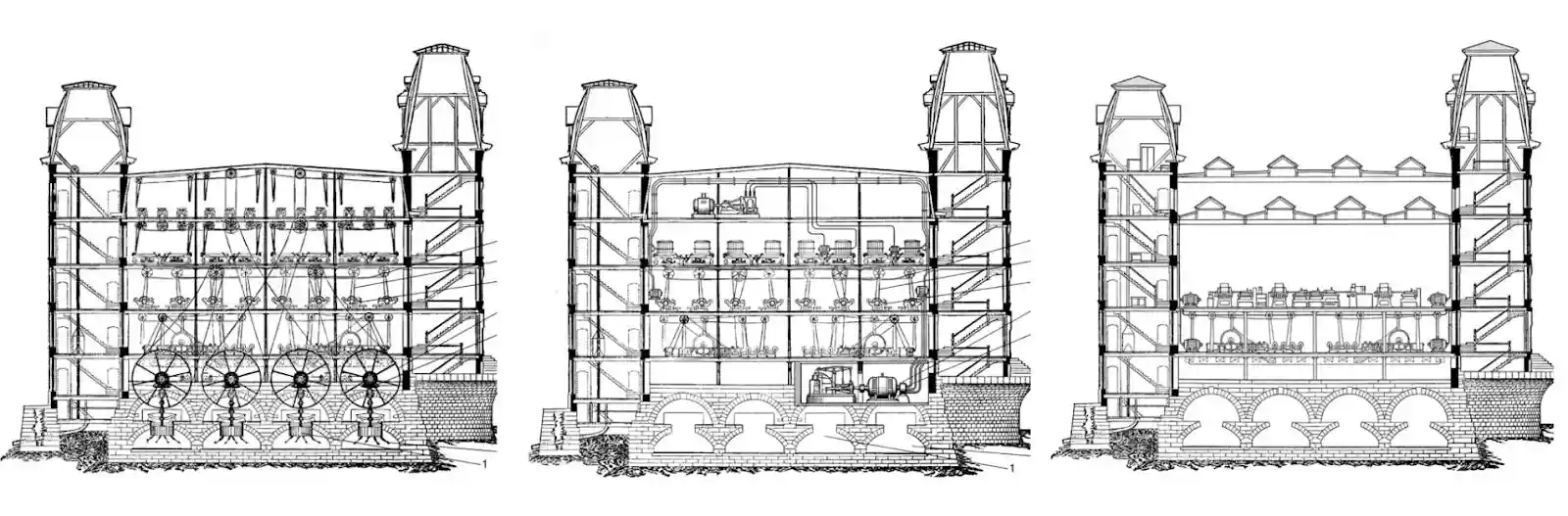
Caption: The three evolutions of the Lowell Textile Mill. From left to right: 1890 steam-powered factory, 1900 electric motor-driven factory, 1920 "unit drive" factory (completely rebuilt from scratch as an electric assembly line).

The returns didn't come from the technology itself, nor from making a single worker or machine spin faster. They came when we finally redesigned the institution and the technology together.

This is the most expensive lesson in technological history, and we are relearning it now.

In 2026, AI is delivering 10x productivity gains for those who know how to use it. But it's not enough. We've replaced the motor, but we haven't redesigned the factory.

Because of a simple fact: Efficient individuals do not equal an efficient organization.

The vast majority of AI products give the feeling of "efficiency" but don't actually drive value. Most of the AI use cases you see are self-congratulatory "efficiency max" posts by individuals on Twitter or company Slack, with zero real impact.
The often-repeated "Service as Software" idea from the past year is on the right track but doesn't provide a blueprint. And it misses the bigger picture. The real shift isn't from tool to service, but building technology and institution together (whether retrofitting the old or building from scratch). A truly efficient future requires a whole new category of products—tomorrow's assembly lines.

Efficient organizations need "Institutional Intelligence".

This article will delve into the seven dimensions that distinguish "Institutional AI" from "Personal AI". Companies across the B2B AI space in the next decade will be built on these differences:
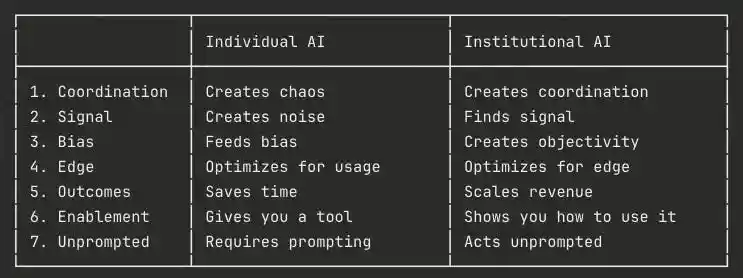
Caption: Comparison table of the seven pillars of Institutional Intelligence

The Seven Pillars of Institutional Intelligence

1. Coordination

Personal AI creates chaos.

Institutional AI creates coordination.

Start with a thought experiment. Suppose you double the number of people in your organization tomorrow, cloning your best employees.

These employees all have slight differences, preferences, quirks, and perspectives (your best employees especially). If not managed properly, with insufficient communication, undefined responsibilities, OKRs, role boundaries... you create chaos.

Measured individually, the organization might be more efficient. But thousands of Agents (or humans) each rowing their own oar, in opposite directions, the best outcome is staying in place, the worst is tearing the organizational cohesion apart.

This is not a hypothesis. Every organization adopting AI without a coordination layer is experiencing this right now. Every employee has their own ChatGPT habits, their own prompt style, their own output—with no connection to anyone else's. The org chart might still exist, but the AI-generated work effectively follows a different path.
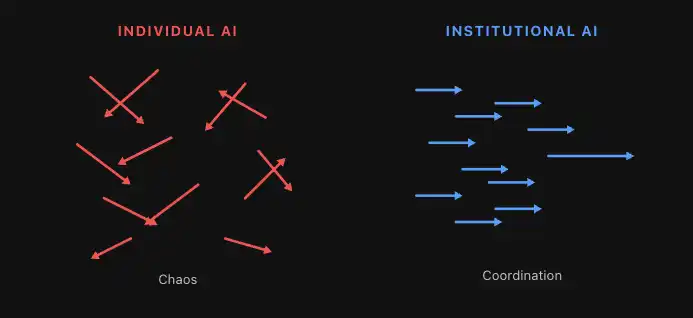
Caption: Efficient individuals (or Agents) rowing in different directions. Without coordination, it's chaos.

Coordination is an absolute hard requirement, for both humans and Agents.

Institutional intelligence will spawn an entire "Agent Management" industry—focused on Agent roles and responsibilities, communication between Agents and between Agents and humans, and how to measure Agent value (pay-per-use is far from enough).

2. Signal

Personal AI creates noise.

Institutional AI finds signal.

Humans today can create—or generate—anything imaginable: AI-written articles, presentations, spreadsheets, photos, videos, songs, websites, software. What a gift.

The problem is, the vast majority of AI-generated content is utter garbage. The flood of AI junk has gotten so bad that some organizations are overcorrecting, simply banning all AI output. Honestly, I feel the same—I run an AI company but ask my executive team not to use AI on any final written product. I can't stand the junk.

Think about what's happening in the PE (Private Equity) industry. Last year, you might have received 10 deal opportunities on your desk. This year, next quarter you'll receive 50 opportunities, each polished to perfection by AI, and you have the same amount of time to judge—to find the one truly solid deal among them.

Generating anything is no longer the problem. For any serious organization, the problem now is generating and filtering for the *right* things. In an AI-driven world, finding that one good deliverable, that one good deal, the signal in the noise, is increasingly critical. The core economic driver of the next decade will be digging the signal out of an exponentially growing mountain of garbage.
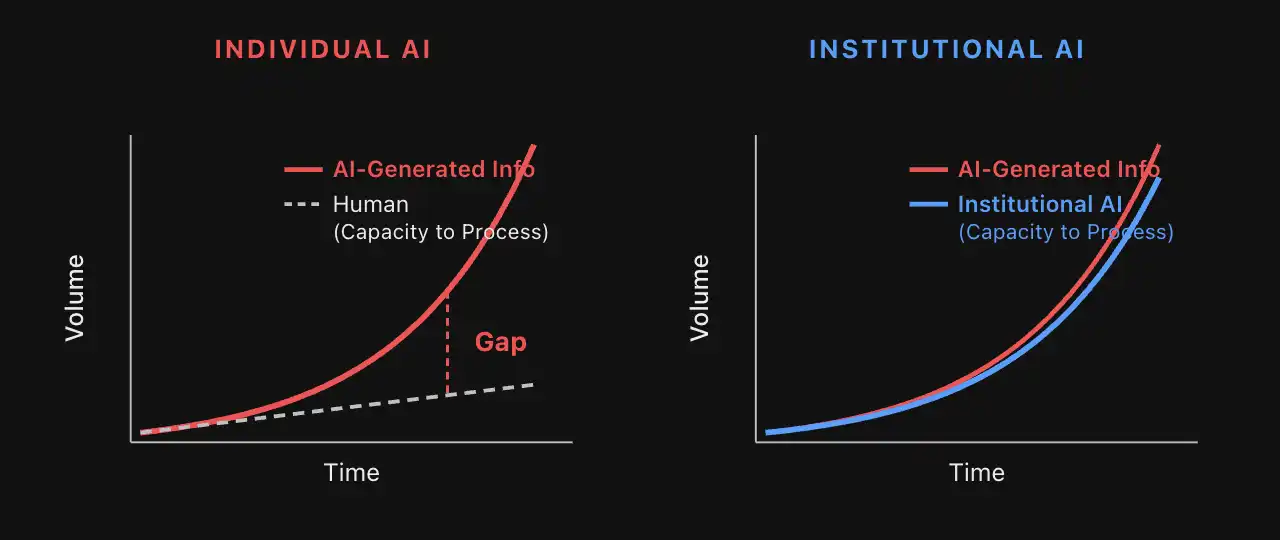
Caption: AI junk generated by personal productivity tools is proliferating exponentially. Humans can no longer sort through the noise themselves; a new class of institutional AI products is needed.

Institutional intelligence must find the signal, must structure the noise to penetrate the junk, and must be definable, deterministic, and auditable in its work.

Personal AI might emphasize the "always-on" productivity of a Clawdbot, satisfying your needs 24/7 in unpredictable ways—essentially non-deterministic Agents. Institutional AI relies on the reliability of deterministic Agents. Agents with predictable checkpoints, steps, and processes can scale, can discover signals, and through these signals drive revenue returns for the organization.

Caption: Matrix is a tool that uses generative technology to cut through noise, opening up a world of deterministic Agents and checkpoints.

3. Bias

Personal AI feeds bias.

Institutional AI creates objectivity.

Discussions around socio-political bias dominated AI discourse for years. The foundational model labs eventually bypassed this with enough RLHF, tuning all models into sycophants. Today, ChatGPT, Claude, and other models are so over-aligned that they agree with you on any topic within the Overton window (and sometimes slightly beyond, looking at you @Grok). The socio-political bias discussion has faded. But a new problem has taken its place.

This over-agreement on everything has become absurdly comical. It's a meme in itself—Claude's reflexive "You're absolutely right!", whether you are absolutely right or not.

This sounds harmless. It's not.

The people pushing AI hardest in many organizations might soon be the historically worst-performing employees. Think about why.

The worst-performing employees in an organization, who get almost no positive feedback all day, will soon have an ASI agreeing with them constantly. They'll think to themselves: 'The smartest intelligence ever agrees with me. My manager is wrong.'

This is addictive. And toxic to the organization.
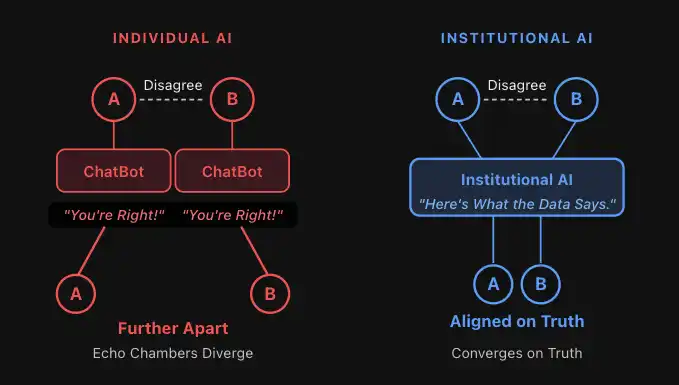
Caption: The echo chamber of personal AI exacerbates division, driving two people further apart; this dynamic, when scaled, creates factions within a previously cohesive organization.

This reveals something important. Personal productivity tools reinforce the user. But what should truly be reinforced is the truth.

Human organizations, over millennia of evolution, built systems specifically to combat this problem:

  • Investment committee meetings
  • Third-party due diligence
  • Boards of directors
  • The US government branches: executive, legislative, judicial
  • Representative democracy, and democracy itself
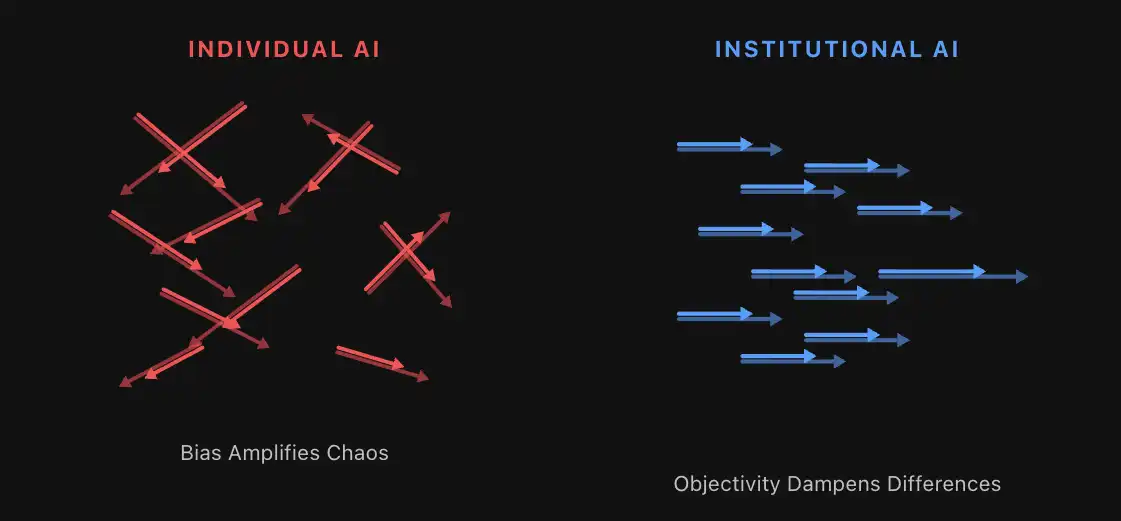
Caption: Objectivity can even mitigate coordination problems—suppressing small disagreements rather than amplifying them.

Organizations rarely fail because employees lack confidence. They fail because no one is willing or able to say "no".

Institutional AI must play this role. It won't be tuned with RLHF to please the user or echo their beliefs, but to challenge their biases. Give positive feedback when behavior is efficient, draw hard lines and enforce corrections when they deviate.

Therefore, the most important Agents within an organization won't be "yes-men", but disciplined "naysayers"—questioning reasoning, exposing risks, enforcing standards. Some of the most impactful AI applications in the future will be built around institutional constraints: AI board members, AI auditors, AI third-party testing, AI compliance...

4. Edge Advantage

Personal AI optimizes for usage.

Institutional AI optimizes for edge advantage.

The capability frontier of AI moves weekly, even daily. Foundational model companies are iterating capabilities rapidly, competing for every person and every organization.

But the classic innovator's dilemma tells us that depth always beats breadth in specific applications:

  • @Midjourney's job is to stay slightly ahead in design imagery.
  • @Elevenlabsio's job is to stay slightly ahead in voice models.
  • @DecagonAI's job is to stay forever ahead in the full-stack customer service experience.

While foundational models will get closer, for domain experts, the true edge advantage is key. Many of the best designers use @Midjourney, many of the best voice AI companies use @Elevenlabsio—because even as foundational models improve, the relentless focus of specialized applications on pushing their specific edge advantage itself defines the advantage.

As long as specialized solutions also evolve, the capabilities that truly matter for economic outcomes—that matter for the enterprise—will always reside with the specialized product.

This is most evident in finance—currently the hottest area for LLM development. Once a capability becomes commoditized, by definition it won't help you beat the market. But if cutting-edge technology can yield a fleeting 1% niche advantage? That 1% can drive billion-dollar returns.
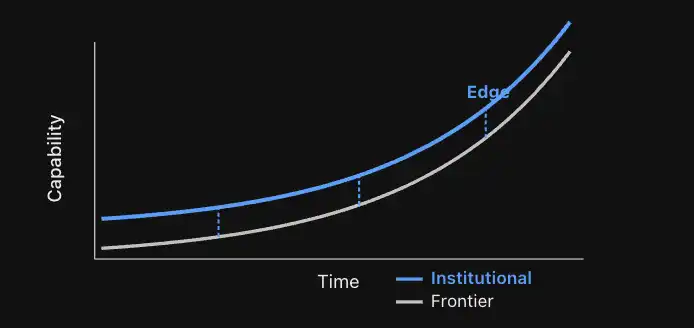
Caption: For any sufficiently specific task, the edge advantage is defined by the institutional solution you build on top of the frontier technology.

Our users are constantly pushing beyond the frontier. The LLM context window grew from 4K to 1 million tokens in four years. Some of our users process 30 billion tokens in a single task. This year we already see a path to processing 100 billion token tasks. Every time the foundational model capability increases, we've gone further.
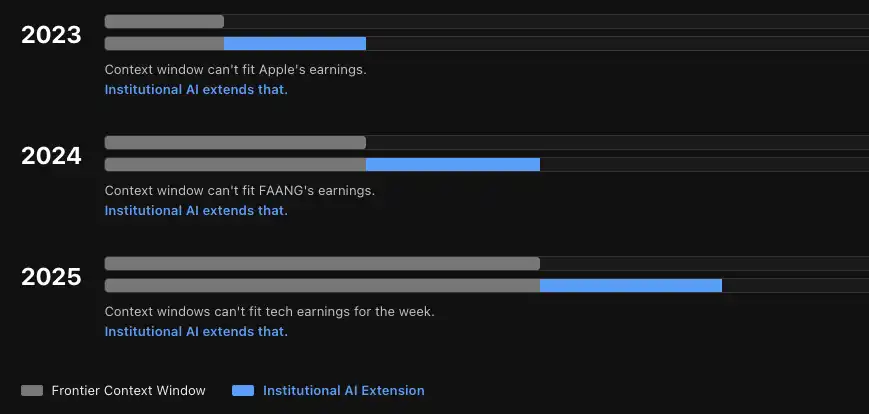
Caption: Context windows, like other capabilities, are a moving target. Comparison of context window evolution over the past three years between frontier labs and Hebbia.

Generality for a broad user base is certainly important, especially in the phase of onboarding employees to AI. But the future won't be people using ChatGPT/Claude *or* vertical solutions, but ChatGPT/Claude *plus* vertical solutions.

Institutional intelligence must leverage domain-specific, even task-specific Agents.

We ask ourselves a question that sounds absurd but isn't:

"Which Agents would an AGI choose to use as shortcuts? Even a superintelligence would want specialized tools for specific domains."

The AI capability frontier will always move, and the winners will be those organizations that leverage the true edge advantage. Everyone else is paying for a very expensive generic commodity.

5. Outcome

Personal AI saves time.

Institutional AI increases revenue.

@MaVolpi once told me something that reshaped my thinking about selling AI to enterprises: "If you ask any CEO whether they prioritize cost-cutting or revenue growth, almost all will say revenue."

But almost every AI product on the market today delivers cost reduction—promising to save you time, do more with fewer people, or replace manpower.

Institutional AI must deliver incremental gains. And incremental gains are much harder to commoditize than saved time.

Take AI-assisted software development. Code IDEs are among the best personal AI productivity tools ever, but they are already facing huge pressure from Claude Code (another personal AI tool). Cognition is playing a completely different game. Their most stable growth business is selling transformation with technology, not selling tools. I bet this model will have staying power.

Pure software is rapidly becoming "uninvestable". Pure services don't scale. The solution layer—where technology and outcomes are bundled together—is where lasting value accrues.

Look at M&A. Personal AI helps analysts model faster. Institutional AI identifies the one worthy acquisition target out of a hundred, then expands the search to a thousand. One saves time, the other creates revenue.
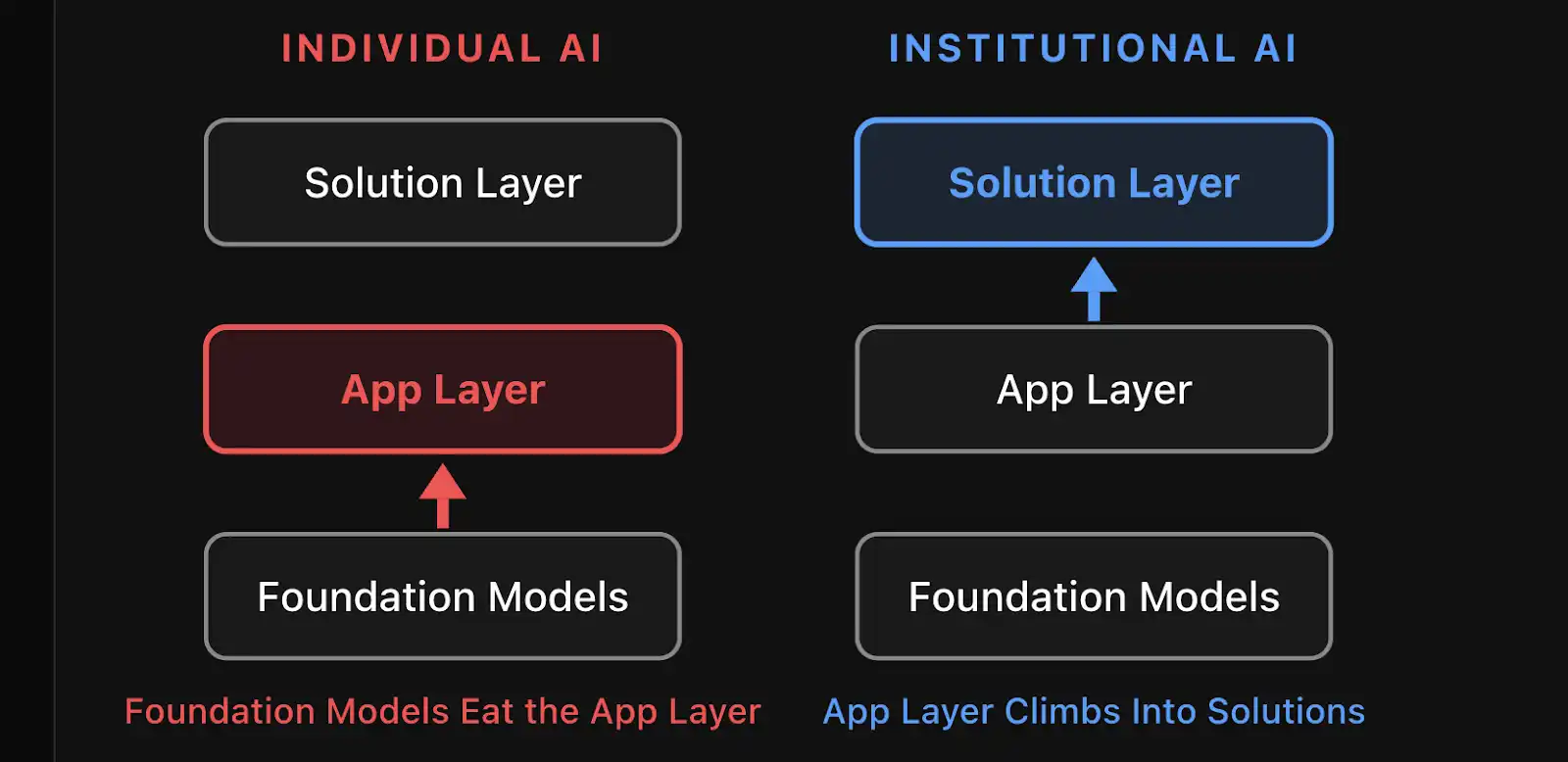
Caption: Foundational model companies are moving up into the application layer. Application layer companies are moving up into the solution layer.

"Moving upstream" is the natural gravitational pull of the market right now. Foundational models are moving into the application layer, application layer companies are moving into the solution layer.

Institutional intelligence *is* the solution layer. And the solution layer—where the outcomes are—will accrue lasting value and capture the largest share of the gains.

6. Enablement

Personal AI gives you a tool.

Institutional AI teaches you how to use it.

No matter how smart, humans resist change.

Believe it or not, there are still successful stores in New York that don't accept credit cards. They know they're losing money, know they lose money by not accepting cards, but just don't move. Similarly, for the foreseeable future, certain employees in certain organizations will simply refuse to use AI.

Transitioning from a purely human organization to an AI-first hybrid organization will be the most persistent, defining challenge of the next decade. And often, the highest-level, most important people in the organization are the last to adopt.
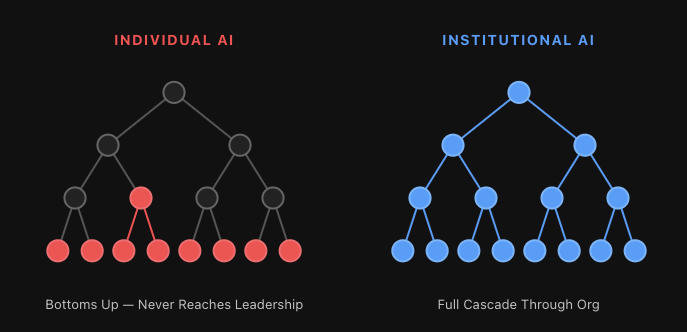
Caption: The highest levels of an organization—those furthest from "productivity tool operation"—are often the slowest but most critical group to adopt new technology.

Palantir is the only "software" company that maintained sky-high valuation multiples during the trillion-dollar tech sell-off of the past two months. There's a reason. Palantir was one of the first true "process engineering" companies. Whether you call it "process engineering" or "writing Claude skill files", the institutional AI of the future will spawn an industry: encoding enterprise processes into Agents and implementing the required change management.
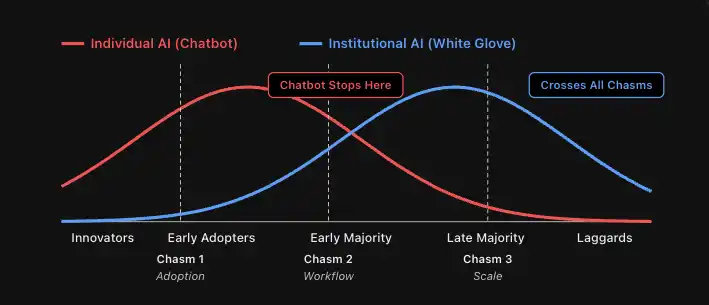
Caption: Full organizational AI adoption will cross multiple chasms, each with its own challenges. Getting processes onto AI will be a major driver.

I'd argue process engineering will be the most important "technology" in the near term.

And in process engineering, business and industry expertise—not software expertise—is paramount. Vertical solutions will cultivate talent with deep expertise in frontline deployment engineering, implementation, and change management.

A top investment bank (top 3 bulge bracket) that chose Hebbia for a full deployment put it best: the reason they didn't go with a major model lab was that "we'd have to explain to their team what a CIM (Confidential Information Memorandum) is". Claude or GPT might understand the domain, but the team responsible for rollout didn't...

This difference is everything.

7. Promptlessness

Personal AI responds to human prompts.

Institutional AI acts proactively, without needing prompts.

There's much discussion about communication between Agents, whether future enterprises and institutions will even need humans.

But the better question is: Will future AI Agents even need prompts?

Writing prompts for AGI is like connecting an electric motor to a handloom. It is fundamentally, irreversibly limited by the weakest link in the organizational supply chain—ourselves. Humans simply don't know the right questions to ask, let alone when to ask them.

The most valuable work AI can do is the work no one thought to ask for. AI should find risks no one spotted, counterparties no one thought of, sales pipelines no one knew existed.

This will completely open up the boundaries of AI use cases.

A promptless system continuously monitors data streams across the entire investment portfolio. It notices the working capital cycle of one portfolio company has been quietly deteriorating for three consecutive months, cross-references it with covenants in the credit agreement, and notifies the operating partner before anyone in the fund even opens that PDF.

When you no longer need humans to prompt the AI, new interfaces and new ways of working emerge. We @Hebbia have strong opinions here. More on that later.

Conclusion

None of this negates the value of chatbots, Agents, and personal AI.

Personal AI will be the vehicle through which most businesses globally first experience the transformative magic of AI. Driving usage, driving ease of use, is a critical first step in the change management needed to build an AI-first economy.

But simultaneously, the need for institutional intelligence is clear, urgent, and massive.

Every organization of the future will have a chatbot from a major model lab. Every organization will also have institutional AI built for specific domain problems—and personal AI will use institutional AI as the most critical tool in its own toolbox.

The "better together" of institutional AI and personal AI is inevitable.

But remember the lesson of the 1890s textile mills. The factories that electrified first lost to the factories that redesigned the workshop.

We have the electricity. It's time to redesign our factories.

Thanks to @aleximm and @WillManidis for review, and Will's "Tool-Shaped Objects" article for inspiring this piece.


Perguntas relacionadas

QWhat is the core argument of the article regarding AI and organizational value?

AThe core argument is that while AI can make individual workers 10x more efficient, it does not automatically make companies 10x more valuable. The real gains come from redesigning the entire organization and its processes around AI, not just adopting the technology itself.

QWhat historical analogy does the author use to illustrate the disconnect between technology adoption and organizational transformation?

AThe author uses the historical analogy of New England textile mills in the 1890s. They initially replaced steam engines with faster electric motors but saw no productivity gains for 30 years. It was only in the 1920s, when factories were completely redesigned with assembly lines and specialized roles for workers and machines, that the true benefits of electrification were realized.

QWhat are the seven key dimensions that distinguish 'Institutional AI' from 'Individual AI'?

AThe seven dimensions are: 1. Coordination (creates alignment vs. creates chaos), 2. Signal (finds signal vs. creates noise), 3. Bias (creates objectivity vs. feeds bias), 4. Edge Advantage (optimizes for a marginal edge vs. optimizes for usage), 5. Results (drives revenue vs. saves time), 6. Enablement (teaches you how to use it vs. gives you a tool), and 7. Promptless (acts autonomously vs. responds to human prompts).

QAccording to the article, why is 'coordination' a critical challenge for AI adoption in organizations?

ACoordination is critical because without it, efficient individuals (or AI agents) working with their own prompts, styles, and outputs create chaos instead of collective value. They work at cross-purposes, similar to people rowing in different directions, which can dismantle organizational cohesion rather than enhance it. A dedicated 'coordination layer' or 'agent management' is a hard requirement.

QWhat shift in the AI market does the article predict regarding where lasting value will be captured?

AThe article predicts a natural market gravitation 'upstream'. Foundational model companies are moving into the application layer, and application-layer companies are moving into the solutions layer. The solutions layer'—where outcomes and results are delivered—is where lasting value will be captured and the largest profit margins will be found, as opposed to pure software (which is becoming un-investable) or pure services (which don't scale).

Leituras Relacionadas

Trading

Spot
Futuros

Artigos em Destaque

O que é GROK AI

Grok AI: Revolucionar a Tecnologia Conversacional na Era Web3 Introdução No panorama em rápida evolução da inteligência artificial, a Grok AI destaca-se como um projeto notável que liga os domínios da tecnologia avançada e da interação com o utilizador. Desenvolvida pela xAI, uma empresa liderada pelo renomado empreendedor Elon Musk, a Grok AI procura redefinir a forma como interagimos com a inteligência artificial. À medida que o movimento Web3 continua a florescer, a Grok AI visa aproveitar o poder da IA conversacional para responder a consultas complexas, proporcionando aos utilizadores uma experiência que é não apenas informativa, mas também divertida. O que é a Grok AI? A Grok AI é um sofisticado chatbot de IA conversacional projetado para interagir com os utilizadores de forma dinâmica. Ao contrário de muitos sistemas de IA tradicionais, a Grok AI abraça uma gama mais ampla de perguntas, incluindo aquelas tipicamente consideradas inadequadas ou fora das respostas padrão. Os principais objetivos do projeto incluem: Raciocínio Fiável: A Grok AI enfatiza o raciocínio de senso comum para fornecer respostas lógicas com base na compreensão contextual. Supervisão Escalável: A integração de assistência de ferramentas garante que as interações dos utilizadores sejam monitorizadas e otimizadas para qualidade. Verificação Formal: A segurança é primordial; a Grok AI incorpora métodos de verificação formal para aumentar a fiabilidade das suas saídas. Compreensão de Longo Contexto: O modelo de IA destaca-se na retenção e recordação de um extenso histórico de conversas, facilitando discussões significativas e contextualizadas. Robustez Adversarial: Ao focar na melhoria das suas defesas contra entradas manipuladas ou maliciosas, a Grok AI visa manter a integridade das interações dos utilizadores. Em essência, a Grok AI não é apenas um dispositivo de recuperação de informações; é um parceiro conversacional imersivo que incentiva um diálogo dinâmico. Criador da Grok AI A mente por trás da Grok AI não é outra senão Elon Musk, um indivíduo sinónimo de inovação em vários campos, incluindo automóvel, viagens espaciais e tecnologia. Sob a égide da xAI, uma empresa focada em avançar a tecnologia de IA de maneiras benéficas, a visão de Musk visa reformular a compreensão das interações com a IA. A liderança e a ética fundacional são profundamente influenciadas pelo compromisso de Musk em ultrapassar os limites tecnológicos. Investidores da Grok AI Embora os detalhes específicos sobre os investidores que apoiam a Grok AI permaneçam limitados, é reconhecido publicamente que a xAI, a incubadora do projeto, é fundada e apoiada principalmente pelo próprio Elon Musk. As anteriores empreitadas e participações de Musk fornecem um forte apoio, reforçando ainda mais a credibilidade e o potencial de crescimento da Grok AI. No entanto, até agora, informações sobre fundações ou organizações de investimento adicionais que apoiam a Grok AI não estão prontamente acessíveis, marcando uma área para exploração futura potencial. Como Funciona a Grok AI? A mecânica operacional da Grok AI é tão inovadora quanto a sua estrutura conceptual. O projeto integra várias tecnologias de ponta que facilitam as suas funcionalidades únicas: Infraestrutura Robusta: A Grok AI é construída utilizando Kubernetes para orquestração de contêineres, Rust para desempenho e segurança, e JAX para computação numérica de alto desempenho. Este trio assegura que o chatbot opere de forma eficiente, escale eficazmente e sirva os utilizadores prontamente. Acesso a Conhecimento em Tempo Real: Uma das características distintivas da Grok AI é a sua capacidade de aceder a dados em tempo real através da plataforma X—anteriormente conhecida como Twitter. Esta capacidade concede à IA acesso às informações mais recentes, permitindo-lhe fornecer respostas e recomendações oportunas que outros modelos de IA poderiam perder. Dois Modos de Interação: A Grok AI oferece aos utilizadores a escolha entre “Modo Divertido” e “Modo Regular”. O Modo Divertido permite um estilo de interação mais lúdico e humorístico, enquanto o Modo Regular foca em fornecer respostas precisas e exatas. Esta versatilidade assegura uma experiência adaptada que atende a várias preferências dos utilizadores. Em essência, a Grok AI combina desempenho com envolvimento, criando uma experiência que é tanto enriquecedora quanto divertida. Cronologia da Grok AI A jornada da Grok AI é marcada por marcos fundamentais que refletem as suas fases de desenvolvimento e implementação: Desenvolvimento Inicial: A fase fundamental da Grok AI ocorreu ao longo de aproximadamente dois meses, durante os quais o treinamento inicial e o ajuste do modelo foram realizados. Lançamento Beta do Grok-2: Numa evolução significativa, o beta do Grok-2 foi anunciado. Este lançamento introduziu duas versões do chatbot—Grok-2 e Grok-2 mini—cada uma equipada com capacidades para conversar, programar e raciocinar. Acesso Público: Após o seu desenvolvimento beta, a Grok AI tornou-se disponível para os utilizadores da plataforma X. Aqueles com contas verificadas por um número de telefone e ativas há pelo menos sete dias podem aceder a uma versão limitada, tornando a tecnologia disponível para um público mais amplo. Esta cronologia encapsula o crescimento sistemático da Grok AI desde a sua concepção até ao envolvimento público, enfatizando o seu compromisso com a melhoria contínua e a interação com o utilizador. Principais Características da Grok AI A Grok AI abrange várias características principais que contribuem para a sua identidade inovadora: Integração de Conhecimento em Tempo Real: O acesso a informações atuais e relevantes diferencia a Grok AI de muitos modelos estáticos, permitindo uma experiência de utilizador envolvente e precisa. Estilos de Interação Versáteis: Ao oferecer modos de interação distintos, a Grok AI atende a várias preferências dos utilizadores, convidando à criatividade e personalização na conversa com a IA. Base Tecnológica Avançada: A utilização de Kubernetes, Rust e JAX fornece ao projeto uma estrutura sólida para garantir fiabilidade e desempenho ótimo. Consideração de Discurso Ético: A inclusão de uma função de geração de imagens demonstra o espírito inovador do projeto. No entanto, também levanta considerações éticas em torno dos direitos autorais e da representação respeitosa de figuras reconhecíveis—uma discussão em curso dentro da comunidade de IA. Conclusão Como uma entidade pioneira no domínio da IA conversacional, a Grok AI encapsula o potencial para experiências transformadoras do utilizador na era digital. Desenvolvida pela xAI e impulsionada pela abordagem visionária de Elon Musk, a Grok AI integra conhecimento em tempo real com capacidades avançadas de interação. Esforça-se por ultrapassar os limites do que a inteligência artificial pode alcançar, mantendo um foco nas considerações éticas e na segurança do utilizador. A Grok AI não apenas incorpora o avanço tecnológico, mas também representa um novo paradigma de conversas no panorama Web3, prometendo envolver os utilizadores com conhecimento hábil e interação lúdica. À medida que o projeto continua a evoluir, ele permanece como um testemunho do que a interseção da tecnologia, criatividade e interação humana pode alcançar.

351 Visualizações TotaisPublicado em {updateTime}Atualizado em 2024.12.26

O que é GROK AI

O que é ERC AI

Euruka Tech: Uma Visão Geral do $erc ai e as suas Ambições no Web3 Introdução No panorama em rápida evolução da tecnologia blockchain e das aplicações descentralizadas, novos projetos surgem frequentemente, cada um com objetivos e metodologias únicas. Um desses projetos é a Euruka Tech, que opera no vasto domínio das criptomoedas e do Web3. O foco principal da Euruka Tech, particularmente do seu token $erc ai, é apresentar soluções inovadoras concebidas para aproveitar as capacidades crescentes da tecnologia descentralizada. Este artigo tem como objetivo fornecer uma visão abrangente da Euruka Tech, uma exploração das suas metas, funcionalidade, a identidade do seu criador, potenciais investidores e a sua importância no contexto mais amplo do Web3. O que é a Euruka Tech, $erc ai? A Euruka Tech é caracterizada como um projeto que aproveita as ferramentas e funcionalidades oferecidas pelo ambiente Web3, focando na integração da inteligência artificial nas suas operações. Embora os detalhes específicos sobre a estrutura do projeto sejam um tanto elusivos, ele é concebido para melhorar o envolvimento dos utilizadores e automatizar processos no espaço cripto. O projeto visa criar um ecossistema descentralizado que não só facilita transações, mas também incorpora funcionalidades preditivas através da inteligência artificial, daí a designação do seu token, $erc ai. O objetivo é fornecer uma plataforma intuitiva que facilite interações mais inteligentes e um processamento eficiente de transações dentro da crescente esfera do Web3. Quem é o Criador da Euruka Tech, $erc ai? Neste momento, a informação sobre o criador ou a equipa fundadora da Euruka Tech permanece não especificada e algo opaca. Esta ausência de dados levanta preocupações, uma vez que o conhecimento sobre o histórico da equipa é frequentemente essencial para estabelecer credibilidade no setor blockchain. Portanto, categorizamos esta informação como desconhecida até que detalhes concretos sejam disponibilizados no domínio público. Quem são os Investidores da Euruka Tech, $erc ai? De forma semelhante, a identificação de investidores ou organizações de apoio para o projeto Euruka Tech não é prontamente fornecida através da pesquisa disponível. Um aspeto que é crucial para potenciais partes interessadas ou utilizadores que consideram envolver-se com a Euruka Tech é a garantia que vem de parcerias financeiras estabelecidas ou apoio de empresas de investimento respeitáveis. Sem divulgações sobre afiliações de investimento, é difícil tirar conclusões abrangentes sobre a segurança financeira ou a longevidade do projeto. Em linha com a informação encontrada, esta seção também se encontra no estado de desconhecido. Como funciona a Euruka Tech, $erc ai? Apesar da falta de especificações técnicas detalhadas para a Euruka Tech, é essencial considerar as suas ambições inovadoras. O projeto procura aproveitar o poder computacional da inteligência artificial para automatizar e melhorar a experiência do utilizador no ambiente das criptomoedas. Ao integrar IA com tecnologia blockchain, a Euruka Tech visa fornecer funcionalidades como negociações automatizadas, avaliações de risco e interfaces de utilizador personalizadas. A essência inovadora da Euruka Tech reside no seu objetivo de criar uma conexão fluida entre os utilizadores e as vastas possibilidades apresentadas pelas redes descentralizadas. Através da utilização de algoritmos de aprendizagem automática e IA, visa minimizar os desafios enfrentados por utilizadores de primeira viagem e agilizar as experiências transacionais dentro do quadro do Web3. Esta simbiose entre IA e blockchain sublinha a importância do token $erc ai, que se apresenta como uma ponte entre interfaces de utilizador tradicionais e as capacidades avançadas das tecnologias descentralizadas. Cronologia da Euruka Tech, $erc ai Infelizmente, devido à informação limitada disponível sobre a Euruka Tech, não conseguimos apresentar uma cronologia detalhada dos principais desenvolvimentos ou marcos na jornada do projeto. Esta cronologia, tipicamente inestimável para traçar a evolução de um projeto e compreender a sua trajetória de crescimento, não está atualmente disponível. À medida que informações sobre eventos notáveis, parcerias ou adições funcionais se tornem evidentes, atualizações certamente aumentarão a visibilidade da Euruka Tech na esfera cripto. Esclarecimento sobre Outros Projetos “Eureka” É importante abordar que múltiplos projetos e empresas partilham uma nomenclatura semelhante com “Eureka.” A pesquisa identificou iniciativas como um agente de IA da NVIDIA Research, que se concentra em ensinar robôs a realizar tarefas complexas utilizando métodos generativos, bem como a Eureka Labs e a Eureka AI, que melhoram a experiência do utilizador na educação e na análise de serviços ao cliente, respetivamente. No entanto, estes projetos são distintos da Euruka Tech e não devem ser confundidos com os seus objetivos ou funcionalidades. Conclusão A Euruka Tech, juntamente com o seu token $erc ai, representa um jogador promissor, mas atualmente obscuro, dentro do panorama do Web3. Embora os detalhes sobre o seu criador e investidores permaneçam não divulgados, a ambição central de combinar inteligência artificial com tecnologia blockchain destaca-se como um ponto focal de interesse. As abordagens únicas do projeto em promover o envolvimento do utilizador através da automação avançada podem diferenciá-lo à medida que o ecossistema Web3 avança. À medida que o mercado cripto continua a evoluir, as partes interessadas devem manter um olhar atento sobre os avanços em torno da Euruka Tech, uma vez que o desenvolvimento de inovações documentadas, parcerias ou um roteiro definido pode apresentar oportunidades significativas no futuro próximo. Neste momento, aguardamos por insights mais substanciais que possam desvendar o potencial da Euruka Tech e a sua posição no competitivo panorama cripto.

400 Visualizações TotaisPublicado em {updateTime}Atualizado em 2025.01.02

O que é ERC AI

O que é DUOLINGO AI

DUOLINGO AI: Integrar a Aprendizagem de Línguas com Inovação Web3 e IA Numa era em que a tecnologia transforma a educação, a integração da inteligência artificial (IA) e das redes blockchain anuncia uma nova fronteira para a aprendizagem de línguas. Apresentamos DUOLINGO AI e a sua criptomoeda associada, $DUOLINGO AI. Este projeto aspira a unir o poder educativo das principais plataformas de aprendizagem de línguas com os benefícios da tecnologia descentralizada Web3. Este artigo explora os principais aspectos do DUOLINGO AI, analisando os seus objetivos, estrutura tecnológica, desenvolvimento histórico e potencial futuro, mantendo a clareza entre o recurso educativo original e esta iniciativa independente de criptomoeda. Visão Geral do DUOLINGO AI No seu cerne, DUOLINGO AI procura estabelecer um ambiente descentralizado onde os alunos podem ganhar recompensas criptográficas por alcançar marcos educativos em proficiência linguística. Ao aplicar contratos inteligentes, o projeto visa automatizar processos de verificação de habilidades e alocação de tokens, aderindo aos princípios do Web3 que enfatizam a transparência e a propriedade do utilizador. O modelo diverge das abordagens tradicionais de aquisição de línguas ao apoiar-se fortemente numa estrutura de governança orientada pela comunidade, permitindo que os detentores de tokens sugiram melhorias ao conteúdo dos cursos e à distribuição de recompensas. Alguns dos objetivos notáveis do DUOLINGO AI incluem: Aprendizagem Gamificada: O projeto integra conquistas em blockchain e tokens não fungíveis (NFTs) para representar níveis de proficiência linguística, promovendo a motivação através de recompensas digitais envolventes. Criação de Conteúdo Descentralizada: Abre caminhos para educadores e entusiastas de línguas contribuírem com os seus cursos, facilitando um modelo de partilha de receitas que beneficia todos os colaboradores. Personalização Através de IA: Ao empregar modelos avançados de aprendizagem de máquina, o DUOLINGO AI personaliza as lições para se adaptar ao progresso de aprendizagem individual, semelhante às características adaptativas encontradas em plataformas estabelecidas. Criadores do Projeto e Governança A partir de abril de 2025, a equipa por trás do $DUOLINGO AI permanece pseudónima, uma prática frequente no panorama descentralizado das criptomoedas. Esta anonimidade visa promover o crescimento coletivo e o envolvimento das partes interessadas, em vez de se concentrar em desenvolvedores individuais. O contrato inteligente implementado na blockchain Solana indica o endereço da carteira do desenvolvedor, o que significa o compromisso com a transparência em relação às transações, apesar da identidade dos criadores ser desconhecida. De acordo com o seu roteiro, o DUOLINGO AI pretende evoluir para uma Organização Autónoma Descentralizada (DAO). Esta estrutura de governança permite que os detentores de tokens votem em questões críticas, como implementações de funcionalidades e alocação de tesouraria. Este modelo alinha-se com a ética de empoderamento comunitário encontrada em várias aplicações descentralizadas, enfatizando a importância da tomada de decisão coletiva. Investidores e Parcerias Estratégicas Atualmente, não existem investidores institucionais ou capitalistas de risco publicamente identificáveis ligados ao $DUOLINGO AI. Em vez disso, a liquidez do projeto origina-se principalmente de trocas descentralizadas (DEXs), marcando um contraste acentuado com as estratégias de financiamento das empresas tradicionais de tecnologia educacional. Este modelo de base indica uma abordagem orientada pela comunidade, refletindo o compromisso do projeto com a descentralização. No seu whitepaper, o DUOLINGO AI menciona a formação de colaborações com “plataformas de educação blockchain” não especificadas, com o objetivo de enriquecer a sua oferta de cursos. Embora parcerias específicas ainda não tenham sido divulgadas, estes esforços colaborativos sugerem uma estratégia para misturar inovação em blockchain com iniciativas educativas, expandindo o acesso e o envolvimento dos utilizadores em diversas vias de aprendizagem. Arquitetura Tecnológica Integração de IA O DUOLINGO AI incorpora dois componentes principais impulsionados por IA para melhorar as suas ofertas educativas: Motor de Aprendizagem Adaptativa: Este motor sofisticado aprende a partir das interações dos utilizadores, semelhante a modelos proprietários de grandes plataformas educativas. Ele ajusta dinamicamente a dificuldade das lições para abordar desafios específicos dos alunos, reforçando áreas fracas através de exercícios direcionados. Agentes Conversacionais: Ao empregar chatbots alimentados por GPT-4, o DUOLINGO AI oferece uma plataforma para os utilizadores se envolverem em conversas simuladas, promovendo uma experiência de aprendizagem de línguas mais interativa e prática. Infraestrutura Blockchain Construído na blockchain Solana, o $DUOLINGO AI utiliza uma estrutura tecnológica abrangente que inclui: Contratos Inteligentes de Verificação de Habilidades: Esta funcionalidade atribui automaticamente tokens aos utilizadores que passam com sucesso em testes de proficiência, reforçando a estrutura de incentivos para resultados de aprendizagem genuínos. Emblemas NFT: Estes tokens digitais significam vários marcos que os alunos alcançam, como completar uma seção do seu curso ou dominar habilidades específicas, permitindo-lhes negociar ou exibir as suas conquistas digitalmente. Governança DAO: Membros da comunidade com tokens podem participar na governança votando em propostas-chave, facilitando uma cultura participativa que incentiva a inovação nas ofertas de cursos e funcionalidades da plataforma. Cronologia Histórica 2022–2023: Conceituação O trabalho preliminar para o DUOLINGO AI começa com a criação de um whitepaper, destacando a sinergia entre os avanços em IA na aprendizagem de línguas e o potencial descentralizado da tecnologia blockchain. 2024: Lançamento Beta Um lançamento beta limitado introduz ofertas em línguas populares, recompensando os primeiros utilizadores com incentivos em tokens como parte da estratégia de envolvimento comunitário do projeto. 2025: Transição para DAO Em abril, ocorre um lançamento completo da mainnet com a circulação de tokens, promovendo discussões comunitárias sobre possíveis expansões para línguas asiáticas e outros desenvolvimentos de cursos. Desafios e Direções Futuras Obstáculos Técnicos Apesar dos seus objetivos ambiciosos, o DUOLINGO AI enfrenta desafios significativos. A escalabilidade continua a ser uma preocupação constante, particularmente no equilíbrio dos custos associados ao processamento de IA e à manutenção de uma rede descentralizada responsiva. Além disso, garantir a criação e moderação de conteúdo de qualidade num ambiente descentralizado apresenta complexidades na manutenção dos padrões educativos. Oportunidades Estratégicas Olhando para o futuro, o DUOLINGO AI tem o potencial de aproveitar parcerias de micro-certificação com instituições académicas, proporcionando validações verificadas em blockchain das habilidades linguísticas. Além disso, a expansão cross-chain poderia permitir que o projeto acedesse a bases de utilizadores mais amplas e a ecossistemas de blockchain adicionais, melhorando a sua interoperabilidade e alcance. Conclusão DUOLINGO AI representa uma fusão inovadora de inteligência artificial e tecnologia blockchain, apresentando uma alternativa focada na comunidade aos sistemas tradicionais de aprendizagem de línguas. Embora o seu desenvolvimento pseudónimo e o modelo económico emergente tragam certos riscos, o compromisso do projeto com a aprendizagem gamificada, educação personalizada e governança descentralizada ilumina um caminho a seguir para a tecnologia educativa no domínio do Web3. À medida que a IA continua a avançar e o ecossistema blockchain evolui, iniciativas como o DUOLINGO AI poderão redefinir a forma como os utilizadores interagem com a educação linguística, empoderando comunidades e recompensando o envolvimento através de mecanismos de aprendizagem inovadores.

384 Visualizações TotaisPublicado em {updateTime}Atualizado em 2025.04.11

O que é DUOLINGO AI

Discussões

Bem-vindo à Comunidade HTX. Aqui, pode manter-se informado sobre os mais recentes desenvolvimentos da plataforma e obter acesso a análises profissionais de mercado. As opiniões dos utilizadores sobre o preço de AI (AI) são apresentadas abaixo.

活动图片