A New Scaling Variable for Text-to-Image Generation, Discovered by ByteDance's Seed Team

marsbitPublicado em 2026-08-12Última atualização em 2026-08-12

Resumo

ByteDance's SEED team investigated a crucial but often overlooked scaling variable in text-to-image diffusion models: the amount of image-grounded information in training captions. They found that simply increasing caption length with natural language does not improve model performance, as it often adds redundancy without new, usable visual supervision. The core discovery is that the final training loss of a diffusion model can be predicted by the *information content* of its text condition, measured by two complementary metrics: Grounded Perplexity Gain (GPG) and Effective Detailness (ED). This establishes a scaling relationship for text conditioning. To systematically increase information content, the team proposed **Structured Prompt (SP)**, a JSON-based representation that organizes visual variables (global scene, object attributes, spatial relationships) into clear fields, enhancing **Diffusability**—the model's ability to learn from captions. For inference, an LLM **Prompter** is trained to convert user queries into detailed SP instances, defining **Promptability**. The overall generation quality is viewed as a product of Diffusability and Promptability. A three-stage training strategy (SFT, cold-start reasoning distillation, and verifier-guided reinforcement) significantly improves the prompter's capability. The structured format also enables efficient iterative refinement through a *refine-render-judge* loop. In matched-control experiments using the same Qwen-Imag...

Text-to-image models have consistently scaled along dimensions of model size, data, and compute. However, the amount of information contained in the Captions paired with training images has rarely been systematically studied as an independent variable. ByteDance's Seed team discovered that longer natural language captions do not necessarily provide more usable visual supervision to the model; compared to length, the amount of information bound to the image within a caption is a better predictor of the final training loss a diffusion model can achieve.

Based on this finding, the team proposed Structured Prompt, aiming to enhance text conditioning from both sides of Diffusability and Promptability. This approach led to significant improvements on tasks involving complex composition, reasoning, and world knowledge generation.
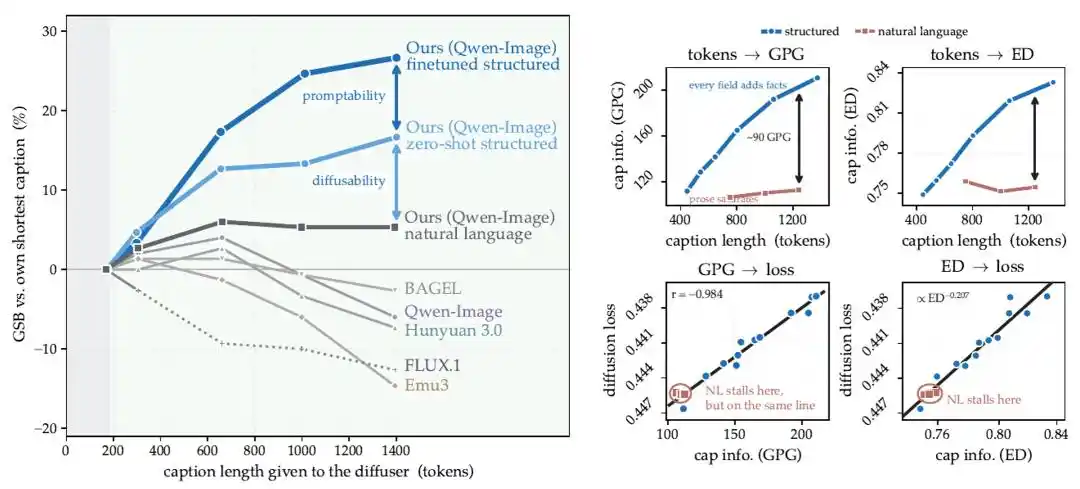
Figure 1 from the paper | Natural language length saturates quickly; structured conditioning continues to increase image information and consistently lowers the diffusion training loss along a unified relationship.

In recent years, the advancement of text-to-image models has largely followed a familiar path: larger models, more data, and increased training compute.

However, there is an easily overlooked difference between text-to-image models and language models. Language models can learn directly from text sequences via self-supervision; text-to-image models rely on image-caption pairs to learn "what kind of text corresponds to what kind of visual content." An image may contain numerous objects, attributes, positions, actions, and relations, but only the parts that are accurately described and clearly bound in the caption can be passed to the model as text-conditioned supervision.

Thus, a fundamental question arises: Beyond scaling up models, data, and compute, can we improve the learning of generation models by increasing the image information carried by captions?

In this new work, ByteDance's Seed team investigated this question. The core conclusion can be summarized in one sentence:

What truly scales with text conditioning is not the number of tokens in a caption, but the image information within it that can be utilized by the model.
  • Paper Title: Scaling Properties of Text Conditioning in Visual Generation
  • Authors: Zilong Chen, Chaorui Deng, Kunchang Li, Hongyi Yuan, Haoqi Fan Affiliation: ByteDance Seed
  • Paper: https://arxiv.org/abs/2607.29679
  • Project Page: https://heheyas.github.io/context-scaling
  • Code: https://github.com/heheyas/context-scaling
  • Models: https://huggingface.co/collections/heheyas/context-scaling
  • Online Demo: https://heheyas-context-scaling.hf.space/
  • Hugging Face Paper: https://huggingface.co/papers/2607.29679

Why Don't Models Get Stronger When Prompts Get Longer?

An intuitive approach is to write training captions or user prompts longer and in more detail. More tokens seem like they should mean more supervision and help the model generate more complex images.

However, experiments gave a different answer. On various existing open-source text-to-image systems, natural language prompts quickly saturated with increasing length, with final performance even falling below that of their respective shortest prompts. Even training diffusion models specifically on the same set of long-text captions yielded limited benefits.

To observe this phenomenon more clearly, the team designed an image reconstruction experiment with a fixed backbone network. For the same reference image, the team generated four natural language captions of progressively increasing detail from the same set of complete annotations, then used the same Qwen-Image model and random seed to attempt to reconstruct the image. These captions described the same entities and relations, with later versions mainly adding length by supplementing and expanding the natural language expressions.

Surprisingly, although the captions became significantly longer, the quality of image reconstruction hardly improved. The added prose mostly explained, rephrased, or connected already present content, rather than continuously adding new, stably usable visual variables.
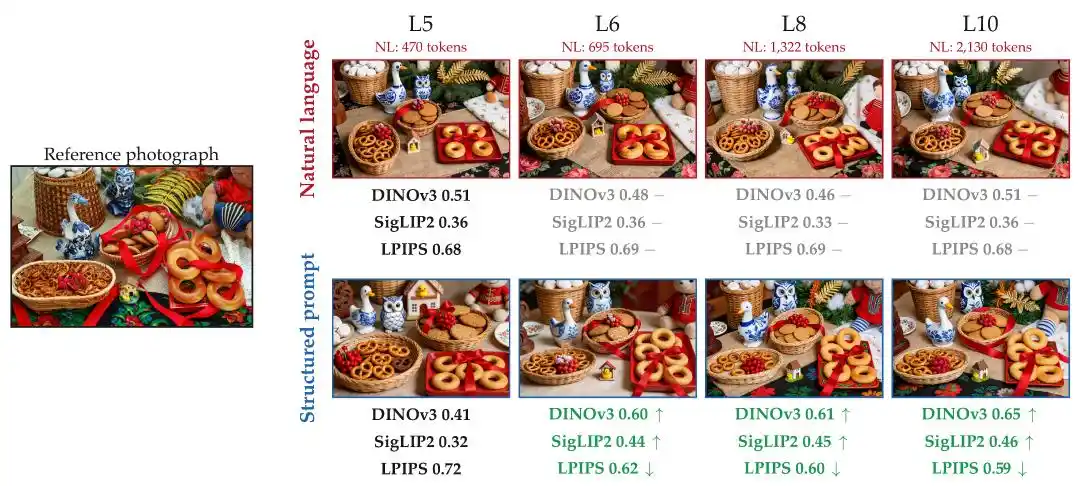
Figure 3 from the paper | Fixed-backbone reconstruction experiment: Reconstruction plateaus as NL Caption continues to lengthen, but gradually restoring SP fields yields continuous improvement.

This indicates that caption length is only a weak proxy variable. A text can be very long yet still fail to clearly specify which attribute belongs to which object, what relation exists between two objects, their respective locations, and their front-back order in the scene.

How to Measure the True Image Information in a Caption?

If token count is insufficient to gauge supervision strength, we need to directly measure the information bound to the image within a caption. For this purpose, the team adapted two complementary metrics from existing work: Grounded Perplexity Gain (GPG) and Effective Detailness (ED).

GPG: How much does the image make the caption "more predictable"?

GPG is a white-box metric that requires reading model token probabilities. For the same caption, the team separately had a frozen vision-language model see and not see the paired image, and calculated the increase in log-likelihood for the caption's content tokens after the image was presented. If the caption contains a large amount of information tightly bound to that image, seeing the image should significantly enhance the model's predictive ability for those tokens.

ED: How many reliable image attributes does the caption cover?

ED is a black-box semantic metric that does not rely on token probabilities. It extracts attributes with entity contexts from the image and the caption separately, then calculates the accuracy of caption attributes and the recall of image attributes. It finally uses F0.5, which places more weight on accuracy, applying stronger penalties to descriptions in the caption without visual grounding.

The two metrics approach the same problem from different angles: GPG focuses on the statistical dependency between image and text, while ED focuses on whether the caption accurately covers verifiable visual content.
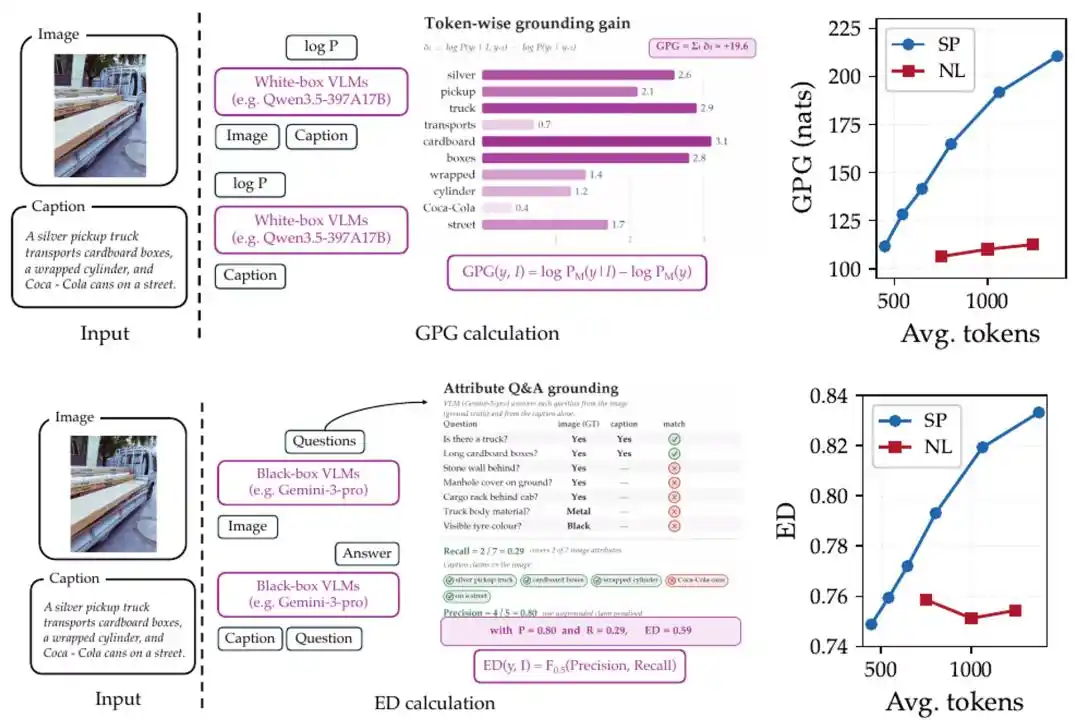
Figure 6 from the paper | Definitions and measurement trends of GPG and ED.

Caption Information Content Can Predict Diffusion Model Training Loss

Next, the team fixed the images, model architecture, initialization method, optimization configuration, and training budget, varying only the training captions. The entire experiment included 15 caption configurations: three natural language versions of different lengths, six Structured Prompt versions gradually restoring fields, and six variants with spatial expression or field masking. Each configuration started from the same BAGEL continued-training checkpoint and independently trained a diffusion model.

The results showed no consistent relationship between the token count of natural language captions and training outcomes. However, when the x-axis was changed to caption information content, configurations of different formats and detail levels fell onto highly regular curves:

  • The converged diffusion loss had an approximately linear relationship with GPG, Pearson r = -0.984.
  • The converged diffusion loss followed a power-law trend with ED, with Pearson r = -0.971 in log-log space.
  • GPG and ED also showed high consistency in ranking different caption configurations, Spearman ρ = 0.96.

The team refers to this as the scaling properties of text conditioning. It is not a theoretical law holding for all models, but an empirical calibration obtained under fixed architecture and training recipe. However, it provides two immediate benefits.

First, it transforms caption information content from a vague "data quality" concept into a trainable variable that can be controlled and measured: when model, images, and compute are fixed, information content can predict the final training loss the model achieves.

Second, after performing one calibration, candidate caption schemes can be compared using GPG or ED under the same training recipe before deciding whether to invest in expensive diffusion model training. For six caption variants not involved in the fitting, the two metrics still accurately predicted their convergence loss.
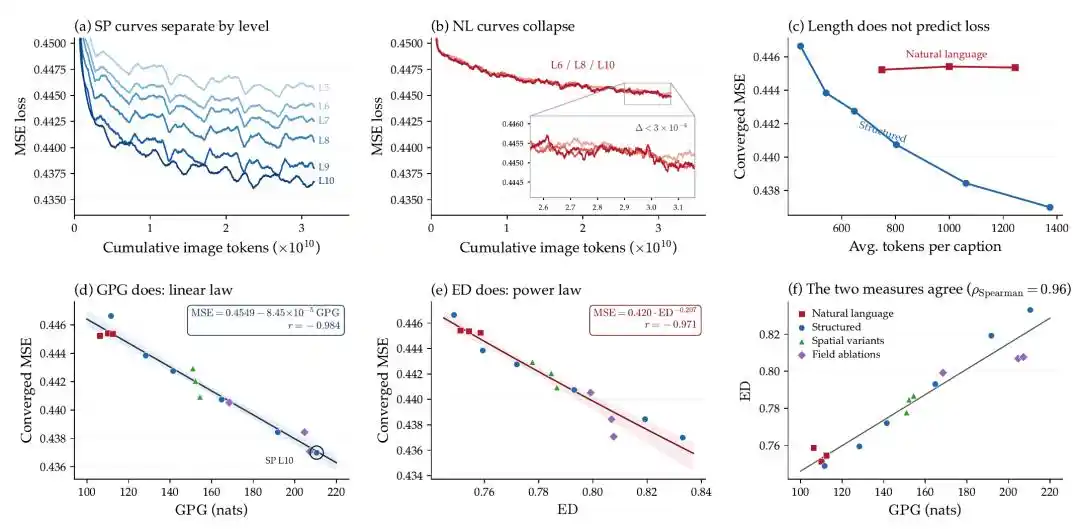
Figure 7 from the paper | Under a fixed training recipe, the convergence loss shows a stable relationship with caption information content.

Structured Prompt: Making Information Not Just More, But Easier for the Model to Use

The earlier experiments reveal a crucial point: merely adding natural language prose is not enough; the new information also needs to be organized in a stable and unambiguous manner.

Therefore, the team proposes Structured Prompt (SP), using structured JSON to represent the visual variables in an image. It consists of three layers:

  • Global Layer: Scene intent, setting, atmosphere, style, lighting, and photographic information.
  • Element Layer: Each subject's identity, attributes, actions, position, optional depth, and local photographic information.
  • Relation Layer: Positional, occlusion, interaction, and semantic relations between different elements.

Compared to free text, the key of SP is not just the "JSON" appearance, but placing different visual variables into stable named fields, reducing ambiguity in attribute assignment, spatial relations, and object binding. In the fixed-backbone reconstruction experiment, reconstruction quality continuously improved as SP fields were gradually restored; in the full training sweep, increased field coverage also consistently raised GPG, ED, and lowered the converged diffusion loss.
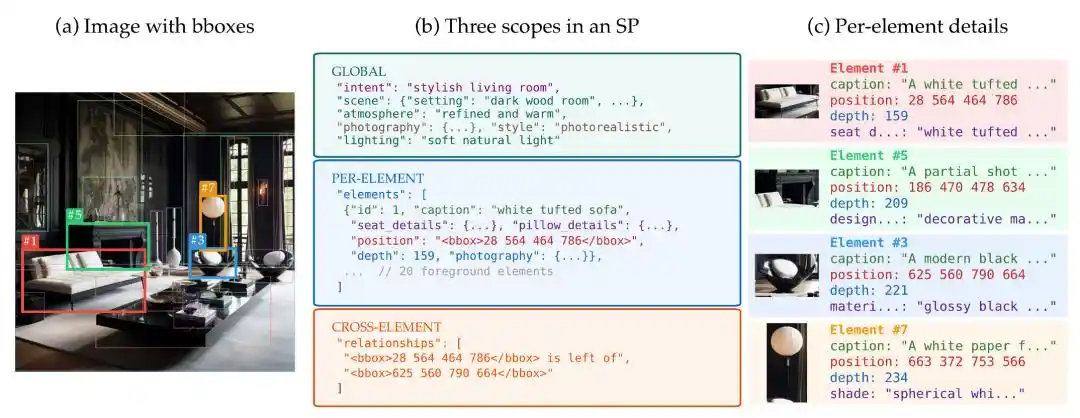
Figure 5 from the paper | Structured Prompt organizes global, element-level, and cross-element visual variables into named fields.

To generate complete SP for large-scale training data, the team constructed an image-to-SP annotation pipeline. A general VLM handles global semantics and local content, Sapiens supplements human pose evidence, DepthAnything V2 provides relative depth, SAM 2.1 provides masks and occlusion cues, and finally a VLM unifies this information into a consistent, complete SP.
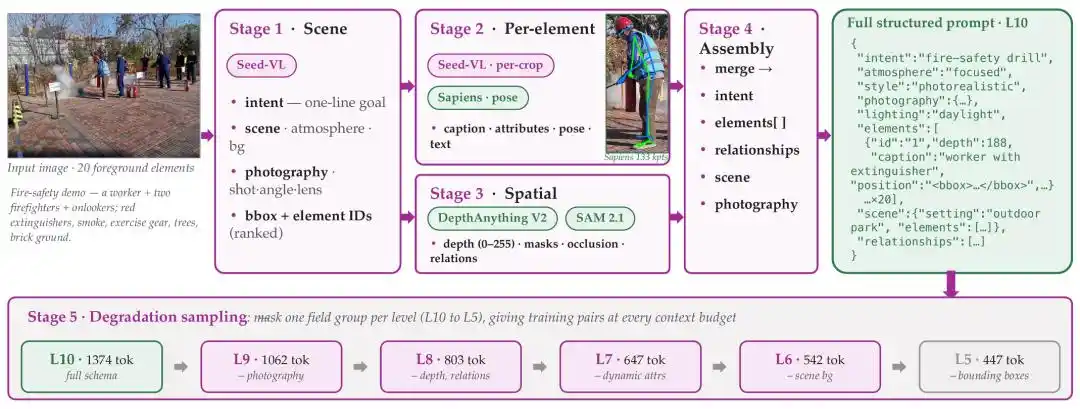
Figure 8 from the paper | VLM and experts for pose, depth, and segmentation collaboratively construct a complete Structured Prompt.

The team terms the ability of a caption representation to expose and organize image supervision for a diffusion model as Diffusability. SP enhances precisely this aspect: without changing the diffusion model architecture, it allows the model to learn more and clearer visual variables from the text condition.

Promptability: With a Good Structure, You Still Need an LLM to Fill It Well

During training, complete SP can be extracted from paired images, but during actual generation, only the user's sentence is available—there is no reference image or oracle annotation. The system also requires an LLM prompter to expand the user request into a detailed, coherent SP that does not violate the original constraints.

The team calls this ability to instantiate structured conditions from user requests Promptability. End-to-end generation quality depends on the joint effect of both sides:

Generation Quality = Diffusability × Promptability

The multiplication sign here is an organizational perspective, not a mathematically derived formula: Diffusability describes what the diffusion model can learn from the caption representation, and Promptability describes whether the LLM can truly produce a high-quality caption instance during inference.
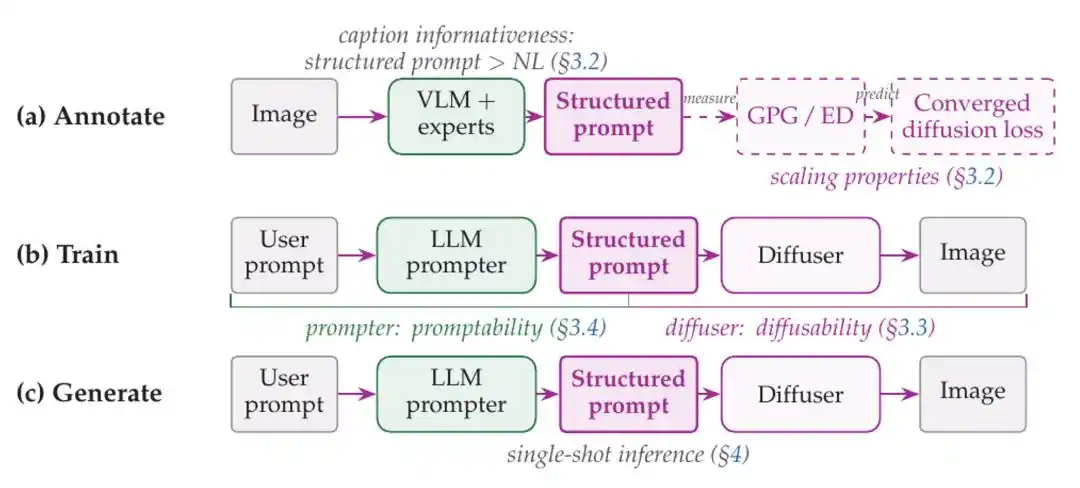
Figure 4 from the paper | Structured Prompt connects annotation, measurement, diffuser training, prompter training, and final generation.

First, the team fixed the SP schema and Qwen-Image diffuser, only replacing the zero-shot LLM prompter. As Qwen3.5 scaled from 0.8B to 397B, GenEval++ score in thinking mode improved from 46.4% to 86.8%. Apart from the smallest model which tended to repeat during thinking and failed to output valid JSON, chain-of-thought provided further improvements at other scales. This indicates that the model capability and reasoning ability of general LLMs can be directly translated into better image generation results through the caption interface.

However, zero-shot LLMs still tend to generate SP lacking in information and with relatively simple composition. To further improve Promptability, the team adopted three-stage training:

SFT learns the distribution of SP content expected by the diffusion model, not just the JSON format.

Cold-start distills "how to deduce SP solely from user requests" from privileged reasoning traces paired with images.

RFT continues optimization on rollouts generated and rendered by the prompter itself, where a verifier selects high-confidence trajectories, and then provides dense token supervision through on-policy self-distillation from an image-conditioned teacher.

Ablation experiments show the three stages serve different purposes: SFT brings the largest single-stage structural improvement, cold-start strengthens the deduction from user requests to SP, and verifier-gated OPSD achieves the strongest results within the prompter's own distribution.
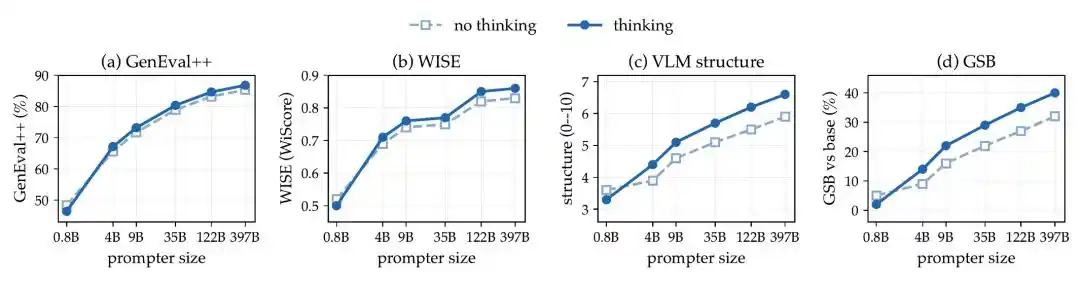
Figure 9 from the paper | With fixed schema and diffuser, generation quality improves with LLM prompter scale and reasoning mode.
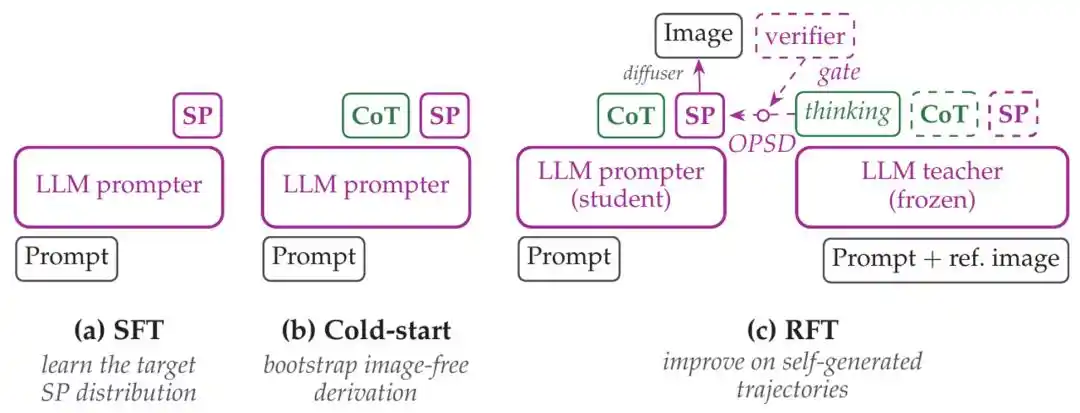
Figure 10 from the paper | Three-stage prompter training: SFT, cold-start, and verifier-gated RFT.

Structured Representation Also Makes the Generation Process Easier to Iteratively Correct

Another natural advantage of SP's field-based representation is that when errors appear in the generated image, the system can locate and modify the corresponding object, attribute, relation, or layout fields, rather than rewriting the entire natural language prompt.

Based on this, the team built a refine-render-judge loop. In each round, the prompter generates or revises SP based on user request and historical feedback, the fixed diffuser renders an image, and an online judge provides PASS/FAIL decisions along with specific issues regarding prompt adherence, structure, and visual quality. If it fails, the next round only needs adjustments around the relevant fields.

Experiments show that increasing iteration budget can further improve structural alignment, adherence, and GSB performance; however, effective reasoning length is not long. For the trained prompter, even when allowed up to 8 rounds, an average of only 2.31 rounds were used; increasing Tmax from 4 to 8 yielded minimal additional benefit. This indicates that text-to-image generation does benefit from iterative error correction, but under the current setup, does not require very long prompt-side reasoning trajectories: after fixing major specification errors, additional rounds saturate quickly.

Figure 14 from the paper | Agentic reasoning loop of refine-render-judge.

Figure 15 from the paper | The loop can correct issues with object splitting, relations, and overall layout.

How Much Improvement Does the Structured Interface Bring to the Same Qwen-Image Base?

The final system consists of an SP-trained diffuser and a trained LLM prompter. It outperforms all compared open-weight models on almost every reported metric and reaches or surpasses most compared closed-source systems on the majority of evaluations, with advantages particularly pronounced on composition, reasoning, and world knowledge tasks.

More crucially, the matched control. To rule out explanations like "it just trained more," the team trained an additional system using the exact same Qwen-Image architecture, training images, training stages, and budget, but consistently using free natural language captions. The results are as follows:
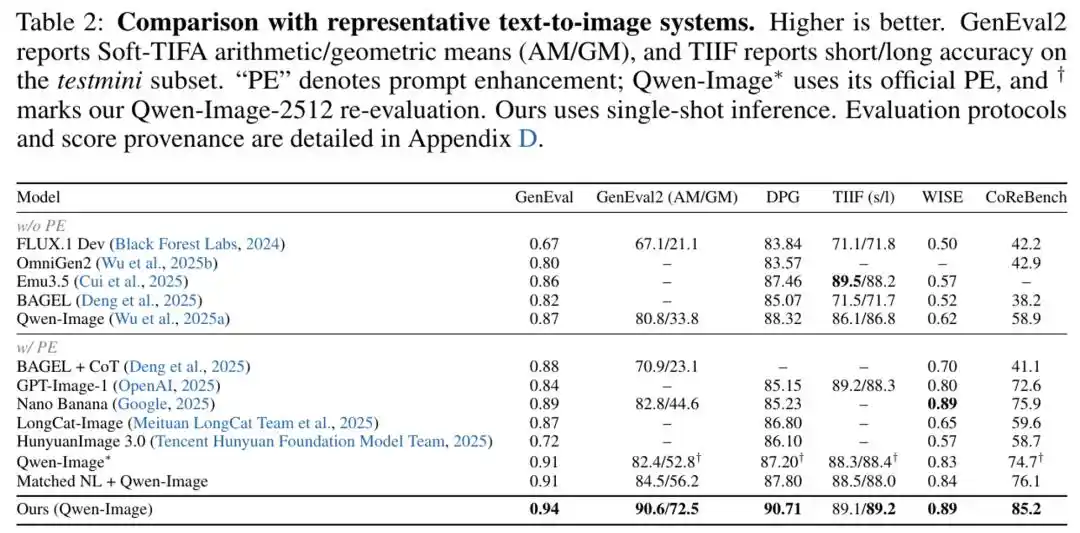
Table 2 from the paper | Complete comparison with representative text-to-image systems. Screenshot retains evaluation definitions, bold text, and footnotes from the paper.

The additional training for the matched NL system indeed brought some improvements, but far from enough to replicate the SP system's results. This indicates that the gains cannot be simply attributed to a larger backbone or more training but are closely related to the structured caption interface used between the prompter and diffuser.

Figure 11 from the paper | Qualitative comparison on complex spatial relations, quantities, and attribute binding.

The Next Step is Not Just to Scale the Model, But Also to Scale the Condition Itself

The starting point of this work is simple: For text-to-image models, captions are not irrelevant metadata, but the primary interface through which image content enters text-conditioned learning.

When captions merely become longer, the new tokens may just rephrase and elaborate; when image information is accurately extracted, clearly bound, and stably organized, the same generation model can learn more from it. GPG and ED make this information a measurable variable, Structured Prompt improves Diffusability, and LLM scaling, post-training, and short-range agentic refinement improve Promptability.

Therefore, the next step in scaling text-to-image should not only focus on "how large the rendering model is" but also ask:

How much image information—information it can truly learn and use—is the text condition passed to the model actually carrying?

This article is from the WeChat official account "Machine Heart"

Criptomoedas em alta

Perguntas relacionadas

QWhat is the key finding of ByteDance Seed team regarding text caption length and its effect on text-to-image model training?

AThe team found that increasing the length of natural language captions does not necessarily provide more usable visual supervision. Instead, the amount of image-grounded information in the caption, measured by metrics like Grounded Perplexity Gain (GPG) and Effective Detailness (ED), is a better predictor of the final training loss a diffusion model can achieve.

QWhat two complementary metrics did the researchers propose to measure the image-grounded information in a caption?

AThe researchers proposed two complementary metrics: 1) **Grounded Perplexity Gain (GPG)**: A white-box metric measuring how much an image makes a caption more predictable for a frozen Vision-Language Model. 2) **Effective Detailness (ED)**: A black-box semantic metric measuring how accurately a caption covers verifiable visual attributes from the image.

QWhat is Structured Prompt (SP) and how does it address the limitations of natural language captions?

AStructured Prompt (SP) is a JSON-based representation that organizes visual variables into hierarchical fields: a global layer (intent, scene, style), an element layer (identity, attributes, position of subjects), and a relation layer (interactions between elements). It addresses natural language ambiguity by stably assigning attributes, spatial relations, and object bindings to specific named fields, thereby increasing the amount of usable visual information (Diffusability) for the model.

QHow does the concept of 'Promptability' relate to the overall generation quality in the proposed system?

APromptability refers to the ability of a Large Language Model (LLM) prompter to instantiate a high-quality Structured Prompt (SP) from a user's simple request during inference. The overall generation quality is viewed as depending on both Diffusability (how much the diffusion model can learn from the caption representation) and Promptability. Enhancing the LLM prompter's capabilities through scaling and multi-stage training directly improves the generation results.

QWhat experimental evidence supports the claim that the gains from Structured Prompt are not simply due to more training data or compute?

AA matched control experiment was conducted. Using the exact same Qwen-Image architecture, training images, stages, and budget, a separate system was trained using only free-form natural language captions. While this matched NL system showed some improvement, its performance was far below that of the SP-based system. This demonstrates that the gains are primarily due to the structured caption interface itself, not merely from extra training of the backbone model.

Leituras Relacionadas

Strategy CEO Announces Plan to Resume Bitcoin Purchases This Year, With Buying Volume 25 Times Selling Volume

Strategy CEO Announces Resumption of Bitcoin Purchases This Year, Buy-to-Sell Ratio at 25x In a FOX Business interview, Phong Le, CEO of Strategy (formerly MicroStrategy), stated the company plans to resume its Bitcoin acquisition strategy within the current year. This ends a pause in buying that began in May. Le revealed that since the start of the year, Strategy has purchased approximately 175,000 bitcoins while selling around 7,000, making its buy volume about 25 times its sell volume. The company remains the world's largest corporate holder of Bitcoin, with 840,447 BTC, representing roughly 4% of the circulating supply. Le explained that recent sales were used to fulfill capital obligations under a newly approved framework, including paying preferred stock dividends, funding share buybacks, and bolstering the company's US dollar reserves, which now stand at about $4.7 billion. This move marks a shift from the firm's previous "never sell" mantra, which had contributed to its market premium. The change in strategy and the associated financial pressures led to a significant drop in its stock price (MSTR) and a rating downgrade from JPMorgan. The CEO framed the company's role as the "JPMorgan of the crypto economy," emphasizing its long-term goal of increasing the amount of Bitcoin per MSTR share. The announcement signals the return of a major institutional buyer to the Bitcoin market, which could provide price support. It is also viewed as a micro-indicator of recovering institutional confidence, suggesting the company believes the most acute phase of liquidity pressure has passed.

marsbitHá 11m

Strategy CEO Announces Plan to Resume Bitcoin Purchases This Year, With Buying Volume 25 Times Selling Volume

marsbitHá 11m

ArthurHayes新文:押注日元升值,ENA未来几月或涨5至10倍

Arthur Hayes argues that the Japanese Yen is significantly undervalued and posits that its appreciation against the US Dollar is imminent. He outlines three potential mechanisms for this shift, dismissing the first two—the Bank of Japan raising interest rates and domestic institutions selling foreign assets—as politically or economically unfeasible. He identifies the third and preferred method: the Japanese Ministry of Finance (MOF) using its holdings of US Treasuries as collateral in the Fed's FIMA repo facility to borrow US dollars, then selling those dollars to buy Yen in the forex market. Hayes believes US Treasury Secretary Bessant has signaled support for this approach, which requires the Fed's Foreign Currency Subcommittee, led by Chairman Walsh, to remove lending limits on the FIMA tool. Hayes asserts that implementing this "Scheme 3" would lead to a significant expansion of US dollar liquidity. He predicts this surge in liquidity will act as a catalyst, driving up the prices of assets like Bitcoin and physical gold. Within the crypto space, he views Ethereum (ETH) as undervalued and singles out Ethena's ENA token as a speculative play with potential for 5-10x gains in the coming months, contingent on a recovery in Bitcoin basis trades that would boost demand for its USDe stablecoin. He concludes that investors should watch for the Fed's rule change as the key trigger for these market movements.

marsbitHá 24m

ArthurHayes新文:押注日元升值,ENA未来几月或涨5至10倍

marsbitHá 24m

Trading

Spot

Artigos em Destaque

O que é $S$

Compreender o SPERO: Uma Visão Abrangente Introdução ao SPERO À medida que o panorama da inovação continua a evoluir, o surgimento de tecnologias web3 e projetos de criptomoeda desempenha um papel fundamental na formação do futuro digital. Um projeto que tem atraído atenção neste campo dinâmico é o SPERO, denotado como SPERO,$$s$. Este artigo tem como objetivo reunir e apresentar informações detalhadas sobre o SPERO, para ajudar entusiastas e investidores a compreender as suas bases, objetivos e inovações nos domínios web3 e cripto. O que é o SPERO,$$s$? O SPERO,$$s$ é um projeto único dentro do espaço cripto que procura aproveitar os princípios da descentralização e da tecnologia blockchain para criar um ecossistema que promove o envolvimento, a utilidade e a inclusão financeira. O projeto é concebido para facilitar interações peer-to-peer de novas maneiras, proporcionando aos utilizadores soluções e serviços financeiros inovadores. No seu núcleo, o SPERO,$$s$ visa capacitar indivíduos ao fornecer ferramentas e plataformas que melhoram a experiência do utilizador no espaço das criptomoedas. Isso inclui a possibilidade de métodos de transação mais flexíveis, a promoção de iniciativas impulsionadas pela comunidade e a criação de caminhos para oportunidades financeiras através de aplicações descentralizadas (dApps). A visão subjacente do SPERO,$$s$ gira em torno da inclusão, visando fechar lacunas dentro das finanças tradicionais enquanto aproveita os benefícios da tecnologia blockchain. Quem é o Criador do SPERO,$$s$? A identidade do criador do SPERO,$$s$ permanece algo obscura, uma vez que existem recursos publicamente disponíveis limitados que fornecem informações detalhadas sobre o(s) seu(s) fundador(es). Esta falta de transparência pode resultar do compromisso do projeto com a descentralização—uma ética que muitos projetos web3 partilham, priorizando contribuições coletivas em vez de reconhecimento individual. Ao centrar as discussões em torno da comunidade e dos seus objetivos coletivos, o SPERO,$$s$ incorpora a essência do empoderamento sem destacar indivíduos específicos. Assim, compreender a ética e a missão do SPERO é mais importante do que identificar um criador singular. Quem são os Investidores do SPERO,$$s$? O SPERO,$$s$ é apoiado por uma diversidade de investidores que vão desde capitalistas de risco a investidores-anjo dedicados a promover a inovação no setor cripto. O foco desses investidores geralmente alinha-se com a missão do SPERO—priorizando projetos que prometem avanço tecnológico social, inclusão financeira e governança descentralizada. Essas fundações de investidores estão tipicamente interessadas em projetos que não apenas oferecem produtos inovadores, mas que também contribuem positivamente para a comunidade blockchain e os seus ecossistemas. O apoio desses investidores reforça o SPERO,$$s$ como um concorrente notável no domínio em rápida evolução dos projetos cripto. Como Funciona o SPERO,$$s$? O SPERO,$$s$ emprega uma estrutura multifacetada que o distingue de projetos de criptomoeda convencionais. Aqui estão algumas das características-chave que sublinham a sua singularidade e inovação: Governança Descentralizada: O SPERO,$$s$ integra modelos de governança descentralizada, capacitando os utilizadores a participar ativamente nos processos de tomada de decisão sobre o futuro do projeto. Esta abordagem promove um sentido de propriedade e responsabilidade entre os membros da comunidade. Utilidade do Token: O SPERO,$$s$ utiliza o seu próprio token de criptomoeda, concebido para servir várias funções dentro do ecossistema. Esses tokens permitem transações, recompensas e a facilitação de serviços oferecidos na plataforma, melhorando o envolvimento e a utilidade gerais. Arquitetura em Camadas: A arquitetura técnica do SPERO,$$s$ suporta modularidade e escalabilidade, permitindo a integração contínua de funcionalidades e aplicações adicionais à medida que o projeto evolui. Esta adaptabilidade é fundamental para manter a relevância no panorama cripto em constante mudança. Envolvimento da Comunidade: O projeto enfatiza iniciativas impulsionadas pela comunidade, empregando mecanismos que incentivam a colaboração e o feedback. Ao nutrir uma comunidade forte, o SPERO,$$s$ pode melhor atender às necessidades dos utilizadores e adaptar-se às tendências do mercado. Foco na Inclusão: Ao oferecer taxas de transação baixas e interfaces amigáveis, o SPERO,$$s$ visa atrair uma base de utilizadores diversificada, incluindo indivíduos que anteriormente podem não ter participado no espaço cripto. Este compromisso com a inclusão alinha-se com a sua missão abrangente de empoderamento através da acessibilidade. Cronologia do SPERO,$$s$ Compreender a história de um projeto fornece insights cruciais sobre a sua trajetória de desenvolvimento e marcos. Abaixo está uma cronologia sugerida que mapeia eventos significativos na evolução do SPERO,$$s$: Fase de Conceituação e Ideação: As ideias iniciais que formam a base do SPERO,$$s$ foram concebidas, alinhando-se de perto com os princípios de descentralização e foco na comunidade dentro da indústria blockchain. Lançamento do Whitepaper do Projeto: Após a fase conceitual, um whitepaper abrangente detalhando a visão, os objetivos e a infraestrutura tecnológica do SPERO,$$s$ foi lançado para atrair o interesse e o feedback da comunidade. Construção da Comunidade e Primeiros Envolvimentos: Esforços ativos de divulgação foram feitos para construir uma comunidade de primeiros adotantes e investidores potenciais, facilitando discussões em torno dos objetivos do projeto e angariando apoio. Evento de Geração de Tokens: O SPERO,$$s$ realizou um evento de geração de tokens (TGE) para distribuir os seus tokens nativos a apoiantes iniciais e estabelecer liquidez inicial dentro do ecossistema. Lançamento da dApp Inicial: A primeira aplicação descentralizada (dApp) associada ao SPERO,$$s$ foi lançada, permitindo que os utilizadores interagissem com as funcionalidades principais da plataforma. Desenvolvimento Contínuo e Parcerias: Atualizações e melhorias contínuas nas ofertas do projeto, incluindo parcerias estratégicas com outros players no espaço blockchain, moldaram o SPERO,$$s$ em um jogador competitivo e em evolução no mercado cripto. Conclusão O SPERO,$$s$ é um testemunho do potencial do web3 e das criptomoedas para revolucionar os sistemas financeiros e capacitar indivíduos. Com um compromisso com a governança descentralizada, o envolvimento da comunidade e funcionalidades inovadoras, abre caminho para um panorama financeiro mais inclusivo. Como em qualquer investimento no espaço cripto em rápida evolução, potenciais investidores e utilizadores são incentivados a pesquisar minuciosamente e a envolver-se de forma ponderada com os desenvolvimentos em curso dentro do SPERO,$$s$. O projeto demonstra o espírito inovador da indústria cripto, convidando a uma exploração mais aprofundada das suas inúmeras possibilidades. Embora a jornada do SPERO,$$s$ ainda esteja a desenrolar-se, os seus princípios fundamentais podem, de facto, influenciar o futuro de como interagimos com a tecnologia, as finanças e uns com os outros em ecossistemas digitais interconectados.

339 Visualizações TotaisPublicado em {updateTime}Atualizado em 2024.12.17

O que é $S$

O que é AGENT S

Agent S: O Futuro da Interação Autónoma no Web3 Introdução No panorama em constante evolução do Web3 e das criptomoedas, as inovações estão constantemente a redefinir a forma como os indivíduos interagem com plataformas digitais. Um projeto pioneiro, o Agent S, promete revolucionar a interação humano-computador através do seu framework aberto e agente. Ao abrir caminho para interações autónomas, o Agent S visa simplificar tarefas complexas, oferecendo aplicações transformadoras em inteligência artificial (IA). Esta exploração detalhada irá aprofundar-se nas complexidades do projeto, nas suas características únicas e nas implicações para o domínio das criptomoedas. O que é o Agent S? O Agent S é um framework aberto e agente, especificamente concebido para abordar três desafios fundamentais na automação de tarefas computacionais: Aquisição de Conhecimento Específico de Domínio: O framework aprende inteligentemente a partir de várias fontes de conhecimento externas e experiências internas. Esta abordagem dupla capacita-o a construir um rico repositório de conhecimento específico de domínio, melhorando o seu desempenho na execução de tarefas. Planeamento ao Longo de Longos Horizontes de Tarefas: O Agent S emprega planeamento hierárquico aumentado por experiência, uma abordagem estratégica que facilita a decomposição e execução eficientes de tarefas intrincadas. Esta característica melhora significativamente a sua capacidade de gerir múltiplas subtarefas de forma eficiente e eficaz. Gestão de Interfaces Dinâmicas e Não Uniformes: O projeto introduz a Interface Agente-Computador (ACI), uma solução inovadora que melhora a interação entre agentes e utilizadores. Utilizando Modelos de Linguagem Multimodais de Grande Escala (MLLMs), o Agent S pode navegar e manipular diversas interfaces gráficas de utilizador de forma fluida. Através destas características pioneiras, o Agent S fornece um framework robusto que aborda as complexidades envolvidas na automação da interação humana com máquinas, preparando o terreno para uma infinidade de aplicações em IA e além. Quem é o Criador do Agent S? Embora o conceito de Agent S seja fundamentalmente inovador, informações específicas sobre o seu criador permanecem elusivas. O criador é atualmente desconhecido, o que destaca ou o estágio nascente do projeto ou a escolha estratégica de manter os membros fundadores em anonimato. Independentemente da anonimidade, o foco permanece nas capacidades e no potencial do framework. Quem são os Investidores do Agent S? Como o Agent S é relativamente novo no ecossistema criptográfico, informações detalhadas sobre os seus investidores e financiadores não estão explicitamente documentadas. A falta de informações disponíveis publicamente sobre as fundações de investimento ou organizações que apoiam o projeto levanta questões sobre a sua estrutura de financiamento e roteiro de desenvolvimento. Compreender o apoio é crucial para avaliar a sustentabilidade do projeto e o seu impacto potencial no mercado. Como Funciona o Agent S? No núcleo do Agent S reside uma tecnologia de ponta que lhe permite funcionar eficazmente em diversos ambientes. O seu modelo operacional é construído em torno de várias características-chave: Interação Humano-Computador Semelhante: O framework oferece planeamento avançado em IA, esforçando-se para tornar as interações com computadores mais intuitivas. Ao imitar o comportamento humano na execução de tarefas, promete elevar as experiências dos utilizadores. Memória Narrativa: Utilizada para aproveitar experiências de alto nível, o Agent S utiliza memória narrativa para acompanhar os históricos de tarefas, melhorando assim os seus processos de tomada de decisão. Memória Episódica: Esta característica fornece aos utilizadores orientações passo a passo, permitindo que o framework ofereça suporte contextual à medida que as tarefas se desenrolam. Suporte para OpenACI: Com a capacidade de funcionar localmente, o Agent S permite que os utilizadores mantenham o controlo sobre as suas interações e fluxos de trabalho, alinhando-se com a ética descentralizada do Web3. Fácil Integração com APIs Externas: A sua versatilidade e compatibilidade com várias plataformas de IA garantem que o Agent S possa integrar-se perfeitamente em ecossistemas tecnológicos existentes, tornando-o uma escolha apelativa para desenvolvedores e organizações. Estas funcionalidades contribuem coletivamente para a posição única do Agent S no espaço cripto, à medida que automatiza tarefas complexas e em múltiplos passos com mínima intervenção humana. À medida que o projeto evolui, as suas potenciais aplicações no Web3 podem redefinir a forma como as interações digitais se desenrolam. Cronologia do Agent S O desenvolvimento e os marcos do Agent S podem ser encapsulados numa cronologia que destaca os seus eventos significativos: 27 de Setembro de 2024: O conceito de Agent S foi lançado num artigo de pesquisa abrangente intitulado “Um Framework Agente Aberto que Usa Computadores como um Humano”, mostrando a base para o projeto. 10 de Outubro de 2024: O artigo de pesquisa foi disponibilizado publicamente no arXiv, oferecendo uma exploração aprofundada do framework e da sua avaliação de desempenho com base no benchmark OSWorld. 12 de Outubro de 2024: Uma apresentação em vídeo foi lançada, proporcionando uma visão visual das capacidades e características do Agent S, envolvendo ainda mais potenciais utilizadores e investidores. Estes marcos na cronologia não apenas ilustram o progresso do Agent S, mas também indicam o seu compromisso com a transparência e o envolvimento da comunidade. Pontos-Chave Sobre o Agent S À medida que o framework Agent S continua a evoluir, várias características-chave destacam-se, sublinhando a sua natureza inovadora e potencial: Framework Inovador: Concebido para proporcionar um uso intuitivo de computadores semelhante à interação humana, o Agent S traz uma abordagem nova à automação de tarefas. Interação Autónoma: A capacidade de interagir autonomamente com computadores através de GUI significa um avanço em direção a soluções computacionais mais inteligentes e eficientes. Automação de Tarefas Complexas: Com a sua metodologia robusta, pode automatizar tarefas complexas e em múltiplos passos, tornando os processos mais rápidos e menos propensos a erros. Melhoria Contínua: Os mecanismos de aprendizagem permitem que o Agent S melhore a partir de experiências passadas, aprimorando continuamente o seu desempenho e eficácia. Versatilidade: A sua adaptabilidade em diferentes ambientes operacionais, como OSWorld e WindowsAgentArena, garante que pode servir uma ampla gama de aplicações. À medida que o Agent S se posiciona no panorama do Web3 e das criptomoedas, o seu potencial para melhorar as capacidades de interação e automatizar processos significa um avanço significativo nas tecnologias de IA. Através do seu framework inovador, o Agent S exemplifica o futuro das interações digitais, prometendo uma experiência mais fluida e eficiente para os utilizadores em diversas indústrias. Conclusão O Agent S representa um ousado avanço na união da IA e do Web3, com a capacidade de redefinir a forma como interagimos com a tecnologia. Embora ainda esteja nas suas fases iniciais, as possibilidades para a sua aplicação são vastas e cativantes. Através do seu framework abrangente que aborda desafios críticos, o Agent S visa trazer interações autónomas para o primeiro plano da experiência digital. À medida que avançamos mais profundamente nos domínios das criptomoedas e da descentralização, projetos como o Agent S desempenharão, sem dúvida, um papel crucial na formação do futuro da tecnologia e da colaboração humano-computador.

936 Visualizações TotaisPublicado em {updateTime}Atualizado em 2025.01.14

O que é AGENT S

Como comprar S

Bem-vindo à HTX.com!Tornámos a compra de Sonic (S) simples e conveniente.Segue o nosso guia passo a passo para iniciar a tua jornada no mundo das criptos.Passo 1: cria a tua conta HTXUtiliza o teu e-mail ou número de telefone para te inscreveres numa conta gratuita na HTX.Desfruta de um processo de inscrição sem complicações e desbloqueia todas as funcionalidades.Obter a minha contaPasso 2: vai para Comprar Cripto e escolhe o teu método de pagamentoCartão de crédito/débito: usa o teu visa ou mastercard para comprar Sonic (S) instantaneamente.Saldo: usa os fundos da tua conta HTX para transacionar sem problemas.Terceiros: adicionamos métodos de pagamento populares, como Google Pay e Apple Pay, para aumentar a conveniência.P2P: transaciona diretamente com outros utilizadores na HTX.Mercado de balcão (OTC): oferecemos serviços personalizados e taxas de câmbio competitivas para os traders.Passo 3: armazena teu Sonic (S)Depois de comprar o teu Sonic (S), armazena-o na tua conta HTX.Alternativamente, podes enviá-lo para outro lugar através de transferência blockchain ou usá-lo para transacionar outras criptomoedas.Passo 4: transaciona Sonic (S)Transaciona facilmente Sonic (S) no mercado à vista da HTX.Acede simplesmente à tua conta, seleciona o teu par de trading, executa as tuas transações e monitoriza em tempo real.Oferecemos uma experiência de fácil utilização tanto para principiantes como para traders experientes.

1.7k Visualizações TotaisPublicado em {updateTime}Atualizado em 2026.06.02

Como comprar S

Discussões

Bem-vindo à Comunidade HTX. Aqui, pode manter-se informado sobre os mais recentes desenvolvimentos da plataforma e obter acesso a análises profissionais de mercado. As opiniões dos utilizadores sobre o preço de S (S) são apresentadas abaixo.

活动图片