A New Player Enters at Third Place, Rothera Disrupts the Prediction Market Landscape

marsbitPublicado em 2026-06-22Última atualização em 2026-06-22

Resumo

"Rothera Skyrockets to Third in Prediction Market Rankings, Disrupting Industry Landscape" Rothera, Robinhood's newly launched prediction market platform, has rapidly climbed to become the third-largest player in the sector by trading volume, trailing only giants Kalshi and Polymarket. Its growth is attributed not to attracting new users, but to migrating existing Robinhood user orders away from partner Kalshi. Previously, Robinhood served as a major distribution channel for Kalshi, accounting for an estimated 25%-35% of its volume. With the launch of Rothera, Robinhood now internally executes events like World Cup contracts, capturing revenue that was previously shared with Kalshi. Data shows Rothera's weekly trading volume surged from $21.9 million to $559 million within weeks, reaching nearly one-fifth of Polymarket's volume. Analysts estimate Robinhood's prediction market business could generate around $10 billion in annual revenue at this pace, potentially surpassing its historical crypto revenue peak. In response, Kalshi is reportedly exploring new distribution channels by engaging with investment banks for a potential IPO, requiring them to integrate their systems with Kalshi to access institutional clients. This shift highlights a new competitive focus in prediction markets: controlling user access and distribution channels rather than just product offerings.

By|Azuma(@azuma_eth)

Last week, Odaily Planet Daily published an article titled "The First Prediction Market Stock Appears!", which primarily mentioned that Robinhood is intercepting orders that previously needed to be executed via Kalshi by building its own prediction market, Rothera. This move aims to reduce revenue sharing with Kalshi and retain profits within its own ecosystem.

Although it was anticipated that Rothera would not face the typical cold start problems of other competitors, its data performance over the past week has still far exceeded our previous expectations. After all, it's hard to imagine that a platform, just launched half a month ago, could directly parachute into third place in the highly competitive prediction market track, trailing only the two giants, Kalshi and Polymarket.
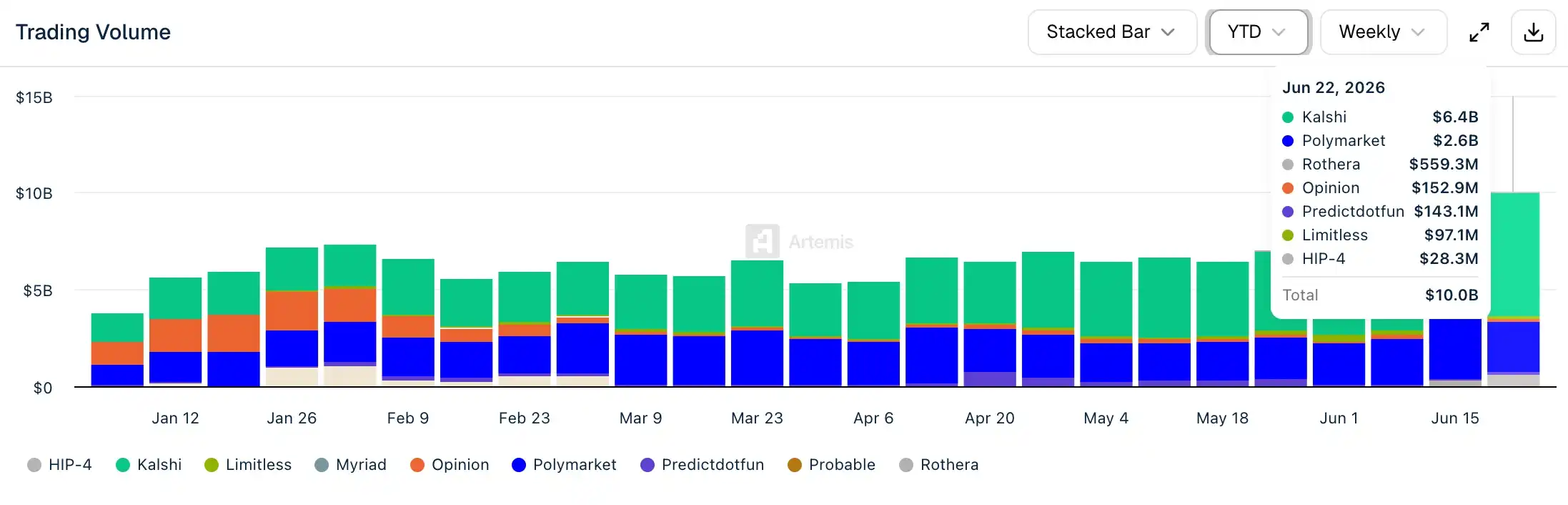
Data from Artemis shows that for the week ending June 8th, as a new platform, Rothera's weekly trading volume was only $21.9 million, still showing a significant gap compared to second-tier platforms like Opinion, Predict, and Limitless. However, for the week ending June 15th, Rothera's weekly trading volume directly jumped to industry third place, reaching $276 million. In the latest week ending June 22nd, Rothera's weekly trading volume has increased to $559 million, almost one-fifth of Polymarket's.

Atypical Growth Case (Can skip if you've read the previous article)

It's important to clarify that Rothera's rise is essentially not due to creating incremental users (though some users may have entered due to the World Cup), but rather a migration of existing orders, not the creation of new users.

Over the past year or so, Robinhood has been one of Kalshi's most important distribution channels. Leveraging tens of millions of retail users and mature access to stock, options, and cryptocurrency trading, Robinhood has funneled a large volume of orders to Kalshi. Piper Sandler analysts estimated that trades completed through the Robinhood channel accounted for about 25%-35% of Kalshi's total trading volume.

The problem is that while these orders came from Robinhood users, they didn't belong to Robinhood itself. Under the previous cooperation model, Robinhood acted more like a front-end traffic portal, while Kalshi was the true infrastructure provider responsible for matching, clearing, and settlement. Revenue generated from each transaction needed to be shared between the two parties.

Rothera is the weapon Robinhood is using to break this profit-sharing model. Since early this month, Robinhood has begun migrating some World Cup-related event contracts to be executed internally on Rothera. This means a large volume of orders that might have previously gone to Kalshi are now retained within Robinhood's own system.

Therefore, in a sense, the surge in Rothera's trading volume is less of a threat to other prediction markets like Polymarket, Predict, or Limitless, and more akin to directly "draining blood" from Kalshi.

Robinhood's Value Capture

The rapid growth of Rothera most directly strengthens Robinhood's ability to capture value from prediction market-related orders on this platform.

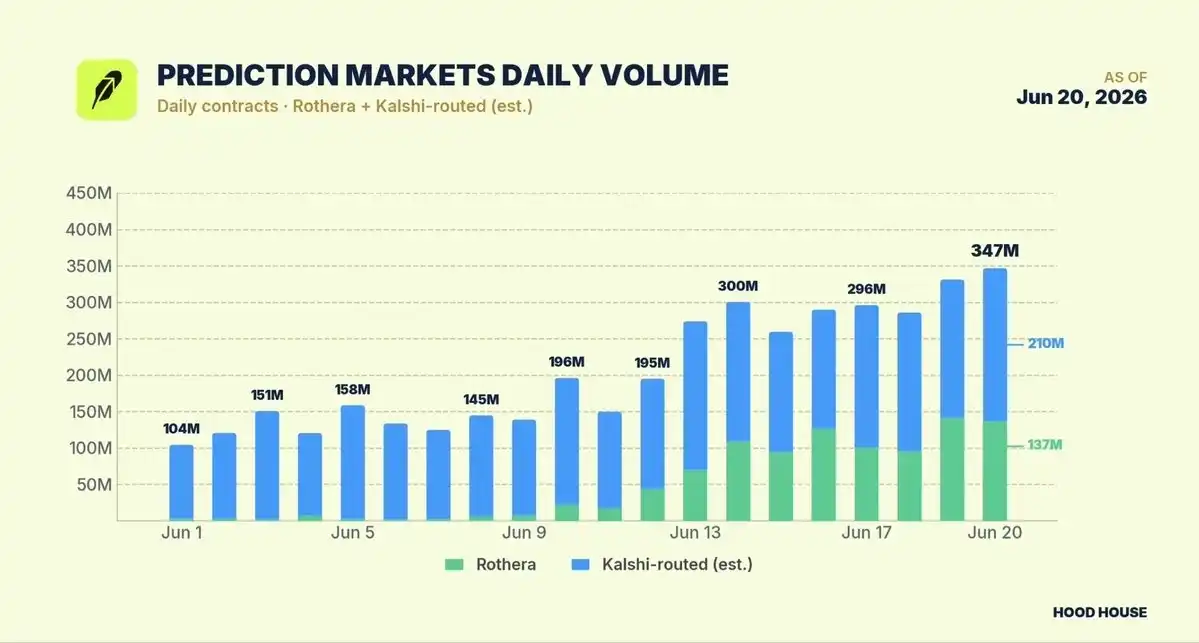
Hood House, an investment research media outlet long tracking Robinhood, combined public data to state that as of June 20th, Robinhood's prediction market business traded a total of 34,700 contracts daily, corresponding to daily revenue of approximately $4.9 million.
Hood House then disclosed its calculation logic:

  • Rothera (primarily hosting World Cup-related markets) daily trading volume had reached 137 million contracts, corresponding to a trading value of approximately $47 million;
  • For comparison, Kalshi's total daily trading volume was about 1.5 billion contracts, corresponding to a trading value of about $416 million; excluding World Cup-related markets, Kalshi's trading volume was about 1 billion contracts, corresponding to a trading value of about $260 million;
  • Considering that Robinhood users still contribute about 20% (a conservative estimate) of Kalshi's non-World Cup market trading volume, this means that about 210 million contracts and $52 million in trading value from Kalshi's non-World Cup related event contracts were completed via Robinhood.

Hood House further made an aggressive estimate based on this, stating that if this growth rate continues, Robinhood's prediction market business has the opportunity to achieve revenue on the scale of billions of dollars this year. This figure even surpasses the historical peak of Robinhood's cryptocurrency-related revenue, which was approximately $900 million achieved in 2025.

Kalshi's Countermeasure: Finding New Channels

Faced with Rothera's rapid rise, Kalshi is clearly aware of the problem.

For Kalshi, Robinhood was both a partner and one of the most important traffic sources in the past. However, as Robinhood begins migrating more and more orders to its own platform, the relationship between the two has become one of direct competition.

A recent piece of news disclosed by The Information may reveal Kalshi's response strategy. Informed sources revealed that Kalshi has begun early, informal discussions with several investment banks regarding a potential future IPO. More notably, Kalshi has presented a clear requirement in its communications with these banks — to be considered for underwriting qualifications in the future IPO, these institutions need to prioritize completing technical integration of their systems with Kalshi. This would allow their institutional clients to directly participate in trading event contracts on the Kalshi platform.

In other words, Kalshi is leveraging the IPO opportunity to find new distribution channels, integrating prediction markets into the client networks of banks, brokerages, and other financial institutions. This also represents a subtle change occurring in the competitive landscape of the prediction market industry. In the past, the focus was on who could offer more contracts or design better products. Now, as prediction markets gradually move into the mainstream financial system, the competitive focus is shifting to another dimension — whoever controls the user access points can more effectively control value.

The rise of Rothera has already demonstrated the significance of distribution capability. Parachuting into third place in the track seems effortless. Challenging Kalshi and Polymarket in the future may not seem like an impossible task either.


Perguntas relacionadas

QWhat is the main reason for the rapid rise of Robinhood's prediction market platform Rothera according to the article?

AThe main reason is the migration of existing orders, not the creation of new users. Robinhood, previously a key distribution channel for Kalshi, began directing orders related to events like the World Cup to its own platform Rothera instead of Kalshi, capturing more value internally.

QHow does Rothera's weekly trading volume compare to that of the industry leader Polymarket as of the latest data mentioned?

AAs of the week ending June 22, Rothera's weekly trading volume reached $5.59 billion, which is nearly one-fifth (or approximately 20%) of Polymarket's volume.

QWhat is Kalshi's reported strategy for responding to the competition from Rothera?

AKalshi is reportedly exploring new distribution channels by discussing a potential future IPO with investment banks. A key requirement is that banks seeking underwriting roles must integrate their systems with Kalshi to allow their institutional clients direct access to trade event contracts on Kalshi's platform.

QWhat major shift in the prediction market competition is highlighted as a result of Rothera's growth?

AThe focus of competition is shifting from merely providing more contracts or better products to controlling user access points. The article states that 'whoever can control the user entry point can more effectively control the value.'

QWhat was the estimated daily revenue for Robinhood's prediction market business as of June 20, according to the Hood House analysis cited?

AAccording to Hood House's analysis based on public data, Robinhood's prediction market business generated an estimated daily revenue of approximately $4.9 million on June 20.

Leituras Relacionadas

Base Under Pressure

**Title: The Pressure Mounts for Base** Base, the Ethereum Layer 2 scaling solution backed by Coinbase, is facing significant pressure and public scrutiny from its leadership following the launch of Robinhood Chain. Base co-founder Jesse Pollak recently acknowledged strategic missteps, admitting that the chain's past focus on social and creator tokens (e.g., through Farcaster, Zora) failed to deliver sustainable adoption. He has refocused on core infrastructure, handing leadership of the Base App back to Coinbase's Cobie. While Base remains a top L2 contender alongside OP Mainnet and Arbitrum, and boasts the highest TVL (nearly $12B), its weaknesses are being highlighted by the new competitor. Key criticisms include its slow progress on decentralization. Base has faced issues with its single sequencer causing block production halts, and L2BEAT is reportedly considering downgrading its decentralization rating from Stage 1 to Stage 0. This contrasts sharply with the rapid initial success of Robinhood Chain, whose DEX quickly entered the top five by volume. The leadership styles of the parent companies are also being compared: Robinhood's CEO actively engages with new projects, while a recent incident where Coinbase's Brian Armstrong briefly changed his profile picture—sparking and then crashing a related meme token—drew community ire and mockery. Pollak stated Base is working with Coinbase on tokenized stocks backed 1:1 by real equity, differentiating it from Robinhood's derivatives model. However, the article argues that Base's most urgent task is to address its long-standing technical and trust issues. With more traditional finance players likely to emulate Robinhood's path, Base must use this competitive pressure to solidify its position as long-term financial infrastructure.

Foresight NewsHá 7m

Base Under Pressure

Foresight NewsHá 7m

White House Concession Removes Ethical Hurdle, Clarity Act Races Against Final Window Before Recess?

On July 21st, industry sources reported that the Trump administration has agreed to include an ethics provision in the "Clarity Act" (Digital Asset Market Clarity Act of 2025). This concession addresses the long-standing conflict-of-interest concerns regarding government officials and the crypto industry, potentially removing the final major obstacle to the bill's progress. Additionally, Patrick Witt, the executive director of the White House's Digital Asset Advisory Committee, confirmed he will remain in his role to help finalize the bill, alleviating previous concerns about his potential departure. The Clarity Act aims to establish a unified federal regulatory framework for the U.S. digital asset market. Its core objective is to resolve regulatory ambiguity by defining different types of digital assets (digital commodities, investment contract assets, and permitted payment stablecoins) and clarifying the respective oversight roles of the SEC and CFTC. This would end the long-running jurisdictional dispute between the two agencies and provide clearer compliance paths for the industry. With the ethics issue moving toward resolution, the most urgent challenge now is time. The U.S. Congress is set to begin its August recess in mid-August, leaving only a few working weeks to finalize the text and advance the bill through the Senate. Industry advocates, like the Blockchain Association's Kristin Smith, stress that this is a critical moment. If negotiations conclude successfully in the coming weeks, the Clarity Act could pass a key hurdle before the recess; otherwise, it may face significant delays. If enacted, the Clarity Act could mark a historic turning point in crypto regulation. By providing a clearer and more predictable legal framework, it aims to reduce uncertainty for businesses, developers, and traditional financial institutions looking to enter the digital asset space, potentially setting a global benchmark for market structure regulation.

Odaily星球日报Há 13m

White House Concession Removes Ethical Hurdle, Clarity Act Races Against Final Window Before Recess?

Odaily星球日报Há 13m

AI Era, Industrial Revolution, and Future Civilization Interview — Zhang Dingwen: The Future Does Not Belong to Chasers

"AI Era, Industrial Revolution and Future Civilization: An Interview with Zhang Dingwen – The Future Does Not Belong to Those Who Chase" In this interview, entrepreneur Zhang Dingwen reflects on his entrepreneurial journey and philosophy, moving beyond discussions of financing or success to emphasize understanding the "era" itself. He argues that true entrepreneurs should not chase short-term trends ("winds"), but position themselves in the direction of long-term technological and societal evolution. Zhang shares key lessons from his early days, including the realization that user value does not automatically translate to commercial value. For him, the core of entrepreneurship is not building a company but constantly upgrading one's own "cognition" – the ability to interpret information, ask the right questions, and understand the underlying "causes" behind business outcomes, not just the effects. His thinking has evolved from a focus on creating good products to a strategic focus on building "entrances" – platforms that naturally connect users to digital services. He sees smart wearables, like watches, not merely as hardware but as potential future gateways combining technological, financial, social, and even fashion attributes to create sustained user relationships and ecosystems. Ultimately, Zhang's vision transcends individual products or companies. He discusses business competition in three stages: product, platform, and finally, "civilization" – where the greatest companies influence how society operates by defining new rules and ways of life. He believes the mission of a truly great enterprise is to solve problems of its time, build enduring trust, and contribute lasting value, leaving behind not just wealth but a positive impact on how the world works. The future, he concludes, belongs not to the fastest, but to those with the correct long-term direction and a commitment to continuous learning and evolution.

marsbitHá 24m

AI Era, Industrial Revolution, and Future Civilization Interview — Zhang Dingwen: The Future Does Not Belong to Chasers

marsbitHá 24m

Cryptocurrency & Stock Market Barometer丨Strategy Cash Reserves Increase to $3.23 Billion, Halting BTC Purchases; Vanguard and Other Asset Managers Increase Holdings in Strategy Stock (July 21)

Market Overview & Warnings: The article warns of high volatility in South Korean stocks and continued dependence on U.S. stocks on geopolitics. Chinese A-shares remain under pressure. It advises against using leverage in current equity markets. For crypto-linked stocks, most have limited growth except Robinhood, with caution advised. U.S. Stock Market: Bearish bets on U.S. stocks, particularly targeting AI-related companies, have reached record highs since 2010, signaling deep skepticism about the sustainability of the AI-driven rally. Tech and chip stocks led a market decline, with the Philadelphia Semiconductor Index potentially entering a bear market. Increased expectations for Federal Reserve interest rate hikes and geopolitical tensions contributed to the negative sentiment. Bitcoin Treasury Company Updates: * Strategy: Increased its cash reserves to $3.23 billion and paused Bitcoin purchases. Several major asset managers, including Vanguard Group and Capital Group, increased their holdings of Strategy (MSTR) stock. * Global corporate Bitcoin buying slowed significantly to just $1.33 million last week. * Other notable activity: Strive purchased 21 BTC; ORANGE JUICE raised $40 million for Bitcoin acquisitions; Bitcoin Japan Corp. raised $60 million, allocating $4.08 million for its first BTC purchase. Other Crypto Treasury Holdings: * Ethereum: BitMine increased its ETH holdings to 5.78 million, nearing its 5% of supply goal. Its total crypto assets, cash, and securities are valued at $11.5 billion. * Solana: No significant corporate treasury activity reported. * Altcoins: HypeStrat made no adjustments to its treasury; its mNAV ratio fell to a long-term low. (Note: This summary is for informational purposes only and does not constitute investment advice.)

marsbitHá 25m

Cryptocurrency & Stock Market Barometer丨Strategy Cash Reserves Increase to $3.23 Billion, Halting BTC Purchases; Vanguard and Other Asset Managers Increase Holdings in Strategy Stock (July 21)

marsbitHá 25m

Trading

Spot
活动图片