A 'Clarity Act': Why Has It Caused Such an Uproar in the Crypto World?

比推Publicado em 2026-01-17Última atualização em 2026-01-17

Resumo

A historical perspective reveals that money has rarely been neutral—it inherently carries an expectation of return. From ancient Mesopotamia to modern banking, the principle that holding or lending money should yield compensation has persisted. Against this backdrop, stablecoins emerged, promising faster settlement, lower costs, and 24/7 availability within a borderless digital economy. However, the proposed U.S. CLARITY Act, combined with the already-passed GENIUS Act, seeks to prohibit stablecoin issuers from paying interest or rewards to holders, permitting only limited “activity-based rewards.” This has sparked intense opposition from both the crypto industry and banking sectors. Critics argue that the bill effectively reduces stablecoins to mere payment conduits rather than capital-optimizing assets, contradicting the historical function of money. Key concerns include unfair competition, as traditional banks can offer interest and rewards while stablecoin issuers are restricted. The bill also introduces ambiguities around decentralized finance (DeFi) and tokenized assets, potentially stifling innovation and pushing capital overseas. Prominent industry figures, including Coinbase CEO Brian Armstrong, have withdrawn support, stating they would prefer no legislation over a harmful one. The bill currently lacks sufficient congressional support, particularly from Democrats, and faces skepticism for reinforcing existing banking structures rather than fostering healthy compe...

Author: Prathik Desai

Original Title: The CLARITY Paradox: When clearer rules cloud competition

Compiled and Edited by: BitpushNews


Historically, money has rarely been neutral; it inherently possesses an appreciative attribute. Long before the emergence of modern banking, people expected that holding or lending money should yield returns.

As early as the third millennium BCE, ancient Mesopotamia saw practices of charging interest on silver loans. From the fifth century BCE onwards, ancient Greece utilized maritime loans to finance high-risk sea trade.

In this system, lenders provided funds for a merchant's single voyage. If the ship sank, they bore the entire loss, but if it returned successfully, they demanded high interest rates (typically between 22% and 30%). In Rome, interest was deeply embedded in economic life, often triggering debt crises that made voluntary debt relief a political necessity.

Throughout these systems, one concept remained consistent: money was not merely a passive store of value. Holding money without compensation was the exception. Even with the advent of modern finance, the perception of money's nature was further reinforced. Bank deposits could yield interest for savers. It was widely accepted that money that did not appreciate would gradually lose its economic value.

It is against this backdrop that stablecoins entered the financial system. If you strip away the blockchain facade, they share little in common with any cryptocurrency or speculative asset. They present themselves as digital dollars, adapted to a blockchain world that eliminates geographical boundaries and saves costs. Stablecoins promise faster settlement, lower friction, and 24/7 availability.

However, U.S. law seeks to prohibit stablecoin issuers from paying yields (or interest) to holders.

This is why the CLARITY Act, currently under review in the U.S. Congress, has become such highly contentious legislation. Viewed in conjunction with its sister bill, the GENIUS Act, which passed in July 2025, this act prohibits stablecoin issuers from paying interest to holders but allows for "activity-based rewards."

This has prompted strong opposition from the banking industry to the current draft of the legislation. Some amendments proposed by banking lobbyists aim to completely stifle stablecoin rewards.

In today's in-depth analysis, I will explain why the CLARITY Act in its current form could impact the crypto industry and why this has left the crypto sector visibly dissatisfied with this legislative proposal.

Let's get into it...

Within 48 hours of reviewing the Senate Banking Committee's draft, Coinbase publicly withdrew its support.

"We would rather have no bill than a bad bill," its CEO Brian Armstrong stated on Twitter, arguing that this proposal, which claims to provide regulatory clarity, would make the industry's situation worse than it is now.

Just hours after the largest U.S. listed crypto company withdrew its support, the Senate Banking Committee postponed its markup session—a meeting intended to discuss amendments to the bill.

The core objections to the bill cannot be ignored. The bill aims to treat stablecoins purely as payment instruments, not as any form of monetary equivalent. This is precisely the crux of the controversy, enough to unsettle anyone expecting stablecoins to revolutionize payments.

This version of the bill demotes stablecoins to mere pipelines, rather than assets that can be used to optimize capital. As I described earlier, money has never operated this way. By prohibiting interest at the base level and banning activity-based rewards for stablecoin use, the bill restricts stablecoins from achieving yield optimization, which is what they claim to excel at.

This is also where concerns about competition arise. If banks are allowed to pay interest on deposits and offer rewards for debit/credit card usage, why prohibit stablecoin issuers from doing the same? This tilts the playing field in favor of existing financial institutions and undermines many of the long-term benefits promised by stablecoins.

Brian's criticism extends beyond stablecoin yields and rewards, also touching on how the bill does more harm than good. He also pointed out the issue of the DeFi ban.
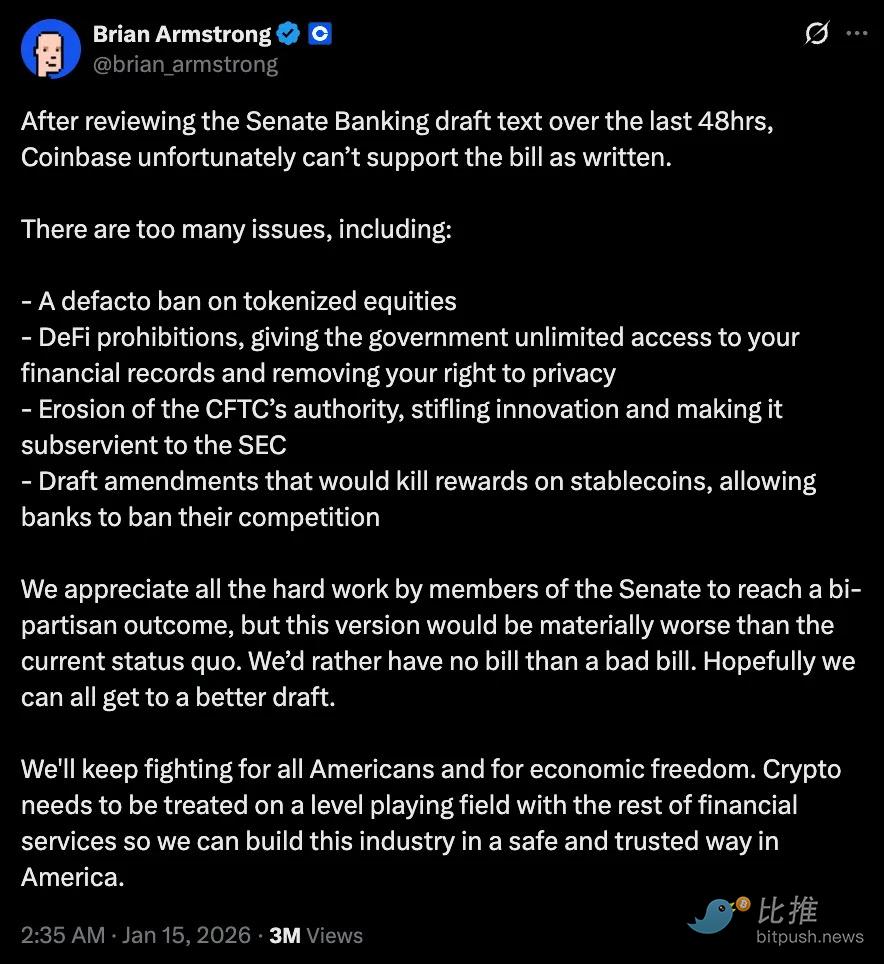
@brian_armstrong

The DeFi Education Fund, a DeFi policy and advocacy organization, also urged senators to oppose legislative amendment proposals that appear "anti-DeFi."

"While we have not yet seen the text of these amendments, their description suggests they would severely harm DeFi technology and/or make market structure legislation more unfavorable for software developers," the organization posted on X.
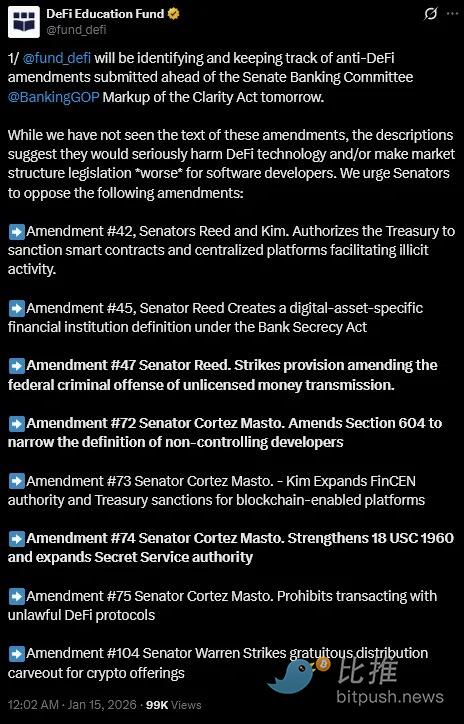
@fund_defi

Although the CLARITY Act formally acknowledges decentralization, its definition is narrow. Protocols under "common control" or those retaining the ability to modify rules or restrict transactions risk being subjected to bank-like compliance obligations.

Regulation aims to introduce scrutiny and accountability. However, decentralization is not static. It is a dynamic spectrum, requiring evolving governance and contingency controls to provide resilience, not dominance. These rigid definitions create additional uncertainty for developers and users.

Next is the tokenization space, where there is a vast gap between promise and policy. Tokenized stocks and funds offer faster settlement, lower counterparty risk, and more continuous price discovery. Ultimately, they enable more efficient markets by compressing clearing cycles and reducing capital trapped in post-trade processes.

However, the current draft of the CLARITY Act leaves tokenized securities in a regulatory vacuum. Its wording does not explicitly prohibit them but introduces sufficient uncertainty regarding the custody of tokenized stocks.

If stablecoins are framed within the payments sphere and tokenized assets are constrained at the issuance stage, the path to more efficient capital markets will be significantly narrowed.

Some argue that stablecoins can exist as payment tools, while yields can be provided through tokenized money market funds, DeFi vaults, or traditional banks. This is not technically wrong. But there will always be market participants seeking more efficient ways to optimize capital. Innovation drives people to find workarounds. Often, these workarounds might involve moving capital overseas. Sometimes, this movement might even be opaque, in ways that regulators might later regret not foreseeing.

However, one argument stands above all others as the primary reason for opposing the bill. It's hard not to see that the bill in its current form structurally reinforces banks, weakens the prospects for innovation, and shackles an industry that could help optimize our current markets.

Worse, it might achieve this at two very high costs. The bill stifles any hope of healthy competition between the banking and crypto industries, while simultaneously allowing banks to profit more. Secondly, it leaves customers at the mercy of these banks, unable to choose to optimize their own yields within a regulated market.

These are high prices to pay, and precisely why critics are reluctant to offer support.

It is concerning that the bill is packaged as an effort to protect consumers, provide regulatory certainty, and bring crypto into the system, while its terms subtly suggest the opposite purpose.

These terms predetermine which parts of the financial system are allowed to compete for value. While banks can continue to operate within familiar boundaries, stablecoin issuers will feel compelled to exist and operate within a narrower economic landscape.

But money dislikes remaining passive. It flows towards efficiency. History shows that whenever capital is constrained in one channel, it always finds another. Ironically, this is precisely the situation the regulation aims to prevent.

Favorably for the crypto industry, the disagreement over this bill is not limited to the crypto sphere.

The bill still lacks sufficient support in Congress. Some Democrats are unwilling to vote in favor without discussion and deliberation on certain proposed amendments. Without their support, the bill cannot advance, even if it dismisses the crypto industry's opposition as noise. Even if all 53 Republicans vote for the bill, it would need at least 7 Democratic votes in the full Senate to pass with a supermajority and overcome a filibuster.

I do not expect the U.S. to produce a bill that satisfies everyone. I don't even think that is possible or desirable. The issue is that the U.S. is not merely regulating a new class of assets; it is attempting to legislate for a form of money whose inherent properties make it highly competitive. This makes it more difficult because it forces lawmakers to confront competition and draft terms that might challenge existing institutions (in this case, banks).

The impulse to tighten definitions, restrict permitted activities, and preserve existing structures is understandable. However, this risks turning regulation into a defensive tool that repels rather than attracts capital.

Therefore, it is essential to correctly understand the质疑 (questioning/doubts) surrounding the Clarity Act—this is not opposition to regulation itself. If the goal is to truly integrate crypto assets into the financial system, rather than simply fencing them off, then the U.S. needs to formulate rules that allow new forms of money to compete, experiment, and evolve within clear regulatory boundaries. This, in turn, would force traditional financial institutions to enhance their own.

In the final analysis, legislation that harms those it is supposed to protect is worse than no legislation at all.


Twitter:https://twitter.com/BitpushNewsCN

Bitpush TG Discussion Group:https://t.me/BitPushCommunity

Bitpush TG Subscription: https://t.me/bitpush

Original article link:https://www.bitpush.news/articles/7603621

Perguntas relacionadas

QWhat is the core controversy surrounding the CLARITY Act according to the article?

AThe core controversy is that the CLARITY Act aims to treat stablecoins purely as payment tools and prohibits issuers from paying interest or rewards to holders. This is seen as stifling competition by favoring traditional banks, which are allowed to pay interest on deposits, and limiting the potential benefits and efficiency that stablecoins promise.

QWhy did Coinbase's CEO, Brian Armstrong, publicly withdraw support for the CLARITY Act?

ABrian Armstrong withdrew support because he believed the proposed legislation, in its current form, would make the industry's situation worse than it is now. He stated, 'We would rather have no bill than a bad bill,' criticizing it for restricting stablecoin rewards and also raising concerns about its impact on decentralized finance (DeFi).

QHow does the article argue that the CLARITY Act historically contradicts the nature of money?

AThe article argues that throughout history, money has rarely been neutral and has inherently had an appreciation attribute, with practices like charging interest on loans dating back to ancient Mesopotamia. It states that 'money dislikes remaining passive' and flows toward efficiency. The Act, by prohibiting returns on stablecoins, contradicts this historical expectation that holding money should be compensated.

QWhat specific concern does the DeFi Education Fund have regarding the CLARITY Act?

AThe DeFi Education Fund expressed concern over proposed amendments to the Act that it described as 'anti-DeFi.' Although it hadn't seen the exact text, the organization warned that these amendments could severely harm DeFi technology and make market structure legislation more unfavorable for software developers, potentially imposing bank-like compliance obligations on decentralized protocols.

QWhat is the political hurdle for the CLARITY Act to pass in the U.S. Senate as mentioned in the article?

AThe article states that the Act lacks sufficient support in Congress. Even if all 53 Republicans voted for it, the bill would need at least 7 Democratic votes to achieve a supermajority and overcome a filibuster in the full Senate. Some Democrats are unwilling to vote for it without discussion and consideration of certain proposed amendments.

Leituras Relacionadas

Annual Salary of Millions Competing for Electricians, Meta Rushes to Open Its Own Technical School

The AI boom is facing an unexpected bottleneck: a severe shortage of skilled construction workers and electricians. As tech giants like Meta, OpenAI, and Alphabet race to build massive data centers—such as OpenAI's $16 billion "Stargate" project—they are hitting a critical labor wall. The U.S. needs an estimated 130,000 more electricians, 240,000 construction workers, and 150,000 supervisors by 2030 for AI infrastructure alone, but tens of thousands of electrician jobs go unfilled each year. While AI companies offer high premiums, with electricians earning up to $280,000 annually, worker scarcity still causes massive losses—delays on a single project can cost $14.2 million per month. The complexity of building AI data centers, which require immense power (equivalent to powering hundreds of thousands of homes), sophisticated electrical systems, and advanced liquid cooling solutions, demands highly skilled technicians who are in short supply. To combat this, companies are investing heavily in training. Meta has committed $115 million to a free training school offering tuition, housing, and stipends, targeting 5,000 new workers. OpenAI is partnering with unions to secure skilled labor. These efforts are paying off, with a significant rise in Gen Z interest in trade schools over college. However, the power demands are staggering. AI data centers are driving a rapid surge in electricity consumption, projected to account for up to 12% of U.S. power use by 2028 and raising costs for consumers. Furthermore, the construction boom is project-based, leading to a potential future glut of trained workers once building peaks, which could depress wages industry-wide. The race for AI supremacy now depends as much on skilled hands as on advanced chips.

marsbitHá 50m

Annual Salary of Millions Competing for Electricians, Meta Rushes to Open Its Own Technical School

marsbitHá 50m

OpenAI No Longer Sells Its Most Expensive Model for Profit

OpenAI is shifting its business strategy away from promoting its most expensive, flagship models for every task. Recent price cuts—80% for GPT-5.6 Luna and 20% for Terra—signal a deeper change: the company now actively advises users that many tasks don't require the most powerful model. Instead, OpenAI recommends a tiered approach: use the high-end GPT-5.6 Sol for complex planning and analysis, then delegate execution to cheaper models like Luna. This mirrors moves by Anthropic, which recently launched Claude Opus 5 at half the price of its top model, Fable 5. Both companies are de-emphasizing flagship models as primary revenue drivers, using them instead for brand prestige and technological showcases. The industry is entering a "mass-market" phase, similar to automotive, where high-volume, cost-effective models handle daily operations and drive scale. OpenAI's price reductions are partly enabled by AI models themselves optimizing underlying code and infrastructure, creating a self-reinforcing cycle of efficiency gains and cost reduction. Competition is shifting from "who is smartest" to "who offers the best value." The goal is no longer selling individual models but fostering widespread API adoption and ecosystem lock-in. By making AI calls cheap and ubiquitous, companies like OpenAI aim to become the indispensable, utility-like infrastructure powering automated workflows—the "water and electricity" of software, quietly embedded everywhere.

marsbitHá 50m

OpenAI No Longer Sells Its Most Expensive Model for Profit

marsbitHá 50m

Will the Fed Definitely Raise Interest Rates in September? How Will Crypto and U.S. Stocks Withstand the Pressure?

The market's expectation for a September Fed rate hike surged dramatically in early August, jumping from under 50% to over 80% within a week. This shift followed a contentious July FOMC meeting, where a 9-3 vote to hold rates revealed growing dissent from hawkish members advocating for an immediate hike to combat persistent inflation. The primary catalyst for this repricing is rising oil prices, driven by renewed geopolitical tensions around the Strait of Hormuz, which threaten global supply. Energy costs directly influence inflation metrics, making the upcoming July CPI report (due August 12th) a critical data point. If it shows inflation reaccelerating, the probability of a September hike will solidify. For Bitcoin and crypto assets, this is typically bearish news. Bitcoin continues to behave as a high-beta, liquidity-sensitive risk asset. A rate hike raises the opportunity cost of holding non-yielding assets and could drive capital toward money markets, pressuring crypto prices in the short term. However, historical patterns suggest that if a hike is perceived as the end of a tightening cycle rather than the start, any negative price impact may be brief. U.S. stocks, particularly crypto-linked equities like Coinbase and growth-oriented tech stocks, are also vulnerable. Higher rates increase discount rates in valuation models, putting pressure on high-multiple companies. This coincides with a pivotal tech earnings season where investor focus has shifted from massive AI capital expenditure to tangible revenue and cash flow generation. Companies with negative cash flow and weak growth narratives could face heightened volatility if borrowing costs rise in September. In summary, a September Fed hike has evolved into a mainstream market scenario. Key factors to watch are oil prices, the July CPI report, and Fed communications, which will determine the final decision and its impact on volatile crypto and equity markets.

marsbitHá 1h

Will the Fed Definitely Raise Interest Rates in September? How Will Crypto and U.S. Stocks Withstand the Pressure?

marsbitHá 1h

Trading

Spot
活动图片





