On L1 Value Capture from Two Solana Proposals

marsbitPublicado em 2026-08-05Última atualização em 2026-08-05

Resumo

The article, "Discussing L1 Value Capture Through Two Solana Proposals," by Max Resnick, explores how Layer 1 (L1) blockchain tokens derive their fundamental value, drawing parallels to traditional asset pricing theory. Resnick argues that L1 token value, like stock value, stems from claims on future income streams for holders, not merely from network activity or technological promise. This value is captured when fees are either burned (economically akin to a buyback) or distributed to stakers (akin to dividends). Inflationary staking rewards, by contrast, redistribute value among holders rather than creating it. The core challenge is the quality and defensibility of fee-based revenue. High-quality fees come from sustainable, recurring demand for the network's economic utility (e.g., long-term financial activity), not from transient speculation (e.g., meme coins, airdrops). The strength of a blockchain's network effects—liquidity, applications, users—can make its revenue more defensible and grant it greater pricing power than often assumed. The article proposes a foundational valuation framework for L1s, separating revenue (fees captured for token holders), costs, and total token supply. A key accounting principle is that inflationary rewards should not be counted as a cost unless the newly minted tokens are symmetrically counted as a value input; otherwise, it misrepresents profitability. Finally, Resnick discusses the economics of increasing protocol fees to boost reven...

Author: Max Resnick, Chief Economist at Anza

Compiled by: Jiahuan, ChainCatcher

I am publishing this article as SIMD 550 (doubling the rate of inflation reduction) and SIMD 553 (resource costs) are about to enter the voting stage. This piece is not a specific commentary on these two proposals; I have already left my comments on the respective GitHub proposals. Here, I primarily discuss how the problems these proposals aim to address relate to the valuation of L1s.

Part 1: The Establishment of Asset Pricing Theory

Before asset pricing theory was formally established, investors were not short of methods to value companies. Some focused on hard assets and liquidation value, others emphasized profits, dividends, growth, management quality, or market psychology. There were many metrics available; what was truly missing was a rigorous framework to explain exactly which metrics determine value and how these metrics should be weighed against each other.

By the late 1920s, on the eve of the Great Depression, this ambiguity had become dangerous. Investors could cite facts like profit growth, market expansion, new technologies, and improved corporate governance, but these facts were often used to justify market prices rather than to derive asset value.

Graham and Dodd (1934) later described that era as one where analysis gave way to "potential and prophecy." Even when data was presented, it became "pseudo-analysis to support the illusions of the moment."

Anyone who frequently indulges in Crypto Twitter should find this scene familiar. Today's discussions around L1 tokens are similarly filled with the potential, prophecy, and pseudo-analysis that characterized the stock market of the late 1920s.

The number of people participating in blockchain development is at a record high. Transaction activity is at an all-time peak. Tokens will become currency, collateral, digital oil, or a call option betting on the future financial system.

Some of these claims may be true and could even imply upside for the underlying network. But if they cannot explain how these factors translate into token holder surplus, they do not constitute a coherent valuation framework.

John Burr Williams was the first to push asset pricing towards rigor. In "The Theory of Investment Value," Williams (1938) argued that value is "the present worth of future dividends, or of future coupons and principal in the case of a bond."

Gordon (1959) later expressed the same idea more succinctly: "A stock, like any other asset, is worth to a buyer only the benefits he expects to receive from it in the future."

Equity has value not because a company is impressive, active, important, or technologically irreplaceable. It has value because equity grants shareholders a claim on future income.

For L1 tokens, value can accrue in two ways. The first is fee burning, which economically resembles a buyback. The second is distributing fees to stakers, which economically resembles a dividend.

Staking rewards funded by issuance are different. They are neither income created by the network nor a cost borne by the network. The protocol creates new tokens and distributes them to stakers while diluting the holdings of non-stakers.

This mechanism may be necessary to secure the network and may determine who gradually comes to own the network over time. But from the perspective of all token holders, it neither creates nor destroys value.

A blockchain can process millions of transactions while creating almost no value for token holders because the surplus may be captured by users, applications, validators, or other intermediaries. Conversely, a chain with less activity may be more valuable if it converts a larger proportion of economic activity into token holder value.

But not all fees are created equal. The 'R' in ARR stands for recurring, meaning sustainable and repeatable income. Dichev, Graham, Harvey, and Rajgopal (2013) noted that high-quality earnings should be "sustainable and repeatable." The same standard applies to L1 fees.

One dollar of fees generated by long-term financial activity is not the same as one dollar generated by airdrops, meme coin mania, cascading liquidations, or temporary network congestion.

Some fees come from users' ongoing demand for scarce block space. Others are merely exhaust from speculative cycles. Once incentives disappear, volatility subsides, or users run out of money, these activities also vanish.

Fee quality depends on persistence and defensibility.

Are users paying because the chain provides long-term economic utility, or because a short-term activity happens to be on this chain? Can the protocol continue to charge these fees without driving users, applications, or order flow elsewhere? Can the token continue to capture these profits, or will this value eventually be competed away by validators, applications, searchers, block builders, users, or other chains?

Historically, crypto investors have often made two opposite errors regarding earnings quality simultaneously.

On one hand, they overestimated earnings quality because much crypto activity is speculative, reflexive, and episodic.

On the other hand, they underestimated earnings quality because they did not fully appreciate the strength of L1 network effects. Liquidity, applications, wallets, infrastructure, users, developers, assets, and order flow reinforce each other.

These network effects may make certain fees harder for competitors to capture than they initially appear. They also suggest that dominant blockchains like Solana and Ethereum may have stronger pricing power than the market generally believes, potentially benefiting from raising fees.

Part 2: Accounting Standards for Revenue, Inflation, and Total Supply

The next step is to specify a minimal fundamental model for L1s that can lead to valuation multiples.

It may be premature to call it the "standard model" now. There is currently no universally accepted standard model for L1 valuation. But the categorization below is the form I believe a standard model should take. It intentionally mirrors the methods stock analysts use to value companies.

The reason this needs to be explicitly written down is that there isn't even consensus on the most basic accounting objects.

I've discussed this framework with some of the smartest people I know, and they often disagree on fundamental questions. Are validator rewards funded by inflation considered a cost? Should foundation expenditures be treated as operating expenses? Should the unspent portion of foundation tokens be included in the token supply? Should MEV paid to validators count as protocol revenue, validator revenue, or neither?

Some of the confusion may stem from the fact that there can be more than one correct way to write a valuation model. Accounting classifications are not unique. As long as the corresponding offsetting items are also adjusted, you can move an item from one side of the ledger to the other while keeping the model correct.

But this flexibility is also dangerous. Many models are internally consistent, but many are not. Having multiple correct methods does not mean there are fewer incorrect ones.

Inflation rewards are the simplest example.

Staking rewards funded by issuance are essentially rewards paid by token holders to stakers via dilution. From the perspective of all token holders combined, the two offset each other. The protocol does not earn revenue when it mints new tokens, nor does it incur a real external cost when distributing these tokens to stakers.
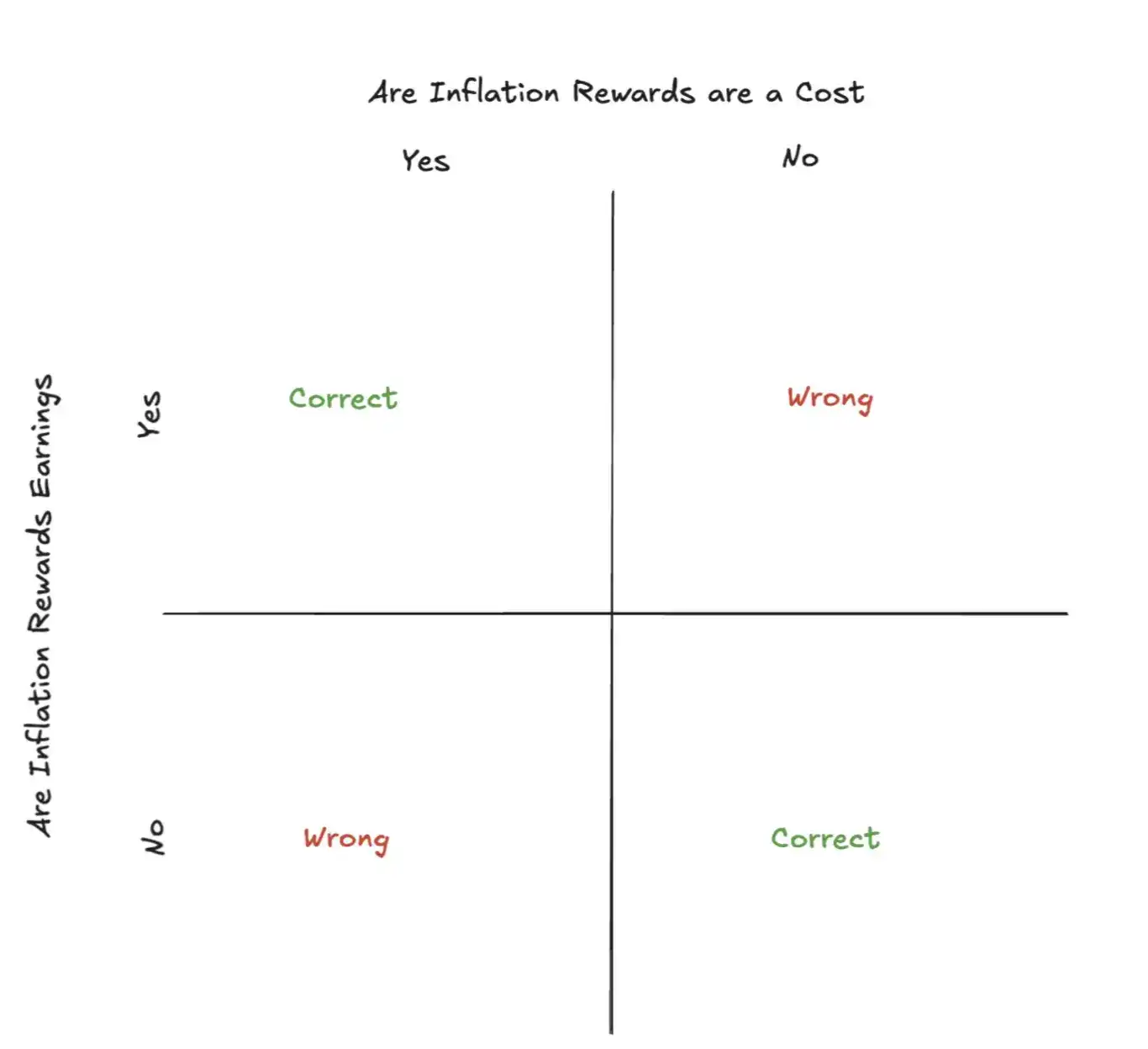
You can create a correct model that treats inflation rewards as a cost, but only if you simultaneously count newly issued tokens as a source of value to offset that cost. Otherwise, the model leads to absurd conclusions, such as Solana being unprofitable because it pays large staking rewards.

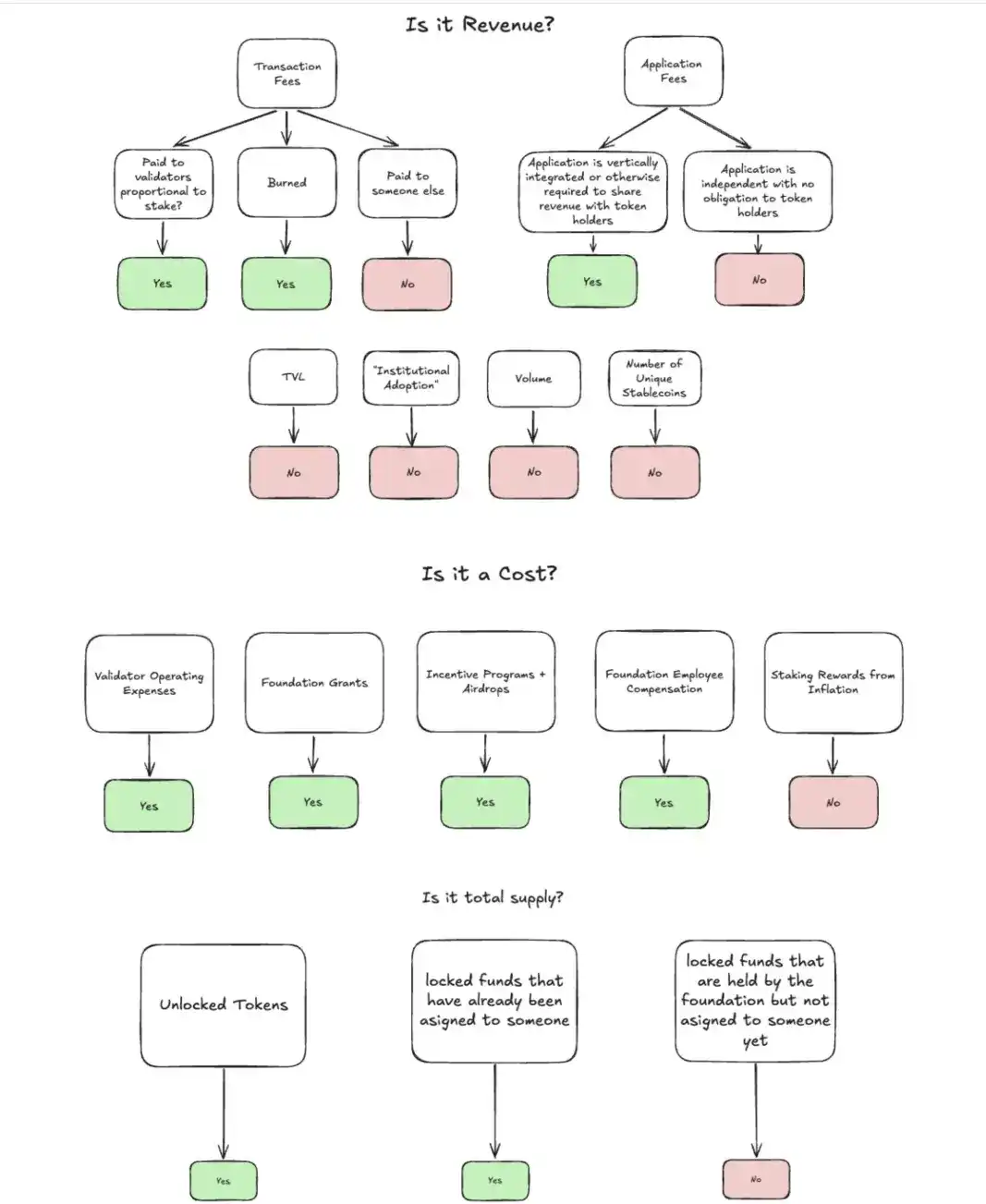
The categorization below is my proposed baseline. It separates three objects: revenue, costs, and total supply.

I believe these definitions most closely resemble the models stock analysts are already familiar with, making them easier to understand and reason about.

Other classifications may be correct, but deviations from this one must have clear justification. Proprietary models come with two costs.

First, they are harder for others to understand. Second, it is easy to miss dependencies between items.

For example, if foundation expenditures are classified as a cost, then the unspent portion of foundation tokens cannot also be included in the total supply, or it would be double-counted. If inflation rewards are classified as a cost, newly issued tokens must be treated symmetrically.
Part 3: Supply, Demand, and Price

Recently, several blockchains have explicitly raised fees with the goal of increasing revenue. However, revenue equals price multiplied by quantity.

Raising fees increases the revenue contributed by transactions that remain, but it also causes some transactions to disappear. Therefore, the net effect of a fee increase on revenue is uncertain; it hinges on the price elasticity of demand for transactions.

To understand the reasoning behind these adjustments, I spoke with some of the decision-makers involved. They believed the fees on these chains were originally too low, so demand was relatively inelastic within that price range.

This argument might apply to specific cases but is not universally true.

I have done some past research utilizing randomness in EIP-1559 pricing. The analysis showed that the price elasticity of gas demand is roughly between 0.6 and 0.8. That is, a 10% price increase leads to a 6% to 8% decrease in quantity demanded.

Moreover, this data only reflects short-term price fluctuations and does not capture the aggregate effects of applications migrating off-chain or optimizing their programs.
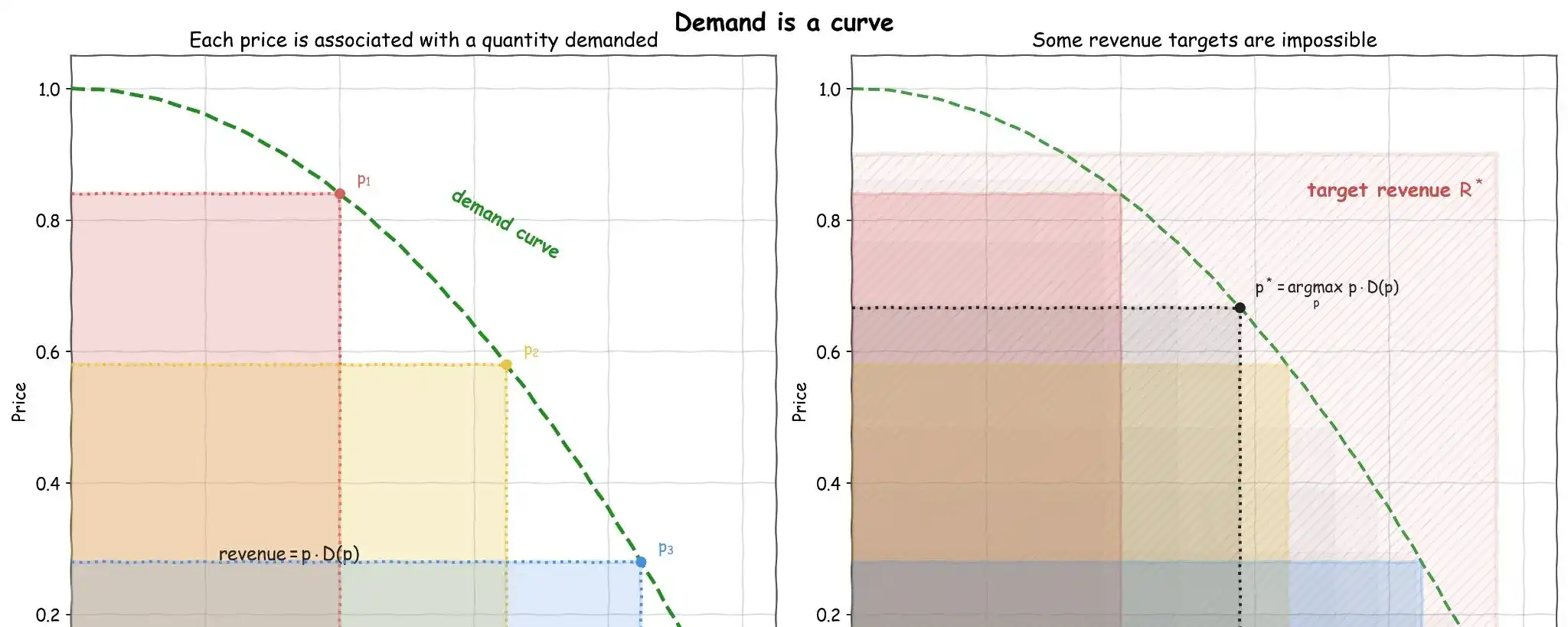
Therefore, a flat fee is a rather blunt instrument for generating revenue. Different types of on-chain transactions have different willingness to pay.

A small wallet transfer, a large stablecoin transfer, and a liquidation may consume the same block space, but they generate different total surplus and have different willingness to pay.
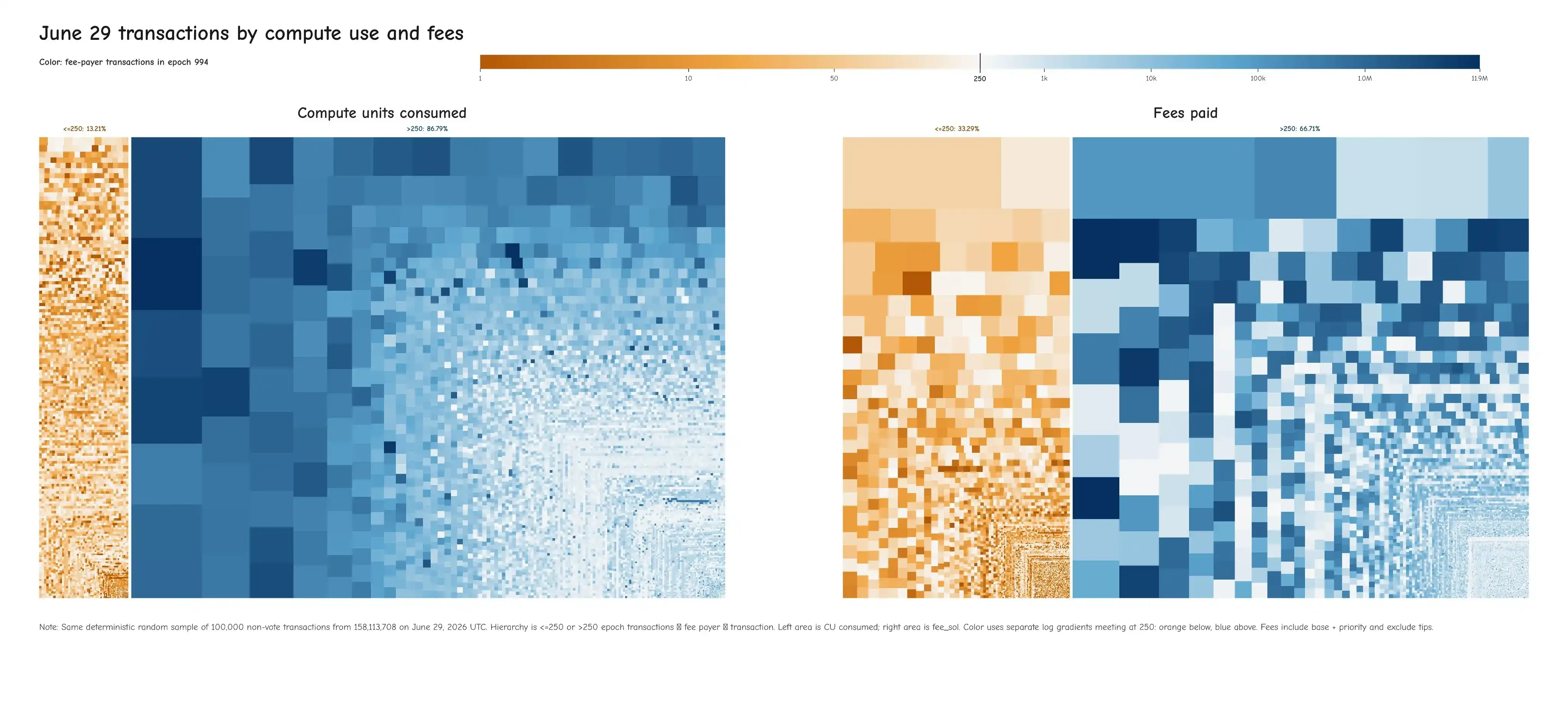
Note: Blue dots represent fee payers who initiated more than 250 transactions in the period, suggesting they are more likely to be bots and thus have higher price elasticity. Bots typically have thin profit margins, so they tend to reduce resource consumption significantly when prices rise.

Protocols want to charge higher fees for transactions with a higher willingness to pay. Computation-based fees are a step in this direction but not thorough enough.

For financial activity, the nominal transaction amount is often a better indicator of willingness to pay than computational load. This is why exchanges typically charge fees based on basis points.

Token programs can provide a way to charge fees proportional to transaction value. By modifying token programs, a small percentage-based fee can be levied on token transfers. This way, even if a high-value transfer uses similar computational resources as a low-value one, the high-value transfer still pays more.


Criptomoedas em alta

Perguntas relacionadas

QAccording to the article, what are the two primary ways that value can be aggregated to L1 token holders, and how do they differ economically from staking rewards funded by inflation?

AAccording to the article, value can be aggregated to L1 token holders in two primary ways: 1) Burning fees, which is economically equivalent to a share buyback, and 2) Distributing fees to stakers, which is economically equivalent to paying a dividend. These differ from staking rewards funded by inflation, which are neither network income nor a real external cost. They represent a redistribution from non-stakers to stakers through dilution, not the creation of value for token holders as a whole.

QWhat is the key difference between 'high-quality' fees and lower-quality fees for an L1 blockchain, as discussed in the article?

AThe key difference lies in the sustainability and defensibility of the fees. High-quality fees are recurring and repeatable, stemming from persistent demand for scarce block space due to long-term economic utility. Lower-quality fees are temporary and non-recurring, often generated by speculative activities like airdrop farming, memecoin frenzies, liquidations, or temporary network congestion that can disappear when incentives fade or volatility subsides.

QIn the author's proposed 'standard model' for L1 accounting, how should inflationary staking rewards and new token issuance be treated, and why?

AIn the author's proposed standard model, inflationary staking rewards should not be treated as a network cost, and newly issued tokens should not be treated as network income. This is because, from the perspective of all token holders, they are offsetting internal transfers—the dilution from new issuance is the 'cost' paid by holders to fund the staking rewards. Treating them as a cost without a corresponding income entry would incorrectly suggest the network is unprofitable.

QWhat caution does the article offer regarding the strategy of increasing protocol fees to raise revenue, and what economic concept is central to this caution?

AThe article cautions that increasing protocol fees does not automatically lead to higher revenue because revenue equals price multiplied by quantity. Raising fees can reduce the quantity of transactions. The central economic concept is the price elasticity of demand. If demand is elastic, a fee increase will lead to a proportionally larger drop in transactions, reducing total revenue. The article cites research suggesting Ethereum gas demand has a price elasticity between 0.6 and 0.8, meaning it is somewhat elastic.

QWhat is the proposed alternative to a uniform fee structure that the author suggests could better capture value from high-willingness-to-pay transactions?

AThe author suggests that a more effective alternative to a uniform fee structure would be to implement fees based on the nominal transaction value, similar to how exchanges charge basis points. This could be done by modifying token programs to levy a small proportional fee on token transfers. This way, a high-value transfer pays more than a low-value transfer even if they consume similar computational resources, better capturing value from transactions with a higher willingness to pay.

Leituras Relacionadas

MARA Opens 'Slipstream' to Public as 'Coldcard' Victims Race to Save Assets

MARA Holdings, a Nasdaq-listed Bitcoin mining and AI infrastructure company (formerly Marathon Digital), has opened its "Slipstream" service to the public. Slipstream allows users to send Bitcoin transactions directly to MARA's mining pool, keeping them hidden from the public mempool until mined into a block, rather than broadcasting them openly. The public launch coincides with a critical vulnerability discovered in Coldcard hardware wallets. A firmware bug dating to March 2021 significantly reduced the randomness when generating wallet seed phrases, making funds vulnerable to theft. Hackers have already stolen an estimated 1,816 BTC (approx. $116 million) from over 5,200 wallets. For users needing to move funds from vulnerable wallets, especially those with multi-signature setups, broadcasting a standard transaction publicly can reveal key details and allow attackers to intercept it. Slipstream mitigates this risk by keeping the transaction private until confirmation. MARA first launched Slipstream in February 2024 for large or non-standard transactions. It does not charge an extra fee; users only pay standard Bitcoin network fees. However, confirmation timing depends on MARA's mining luck, as it controls roughly 5.37% of the Bitcoin network's total hashrate. The Bitcoin community views Slipstream's open access as a practical crisis tool for Coldcard holders, not a permanent replacement for the public mempool for everyday transactions.

cryptonews.ruHá 11m

MARA Opens 'Slipstream' to Public as 'Coldcard' Victims Race to Save Assets

cryptonews.ruHá 11m

Trading

Spot

Artigos em Destaque

O que é SOLANA

HarryPotterWifHatMyroWynn10Inu,$solana: Uma Mergulho no Projeto de Meme Coin Trendy Introdução No panorama em constante evolução das criptomoedas, projetos inovadores surgem continuamente, capturando a imaginação de investidores e entusiastas. Um desses projetos é o HarryPotterWifHatMyroWynn10Inu,$solana, uma moeda meme que começou a esculpir seu nicho dentro da comunidade cripto. Este artigo tem como objetivo fornecer uma visão abrangente do projeto, elucidando seu propósito, arquitetura, criador, investidores e marcos notáveis ao longo da jornada. O que é HarryPotterWifHatMyroWynn10Inu,$solana? Visão Geral HarryPotterWifHatMyroWynn10Inu,$solana é um projeto de moeda meme estruturado na blockchain Solana – uma plataforma conhecida pela sua escalabilidade e rapidez. Com o objetivo de trazer alegria e criatividade para o espaço cripto, este projeto não serve apenas como um token de negociação, mas também como um catalisador para a geração e partilha de conteúdo meme. Esta comunidade, no seu núcleo, é incentivada a participar ativamente, proporcionando um ecossistema dinâmico onde a criatividade e a colaboração prosperam. Objetivos e Metas Na sua essência, o projeto visa fomentar um ambiente onde os entusiastas de meme possam congregar, partilhar e criar conteúdo meme novo. Esta abordagem orientada pela narrativa infunde entusiasmo dentro da comunidade, impulsionando o envolvimento e ao mesmo tempo lançando luz sobre as robustas funcionalidades inerentes à blockchain Solana. Ao construir um projeto focado na comunidade, HarryPotterWifHatMyroWynn10Inu,$solana também deseja explorar o impacto social das moedas digitais como meio de expressão. Quem é o Criador de HarryPotterWifHatMyroWynn10Inu,$solana? A identidade do criador por trás de HarryPotterWifHatMyroWynn10Inu,$solana permanece envolta em mistério. O projeto foi estruturado de tal forma que a propriedade foi renunciada; portanto, ele prospera como uma iniciativa liderada pela comunidade. Esta descentralização promove transparência e participação democrática entre todos os intervenientes envolvidos. Tal abordagem está a tornar-se cada vez mais popular no mundo das moedas meme, onde o envolvimento da comunidade reina supremo. Quem são os Investidores de HarryPotterWifHatMyroWynn10Inu,$solana? Até agora, não há informações disponíveis publicamente sobre os investidores ou fundações específicas que apoiam HarryPotterWifHatMyroWynn10Inu,$solana. A ausência de investidores conhecidos enfatiza ainda mais a ética orientada para a comunidade do projeto, uma vez que este se mantém independente de estruturas financeiras tradicionais. Esta independência permite que o projeto desenvolva a sua identidade livre de pressões externas, confiando em vez disso no interesse coletivo da sua base de utilizadores. Como Funciona HarryPotterWifHatMyroWynn10Inu,$solana? Modelo Econômico O projeto emprega um modelo econômico único que sustenta sua funcionalidade e envolvimento dos utilizadores. As transações dentro de HarryPotterWifHatMyroWynn10Inu,$solana são projetadas para serem benéficas para todas as partes envolvidas. Cada negociação acarreta uma taxa, que é posteriormente redistribuída entre os detentores atuais, enquanto simultaneamente aumenta o fundo de liquidez. Os principais componentes deste modelo incluem: Mecanismo de Reflexão: Uma parte das taxas de transação é devolvida aos detentores, promovendo o investimento a longo prazo no token. Aquisição de Pool de Liquidez: Fundos são alocados para aumentar a liquidez, garantindo que as operações de compra e venda possam ser executadas sem problemas. Mecanismos de Queima: Uma parte dos tokens pode ser queimada para criar escassez, potencialmente aumentando o valor à medida que a demanda aumenta. Este design incentiva um ecossistema auto-sustentável que prospera com as interações e investimentos da comunidade. Envolvimento da Comunidade No coração de HarryPotterWifHatMyroWynn10Inu,$solana está o valor atribuído ao envolvimento da comunidade. Ao permitir que os utilizadores participem no desenvolvimento do projeto através de várias atividades, como criação e promoção de memes, o projeto promove um ecossistema vibrante onde a criatividade pode florescer. Linha do Tempo de HarryPotterWifHatMyroWynn10Inu,$solana A trajetória de HarryPotterWifHatMyroWynn10Inu,$solana apresenta vários eventos notáveis que moldaram sua posição atual na comunidade cripto: Criação: A data específica de criação permanece não divulgada, mas a origem do projeto está enraizada na cultura meme que permeia a era digital. Assunção da Comunidade: Após a renúncia da propriedade por seu criador, o projeto transitou para um modelo liderado pela comunidade, permitindo que todos os participantes tenham uma participação em seu sucesso. Audit e Coleção de NFT: Em uma tentativa de fortalecer a credibilidade, o projeto completou uma auditoria minuciosa, lançando simultaneamente uma coleção de NFT que serve para incorporação de sua ética centrada em memes. Parcerias e Desenvolvimento: O projeto está atualmente em processo de busca de parcerias potenciais com outros tokens e organizando o desenvolvimento de um website único e opções de merchandising baseadas em seus memes lendários. Pontos Chave Em resumo, HarryPotterWifHatMyroWynn10Inu,$solana assume um papel notável dentro do setor de moedas meme da criptomoeda. Aqui estão algumas das principais conclusões: Iniciativa Liderada pela Comunidade: O projeto prospera como um esforço colaborativo, incentivando contribuições ativas dos membros da sua comunidade enquanto se desliga das reivindicações de propriedade. Modelo Econômico Inovador: Utilizando mecanismos de reflexão, aquisição de liquidez e queima, cria um ambiente financeiro robusto e envolvente para os utilizadores. Envolvimento com NFT e Mercadorias: Com o lançamento de uma coleção de NFT, o projeto busca aprofundar o envolvimento em sua comunidade, reforçando o vínculo entre a cultura meme e moeda digital. Exploração de Parcerias: A iniciativa não está estagnada – o desenvolvimento contínuo e potenciais parcerias indicam uma abordagem visionária voltada para um crescimento sustentável. Conclusão À medida que HarryPotterWifHatMyroWynn10Inu,$solana continua a ganhar tração no panorama das criptomoedas, sua mistura única de envolvimento comunitário, estruturas econômicas inovadoras e integração da cultura meme delineiam seu potencial caminho à frente. Mesmo com o mistério que envolve suas origens e afiliações de investidores, o projeto captura uma história intrigante que fala à essência da inovação descentralizada. Em um mundo onde as criptomoedas são frequentemente vistas através de uma lente puramente financeira, HarryPotterWifHatMyroWynn10Inu,$solana demonstra que o movimento cripto incorpora criatividade, comunidade e colaboração. Seja você um investidor experiente ou um novato, a jornada em desenvolvimento deste projeto de moeda meme certamente serve como um estudo de caso envolvente digno de atenção.

600 Visualizações TotaisPublicado em {updateTime}Atualizado em 2024.12.03

O que é SOLANA

O que é SOLANA 2.0

BarbieCrashBandicootRFK777Inu, $SOLANA 2.0: Um Novo Jogador no Cenário Cripto Introdução ao BarbieCrashBandicootRFK777Inu, $SOLANA 2.0 No sempre evolutivo cenário das criptomoedas, novos participantes estão continuamente a capturar a atenção de investidores e entusiastas. Entre estes projetos emergentes está BarbieCrashBandicootRFK777Inu, representado pelo símbolo de criptomoeda $SOLANA 2.0. Esta iniciativa única combina elementos de glamour, aventura e cultura meme, propondo-se a desafiar as expectativas numa arena altamente competitiva. Com aspirações de crescimento e inovação, este projeto captura o espírito de um azarão a lutar contra gigantes estabelecidos. O que é BarbieCrashBandicootRFK777Inu, $SOLANA 2.0? No seu núcleo, BarbieCrashBandicootRFK777Inu é um projeto de criptomoeda que se inspira em várias referências culturais icónicas. Incluindo a elegância e charme associados à Barbie, a energia dinâmica de Crash Bandicoot e a determinação incansável representada por RFK, o projeto pretende oferecer uma experiência multifacetada no mundo das criptomoedas. O objetivo principal do projeto BarbieCrashBandicootRFK777Inu é fundir estes elementos díspares num ecossistema coeso que atraia um amplo público. Ao abraçar a whimsicalidade da cultura meme enquanto se mantém enraizado nos princípios da descentralização e do empoderamento financeiro, o projeto posicionou-se como uma opção atraente tanto para investidores experientes quanto para novatos no mundo cripto. Quem é o Criador do BarbieCrashBandicootRFK777Inu, $SOLANA 2.0? Apesar do crescente interesse em BarbieCrashBandicootRFK777Inu, as informações sobre o seu criador continuam a ser amplamente desconhecidas. O anonimato do seu fundador ou equipa de desenvolvimento levanta questões sobre a estrutura e governança do projeto. No mundo das criptomoedas, não é incomum que os projetos operem sem criadores públicos. Esta falta de informação pode desmotivar alguns potenciais investidores, enquanto outros podem vê-la como uma oportunidade de abraçar o espírito de descentralização que fundamenta muitas iniciativas de criptomoeda. Quem são os Investidores do BarbieCrashBandicootRFK777Inu, $SOLANA 2.0? Atualmente, há escassas informações disponíveis sobre as fundações ou organizações de investimento que apoiam BarbieCrashBandicootRFK777Inu. A falta de suporte de investimento detalhado do projeto destaca a natureza independente de várias criptomoedas. Neste caso, ainda permanece a incógnita se o financiamento do projeto virá do apoio da comunidade ou do suporte de entidades financeiras maiores. Como Funciona o BarbieCrashBandicootRFK777Inu, $SOLANA 2.0? BarbieCrashBandicootRFK777Inu é concebido com várias características que contribuem para a sua singularidade no espaço cripto saturado. Embora detalhes técnicos específicos permaneçam em segredo, espera-se que o projeto incorpore funcionalidades destinadas a melhorar o envolvimento dos utilizadores e fomentar o crescimento da comunidade. A combinação de influências variadas — desde a moda e aventura até o gaming — incentiva uma atmosfera inclusiva que atende a interesses diversos. Adicionalmente, os laços do projeto com o ecossistema $SOLANA 2.0 sugerem potenciais vantagens tecnológicas. Isto pode incluir velocidades de transação inovadoras, escalabilidade e custo-efetividade, alinhando-se com as capacidades técnicas da blockchain Solana. Os fundadores do projeto parecem estar a aproveitar esta base tecnológica para criar uma experiência comunitária duradoura e uma oferta de produtos substancial. Linha do Tempo do BarbieCrashBandicootRFK777Inu, $SOLANA 2.0 A jornada do BarbieCrashBandicootRFK777Inu contém vários marcos-chave, fornecendo uma visão sobre o desenvolvimento do projeto até agora: Conceitualização do Projeto: Ideias iniciais surgiram em torno da fusão de glamour, aventura e cultura meme, fornecendo a estrutura para o conceito único do projeto. Criação do Token: O token simbólico $SOLANA 2.0 foi estabelecido, concebido para incorporar as aspirações do projeto e atrair o interesse de investidores potenciais. Desenvolvimento do Projeto: Atualmente, o projeto está a passar por novos desenvolvimentos, com ênfase em desafiar os jogadores estabelecidos no espaço cripto e entregar ofertas inovadoras. Estes marcos refletem a trajetória de crescimento do projeto, enquanto destacam o seu compromisso em desenvolver uma experiência pioneira em criptomoedas. Pontos-Chave Sobre BarbieCrashBandicootRFK777Inu, $SOLANA 2.0 Conceito Único: BarbieCrashBandicootRFK777Inu destaca-se ao fundir elementos de glamour, aventura e cultura meme num único projeto de criptomoeda. Espírito de Azarão: O projeto abraça uma persona de azarão, visando desafiar projetos de criptomoeda estabelecidos e criar um nicho na indústria. Fase de Desenvolvimento: Esforços de desenvolvimento ativos estão em andamento, com a intenção de fornecer ofertas novas e inovadoras em alinhamento com as expectativas da comunidade e investidores. Conclusão BarbieCrashBandicootRFK777Inu, representado pelo símbolo $SOLANA 2.0, é uma nova entrada intrigante no mercado de criptomoedas. A sua mistura única de referências culturais e visão ambiciosa pode ressoar com aqueles que buscam valores alternativos em projetos no panorama cripto. Embora o estado desconhecido do seu criador e investidores possa levantar sobrancelhas, a ênfase do projeto em charme e aventura apresenta uma narrativa cativante que expande os limites do que as criptomoedas podem representar. À medida que o projeto continua a desenvolver-se, será interessante observar a sua evolução dentro do amplo cenário cripto e como se posiciona entre os seus concorrentes. Para aqueles envolvidos, BarbieCrashBandicootRFK777Inu pode muito bem desbloquear experiências surpreendentes que redefinem o envolvimento com ativos digitais. Por agora, à medida que o projeto avança, a sua jornada serve como um lembrete de que a inovação no espaço cripto não conhece limites, oferecendo tudo, desde excitação e entretenimento até a potencialidade de empoderamento financeiro.

189 Visualizações TotaisPublicado em {updateTime}Atualizado em 2024.12.03

O que é SOLANA 2.0

Como comprar SOL

Bem-vindo à HTX.com!Tornámos a compra de Solana (SOL) simples e conveniente.Segue o nosso guia passo a passo para iniciar a tua jornada no mundo das criptos.Passo 1: cria a tua conta HTXUtiliza o teu e-mail ou número de telefone para te inscreveres numa conta gratuita na HTX.Desfruta de um processo de inscrição sem complicações e desbloqueia todas as funcionalidades.Obter a minha contaPasso 2: vai para Comprar Cripto e escolhe o teu método de pagamentoCartão de crédito/débito: usa o teu visa ou mastercard para comprar Solana (SOL) instantaneamente.Saldo: usa os fundos da tua conta HTX para transacionar sem problemas.Terceiros: adicionamos métodos de pagamento populares, como Google Pay e Apple Pay, para aumentar a conveniência.P2P: transaciona diretamente com outros utilizadores na HTX.Mercado de balcão (OTC): oferecemos serviços personalizados e taxas de câmbio competitivas para os traders.Passo 3: armazena teu Solana (SOL)Depois de comprar o teu Solana (SOL), armazena-o na tua conta HTX.Alternativamente, podes enviá-lo para outro lugar através de transferência blockchain ou usá-lo para transacionar outras criptomoedas.Passo 4: transaciona Solana (SOL)Transaciona facilmente Solana (SOL) no mercado à vista da HTX.Acede simplesmente à tua conta, seleciona o teu par de trading, executa as tuas transações e monitoriza em tempo real.Oferecemos uma experiência de fácil utilização tanto para principiantes como para traders experientes.

1.8k Visualizações TotaisPublicado em {updateTime}Atualizado em 2026.06.02

Como comprar SOL

Discussões

Bem-vindo à Comunidade HTX. Aqui, pode manter-se informado sobre os mais recentes desenvolvimentos da plataforma e obter acesso a análises profissionais de mercado. As opiniões dos utilizadores sobre o preço de SOL (SOL) são apresentadas abaixo.

活动图片