Inflation Has Not Improved. Will Warsh Support a Rate Hike on Friday?

marsbitPublicado em 2026-08-27Última atualização em 2026-08-27

Resumo

U.S. inflation remained stubbornly high in July, with the PCE price index holding at a year-on-year increase of 3.7%, unchanged from June and still far above the Federal Reserve's 2% target. The core PCE index also stayed flat at 3.3%. While inflation did not worsen, the fact that it did not improve either has increased market expectations for further interest rate hikes. Futures pricing now indicates a higher probability of a rate increase in September and fully prices in one hike by year-end. The economic backdrop is mixed. Second-quarter GDP growth was revised to 1.5%, but underlying components like consumer spending and business investment were robust. However, inflation-adjusted consumer spending stalled in July, and real incomes have barely grown over the past year, eroding purchasing power. The data provides arguments for both sides of the policy debate. The "wait-and-see" camp points to the lack of acceleration in inflation and upcoming methodological changes that may lower reported figures. The "pro-hike" camp highlights that inflation remains hotter than forecasts, sticky services prices, rising diesel and chip costs, and renewed trade tensions with Canada. All eyes are now on Fed Chair Kevin Warsh's upcoming speech at Jackson Hole for clarity on his policy stance. With inflation persistently above target for over five years and midterm elections approaching where prices are a key issue, the pressure for decisive action is mounting. The speech carries significant...

Early Wednesday morning, the U.S. Commerce Department released the latest inflation figures.

The inflation rate, as measured by the PCE price index, rose 3.7% year-on-year in July, exactly the same as in June. This marks its 65th consecutive month above the Federal Reserve's 2% target. Second-quarter GDP grew at an annualized rate of 1.5%, identical to the initial estimate from last month and slower than the first quarter's 2.1%. Meanwhile, after adjusting for inflation, consumer spending in July did not increase at all.

The New York Times summarized the report in one sentence: America's stubborn inflation problem did not get worse in July, but it did not get better either. The issue is that in the current atmosphere within the Federal Reserve, "not getting better" is itself an answer.

Why Does "Unchanged" Raise Rate Hike Odds?

Because economists expected it to fall. A Reuters survey predicted 3.6%, while the actual figure came out at 3.7%. The month-on-month figure also exceeded expectations, with overall prices rising 0.2% (expected 0.1%), compared to a 0.1% decline in June, which had been the weakest month since April 2020. Core PCE (excluding volatile food and energy) rose 3.3% year-on-year, again identical to June, with the month-on-month rate increasing from 0.1% to 0.2%.

Upon the data release, fed funds futures showed the probability of a September rate hike jumped from about 36% to around 44%. Traders have fully priced in one rate hike by the end of the year.

Omair Sharif, founder of the forecasting firm Inflation Insights, gave the shortest possible assessment: "This is a rate-hike supportive report."

Heather Long, Chief Economist at Navy Federal Credit Union, was more comprehensive: "The United States still has an inflation problem. The latest data gives (Warsh) time to wait and see, but he must be clearer about what he's watching closely and what circumstances would lead him to hike."

The dollar hit its biggest gain in nearly four weeks that day, recouping roughly half of the losses incurred after Treasury Secretary Besant intervened to support the bond market last week. The Bloomberg Dollar Spot Index rose as much as 0.3%, while the yen fell 0.2% to 159.45.

How Did Rate Hike Probability Get Here?

PCE peaked at 7.2% in June 2022, and the steepest round of rate hikes since the 1980s subsequently pulled it back onto a path toward 2%. That path was interrupted last year. A round of import tariffs following Trump's return to the White House pushed up prices for a wide range of goods.

In late February this year, the U.S. and Israel took action against Iran. Before the war started, PCE was 2.9%. The conflict shut down roughly one-fifth of global oil supply, sending energy prices spiraling upward and pushing PCE to a three-year high of 4.1% in May.

Six months on, a final resolution to the conflict remains distant, but the intensity of fighting has decreased, and oil prices along with the wave of inflation they fueled have receded from their late-spring highs.

They receded to 3.7%, and then stalled there.

The trouble is, new tariff pressures are on the way: Last Friday, U.S. negotiations with its second-largest trading partner, Canada, broke down. New tariffs on $20 billion worth of Canadian goods have taken effect, and both sides have since announced additional retaliatory measures set to take effect in the coming months.

The nuance of this report is that both the camp advocating for patience and the camp advocating for a rate hike can find ammunition in it.

The camp advocating for patience sees that: inflation did not worsen; high oil prices, aside from specific categories like airfare, have barely spread throughout the broader economy; and starting next month, the Bureau of Economic Analysis will change how it calculates prices for a subset of services (portfolio management services, software, and computer accessories) – an adjustment that is likely to lower measured inflation.

The camp advocating for a rate hike sees that: both headline and core inflation in July were hotter than forecasters expected; service prices excluding housing (an indicator some officials view as a gauge of underlying price pressure) rose faster than in June; diesel prices are near record highs, which will push up the cost of far more than one category of goods; the AI boom is pushing up chip prices; and the trade war with Canada has just reignited.

And the most fundamental argument has nothing to do with the monthly data: inflation has been above target for over five years. The argument from this camp is that the central bank must act decisively, or risk losing credibility.

But in reality, the economy is cooling. This is the most easily overlooked, and most critical, half of the report.

In July, inflation-adjusted consumer spending saw zero growth, after posting strong gains in the previous two months. In nominal terms, personal income rose 0.4% and consumer spending rose 0.2%, both exceeding expectations; but after subtracting inflation, real growth was zero.

Even more telling is income: compared to a year ago, inflation-adjusted income rose only 0.2%, and it had been negative for many months prior.

In other words, even as the inflation rate number is coming down, five years of cumulative price increases have eroded incomes. This explains why in consumer confidence surveys, most Americans remain pessimistic about the economy and their own financial situation.

What Will Warsh Say on Friday?

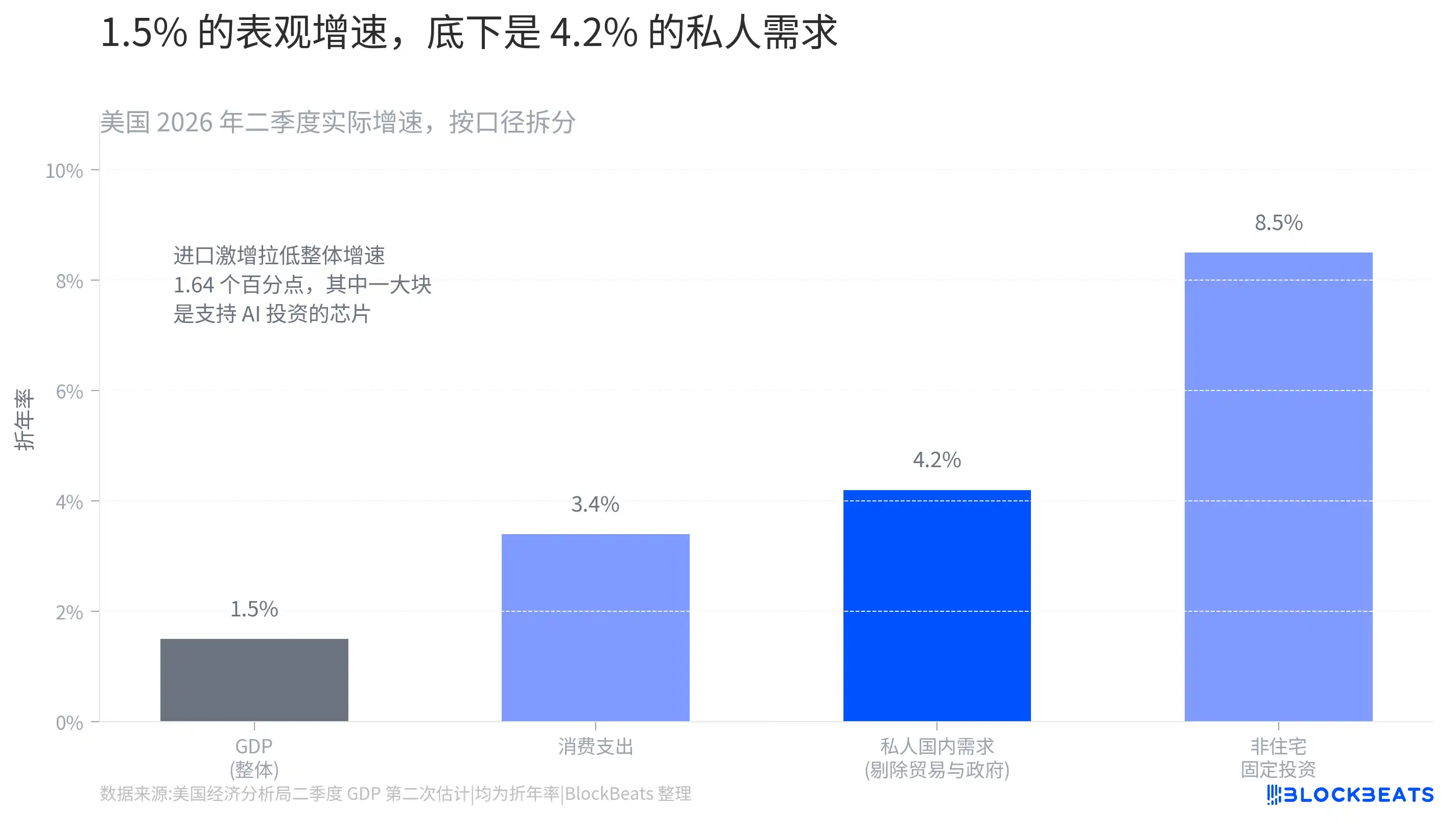
Second-quarter GDP at 1.5% sounds mediocre. But the underlying structure is nothing like that.

Consumer spending, which accounts for over two-thirds of U.S. economic activity, grew at an annualized rate of 3.4%, revised up from the initial estimate of 3.2%; in the first quarter, this figure was only 0.5%. Business investment excluding residential structures grew 8.5%, reflecting the heat of AI investment. And a specific measure of the economy's intrinsic strength – final sales to private domestic purchasers, which strips out volatile government spending and trade – grew 4.2%, the strongest in over three years, revised up from the initial 3.9%; in the first quarter, it was 1.7%.
Housing investment also rose, for the first time since late 2024.

So what dragged the 1.5% figure down? Imports.

Imports surged at a 12.5% annualized rate in the second quarter, with a significant chunk being computer chips and related products supporting AI investment. GDP only counts domestic production, and imports are subtracted – this single item alone knocked off 1.64 percentage points. Government spending fell 1%, with non-defense outlays pulling back sharply, also acting as a drag.

Thus, a strange picture emerges: chips bought to build AI are depressing this country's growth number.

The second-quarter GDP will have a third and final revision, to be released on September 30th.

The landing point for all this data is the podium at Jackson Hole this Friday.

Federal Reserve Chairman Kevin Warsh will deliver his first major speech since taking office. He has promised to end above-target inflation but has yet to give any hint as to whether he believes inflation can subside on its own without a rate hike. Wednesday's data did not show that it can.

The policy rate has been parked in the 3.5% to 3.75% range since last December. At the July meeting, three officials voted against, advocating for a 25 basis point rate hike.

Bank of America FX strategist Alex Cohen highlighted the uncertainty surrounding the speech: "There is clear two-way risk around Warsh's Jackson Hole speech. It remains a wild card."

And beyond all this, there is another timeline: the midterm elections are 10 weeks away. Gasoline prices remain high due to the war with Iran, the president is threatening new tariffs on Canada and China, and AI infrastructure spending is pushing up prices for computers, gaming consoles, and semiconductors.

Prices are becoming a core issue in this election.

Perguntas relacionadas

QAccording to the article, why did the unchanged July PCE inflation rate of 3.7% actually increase the probability of a Fed rate hike?

AThe unchanged rate of 3.7% was seen as increasing the probability of a rate hike because economists had forecast a decrease to 3.6%. The 'no improvement' outcome, along with monthly figures coming in hotter than expected, was interpreted by markets as data supporting a more hawkish Fed stance.

QWhat are the two main opposing views within the Fed cited in the article, based on the July inflation report?

AOne view advocates for waiting, citing that inflation did not worsen, high oil prices haven't broadly diffused, and upcoming methodological changes may lower measured inflation. The other view advocates for hiking rates, citing that overall and core inflation were hotter than forecasts, certain service prices are rising faster, and prolonged above-target inflation risks damaging the Fed's credibility.

QHow does the article explain the paradox of a seemingly weak 1.5% Q2 GDP growth rate alongside strong underlying economic components?

AThe article explains that components like consumer spending (3.4%) and business investment (8.5% excluding housing) were strong. The weak 1.5% headline figure was primarily dragged down by a surge in imports (12.5%), especially AI-related chips, which are subtracted in GDP calculation, and a decrease in government spending.

QWhat key uncertainty does the article highlight regarding Fed Chairman Kevin Warsh's upcoming Jackson Hole speech?

AThe article highlights that a key uncertainty is whether Chairman Warsh will signal a belief that inflation can fall back to target without further rate hikes. His speech presents 'clear two-way risk' as he has promised to end above-target inflation but hasn't yet hinted at his policy leaning.

QBeyond the immediate economic data, what two broader factors does the article mention as contributing to ongoing price pressures and political significance?

AThe article mentions upcoming new tariffs following the collapsed U.S.-Canada trade talks and the high price of gasoline due to the Iran conflict as factors contributing to price pressures. It notes that prices have become a core issue with the midterm elections 10 weeks away.

Leituras Relacionadas

Accumulation Across the Entire Market, BTC May Challenge the $86,000 Resistance Zone?

Record-breaking short liquidations ignited a roughly 26% rebound in Bitcoin from the August lows. Unlike previous leverage-driven squeezes, this rally is supported by substantial buy-side demand. U.S. spot ETFs recorded their strongest weekly inflows of the year, with $2.23 billion, while bitcoin continued to flow out of exchanges. On-chain data shows all wallet cohorts are simultaneously accumulating coins, confirming broad-based buying. Leverage has been effectively cleared post-squeeze, with bitcoin-denominated futures open interest contracting. The funding rate has hovered around neutral, indicating the move was driven more by short covering than new speculative longs. A key challenge lies ahead: a significant supply wall in the $81k to $86k range. This zone is defined by the cost basis of long-term holders, concentrated sell-side order book liquidity, and pending short liquidation clusters. Market structure appears top-heavy, with large-cap assets outperforming smaller ones, a pattern typical of early-cycle rallies. Bitcoin has also decoupled from equities during this move. Cycle indicators have risen from a prolonged "cool" phase, positioning the market in an early stage, far from historical top readings. The path forward hinges on whether this overhead supply can be absorbed. A sustained close above ~$83.3k with continued ETF inflows would signal strength. Conversely, a break below the ~$70k short-term holder cost basis, and ultimately the ~$62k-$65k support floor, would indicate weakening momentum.

marsbitHá 32m

Accumulation Across the Entire Market, BTC May Challenge the $86,000 Resistance Zone?

marsbitHá 32m

When Real Estate Ownership Goes Digital: What Happens to Your Rights, Risks, and Liquidity?

"Tokenizing Real Estate: Rights, Risks, and the Path to Liquidity" While tokenizing real-world assets (RWA) gains traction, real estate presents unique complexities. Beyond technical token issuance, critical challenges remain: enforcing legal rights, managing the underlying physical asset, and creating genuine secondary market liquidity. This article explores these issues through OneAsset, a Dubai-based commercial real estate (CRE) tokenization platform. OneAsset moves away from simply offering asset fragmentation. Instead, it focuses on institutional-grade infrastructure, prioritizing asset quality, legal enforceability, and operational fundamentals. Each property is held in an independent, single-asset vault, backed by a legally separate Special Purpose Vehicle (SPV) for bankruptcy remoteness. Investors acquire tokens representing the economic rights to a specific property, with precise legal claims defined by the underlying SPV structure. OneAsset emphasizes that tokenization cannot transform a poor-quality asset. Its initial focus is on institutional investors and quality Dubai-based CRE, selected for stable tenant cash flows and a clear regulatory environment. The platform integrates compliance by design, aiming to embed investor qualification and transfer rules directly into the token architecture. A core insight is that asset fragmentation does not automatically create liquidity. True liquidity depends on the asset's inherent quality—its location, cash flow, and valuation—as well as sufficient buyer demand. The goal is not just tradability, but making real estate rights more easily priced, verified, and reallocated. Looking ahead, the article discusses the potential for "AiFi" (AI-powered finance). For AI agents to autonomously allocate capital, investment assets like real estate tokens must become truly "machine-readable." This requires a high degree of standardization in legal rights, valuations, cash flows, and compliance data—a direction OneAsset is pursuing through its structured data reporting. In conclusion, real estate tokenization is shifting from a technology narrative to a focus on asset fundamentals. Blockchain can enhance efficiency and programmability, but it cannot replace sound underwriting, property management, or legal execution. The real work begins after the asset is on-chain.

marsbitHá 1h

When Real Estate Ownership Goes Digital: What Happens to Your Rights, Risks, and Liquidity?

marsbitHá 1h

After Affecting Two Generations, Meta Ordered to Pay $18 Billion in Damages

After more than two decades, a legal parallel has emerged. In 1998, major U.S. tobacco companies settled for $206 billion, leading to strict advertising bans and warning labels that significantly reduced smoking rates. On August 26, 2026, Meta reached a landmark settlement with U.S. attorneys general, agreeing to pay up to approximately $18 billion and implement mandatory changes to Facebook and Instagram. This historic settlement, one of the largest against a tech company, stems from allegations that Meta deliberately designed addictive features like infinite scroll and push notifications, harming youth mental health and violating child privacy laws. Facing a potential $1.4 trillion lawsuit and a series of unfavorable jury verdicts, Meta chose to settle on the eighth day of trial to avoid a catastrophic ruling. The core of the agreement is not just the financial penalty, which Meta will pay over 10 years, but a series of strict, 10-year product mandates for young users. These include a hard two-hour daily time limit (combined across apps), a default "nighttime block" from midnight to 6 AM, restricted notifications during school hours, hidden "like" counts, an optional non-algorithmic feed, and stronger age verification. An independent auditor will monitor compliance. Crucially, roughly 30% ($5.3 billion) of Meta's payment is contingent on YouTube and TikTok adopting similar measures and paying around $5 billion each. This move aims to create an industry-wide standard and prevent Meta from being competitively disadvantaged. The settlement is being likened to Big Tobacco's "tobacco moment." By legally framing addictive algorithm design as a "public nuisance," it sets a powerful precedent. Nearly 3,000 similar cases are pending against other social media giants, signaling a fundamental shift in regulatory pressure. The era where platforms could deny the addictive impact of their designs on children is effectively over.

marsbitHá 1h

After Affecting Two Generations, Meta Ordered to Pay $18 Billion in Damages

marsbitHá 1h

Trading

Spot
活动图片