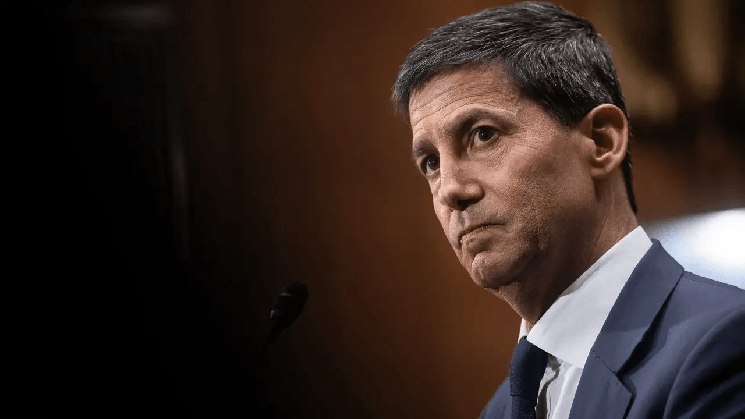
Telegram founder Pavel Durov internationally wanted, Russia’s FSB says

cointelegraphPublicado em 2026-07-29Última atualização em 2026-07-29

Resumo

Russian authorities have placed Telegram founder Pavel Durov on an international wanted list, escalating a criminal case. The Federal Security Service (FSB) charged him with facilitating terrorist activity for allegedly failing to remove channels and bots used by Ukrainian intelligence, terrorist groups, and extremists to coordinate attacks and recruit operatives. Durov, who confirmed an earlier case in February, accused Russia of using investigations to pressure Telegram and restrict access. Separately, he faces an ongoing criminal probe in France over alleged illegal activity on the platform, though travel restrictions there have been lifted.

Russian authorities have placed Telegram founder Pavel Durov on an international wanted list as they escalate a criminal case accusing him of facilitating terrorist activity.

Russia’s Federal Security Service (FSB) said on Wednesday that it had charged Durov with facilitating terrorist activity and issued an international warrant for his arrest, local news agency Interfax reported.

The FSB alleged that Telegram failed to remove channels, chats and bots that Ukrainian intelligence services, terrorist groups and extremist organizations used to coordinate attacks, recruit operatives and conduct cyber fraud.

The development follows reports in February that Russian authorities had opened a criminal case against Durov. At the time, Durov confirmed the case in a post on X and accused Russian authorities of using the investigation to pressure Telegram, writing: “Each day, the authorities fabricate new pretexts to restrict Russians’ access to Telegram as they seek to suppress the right to privacy and free speech.”

Separately, Durov still faces an ongoing criminal investigation in France over alleged illegal activity on Telegram, although French authorities lifted travel restrictions earlier this year, allowing him to leave the country.

Related: Pavel Durov says Telegram to roll out native Gram crypto wallet

Perguntas relacionadas

QWhat are the specific allegations against Pavel Durov made by Russia's FSB?

ARussia's FSB alleges that Pavel Durov facilitated terrorist activity. Specifically, they accuse Telegram of failing to remove channels, chats, and bots that were used by Ukrainian intelligence services, terrorist groups, and extremist organizations to coordinate attacks, recruit operatives, and conduct cyber fraud.

QWhat action did the FSB take regarding Pavel Durov's case according to the article?

ARussia's Federal Security Service (FSB) charged Pavel Durov with facilitating terrorist activity and issued an international warrant for his arrest, placing him on an international wanted list.

QWhat was Pavel Durov's response to the initial criminal case opened against him by Russian authorities in February?

AIn a post on X, Pavel Durov accused Russian authorities of using the investigation to pressure Telegram. He stated that authorities were fabricating new pretexts each day to restrict Russians' access to Telegram in an attempt to suppress the right to privacy and free speech.

QBesides Russia, which other country is mentioned as having a criminal investigation involving Pavel Durov and Telegram?

APavel Durov also faces an ongoing criminal investigation in France over alleged illegal activity on Telegram, although French authorities lifted travel restrictions earlier this year.

QWhat related topic involving Telegram was mentioned at the end of the article?

AThe article mentions a related topic: "Pavel Durov says Telegram to roll out native Gram crypto wallet."

Leituras Relacionadas

Virtuals Launches Hyperboost: Extends 14 Days of Rewards for Each Graduated Token to Combat 'Peak on Day One' Curse

Virtuals Protocol launched "Hyperboost" on July 27, 2026, to combat the "first-day peak" trend where over 75% of its AI Agent tokens see trading volume peak within 24 hours of graduation (launch to Uniswap). The mechanism automatically allocates a fraction of each token's previously idle graduation supply into a 14-day reward pool. Rewards are distributed daily, split between users based on trading volume share and creators for content posted about the token on platforms like X. Claims are immediate with no vesting. Early data from the first ~48 hours shows newly graduated tokens like AMARA and MAGE still experiencing significant post-graduation price declines (-78% and -55% in 24h respectively), indicating it's too early to judge effectiveness. Community concerns focus on potential wash trading due to volume-based rewards and a lack of transparency around content reward criteria. Hyperboost is part of Virtuals' broader ecosystem, which has over 18,000 AI Agent tokens and $750M+ in protocol revenue. While the feature could theoretically boost activity for its native VIRTUAL token by increasing trading volume in its paired pools, VIRTUAL's price remains influenced by broader market trends, down 7.4% over the past week. Observers note that several weeks of data will be needed to properly assess the mechanism's impact on sustaining post-graduation trading activity.

marsbitHá 12m

Virtuals Launches Hyperboost: Extends 14 Days of Rewards for Each Graduated Token to Combat 'Peak on Day One' Curse

marsbitHá 12m

Kevin Warsch's Fed Decision Nears: Here's Why TD Securities Thinks the Dollar Could Still Fall

The upcoming Federal Reserve decision under Chair Kevin Warsh is widely expected to result in no change to interest rates for the fifth consecutive meeting, with market-implied probability at 95-98%. Bitcoin has already reacted to this uncertainty, briefly dropping before stabilizing near $63,660, extending its July losses. TD Securities argues that despite this consensus, markets are still mispricing the risk of a rate hike. The bank contends that the dollar is poised to fall once the Fed confirms a hold, as current pricing reflects an exaggerated probability of tightening driven by geopolitical risk premiums, not likely Fed action. This potential mispricing represents one of the largest gaps between market expectations and actual Fed policy in a decade. Post-decision, TD forecasts further dollar weakening, expecting a roughly 2% decline by late 2026, as the Fed is seen maintaining rates absent clear evidence of sustained inflation and labor market strength. For Bitcoin, the Fed's tone is critical. A hold accompanied by dovish signals, strong AI investment forecasts, and positive upcoming PCE inflation data could support a move toward $68,000-$70,000. Conversely, unexpectedly hawkish communication risks pushing prices back toward the $58,000-$60,000 range. A weaker dollar, as predicted by TD, could also provide a supportive backdrop for Bitcoin and other risk assets.

cryptonews.ruHá 18m

Kevin Warsch's Fed Decision Nears: Here's Why TD Securities Thinks the Dollar Could Still Fall

cryptonews.ruHá 18m

What Happens When Two Miners Find a Block in the Same Second? How the 'Orphan Race' Unfolds

Bitcoin mining is a race without a real-time referee. A newly mined block must physically propagate across the global peer-to-peer network before consensus is reached on the chain's tip. This takes seconds, sometimes longer on congested connections. If a second miner finds a valid block before learning of a competing one, they build on their last-known version and broadcast their own block. For a short time, two equally valid blocks exist at the same height, creating a temporary chain split. The network resolves this not by voting or timestamps, but by Proof-of-Work: the chain that accumulates the most work becomes canonical. Blocks on the losing side are "orphaned" or "stale." Their miners lose the block reward and fees, though unconfirmed transactions return to the mempool. Usually, a single subsequent block resolves the tie. A notable two-block reorganization occurred on March 24, 2026. Antpool and Foundry USA mined competing versions of block 941,881 seconds apart. ViaBTC extended Antpool's chain, while Foundry extended its own, creating a one-block split. Foundry then pulled ahead by mining six consecutive blocks, making its chain the heaviest. All nodes switched to Foundry's chain, orphaning blocks from Antpool and ViaBTC. While such multi-block reorganizations are rare, the underlying race condition is common. Analysis shows about 9.2% of block intervals in a sample period were under 60 seconds, each representing a potential short-lived race. Fast relay networks have reduced propagation delays, making prolonged splits rarer. However, the event highlighted a trend of hash rate concentration, where well-resourced pools have a higher chance of winning any specific race and mining consecutive blocks, marginalizing smaller miners.

cryptonews.ruHá 28m

What Happens When Two Miners Find a Block in the Same Second? How the 'Orphan Race' Unfolds

cryptonews.ruHá 28m

Trading

Spot
活动图片