Virtuals Launches Hyperboost: Extends 14 Days of Rewards for Each Graduated Token to Combat 'Peak on Day One' Curse

marsbitPublicado em 2026-07-29Última atualização em 2026-07-29

Resumo

Virtuals Protocol launched "Hyperboost" on July 27, 2026, to combat the "first-day peak" trend where over 75% of its AI Agent tokens see trading volume peak within 24 hours of graduation (launch to Uniswap). The mechanism automatically allocates a fraction of each token's previously idle graduation supply into a 14-day reward pool. Rewards are distributed daily, split between users based on trading volume share and creators for content posted about the token on platforms like X. Claims are immediate with no vesting. Early data from the first ~48 hours shows newly graduated tokens like AMARA and MAGE still experiencing significant post-graduation price declines (-78% and -55% in 24h respectively), indicating it's too early to judge effectiveness. Community concerns focus on potential wash trading due to volume-based rewards and a lack of transparency around content reward criteria. Hyperboost is part of Virtuals' broader ecosystem, which has over 18,000 AI Agent tokens and $750M+ in protocol revenue. While the feature could theoretically boost activity for its native VIRTUAL token by increasing trading volume in its paired pools, VIRTUAL's price remains influenced by broader market trends, down 7.4% over the past week. Observers note that several weeks of data will be needed to properly assess the mechanism's impact on sustaining post-graduation trading activity.

Author: Claude, Shenchao TechFlow

Shenchao TL;DR: Virtuals Protocol launched the "Hyperboost" mechanism on July 27th, which converts a portion of the idle token supply at graduation into 14 days of daily released trading and content rewards, automatically covering all newly graduated tokens.

Official data shows that over 75% of tokens on the platform reach their trading volume peak within 24 hours after graduation launch, followed by a rapid decline. Hyperboost aims to extend this price discovery window, but the mechanism has only been live for two days. Early graduated projects still show the typical 'post-graduation plunge' trend, and its effectiveness remains to be seen.
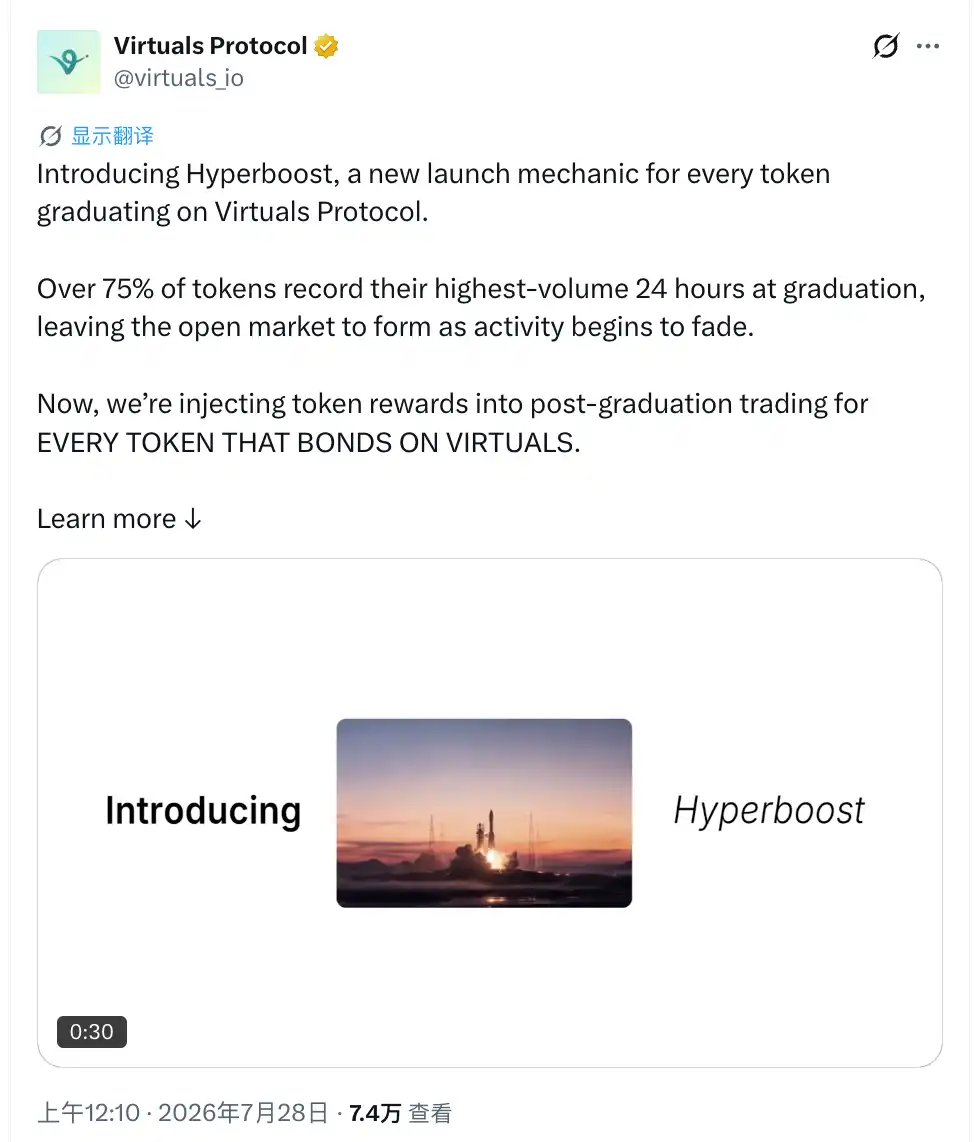
The AI Agent token launch platform Virtuals Protocol has long faced a persistent issue:

The day a token "graduates" from the bonding curve and launches, its trading volume typically peaks and then declines steadily. Platform data indicates that over 75% of tokens record their highest trading volume within 24 hours after graduation, with public market activity quickly fading thereafter.

On July 27th, Virtuals introduced the Hyperboost mechanism, attempting to use economic incentives to prolong post-graduation market interest.

Mechanism Breakdown: Idle Supply Converted to Trading Rewards, Released Daily for 14 Days

The core logic of Hyperboost is to activate a portion of token supply that was previously idle.

In the past, when a token graduated from the bonding curve and entered public trading on Uniswap, a portion of the supply was reserved for smoothing the transition, essentially remaining idle.

Hyperboost reallocates this portion, converting it into a reward pool released daily over the 14 days following graduation.

Rewards are distributed along two tracks: trading rewards are allocated based on a wallet's proportion of the day's trading volume; content rewards are directed at creators publishing content about the token on platforms like X. A total of 1/14th of the total rewards are released each day, with no lock-up or vesting restrictions upon claiming. Rewards are claimable upon arrival.

This mechanism activates automatically, requiring no founder configuration or manual activation. All tokens completing graduation after 16:00 UTC on July 27th will automatically enter the Hyperboost window.

The official whitepaper does not disclose the specific idle supply ratio or reward allocation percentage, only describing it as "a fraction of token supply".

Details regarding the content reward evaluation criteria are also limited. The community has raised questions about the transparency of anti-sybil mechanisms and content scoring rules.

Virtuals Ecosystem Status: 18k+ Agents, Market Cap ~$400M

Hyperboost is not an isolated product; it is embedded within Virtuals' broader AI Agent tokenization ecosystem.

As of H1 2026, the Virtuals Protocol platform has launched over 18,000 AI Agent tokens, with cumulative protocol revenue exceeding $75 million.

Amidst overall crypto market shifts and AI Agent development, Virtuals has undertaken intensive ecosystem and product expansion efforts since the beginning of the year. In March, it launched the ERC-8183 standard (in collaboration with the Ethereum Foundation) for on-chain AI Agent identity.

In early July, it completed the migration of cross-chain infrastructure from LayerZero to Chainlink CCIP, involving over $700 million in VIRTUAL liquidity. Robinhood Chain also announced plans to integrate Virtuals' AI Agent infrastructure on its new chain.

The above developments align more with long-term considerations and updates to the product foundation. Hyperboost appears more like an innovative play in token trading and rules.

Two Days Post-Launch, Some Graduated Projects Still 'Plummeting as Usual'

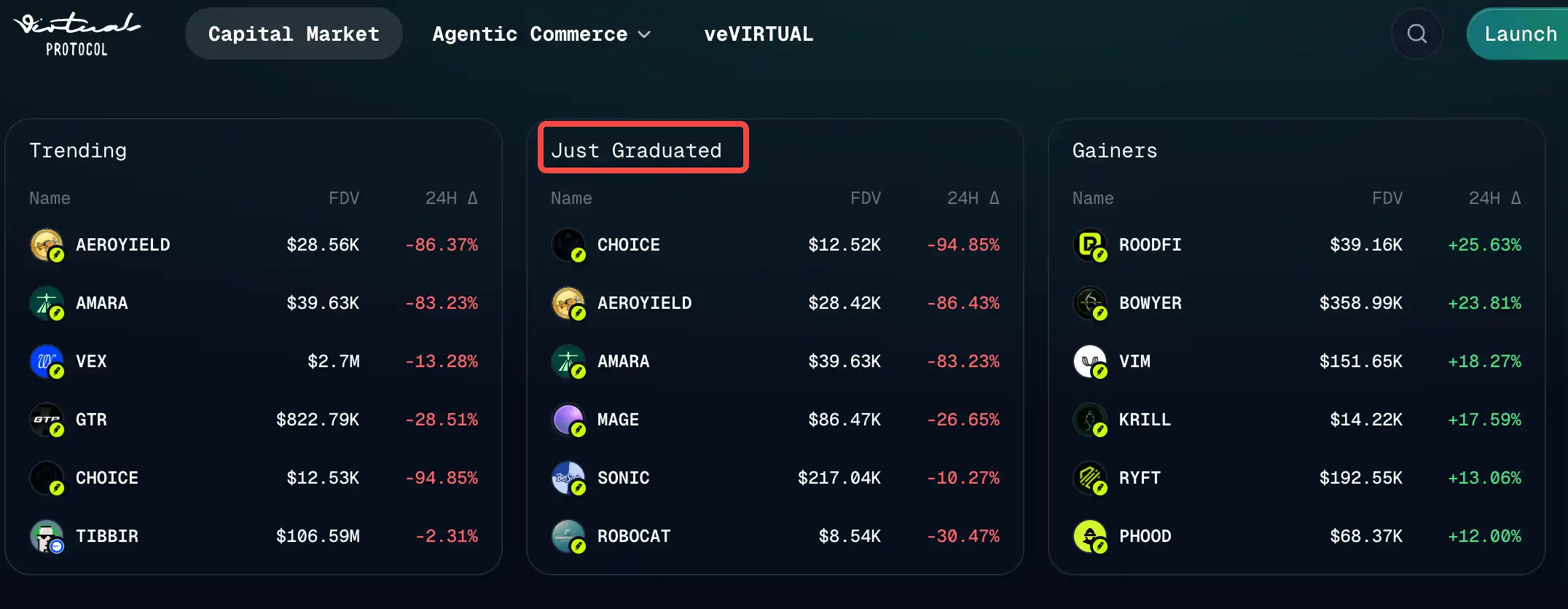
Hyperboost has been live for only about two days. The "Just Graduated" section on app.virtuals.io shows some early examples.

AMARA (Amara Exchange) graduated about 9 hours ago, FDV ~$51k, 24-hour decline ~78%, trading volume ~$358k, holders ~185.

MAGE is associated with the Mage Trading AI Agent, 24-hour decline ~55%. GTR (gtr.trade) launched ~4 days ago, FDV ~$700k, 24-hour decline ~44%, holders ~1700, liquidity ~$110k.

The data from these examples still presents the typical "peak post-graduation followed by decay" pattern, precisely what Hyperboost aims to mitigate. However, given the mechanism has been active for less than 48 hours and the first 14-day reward cycle is not yet complete, the current sample size and time span are insufficient to judge effectiveness.
Core Questions: Could Trading Volume Rewards Become a Farmer's ATM?

Currently, community discussions around this new product focus on several key points.

First, if trading rewards are allocated based on trading volume share, this design inherently attracts wash trading. If a wallet contributes 50% of the day's trading volume, it claims 50% of that day's trading rewards. For tokens with an FDV of only tens of thousands of dollars, the cost of wash trading could be lower than the reward revenue, creating a clear arbitrage opportunity.

The official response is that the daily reward pool is fixed. Even if someone wash trades, they merely take a larger slice of a fixed pie, not infinitely inflating it. However, this argument holds only if the reward pool itself is relatively small (undisclosed by the official). If the reward scale is significant, wash trading incentives remain.

Second, the evaluation criteria for content rewards are also vague. Current rules state "parameters are set by the protocol and may be adjusted to maintain distribution integrity" but do not disclose specifics like the content scoring mechanism, whether account verification is needed, or how to prevent bulk spamming.

For a mechanism publicly stated to incentivize content creation on platform X, the absence of these rules casts doubt on its practical effectiveness.

Limited Impact on VIRTUAL Token

In narrative terms, Hyperboost provides VIRTUAL with a new growth story. If the mechanism genuinely extends the active trading period of graduated tokens, it implies more trading volume flows through VIRTUAL-paired liquidity pools, indirectly increasing demand for VIRTUAL.

According to TronWeekly, the VIRTUAL price showed short-term technical bullish signals following the Hyperboost launch, with some analysts setting a short-term target of $0.70.

However, simultaneously, VIRTUAL has declined about 7.4% over the past 7 days, still generally weighed down by the broader market downturn. BTC recently turned negative, and overall crypto market sentiment is weak.

A breakout star token might be more effective in reversing this trend. Follow-up metrics to watch include the trading volume retention rate of graduated tokens during the 14-day window, whether the number of newly graduated tokens increases due to the incentives, and the actual consumption of VIRTUAL as a pairing asset.

Accumulating sufficient data for these points will likely take at least 2 to 4 weeks. Nevertheless, in a climate where many crypto projects are shutting down or pivoting, it is encouraging to see Virtuals continuously iterate and update its playbook.


Criptomoedas em alta

Perguntas relacionadas

QWhat is the Hyperboost mechanism launched by Virtuals Protocol and what problem does it aim to solve?

AVirtuals Protocol launched the Hyperboost mechanism on July 27th. It aims to combat the 'first-day peak curse,' where over 75% of tokens on the platform see their highest trading volume within 24 hours of graduation before rapidly declining. Hyperboost automatically converts a portion of a graduating token's initially idle supply into a 14-day reward pool, released daily to incentivize trading and content creation, thereby attempting to extend the price discovery window.

QHow does the Hyperboost mechanism distribute its rewards?

AThe Hyperboost reward pool is distributed across two tracks over 14 days: 1) Trading Rewards: Distributed to wallets based on their daily trading volume share for that specific token. 2) Content Rewards: Awarded to creators who publish content about the token on platforms like X (formerly Twitter). Each day, 1/14th of the total reward pool is released. Users can claim their rewards with no lock-up or vesting period.

QAccording to the article, what are the main concerns within the community regarding the Hyperboost mechanism?

AThe community's main concerns focus on potential exploitation: 1) Trading rewards based on volume share could incentivize wash trading, especially for low-FDV tokens where the reward might outweigh the cost of fake trading. 2) The criteria and anti-spam mechanisms for content rewards are vague and lack transparency, raising questions about how content quality is judged and how 'farming' with bot accounts will be prevented.

QWhat was the performance of some early token samples after the Hyperboost launch, and what does this indicate?

AEarly samples like AMARA, MAGE, and GTR, which graduated shortly after Hyperboost went live, still showed significant price declines (~44% to ~78% in 24 hours). This indicates the typical 'post-graduation slump' pattern that Hyperboost is designed to mitigate. However, the article notes that with the mechanism being active for less than 48 hours and the full 14-day cycle not yet complete, it's too early to judge its effectiveness based on this limited data.

QWhat is the potential impact of Hyperboost on the VIRTUAL token itself, and what factors will determine its success?

AHyperboost could indirectly benefit the VIRTUAL token by potentially increasing trading activity and volume across its paired liquidity pools, thus boosting demand for VIRTUAL as the pairing asset. However, its direct impact is considered limited, as VIRTUAL's price remains influenced by broader market trends. The mechanism's success should be measured by observing metrics over 2-4 weeks, such as the retention of trading volume for graduated tokens during the 14-day window, an increase in new token graduations, and the actual consumption/utility of VIRTUAL in these pools.

Leituras Relacionadas

Only 153 Venture Capital Firms Invested in July: Is the Crypto VC Industry Experiencing a 'Mass Extinction'?

In July 2026, only 153 unique venture capital firms participated in disclosed crypto funding rounds, marking the lowest monthly count since November 2020. This figure represents an 87% decline from the peak of 1,177 firms in 2022. Overall, the first seven months of 2026 saw crypto projects raise approximately $11.78 billion across 481 rounds. This crypto VC contraction contrasts sharply with the broader venture capital landscape, where global VC investment reached a record $560.4 billion in H1 2026, heavily fueled by major AI company financings. This shift in capital allocation has drawn funds away from the crypto sector. Within crypto, funding is highly concentrated. Trading platforms, prediction markets, and payment sectors absorbed 53% of the total capital. While early-stage deals remain frequent, the largest sums flow to a few late-stage rounds and mergers & acquisitions, which surged to $7.23 billion in Q2 2026. The market is consolidating around top funds like a16z crypto and Dragonfly, which successfully raised new multi-billion dollar funds, while many smaller firms have retreated. Analysts describe this as a "great extinction" for crypto VCs, where capital is becoming more selective, favoring proven business models and assets over early-stage speculation. This raises the bar for project quality, funding efficiency, and viable exit paths.

marsbitHá 20m

Only 153 Venture Capital Firms Invested in July: Is the Crypto VC Industry Experiencing a 'Mass Extinction'?

marsbitHá 20m

Strategy's Loss in the Second Quarter Reaches $8.22 Billion Amid Bitcoin Decline

Strategy, the largest corporate holder of Bitcoin, reported a net loss of $8.22 billion for the second quarter. This loss was primarily driven by an $8.32 billion unrealized loss on its Bitcoin holdings due to a decline in the asset's price during the period. Despite these paper losses, the company increased its Bitcoin holdings to 843,775 BTC, a 25% growth since the start of the year. As part of a new monetization strategy, Strategy sold approximately $218.4 million worth of Bitcoin, mainly to fund dividends for preferred shareholders, with $216 million of that sold after Q2 ended. The company also built a $3.75 billion cash reserve, which it claims is sufficient to cover over two years of dividend and interest payments, aiming to insulate itself from Bitcoin's volatility while meeting obligations. Following the earnings release, Strategy's stock (MSTR) rose 4.7% in regular trading but corrected slightly after-hours. This pattern reflects how the company's accounting results are heavily tied to Bitcoin's price swings, even as its long-term strategy remains unchanged. The report indicates that Strategy is maintaining its core strategy of accumulating Bitcoin while building a financial buffer. This quarterly loss follows a recognizable pattern, with the company posting significant unrealized losses in previous quarters (e.g., $12.4 billion in Q4 2025 and ~$12.5 billion in Q1 2026) due to fair-value accounting. A key technical shift is its new monetization program, which introduces periodic selling pressure on the market, transitioning Strategy from a pure accumulator to a participant that occasionally adds supply. A critical question remains: how long can the cash reserve cover dividend obligations if a Bitcoin price downturn persists beyond two years?

cryptonews.ruHá 40m

Strategy's Loss in the Second Quarter Reaches $8.22 Billion Amid Bitcoin Decline

cryptonews.ruHá 40m

Will Terrorist Durov Ban Russian Officials?

Telegram founder Pavel Durov publicly reacted to being labeled a "terrorist" by Russian authorities, stating the designation came after he refused demands for mass surveillance and censorship on the platform. In a Telegram post, he highlighted that this status formally bans him from "publishing information online." Durov concluded with a statement widely circulated: Russian officials "clearly don't understand who can ban whom on the internet." This remark suggests Durov could potentially restrict official Russian government and officials' channels on Telegram, which continue to operate on the platform despite its formal blocking in Russia. The situation parallels previous, slow-moving state directives, like switching officials to domestic cars, contrasted with the current push to migrate all government communication to the Russian-made messenger MAX by 2030. However, reports indicate many officials still use Telegram via workarounds, fearing surveillance on MAX, while alternatives like BiP and KakaoTalk recently became inaccessible in Russia without a VPN. Durov has not specified any immediate actions against state channels. His statement is an initial response, with further developments depending on the authorities' reaction. The dynamic differs from 2020 when Russian regulators lifted a block on Telegram; now, Durov implies control from within the platform itself over the official accounts that persisted through that earlier blockade.

cryptonews.ruHá 40m

Will Terrorist Durov Ban Russian Officials?

cryptonews.ruHá 40m

DeepSeek V4 Official Version Arrives, New Capabilities Emerge, Value-for-Money King Enters the Fray

On July 31st, DeepSeek officially launched the public API beta for its DeepSeek-V4-Flash model. A key highlight is its performance on multiple Agent benchmark tests, reportedly nearing or even surpassing the level of the V4-Pro preview version from three months ago. Notably, the Flash model achieves this with significantly smaller scale (130B active parameters vs. Pro's 490B), suggesting that post-training optimization and data quality may be as crucial as raw model size. DeepSeek emphasized that the V4-Flash-0731 uses the same model architecture and size as its preview version, with improvements attributed solely to "re-trained post-training." The update also marks the official debut of DeepSeek's self-developed Agent framework, "Harness." The move signals DeepSeek's strategic push to position its cost-effective Flash model as a competitive base for Agent applications—scenarios requiring autonomous planning, tool usage, and complex task execution—where inference speed and cost are critical. By natively supporting OpenAI's Responses API format and adapting for code-generation scenarios, DeepSeek aims not just to be a cheaper alternative but to establish its own ecosystem in the Agent era. This release follows DeepSeek's record-breaking ~$50 billion fundraising round roughly two months prior, underscoring market confidence in its technology and commercialization prospects. The company is reportedly preparing for another funding round at a valuation of approximately $71 billion. The Flash model's advancement represents a step in fulfilling the high expectations that come with this valuation, setting the stage for the impending release of the V4-Pro official version and intensifying competition in the global Agent landscape.

marsbitHá 44m

DeepSeek V4 Official Version Arrives, New Capabilities Emerge, Value-for-Money King Enters the Fray

marsbitHá 44m

Trading

Spot

Artigos em Destaque

Como comprar ONE

Bem-vindo à HTX.com!Tornámos a compra de Harmony (ONE) simples e conveniente.Segue o nosso guia passo a passo para iniciar a tua jornada no mundo das criptos.Passo 1: cria a tua conta HTXUtiliza o teu e-mail ou número de telefone para te inscreveres numa conta gratuita na HTX.Desfruta de um processo de inscrição sem complicações e desbloqueia todas as funcionalidades.Obter a minha contaPasso 2: vai para Comprar Cripto e escolhe o teu método de pagamentoCartão de crédito/débito: usa o teu visa ou mastercard para comprar Harmony (ONE) instantaneamente.Saldo: usa os fundos da tua conta HTX para transacionar sem problemas.Terceiros: adicionamos métodos de pagamento populares, como Google Pay e Apple Pay, para aumentar a conveniência.P2P: transaciona diretamente com outros utilizadores na HTX.Mercado de balcão (OTC): oferecemos serviços personalizados e taxas de câmbio competitivas para os traders.Passo 3: armazena teu Harmony (ONE)Depois de comprar o teu Harmony (ONE), armazena-o na tua conta HTX.Alternativamente, podes enviá-lo para outro lugar através de transferência blockchain ou usá-lo para transacionar outras criptomoedas.Passo 4: transaciona Harmony (ONE)Transaciona facilmente Harmony (ONE) no mercado à vista da HTX.Acede simplesmente à tua conta, seleciona o teu par de trading, executa as tuas transações e monitoriza em tempo real.Oferecemos uma experiência de fácil utilização tanto para principiantes como para traders experientes.

358 Visualizações TotaisPublicado em {updateTime}Atualizado em 2026.06.02

Como comprar ONE

Discussões

Bem-vindo à Comunidade HTX. Aqui, pode manter-se informado sobre os mais recentes desenvolvimentos da plataforma e obter acesso a análises profissionais de mercado. As opiniões dos utilizadores sobre o preço de ONE (ONE) são apresentadas abaixo.

活动图片