Why Bitcoin Ignores Bad News from the US? The Answer is in the QCP Report

cryptonews.ruPublicado em 2026-08-18Última atualização em 2026-08-18

Resumo

The Bitcoin market is showing resilience despite weak US economic data and high oil prices, according to a QCP Capital report. While poor retail sales and consumer sentiment figures lowered expectations for an immediate Fed rate hike, persistently high oil prices complicate the inflation outlook. Bitcoin itself is trading in a narrow range just above $63,000, absorbing negative news without a significant breakdown. Similarly, Ethereum remains around $1,900. Market volatility is compressing, with implied volatility exceeding realized volatility, creating conditions for short volatility strategies, though QCP warns of significant risks if volatility spikes unexpectedly. Trader focus is now shifting to key upcoming events: the FOMC meeting minutes, July's PCE inflation data, and the Jackson Hole Economic Symposium, which could provide a new directional catalyst for the market currently stuck in a wait-and-see pattern.

A report from trading firm QCP Capital has noted that the Bitcoin market remains in a stable range despite weak macroeconomic data from the US and rising oil prices. Analysts at the company point out that the asset's quotes are holding near the lower boundary of its recent trading channel, while volatility continues to decline.
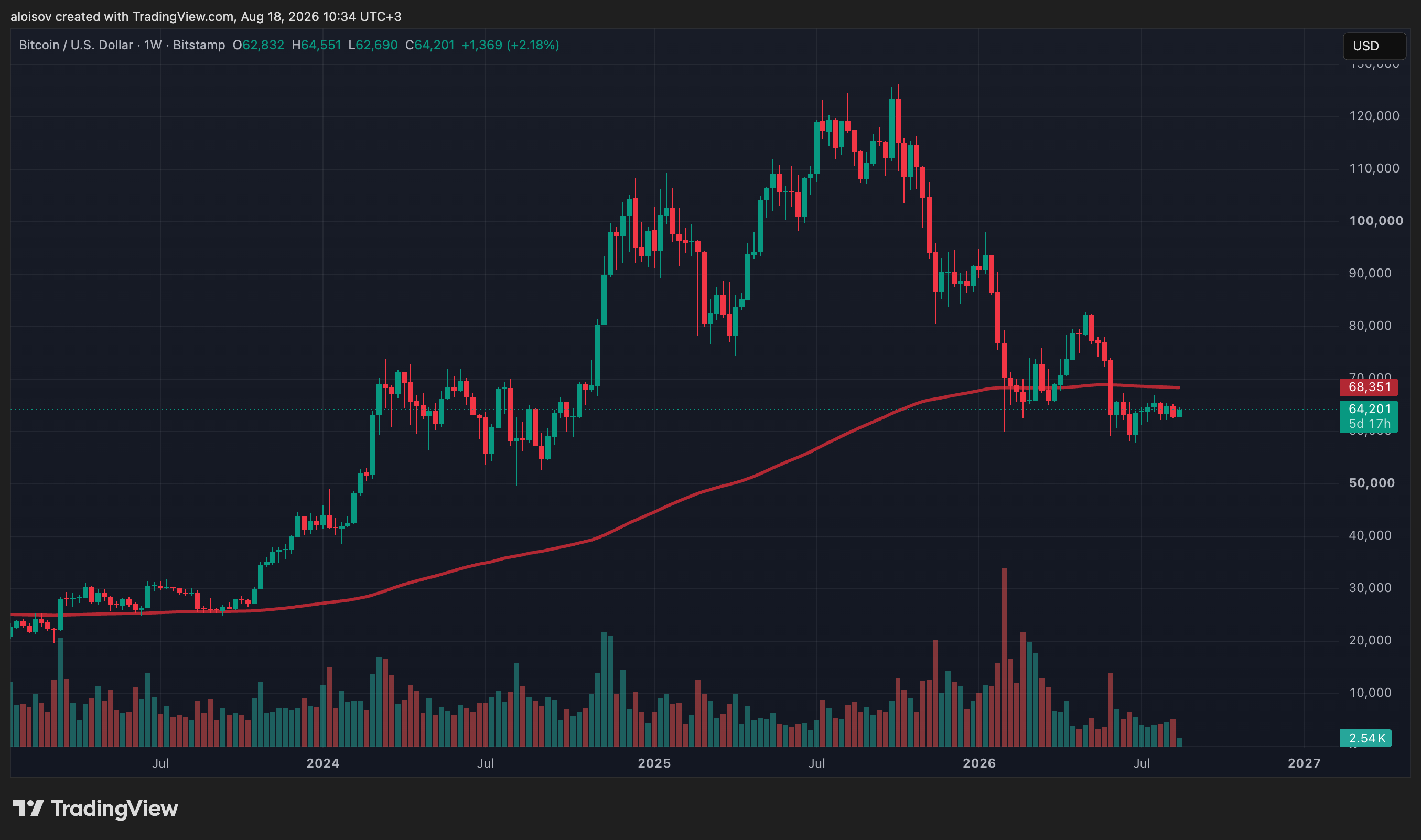
1-week BTC/USD chart and 200EMA. Source: Bitstamp

Weak Data, Strong Oil

U.S. stock indexes closed Friday, August 14th, slightly in the red: the S&P 500 lost 0.17%, the Nasdaq Composite fell 0.28%, and the Dow Jones dropped by approximately 108 points. According to QCP, economic statistics provided a more significant signal. The University of Michigan's preliminary Consumer Sentiment Index fell to 51.0 in August from 55.2 in July, and retail sales in July declined by 0.6%—the strongest monthly drop since May 2025.

Coupled with weaker labor market data released earlier this month, this statistics have reduced expectations for an immediate tightening of monetary policy. Federal funds rate futures now price in roughly a 30% probability of a 25 basis point rate hike at the September meeting. However, inflation remains above the target level, so the future policy trajectory will still depend on incoming data.

Oil remains the main counterweight to weakening business activity. WTI traded around $82.40, and Brent around $88.70 early Monday amid unresolved negotiations concerning the Strait of Hormuz. High energy prices can translate into general inflation and inflation expectations, complicating the interpretation of weak activity data for regulators.

The Range Holds, No Momentum

Against this backdrop, Bitcoin continues, as QCP notes, to "stagnate" rather than sharply decline. The spot price is holding just above $63,000 after a drop of about 3% over the week, continuing to fluctuate within the range that has defined its dynamics in recent weeks.

Analysts emphasize an important difference from the previous review: Bitcoin continues to absorb negative macroeconomic and geopolitical news without a sustained breakdown to the downside.

Instead of looking for directional signals at specific price levels, QCP suggests focusing on the fact that Bitcoin remains near the lower boundary of its recent range. A sustained exit beyond this channel would provide more information about market participants' positioning than the relatively restrained fluctuations within it.

Ethereum shows a similar lack of momentum, trading around $1,900 in recent sessions. Thus, the entire crypto market is currently characterized more by restrained conviction among participants than by acute stress.

Volatility is Compressing

The options market reflects the same calm. Bitcoin's one-week implied volatility is around 26%, while the seven-day realized volatility is closer to 20%. This gap means that options are still pricing in more movement than Bitcoin has actually demonstrated recently.

This is where the essence of the strategy analyzed by QCP in its report comes into play—so-called short volatility. The concept is simple: when implied volatility is higher than realized volatility, a trader can sell options, hoping to profit from the difference between how much movement is "priced in" and how much movement actually occurs.

  • The trader sells options (calls, puts, or their combinations) on Bitcoin or Ethereum

  • The option buyer pays a premium for the right, but not the obligation, to buy or sell the asset at a fixed price

  • If realized volatility turns out to be lower than what was priced into the option, the seller can potentially profit from the decay of the option's time value

  • However, if the market moves sharply and unexpectedly, the option seller incurs a loss, which is theoretically unlimited for naked positions

QCP explicitly warns: such a gap between implied and realized volatility is often called a positive volatility risk premium, but it does not mean that short volatility strategies are automatically profitable. Realized volatility can spike sharply, especially in the face of unexpected macroeconomic, geopolitical, or crypto-specific events—and then losses on sold options can exceed the premium received.

Overall, volatility has decreased over the past week as several scheduled catalyst events have passed. The U.S. Congress is on recess, so risks from the legislative agenda are also reduced for the near term, although the macroeconomic calendar remains busy.

Focus on the Jackson Hole Symposium

Market attention is shifting back to monetary policy. On Wednesday, the minutes of the July FOMC (Federal Open Market Committee—the body of the U.S. Federal Reserve responsible for the interest rate) meeting will be released—the document may provide more details on the 9-to-3 vote to keep the rate unchanged, including the arguments of the three committee members who voted for an increase.

Next, on August 26th, the July PCE index (Personal Consumption Expenditures index—a key inflation indicator monitored by the Fed) and the second estimate of Q2 GDP will be released, and from August 27th to 29th, the Economic Policy Symposium in Jackson Hole will take place. This year's theme is "Financial Innovations: Implications for Payments and Policy," making the event particularly significant for both monetary policy participants and digital asset market players.

For the crypto market, the backdrop remains more balanced than directional. Weak consumption and sentiment data have reduced some pressure in favor of further policy tightening, while high oil prices continue to complicate the inflation picture. Meanwhile, restrained realized volatility and sideways range movement indicate that neither side has yet gained sustained momentum.

Key Events

  • August 19 — FOMC meeting minutes

  • August 26 — U.S. July PCE index, second estimate of Q2 GDP

  • August 27–29 — Economic Policy Symposium in Jackson Hole

  • September 15–16 — FOMC meeting

The Bitcoin range resembles a taut but unbroken string—the market tests its boundaries again and again, yet a breakout has not occurred so far.

Currently, price and volatility are moving in sync, as if frozen in anticipation of a new external impulse—be it inflation data or signals from the Fed at the Jackson Hole symposium.

AI Opinion

From the perspective of machine data analysis, Bitcoin's range-bound phase finds a parallel in the asset's history after reaching peaks. As Hash Telegraph noted, after peaking at $73,679 in March 2024, Bitcoin traded for almost eight months within a $20,000 wide channel before breaking out on the backdrop of Trump's election victory. Similar mechanics—a prolonged hang-up in a wide channel after a local high followed by a sharp exit on an external trigger—recur in the asset's history more often than is commonly assumed when assessing the current pause.

The macroeconomic calendar rarely creates such a density of catalysts in a row—the FOMC minutes, PCE index, and Jackson Hole symposium form a kind of decision-making funnel, where the market postpones positioning until the last event. The risk of such a waiting strategy is that participants may react simultaneously to several signals, rather than sequentially, which can abruptly widen the range instead of a smooth breakout. Will the current channel remain relevant after the symposium, or will a new narrative on digital payments set a different trajectory for the crypto market?


Criptomoedas em alta

Perguntas relacionadas

QAccording to the QCP Capital report, how does the bitcoin market react to negative US macro news?

AThe bitcoin market is absorbing the negative macroeconomic and geopolitical news without a sustained breakdown to the downside. It remains within a stable range, showing resilience and a lack of clear directional momentum.

QWhat key US economic data points mentioned in the article are currently weakening market expectations for an immediate policy tightening?

AThe weakening data points include the University of Michigan's preliminary consumer sentiment index dropping to 51.0 in August, July retail sales falling by 0.6%, and earlier weaker-than-expected labor market data. These have reduced expectations for an immediate monetary tightening by the Fed.

QWhat trading strategy related to volatility does QCP discuss, and what are its risks?

AQCP discusses the 'short volatility' strategy. This involves selling options when implied volatility is higher than realized volatility, aiming to profit from the decay of time value. The key risk is that realized volatility can spike unexpectedly due to macro, geopolitical, or crypto-specific events, potentially causing losses that exceed the premium received.

QWhat upcoming economic events are highlighted as key catalysts for the market's focus?

AThe key upcoming events are: the FOMC meeting minutes on August 19, the July PCE index and the second estimate of Q2 GDP on August 26, and the Jackson Hole Economic Symposium from August 27 to 29.

QWhat historical pattern regarding bitcoin's price action after a peak is mentioned in the article's 'AI Opinion' section?

AThe 'AI Opinion' section notes a historical pattern where after reaching a peak (like the $73,679 high in March 2024), bitcoin often trades within a wide range for an extended period before breaking out sharply due to an external trigger, such as a major political event.

Leituras Relacionadas

Century-Old Chain Director Regulations Revived, a16z Faces Antitrust Investigation

The US Department of Justice has launched an antitrust investigation into venture capital firm Andreessen Horowitz (a16z), according to people familiar with the matter. The probe centers on whether a16z partners improperly hold board seats at competing artificial intelligence companies, specifically Databricks Inc. and Fivetran Inc., which both provide data collection and analytics services. a16z co-founder Ben Horowitz sits on Databricks' board, while partner Martin Casado is on Fivetran's board. The previously unreported investigation, ongoing for nearly a year, began around the time regulators reviewed and ultimately approved Fivetran's acquisition of a rival, dbt labs, last October. The inquiry revives a Biden-era enforcement focus on "interlocking directorates" under a 1914 law, where individuals or entities serve on the boards of direct competitors. While typical resolutions involve directors resigning from one board, this case is notable because the concern involves multiple partners from the same firm serving on competing boards. The scrutiny is heightened by a16z's significant political connections and influence, including donations to groups supporting both Trump and Harris, and its advocacy for relaxed AI regulations. A16z, managing $90 billion in assets, is a major investor in AI startups. The DOJ has not decided on any action, and the investigation may conclude without charges.

marsbitHá 2m

Century-Old Chain Director Regulations Revived, a16z Faces Antitrust Investigation

marsbitHá 2m

What Is the Cost of Bitcoin Mining Companies Going All-In on AI?

Bitcoin mining companies are undergoing a massive transformation, pivoting from cryptocurrency mining to AI infrastructure and high-performance computing (HPC) services. This shift is driven by the severe profitability crisis in Bitcoin mining following the 2024 halving and the October 2025 market crash, which pushed mining costs as high as $140,000 while Bitcoin's price fell to around $63,000. In response, major public miners like Core Scientific and TeraWulf are rebranding as "energy infrastructure platforms" or "AI cloud service providers." Their revenue structures have flipped, with AI/HPC hosting now constituting over 70-80% of quarterly revenue, dramatically surpassing declining Bitcoin mining income. They are securing massive, long-term contracts worth tens of billions of dollars with tech giants like AMD, CoreWeave, and Anthropic, locking in future cash flow. However, this all-in bet on AI carries significant risks. The AI compute market lacks Bitcoin's self-correcting mechanism, where unprofitable miners exit, reducing network difficulty and boosting profitability for those who remain. An AI compute supply glut could rapidly drive prices down, making today's lucrative long-term contracts burdensome. Furthermore, the transition is largely one-way; retrofitting facilities for AI and signing decade-plus contracts makes it nearly impossible to return to mining when its profitability eventually rebounds. Some companies, like Marathon Digital and Hut 8, are taking a more hedged approach. They are funding AI expansion through debt secured by Bitcoin holdings or by spinning off mining into separate subsidiaries, rather than completely divesting. This strategy maintains the optionality to shift power load back to Bitcoin mining if it becomes profitable again, positioning them as flexible power operators rather than being captive to a single, unproven market cycle. The article concludes that while the pivot to AI is a necessary survival move for many, abandoning Bitcoin mining entirely for long-term AI contracts is a risky gamble that could backfire.

marsbitHá 6m

What Is the Cost of Bitcoin Mining Companies Going All-In on AI?

marsbitHá 6m

Walsh May "Beat Around the Bush" at Global Central Bankers' Conference, but Internal Fed Division Is the Real Focus?

With the annual Jackson Hole symposium approaching, market expectations are rising for clues from Federal Reserve Chair Kevin Wash's upcoming speech on September monetary policy. However, analysts caution that expectations for clear guidance may be overstated, while underestimating the Fed's growing internal divisions. Since taking office in May, Wash has adopted a notably less communicative style than his predecessor, downplaying forward guidance and emphasizing policy independence from market pricing. His scheduled speech on "Financial Innovation in Payments" is thus more likely to focus on broad narratives than near-term policy signals. The more significant focus lies within the Fed itself. At Wash's first meeting in June, nearly half the committee's dot plot projections hinted at a 2026 rate hike need. The July meeting saw three regional Fed presidents dissent in favor of an immediate rate increase—an unusually high level of early-term dissent. This internal rift presents a clearer signal of policy uncertainty than any public speech. Market pricing currently shows high conviction for a September pause, with prediction markets assigning roughly a 74% probability to unchanged rates. Despite this consensus, traders remain wary of potential hawkish surprises amid mixed economic data. Analysts suggest that for investors, tracking the evolving voting patterns within the FOMC may offer more insight into future rate direction than parsing Wash's likely guarded Jackson Hole remarks.

marsbitHá 7m

Walsh May "Beat Around the Bush" at Global Central Bankers' Conference, but Internal Fed Division Is the Real Focus?

marsbitHá 7m

Automotive Chips Initiate a New Round of Game

After two years of deep inventory correction, the global automotive semiconductor industry is signaling a turning point in the second half of 2026, entering a structural upcycle. Unlike the broad-based shortages of 2022, this recovery is characterized by significant divergence across different chip segments, driven by 800V high-voltage platforms, high-level autonomous driving, and ongoing localization of supply chains in China. The industry-wide destocking cycle has concluded, with inventory levels at automakers and Tier 1 suppliers returning to healthy ranges. Key indicators, including rising OEM orders, lengthening component lead times, improving vendor revenues, and the initiation of price hikes by major suppliers like Infineon and Texas Instruments, confirm the start of a replenishment cycle. Segments are diverging into three tiers based on demand and supply dynamics. The first and strongest tier includes Silicon Carbide (SiC), high-voltage IGBTs, and automotive power management chips, fueled by the rapid adoption of 800V platforms. The second tier, experiencing a moderate recovery, comprises high-end 32-bit MCUs and automotive NOR Flash/DRAM, benefiting from advanced compute domains and AI-driven capacity constraints on mature nodes. The third tier, consisting of low-voltage MOSFETs and basic body electronics, remains stable with ample supply. The core growth logic has shifted from pure vehicle sales volume to increasing semiconductor content per vehicle. This is propelled by the transition to domain/centralized E/E architectures, software-defined vehicles, and new applications like commercial vehicle electrification and V2X communications. While the domestic Chinese supply chain is seizing this window for localization, risks remain, including potential softness in end-demand, future SiC oversupply, and possible easing of 8-inch wafer capacity constraints. In the near term, key segments are expected to see simultaneous volume and price increases, with the industry's cyclicality gradually giving way to more prominent long-term growth characteristics.

marsbitHá 27m

Automotive Chips Initiate a New Round of Game

marsbitHá 27m

Trading

Spot

Artigos em Destaque

O que é BITCOIN

Compreender o HarryPotterObamaSonic10Inu (ERC-20) e a Sua Posição no Espaço Cripto Nos últimos anos, o mercado de criptomoedas assistiu a um aumento na popularidade das moedas meme, cativando não apenas os traders, mas também aqueles que procuram envolvimento comunitário e valor de entretenimento. Entre estes tokens únicos está o HarryPotterObamaSonic10Inu (ERC-20), um projeto intrigante que mistura referências culturais no tecido das criptomoedas. Este artigo explora os principais aspetos do HarryPotterObamaSonic10Inu, examinando os seus mecanismos, a sua ética orientada pela comunidade e o seu envolvimento com o vasto panorama cripto. O que é o HarryPotterObamaSonic10Inu (ERC-20)? Como o nome sugere, o HarryPotterObamaSonic10Inu é uma moeda meme construída na blockchain Ethereum, classificada sob o padrão ERC-20. Ao contrário das criptomoedas tradicionais, que podem enfatizar a utilidade prática ou o potencial de investimento, este token prospera no valor de entretenimento e na força da sua comunidade. O projeto visa promover um ambiente onde utilizadores envolvidos possam reunir-se, partilhar ideias e participar em atividades inspiradas por diversos fenómenos culturais. Uma característica notável do HarryPotterObamaSonic10Inu é a zero taxa sobre transações. Este elemento atraente visa encorajar a negociação e o envolvimento da comunidade, isento de encargos adicionais que podem desencorajar os traders de pequena escala. A oferta total da moeda está fixada em mil milhões de tokens, uma cifra que marca a sua intenção de manter uma circulação substancial dentro da comunidade. Criador do HarryPotterObamaSonic10Inu (ERC-20) As origens do HarryPotterObamaSonic10Inu estão um pouco envoltas em mistério; os detalhes sobre o criador permanecem desconhecidos. O desenvolvimento deste token carece de uma equipa identificável ou de um plano explícito, o que não é raro no setor das moedas meme. Em vez disso, o projeto surgiu de forma orgânica, com o seu progresso a depender fortemente do entusiasmo e da participação da sua comunidade. Investidores do HarryPotterObamaSonic10Inu (ERC-20) No que diz respeito a investimentos externos e apoios, o HarryPotterObamaSonic10Inu também permanece ambíguo. O token não lista quaisquer fundações de investimento conhecidas ou apoio organizacional significativo. Em vez disso, o “sangue vital” do projeto é a sua comunidade de base, que informa o seu crescimento e sustentabilidade através da ação coletiva e do envolvimento no espaço cripto. Como Funciona o HarryPotterObamaSonic10Inu (ERC-20)? Como uma moeda meme, o HarryPotterObamaSonic10Inu opera principalmente fora dos quadros tradicionais que muitas vezes governam o valor dos ativos. Existem vários aspetos distintivos que definem como o projeto funciona: Transações Sem Taxas: Sem taxas sobre transações, os utilizadores podem comprar e vender o token livremente, sem a preocupação de custos ocultos. Envolvimento da Comunidade: O projeto prospera na interação da comunidade, aproveitando plataformas de redes sociais para criar entusiasmo e facilitar a participação. Discussões, partilha de conteúdo e envolvimento são elementos cruciais que ajudam a expandir o seu alcance e a fomentar a lealdade entre os apoiantes. Sem Utilidade Prática: Deve ser notado que o HarryPotterObamaSonic10Inu não oferece utilidade concreta dentro do ecossistema financeiro. Em vez disso, é classificado como um token principalmente para entretenimento e atividades comunitárias. Referência Cultural: O token incorpora de forma inteligente elementos da cultura popular para atrair interesse, conectando-se tanto com entusiastas de memes como com seguidores de criptomoedas. HarryPotterObamaSonic10Inu exemplifica como as moedas meme operam de forma diferente de projetos de criptomoedas mais tradicionais, entrando no mercado como construções sociais inovadoras em vez de ativos utilitários. Linha do Tempo do HarryPotterObamaSonic10Inu (ERC-20) A história do HarryPotterObamaSonic10Inu é marcada por vários marcos notáveis: Criação: O token surgiu de um meme viral, capturando a imaginação de muitos entusiastas de criptomoedas. Datas específicas de criação não estão disponíveis, sublinhando a sua ascensão orgânica. Listagem em Exchanges: O HarryPotterObamaSonic10Inu conseguiu entrar em várias exchanges, permitindo um acesso e negociação mais fáceis pela comunidade. Iniciativas de Envolvimento da Comunidade: Atividades contínuas direcionadas a melhorar a interação comunitária, incluindo concursos, campanhas em redes sociais e geração de conteúdo por fãs e defensores. Planos de Expansão Futura: O roteiro do projeto inclui o lançamento de uma coleção de NFTs, mercadorias e um site de eCommerce relacionado aos seus temas culturais, envolvendo ainda mais a comunidade e tentando adicionar mais dimensões ao seu ecossistema. Pontos-Chave sobre o HarryPotterObamaSonic10Inu (ERC-20) Natureza Orientada pela Comunidade: O projeto prioriza a contribuição coletiva e a criatividade, assegurando que o envolvimento dos utilizadores está na vanguarda do seu desenvolvimento. Classificação como Moeda Meme: Representa o epítome da criptomoeda baseada em entretenimento, destacando-se dos veículos de investimento tradicionais. Sem Afiliação Direta com o Bitcoin: Apesar da semelhança no nome do ticker, o HarryPotterObamaSonic10Inu é distinto e não tem qualquer relação com o Bitcoin ou outras criptomoedas estabelecidas. Foco na Colaboração: O HarryPotterObamaSonic10Inu é projetado para criar um espaço de colaboração e partilha de histórias entre os seus detentores, proporcionando uma via para a criatividade e o fortalecimento da comunidade. Perspectivas Futuras: A ambição de expandir além da sua premissa inicial para NFTs e mercadorias delineia um caminho para o projeto potencialmente entrar em avenidas mais mainstream dentro da cultura digital. À medida que as moedas meme continuam a capturar a imaginação da comunidade cripto, HarryPotterObamaSonic10Inu (ERC-20) destaca-se devido aos seus laços culturais e abordagem centrada na comunidade. Embora possa não se encaixar no molde típico de um token orientado para utilidade, a sua essência reside na alegria e camaradagem fomentadas entre os seus apoiantes, destacando a natureza em evolução das criptomoedas em uma era cada vez mais digital. À medida que o projeto continua a desenvolver-se, será importante observar como as dinâmicas comunitárias influenciam a sua trajetória no panorama em constante mudança da tecnologia blockchain.

2.4k Visualizações TotaisPublicado em {updateTime}Atualizado em 2024.12.03

O que é BITCOIN

Como comprar BTC

Bem-vindo à HTX.com!Tornámos a compra de Bitcoin (BTC) simples e conveniente.Segue o nosso guia passo a passo para iniciar a tua jornada no mundo das criptos.Passo 1: cria a tua conta HTXUtiliza o teu e-mail ou número de telefone para te inscreveres numa conta gratuita na HTX.Desfruta de um processo de inscrição sem complicações e desbloqueia todas as funcionalidades.Obter a minha contaPasso 2: vai para Comprar Cripto e escolhe o teu método de pagamentoCartão de crédito/débito: usa o teu visa ou mastercard para comprar Bitcoin (BTC) instantaneamente.Saldo: usa os fundos da tua conta HTX para transacionar sem problemas.Terceiros: adicionamos métodos de pagamento populares, como Google Pay e Apple Pay, para aumentar a conveniência.P2P: transaciona diretamente com outros utilizadores na HTX.Mercado de balcão (OTC): oferecemos serviços personalizados e taxas de câmbio competitivas para os traders.Passo 3: armazena teu Bitcoin (BTC)Depois de comprar o teu Bitcoin (BTC), armazena-o na tua conta HTX.Alternativamente, podes enviá-lo para outro lugar através de transferência blockchain ou usá-lo para transacionar outras criptomoedas.Passo 4: transaciona Bitcoin (BTC)Transaciona facilmente Bitcoin (BTC) no mercado à vista da HTX.Acede simplesmente à tua conta, seleciona o teu par de trading, executa as tuas transações e monitoriza em tempo real.Oferecemos uma experiência de fácil utilização tanto para principiantes como para traders experientes.

4.9k Visualizações TotaisPublicado em {updateTime}Atualizado em 2026.06.02

Como comprar BTC

O que é $BITCOIN

OURO DIGITAL ($BITCOIN): Uma Análise Abrangente Introdução ao OURO DIGITAL ($BITCOIN) OURO DIGITAL ($BITCOIN) é um projeto baseado em blockchain que opera na rede Solana, com o objetivo de combinar as características dos metais preciosos tradicionais com a inovação das tecnologias descentralizadas. Embora partilhe um nome com o Bitcoin, frequentemente referido como “ouro digital” devido à sua percepção como uma reserva de valor, o OURO DIGITAL é um token separado projetado para criar um ecossistema único dentro da paisagem Web3. O seu objetivo é posicionar-se como um ativo digital alternativo viável, embora os detalhes sobre as suas aplicações e funcionalidades ainda estejam em desenvolvimento. O que é o OURO DIGITAL ($BITCOIN)? OURO DIGITAL ($BITCOIN) é um token de criptomoeda explicitamente projetado para uso na blockchain Solana. Em contraste com o Bitcoin, que fornece um papel amplamente reconhecido como armazenamento de valor, este token parece focar em aplicações e características mais amplas. Aspectos notáveis incluem: Infraestrutura Blockchain: O token é construído na blockchain Solana, conhecida pela sua capacidade de lidar com transações de alta velocidade e baixo custo. Dinâmicas de Oferta: O OURO DIGITAL tem um fornecimento máximo limitado a 100 quatrilhões de tokens (100P $BITCOIN), embora os detalhes sobre o seu fornecimento circulante ainda não tenham sido divulgados. Utilidade: Embora as funcionalidades precisas não estejam explicitamente delineadas, existem indicações de que o token poderia ser utilizado para várias aplicações, potencialmente envolvendo aplicações descentralizadas (dApps) ou estratégias de tokenização de ativos. Quem é o Criador do OURO DIGITAL ($BITCOIN)? Neste momento, a identidade dos criadores e da equipa de desenvolvimento por trás do OURO DIGITAL ($BITCOIN) permanece desconhecida. Esta situação é típica entre muitos projetos inovadores no espaço da blockchain, particularmente aqueles alinhados com finanças descentralizadas e fenómenos de moedas meme. Embora tal anonimato possa fomentar uma cultura orientada pela comunidade, intensifica as preocupações sobre governança e responsabilidade. Quem são os Investidores do OURO DIGITAL ($BITCOIN)? As informações disponíveis indicam que o OURO DIGITAL ($BITCOIN) não tem apoiantes institucionais conhecidos ou investimentos proeminentes de capital de risco. O projeto parece operar num modelo peer-to-peer focado no apoio e adoção da comunidade, em vez de rotas de financiamento tradicionais. A sua atividade e liquidez estão principalmente situadas em exchanges descentralizadas (DEXs), como a PumpSwap, em vez de plataformas de negociação centralizadas estabelecidas, destacando ainda mais a sua abordagem de base. Como Funciona o OURO DIGITAL ($BITCOIN) A mecânica operacional do OURO DIGITAL ($BITCOIN) pode ser elaborada com base no seu design de blockchain e nas características da rede: Mecanismo de Consenso: Ao aproveitar o exclusivo proof-of-history (PoH) da Solana combinado com um modelo de proof-of-stake (PoS), o projeto assegura uma validação eficiente das transações, contribuindo para o alto desempenho da rede. Tokenomics: Embora mecanismos deflacionários específicos não tenham sido extensivamente detalhados, o vasto fornecimento máximo de tokens implica que pode atender a microtransações ou casos de uso de nicho que ainda estão por definir. Interoperabilidade: Existe o potencial para integração com o ecossistema mais amplo da Solana, incluindo várias plataformas de finanças descentralizadas (DeFi). No entanto, os detalhes sobre integrações específicas permanecem não especificados. Cronologia de Eventos Chave Aqui está uma cronologia que destaca marcos significativos relacionados ao OURO DIGITAL ($BITCOIN): 2023: O lançamento inicial do token ocorre na blockchain Solana, marcado pelo seu endereço de contrato. 2024: O OURO DIGITAL ganha visibilidade ao tornar-se disponível para negociação em exchanges descentralizadas como a PumpSwap, permitindo que os utilizadores o negociem contra SOL. 2025: O projeto testemunha atividade de negociação esporádica e potencial interesse em envolvimentos liderados pela comunidade, embora não tenham sido documentadas parcerias ou avanços técnicos notáveis até ao momento. Análise Crítica Forças Escalabilidade: A infraestrutura subjacente da Solana suporta altos volumes de transações, o que pode aumentar a utilidade do $BITCOIN em vários cenários de transação. Acessibilidade: O potencial preço de negociação baixo por token pode atrair investidores de retalho, facilitando uma participação mais ampla devido a oportunidades de propriedade fracionada. Riscos Falta de Transparência: A ausência de apoiantes, desenvolvedores ou um processo de auditoria publicamente conhecidos pode gerar ceticismo em relação à sustentabilidade e confiabilidade do projeto. Volatilidade do Mercado: A atividade de negociação depende fortemente do comportamento especulativo, o que pode resultar em volatilidade significativa dos preços e incerteza para os investidores. Conclusão O OURO DIGITAL ($BITCOIN) surge como um projeto intrigante, mas ambíguo, dentro do ecossistema em rápida evolução da Solana. Embora tente aproveitar a narrativa do “ouro digital”, a sua divergência do papel estabelecido do Bitcoin como reserva de valor sublinha a necessidade de uma diferenciação mais clara da sua utilidade pretendida e estrutura de governança. A aceitação e adoção futuras dependerão provavelmente da abordagem da atual opacidade e da definição mais explícita das suas estratégias operacionais e económicas. Nota: Este relatório abrange informações sintetizadas disponíveis até outubro de 2023, e desenvolvimentos podem ter ocorrido além do período de pesquisa.

491 Visualizações TotaisPublicado em {updateTime}Atualizado em 2025.05.13

O que é $BITCOIN

Discussões

Bem-vindo à Comunidade HTX. Aqui, pode manter-se informado sobre os mais recentes desenvolvimentos da plataforma e obter acesso a análises profissionais de mercado. As opiniões dos utilizadores sobre o preço de BTC (BTC) são apresentadas abaixo.

活动图片