What Is the Cost of Bitcoin Mining Companies Going All-In on AI?

marsbitPublicado em 2026-08-18Última atualização em 2026-08-18

Resumo

Bitcoin mining companies are undergoing a massive transformation, pivoting from cryptocurrency mining to AI infrastructure and high-performance computing (HPC) services. This shift is driven by the severe profitability crisis in Bitcoin mining following the 2024 halving and the October 2025 market crash, which pushed mining costs as high as $140,000 while Bitcoin's price fell to around $63,000. In response, major public miners like Core Scientific and TeraWulf are rebranding as "energy infrastructure platforms" or "AI cloud service providers." Their revenue structures have flipped, with AI/HPC hosting now constituting over 70-80% of quarterly revenue, dramatically surpassing declining Bitcoin mining income. They are securing massive, long-term contracts worth tens of billions of dollars with tech giants like AMD, CoreWeave, and Anthropic, locking in future cash flow. However, this all-in bet on AI carries significant risks. The AI compute market lacks Bitcoin's self-correcting mechanism, where unprofitable miners exit, reducing network difficulty and boosting profitability for those who remain. An AI compute supply glut could rapidly drive prices down, making today's lucrative long-term contracts burdensome. Furthermore, the transition is largely one-way; retrofitting facilities for AI and signing decade-plus contracts makes it nearly impossible to return to mining when its profitability eventually rebounds. Some companies, like Marathon Digital and Hut 8, are taking a mor...

Written by: Prathik Desai

Compiled by: Luffy, Foresight News

Over the past year, every major publicly-traded Bitcoin miner has faced a survival crisis. A look at their financial reports reveals they are shedding their identity as "miners."

Now they are repackaging and repositioning themselves, calling themselves "energy infrastructure platforms," "vertically integrated AI cloud service providers," or "digital infrastructure enterprises built on electricity, land, and computing power."

Behind this rebranding lies a transformation in their revenue structure, with their market capitalization now exceeding valuations from when they were purely Bitcoin mining companies.

On the surface, the story seems wonderful. Struggling miners have seized the opportunity, embraced the explosive demand for AI inference computing power, and found a path to self-rescue. But if we take a broader perspective, they are also giving up some crucial things.

This article will explain why a 180-degree shift away from Bitcoin mining could backfire on miners in the future.

What Sparked This Transformation?

The Bitcoin block reward halving in April 2024 forced miners to make a choice: either mine Bitcoin, hold it, and wait to sell at a higher price, or retrofit their hardware to diversify into high-performance computing (HPC). In October 2024, Bitcoin's price rose from below $70,000, peaking at $124,000 in October 2025. This rally led some miners to continue mining and hoarding their output.

However, the market liquidation event on October 10, which wiped $19 billion from the crypto market's capitalization within 24 hours, triggered a downturn that has yet to be fully recovered from.

The current Bitcoin price of around $63,000 is nearly halved from last October's high. At this level, selling mined Bitcoin yields almost no profit. Bitcoin mining costs are affected by both electricity prices and network difficulty. The comprehensive mining cost rose from about $40,000 in February 2024 to a range of $90,000-$110,000 between October 2025 and July 2026. By August this year, Bitcoin's comprehensive mining cost hit a new high, soaring to $140,000.
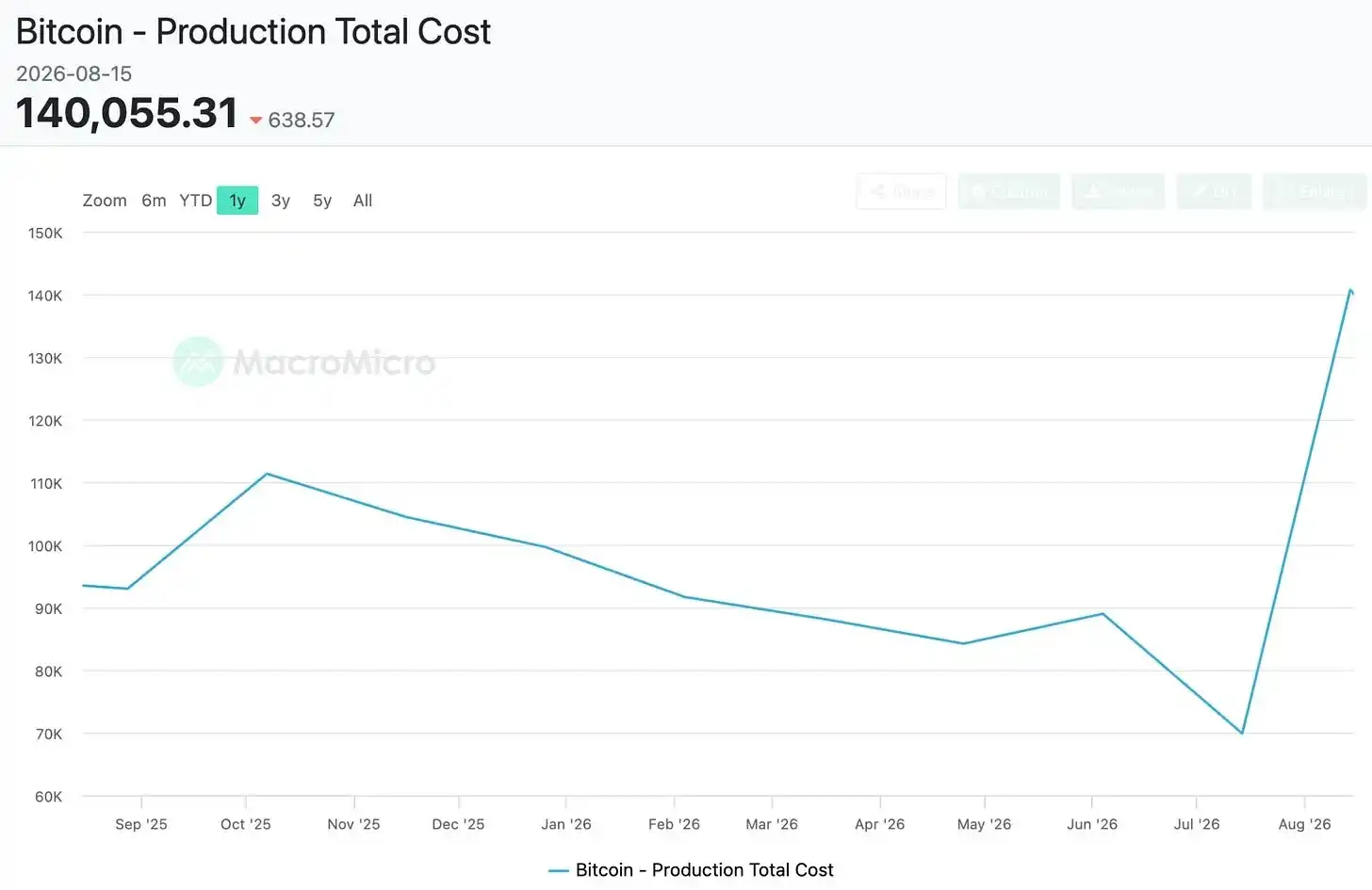
Source: MacroMicro

During the same period of worsening mining conditions, massive capital has flooded into the AI inference sector.

Bitcoin miners use ASIC chips to run complex algorithms and obtain block rewards. This hardware infrastructure is highly similar to the underlying requirements for high-performance computing and AI inference. This makes the transition to AI inference less daunting for miners, significantly lowering the barrier to entry. For miners seeking profitable outlets, pivoting to AI seems like a natural move.

Almost the entire listed mining sector has collectively changed course. The shift in revenue structure over the past few quarters vividly illustrates the scale of this transformation.

Take Core Scientific as an example: In Q2 2025, data center hosting services for AI and HPC generated only $10.6 million in quarterly revenue; during the same period, revenue from mining and selling Bitcoin was $62.4 million. Twelve months later, their positions were almost completely reversed. In Q2 2026, hosting revenue was $136.7 million, while mining revenue shrank by 65% to $21.5 million.

The proportion of hosting revenue to total company revenue skyrocketed from 14% last year to 83%.

TeraWulf's HPC leasing revenue already accounts for 71% of its total revenue. This business line had no revenue in the same period last year but reached $32 million in Q2 2026; during the same period, crypto asset mining revenue shrank by about 75%, remaining at only $13 million.
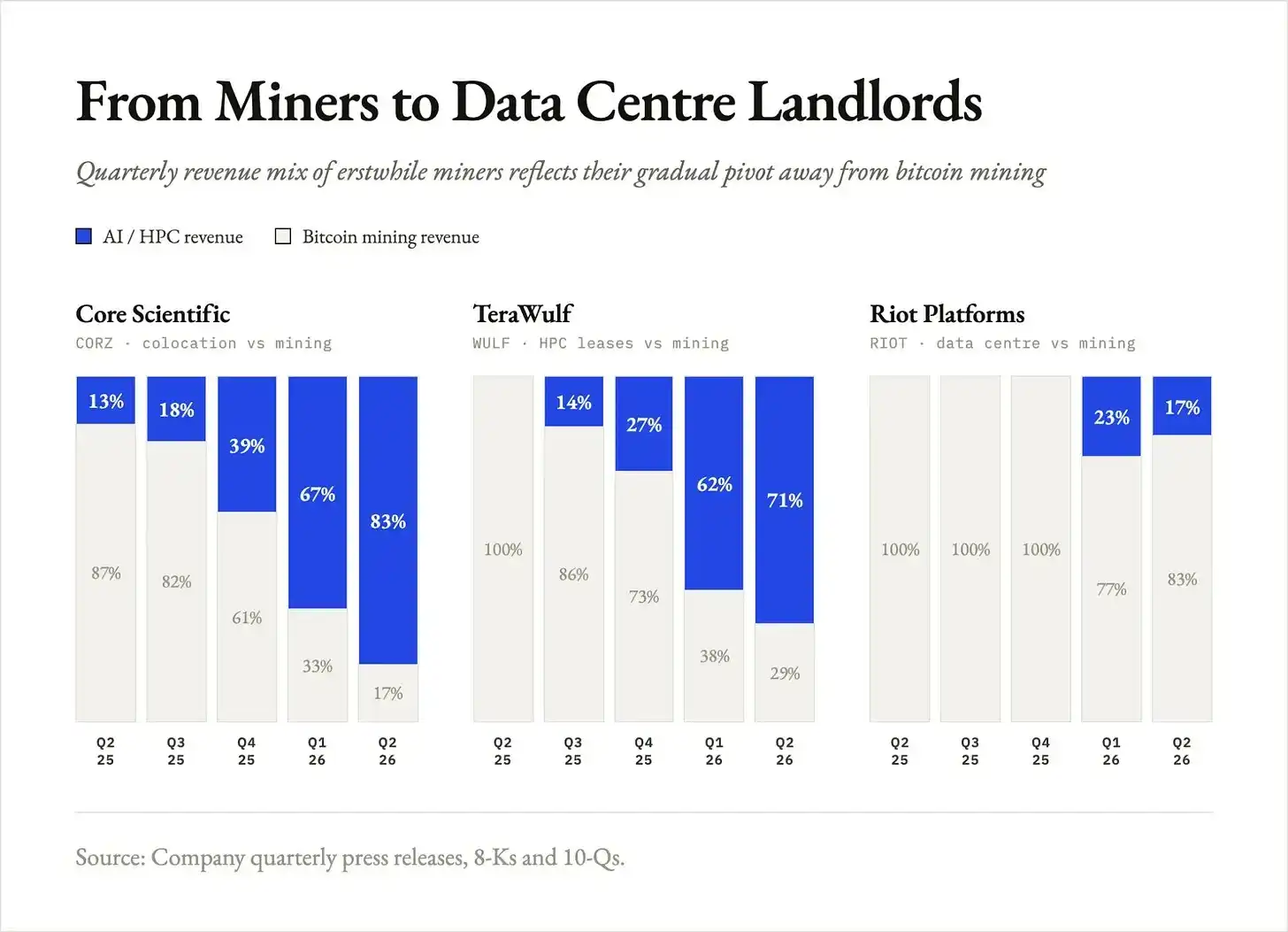
Many miners are also retrofitting their existing mining facilities and hardware to accommodate AI and HPC businesses.

A Worrisome Land Grab

The shift from Bitcoin mining to AI computing power has turned into a collective stampede. Beyond allocating existing capacity to AI, former Bitcoin miners are frantically securing electricity, land, and signing numerous demand orders. The total value of contracts already in place amounts to tens of billions of dollars.

Core Scientific has committed up to 2.5GW of available computing capacity to AMD and CoreWeave, with potential total revenue exceeding $24 billion over the contract period. Hut 8 holds 949 megawatts of contracted computing power with a base contract value of $26.6 billion and has secured $7.5 billion in new project financing.

TeraWulf signed a 20-year lease agreement worth approximately $19 billion with Anthropic and acquired a gigawatt-scale campus in Kentucky to meet computing demand. Over the past six months, Riot Platforms completed multiple leases totaling 241 megawatts, corresponding to a contract size of about $10 billion. Just last week, IREN delivered its first batch of AI cloud deployment nodes to Microsoft—a five-year contract valued at $9.7 billion; it also secured a 5GW partnership with Nvidia and continues acquiring power sites in Texas and Spain to supply computing needs.

This series of massive contracts has ignited market enthusiasm. Compared to miners' past businesses, signing 20-year leases with leading cloud providers promises more stable cash flow. After a full year of mining losses, locking in contracts for up to fifteen years seems like solid, tangible reality.

However, much market commentary underestimates the hidden risks.

Despite the hardship of mining, Bitcoin mining possesses a characteristic that AI hosting lacks: a self-healing mechanism. When mining becomes unprofitable, miners shut down their machines; when enough miners exit, the Bitcoin network difficulty automatically adjusts downward. The remaining miners, with the same equipment and electricity costs, can achieve higher returns.
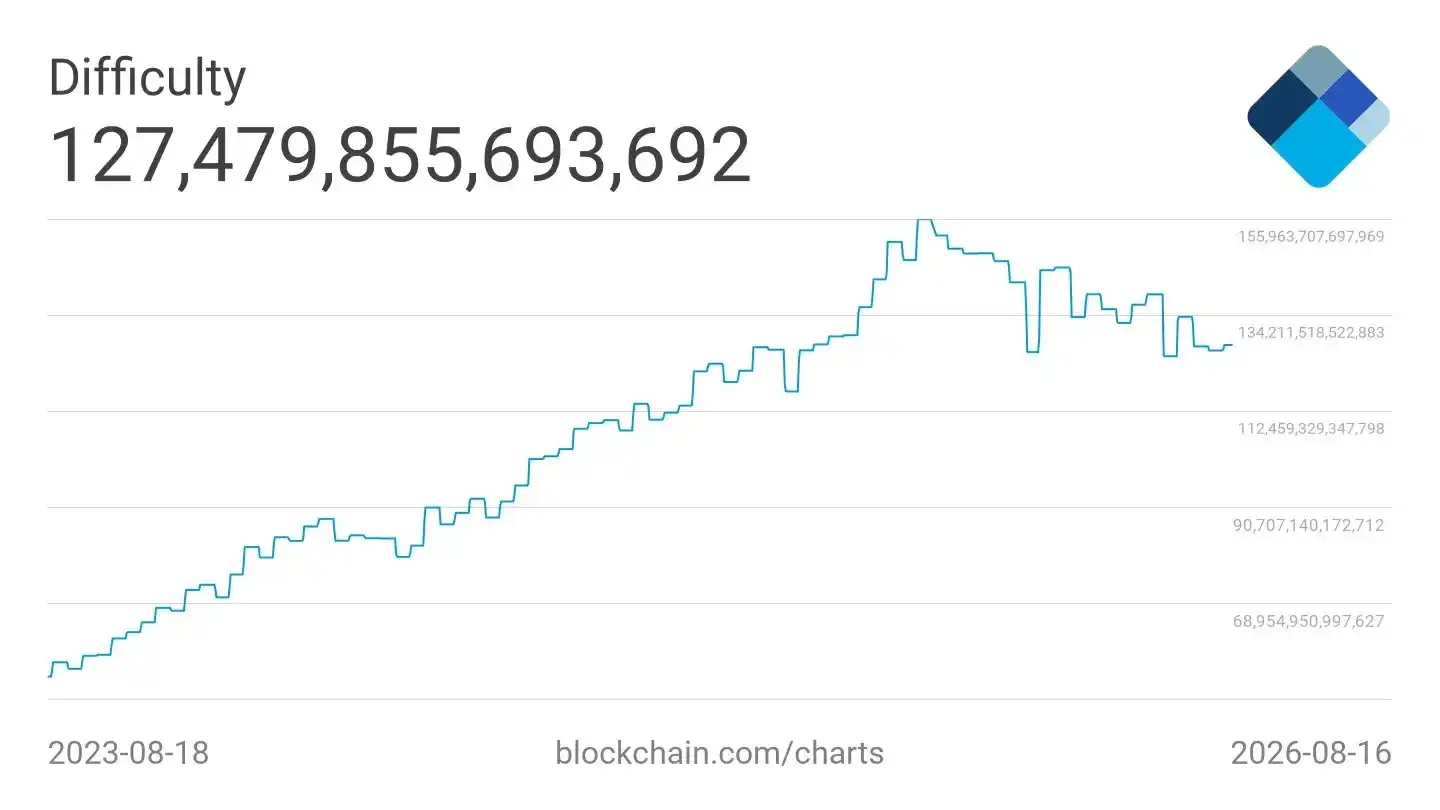
After many miners switched to the AI sector, Bitcoin's network difficulty has dropped from its peak of around 156 trillion in 2025 to 127.5 trillion. Every company exiting mining is making the mining rewards higher for those who remain.

However, the AI computing power industry lacks this automatic adjustment mechanism. If too many players flood in, causing an oversupply of computing power, prices will be driven down.

Although overall demand for AI computing is rising, prices may actually fall—seemingly contrary to basic economic principles. In fact, several AI companies have already lowered their service prices. In the early days of the industry, with hardware and supporting resources scarce, service providers could charge high premiums. Now, cloud giants worldwide are competing for megawatt-level power resources, and this scarcity has attracted a large number of Bitcoin miners and data center operators to massively expand capacity. Once new supply fills the demand gap, computing power prices will decline rapidly.

When prices fall, the 15-20 year long-term leases miners are signing at today's high prices will look prohibitively expensive in hindsight.

There is another tricky aspect to this transition: the path is largely one-way. Converting a mining facility into an AI computing campus is straightforward; the power infrastructure is already in place. But once you replace ASIC miners with H100 GPUs and sign a 20-year lease, you'll be tightly bound by this contract for the next two decades, unable to easily switch back to mining.

When market cycles reverse in the future, with Bitcoin prices breaking away from the $60,000 low and network difficulty decreasing, mining will inevitably become profitable again. By then, former miners who have completely transformed, constrained by multi-year long-term leases, can only watch the opportunity pass by. Worse still, if the actual revenue from AI computing falls short of the optimistic expectations at signing, a double blow will follow.

So, should miners not transform and just wait patiently for the mining cycle to turn? I don't think so. For most companies, transformation is a forced choice for survival. With a comprehensive mining cost of $140,000 and the coin price at only $63,000, continuing to mine is commercially unviable; AI is the only immediate lifeline.

But the will to survive drives companies to make extreme choices. The risk lies precisely with those players who go all-in on AI: forced by survival pressure, they completely abandon Bitcoin mining, destroy/replace all ASIC miners, and lock themselves into decades-long contracts in a nascent industry that will still experience price corrections.

However, not all miners have chosen a complete 180-degree turn; some companies have been more cautious.

Those With Hedging Options Hold the Advantage

Marathon Digital, the listed mining company with the largest Bitcoin treasury, has taken a cautious path. In Q2 2026, it sold 30% of its Bitcoin holdings to reduce debt, but it has not abandoned its Bitcoin mining equipment. Instead, it chose another way to fund its AI expansion.

MARA used its remaining Bitcoin as collateral to secure $150 million in funding through a 2026 credit facility to finance its AI business expansion. As of June 30, its balance sheet still holds over 35,000 Bitcoins while maintaining a flexible, load-adjustable mining operation.

Hut 8 has also not abandoned mining. It spun off its Bitcoin mining business into a new, wholly-owned subsidiary, American Bitcoin Corp, while the parent company focuses on HPC and AI infrastructure.

By keeping mining machines running and maintaining Bitcoin inventories, these companies hold an option abandoned by those who have gone all-in on the transformation. When mining becomes profitable again, they can switch their power load back to mining; companies deeply tied to long-term AI contracts can only watch from the sidelines.

Treating old mining operations as baggage and betting everything on AI computing is gambling on an unproven future. But historical patterns are easy to predict: chips, computers, smartphones—every emerging technology sees product prices fall as the industry matures. Signs of price softening have already appeared in the AI computing power industry.

Companies like Marathon and Hut 8 are not missing out on the AI boom. They haven't liquidated everything to buy GPUs. Instead, they retain some mining capacity and Bitcoin holdings, treating AI as a diversification strategy rather than betting all their capital on an immature sector that will undergo price re-evaluation. As long as the ASIC miners are still there, when mining becomes more profitable and AI computing premiums fade, they can switch the load back to mining Bitcoin.

From a broader perspective, these companies are essentially power operators; the hardware on top is either ASIC miners or H100 graphics cards. Companies that can flexibly allocate power resources between mining and AI computing based on which business yields higher returns will not be entirely at the mercy of market cycles and narratives.

Criptomoedas em alta

Perguntas relacionadas

QWhat is the main reason leading major listed Bitcoin mining companies to shift their focus towards AI and high-performance computing (HPC)?

AThe primary driver is a severe survival crisis triggered by the Bitcoin block reward halving in April 2024 and a subsequent sharp drop in Bitcoin's price. With the current price of Bitcoin around $63,000 and the all-in mining cost having soared to as high as $140,000, continuing to mine and sell Bitcoin is largely unprofitable. Simultaneously, the explosive growth in demand for AI inference computing power offers a seemingly viable and lucrative alternative business model.

QWhat is a key long-term risk for miners who sign large, multi-year contracts for AI compute capacity at current high prices?

AA major risk is being locked into long-term (e.g., 15-20 year) contracts at peak prices. As more players enter the AI compute market and supply expands, the scarcity premium is likely to diminish, leading to a decline in compute pricing. Companies that signed contracts based on current high valuations may find their contracts economically burdensome in the future, while being unable to easily switch back to Bitcoin mining.

QHow does the Bitcoin mining industry's self-adjusting mechanism contrast with the dynamics of the AI compute market?

ABitcoin mining has a built-in self-healing mechanism: when mining becomes unprofitable, miners shut off machines, leading to a decrease in the network's mining difficulty. This automatically improves profitability for the remaining miners. In contrast, the AI compute market lacks such an automatic adjustment. If an oversupply of compute power develops, prices can be driven down without a corresponding automatic mechanism to restore profitability for suppliers.

QWhich mining companies are cited as examples of taking a more cautious, diversified approach to the AI shift, and what does this approach involve?

AMarathon Digital (MARA) and Hut 8 are cited as examples. Their cautious approach involves not fully abandoning Bitcoin mining. Marathon used part of its Bitcoin treasury as collateral for loans to fund AI expansion while retaining its mining hardware and a significant Bitcoin reserve. Hut 8 spun off its Bitcoin mining into a separate subsidiary while focusing the parent company on HPC/AI. This preserves the optionality to switch power back to mining if it becomes more profitable again.

QAccording to the article, what fundamental capability gives flexible miners a strategic advantage over those who are 'all-in' on AI?

AThe fundamental advantage is being able to act as flexible power operators. Companies that retain both Bitcoin mining hardware (ASICs) and AI computing hardware (GPUs) can dynamically allocate their electricity and infrastructure resources based on which application—Bitcoin mining or AI compute—offers higher returns at any given time. This flexibility protects them from being solely dependent on the volatile cycles of either market.

Leituras Relacionadas

Dutch Prosecutors Seize $2.55 Million in Cryptocurrency Linked to Bankrupt Company Knaken

Dutch prosecutors have liquidated all remaining cryptocurrency assets belonging to the bankrupt trading platform Knaken, recovering $2.55 million for creditors. However, the court-appointed trustee warned that the platform's 6,300 affected clients will likely recover only a small portion of their investments, estimated between $11.6 and $13.9 million. The trustee, Carl Hamm, stated that the platform operated with a significant structural deficit, mixing client investments with operational expenses, rather than fully covering user deposits. Investigations reveal that Knaken's owner, Ronald J., transferred $2.67 million from company accounts to a private entity he owned—a transaction the court described as a conflict of interest. Despite financial troubles beginning as early as 2020, Knaken continued to expand its client base and secured high-profile sponsorship deals with major Dutch football clubs, without disclosing its difficulties to the Dutch Central Bank. The platform also issued participation certificates and took loans from clients. Prior to the bankruptcy declaration, Dutch authorities seized and sold Knaken's remaining crypto reserves under a law permitting the liquidation of rapidly depreciating assets. This $2.55 million is currently the only liquid asset in the bankruptcy estate. Some legal counsel for the victims questioned whether authorities overstepped by liquidating client assets. In response, Ronald J. contested some of the trustee's claims, asserting that Knaken acted as a broker with verifiable trade logs and that separate banking structures were later implemented for client funds. He acknowledged an asset shortfall but is actively working on a creditor settlement plan. The trustee is currently assessing the feasibility of any proposed settlement.

cryptonews.ruHá 34m

Dutch Prosecutors Seize $2.55 Million in Cryptocurrency Linked to Bankrupt Company Knaken

cryptonews.ruHá 34m

Trading

Spot

Artigos em Destaque

O que é BITCOIN

Compreender o HarryPotterObamaSonic10Inu (ERC-20) e a Sua Posição no Espaço Cripto Nos últimos anos, o mercado de criptomoedas assistiu a um aumento na popularidade das moedas meme, cativando não apenas os traders, mas também aqueles que procuram envolvimento comunitário e valor de entretenimento. Entre estes tokens únicos está o HarryPotterObamaSonic10Inu (ERC-20), um projeto intrigante que mistura referências culturais no tecido das criptomoedas. Este artigo explora os principais aspetos do HarryPotterObamaSonic10Inu, examinando os seus mecanismos, a sua ética orientada pela comunidade e o seu envolvimento com o vasto panorama cripto. O que é o HarryPotterObamaSonic10Inu (ERC-20)? Como o nome sugere, o HarryPotterObamaSonic10Inu é uma moeda meme construída na blockchain Ethereum, classificada sob o padrão ERC-20. Ao contrário das criptomoedas tradicionais, que podem enfatizar a utilidade prática ou o potencial de investimento, este token prospera no valor de entretenimento e na força da sua comunidade. O projeto visa promover um ambiente onde utilizadores envolvidos possam reunir-se, partilhar ideias e participar em atividades inspiradas por diversos fenómenos culturais. Uma característica notável do HarryPotterObamaSonic10Inu é a zero taxa sobre transações. Este elemento atraente visa encorajar a negociação e o envolvimento da comunidade, isento de encargos adicionais que podem desencorajar os traders de pequena escala. A oferta total da moeda está fixada em mil milhões de tokens, uma cifra que marca a sua intenção de manter uma circulação substancial dentro da comunidade. Criador do HarryPotterObamaSonic10Inu (ERC-20) As origens do HarryPotterObamaSonic10Inu estão um pouco envoltas em mistério; os detalhes sobre o criador permanecem desconhecidos. O desenvolvimento deste token carece de uma equipa identificável ou de um plano explícito, o que não é raro no setor das moedas meme. Em vez disso, o projeto surgiu de forma orgânica, com o seu progresso a depender fortemente do entusiasmo e da participação da sua comunidade. Investidores do HarryPotterObamaSonic10Inu (ERC-20) No que diz respeito a investimentos externos e apoios, o HarryPotterObamaSonic10Inu também permanece ambíguo. O token não lista quaisquer fundações de investimento conhecidas ou apoio organizacional significativo. Em vez disso, o “sangue vital” do projeto é a sua comunidade de base, que informa o seu crescimento e sustentabilidade através da ação coletiva e do envolvimento no espaço cripto. Como Funciona o HarryPotterObamaSonic10Inu (ERC-20)? Como uma moeda meme, o HarryPotterObamaSonic10Inu opera principalmente fora dos quadros tradicionais que muitas vezes governam o valor dos ativos. Existem vários aspetos distintivos que definem como o projeto funciona: Transações Sem Taxas: Sem taxas sobre transações, os utilizadores podem comprar e vender o token livremente, sem a preocupação de custos ocultos. Envolvimento da Comunidade: O projeto prospera na interação da comunidade, aproveitando plataformas de redes sociais para criar entusiasmo e facilitar a participação. Discussões, partilha de conteúdo e envolvimento são elementos cruciais que ajudam a expandir o seu alcance e a fomentar a lealdade entre os apoiantes. Sem Utilidade Prática: Deve ser notado que o HarryPotterObamaSonic10Inu não oferece utilidade concreta dentro do ecossistema financeiro. Em vez disso, é classificado como um token principalmente para entretenimento e atividades comunitárias. Referência Cultural: O token incorpora de forma inteligente elementos da cultura popular para atrair interesse, conectando-se tanto com entusiastas de memes como com seguidores de criptomoedas. HarryPotterObamaSonic10Inu exemplifica como as moedas meme operam de forma diferente de projetos de criptomoedas mais tradicionais, entrando no mercado como construções sociais inovadoras em vez de ativos utilitários. Linha do Tempo do HarryPotterObamaSonic10Inu (ERC-20) A história do HarryPotterObamaSonic10Inu é marcada por vários marcos notáveis: Criação: O token surgiu de um meme viral, capturando a imaginação de muitos entusiastas de criptomoedas. Datas específicas de criação não estão disponíveis, sublinhando a sua ascensão orgânica. Listagem em Exchanges: O HarryPotterObamaSonic10Inu conseguiu entrar em várias exchanges, permitindo um acesso e negociação mais fáceis pela comunidade. Iniciativas de Envolvimento da Comunidade: Atividades contínuas direcionadas a melhorar a interação comunitária, incluindo concursos, campanhas em redes sociais e geração de conteúdo por fãs e defensores. Planos de Expansão Futura: O roteiro do projeto inclui o lançamento de uma coleção de NFTs, mercadorias e um site de eCommerce relacionado aos seus temas culturais, envolvendo ainda mais a comunidade e tentando adicionar mais dimensões ao seu ecossistema. Pontos-Chave sobre o HarryPotterObamaSonic10Inu (ERC-20) Natureza Orientada pela Comunidade: O projeto prioriza a contribuição coletiva e a criatividade, assegurando que o envolvimento dos utilizadores está na vanguarda do seu desenvolvimento. Classificação como Moeda Meme: Representa o epítome da criptomoeda baseada em entretenimento, destacando-se dos veículos de investimento tradicionais. Sem Afiliação Direta com o Bitcoin: Apesar da semelhança no nome do ticker, o HarryPotterObamaSonic10Inu é distinto e não tem qualquer relação com o Bitcoin ou outras criptomoedas estabelecidas. Foco na Colaboração: O HarryPotterObamaSonic10Inu é projetado para criar um espaço de colaboração e partilha de histórias entre os seus detentores, proporcionando uma via para a criatividade e o fortalecimento da comunidade. Perspectivas Futuras: A ambição de expandir além da sua premissa inicial para NFTs e mercadorias delineia um caminho para o projeto potencialmente entrar em avenidas mais mainstream dentro da cultura digital. À medida que as moedas meme continuam a capturar a imaginação da comunidade cripto, HarryPotterObamaSonic10Inu (ERC-20) destaca-se devido aos seus laços culturais e abordagem centrada na comunidade. Embora possa não se encaixar no molde típico de um token orientado para utilidade, a sua essência reside na alegria e camaradagem fomentadas entre os seus apoiantes, destacando a natureza em evolução das criptomoedas em uma era cada vez mais digital. À medida que o projeto continua a desenvolver-se, será importante observar como as dinâmicas comunitárias influenciam a sua trajetória no panorama em constante mudança da tecnologia blockchain.

2.4k Visualizações TotaisPublicado em {updateTime}Atualizado em 2024.12.03

O que é BITCOIN

Como comprar BTC

Bem-vindo à HTX.com!Tornámos a compra de Bitcoin (BTC) simples e conveniente.Segue o nosso guia passo a passo para iniciar a tua jornada no mundo das criptos.Passo 1: cria a tua conta HTXUtiliza o teu e-mail ou número de telefone para te inscreveres numa conta gratuita na HTX.Desfruta de um processo de inscrição sem complicações e desbloqueia todas as funcionalidades.Obter a minha contaPasso 2: vai para Comprar Cripto e escolhe o teu método de pagamentoCartão de crédito/débito: usa o teu visa ou mastercard para comprar Bitcoin (BTC) instantaneamente.Saldo: usa os fundos da tua conta HTX para transacionar sem problemas.Terceiros: adicionamos métodos de pagamento populares, como Google Pay e Apple Pay, para aumentar a conveniência.P2P: transaciona diretamente com outros utilizadores na HTX.Mercado de balcão (OTC): oferecemos serviços personalizados e taxas de câmbio competitivas para os traders.Passo 3: armazena teu Bitcoin (BTC)Depois de comprar o teu Bitcoin (BTC), armazena-o na tua conta HTX.Alternativamente, podes enviá-lo para outro lugar através de transferência blockchain ou usá-lo para transacionar outras criptomoedas.Passo 4: transaciona Bitcoin (BTC)Transaciona facilmente Bitcoin (BTC) no mercado à vista da HTX.Acede simplesmente à tua conta, seleciona o teu par de trading, executa as tuas transações e monitoriza em tempo real.Oferecemos uma experiência de fácil utilização tanto para principiantes como para traders experientes.

4.9k Visualizações TotaisPublicado em {updateTime}Atualizado em 2026.06.02

Como comprar BTC

O que é $BITCOIN

OURO DIGITAL ($BITCOIN): Uma Análise Abrangente Introdução ao OURO DIGITAL ($BITCOIN) OURO DIGITAL ($BITCOIN) é um projeto baseado em blockchain que opera na rede Solana, com o objetivo de combinar as características dos metais preciosos tradicionais com a inovação das tecnologias descentralizadas. Embora partilhe um nome com o Bitcoin, frequentemente referido como “ouro digital” devido à sua percepção como uma reserva de valor, o OURO DIGITAL é um token separado projetado para criar um ecossistema único dentro da paisagem Web3. O seu objetivo é posicionar-se como um ativo digital alternativo viável, embora os detalhes sobre as suas aplicações e funcionalidades ainda estejam em desenvolvimento. O que é o OURO DIGITAL ($BITCOIN)? OURO DIGITAL ($BITCOIN) é um token de criptomoeda explicitamente projetado para uso na blockchain Solana. Em contraste com o Bitcoin, que fornece um papel amplamente reconhecido como armazenamento de valor, este token parece focar em aplicações e características mais amplas. Aspectos notáveis incluem: Infraestrutura Blockchain: O token é construído na blockchain Solana, conhecida pela sua capacidade de lidar com transações de alta velocidade e baixo custo. Dinâmicas de Oferta: O OURO DIGITAL tem um fornecimento máximo limitado a 100 quatrilhões de tokens (100P $BITCOIN), embora os detalhes sobre o seu fornecimento circulante ainda não tenham sido divulgados. Utilidade: Embora as funcionalidades precisas não estejam explicitamente delineadas, existem indicações de que o token poderia ser utilizado para várias aplicações, potencialmente envolvendo aplicações descentralizadas (dApps) ou estratégias de tokenização de ativos. Quem é o Criador do OURO DIGITAL ($BITCOIN)? Neste momento, a identidade dos criadores e da equipa de desenvolvimento por trás do OURO DIGITAL ($BITCOIN) permanece desconhecida. Esta situação é típica entre muitos projetos inovadores no espaço da blockchain, particularmente aqueles alinhados com finanças descentralizadas e fenómenos de moedas meme. Embora tal anonimato possa fomentar uma cultura orientada pela comunidade, intensifica as preocupações sobre governança e responsabilidade. Quem são os Investidores do OURO DIGITAL ($BITCOIN)? As informações disponíveis indicam que o OURO DIGITAL ($BITCOIN) não tem apoiantes institucionais conhecidos ou investimentos proeminentes de capital de risco. O projeto parece operar num modelo peer-to-peer focado no apoio e adoção da comunidade, em vez de rotas de financiamento tradicionais. A sua atividade e liquidez estão principalmente situadas em exchanges descentralizadas (DEXs), como a PumpSwap, em vez de plataformas de negociação centralizadas estabelecidas, destacando ainda mais a sua abordagem de base. Como Funciona o OURO DIGITAL ($BITCOIN) A mecânica operacional do OURO DIGITAL ($BITCOIN) pode ser elaborada com base no seu design de blockchain e nas características da rede: Mecanismo de Consenso: Ao aproveitar o exclusivo proof-of-history (PoH) da Solana combinado com um modelo de proof-of-stake (PoS), o projeto assegura uma validação eficiente das transações, contribuindo para o alto desempenho da rede. Tokenomics: Embora mecanismos deflacionários específicos não tenham sido extensivamente detalhados, o vasto fornecimento máximo de tokens implica que pode atender a microtransações ou casos de uso de nicho que ainda estão por definir. Interoperabilidade: Existe o potencial para integração com o ecossistema mais amplo da Solana, incluindo várias plataformas de finanças descentralizadas (DeFi). No entanto, os detalhes sobre integrações específicas permanecem não especificados. Cronologia de Eventos Chave Aqui está uma cronologia que destaca marcos significativos relacionados ao OURO DIGITAL ($BITCOIN): 2023: O lançamento inicial do token ocorre na blockchain Solana, marcado pelo seu endereço de contrato. 2024: O OURO DIGITAL ganha visibilidade ao tornar-se disponível para negociação em exchanges descentralizadas como a PumpSwap, permitindo que os utilizadores o negociem contra SOL. 2025: O projeto testemunha atividade de negociação esporádica e potencial interesse em envolvimentos liderados pela comunidade, embora não tenham sido documentadas parcerias ou avanços técnicos notáveis até ao momento. Análise Crítica Forças Escalabilidade: A infraestrutura subjacente da Solana suporta altos volumes de transações, o que pode aumentar a utilidade do $BITCOIN em vários cenários de transação. Acessibilidade: O potencial preço de negociação baixo por token pode atrair investidores de retalho, facilitando uma participação mais ampla devido a oportunidades de propriedade fracionada. Riscos Falta de Transparência: A ausência de apoiantes, desenvolvedores ou um processo de auditoria publicamente conhecidos pode gerar ceticismo em relação à sustentabilidade e confiabilidade do projeto. Volatilidade do Mercado: A atividade de negociação depende fortemente do comportamento especulativo, o que pode resultar em volatilidade significativa dos preços e incerteza para os investidores. Conclusão O OURO DIGITAL ($BITCOIN) surge como um projeto intrigante, mas ambíguo, dentro do ecossistema em rápida evolução da Solana. Embora tente aproveitar a narrativa do “ouro digital”, a sua divergência do papel estabelecido do Bitcoin como reserva de valor sublinha a necessidade de uma diferenciação mais clara da sua utilidade pretendida e estrutura de governança. A aceitação e adoção futuras dependerão provavelmente da abordagem da atual opacidade e da definição mais explícita das suas estratégias operacionais e económicas. Nota: Este relatório abrange informações sintetizadas disponíveis até outubro de 2023, e desenvolvimentos podem ter ocorrido além do período de pesquisa.

491 Visualizações TotaisPublicado em {updateTime}Atualizado em 2025.05.13

O que é $BITCOIN

Discussões

Bem-vindo à Comunidade HTX. Aqui, pode manter-se informado sobre os mais recentes desenvolvimentos da plataforma e obter acesso a análises profissionais de mercado. As opiniões dos utilizadores sobre o preço de BTC (BTC) são apresentadas abaixo.

活动图片