Anthropic Eyes 'Training Chips'? Reportedly Considered Acquiring AI Chip Company MatX for $7 Billion

marsbitPublicado em 2026-08-29Última atualização em 2026-08-29

Resumo

AI giant Anthropic reportedly discussed acquiring AI chip startup MatX for approximately $7 billion to accelerate its in-house chip development, specifically targeting "training chips" for large language models. This move follows OpenAI's recent unveiling of its own inference chip, "Jalapeño," highlighting a growing trend of major AI companies vertically integrating into hardware. However, the MatX deal was ultimately abandoned, with talks shifting toward potential collaboration instead. Anthropic's interest in MatX, a company founded in 2023 by former Google TPU engineers, underscores its strategic push to secure faster and more cost-efficient computing power for its Claude model. The company's broader chip ambitions are further evidenced by its recruitment of key industry veterans, including former Google TPU leader Amir Salek and ex-OpenAI chip engineer Clive Chan, to build an internal chip team. Anthropic is also actively meeting with several other AI chip startups to evaluate different architectures. Despite this significant investment in chip design capabilities, Anthropic reportedly plans to maintain a multi-vendor strategy, continuing its partnerships with major suppliers like Nvidia and Google. Developing advanced chips remains a costly and time-intensive endeavor, making the acquisition of an established startup like MatX an attractive, though currently unrealized, shortcut to gain expertise and potentially reduce long-term costs.

The 'battle' among AI large model companies is spreading all the way to chips.

Just a few days ago, OpenAI proudly announced its first self-developed inference chip 'Jalapeño' outperforming Nvidia, while on the other side, Anthropic's chip 'ambitions' have also surfaced......

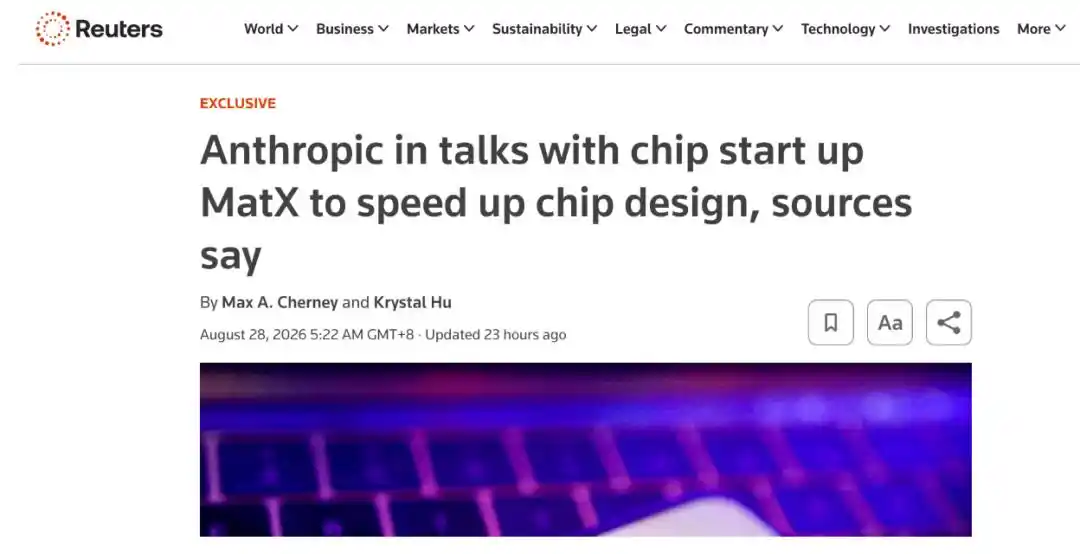
According to an exclusive Reuters report, Anthropic previously discussed acquiring AI chip startup MatX for approximately $7 billion, hoping to accelerate internal chip development through this move.
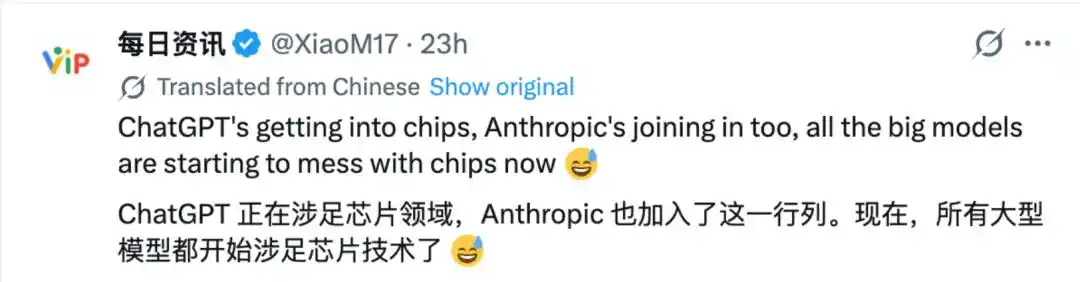
Seeing this news, netizens also exclaimed, first OpenAI, now Anthropic, "Now large models are all starting to get involved in the chip field."
However, unfortunately, this deal ultimately did not proceed. According to informed sources, the discussions between the two parties have currently shifted from acquisition to potential cooperation.

As for the specific reasons for the termination of the acquisition negotiations, Reuters has not yet disclosed them. However, it is worth noting the seriousness Anthropic showed towards this deal: In order to find faster and cheaper computing power for Claude, this model company has already begun to delve from the model layer all the way down to the chip layer.

And what kind of chip company is this that could command such a high price from Anthropic for an acquisition?

Information shows that MatX was founded in 2023, and its co-founders Reiner Pope and Mike Gunter are both from Google. Reiner Pope was involved in Google TPU software and large model infrastructure-related work, while Mike Gunter has long been engaged in TPU hardware design.

In February of this year, MatX completed a $500 million Series B funding round, with investors including Jane Street, Situational Awareness, and others.
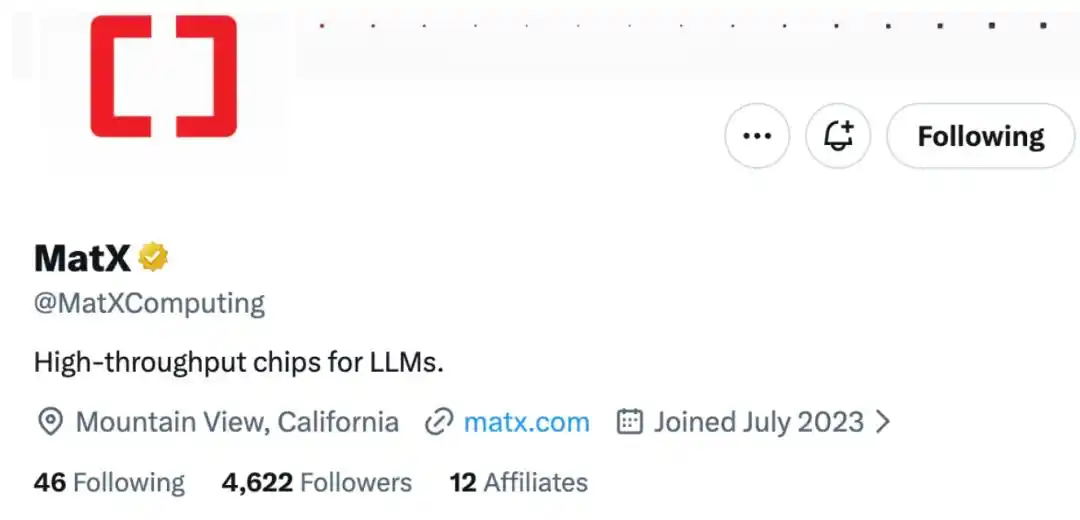
Notably, MatX focuses on designing chips for large language models, primarily serving the 'training' phase.

This point might be an important reason why Anthropic chose to engage with them. Reuters cited informed sources saying that the negotiations with MatX indicate Anthropic may be interested in developing its own 'training chips', and of course, it might also launch chips for inference in the future.

This clearly forms an interesting contrast with the path recently announced by OpenAI: OpenAI's first self-developed chip 'Jalapeño' currently emphasizes inference: how to run model services with lower latency, higher throughput, and better energy efficiency after the model has been trained. The interest exposed by Anthropic, however, extends simultaneously to the training side.

Actually, it's not surprising for Anthropic to start laying out a 'training chip' strategy.

Currently, as models become larger and larger, model training is increasingly resembling a super engineering project. From pre-training, post-training to reinforcement learning, each model iteration requires mobilizing massive clusters of chips. Even a few percentage points improvement in training efficiency, when scaled to tens of thousands or even hundreds of thousands of accelerators, can ultimately correspond to a significant cost difference.

If chips, model architecture, and training systems can be co-designed from the start, this advantage could be further amplified.

This is also why Google started building TPUs many years ago, Amazon has Trainium, and OpenAI is now closely following with Jalapeño...... Chips are gradually becoming part of model capabilities.

MatX is not the only chip company Anthropic has contacted

In fact, Anthropic is not only contacting MatX but is seriously planning chip design.

According to Reuters, in recent weeks, Anthropic has held meetings with multiple AI chip startups. However, it has not yet decided which company to ultimately acquire, nor has it fully determined which technical route its self-developed chips will adopt. A major purpose of these contacts is to systematically allow Anthropic's engineers and management to understand the different AI chip architectures currently on the market.

At the same time, Anthropic is also aggressively recruiting talent in the chip field.

Just a few days ago, Bloomberg reported that Anthropic is forming an internal chip team and has hired former Google TPU core lead Amir Salek to join the computing department to advance the self-developed chip plan.
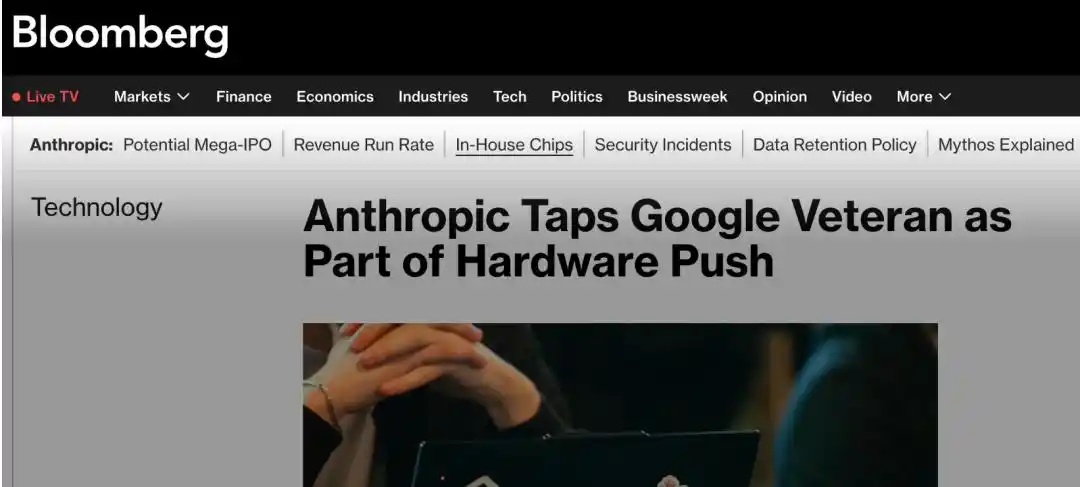
Amir Salek is a seasoned veteran in the chip industry. He joined Google in 2013, participated in founding and leading its custom chip business, and long-termly oversaw the TPU project until leaving in 2022. During this time, he drove the development and delivery of Google's first seven generations of TPU products and participated in building Google's custom chip capabilities for data centers.

Before joining Google, Salek worked at Nvidia for about eight years, serving as Senior Engineering Director, and founded and led Nvidia's system-on-chip (SoC) design department, accumulating extensive experience in GPU, mobile processors, and other chip fields.

After leaving Google in 2022, Salek moved into the investment field, joining the private equity firm Cerberus Capital Management as a Senior Managing Director, and also serving as a partner at its deep-tech investment platform Tracker Ventures, focusing on semiconductors, AI, edge computing, and other fields.

Now he returns to the front lines of chip R&D by joining Anthropic's computing team. It is reported that he will report to the company's head of computing, James Bradbury.

Earlier this year, in June, Anthropic also hired former OpenAI chip engineer Clive Chan, who had participated in OpenAI's self-developed chip project.

If we connect these operations, the overall view of Anthropic's chip roadmap becomes very clear: Hiring chip talent, building an internal team, researching different architectures, contacting chip startups, and even directly considering billion-dollar-level acquisitions......

Of course, Anthropic does not plan to completely shift to self-developed chips. According to Reuters, it still plans to continue with a multi-chip strategy, maintaining cooperation with chip and cloud computing suppliers like Nvidia and Google.

Because chip design itself is a massive, expensive, and time-consuming engineering project. Even with ample funds, it is not an easy task. It must be noted that an actually usable advanced chip might take a year or even longer from design to deployment, and the design cost for a single generation of chips could reach hundreds of millions of dollars.

Therefore, acquisition targets like MatX are very attractive to Anthropic. After all, directly acquiring a mature AI chip startup can quickly gain internal chip design experience and potentially reduce costs in the long run.

And you? What do you think of Anthropic's move?

Reference links:

https://www.reuters.com/business/finance/anthropic-planned-then-abandoned-7-billion-purchase-matx-sources-say-2026-08-27/

https://www.bloomberg.com/news/articles/2026-08-21/anthropic-taps-google-chip-veteran-as-part-of-push-into-hardware

This article comes from the WeChat public account "Almost Human" (ID: almosthuman2014), author: Focus on AI

Criptomoedas em alta

Perguntas relacionadas

QWhat was Anthropic's reported plan regarding AI chip startup MatX, according to Reuters?

AAnthropic reportedly discussed acquiring the AI chip startup MatX for about $7 billion to accelerate its internal chip development.

QWhy is MatX considered a significant target for Anthropic, based on its expertise?

AMatX is significant because it focuses on designing chips for large language models, specifically for the training phase, which aligns with Anthropic's potential interest in developing its own training chips.

QWhat key personnel move did Bloomberg report regarding Anthropic's push into hardware?

ABloomberg reported that Anthropic hired former Google TPU core lead Amir Salek to join its computing team to advance its in-house chip initiative.

QHow does Anthropic's apparent chip strategy differ from OpenAI's recently announced approach?

AAnthropic's interest appears to extend into training chips for model development, while OpenAI's first in-house chip, 'Jalapeño,' is currently emphasized for inference tasks after model training.

QWhat is Anthropic's overall stance on chip procurement despite its in-house development efforts?

AAnthropic plans to continue a multi-chip strategy, maintaining partnerships with suppliers like Nvidia and Google, rather than fully transitioning to in-house chips, due to the high cost and complexity of chip design.

Leituras Relacionadas

Dialogue with Epoch Ventures Founder: Large-Scale Capital Rotation Has Begun, the Four-Year Cycle Has Ended

Epoch Ventures founder Eric Yakes discusses why Bitcoin's traditional four-year boom-bust cycle may be ending. He argues that Bitcoin, with recent drawdowns limited to around 50% instead of 80%, is transitioning from a high-risk asset to a hedge against currency debasement due to institutional inflows and lower volatility. This shift allows for higher portfolio allocations and disconnects Bitcoin from general risk assets. Yakes outlines Bitcoin's path to global adoption through three monetary functions: store of value, medium of exchange, and unit of account. He believes Bitcoin is currently in the store-of-value phase. A massive capital rotation from gold into Bitcoin is imminent once Bitcoin achieves deeper liquidity, potentially seeing prices rise tenfold. A key mechanism for this transition involves stablecoins. Yakes posits that the U.S. Treasury, facing a debt spiral, will promote stablecoin adoption to create demand for U.S. Treasuries. As stablecoins grow, they will increasingly hold Bitcoin in their reserves to differentiate themselves, leading to a "Bitcoinization" of stablecoins. This sets the stage for "hyperbitcoinization" as fiat currencies become obsolete. Addressing concerns about centralization from ETFs and custodians, Yakes argues Bitcoin's easy self-custody creates a powerful exit threat that deters malicious control. Wealth concentration among early holders is seen as a natural, temporary phase in an emerging economy. Finally, Yakes explains his firm's investment focus: building Bitcoin-compatible financial infrastructure, particularly Bitcoin-backed lending, to bridge traditional finance with the Bitcoin ecosystem.

marsbitHá 2m

Dialogue with Epoch Ventures Founder: Large-Scale Capital Rotation Has Begun, the Four-Year Cycle Has Ended

marsbitHá 2m

Weekly Editor's Picks (0822-0828)

**Weekly Editor's Picks (Aug 22-28)** **Theme:** This weekly digest curates in-depth analysis from the fast-moving information flow, filtering noise to deliver insights. **Macro & Geopolitics** * **US Treasury Strategy:** Wall Street expects potential signals in November regarding future borrowing through more short-term bills and notes, alongside expanded bond buybacks to ease long-term yield pressure. A direct cut in long-term bond issuance is also a rising possibility. * **Gold Outlook:** Goldman Sachs sees fundamental buying, ETF inflows, and options activity driving gold above $4,600/oz. They maintain a year-end target of $4,900, noting potential upside from increased macro hedging demand. Options positions could amplify moves in either direction. **Investment & Crypto** * **Arthur Hayes Interview:** The BitMEX co-founder argues crypto is the primary release valve for central bank liquidity. He predicts ETH could reach $30,000 and sees FLOP potentially surpassing ETH. The Clarity Act is criticized as harmful to US crypto innovation. He views war as the biggest market risk. * **Crypto Leverage Plays:** Analysis of crypto-correlated stocks (MSTR, COIN, etc.) during BTC's 24% weekly surge, ranking their leverage and risk profiles. * **Altcoin Season:** The altcoin market cap surpassed $1 trillion, with 92% of tokens rising. The rally is becoming more fundamentals-driven. * **ZEC & TAO ETFs:** Zcash hit an 8-year high, fueled by Grayscale's progress in converting its Zcash Trust to a spot ETF. A similar "trust-to-ETF" path is noted for Bittensor (TAO). * **Tokenomics Shifts:** Hyperliquid (HYPE) activated a new revenue stream for buybacks. Ethena (ENA) announced a buyback of locked VC tokens and canceled future monthly unlocks, significantly reducing sell-side pressure. **AI & Semiconductors** * **NVIDIA Earnings:** Approaching $100B in quarterly revenue, with growth potentially continuing at 70% next year. Demand is broadening beyond major cloud providers. Supply remains a constraint. * **SK Hynix:** A technical and fundamental analysis following a significant pullback. The company announced a major share buyback. Key risks include competition from Samsung and high stock volatility. **CeFi & DeFi** * **DeFi Picks:** Highlights protocols with strong revenue metrics (UNI, AAVE, JUP, etc.) as potential opportunities. * **Crypto Credit Lines:** Galaxy Digital launched a credit line product allowing users to borrow against BTC, ETH, and SOL portfolios at 8.99% APR, targeting holders needing liquidity without selling assets. **Ethereum & Scaling** * **BitMine's ETH Holdings:** The public company is nearing a 5% stake in all ETH. Analysis discusses the lack of direct network control but highlights concentration risks, regulatory implications, and the company's leveraged bet on a single asset. Fundstrat's Tom Lee suggests buying won't stop at 5% and sees a $10,000 price target for ETH. **Other Notable Topics** * **Meme Coin Drama:** The cycle of rumors, pumps, and dumps around potential "Trump-themed" tokens. * **SOL Burn Proposal:** A vote could significantly increase the daily SOL burn rate. * **Security Incident:** A high-profile Chinese influencer alleged a multi-million dollar crypto scam. * **Weekly Recap:** Key events included BTC reclaiming $80k, speculation about crypto trading on X, and significant altcoin market cap growth.

marsbitHá 2h

Weekly Editor's Picks (0822-0828)

marsbitHá 2h

Trading

Spot

Artigos em Destaque

Como comprar CHIP

Bem-vindo à HTX.com!Tornámos a compra de USD.AI (CHIP) simples e conveniente.Segue o nosso guia passo a passo para iniciar a tua jornada no mundo das criptos.Passo 1: cria a tua conta HTXUtiliza o teu e-mail ou número de telefone para te inscreveres numa conta gratuita na HTX.Desfruta de um processo de inscrição sem complicações e desbloqueia todas as funcionalidades.Obter a minha contaPasso 2: vai para Comprar Cripto e escolhe o teu método de pagamentoCartão de crédito/débito: usa o teu visa ou mastercard para comprar USD.AI (CHIP) instantaneamente.Saldo: usa os fundos da tua conta HTX para transacionar sem problemas.Terceiros: adicionamos métodos de pagamento populares, como Google Pay e Apple Pay, para aumentar a conveniência.P2P: transaciona diretamente com outros utilizadores na HTX.Mercado de balcão (OTC): oferecemos serviços personalizados e taxas de câmbio competitivas para os traders.Passo 3: armazena teu USD.AI (CHIP)Depois de comprar o teu USD.AI (CHIP), armazena-o na tua conta HTX.Alternativamente, podes enviá-lo para outro lugar através de transferência blockchain ou usá-lo para transacionar outras criptomoedas.Passo 4: transaciona USD.AI (CHIP)Transaciona facilmente USD.AI (CHIP) no mercado à vista da HTX.Acede simplesmente à tua conta, seleciona o teu par de trading, executa as tuas transações e monitoriza em tempo real.Oferecemos uma experiência de fácil utilização tanto para principiantes como para traders experientes.

671 Visualizações TotaisPublicado em {updateTime}Atualizado em 2026.06.02

Como comprar CHIP

Discussões

Bem-vindo à Comunidade HTX. Aqui, pode manter-se informado sobre os mais recentes desenvolvimentos da plataforma e obter acesso a análises profissionais de mercado. As opiniões dos utilizadores sobre o preço de CHIP (CHIP) são apresentadas abaixo.

活动图片