Altcoin season never ended, traders just missed the winners: Hayes

cointelegraphPublicado em 2025-12-20Última atualização em 2025-12-20

Resumo

Arthur Hayes, co-founder of BitMEX, argues that the altcoin season is already here and never truly stopped, contrary to traders who are still waiting for it to begin. He states that many are mistakenly expecting a repeat of previous cycles, hoping the same cryptocurrencies and narratives will surge again. Hayes warns traders to adjust their strategies and focus on new market developments instead of relying on past patterns. He cites Hyperliquid (HYPE) and Solana (SOL) as examples of assets that have already experienced massive rallies in this cycle. However, not everyone agrees; some industry experts, like CoinQuant CEO Maen Ftoui, believe the next altcoin season will be dominated by older cryptocurrencies with or expecting an ETF. The debate continues on how and when the next altcoin season will fully unfold.

While many crypto traders are still waiting for the next altcoin season to begin, BitMEX co-founder Arthur Hayes said it’s been underway all along.

“There is always an altcoin season happening... and [if you’re] always saying altcoin season isn’t there, [it’s] because you didn’t own what went up,” Hayes said during a podcast interview published to YouTube on Thursday.

Hayes said many traders are still expecting the altcoin season to play out the same way it did in previous years, assuming the same cryptocurrencies and narratives will repeat. “You wanted it to be like last altcoin season, because then you felt like you knew what you had to do,” Hayes said.

Hayes warns that traders should “adjust” and not look at the past

“Oh, I gotta buy these things because that is what pumped in the last season,” he added.

Arthur Hayes (right) spoke to Kyle Chasse (left) on his podcast on Thursday. Source: Kyle Chasse

Hayes said that crypto traders should rethink their approach and pay attention to what’s new in the market, rather than relying on history. “This is a new season, new things pump,” he emphasized.

Hayes pointed to Hyperliquid (HYPE) as being the “best story” of this crypto cycle so far, pointing to launching at “two or three bucks,” before “ripping all the way to $60.”

He also cited Solana (SOL), which shed most of its gains in 2022 down to almost “seven bucks,” before surging to nearly $300 at the beginning of this year.
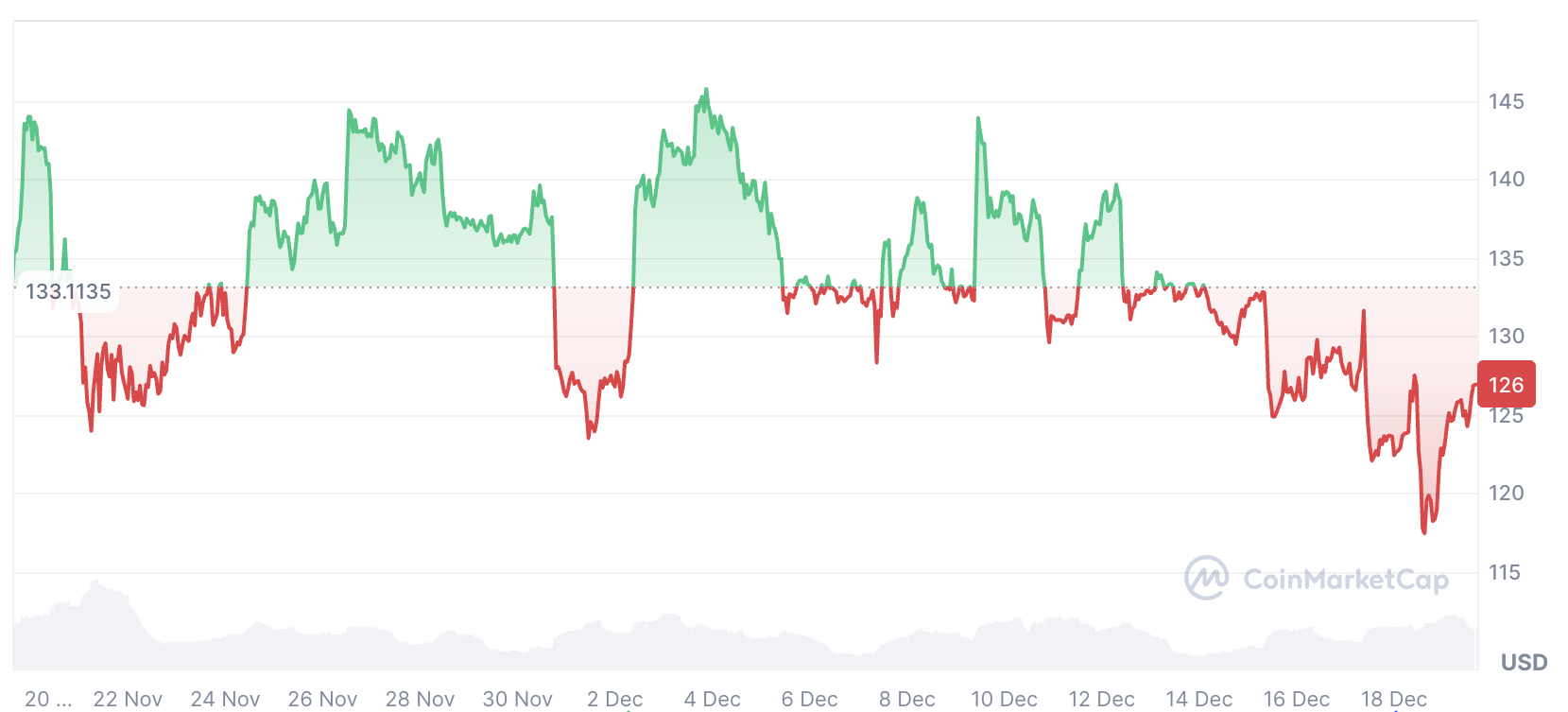
Solana is down 6.27% over the past 30 days. Source: CoinMarketCap

“Again, there’s been altcoin season. You just didn’t participate in it,” he said.

Not everyone agrees with Hayes, however. CoinQuant CEO Maen Ftoui recently told Cointelegraph that older cryptocurrencies with an exchange-traded fund (ETF) or expected to receive an ETF will soak up much of the capital deployed during the next altcoin season.

Industry debates what the next altcoin season will look like

Many in the industry have differing views on how and when the next altcoin season will unfold.

Related: Bitwise exec says 2026 will be crypto’s real bull year; here’s why

Some traders are still waiting for the traditional rotation, starting with Bitcoin (BTC) reaching new highs before capital rotates into Ether (ETH) and then into smaller altcoins.

Meanwhile, Bitfinex analysts said in August that altcoins are unlikely to see a broad, outsized rally until ETFs offering exposure beyond the largest cryptocurrencies are approved.

Magazine: Big questions: Would Bitcoin survive a 10-year power outage?

Perguntas relacionadas

QAccording to Arthur Hayes, why do some traders believe that altcoin season hasn't happened?

ABecause they didn't own the cryptocurrencies that actually went up in value.

QWhat does Arthur Hayes suggest traders should do instead of relying on past market patterns?

AHe suggests traders should adjust their approach and pay attention to what's new in the market.

QWhich two cryptocurrencies does Hayes specifically mention as examples of this cycle's winners?

AHyperliquid (HYPE) and Solana (SOL).

QWhat alternative view does CoinQuant CEO Maen Ftoui present regarding the next altcoin season?

AHe believes older cryptocurrencies with an ETF or expected to receive an ETF will soak up much of the capital deployed during the next altcoin season.

QAccording to Bitfinex analysts, what needs to happen before altcoins see a broad, outsized rally?

AETFs offering exposure beyond the largest cryptocurrencies need to be approved.

Leituras Relacionadas

Lighthouses Guide the Way, Torches Claim Sovereignty: A Hidden War Over AI Allocation Rights

The article "Lighthouse Guides Direction, Torch Fights for Sovereignty: A Hidden War Over AI Allocation" by Zhixiong Pan examines the underlying power struggle in AI development, moving beyond superficial metrics like model size and performance rankings. It identifies two coexisting paradigms: the "Lighthouse," representing state-of-the-art (SOTA), centralized AI systems controlled by tech giants like OpenAI and Google, which push cognitive boundaries but are resource-intensive and create dependency risks; and the "Torch," symbolizing open-source, locally deployable models (e.g., DeepSeek, Mistral) that democratize access, ensure data sovereignty, and enable private, customizable AI assets. The Lighthouse drives innovation and sets technical directions but poses risks in accessibility, control, and single-point failures. The Torch, while shifting security and responsibility to users, offers resilience, cost stability, and compliance for critical applications in sectors like healthcare and finance. The interplay between these models forms a symbiotic relationship: Lighthouses expand capabilities, while Torches disseminate and stabilize these advances, collectively elevating AI’s baseline. Ultimately, the conflict is over AI allocation rights—defining default intelligence, managing externalities, and determining individual control. A dual strategy—using Lighthouses for frontier tasks and Torches for private, reliable deployment—is proposed as the pragmatic path forward, balancing extreme capability with broad, sovereign access. The true measure of the AI era lies not in raw power but in whether individuals possess "a light they don’t have to borrow from anyone."

marsbitHá 3m

Lighthouses Guide the Way, Torches Claim Sovereignty: A Hidden War Over AI Allocation Rights

marsbitHá 3m

The $45 Million 'Invisible' Hunter: Cat Sister's Trading Evolution

"Pickle Cat," an anonymous crypto trader known by a green cucumber cat avatar, has earned up to $45 million in profits on Binance Futures, topping the platform’s "smart money" leaderboard. In a recent interview, she shared her evolution from high-frequency trading—which she calls "fake hard work"—to low-frequency, low-leverage swing trading. Early on, she realized that her intense, short-term trading underperformed a simple Bitcoin buy-and-hold strategy. Her approach now centers on macro trends rather than technical indicators. She views crypto as highly sensitive to macro liquidity cycles and real interest rates, noting that the market is shifting from retail-driven sentiment to institutional accumulation. She predicts a slow bull market led by institutions, potentially lasting until Q1 2026. Cat emphasizes that discipline isn’t learned but earned through painful experiences like blowups. She advises traders to understand their psychological tendencies—for example, using high pain tolerance to hold winning positions longer. She also highlights narrative shifts in crypto, from ICOs and DeFi to NFTs and memecoins, and sees prediction markets as a promising frontier. Her advice to retail traders is clear: avoid high-frequency or news-based trading, focus on longer-term swings, and accept that small losses are necessary for learning. Ultimately, she defines winning not by profits alone, but by the ability to preserve gains and improve one’s life.

marsbitHá 15m

The $45 Million 'Invisible' Hunter: Cat Sister's Trading Evolution

marsbitHá 15m

2 Days, 20x: A Quick Look at the Automated Market Making Mechanism of the New Gem Snowball

The meme token Snowball" launched on pump.fun on December 18 and gained significant traction in the English-speaking crypto community, reaching a $10 million market cap within four days while largely flying under the radar in Chinese crypto circles. Its core innovation is an automated market-making mechanism: instead of the typical "creator fee" (usually 0.5%–1% per transaction) going to the developer’s wallet—a common setup that often leads to rug pulls—Snowball directs 100% of this fee to an on-chain bot. This bot periodically: 1. Buys back tokens to create buy pressure, 2. Adds the purchased tokens and corresponding SOL to the liquidity pool to improve depth, 3. Burns 0.1% of tokens to induce deflation. The fee rate also adjusts dynamically based on market cap (0.05%–0.95%) to balance accumulation and transaction friction. The idea is a "snowball effect": trading generates fees → fees fuel buybacks → buybacks may push price up → higher prices attract more trading. On-chain data shows 7,270 holders, with the top 10 holding ~20% of supply. Trading volume has been relatively balanced between buys and sells. However, the token remains highly speculative. While the structure reduces dev exit risk, it doesn’t eliminate other meme coin risks like low liquidity, narrative fatigue, or large holder dumps. Similar projects like FIREBALL are emerging, suggesting a trend toward "mechanism-driven memes." But as past examples like OlympusDAO and Safemoon show, complex tokenomics alone don’t guarantee sustainability—external demand and market conditions remain critical. In short: Snowball is a meme first and an experiment second. Its mechanism is interesting, but it doesn’t change the high-risk, speculative nature of meme coins.

marsbitHá 34m

2 Days, 20x: A Quick Look at the Automated Market Making Mechanism of the New Gem Snowball

marsbitHá 34m

Trading

Spot
Futuros
活动图片