Why Large Language Models Aren't Smarter Than You?

深潮Publicado em 2025-12-15Última atualização em 2025-12-15

Resumo

The article explores why large language models (LLMs) are not inherently smarter than their users, arguing that their reasoning ability depends entirely on how users guide them. When discussing complex topics informally, LLMs often fail to maintain conceptual coherence and produce shallow or derailed responses. However, if the user first formalizes the problem using precise, scientific language, the model's reasoning stabilizes. This occurs because different language styles activate distinct "attractor regions" in the model’s latent space—areas shaped by training data that support specific types of computation. Formal language (e.g., scientific or mathematical) activates regions conducive to structured reasoning, featuring low ambiguity, explicit relationships, and symbolic constraints. These regions support multi-step logic and conceptual stability. In contrast, informal language triggers attractors optimized for social fluency and associative coherence, which lack the scaffolding for sustained analytical thought. Thus, users determine the LLM’s effectiveness: those who can formulate prompts using high-structure language activate more powerful reasoning regions. The model’s performance ceiling is not its own intelligence limit but reflects the user’s ability to access and sustain high-capacity attractors. The author concludes that true artificial reasoning requires architectural separation between internal reasoning and external expression—a dedicated reasoning manifo...

Written by: iamtexture

Compiled by: AididiaoJP, Foresight News

When I explain a complex concept to a large language model, its reasoning repeatedly breaks down whenever I use informal language for extended discussions. The model loses structure, veers off course, or simply generates shallow completion patterns, failing to maintain the conceptual framework we've built.

However, when I force it to formalize first—that is, to restate the problem in precise, scientific language—the reasoning immediately stabilizes. Only after the structure is established can it safely convert into colloquial language without degrading the quality of understanding.

This behavior reveals how large language models "think" and why their reasoning ability is entirely dependent on the user.

Core Insight

Language models do not possess a dedicated space for reasoning.

They operate entirely within a continuous stream of language.

Within this language stream, different language patterns reliably lead to different attractor regions. These regions are stable states of representational dynamics that support different types of computation.

Each language register, such as scientific discourse, mathematical notation, narrative storytelling, and casual conversation, has its own unique attractor region, shaped by the distribution of training data.

Some regions support:

  • Multi-step reasoning

  • Relational precision

  • Symbolic transformation

  • High-dimensional conceptual stability

Others support:

  • Narrative continuation

  • Associative completion

  • Emotional tone matching

  • Dialogue imitation

Attractor regions determine what types of reasoning are possible.

Why Formalization Stabilizes Reasoning

Scientific and mathematical language reliably activate attractor regions with higher structural support because these registers encode linguistic features of higher-order cognition:

  • Explicit relational structures

  • Low ambiguity

  • Symbolic constraints

  • Hierarchical organization

  • Lower entropy (information disorder)

These attractors can support stable reasoning trajectories.

They can maintain conceptual structures across multiple steps.

They exhibit strong resistance to reasoning degradation and deviation.

In contrast, the attractors activated by informal language are optimized for social fluency and associative coherence, not designed for structured reasoning. These regions lack the representational scaffolding needed for sustained analytical computation.

This is why the model breaks down when complex ideas are expressed casually.

It is not "feeling confused."

It is switching regions.

Construction and Translation

The coping method that naturally emerges in conversation reveals an architectural truth:

Reasoning must be constructed within high-structure attractors.

Translation into natural language must occur only after the structure is in place.

Once the model has built the conceptual structure within a stable attractor, the translation process does not destroy it. The computation is already complete; only the surface expression changes.

This two-stage dynamic of "construct first, then translate" mimics human cognitive processes.

But humans execute these two stages in two different internal spaces.

Large language models attempt to accomplish both within the same space.

Why the User Sets the Ceiling

Here is a key takeaway:

Users cannot activate attractor regions that they themselves cannot express in language.

The user's cognitive structure determines:

  • The types of prompts they can generate

  • Which registers they habitually use

  • What syntactic patterns they can maintain

  • How much complexity they can encode in language

These characteristics determine which attractor region the large language model will enter.

A user who cannot utilize the structures that activate high-reasoning attractors through thinking or writing will never guide the model into these regions. They are locked into the attractor regions associated with their own linguistic habits. The large language model will map the structure they provide and will never spontaneously leap into more complex attractor dynamical systems.

Therefore:

The model cannot surpass the attractor regions accessible to the user.

The ceiling is not the upper limit of the model's intelligence, but the user's ability to activate high-capacity regions in the potential manifold.

Two people using the same model are not interacting with the same computational system.

They are guiding the model into different dynamical modes.

Architectural Implications

This phenomenon exposes a missing feature in current AI systems:

Large language models conflate the reasoning space with the language expression space.

Unless these two are decoupled—unless the model possesses:

  • A dedicated reasoning manifold

  • A stable internal workspace

  • Attractor-invariant concept representations

Otherwise, the system will always risk collapse when shifts in language style cause a switch in the underlying dynamical region.

This workaround, forcing formalization and then translation, is not just a trick.

It is a direct window into the architectural principles that a true reasoning system must satisfy.


Perguntas relacionadas

QWhy does the reasoning of large language models tend to collapse during informal discussions?

ABecause informal language activates attractor regions optimized for social fluency and associative coherence, which lack the representational scaffolding needed for structured reasoning. When the language style shifts, the model switches to a different attractor region that does not support sustained analytical computation.

QHow does formalization help stabilize the reasoning of large language models?

AFormalization uses precise, scientific language that activates attractor regions with higher structural support. These regions encode linguistic features like explicit relational structures, low ambiguity, symbolic constraints, hierarchical organization, and lower entropy, which enable stable reasoning trajectories and maintain conceptual structure across multiple steps.

QWhat determines the type of reasoning possible in a large language model?

AThe attractor region activated by the language input determines the type of reasoning possible. Different language registers, such as scientific discourse or casual chat, have distinct attractor regions shaped by the training data distribution, which support different types of computation like multi-step reasoning or narrative continuation.

QWhy can't large language models exceed the user's cognitive capabilities?

AUsers can only activate attractor regions that they can express through their language. If a user cannot generate prompts that activate high-reasoning attractor regions, the model remains locked into shallow regions aligned with the user's linguistic habits. Thus, the model's performance is limited by the user's ability to access high-capacity regions in the potential manifold.

QWhat architectural insight does the 'formalize then translate' approach reveal about large language models?

AIt reveals that current AI systems lack a dedicated reasoning space separate from the language expression space. Without decoupling these—such as having a dedicated reasoning manifold, a stable internal workspace, or attractor-invariant concept representations—the system will always risk collapsing when language style changes cause switches in underlying dynamical regions.

Leituras Relacionadas

USDC Begins Nested Issuance, Coinbase Launches Custom Stablecoin Branding Service

Coinbase has launched its "Custom Stablecoins" platform, enabling businesses to offer branded stablecoins. The first client is Flipcash, a social payments app, which has introduced USDF. USDF is a Solana-based stablecoin, pegged 1:1 to USDC, and is designed to serve as a stable pricing and settlement unit for Flipcash's user-created community currencies. This move shifts the focus of stablecoins from being standalone assets or investment products to becoming embedded payment and settlement components within broader applications. For businesses like Flipcash, the core need is not to become a stablecoin issuer, but to integrate stable, reliable digital cash functionality—handling pricing, payments, and settlements—without managing the complex underlying infrastructure of issuance, reserves, on-chain contracts, fiat on-ramps, and compliance. Coinbase's platform provides this infrastructure as a service, positioning the exchange as a stablecoin infrastructure provider. While USDC remains the foundational reserve asset, the branded token (e.g., USDF) offers applications a tailored, user-facing financial tool. This development highlights a potential path for stablecoins to become ubiquitous backend utilities in social, gaming, and e-commerce applications, though it also brings significant regulatory and operational complexities associated with handling real user funds.

链捕手Há 39m

USDC Begins Nested Issuance, Coinbase Launches Custom Stablecoin Branding Service

链捕手Há 39m

Detained for 37 Days: The First Wave of People Who Got Rich from 'AI Gateways' Are Starting to Go to Jail

A prominent AI proxy service operator was reportedly detained for 37 days and is now on bail pending trial, highlighting the legal risks in China's booming but unregulated AI intermediary market. These services act as "AI scalpers," providing domestic users with access to restricted overseas models (like OpenAI, Claude) by bundling APIs, handling payments, and bypassing network blocks, all for a fee. Their controversial profitability stems from practices like bulk-registering accounts to resell free credits, exploiting refund policies, overcharging for tokens, substituting cheaper models, and illegally selling user conversation data. Major figures, including cryptocurrency entrepreneurs, are now entering this space. Legally, these operations face severe risks. Their core model often involves unauthorized API access and operating without required telecom licenses, potentially constituting illegal business operations. They fail to meet data security obligations for the vast amounts of user data they process, risking charges for failing to fulfill network security duties. Crucially, the unauthorized collection and sale of user data, which can include personal and commercial secrets, easily meets the threshold for the crime of infringing on personal information. The case underscores a critical juncture for the AI industry. While proxies lower access barriers, they expose user data to unsecured middlemen and undermine the business models of AI developers, forcing them to divert resources to security and distorting market value perceptions. The article argues that the industry's sustainable future depends on building trust, protecting data, and fostering compliant competition, moving away from its current "wild growth" phase.

marsbitHá 1h

Detained for 37 Days: The First Wave of People Who Got Rich from 'AI Gateways' Are Starting to Go to Jail

marsbitHá 1h

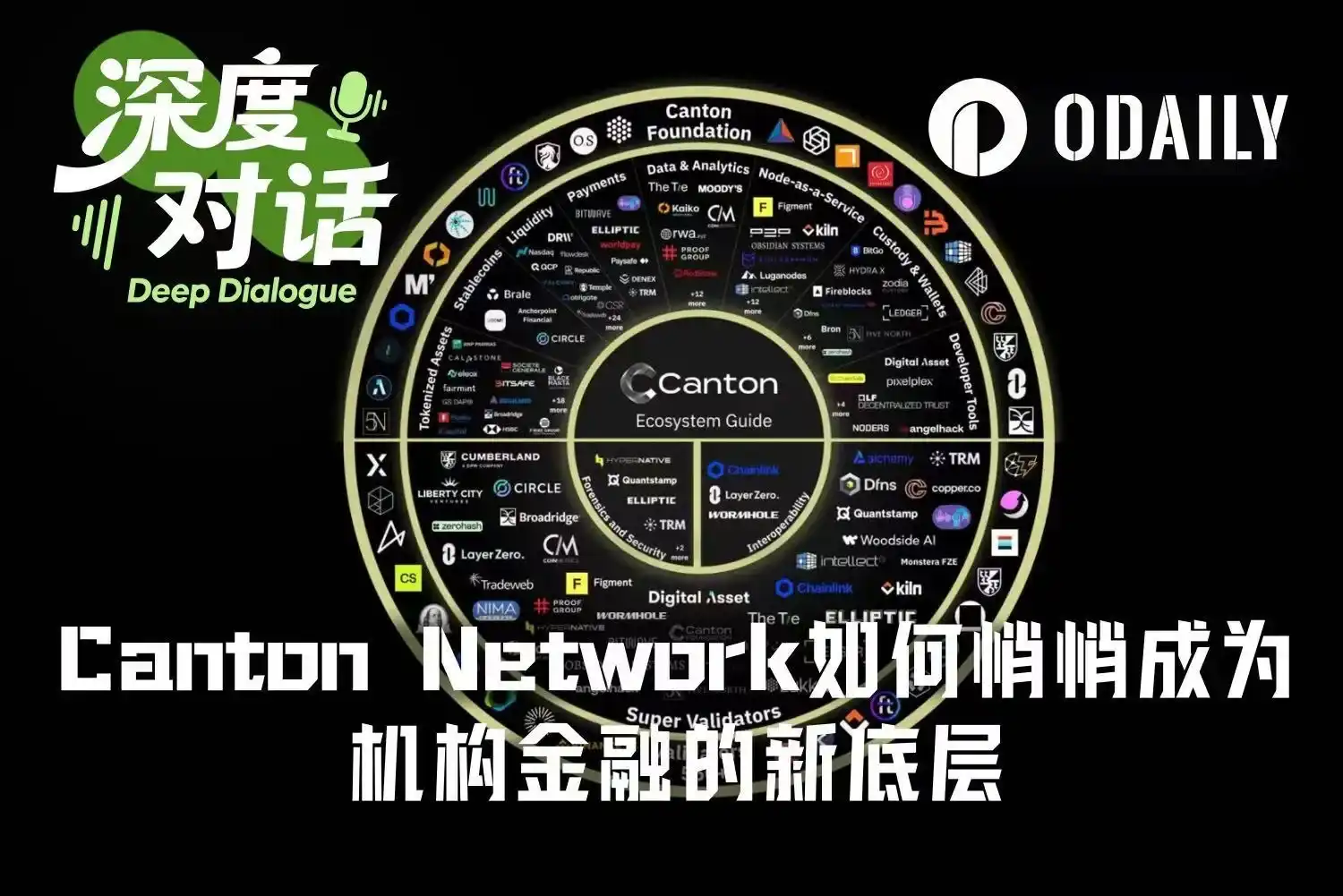
Putting Markets On-Chain: Canton Network Quietly Becomes the New Backbone of Institutional Finance

**Title: Letting the Market Itself Go On-Chain: Canton Network Quietly Becomes the New Backbone for Institutional Finance** **Summary:** The Canton Network, a blockchain platform designed for institutional finance, is gaining significant traction. A key sign of its maturity was Visa's recent entry as a super-validator, a proposal approved in just three days—highlighting prior, extensive collaboration between traditional finance and crypto. Unlike public chains like Ethereum that prioritize transparency and asset onboarding, Canton focuses on enabling confidential, compliant business operations for regulated institutions. Its core design features built-in **data visibility control**, meaning transaction details are only shared between direct counterparties. This privacy is fundamental, allowing competing institutions (like banks Goldman Sachs, JPMorgan, and BNP Paribas, all validators) to interact on the same network without exposing sensitive positions or strategies. Developed by Wall Street veterans at Digital Asset, Canton has taken a slow, deliberate approach to onboard real financial activity. It now handles over **$9 trillion monthly** in transaction volume, primarily from real-world institutional use cases like **tokenized repo agreements**, Treasury settlements, and collateral mobility. Major live applications include **JPM Coin** for institutional payments and **DTCC's tokenized U.S. Treasuries** project. Canton's native token, **CC**, is framed as a "network utility asset" with zero pre-mine or VC allocations. Its value is intended to be driven by the volume of real financial activity on the network. Looking ahead, Canton aims to become the invisible foundational layer for global finance—enabling atomic settlement (where payment and asset delivery occur simultaneously), 24/7 capital flows, and the native issuance and settlement of various asset classes, from corporate bonds to potentially equities. The main challenges are no longer technical but involve navigating fragmented global regulations and integrating with legacy financial systems.

marsbitHá 1h

Putting Markets On-Chain: Canton Network Quietly Becomes the New Backbone of Institutional Finance

marsbitHá 1h

Trading

Spot
Futuros

Artigos em Destaque

Como comprar T

Bem-vindo à HTX.com!Tornámos a compra de Threshold Network Token (T) simples e conveniente.Segue o nosso guia passo a passo para iniciar a tua jornada no mundo das criptos.Passo 1: cria a tua conta HTXUtiliza o teu e-mail ou número de telefone para te inscreveres numa conta gratuita na HTX.Desfruta de um processo de inscrição sem complicações e desbloqueia todas as funcionalidades.Obter a minha contaPasso 2: vai para Comprar Cripto e escolhe o teu método de pagamentoCartão de crédito/débito: usa o teu visa ou mastercard para comprar Threshold Network Token (T) instantaneamente.Saldo: usa os fundos da tua conta HTX para transacionar sem problemas.Terceiros: adicionamos métodos de pagamento populares, como Google Pay e Apple Pay, para aumentar a conveniência.P2P: transaciona diretamente com outros utilizadores na HTX.Mercado de balcão (OTC): oferecemos serviços personalizados e taxas de câmbio competitivas para os traders.Passo 3: armazena teu Threshold Network Token (T)Depois de comprar o teu Threshold Network Token (T), armazena-o na tua conta HTX.Alternativamente, podes enviá-lo para outro lugar através de transferência blockchain ou usá-lo para transacionar outras criptomoedas.Passo 4: transaciona Threshold Network Token (T)Transaciona facilmente Threshold Network Token (T) no mercado à vista da HTX.Acede simplesmente à tua conta, seleciona o teu par de trading, executa as tuas transações e monitoriza em tempo real.Oferecemos uma experiência de fácil utilização tanto para principiantes como para traders experientes.

411 Visualizações TotaisPublicado em {updateTime}Atualizado em 2025.03.21

Como comprar T

Discussões

Bem-vindo à Comunidade HTX. Aqui, pode manter-se informado sobre os mais recentes desenvolvimentos da plataforma e obter acesso a análises profissionais de mercado. As opiniões dos utilizadores sobre o preço de T (T) são apresentadas abaixo.

活动图片