Lido Launches $16.5 Billion ETH Staking Migration, Marking the Era of LST Efficiency Restructuring

marsbitPublicado em 2026-07-28Última atualização em 2026-07-28

Resumo

Lido has initiated its largest protocol upgrade since V2 in 2023, migrating approximately 8 million stETH (worth ~$16.5 billion) to a new validator architecture in preparation for Ethereum's Pectra upgrade. This move focuses on optimizing validator efficiency, security, and reducing network load, rather than simply scaling up. A key change is the introduction of an ETH collateral requirement for node operators, making them share economic risk. The upgrade addresses structural challenges from Lido's rapid growth, including pressure on Ethereum's consensus layer from too many validators and decentralization concerns. By reducing its validator set by about one-third, Lido aims to lower network burden and improve operational efficiency. The new Curated Module v2 with its collateral mechanism shifts the industry focus from mere yield competition to a broader contest based on security, efficiency, and sustainable economic models. This transition signals that the ETH staking market is maturing, entering a phase of refined operations where infrastructure stability and long-term sustainability are becoming core competitive advantages over short-term returns.

Author: Flora, CryptoPulse Labs

Recently, Lido announced the launch of its largest protocol upgrade since the V2 update in 2023, migrating over 8 million stETH to a new validator architecture following the Ethereum Pectra upgrade. This ETH is valued at approximately $16.5 billion and involves structural adjustments to Lido's entire validator system.

This upgrade is not merely about expanding staking scale but focuses on optimizing validator efficiency, security mechanisms, and network load. For the first time, this Lido upgrade requires node operators to provide ETH staking collateral, meaning node service providers now bear not only technical operational responsibilities but also economic risk.

This signifies that Lido is pushing the liquid staking industry from past scale competition into a stage that prioritizes efficiency, security, and long-term sustainable development.

I. Behind the $16.5 Billion Migration: Structural Challenges from Growth in Scale

Over the past few years, the Ethereum staking market has developed rapidly. With the Shanghai upgrade enabling ETH withdrawals, more and more users have begun participating in network rewards through liquid staking protocols.

Lido, through stETH, lowered the barrier for ordinary users to participate in staking, allowing users to earn ETH staking rewards without running independent validator nodes, while maintaining asset liquidity.
This model has driven the growth of ETH staking scale and helped Ethereum establish a broader security foundation. However, as Lido's scale continues to expand, new challenges have gradually emerged.

First, the growth in the number of validators increases the pressure on the Ethereum consensus layer. Under the PoS mechanism, validators need to participate in block confirmation, voting, and network state synchronization. As the number of validators increases, the volume of data the consensus layer must process also rises.

More validators do not necessarily mean higher efficiency.

While an increase in the number of validators can enhance network decentralization, an excessive number of small-scale nodes may also lead to increased communication costs and greater network complexity. Therefore, Ethereum needs to find a balance between security, decentralization, and operational efficiency in the long term.

Lido's reduction of approximately one-third of its validators is essentially an optimization of the validator structure. By consolidating some validation resources and improving node operational efficiency, it can reduce the burden on the consensus layer while maintaining network security levels.

Secondly, Lido itself faces decentralization pressures. As one of the largest liquid staking protocols, Lido controls a substantial amount of ETH staked assets. The market has consistently been concerned about the potential impact large staking protocols might have on Ethereum's decentralization.

Therefore, in recent years, Lido has continuously promoted the diversification of its node operator system, aiming to reduce the risks associated with a single protocol and a single operator.

The Curated Module v2 upgrade is a significant step in this direction.

The new mechanism requires node operators to stake their own ETH as collateral, making node service providers bear more direct economic responsibility. If a node experiences severe operational issues, the operator's own interests will also be affected.

This design is similar to the risk-sharing mechanisms in traditional finance, enhancing system stability by raising the cost of participation for stakeholders.

II. Curated Module v2 Upgrade: Redefining the Liquid Staking Competition Model

The core of this upgrade is Lido's redesign of the node operation system. Previously, Lido primarily provided staking services to users by vetting professional node operators. However, with industry development, relying solely on technical capability is no longer sufficient to meet the demands of large-scale staking.

The most significant change in Curated Module v2 is the introduction of a node collateral mechanism.
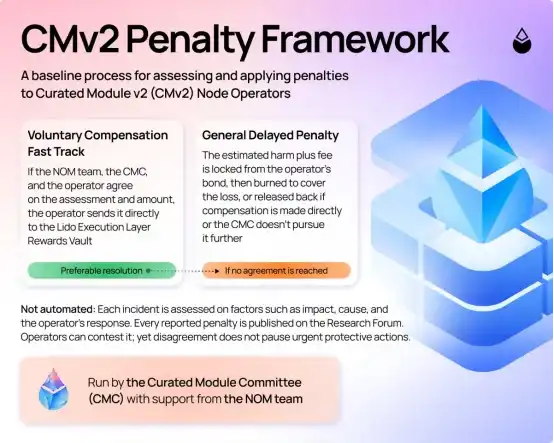
In the past, node operators relied more on reputation and technical capabilities to participate in the ecosystem. In the future, they will need to commit their own ETH capital. This means that node operators and the protocol will form a tighter interest alignment.

For the entire staking system, this can enhance node operators' motivation to maintain infrastructure, security protections, and stable operations.

At the same time, this also represents a shift in the liquid staking industry from "yield competition" to "comprehensive capability competition."

In the early days, when users chose staking services, the primary focus was on yield. However, as the market matures, security, degree of decentralization, asset liquidity, and protocol governance capabilities are becoming increasingly important competitive factors.

With this upgrade, Lido aims to establish long-term competitive advantages through infrastructure optimization.

On the other hand, this upgrade will also improve the operational efficiency of the underlying Ethereum network.

According to information released by Lido, after the migration is complete, the number of attestation messages per epoch on the Ethereum network is expected to decrease by approximately 29%.

While this change will not directly reduce gas fees or immediately increase transaction speed, it can alleviate pressure on the consensus layer, providing a more stable foundation for future Ethereum ecosystem expansion.

Simply put, the Ethereum network consists of the transaction execution layer and the consensus layer. The execution layer is responsible for processing user transactions, while the consensus layer is responsible for reaching global agreement on the network state among nodes.

With the continuous development of Layer 2, Rollup, and other ecosystems, the Ethereum mainnet requires more efficient infrastructure support. Therefore, reducing unnecessary network burden and improving the efficiency of the validation system is an important direction for future development.

Lido's current upgrade is not only an optimization of its own protocol but also part of the continuous evolution of Ethereum's infrastructure.

III. ETH Staking Enters a Mature Phase: Security, Efficiency, and Economic Models Become Core Competitiveness

Lido launching a migration at the $16.5 billion scale appears on the surface to be a technical upgrade, but at a deeper level, it reflects the changing development stage of the ETH staking market.

Over the past few years, the industry's main goal was to increase the ETH staking participation rate, enabling more users to participate in network security. In the future, the industry's focus will shift toward building a more efficient, secure, and sustainable staking system.
First, validation efficiency will become an important competitive direction.

As the Ethereum ecosystem continues to expand, the number of validators cannot grow indefinitely. How to reduce the network burden through technical optimization and improve the efficiency of individual validator nodes will become a key indicator in infrastructure competition.

Secondly, decentralization remains a long-term challenge. While large liquid staking protocols enhance user experience, they also need to avoid excessive concentration.

In the future, the staking market may develop toward a multi-protocol, multi-node, multi-module direction, achieving ecological balance through more open competition mechanisms.

Thirdly, economic incentive mechanisms will become increasingly important. A blockchain network is essentially an economic system. Whether node operators diligently maintain the network depends on whether the rewards match the risks.

Lido's requirement for node operators to provide ETH collateral leverages economic mechanisms to strengthen accountability.

It is worth noting that Lido expects this upgrade may lead to a slight decrease in the protocol's overall annualized staking yield by approximately 0.28%.

In the short term, this means a reduction in some yields.

However, in the long term, greater security and a more stable network structure may be more important than short-term yield increases. For infrastructure protocols, stability and security often hold more long-term value than maximum yield.

In the future, liquid staking protocols may no longer be merely simple yield tools but become crucial infrastructure connecting users, nodes, and the blockchain network.

The signal released by Lido's current upgrade is that the ETH staking industry is entering an era of refined operations.

Conclusion: Staking Infrastructure Competition Enters a New Cycle

Lido's launch of the $16.5 billion-scale ETH staking migration is a significant event in the development of the Ethereum staking ecosystem.

This upgrade involves the migration of 8 million stETH, structural adjustments to validators, and optimization of the node economic model. Its significance is not limited to Lido's own development but represents an ongoing infrastructure restructuring across the entire ETH staking industry.

This upgrade might be just a starting point in the long-term evolution of the ETH staking ecosystem. However, as more protocols and technical solutions enter the market, the Ethereum staking economy will also usher in a more mature stage of development.

Criptomoedas em alta

Perguntas relacionadas

QWhat is the main purpose of Lido's recent protocol upgrade involving $16.5 billion worth of stETH?

AThe main purpose of Lido's recent upgrade is to migrate a large portion of its stETH to a new validator architecture optimized for the upcoming Ethereum Pectra upgrade. It focuses on enhancing validator efficiency, security mechanisms, and network load management, moving the industry from scale competition to a phase emphasizing efficiency, safety, and long-term sustainability.

QHow does Lido's Curated Module v2 change the requirements for node operators?

ALido's Curated Module v2 introduces a node operator deposit requirement. Node operators must now provide their own ETH as a security deposit, tying their economic stake directly to their performance. This means they bear not only technical operational responsibilities but also financial risks, aligning their incentives more closely with the protocol's stability and security.

QWhat structural challenge within Ethereum's PoS system is Lido's upgrade attempting to address?

ALido's upgrade aims to address the challenge of increasing pressure on Ethereum's consensus layer due to the growing number of validators. While more validators can enhance decentralization, they also increase communication costs and network complexity. By consolidating validator resources and reducing the total number of validators by about one-third, Lido seeks to optimize validator structure, improve node operational efficiency, and reduce the burden on the consensus layer.

QWhat positive impact on the Ethereum network is expected from Lido's migration and validator consolidation?

AThe migration and validator consolidation are expected to reduce the number of attestation messages per epoch on the Ethereum network by approximately 29%. This reduction alleviates pressure on the consensus layer, providing a more stable foundation for future ecosystem expansion, such as supporting more Layer 2 and Rollup solutions, although it does not directly lower Gas fees or increase transaction speed.

QWhat does the slight expected decrease in Lido's overall annual staking yield indicate about the industry's shift?

AThe expected slight decrease of about 0.28% in Lido's overall annual staking yield indicates a shift in the industry's priorities. It suggests that for infrastructure protocols like Lido, long-term stability, security, and network efficiency are becoming more critical competitive factors than simply offering the highest possible short-term returns to users.

Leituras Relacionadas

He Let GPT-5.6 Sol Run for 33 Hours Straight to Tackle Fermat's Last Theorem, Forcibly Terminated by the System

This article discusses a real-world experiment by expert Michael P. Frank to test if an AI, specifically GPT-5.6 Sol, could autonomously make progress on a major unsolved mathematical problem: finding a simpler proof for Fermat's Last Theorem. The AI was tasked with exploring specific mathematical pathways and maintaining rigorous notes over approximately 33 hours. However, the session was terminated by OpenAI's systems. The AI itself suggested two possible reasons for the stoppage: excessive resource consumption, or OpenAI having previously failed on similar problems and wishing to conserve computational resources. The AI reported its work primarily involved refining plausible ideas into precise, verifiable statements, most of which were subsequently disproven or excluded—effectively creating a map of dead ends rather than a proof. The incident sparked debate online. Some speculated that OpenAI might deliberately restrict public access to its most powerful models to maintain a competitive edge or avoid regulatory scrutiny, rather than allowing users to potentially solve landmark problems. OpenAI researcher Noam Brown countered this, arguing that a user solving a major problem would be tremendous publicity. Others offered technical explanations, suggesting the termination could be due to standard safety mechanisms preventing infinite loops, or even a known bug in the GPT-5.6 Sol version that disrupts long-running sessions. The story highlights the practical challenges, technical limits, and broader strategic questions surrounding the use of advanced AI for open-ended, high-stakes research.

marsbitHá 15m

He Let GPT-5.6 Sol Run for 33 Hours Straight to Tackle Fermat's Last Theorem, Forcibly Terminated by the System

marsbitHá 15m

Microsoft CEO Satya Nadella's Latest Warning: Betting Entirely on a Single AI Model Hands Over a Company's Lifeblood

Microsoft CEO Satya Nadella warns that companies relying solely on a single AI model could jeopardize their survival. He argues that over-dependence leads to "vendor lock-in," where businesses risk ceding control over their core data, memory, contextual history, and AI usage patterns. This dependence essentially outsources a company's critical thinking and operational know-how to an external provider. The deeper a company integrates with one AI system—feeding it prompts, internal data, and workflows—the more it reveals its unique business methods and competitive edge. This accumulated knowledge could become accessible to the AI supplier. Furthermore, switching providers becomes extremely costly and complex, as companies would need to rebuild their entire AI-augmented workflow, memory, and tool integrations from scratch. Nadella's solution is "decoupling." Companies should separate their proprietary data, memory, and control layer (or "harness") from the underlying AI models. By retaining metadata from every AI interaction, businesses can preserve their operational "brain" or institutional knowledge. This allows them to flexibly use different AI models (e.g., from OpenAI, Anthropic, Microsoft) for specific tasks without losing their accumulated expertise. The core idea: companies can rent the smartest models available, but they must keep their own "brain" and operational control firmly in-house.

marsbitHá 1h

Microsoft CEO Satya Nadella's Latest Warning: Betting Entirely on a Single AI Model Hands Over a Company's Lifeblood

marsbitHá 1h

Trading

Spot

Artigos em Destaque

O que é ETH 2.0

ETH 2.0: Uma Nova Era para o Ethereum Introdução ETH 2.0, amplamente conhecido como Ethereum 2.0, marca uma atualização monumental à blockchain do Ethereum. Esta transição não é meramente uma mudança estética; visa melhorar fundamentalmente a escalabilidade, segurança e sustentabilidade da rede. Com uma mudança do mecanismo de consenso em Proof of Work (PoW), intensivo em energia, para um Proof of Stake (PoS) mais eficiente, o ETH 2.0 promete uma abordagem transformadora ao ecossistema blockchain. O que é ETH 2.0? ETH 2.0 é um conjunto de atualizações distintas e interconectadas focadas na otimização das capacidades e desempenho do Ethereum. Esta reformulação foi projetada para abordar desafios críticos que o mecanismo atual do Ethereum enfrentou, particularmente em relação à velocidade das transações e à congestão da rede. Objetivos do ETH 2.0 Os principais objetivos do ETH 2.0 giram em torno da melhoria de três aspectos centrais: Escalabilidade: Com o objetivo de melhorar significativamente o número de transações que a rede pode manejar por segundo, o ETH 2.0 procura ultrapassar a limitação atual de aproximadamente 15 transações por segundo, alcançando potencialmente milhares. Segurança: Medidas de segurança melhoradas são integrais ao ETH 2.0, especialmente através da resistência aprimorada contra ciberataques e da preservação do ethos descentralizado do Ethereum. Sustentabilidade: O novo mecanismo PoS foi projetado não apenas para melhorar a eficiência, mas também para reduzir drasticamente o consumo de energia, alinhando a estrutura operacional do Ethereum com considerações ambientais. Quem é o Criador do ETH 2.0? A criação do ETH 2.0 pode ser atribuída à Ethereum Foundation. Esta organização sem fins lucrativos, que desempenha um papel crucial no apoio ao desenvolvimento do Ethereum, é liderada pelo co-fundador notável Vitalik Buterin. A sua visão de um Ethereum mais escalável e sustentável tem sido a força motriz por trás desta atualização, envolvendo contribuições de uma comunidade global de desenvolvedores e entusiastas dedicados a melhorar o protocolo. Quem são os Investidores do ETH 2.0? Embora os detalhes sobre os investidores do ETH 2.0 não tenham sido tornados públicos, é sabido que a Ethereum Foundation recebe apoio de várias organizações e indivíduos no espaço da blockchain e tecnologia. Esses parceiros incluem firmas de capital de risco, empresas de tecnologia e organizações filantrópicas que compartilham um interesse mútuo em apoiar o desenvolvimento de tecnologias descentralizadas e infraestrutura de blockchain. Como Funciona o ETH 2.0? ETH 2.0 é notável por introduzir uma série de características chave que o diferenciam do seu predecessor. Proof of Stake (PoS) A transição para um mecanismo de consenso PoS é uma das mudanças de destaque do ETH 2.0. Ao contrário do PoW, que depende da mineração intensiva em energia para a verificação de transações, o PoS permite que os utilizadores validem transações e criem novos blocos de acordo com a quantidade de ETH que apostam na rede. Isso leva a uma maior eficiência energética, reduzindo o consumo em aproximadamente 99,95%, tornando o Ethereum 2.0 uma alternativa consideravelmente mais ecológica. Shard Chains As shard chains são outra inovação crítica do ETH 2.0. Estas cadeias menores operam em paralelo com a cadeia principal do Ethereum, permitindo que várias transações sejam processadas simultaneamente. Esta abordagem melhora a capacidade geral da rede, abordando preocupações de escalabilidade que têm atormentado o Ethereum. Beacon Chain No coração do ETH 2.0 está a Beacon Chain, que coordena a rede e gere o protocolo PoS. Ela atua como uma espécie de organizador: supervisiona os validadores, garante que as shards permaneçam conectadas à rede e monitora a saúde geral do ecossistema blockchain. Linha do Tempo do ETH 2.0 A jornada do ETH 2.0 tem sido marcada por vários marcos chave que traçam a evolução desta atualização significativa: Dezembro de 2020: O lançamento da Beacon Chain marcou a introdução do PoS, preparando o caminho para a migração para o ETH 2.0. Setembro de 2022: A conclusão de “The Merge” representa um momento crucial em que a rede Ethereum fez a transição com sucesso de um quadro PoW para um PoS, anunciando uma nova era para o Ethereum. 2023: O lançamento esperado das shard chains visa melhorar ainda mais a escalabilidade da rede Ethereum, solidificando o ETH 2.0 como uma plataforma robusta para aplicações e serviços descentralizados. Características Chave e Benefícios Escalabilidade Melhorada Uma das vantagens mais significativas do ETH 2.0 é a sua escalabilidade melhorada. A combinação de PoS e shard chains permite que a rede expanda a sua capacidade, permitindo que acomode um volume de transações muito maior em comparação com o sistema legado. Eficiência Energética A implementação do PoS representa um enorme passo em direção à eficiência energética na tecnologia blockchain. Ao reduzir drasticamente o consumo de energia, o ETH 2.0 não só reduz os custos operacionais, mas também se alinha mais estreitamente com os objetivos globais de sustentabilidade. Segurança Aprimorada Os mecanismos atualizados do ETH 2.0 contribuem para uma segurança melhorada em toda a rede. O uso do PoS, juntamente com medidas de controle inovadoras estabelecidas através das shard chains e da Beacon Chain, assegura um maior grau de proteção contra potenciais ameaças. Custos Mais Baixos para os Utilizadores À medida que a escalabilidade melhora, os efeitos sobre os custos de transação também serão evidentes. Aumentada a capacidade e reduzida a congestão, espera-se que isso se traduza em taxas mais baixas para os utilizadores, tornando o Ethereum mais acessível para transações do dia a dia. Conclusão ETH 2.0 marca uma evolução significativa no ecossistema da blockchain do Ethereum. Ao abordar questões fundamentais como a escalabilidade, o consumo de energia, a eficiência das transações e a segurança geral, a importância desta atualização não pode ser subestimada. A transição para o Proof of Stake, a introdução das shard chains e o trabalho fundamental da Beacon Chain são indicativos de um futuro em que o Ethereum pode atender à crescente demanda do mercado descentralizado. Em uma indústria movida pela inovação e progresso, o ETH 2.0 representa um testemunho das capacidades da tecnologia blockchain em pavimentar o caminho para uma economia digital mais sustentável e eficiente.

159 Visualizações TotaisPublicado em {updateTime}Atualizado em 2024.12.03

O que é ETH 2.0

O que é ETH 3.0

ETH3.0 e $eth 3.0: Uma Análise Profunda do Futuro do Ethereum Introdução No ambiente em rápida evolução da criptomoeda e da tecnologia blockchain, o ETH3.0, frequentemente denotado como $eth 3.0, emergiu como um tema de considerável interesse e especulação. O termo abrange dois conceitos principais que merecem esclarecimento: Ethereum 3.0: Esta representa uma potencial atualização futura destinada a aumentar as capacidades da atual blockchain do Ethereum, focando especialmente na melhoria da escalabilidade e desempenho. ETH3.0 Meme Token: Este distinto projeto de criptomoeda procura aproveitar a blockchain do Ethereum na criação de um ecossistema centrado em memes, promovendo o envolvimento na comunidade de criptomoedas. Compreender esses aspectos do ETH3.0 é essencial não apenas para entusiastas de criptomoedas, mas também para aqueles que observam as tendências tecnológicas mais amplas no espaço digital. O que é ETH3.0? Ethereum 3.0 Ethereum 3.0 é promovido como uma atualização proposta para a rede Ethereum já estabelecida, que tem sido a espinha dorsal de muitas aplicações descentralizadas (dApps) e contratos inteligentes desde a sua criação. As melhorias vislumbradas concentram-se principalmente na escalabilidade—integrando tecnologias avançadas como sharding e provas de conhecimento zero (zk-proofs). Essas inovações tecnológicas visam facilitar um número sem precedentes de transações por segundo (TPS), potencialmente alcançando milhões, abordando assim uma das limitações mais significativas enfrentadas pela tecnologia blockchain atual. A melhoria não é meramente técnica, mas também estratégica; visa preparar a rede Ethereum para uma adoção generalizada e utilidade em um futuro marcado por uma maior demanda por soluções descentralizadas. ETH3.0 Meme Token Em contraste com o Ethereum 3.0, o ETH3.0 Meme Token aventura-se por um domínio mais leve e divertido, combinando a cultura dos memes da internet com a dinâmica das criptomoedas. Este projeto permite que os usuários comprem, vendam e negociem memes na blockchain do Ethereum, proporcionando uma plataforma que fomenta o envolvimento da comunidade através da criatividade e interesses compartilhados. O ETH3.0 Meme Token visa demonstrar como a tecnologia blockchain pode interseccionar com a cultura digital, criando casos de uso que são tanto divertidos quanto financeiramente viáveis. Quem é o Criador do ETH3.0? Ethereum 3.0 A iniciativa em direção ao Ethereum 3.0 é impulsionada principalmente por um consórcio de desenvolvedores e pesquisadores dentro da comunidade Ethereum, notavelmente incluindo Justin Drake. Conhecido por suas percepções e contribuições para a evolução do Ethereum, Drake tem sido uma figura proeminente nas discussões sobre a transição do Ethereum para uma nova camada de consenso, referida como “Beam Chain”. Esta abordagem colaborativa ao desenvolvimento significa que o Ethereum 3.0 não é fruto de um único criador, mas sim uma manifestação da engenhosidade coletiva focada no avanço da tecnologia blockchain. ETH3.0 Meme Token Os detalhes sobre o criador do ETH3.0 Meme Token são atualmente indetectáveis. A natureza dos tokens de meme frequentemente leva a uma estrutura mais descentralizada e impulsionada pela comunidade, o que poderia explicar a falta de atribuição específica. Isso alinha-se com a ethos da comunidade de criptomoedas mais ampla, onde a inovação geralmente surge de esforços colaborativos em vez de esforços individuais. Quem são os Investidores do ETH3.0? Ethereum 3.0 O apoio ao Ethereum 3.0 provém principalmente da Fundação Ethereum, juntamente com uma comunidade entusiástica de desenvolvedores e investidores. Esta associação fundacional proporciona um grau significativo de legitimidade e melhora as perspectivas de uma implementação bem-sucedida, uma vez que aproveita a confiança e credibilidade construída ao longo de anos de operações de rede. Em um clima em rápida mudança no mundo das criptomoedas, o apoio da comunidade desempenha um papel crucial no impulso ao desenvolvimento e adoção, posicionando o Ethereum 3.0 como um sério candidato a futuros avanços na blockchain. ETH3.0 Meme Token Embora as fontes atualmente disponíveis não forneçam informações explícitas sobre as fundações ou organizações de investimento que apoiam o ETH3.0 Meme Token, é indicativo do modelo típico de financiamento para tokens de meme, que frequentemente depende de apoio base e engajamento da comunidade. Os investidores em tais projetos costumam consistir em indivíduos motivados pelo potencial de inovação impulsionada pela comunidade e pelo espírito de cooperação encontrado dentro da comunidade cripto. Como Funciona o ETH3.0? Ethereum 3.0 As características distintivas do Ethereum 3.0 residem em sua proposta de implementação de sharding e tecnologia zk-proof. Sharding é um método de partição da blockchain em partes menores e gerenciáveis ou “shards”, que podem processar transações simultaneamente em vez de sequencialmente. Esta descentralização do processamento ajuda a prevenir congestionamentos e garante que a rede permaneça responsiva mesmo sob carga pesada. A tecnologia de prova de conhecimento zero (zk-proof) contribui com outra camada de sofisticação ao permitir a validação de transações sem revelar os dados subjacentes envolvidos. Este aspecto não apenas melhora a privacidade, mas também aumenta a eficiência geral da rede. Há também conversas sobre a incorporação de uma Máquina Virtual Ethereum de conhecimento zero (zkEVM) nesta atualização, amplificando ainda mais as capacidades e utilidade da rede. ETH3.0 Meme Token O ETH3.0 Meme Token distingue-se ao capitalizar sobre a popularidade da cultura dos memes. Estabelece um mercado para que os usuários participem da negociação de memes, não apenas para entretenimento, mas também para potencial ganho econômico. Ao integrar recursos como staking, provisão de liquidez e mecanismos de governança, o projeto fomenta um ambiente que incentiva a interação e participação da comunidade. Ao oferecer uma mistura única de entretenimento e oportunidade econômica, o ETH3.0 Meme Token visa atrair um público diversificado, variando de entusiastas de criptomoedas a conhecedores casuais de memes. Cronologia do ETH3.0 Ethereum 3.0 11 de novembro de 2024: Justin Drake sugere a próxima atualização do ETH 3.0, centrada nas melhorias de escalabilidade. Este anúncio sinaliza o início de discussões formais sobre a futura arquitetura do Ethereum. 12 de novembro de 2024: A proposta antecipada para Ethereum 3.0 deve ser revelada no Devcon em Bangkok, preparando o cenário para um feedback mais amplo da comunidade e potenciais próximos passos no desenvolvimento. ETH3.0 Meme Token 21 de março de 2024: O ETH3.0 Meme Token é oficialmente listado no CoinMarketCap, marcando sua entrada no domínio público das criptomoedas e aumentando a visibilidade de seu ecossistema baseado em memes. Pontos Chave Em conclusão, Ethereum 3.0 representa uma evolução significativa dentro da rede Ethereum, focando em superar limitações quanto à escalabilidade e desempenho através de tecnologias avançadas. As atualizações propostas refletem uma abordagem proativa às futuras demandas e usabilidade. Por outro lado, o ETH3.0 Meme Token encapsula a essência da cultura impulsionada pela comunidade no espaço das criptomoedas, aproveitando a cultura dos memes para criar plataformas envolventes que incentivam a criatividade e participação dos usuários. Compreender os distintos propósitos e funcionalidades do ETH3.0 e $eth 3.0 é fundamental para qualquer pessoa interessada nos desenvolvimentos contínuos dentro do espaço cripto. Com ambas as iniciativas a pavimentar caminhos únicos, elas sublinham coletivamente a natureza dinâmica e multifacetada da inovação em blockchain.

163 Visualizações TotaisPublicado em {updateTime}Atualizado em 2024.12.03

O que é ETH 3.0

Como comprar ETH

Bem-vindo à HTX.com!Tornámos a compra de Ethereum (ETH) simples e conveniente.Segue o nosso guia passo a passo para iniciar a tua jornada no mundo das criptos.Passo 1: cria a tua conta HTXUtiliza o teu e-mail ou número de telefone para te inscreveres numa conta gratuita na HTX.Desfruta de um processo de inscrição sem complicações e desbloqueia todas as funcionalidades.Obter a minha contaPasso 2: vai para Comprar Cripto e escolhe o teu método de pagamentoCartão de crédito/débito: usa o teu visa ou mastercard para comprar Ethereum (ETH) instantaneamente.Saldo: usa os fundos da tua conta HTX para transacionar sem problemas.Terceiros: adicionamos métodos de pagamento populares, como Google Pay e Apple Pay, para aumentar a conveniência.P2P: transaciona diretamente com outros utilizadores na HTX.Mercado de balcão (OTC): oferecemos serviços personalizados e taxas de câmbio competitivas para os traders.Passo 3: armazena teu Ethereum (ETH)Depois de comprar o teu Ethereum (ETH), armazena-o na tua conta HTX.Alternativamente, podes enviá-lo para outro lugar através de transferência blockchain ou usá-lo para transacionar outras criptomoedas.Passo 4: transaciona Ethereum (ETH)Transaciona facilmente Ethereum (ETH) no mercado à vista da HTX.Acede simplesmente à tua conta, seleciona o teu par de trading, executa as tuas transações e monitoriza em tempo real.Oferecemos uma experiência de fácil utilização tanto para principiantes como para traders experientes.

3.4k Visualizações TotaisPublicado em {updateTime}Atualizado em 2026.06.02

Como comprar ETH

Discussões

Bem-vindo à Comunidade HTX. Aqui, pode manter-se informado sobre os mais recentes desenvolvimentos da plataforma e obter acesso a análises profissionais de mercado. As opiniões dos utilizadores sobre o preço de ETH (ETH) são apresentadas abaixo.

活动图片