Silicon Valley AI Landscape Shifts: Karpathy Jumps Ship, Musk Steps In, Son Left Holding the Fort

marsbitPublicado em 2026-05-21Última atualização em 2026-05-21

Resumo

Silicon Valley's AI landscape is shifting as key talent moves and financial pressures mount. Andrej Karpathy, a prominent AI researcher and former OpenAI co-founder, has announced he is joining competitor Anthropic full-time. His departure highlights a talent drain at OpenAI, where most of the original founders have now left. Karpathy, known for his engineering work at Tesla, is expected to help Anthropic develop more efficient model training methods using its Claude AI, challenging OpenAI's current compute-intensive approach. The move coincides with diverging financial paths for the two AI giants. Anthropic is reportedly on track to post its first quarterly profit with $10.9B in sales, while OpenAI, despite a massive $852B valuation and a recent $122B funding round led by SoftBank's Masayoshi Son, faces significant compute costs and potential heavy losses as it pushes for a rapid IPO. Son has invested over $60B in OpenAI, a concentrated bet that has drawn internal criticism over its risk, reminiscent of SoftBank's past losses on WeWork. Elon Musk, an OpenAI co-founder turned rival, is also influencing the dynamic. After losing a lawsuit against OpenAI, Musk's SpaceX leased its massive "Colossus 1" computing center, equipped with over 220,000 Nvidia GPUs, to Anthropic in a deal worth $40-45B. This provides Anthropic with crucial computational resources while pressuring OpenAI. The developments signal a consolidation where only well-capitalized players can compete in founda...

Two pieces of news spread through Silicon Valley almost simultaneously.

One: Anthropic is expected to achieve $10.9 billion in sales this quarter, reaching quarterly profitability for the first time.

Another: OpenAI is accelerating its IPO process, planning to confidentially file its prospectus in the coming weeks at the earliest, with a potential listing in the fall, and a valuation that could reach a trillion dollars.

Upon the news, SoftBank Group's stock price soared nearly 20% intraday, with its market value rising approximately 240 billion RMB in a single day.

One has just touched the profitability line, while the other, still in the red, is rushing to go public. Looking back at the personnel change two days ago, the logic becomes clear—

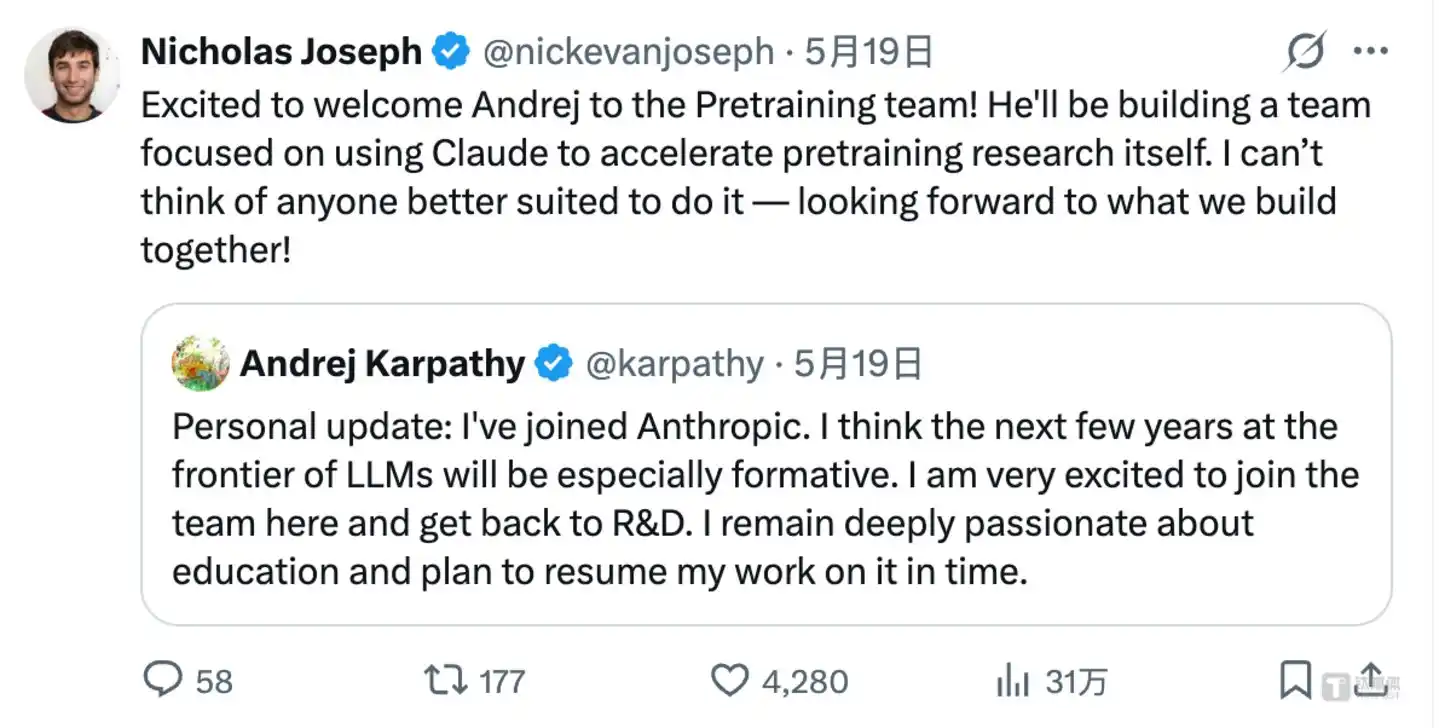
On May 19th, former OpenAI co-founder Andrej Karpathy announced on X: he is joining Anthropic full-time.
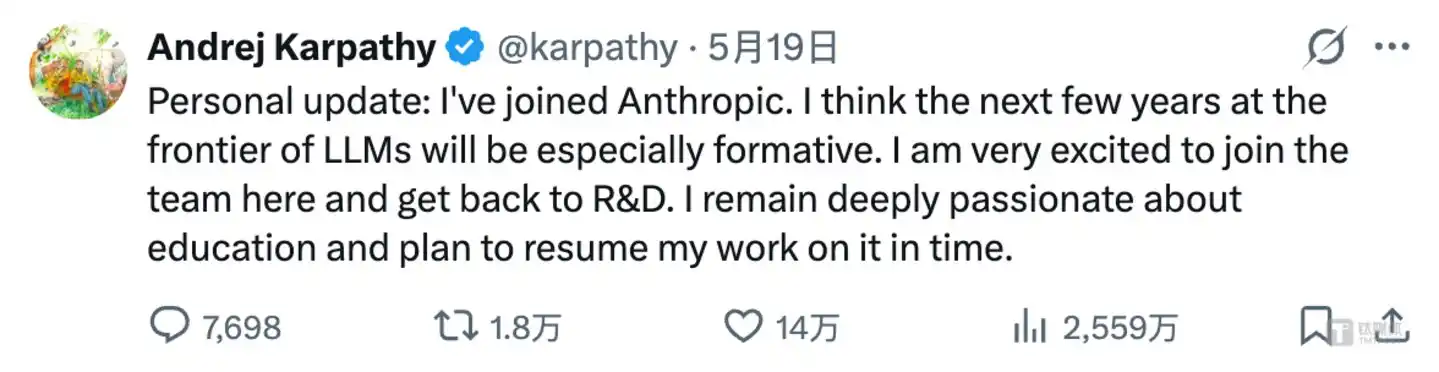
This is no ordinary job change.

Today's OpenAI is already the largest AI company by volume in the capital markets.

It just completed a $122 billion financing round at an $852 billion valuation.

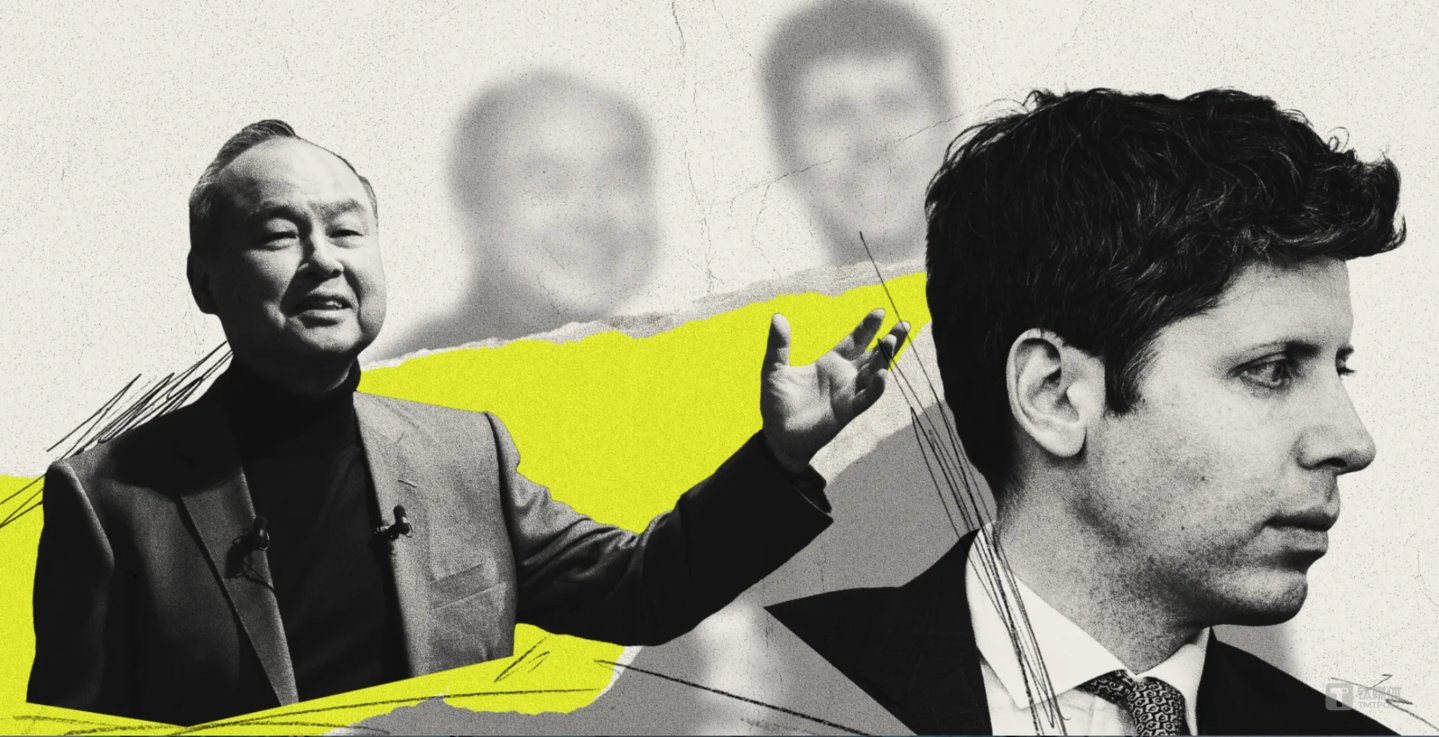
Japan's SoftBank's Masayoshi Son, ignoring internal executive opposition, concentrated over $60 billion to bet on OpenAI.

But inside the company, something else is happening:

Of the 11 co-founders who signed the startup agreement in that humble office back in the day, only two remain—CEO Sam Altman and President Greg Brockman.

Capital is piling up, but core founders are dwindling.

The reasons behind this go beyond a simple explanation of "philosophical differences"; it's more like the result of a clash over strategy, competition for computing power, and a game of giants.

Who is Karpathy? Why Did He Choose Anthropic?

To understand this, one must first grasp Karpathy's position in the AI industry.

In the eyes of top investors, he is not just a technical manager but more like a key figure who can directly influence R&D pace—whichever company he joins, that company's model iteration speed changes.

The 39-year-old Karpathy does have a standout resume.

While pursuing his PhD at Stanford under Fei-Fei Li, he helped create Stanford's first deep learning course.

But what truly made him famous was his five years at Tesla.

He left OpenAI to join Tesla in 2017, and briefly returned to OpenAI in 2023.
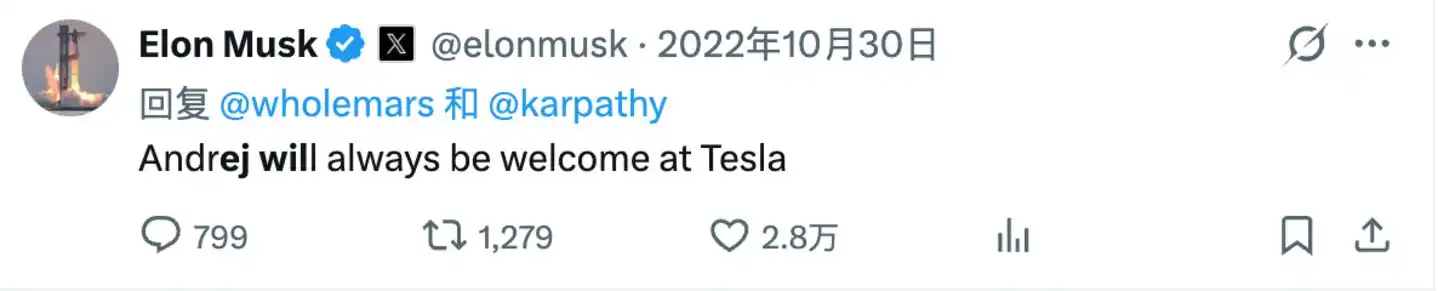
In 2017, Musk, then an OpenAI board member, bypassed OpenAI management and directly recruited Karpathy to Tesla, responsible for AI and autonomous driving vision. Court evidence shows this move displeased OpenAI at the time.
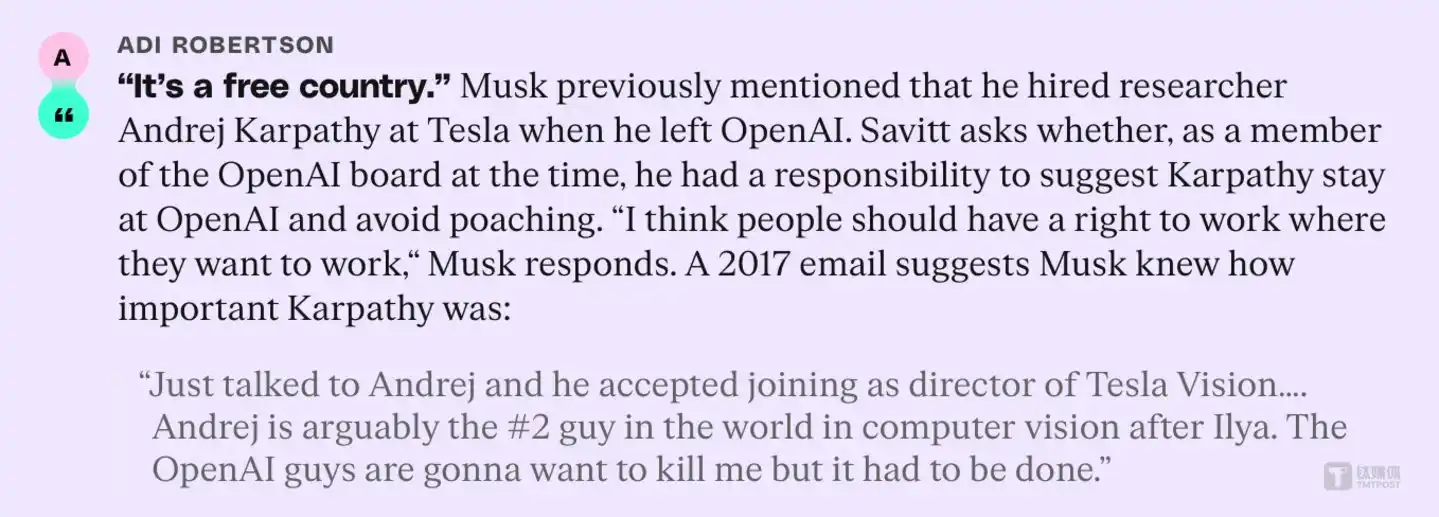
At Tesla, Karpathy did far more than write papers.

He built the autonomous driving engineering system from scratch, including assembling a data labeling team and deploying neural networks onto Tesla's self-designed chips.

The tech circle's trendy concept of "Vibe Coding" in recent years was also popularized by him.

So, what will he do at Anthropic now?

The answer: Join the pre-training team to use Claude to accelerate the pre-training of the next-generation model.
Simply put, OpenAI currently trains large models mainly by brute-forcing computing power—massive amounts of NVIDIA GPUs running simultaneously, competing on who can afford more electricity and hardware costs.

What Karpathy aims to do at Anthropic is to have Claude help accelerate the training process itself.

If this path succeeds, the training cost of large models will drop significantly.

Karpathy's choice actually signals something: from the perspective of those actually doing engineering work, the path of simply burning money on computing power is nearing its end; using models to assist training is a more realistic direction.

Compute Consumption and the "WeWork Shadow"

The successive departure of core talent is often related to the company's operational direction.

Today's OpenAI has transformed from an early non-profit research institution into a company bearing revenue pressure.

As of February 2026, OpenAI's annualized revenue exceeded $25 billion.

But compute costs are growing even faster.

According to a 2024 Reuters report citing insider predictions, OpenAI might face up to $14 billion in losses in 2026, with positive cash flow not expected until 2029. This prediction has not been updated or confirmed.

Compute power is a heavy asset with rapid depreciation. To control losses, OpenAI began cutting unprofitable projects.

The Sora video project was shut down in March this year because it reportedly burned about $1 million per day in server costs, with user growth falling short of expectations.

The OpenAI for Science division, established in 2025, also saw its team split and merged into other product lines.

These adjustments, on one hand, are to comply with the requirements for transitioning to a "Public Benefit Corporation (PBC)" in 2025, and on the other hand, are preparations for the IPO. But for the scientists who joined driven by technological ideals, the company's priorities have changed.

And it is at this moment that Son chose to double down.

Over the past year, SoftBank has channeled over $60 billion into OpenAI through various means.

There is significant internal controversy at SoftBank about this.

Several executives privately believe concentrating this much capital on a single private company is excessively risky.

To raise funds, SoftBank sold off some assets, including NVIDIA shares. Simultaneously, the Vision Fund cut about 20% of its staff, tilting resources towards the AI track.

What SoftBank executives fear is a repeat of the WeWork debacle.

Back then, Son was enamored with WeWork's business story, ultimately losing tens of billions. According to Bloomberg, some insiders used the term "starstruck" to describe Son's attitude towards Altman this time—eerily similar to his attitude towards WeWork's founder back in the day.

After investing $60 billion, SoftBank did not secure a substantive board seat at OpenAI. But Son had already missed the last internet wave; he is unwilling to miss AI again. In his view, these losses are the price to pay for a ticket to "base intelligence."

And when the news of OpenAI's IPO came out, SoftBank's market value rose by 240 billion RMB in a single day—at least for now, this bet hasn't lost.
Musk's Compute Play

The one best at causing trouble in this game is still Musk.

He is one of OpenAI's earliest co-founders and now its most direct competitor.

In May this year, Musk lost his lawsuit against OpenAI for deviating from its original purpose, on grounds of the statute of limitations.

But the trial disclosed much information: the one who originally wanted to turn OpenAI into a for-profit company was none other than Musk himself.

He had calculated the math—Mars colonization needs about $80 billion, and controlling an AGI company was his way to raise funds.

Failing to gain control, he chose to exit, stop funding, and simultaneously poached Karpathy.

Although he lost the lawsuit, Musk soon took action on the compute front.

In early May, Musk announced the merger of xAI into SpaceX. Subsequently, SpaceX leased its Colossus 1 computing center in Memphis, Tennessee—equipped with over 220,000 NVIDIA GPUs—to Anthropic as a whole. SpaceX's IPO prospectus shows the total value of this lease is between $40 and $45 billion.
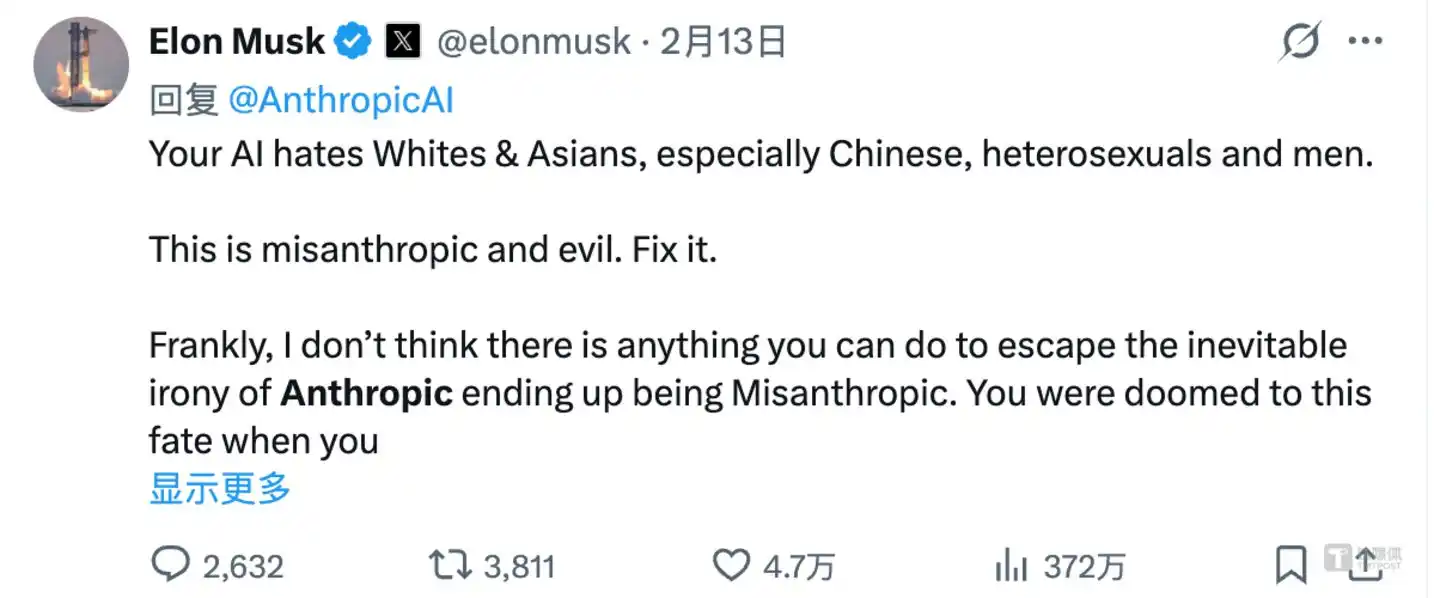

Just months ago, Musk publicly called Anthropic "misanthropic and evil" on X.

But before business interests, positions can be adjusted at any time.

Musk pinpointed OpenAI's weak spot—compute power.

Leasing the computing center to Anthropic, on one hand, generates hefty rent, and on the other hand, indirectly strengthens the power of OpenAI's competitor, putting pressure on OpenAI.

Anthropic's Fearsome Comeback

With ample compute power, Anthropic's performance is indeed accelerating.

In April 2026, Anthropic announced its annualized revenue exceeded $30 billion, surpassing OpenAI (approximately $25 billion) in scale for the first time.

By May 21st, the Wall Street Journal further disclosed: Anthropic is expected to achieve $10.9 billion in sales in the second quarter, reaching quarterly profitability for the first time.

For reference, it took Salesforce over twenty years to reach a comparable revenue scale. Anthropic, from its founding in 2021 to now, took less than five years.
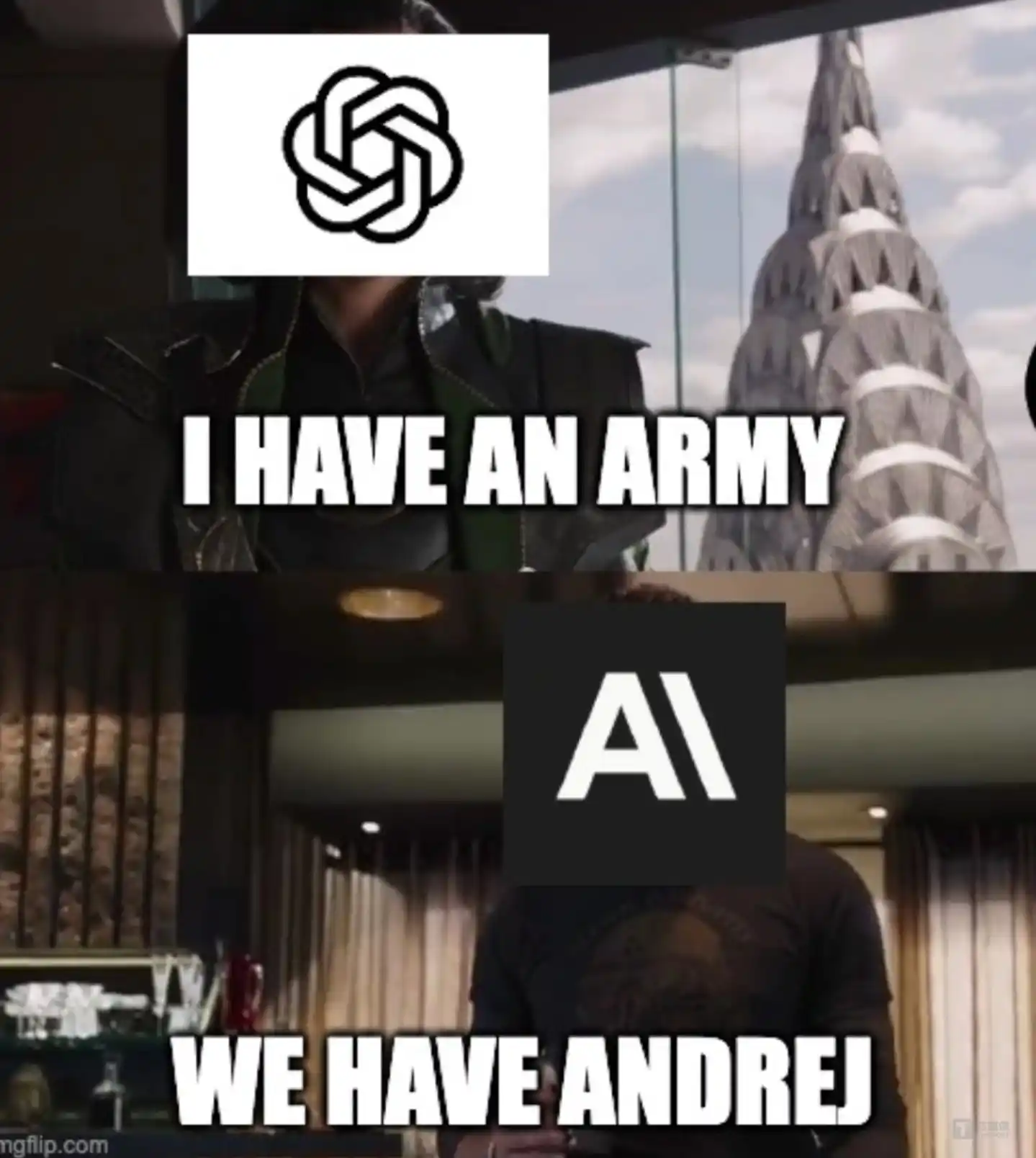
More crucial is cost control.

Anthropic's product line is relatively focused, mainly on enterprise-level code generation and AI agents, without venturing into C-end video generation and other fields. Its model training costs are estimated to be only about one-fourth of OpenAI's.

Higher revenue, lower expenditure—that's Anthropic's current advantage.

For someone like Karpathy, who has long focused on engineering implementation, this difference is persuasive.

From Karpathy's choice to the compute-power game among giants, this round of competition sends a signal: the threshold for large-scale model foundational training is already very high, making it difficult for ordinary entrepreneurs to find opportunities in the general model domain. More pragmatic paths are either to focus on specific B-end scenarios like Anthropic does—such as using AI to solve workflow problems with clear willingness to pay, like code generation; or to find niche opportunities in directions like AI-assisted training, synthetic data, etc. Compute costs determine who can survive this round; that's the most fundamental calculation.

(This article was first published on TMTPost APP, author | Silicon Valley Tech_news, editor | Linshen)

Leituras Relacionadas

Putting Markets On-Chain: Canton Network Quietly Becomes the New Backbone of Institutional Finance

**Title: Letting the Market Itself Go On-Chain: Canton Network Quietly Becomes the New Backbone for Institutional Finance** **Summary:** The Canton Network, a blockchain platform designed for institutional finance, is gaining significant traction. A key sign of its maturity was Visa's recent entry as a super-validator, a proposal approved in just three days—highlighting prior, extensive collaboration between traditional finance and crypto. Unlike public chains like Ethereum that prioritize transparency and asset onboarding, Canton focuses on enabling confidential, compliant business operations for regulated institutions. Its core design features built-in **data visibility control**, meaning transaction details are only shared between direct counterparties. This privacy is fundamental, allowing competing institutions (like banks Goldman Sachs, JPMorgan, and BNP Paribas, all validators) to interact on the same network without exposing sensitive positions or strategies. Developed by Wall Street veterans at Digital Asset, Canton has taken a slow, deliberate approach to onboard real financial activity. It now handles over **$9 trillion monthly** in transaction volume, primarily from real-world institutional use cases like **tokenized repo agreements**, Treasury settlements, and collateral mobility. Major live applications include **JPM Coin** for institutional payments and **DTCC's tokenized U.S. Treasuries** project. Canton's native token, **CC**, is framed as a "network utility asset" with zero pre-mine or VC allocations. Its value is intended to be driven by the volume of real financial activity on the network. Looking ahead, Canton aims to become the invisible foundational layer for global finance—enabling atomic settlement (where payment and asset delivery occur simultaneously), 24/7 capital flows, and the native issuance and settlement of various asset classes, from corporate bonds to potentially equities. The main challenges are no longer technical but involve navigating fragmented global regulations and integrating with legacy financial systems.

marsbitHá 17m

Putting Markets On-Chain: Canton Network Quietly Becomes the New Backbone of Institutional Finance

marsbitHá 17m

It's Bankless That Needs Ethereum, Not Ethereum That Needs Bankless

Titled "Bankless Needs Ethereum, Not the Other Way Around," this article analyzes the significant recent news involving Bankless, a prominent crypto media outlet. Bankless co-founder David Hoffman announced the sale of all his ETH holdings, while the company also reportedly underwent major layoffs, with its founders parting ways. The news, likened to a high-profile defection, initially sent shockwaves through the Ethereum community, given Bankless's historical role as a key evangelist and "semi-official" narrative builder for Ethereum. For years, through its podcasts and writings, Bankless championed core Ethereum ideas like "ultrasound money" and the blockchain's role as a new financial settlement layer, acting as a crucial community hub and belief system during its growth phase. However, the article argues this development is not necessarily negative for Ethereum. It suggests Bankless's "first mission"—serving as Ethereum's passionate, inward-facing "propaganda department"—has largely been completed. As Ethereum matures and moves towards mainstream, institutional adoption, the narrative baton has shifted. Today, the value propositions of ETH are increasingly communicated to traditional finance by asset managers like BlackRock and VanEck, public companies adding ETH to their treasuries, and established financial figures. This represents a natural evolution towards a more decentralized, professional, and institutionally-focused narrative network. Therefore, while Bankless's retreat marks the end of an era, it signifies Ethereum's growing resilience and its reduced reliance on any single entity for belief, as its story is now carried forward by a broader and more mature ecosystem of advocates.

链捕手Há 38m

It's Bankless That Needs Ethereum, Not Ethereum That Needs Bankless

链捕手Há 38m

Google Officially Declares War

Google Declares War with AI-First I/O 2026 At its 2026 I/O developer conference, Google launched an aggressive, multi-pronged offensive, embedding AI across its ecosystem and challenging rivals on performance and price. The event showcased three major releases: Gemini 3.5 Flash, the video-centric Gemini Omni Flash, and the system-level AI assistant Spark. Gemini 3.5 Flash, despite being a smaller "Flash" model, outperforms its Pro counterpart in key benchmarks like mathematical reasoning (GSM8K) and coding (SWE-bench). Google attributes this to "extreme knowledge distillation" from a larger teacher model and a novel, highly granular MoE (Mixture of Experts) architecture with 256 experts, achieving sub-65ms response times. The native multi-modal model, Gemini Omni Flash, offers real-time video understanding with 120ms latency, enabling applications like preventing a cup from overfilling. The new Spark assistant gains deep Android system integration, allowing it to automate complex multi-app workflows based on voice commands. Complementing these, Google unveiled lightweight AI glasses featuring Micro-OLED displays and on-device Gemini chips for instant, offline translation and scene analysis. CEO Sundar Pichai announced Gemini has reached 900 million monthly active users, leveraged through integration into Chrome, Android, and Workspace. Google also slashed prices dramatically: the Gemini 3.5 Flash API is priced at a fraction of competitor rates. This price war is enabled by Google's vertically integrated TPU infrastructure. The strategy signals a shift: standalone AI models are becoming commoditized. Google's advantage lies in its "device + cloud + ecosystem + hardware" integration, aiming to reshape internet traffic from user-initiated searches to AI-driven service distribution. This move pressures pure-play AI firms like OpenAI and Anthropic on business models, and challenges Apple to respond in the next-generation, screen-less device race.

链捕手Há 58m

Google Officially Declares War

链捕手Há 58m

Top 10 Promising Emerging Hyperliquid Native Protocols to Watch

Title: A Review of 10 Emerging Native Protocols on Hyperliquid Hyperliquid is evolving beyond perpetual contracts into a comprehensive on-chain financial stack. This article highlights 10 key native protocols driving this growth: 1. **Monetrix**: A yield-optimizing protocol akin to Ethena, aggregating funding rates, HLP rewards, maker rebates, and HIP-3 into a single stablecoin yield. 2. **ROSETTA**: An automated stablecoin yield router, allocating USDC across top protocols (e.g., Felix, Aave, HLP) for optimal returns, factoring in gas and slippage. 3. **papertrade.xyz**: A fair-launched perpetuals protocol offering up to 1000x leverage, no funding rates, no slippage, and fully on-chain, oracle-based execution. 4. **alt.fun**: A launchpad where tokens are paired with leveraged perpetual positions (2x-5x), linking token price to trading activity and underlying position performance. 5. **Ventuals**: Pre-IPO perpetual contracts (built on HIP-3) allowing up to 10x leveraged speculation on valuations of private companies like SpaceX and Stripe. 6. **Liminal**: A delta-neutral yield protocol that captures funding rates via automated short positions and uses generated xTokens (xBTC, etc.) as DeFi collateral. 7. **Melt**: Brings tokenized stocks, commodities, and RWAs to Hyperliquid spot markets, enabling 24/7 trading alongside crypto assets. 8. **Chainsight**: An oracle and data infrastructure protocol providing low-latency (<3s) price feeds, volatility indices, and risk metrics for novel derivatives. 9. **rip.xyz**: Tokenized vault strategies on HyperEVM; its flagship rHYPURR offers liquidity and fractional exposure to a Hypurr NFT basket, priced hourly via NAV. 10. **Markets**: A perpetuals exchange (by Kinetiq) for trading stocks, forex, commodities, bonds, and crypto with up to 50x leverage, using USDH collateral and Kaiko oracles. These protocols form the foundational layer for generating real yield, liquidity, and innovative financial products natively on Hyperliquid.

marsbitHá 1h

Top 10 Promising Emerging Hyperliquid Native Protocols to Watch

marsbitHá 1h

Trading

Spot
Futuros

Artigos em Destaque

Como comprar ONE

Bem-vindo à HTX.com!Tornámos a compra de Harmony (ONE) simples e conveniente.Segue o nosso guia passo a passo para iniciar a tua jornada no mundo das criptos.Passo 1: cria a tua conta HTXUtiliza o teu e-mail ou número de telefone para te inscreveres numa conta gratuita na HTX.Desfruta de um processo de inscrição sem complicações e desbloqueia todas as funcionalidades.Obter a minha contaPasso 2: vai para Comprar Cripto e escolhe o teu método de pagamentoCartão de crédito/débito: usa o teu visa ou mastercard para comprar Harmony (ONE) instantaneamente.Saldo: usa os fundos da tua conta HTX para transacionar sem problemas.Terceiros: adicionamos métodos de pagamento populares, como Google Pay e Apple Pay, para aumentar a conveniência.P2P: transaciona diretamente com outros utilizadores na HTX.Mercado de balcão (OTC): oferecemos serviços personalizados e taxas de câmbio competitivas para os traders.Passo 3: armazena teu Harmony (ONE)Depois de comprar o teu Harmony (ONE), armazena-o na tua conta HTX.Alternativamente, podes enviá-lo para outro lugar através de transferência blockchain ou usá-lo para transacionar outras criptomoedas.Passo 4: transaciona Harmony (ONE)Transaciona facilmente Harmony (ONE) no mercado à vista da HTX.Acede simplesmente à tua conta, seleciona o teu par de trading, executa as tuas transações e monitoriza em tempo real.Oferecemos uma experiência de fácil utilização tanto para principiantes como para traders experientes.

285 Visualizações TotaisPublicado em {updateTime}Atualizado em 2025.03.21

Como comprar ONE

Discussões

Bem-vindo à Comunidade HTX. Aqui, pode manter-se informado sobre os mais recentes desenvolvimentos da plataforma e obter acesso a análises profissionais de mercado. As opiniões dos utilizadores sobre o preço de ONE (ONE) são apresentadas abaixo.

活动图片