In the traditional perception of many people, Ethereum's core positioning has always been the "World Computer" or "Global Settlement Layer".
Over the past decade, it has indeed been responsible for executing smart contracts, supporting DeFi, and underpinning NFTs, effectively becoming a programmable financial and application execution layer.
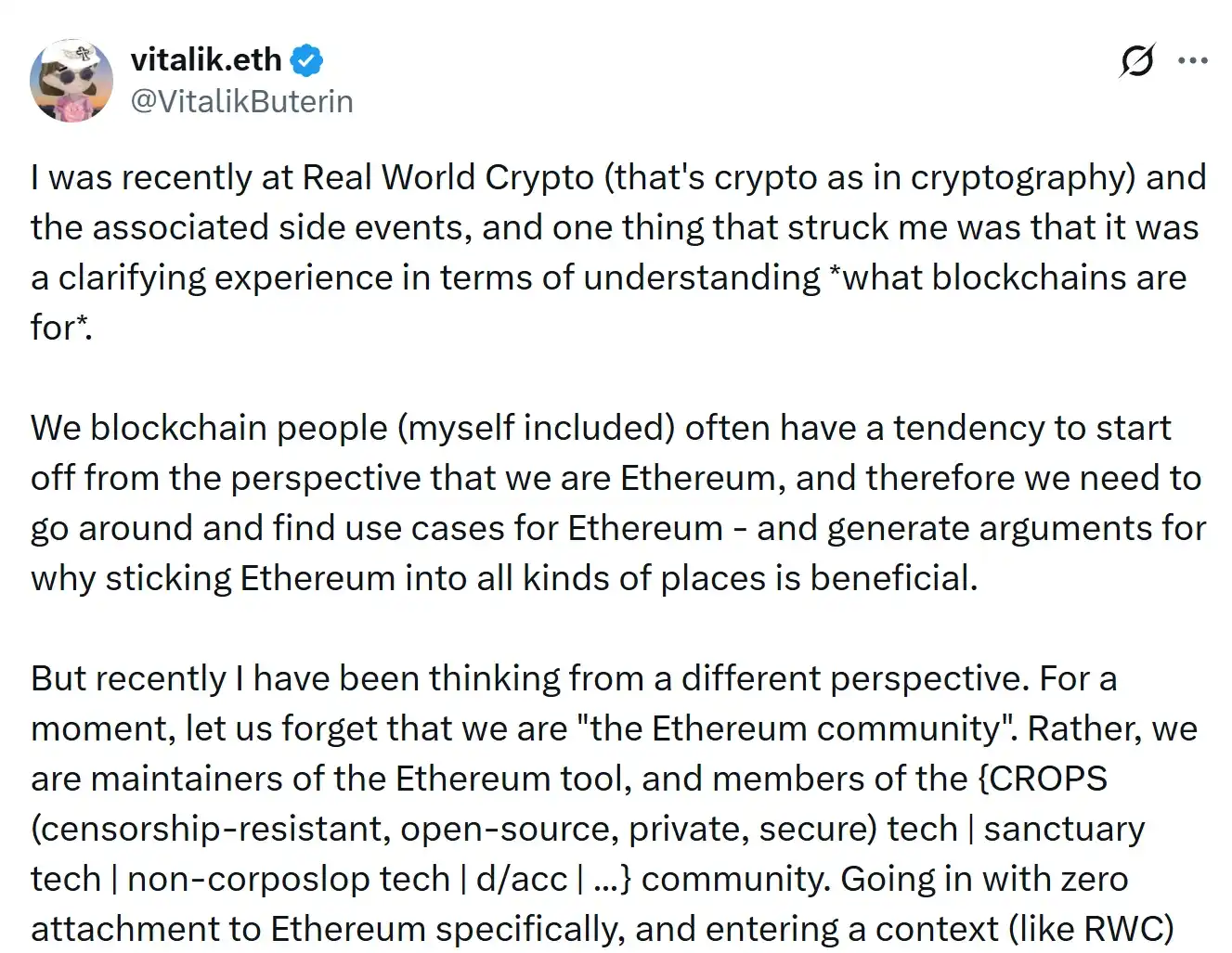
But on March 12, Vitalik Buterin proposed a rather refreshing perspective—the crypto industry may have overcomplicated the actual use cases of blockchain. The most fundamental value of Ethereum might not be the smart contract functionality we have always emphasized, but an extremely simple primitive:
A cryptographically secure, globally shared "public bulletin board".
Many users might wonder, from a "computer" to a "bulletin board", is this a functional regression, or is there another angle to consider?
I. The "Global Shared Memory" Behind the "Bulletin Board"
The so-called "public bulletin board", as the name implies, is fundamentally about data availability.
It's simple to understand: imagine a giant bulletin board posted in a central city square—anyone can read it, nothing can be withdrawn, and there is no censorship. This simply refers to a bulletin board on a global scale: global users can confirm that the data indeed exists, even the most powerful government cannot erase it, and no administrator can prevent you from publishing compliant content.
Ultimately, many digital systems, such as secure online voting and software version control, have a core need not for complex financial transactions, but for an anti-censorship, publicly verifiable data publishing space. This is precisely the "bulletin board" long sought in the field of cryptography:
- Secure voting systems. Traditional electronic voting relies on centralized databases, which carry the risk of tampering. Publishing voting records on Ethereum allows anyone to verify the results, while the privacy of the votes is protected by cryptography;
- Certificate revocation systems. Revocation lists for HTTPS certificates, software signing certificates, etc., need a publicly accessible, tamper-proof data source. Blockchain is naturally suited for this role;
- Multi-party coordination and governance. Open-source projects, decentralized governance, community funds—these scenarios require multiple parties to collaborate without trusting each other. Ethereum can serve as a neutral coordination layer to publish data and verify actions;
These scenarios share a common characteristic: they don't need Ethereum to "run" anything, they just need Ethereum to "remember" something. Vitalik therefore gave a more precise ultimate definition: Ethereum is global shared memory.
Anyone can write to it, anyone can read from it, and no one can unilaterally erase it—not a company, not a government, not even Vitalik himself.
This positioning also corresponds to a clear technical path. The 2024 EIP-4844 (Blob data) was the initial scaling of this bulletin board. The full rollout of PeerDAS (Peer Data Availability Sampling) in 2026 expanded the "area" of the bulletin board a hundredfold. Ethereum is no longer fixated on the TPS of the main chain, but is committed to becoming the global storage center with the largest capacity and highest security, a foundational layer providing globally shared data availability.
II. With AI's Arrival, the Public Bulletin Board Becomes More Necessary
Understanding the essence of the "bulletin board", and then looking at the advent of AI, reveals that these are not two separate things, but two sides of the same coin.
Objectively speaking, the "bulletin board" line of thinking is actually quite related to the current impact of AI on Web3. Because increasingly, the number of conversations people have with AI daily has surpassed the number with any single human. But with current AI services, what you asked, when you asked it, how many times you asked—all are tied to your real identity.
For example, using ChatGPT requires an email and credit card; calling the Claude API leaves clear billing records; every prompt is a digital trace pointing back to you.
Therefore, in February 2026, Vitalik and the Ethereum Foundation's AI lead, Davide Crapis, jointly proposed ZK API Usage Credits, aiming to enable anonymous calls to AI large models using zero-knowledge proofs. The logic of the proposal is clear:
A user deposits funds (e.g., 100 USDC) into a smart contract, which records this deposit in an encrypted list on-chain. Thereafter, each time the user calls an AI API, they don't need to expose their identity; they just need to generate a zero-knowledge proof demonstrating "I have the right to use this credit" to complete the call.
What does this scheme require? A public bulletin board, a publicly verifiable, immutable data layer, to record "who has how much credit", without recording "who is who".
Simultaneously, the proliferation of AI Agents brings another new issue: how can these automatically running programs achieve economic coordination amongst themselves? After all, when one AI Agent needs to call the service of another AI Agent, it needs to pay, establish credibility, and handle disputes. But it has no bank account, no legal identity, and no "real-name information" trusted by centralized platforms.
Ethereum, as an economic coordination layer for AI Agents, provides a natural answer. Agents can initiate transactions on-chain, stake collateral, and establish verifiable reputation records—all built upon the transparent data layer provided by that "bulletin board".
In a broader framework, this positioning of the relationship between Ethereum and AI is even one of integration—as AI's capabilities grow stronger, the needs for privacy protection, verifiability, and decentralization become more rigid.
So, Ethereum is not competing with AI; it is aiming to become the most needed infrastructure in the AI era: a public data layer that anyone can write to, anyone can trust, and no one can shut down.
III. Is the "Smart Contract" Narrative Not Enough Anymore?
Perhaps in Vitalik Buterin's vision, the majority of future Ethereum users might not be "humans", but AI Agents.
Therefore, this shift in positioning from "World Computer" to "Bulletin Board", while easily misinterpreted as lowering expectations, is actually the opposite in understanding.
The "World Computer" is a narrative from an internal perspective, asking "what can our technology do?", while the "Bulletin Board" is a perspective from external demand, asking "what does the world truly need?".
This perhaps also benefits from the people Vitalik met at cryptography conferences—those voting system researchers, certificate protocol designers, privacy tool developers. They had no interest in blockchain or Ethereum, but the things they needed were exactly what Ethereum could provide.
Therefore, the author believes Ethereum is indeed becoming more realistic step by step, because this is the proper stance of a mature technology: it no longer tries to define application scenarios, but instead refines itself into a sufficiently reliable piece of infrastructure, waiting for the scenarios that truly need it to grow naturally.
Just like TCP/IP doesn't explain what the internet can do, but without TCP/IP, the internet can do nothing.
From this perspective, this is perhaps Ethereum's moment of "looking inward when actions don't yield results".
After all, the core, most irreplaceable value of blockchain has always been that truth which is not subject to anyone's will. This means that no matter how fast AI evolves, no matter how blurred the line between reality and illusion becomes, as long as this bulletin board exists, humanity will have a place to store "truth".
This, perhaps, is Ethereum's most honest self-positioning yet.