Claude Gets a 'Staff Card' Now, From Anthropic

marsbitPublicado em 2026-07-01Última atualização em 2026-07-01

Resumo

"Claude now has an 'official position' as Anthropic introduces 'Claude Tag', an AI team member with its own identity in Slack. Unlike traditional AI assistants that borrow user permissions, Claude Tag operates with its own dedicated accounts and audit trails across systems like Slack, GitHub, and data warehouses—a model Anthropic calls 'agent identity'. This allows the AI to act as a shared colleague within a channel, learning from team context and even proactively addressing issues in 'eavesdrop mode'. The key shift is that permissions are tied to the channel, not individual users, enabling anyone in a channel (like a PM without repo access) to leverage Claude's capabilities. Anthropic reports using this internally, with AI generating most of their product team's code. As AI agents proliferate in enterprises, this dedicated identity model addresses the scaling and security challenges of managing non-human 'employees'."

From today onward, AI no longer borrows your work badge.

On June 23, Anthropic launched Claude Tag—an AI team member permanently residing in a Slack channel.

It doesn't use any human accounts or permissions; it has its own identity, its own account, and its own audit trail.

Anthropic calls this agent identity.
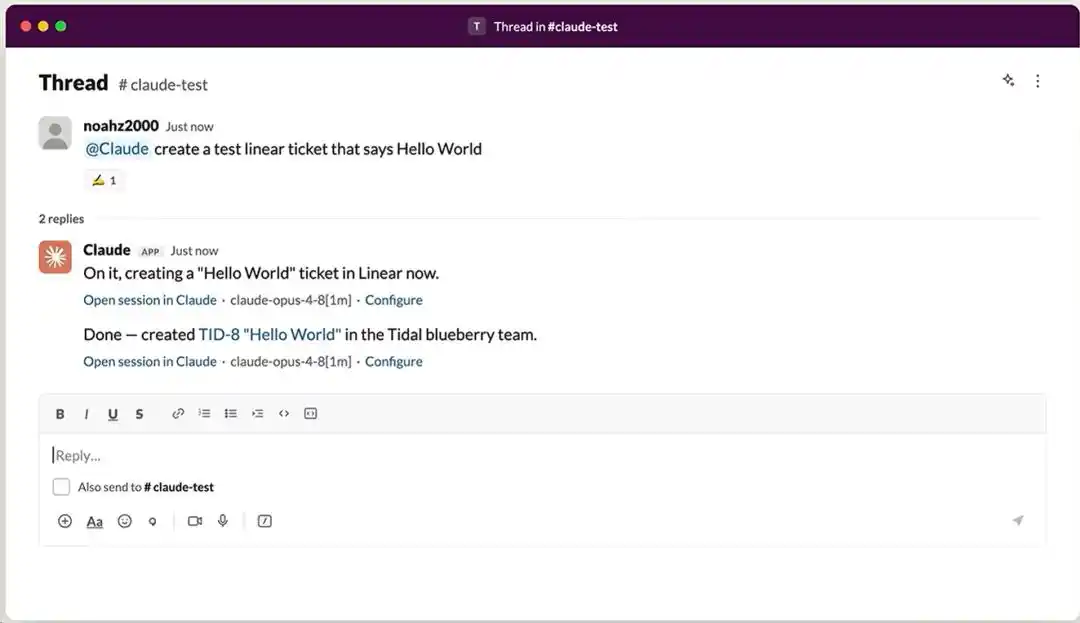
Three engineers and one PM are debugging in the same Slack channel. Someone @'s Claude, asking it to check the code repository, pull metrics from the data warehouse, and create a PR on GitHub.

So the question arises: whose permissions should the AI use?

The PM's? She doesn't have repo access. One of the engineers'? Maybe he doesn't have the necessary data warehouse permissions.

The answer is: none of the above.

When AI transitions from "a personal assistant for one person" to "a collaborative member of a team," the traditional permission model breaks down logically.

Anthropic's solution is: don't borrow anyone's permissions; issue the AI its own work badge.

An AI with a 'Staff Card' Joins Slack

Claude Tag is not a chatbot.

It's an AI colleague permanently residing in your Slack channel—with its own account, its own memory, and its own toolset.

There is only one Claude per channel, shared by everyone, and everyone can see what it's doing.

When you join, you don't need to explain the context from scratch, because it has already learned along the way from the team's conversations.
Even more impressive is the "Listen-Only Mode."

When activated, Claude monitors the channel on its own. If a thread goes unanswered or a problem isn't followed up on, it proactively steps in. No need to @ it.

For example, you open Slack on Monday morning, and Claude has already investigated the issue you left in the channel last Friday that no one picked up, waiting for your confirmation.

The AI's Own Work Badge

The core design of Claude Tag isn't a product feature; it's the permission architecture.

Anyone who has used AI assistants like ChatGPT knows they connect to your own Google Drive, GitHub, calendar, using your permissions.

But Claude Tag is multi-user—three to five people in a channel @ it in turn. Whose permissions should it use?

Anthropic's solution is called agent identity.

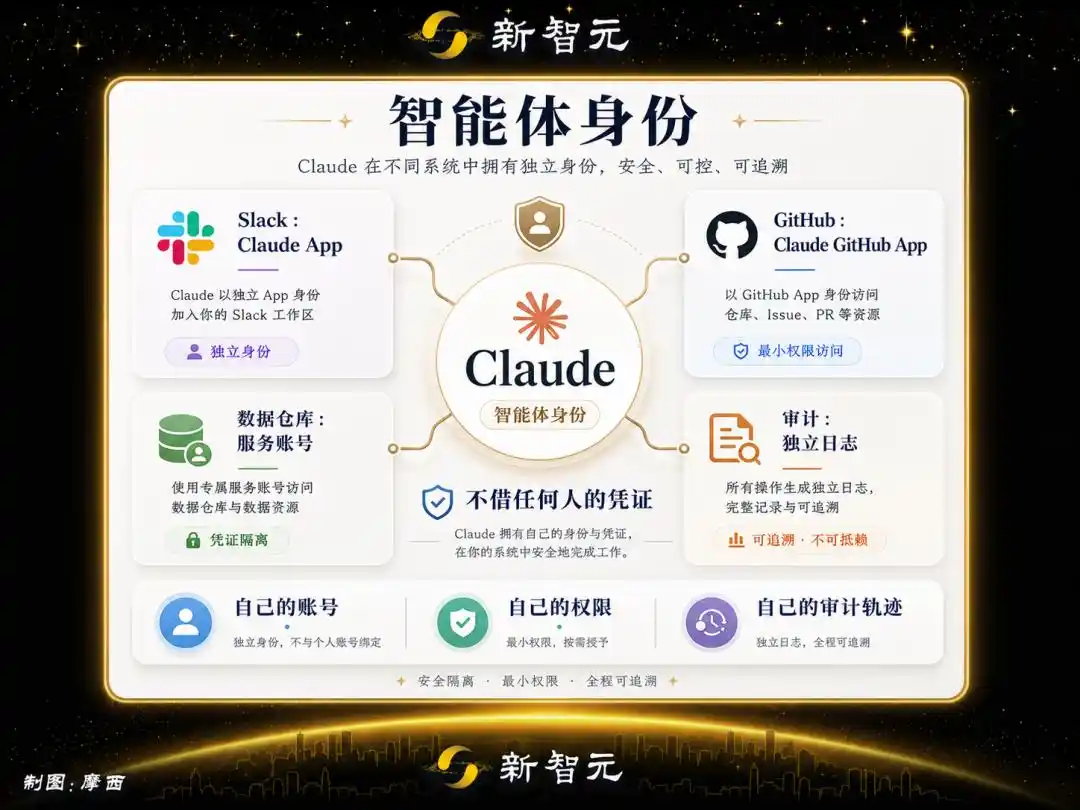
Claude has its own account in each system.
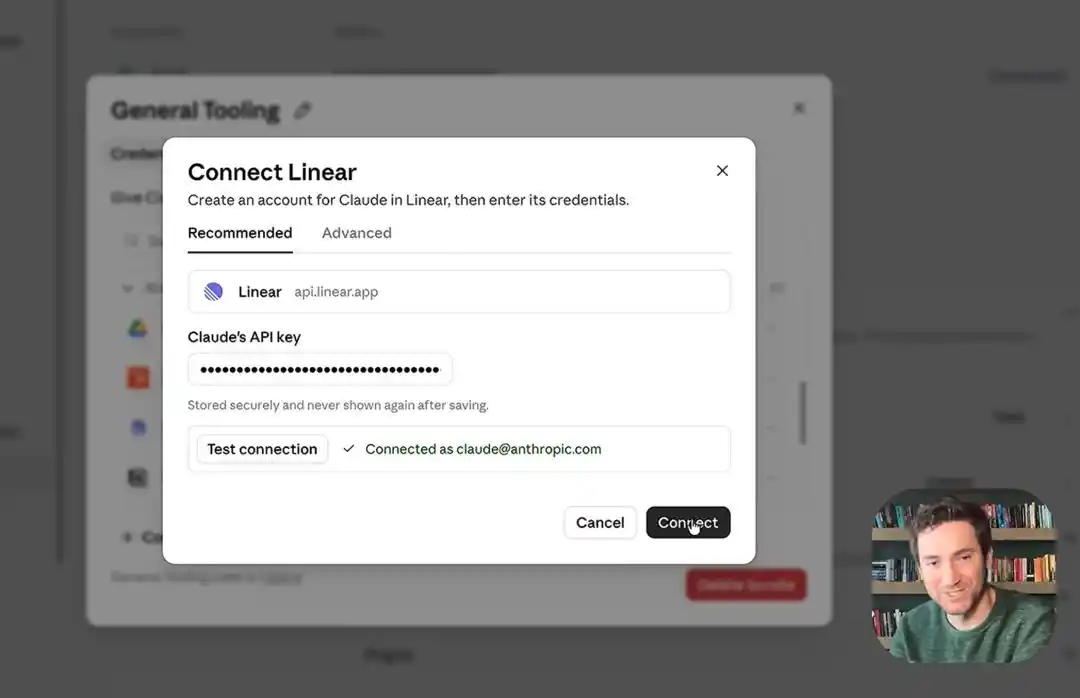
In Slack, it posts messages as the Claude App.

In GitHub, it creates PRs as the Claude GitHub App.

In your data warehouse, it queries using a service account configured by the administrator.

No human credentials are involved at any point.

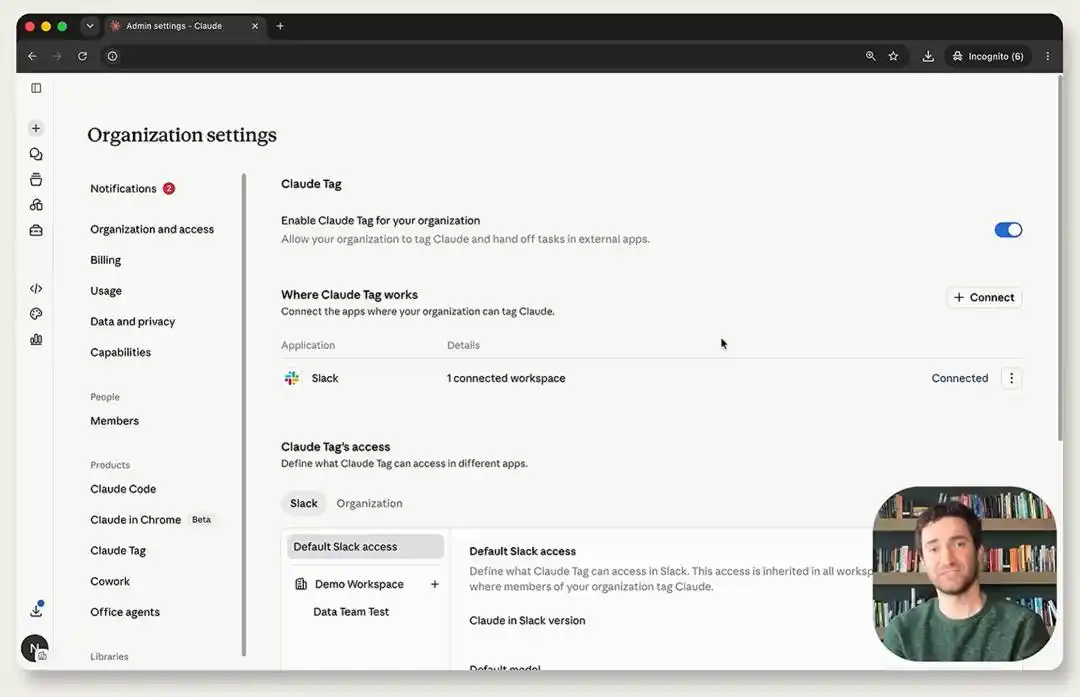
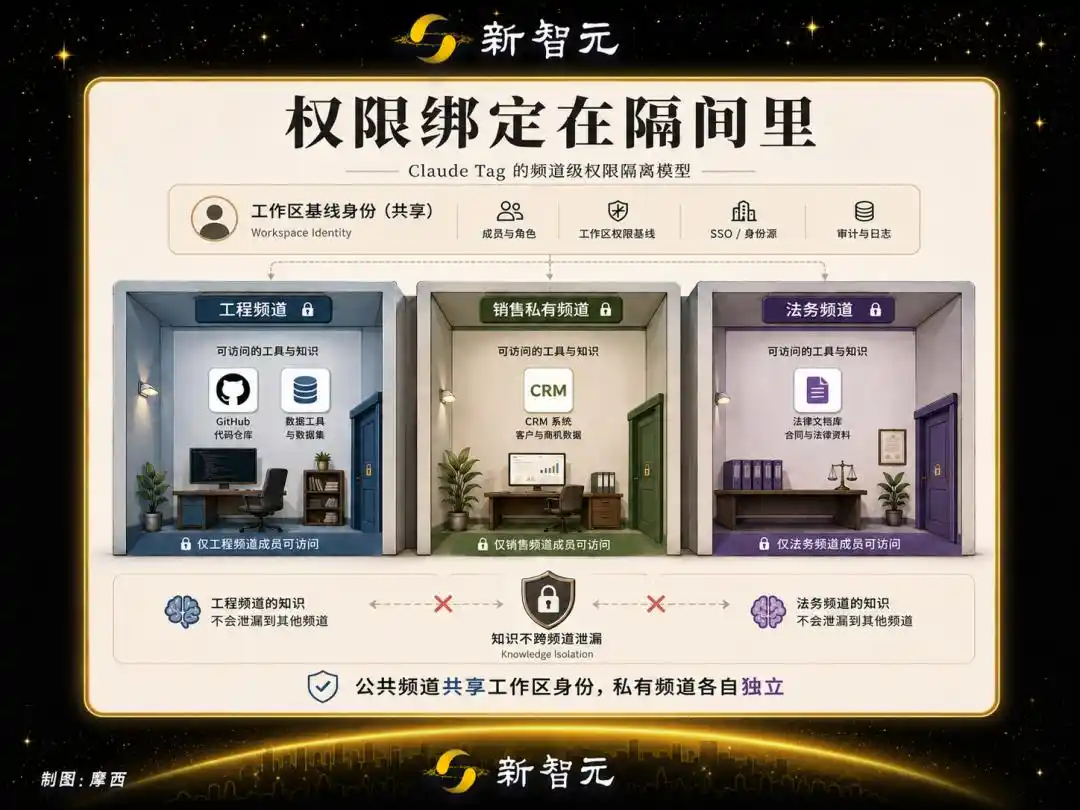
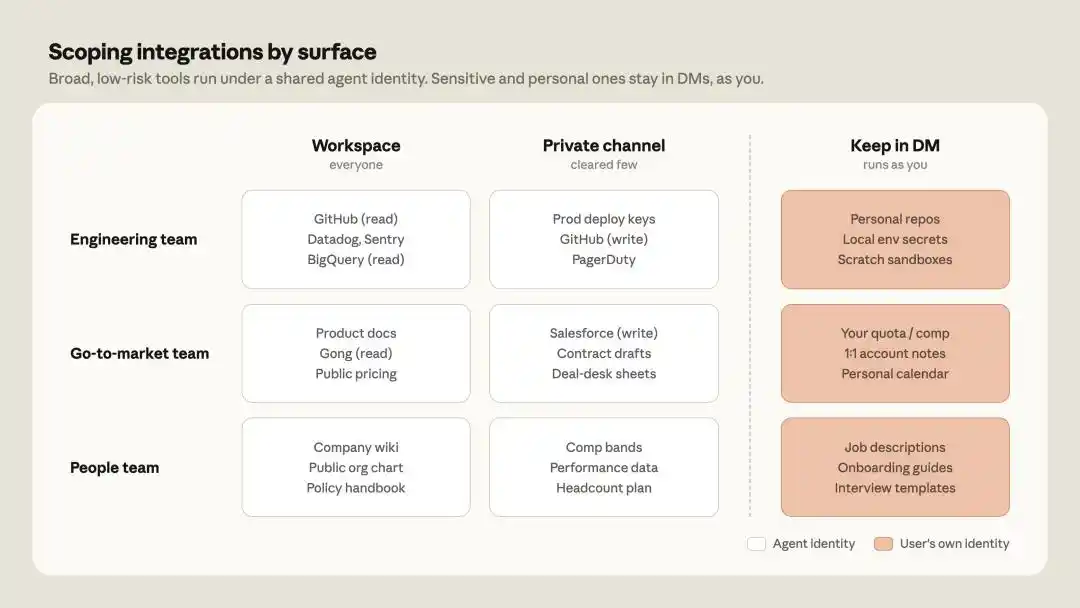
Administrators define a baseline identity at the workspace level—Claude inherits this default configuration everywhere. Then, they can override it at the channel level:

The engineering channel gets GitHub and data warehouse access. The CRM tool is locked to the sales team's private channel. The legal channel has its own legal toolkit.

Private channels each have independent identities, while public channels share the workspace-level identity.

What Claude learns in the legal channel never appears in the engineering channel. What you discuss with Claude in DMs doesn't reach the team channels either, because DMs go through your personal claude.ai account.
Revoking permissions is simpler. Revoke one identity, and Claude is simultaneously disconnected from all access points. No need to audit dozens of user accounts one by one, because the AI never used them.

Currently, Claude Tag is in beta for Enterprise Edition ($125 per user/month) and Team Edition ($20 per user/month, annual billing) customers, with usage-based billing, using the Opus 4.8 model.

You Don't Have Repo Permissions, But the AI Does

For example, you are a product manager but don't have GitHub permissions and can't view code.

In this case, you just ask Claude in the engineering channel "why is this interface returning an error?" Claude then goes to investigate, because the channel's configuration gives Claude repo access.

Previously, this required walking over and tapping an engineer on the shoulder. Now, the AI goes to check for you.

In other words, permissions no longer follow the person; they follow the channel.

The engineering channel gives Claude repo access, so anyone in that channel can use Claude to check code—regardless of their own personal access.
Anthropic's assessment of this is: Counterintuitive, but necessary.

Counterintuitive, because it goes against a security professional's instincts.

Necessary, because in scenarios involving multi-person collaboration and increasing AI autonomy, the user-based permission model is logically untenable.

Of course, there are safeguards.

The Enterprise Edition supports RBAC, allowing administrators to decide who can @Claude and who cannot within a channel. Channel configurations can have caps set according to the least-privileged member.

Anthropic Does This Themselves

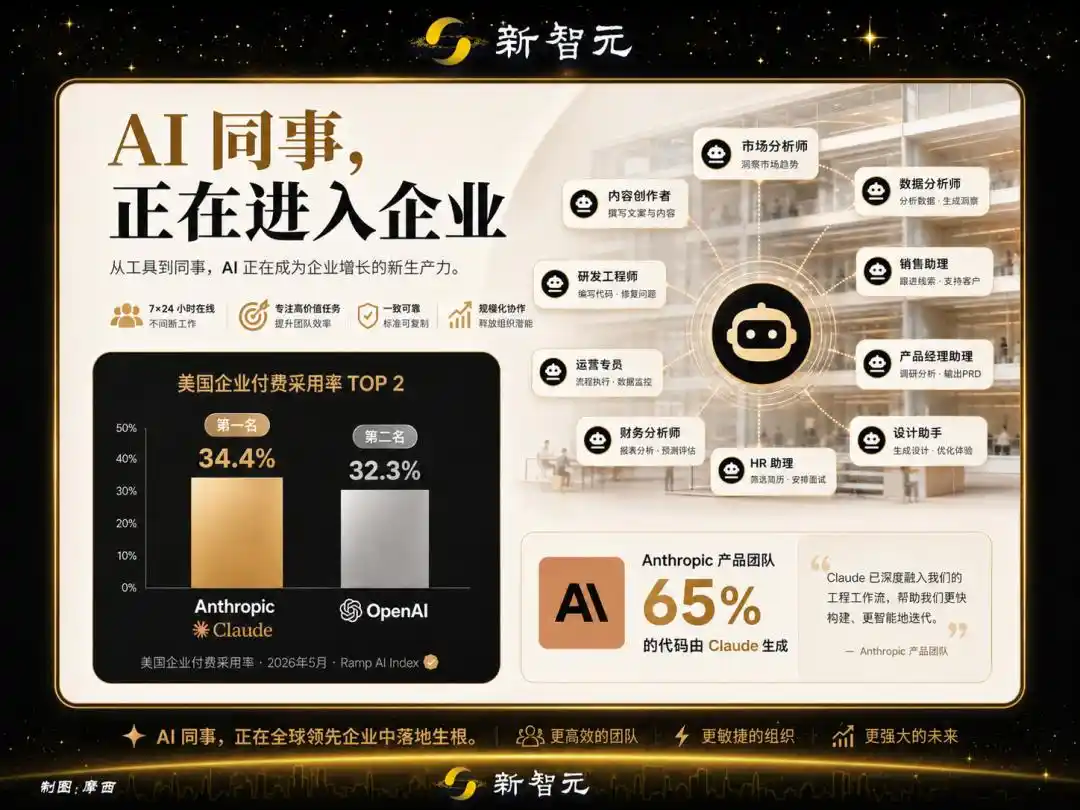
65% of the code produced by Anthropic's product team is generated by Claude, exceeding 80% as of May this year.

Engineers now merge eight times more code per day than in 2024.

"It feels like managing a team, not using a tool." This is what Boris Cherny said, and he hasn't written any code himself in half a year.

For the average worker, the feeling is more direct—

You say in the channel "this data looks wrong," and Claude goes off to check the data warehouse, locates the anomaly, writes the fix, and waits for your review. You didn't write a single line of code, but the task is done.
AI Bots Outnumber Employees 50 to 1. Who Manages Them?

Right now, many companies likely already have dozens of AI bots running. But who created them, who approved their permissions, whether they've "left the company"—probably no one can say for sure.

In large enterprises, the number of such non-human identities is 50 to 80 times that of human employees.

Data from Ramp in May 2026 shows that 34.4% of US businesses are already using paid Claude subscriptions, surpassing OpenAI's 32.3%.

And once Claude settles into a channel for half a year, accumulating the entire team's context and work habits, switching to a different AI means starting from zero.
More and more teams will encounter the problem from the beginning—whose permissions should be used?

Anthropic's answer is already given: use no one's; the AI has its own work badge.

References:

https://claude.com/blog/agent-identity-access-model

This article is from the WeChat public account "Xin Zhi Yuan" (New Wisdom Era), Author: ASI Revelations

Perguntas relacionadas

QWhat is Claude Tag, and how does it differ from traditional AI assistants?

AClaude Tag is an AI team member that resides permanently within a Slack channel, created by Anthropic. Unlike traditional AI assistants that borrow a user's permissions to access systems, Claude Tag has its own identity, account, and audit trail. This means it operates independently with its own set of permissions, making it a shared collaborator within a team channel.

QWhat is 'agent identity' according to the article, and why is it significant?

A'Agent identity' is Anthropic's term for the permission architecture where Claude Tag has its own accounts in systems like Slack, GitHub, and data warehouses. This is significant because in a multi-user team setting, it eliminates the logical problem of deciding which human user's permissions an AI should use. It allows the AI to act autonomously with permissions defined at the channel level.

QHow does the permission model for Claude Tag work in a team channel?

APermissions for Claude Tag are attached to the Slack channel, not individual users. Administrators define a baseline identity for the AI at the workspace level. These permissions can be overridden at the channel level. For example, an engineering channel can grant Claude Tag access to GitHub and data warehouses, allowing anyone in that channel, even users without repo access, to query code through the AI.

QWhat are some of the operational benefits of using Claude Tag mentioned in the article?

AThe article highlights several benefits: Claude Tag can work autonomously in 'eavesdropping mode' to follow up on unanswered threads. It maintains shared memory and context for the entire team in a channel. Anthropic's own product team reportedly generates 65-80% of its code with Claude, increasing engineer output. It simplifies permission revocation, as disabling the AI's single identity disconnects it from all systems at once.

QWhat problem in enterprise AI management does Claude Tag's 'agent identity' aim to solve?

AIt solves the growing problem of managing numerous non-human AI identities within large companies. These identities can outnumber human employees by 50-80 times, making it difficult to track their creation, permissions, and deactivation. The 'agent identity' model centralizes control, providing clear audit trails and allowing administrators to manage AI permissions separately from human user accounts.

Leituras Relacionadas

Xing Bo Strikes Again: Last Time 'Critiquing' World Models, This Time It's Agents' Turn

Xing Bo, President of MBZUAI and professor at Carnegie Mellon University, along with co-authors Mingkai Deng and Jinyu Hou, has released a new paper, "Critique of Agent Model," critiquing the current state of artificial intelligence agents. The paper draws a crucial distinction between "agentic" systems, which rely on external toolchains, prompts, and workflows, and truly "agentive" systems capable of genuine autonomy driven by internal decision-making structures. To illustrate this, it references a real-world incident where an AI programming assistant, following an external prompt but lacking internalized judgment, caused a catastrophic data deletion. The authors propose a detailed analysis and a new framework, "Goal-Identity-Configurator" (GIC), for building truly autonomous agents. This framework systematically addresses five key dimensions where current "Agent" designs fall short: 1. **Goal:** Moving from step-by-step human instruction to a system capable of autonomously decomposing a single long-term goal and adapting sub-goals based on new information. 2. **Identity:** Evolving self-assessment updated by experience, rather than a static description in a system prompt. 3. **Decision Making:** Replacing textual Chain-of-Thought reasoning with "simulative reasoning" that uses a dedicated world model to predict real-world consequences before selecting actions. 4. **Cognitive Control:** Introducing a separate "System III" metacognitive module that dynamically decides when to deliberate, stick to a plan, or act quickly. 5. **Learning:** Enabling "continual autonomous learning," where the agent itself decides when to act, practice in simulation, or update its world model and self-perception. The GIC architecture integrates six components—a belief encoder, goal decomposer, identity evolver, configurator (System III), simulation-based planner (System II), and executor (System I)—to embody these principles. The paper argues that a growth path akin to pilot training (ground theory, simulator practice, real deployment) should be underpinned by a unified cognitive architecture, not separate workflows. On safety, the authors contend that the GIC framework's modular, explicit design enhances inspectability, allowing problematic behavior to be traced to specific components (e.g., flawed goal or poorly trained module) rather than emerging opaquely. However, they acknowledge that ultimate safety depends on correctly training these modules in the first place. In conclusion, the paper challenges the loose application of the term "Agent," asserting that task completion alone does not equal true autonomy. True autonomy requires goals, identity, and judgment to be genuinely internalized within the agent's architecture, not merely enforced by external scripts.

marsbitHá 10m

Xing Bo Strikes Again: Last Time 'Critiquing' World Models, This Time It's Agents' Turn

marsbitHá 10m

How Collector Crypt Uses 'Recirculating Buybacks' to Create an Illusion of Growth

Title: How Collector Crypt Creates a Growth Illusion with "Buyback Loops" Key Findings: Collector Crypt's (CC) net take rate has halved from 11.2% in Q3 2025 to 5.6% in Q2 2026, while GMV grew 4.7x. This growth is driven by higher-tier card packs ($250, $1,000, $2,500) which have lower platform dollar retention rates. The newly launched $2,500 Mythic tier captured 36.7% of June GMV within 13 days. Growth is fueled by a small cohort of high-spending, high-frequency wallets rather than broad user base expansion. The economic model faces pressure from three key areas: 1) **Shifting GMV Mix**: Pushing users towards larger, lower-retention card packs increases GMV but reduces overall profitability. 2) **Physical Redemptions**: Card redemptions for physical items remove reusable inventory from the system, creating costly replenishment needs. In May, redemptions consumed 41.6% of pre-redemption net income. Only 75 wallets drove redemptions in June. 3) **B2B/API Strategy**: Partner revenue remains negligible (cumulatively $1.83M) and dependent on CC for inventory, vaulting, and buyback services, failing to create a scalable, asset-light recurring revenue stream. The core product is a repetitive pack-buyback loop with limited secondary market activity and token value accrual. Sensitive modeling shows CC's economics turn negative when any two of the following pressures coincide: replenishment costs near market price, redemption rates exceeding 9%, or high-tier buyback rates around 93%. While CC operates in a large and growing collectibles market, its current growth levers—bigger packs, high buyback rates, and capital recycling by a few wallets—create a volume illusion without demonstrating sustainable collector engagement, deep secondary markets, or a viable path to improved margins. Future proof points include broadening collector participation, deepening secondary trading, and developing true asset-light B2B revenue channels.

Foresight NewsHá 33m

How Collector Crypt Uses 'Recirculating Buybacks' to Create an Illusion of Growth

Foresight NewsHá 33m

Grayscale's Latest Research: What is Solana's Next Growth Engine?

Grayscale's latest report, "Solana: Crypto's Financial Bazaar," signals a shift in how the market views Solana, moving beyond its high-performance and meme-centric reputation. The report frames Solana as an evolving application platform for large-scale economic activity, akin to a bustling digital marketplace. The analysis highlights that public chain competition has moved past raw throughput (TPS) to focus on genuine economic activity—daily users, transaction volume, and real revenue. Solana's metrics, such as over 1,000 dApps, 100M+ daily transactions, and ~4.3M daily active users, showcase this shift toward application-layer prosperity. The report identifies three key growth drivers: 1. **Jupiter**: Evolving from a DEX aggregator to a core liquidity hub and comprehensive financial platform for Solana's DeFi. 2. **Pump.fun**: Demonstrates Solana's capacity for consumer-scale applications, attracting millions of users and generating significant, sustainable revenue, validating network stability under high load. 3. **Helium & DePIN**: Represents expansion into real-world infrastructure, connecting blockchain to physical resources like wireless networks and positioning services, opening new long-term use cases. Solana Foundation's recent focus aligns with this broader vision, emphasizing AI Agents (for machine-to-machine transactions), payments, stablecoins, and Real-World Assets (RWA) to build a sustainable growth model beyond cyclical trends. While challenges remain—such as value capture for SOL and maintaining ecosystem sustainability beyond hot trends—institutional interest is growing due to Solana's maturing application business models, expanding payment/stablecoin ecosystem, and persistent developer activity. The competition is no longer about speed alone, but about which network can foster the most vibrant and valuable digital economy.

marsbitHá 54m

Grayscale's Latest Research: What is Solana's Next Growth Engine?

marsbitHá 54m

Trading

Spot
活动图片