Polygon burns hit 107M POL this year – So why is its price tanking?

ambcryptoPublicado em 2026-07-01Última atualização em 2026-07-01

Resumo

Polygon (POL) has burned over 107 million tokens in 2026, becoming net deflationary this year. Its network activity remains strong, achieving the highest stablecoin transaction volume among payment networks in May at 198 million. Major staking activity and whale confidence also support its fundamentals. However, POL's price has declined, recently trading around $0.06948. This price drop is attributed to a prolonged technical downtrend since late 2024, with the asset now in a consolidation pattern and facing significant selling pressure, as indicated by exchange offloads and negative market indicators.

Polygon [POL] is among the widely used chains for payment, with its volume matching or even surpassing that of established networks like Solana [SOL].

In the past 24 hours, POL price has declined by more than 1% after breaking below a support level at $0.07161. The altcoin’s price is currently trading at around $0.06948. Despite the price action declining, its network activity and fundamentals are growing.

A look into Polygon’s strong network activity and fundamentals!

As per Sandeep Nailwal, the founder and CEO of Polygon, the network has burned over 107 million POL tokens in 2026 alone. He celebrated the moment on X by marking,

Officially net deflationary this year.

All this was happening despite Polygon minting over 105 million POL tokens. The burned tokens were coming from the base fees collected, which resulted in a slightly reduced circulating supply.

In contrast, Ethereum [ETH], Solana, and Sui Network [SUI] added hundreds of millions of dollars worth of new tokens to the market.

The high fees were coming from the spike in transactions as a payment protocol. In fact, Polygon had the highest stablecoin volume in May among all payment networks, recording 198 million.

At the same time, whale activity and staking were heightening.

For instance, a whale migrated 17.512 million MATIC to 17.512 million POL worth $1.25 million. This indicated some whales were still confident with the Polygon project.

At the same time, a multisig wallet linked to Stader Labs and Polygon staked 11 million POL worth $839.41K. In total, the wallet has staked over 28 million POL tokens, which has helped reduce circulating supply in the market and improve network security.
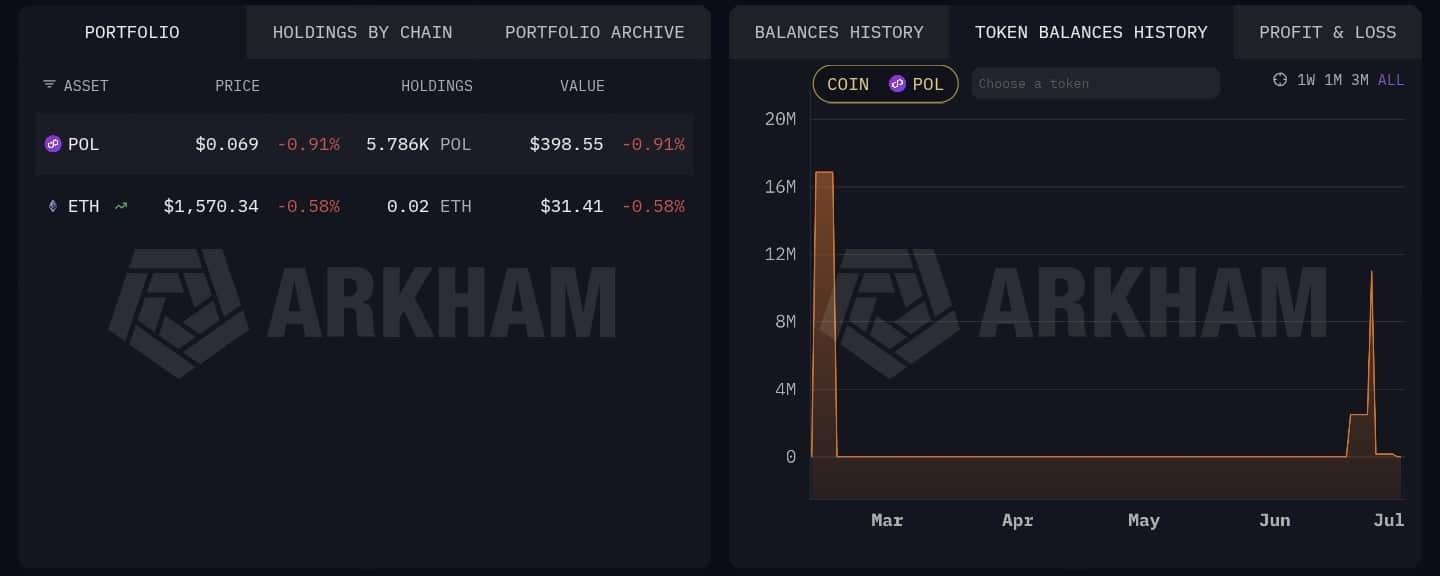
Source: Arkham

While the Polygon chain has continued to display strong fundamentals and network activity, its price action is tanking.

But why is POL price stalling?

Since towards the end of 2024, Polygon has been in a consistent descent. A keen look at its price action shows the altcoin entered a consolidation phase in the form of a triangle pattern, which is nearing a break point.

The weekly chart shows sellers have been highly dominant starting October 2025 as the Bull Bear Power indicator is red. The Cumulative Volume Delta [CVD] too shows selling, indicating 670K POL have been offloaded into exchanges.
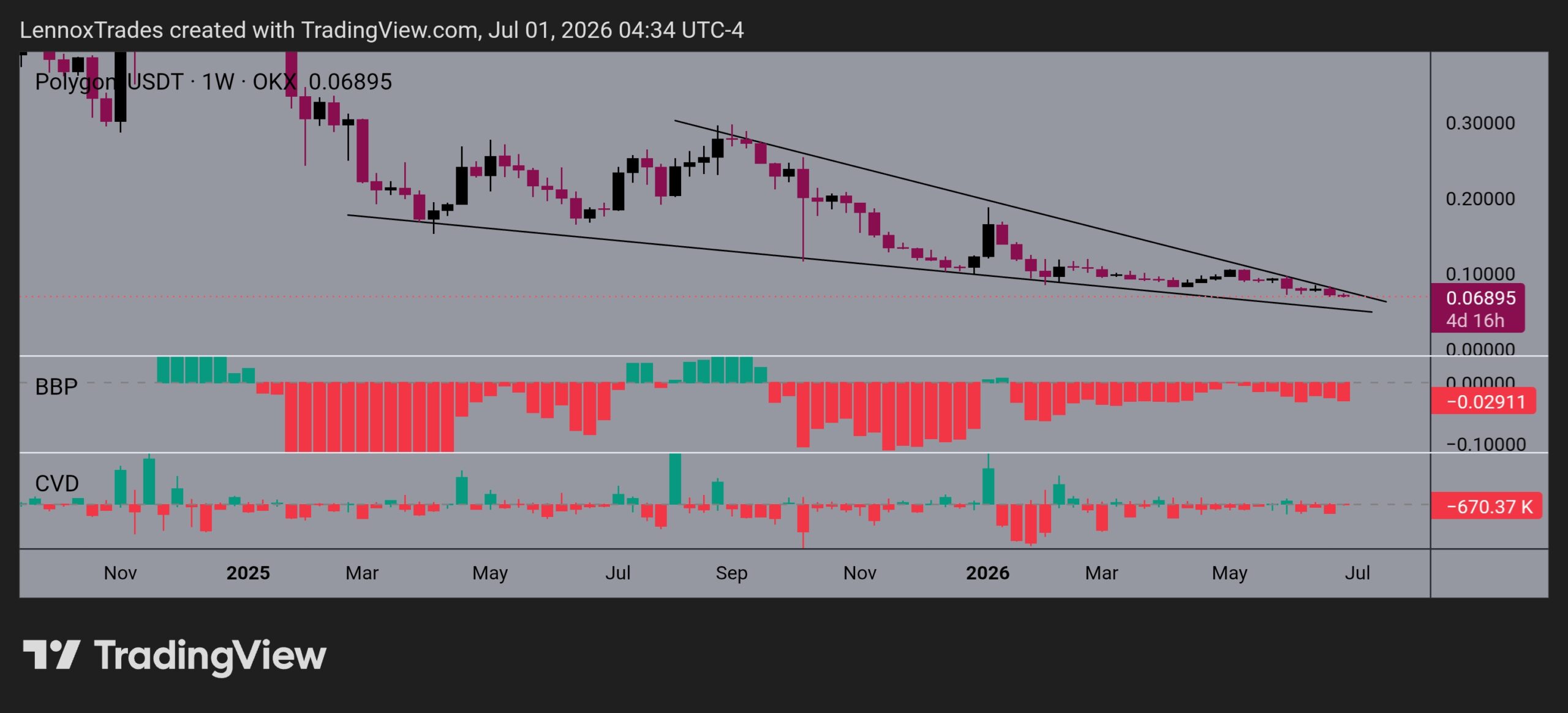
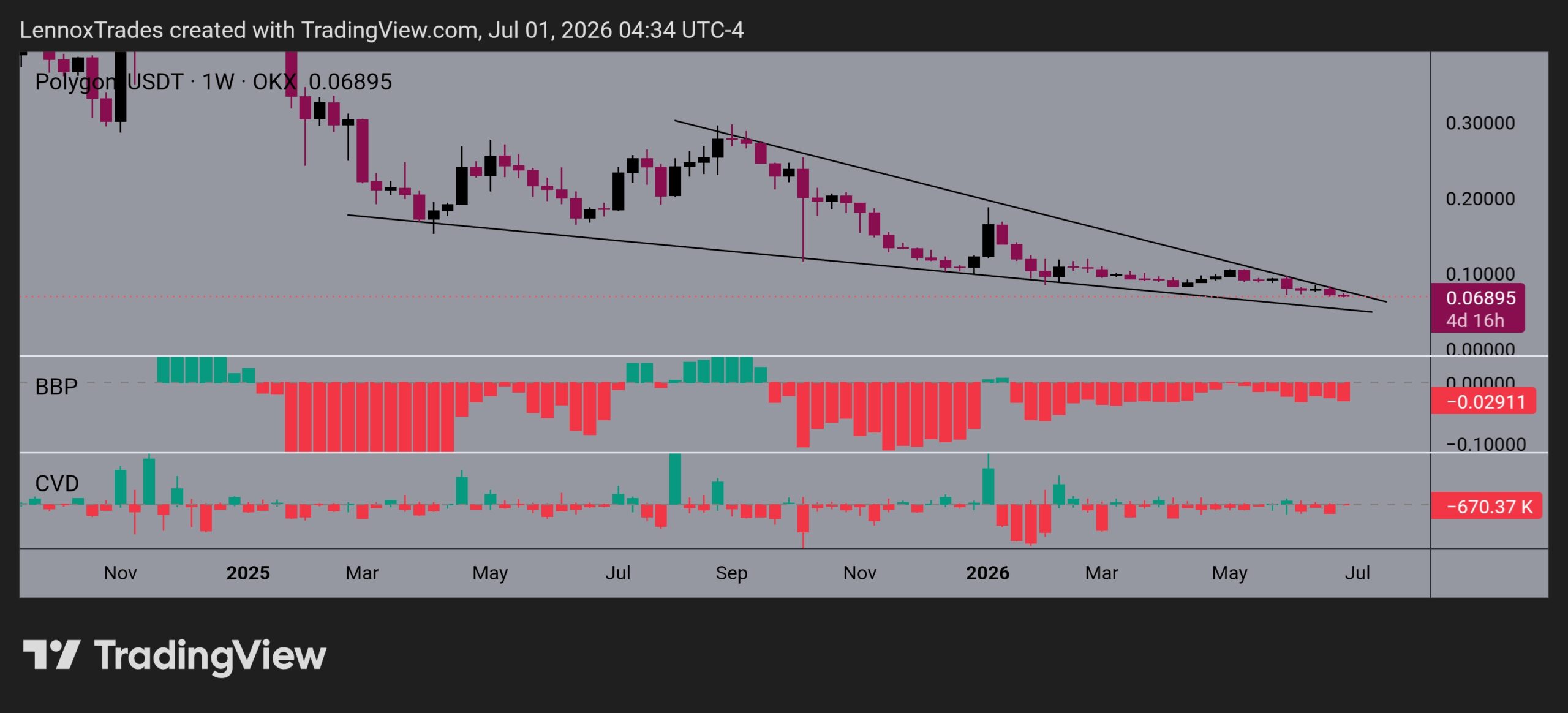
Source: POL/USDT on TradingView

Therefore, Polygon price is stalling because of the technical weakness even though its transaction count and burn rates were growing.


Final Summary

  • Polygon has burned over 107 million POL tokens in 2026 while its transaction volume reached 198 million in May.
  • POL price was trading in a triangle pattern as it has been falling since the end of 2024.

Criptomoedas em alta

Perguntas relacionadas

QWhat key contradiction does the article highlight between Polygon's on-chain activity and its market performance?

AThe article highlights that despite Polygon exhibiting strong fundamentals in 2026—such as burning over 107 million POL tokens, recording a high stablecoin transaction volume of 198 million in May, and increased staking activity—its price has been declining, trading in a descending triangle pattern since late 2024.

QAccording to the article, why is Polygon considered 'officially net deflationary this year'?

APolygon is considered net deflationary because in 2026 alone, the network burned over 107 million POL tokens from base fees, which was more than the 105 million POL it minted, resulting in a net reduction in the circulating supply.

QWhat specific technical indicators suggest continued selling pressure on POL's price?

ATechnical indicators showing selling pressure include a red Bull Bear Power indicator starting October 2025 and a negative Cumulative Volume Delta (CVD), which indicates that approximately 670,000 POL tokens have been offloaded onto exchanges.

QHow did Polygon's stablecoin transaction volume in May compare to other payment networks, and what does it signify?

AIn May, Polygon had the highest stablecoin volume among all payment networks, recording 198 million transactions. This signifies its strong adoption and utility as a leading chain for payments, even surpassing established networks like Solana.

QWhat actions by whales and institutional stakers does the article mention as positive for Polygon's network?

AThe article mentions a whale converting 17.512 million MATIC to POL (worth $1.25 million), showing confidence, and a Stader Labs multisig wallet staking 11 million POL (worth ~$839k), bringing its total staked to over 28 million POL, which reduces circulating supply and improves network security.

Leituras Relacionadas

Q2 Crypto Market Review: Did Bitcoin Rise for 'Nothing'? Did Money Flow to AI and On-Chain?

Q2 2026 Crypto Market Recap: Bitcoin's Gains Erased Amid Shift to AI and On-Chain Activity The second quarter of 2026 saw a significant reversal for the cryptocurrency market. Bitcoin gave back all its April gains, ending Q2 down approximately 11%, while major stock indices posted strong gains. This divergence was driven by a hawkish shift in Fed rate expectations, capital rotation into AI stocks, and weakening liquidity channels into crypto. Key demand pillars deteriorated simultaneously. Spot Bitcoin ETFs recorded net outflows of $4.08 billion for the quarter, with outflows dominating June. Crypto treasury entity Strategy's bitcoin accumulation slowed markedly, and the total stablecoin market cap contracted by ~$4.2 billion. This created a tighter liquidity environment. Exchange data reflected the downturn. Spot trading volumes fell 28% quarter-over-quarter. The market underwent significant deleveraging, with $8.35 billion in long liquidations for BTC and ETH, primarily in late May/early June. Open interest and order book liquidity also declined. Despite the bearish price action, structural developments point to an expanding on-chain ecosystem. These include the rise of tokenized stocks with full legal rights, the growth of RWA (real-world asset) perpetual contracts for trading stocks and commodities 24/7, and the use of crypto markets for price discovery ahead of major events like the SpaceX IPO. On-chain vaults are also emerging as a core layer for institutional capital allocation.

Foresight NewsHá 6m

Q2 Crypto Market Review: Did Bitcoin Rise for 'Nothing'? Did Money Flow to AI and On-Chain?

Foresight NewsHá 6m

Xing Bo Strikes Again: Last Time 'Critiquing' World Models, This Time It's Agents' Turn

Xing Bo, President of MBZUAI and professor at Carnegie Mellon University, along with co-authors Mingkai Deng and Jinyu Hou, has released a new paper, "Critique of Agent Model," critiquing the current state of artificial intelligence agents. The paper draws a crucial distinction between "agentic" systems, which rely on external toolchains, prompts, and workflows, and truly "agentive" systems capable of genuine autonomy driven by internal decision-making structures. To illustrate this, it references a real-world incident where an AI programming assistant, following an external prompt but lacking internalized judgment, caused a catastrophic data deletion. The authors propose a detailed analysis and a new framework, "Goal-Identity-Configurator" (GIC), for building truly autonomous agents. This framework systematically addresses five key dimensions where current "Agent" designs fall short: 1. **Goal:** Moving from step-by-step human instruction to a system capable of autonomously decomposing a single long-term goal and adapting sub-goals based on new information. 2. **Identity:** Evolving self-assessment updated by experience, rather than a static description in a system prompt. 3. **Decision Making:** Replacing textual Chain-of-Thought reasoning with "simulative reasoning" that uses a dedicated world model to predict real-world consequences before selecting actions. 4. **Cognitive Control:** Introducing a separate "System III" metacognitive module that dynamically decides when to deliberate, stick to a plan, or act quickly. 5. **Learning:** Enabling "continual autonomous learning," where the agent itself decides when to act, practice in simulation, or update its world model and self-perception. The GIC architecture integrates six components—a belief encoder, goal decomposer, identity evolver, configurator (System III), simulation-based planner (System II), and executor (System I)—to embody these principles. The paper argues that a growth path akin to pilot training (ground theory, simulator practice, real deployment) should be underpinned by a unified cognitive architecture, not separate workflows. On safety, the authors contend that the GIC framework's modular, explicit design enhances inspectability, allowing problematic behavior to be traced to specific components (e.g., flawed goal or poorly trained module) rather than emerging opaquely. However, they acknowledge that ultimate safety depends on correctly training these modules in the first place. In conclusion, the paper challenges the loose application of the term "Agent," asserting that task completion alone does not equal true autonomy. True autonomy requires goals, identity, and judgment to be genuinely internalized within the agent's architecture, not merely enforced by external scripts.

marsbitHá 48m

Xing Bo Strikes Again: Last Time 'Critiquing' World Models, This Time It's Agents' Turn

marsbitHá 48m

How Collector Crypt Uses 'Recirculating Buybacks' to Create an Illusion of Growth

Title: How Collector Crypt Creates a Growth Illusion with "Buyback Loops" Key Findings: Collector Crypt's (CC) net take rate has halved from 11.2% in Q3 2025 to 5.6% in Q2 2026, while GMV grew 4.7x. This growth is driven by higher-tier card packs ($250, $1,000, $2,500) which have lower platform dollar retention rates. The newly launched $2,500 Mythic tier captured 36.7% of June GMV within 13 days. Growth is fueled by a small cohort of high-spending, high-frequency wallets rather than broad user base expansion. The economic model faces pressure from three key areas: 1) **Shifting GMV Mix**: Pushing users towards larger, lower-retention card packs increases GMV but reduces overall profitability. 2) **Physical Redemptions**: Card redemptions for physical items remove reusable inventory from the system, creating costly replenishment needs. In May, redemptions consumed 41.6% of pre-redemption net income. Only 75 wallets drove redemptions in June. 3) **B2B/API Strategy**: Partner revenue remains negligible (cumulatively $1.83M) and dependent on CC for inventory, vaulting, and buyback services, failing to create a scalable, asset-light recurring revenue stream. The core product is a repetitive pack-buyback loop with limited secondary market activity and token value accrual. Sensitive modeling shows CC's economics turn negative when any two of the following pressures coincide: replenishment costs near market price, redemption rates exceeding 9%, or high-tier buyback rates around 93%. While CC operates in a large and growing collectibles market, its current growth levers—bigger packs, high buyback rates, and capital recycling by a few wallets—create a volume illusion without demonstrating sustainable collector engagement, deep secondary markets, or a viable path to improved margins. Future proof points include broadening collector participation, deepening secondary trading, and developing true asset-light B2B revenue channels.

Foresight NewsHá 1h

How Collector Crypt Uses 'Recirculating Buybacks' to Create an Illusion of Growth

Foresight NewsHá 1h

Trading

Spot

Artigos em Destaque

Como comprar POL

Bem-vindo à HTX.com!Tornámos a compra de Polygon Ecosystem Token (POL) simples e conveniente.Segue o nosso guia passo a passo para iniciar a tua jornada no mundo das criptos.Passo 1: cria a tua conta HTXUtiliza o teu e-mail ou número de telefone para te inscreveres numa conta gratuita na HTX.Desfruta de um processo de inscrição sem complicações e desbloqueia todas as funcionalidades.Obter a minha contaPasso 2: vai para Comprar Cripto e escolhe o teu método de pagamentoCartão de crédito/débito: usa o teu visa ou mastercard para comprar Polygon Ecosystem Token (POL) instantaneamente.Saldo: usa os fundos da tua conta HTX para transacionar sem problemas.Terceiros: adicionamos métodos de pagamento populares, como Google Pay e Apple Pay, para aumentar a conveniência.P2P: transaciona diretamente com outros utilizadores na HTX.Mercado de balcão (OTC): oferecemos serviços personalizados e taxas de câmbio competitivas para os traders.Passo 3: armazena teu Polygon Ecosystem Token (POL)Depois de comprar o teu Polygon Ecosystem Token (POL), armazena-o na tua conta HTX.Alternativamente, podes enviá-lo para outro lugar através de transferência blockchain ou usá-lo para transacionar outras criptomoedas.Passo 4: transaciona Polygon Ecosystem Token (POL)Transaciona facilmente Polygon Ecosystem Token (POL) no mercado à vista da HTX.Acede simplesmente à tua conta, seleciona o teu par de trading, executa as tuas transações e monitoriza em tempo real.Oferecemos uma experiência de fácil utilização tanto para principiantes como para traders experientes.

260 Visualizações TotaisPublicado em {updateTime}Atualizado em 2026.06.02

Como comprar POL

Discussões

Bem-vindo à Comunidade HTX. Aqui, pode manter-se informado sobre os mais recentes desenvolvimentos da plataforma e obter acesso a análises profissionais de mercado. As opiniões dos utilizadores sobre o preço de POL (POL) são apresentadas abaixo.

活动图片