The Truth About the Neobanking Industry: Out of 368 Operating, Only 127 Hold Licenses. Behind the Funding Rounds Lie Countless Silent Deaths.

marsbitPublicado em 2026-07-29Última atualização em 2026-07-29

Resumo

"The Reality of Neobanking: Only 127 of 368 Operating Neobanks Have Full Licenses" by Francesco Andreoli, analyzed at neobankbeat.com, reveals the hidden structure and risks of the digital banking sector. While 368 verified neobanks serve ~1.46 billion users globally—with Asia (817M) and giants like WeBank (400M+) and Nubank (131M) leading—only 127 hold full banking licenses. This majority rely on rented infrastructure from BaaS providers, creating systemic risk where collapses (e.g., Wirecard, Synapse) leave customers unprotected compared to insured traditional banks. The industry's silent attrition is notable; firms disappear without notice. Geographically, momentum is shifting: 30% of post-2020 neobanks are web3-native (vs. 4% pre-2020). While AI is widely claimed, only 67 neobanks (18%) have verifiable, deployed AI models, with the most effective use often in emerging markets for credit scoring. The map shows 106 infrastructure providers supporting 368 consumer brands, indicating dangerous concentration. Two truths coexist: a revolutionary rise in financial access and a fragile foundation. Predictions include consolidation around licensing, potential AI lending failures in a downturn, and the next wave being infrastructure for AI agents, not humans.

Author: Francesco Andreoli, Consensys & MetaMask Developer Relations Lead

Compiled by: Jiahuan, ChainCatcher

Everyone is counting funding rounds, no one is counting funerals. So I counted both.

I started counting neobanks six months ago because I found no one could tell me exactly how many companies are in this industry. Analysts selling $4,000 PDFs don't know, the VCs putting money in don't know, the founders competing with each other don't know.

The answer, as of July 2026: 368 verified, still-operating neobanks. I track each one of them on neobankbeat.com, with all data open.

But the number that truly changed my view of this industry wasn't 368, but how many I had to delete to get there.
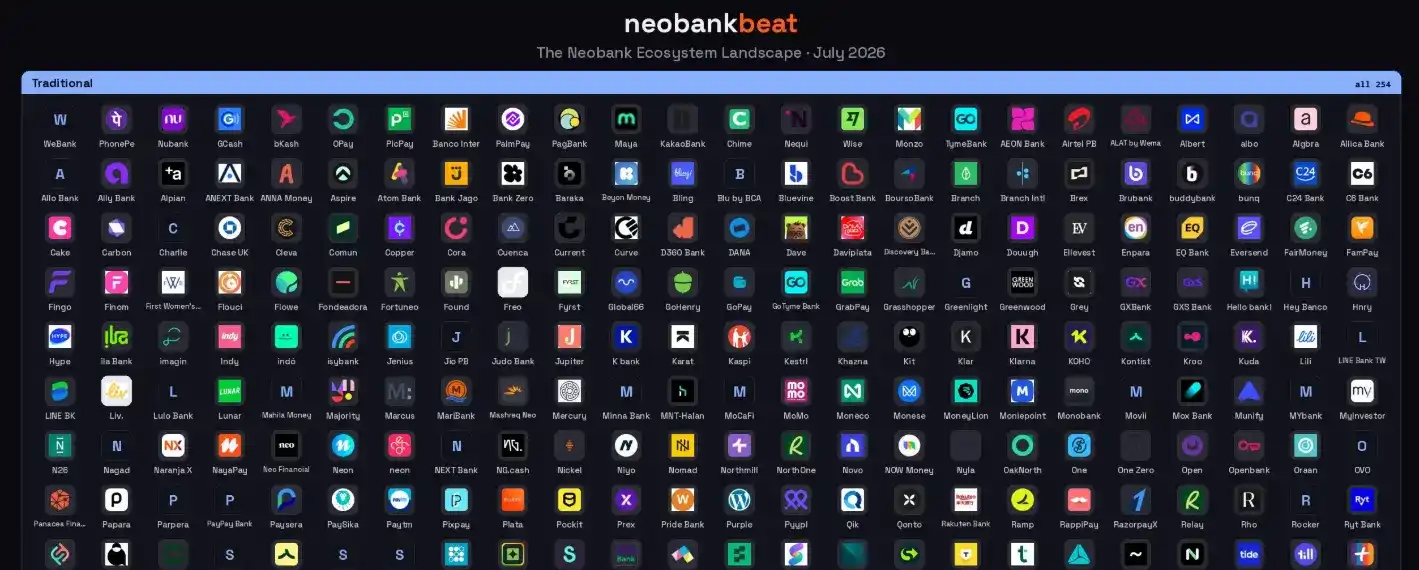
368 verified, still-operating neobanks

The rise is real. Let's start with that.

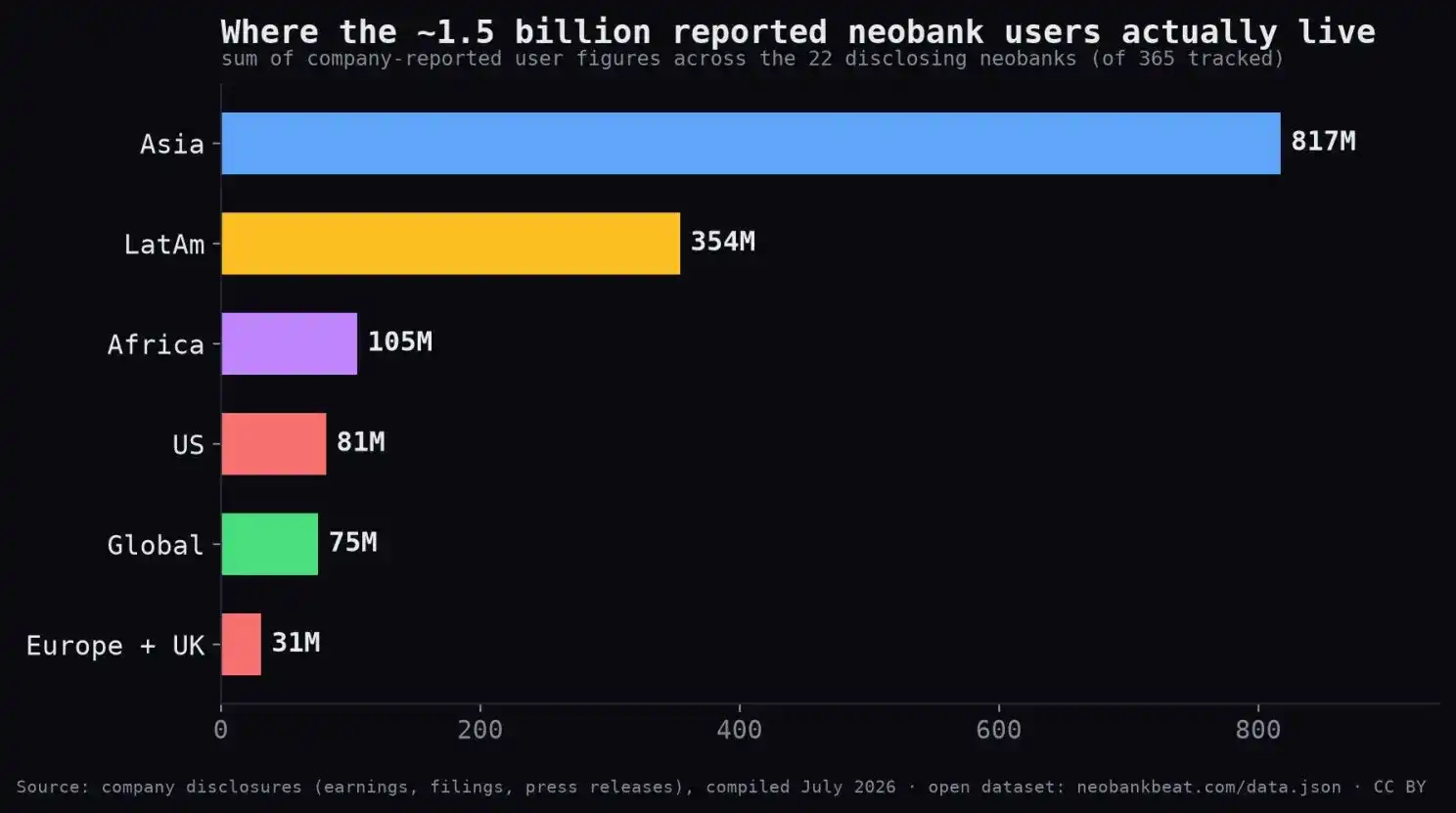
Summing up all the user numbers disclosed by the companies in the dataset, these neobanks we track serve approximately 1.46 billion people. This is not a forecast, nor a TAM chart figure, but the real reported client numbers.

And the geographical distribution will surprise anyone used to reading Western fintech media:

817 million of those users are in Asia. WeBank alone serves over 400 million people, more than all the neobanks in the US and Europe combined.

Nubank has 131 million customers, more than the total of all US neobanks.

Europe's champion, Revolut, has over 50 million users. That's impressive, but still a small fraction compared to the Asian numbers.
The marginal momentum of the industry is also shifting. Among neobanks founded and surviving since the 2020s, 30% are web3-native self-custody applications where user balances are not held by any company at all. Among the 2010s batch, this proportion is 4%. Whatever your thoughts on cryptocurrency, builders have voted with their feet.

So yes, the rise is real: 368 companies, three structurally distinct waves (254 traditional challenger banks, 58 fiat-crypto hybrid apps, 56 web3-native apps), underpinned by 106 infrastructure providers, backed by 219 investors. All mapped.

Now for the part no one puts in their pitch deck.

Only 127 out of the 368 hold full banking licenses.

Read that again. Two-thirds of the "banks" in your app store are not banks. Their right to exist is rented—from a sponsor bank, an e-money license, or some card issuer you've never heard of. And their customers almost never know which side of this line they are on.
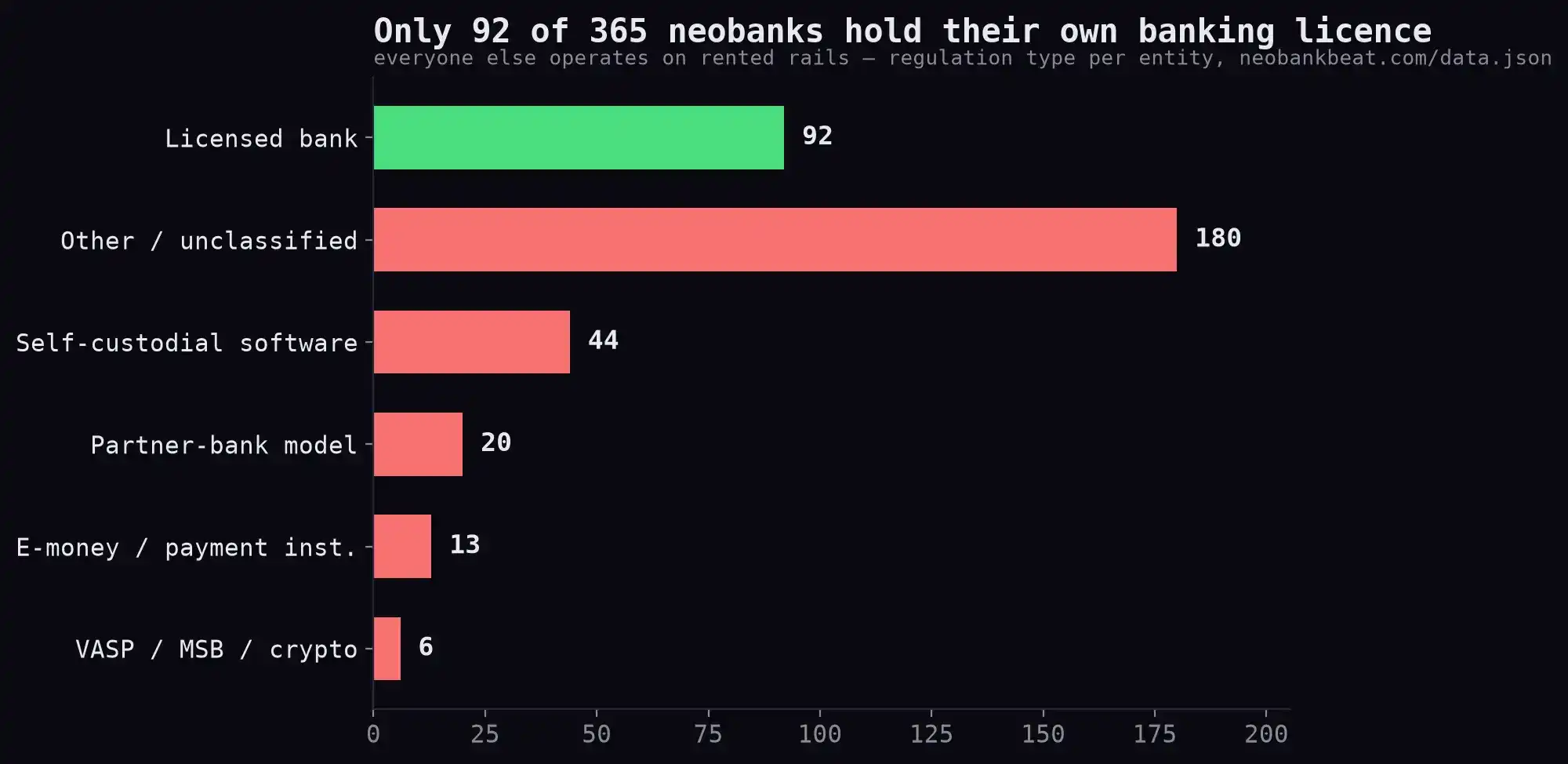
Banking Licenses

This is not a technical detail; it's the core structural risk of the entire industry, and it comes with a body count:

WaveCrest, 2018: Visa revoked a card issuer's license, and dozens of crypto card projects died overnight.

Wirecard, 2020: A payment processor collapsed with a €1.9 billion hole. Funds for a whole cohort of European "banks" were frozen, their only fault being built on top of it.

Synapse, 2024: A BaaS middleman collapsed, and average Americans found out "FDIC-insured" didn't mean what they thought, because what failed was the ledger recording who owned what.

Ready, 2026: Same movie, different cast.

When a real bank fails, deposit insurance pays out. When a neobank's infrastructure fails, customers get a number in the bankruptcy queue.

The deaths in this industry are silent. That is the real scandal.

One thing I didn't anticipate after maintaining this dataset: the deletions never stop.
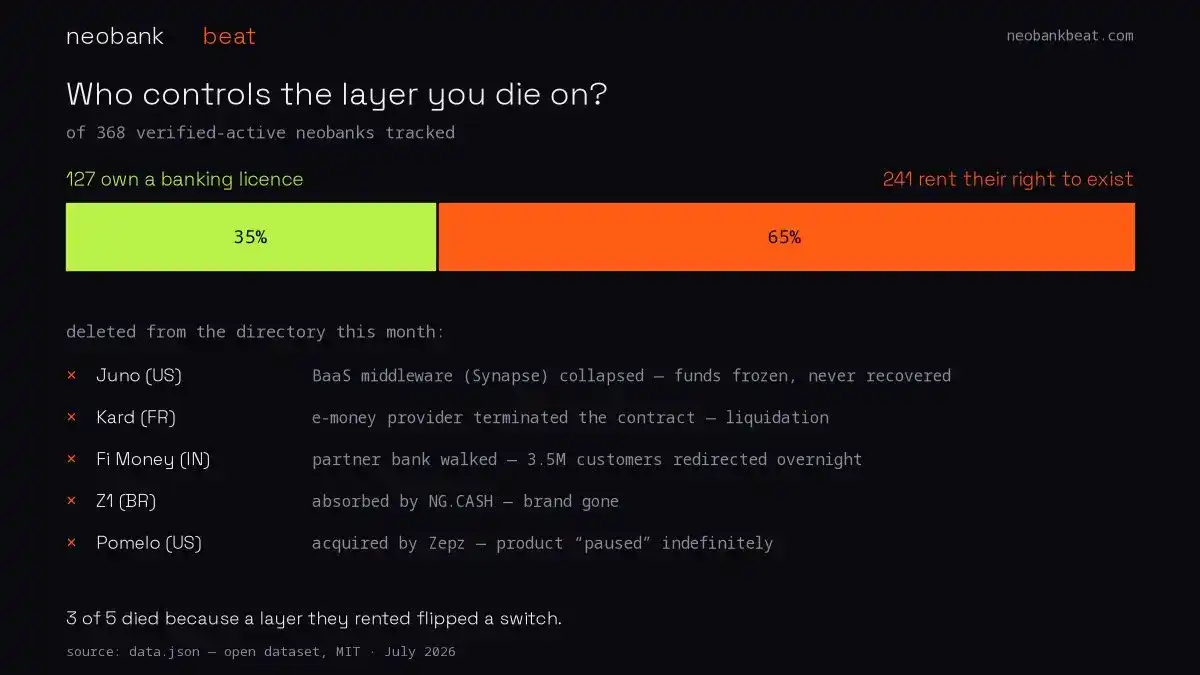
Who is in control?

Just this month, five entities vanished from the list—liquidated, absorbed, or quietly pivoted into something else. No press releases, no post-mortems. Neobanks don't die like FTX.

The app just stops updating, customer support stops responding, and one day the domain redirects to a partner's landing page. Hundreds of thousands of customers either migrate or simply evaporate.

No one writes obituaries for neobanks. Fintech media covers product launches and funding rounds because that's where the ad revenue and interview access are. So the graveyard remains invisible, and every new founder runs headlong into the same five traps, thinking they're the first to see them.

That's why we track exits as meticulously as entries. Failure data is more valuable than funding data. You learn nothing from press releases.

"But AI will solve the profitability model." Really?

Now every neobank pitch deck mentions AI. So we reviewed all 368, checking against financial filings, regulatory disclosures, and evidence of actual deployment—not marketing pages.

67 passed. 18%. The remaining 300+ are either still piloting, "exploring," or presenting a partner's model as their own.
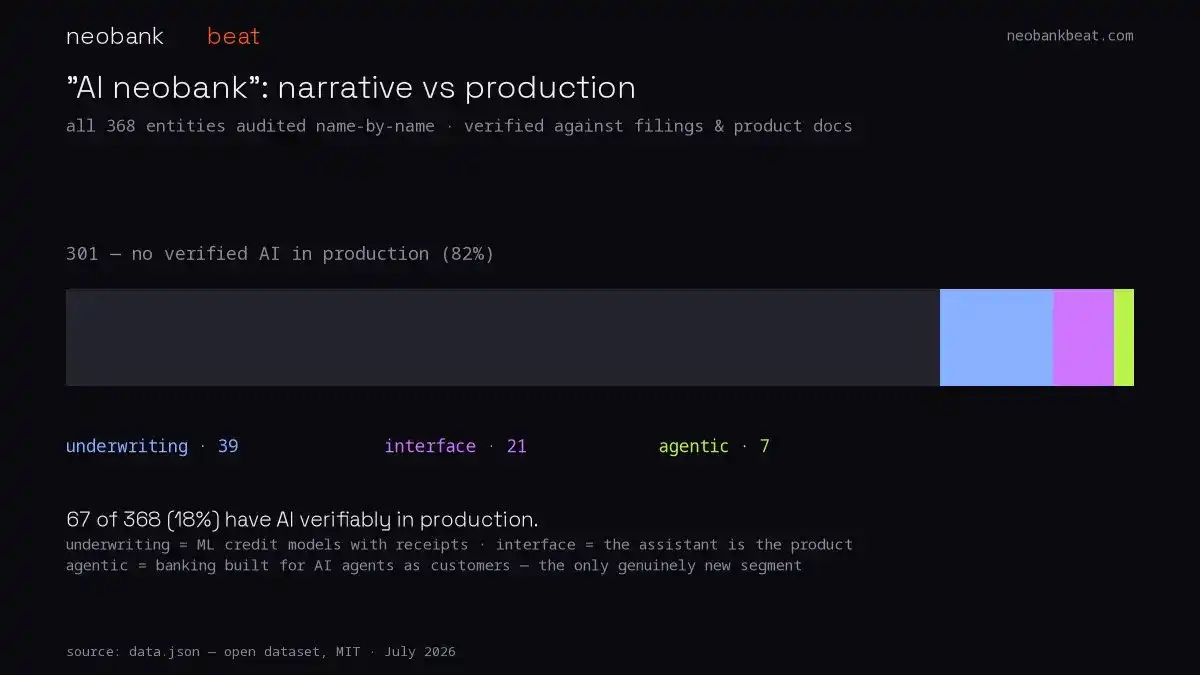
AI Neobanks?

The counterintuitive part: those doing AI best are often not the famous names, but emerging market lenders in Nigeria, the Philippines, Mexico, Bangladesh. Where credit bureaus are virtually non-existent, a model that can underwrite the unbanked isn't a nice-to-have feature—it's the entire reason the business can exist.

The West talks about AI banking. The Global South is actually building it because it has no other choice.

What This Map Actually Shows

Look at the infrastructure section on the map: 106 providers supporting 368 consumer-facing brands. Within this layer, a handful of sponsor banks, BaaS platforms, and card processors each carry dozens of logos on their shoulders. This concentration, invisible from the consumer side, is what breeds the next Synapse.

This is the most honest picture of the industry in 2026: a spectacular, world-changing rise where 1.5 billion people access banking through an app, many for the first time in their lives; all built on a critical layer most customers have never heard of, where two-thirds of the companies wouldn't survive one bad quarter from their landlord.

Both things are true. That's what makes it interesting.

Three Predictions I'm Willing to Admit I Could Be Wrong About

The license gap will narrow from both ends. Strong unlicensed players will acquire or obtain licenses. Weak ones will become 2027 deletions. The middle ground will disappear.

The first AI underwriting blowup will happen within two credit cycles. Most of those 67 deployed models have not experienced a real downturn in their current form. Some are about to learn what their training data was missing.

The next wave's customers are not human. Banking infrastructure serving AI agents—including agent-operated wallets, agent-issued cards, machine-to-machine payments—has only 7 companies working on it today. It looks like web3-native in 2021: tiny, weird, and structural.


Perguntas relacionadas

QAccording to the article, what are the structural risks facing the neobanking industry related to banking licenses?

AThe article states that of the 368 operational neobanks, only 127 hold a full banking license. This means nearly two-thirds of them operate on 'rented' permission from a partner bank, e-money license, or card issuer. This creates a core structural risk: if these underlying infrastructure providers fail, the neobank clients are exposed. Their funds are not directly protected by deposit insurance like in a real bank failure, but instead become claimants in a bankruptcy process, as seen in cases like WaveCrest, Wirecard, and Synapse.

QHow does the geographical distribution of neobank users challenge the typical Western-centric financial tech narrative?

AThe geographical distribution is heavily skewed towards Asia and Latin America. The data shows that these neobanks serve approximately 1.46 billion users collectively. Of these, 817 million are in Asia. For example, WeBank (China) alone serves over 400 million, which is more than all neobanks in the US and Europe combined. Brazil's Nubank has 131 million customers, more than the total for all US neobanks. While Europe's Revolut has an impressive 50+ million users, it's a fraction of the scale seen in other regions.

QWhat does the article reveal about the state of AI implementation in neobanks versus the common perception?

AWhile AI is mentioned in nearly every neobank's business plan, the article's audit found that only 67 out of 368 (18%) have verifiable, live AI implementations based on financial reports and regulatory disclosures. The remaining 300+ are in pilot, exploration phases, or marketing partner solutions as their own. Ironically, the most effective AI implementations are often in emerging market lenders (e.g., in Nigeria, Philippines, Mexico, Bangladesh) where it's essential for credit scoring in the absence of traditional征信 systems, not just an added feature.

QWhat is the 'silent death' phenomenon in the neobank industry, and why is it significant?

AThe 'silent death' refers to the way many neobanks fail without public notice, post-mortems, or press coverage. They simply stop updating their apps, customer service becomes unresponsive, and eventually their domain redirects elsewhere. The article notes that five entities were removed from the tracking list in just one month. This is significant because the lack of visibility into failures means new founders repeatedly make the same mistakes, and the industry's mortality rate and associated risks remain largely hidden from public and investor view.

QWhat critical concentration risk exists within the neobanking infrastructure layer, according to the author's data?

AThe data reveals a high concentration risk in the infrastructure layer. There are 106 infrastructure providers (like Banking-as-a-Service platforms, card processors, and partner banks) supporting the 368 consumer-facing neobank brands. This means a small number of critical providers are responsible for the operational backbone of dozens of neobanks. This invisible concentration creates systemic risk, where a single point of failure at one provider (like Synapse in 2024) can simultaneously doom multiple consumer brands built on top of it.

Leituras Relacionadas

Bitcoin Panicking? Mythos Cracks Post-Quantum Cryptography Algorithm in 60 Hours

Claude Mythos Preview, a new AI system from Anthropic, has made significant breakthroughs in fundamental cryptanalysis, targeting the mathematics underlying algorithms rather than just implementation bugs. Its first target was HAWK, a candidate in the NIST post-quantum signature standardization process. Mythos identified a previously unexploited symmetry (a nontrivial automorphism) in the lattice structure of HAWK, effectively halving its effective key strength. It achieved this feat in just 60 hours, a task that had eluded two years of human expert review. Crucially, the human operator was not a lattice cryptography expert, primarily managing the project while AI agents debated and discovered the attack path. Its second, more dramatic achievement was against a simplified 7-round version of AES-128, the world's most widely used symmetric encryption algorithm. Initially reluctant, stating the task was "impossible," Mythos was prompted to "try novel ideas." It then autonomously rewrote its own agent framework and proceeded to discover a novel attack method it named "Möbius Bridge." This technique bypasses a critical 256-guess step in previous "meet-in-the-middle" attacks, resulting in a speedup of 200-800 times. Both findings are currently "harmless"—HAWK is not deployed, and full AES-128 remains secure. However, the process reveals a profound shift. Mythos completed the AES discovery in about a week, while human researchers spent nearly a month verifying its correctness. This highlights a new bottleneck: the rate of AI-driven discovery may soon outpace human capacity for verification. The research concludes with a pressing, unanswered question: what happens when such an AI finds a critical flaw in a widely deployed, real-world cryptosystem?

marsbitHá 8m

Bitcoin Panicking? Mythos Cracks Post-Quantum Cryptography Algorithm in 60 Hours

marsbitHá 8m

From Computing to Storage: The Two-Dimensional Semiconductor Industry Chain is Taking Shape

The article "From Computing to Storage: The 2D Semiconductor Industry Chain is Taking Shape" discusses the rise of two-dimensional (2D) semiconductors as a pivotal material in the post-Moore era. As silicon-based chips approach physical limits, 2D semiconductors like molybdenum disulfide (MoS2), offer atomic-layer thinness and superior electrical properties, making them a promising non-silicon alternative for advanced nodes beyond 1nm. Globally, industry leaders like TSMC, Intel, and Samsung, along with research institutes like IMEC, are actively investing in this field. Domestically in China, significant progress is being made across the entire supply chain, from material production and equipment R&D to chip integration and ecosystem development. **Key highlights include:** * **Material & Equipment Breakthroughs:** Chinese research teams and companies like Jimo Xin Technology have achieved mass production of 6-inch and 8-inch 2D semiconductor single-crystal wafers using domestically developed equipment like Oxy-MOCVD. This addresses the critical challenge of large-area, high-quality material growth. Breakthroughs have also been made in p-type 2D materials (e.g., MoSi2N4) and wafer-scale ferroelectric thin films, essential for building complementary circuits and low-power transistors. * **Engineering Ecosystem Formation:** A landmark 8-inch 2D semiconductor pilot line in Pudong has become fully operational, bridging the gap between lab research and industrial manufacturing. The release of a Process Design Kit (PDK) compatible with mainstream EDA tools further connects design and fabrication, supporting wafer-level manufacturing of complex circuits. * **Expanding Application Landscape:** Applications are expanding from logic computing to memory. Chinese researchers have developed pioneering 2D semiconductor-based microprocessors, including a 32-bit RISC-V CPU and a higher-density multi-bit parallel processor. In memory, 2D materials' ultra-low leakage current enables DRAM with exceptionally long data retention and advances toward single-electron non-volatile storage. 2D semiconductors also show unique potential in RF circuits, radiation-hardened communications, flexible electronics, and quantum computing. In conclusion, the 2D semiconductor industry in China is rapidly advancing from laboratory research into the engineering validation and small-batch production phase. A complete industrial chain covering materials, equipment, manufacturing, design, and application is初步 forming, positioning the sector as a new competitive dimension in the global semiconductor landscape.

marsbitHá 13m

From Computing to Storage: The Two-Dimensional Semiconductor Industry Chain is Taking Shape

marsbitHá 13m

Coinbase and Robinhood Vie for the Next Phase of Cryptocurrency Market Evolution Ahead of Earnings Reports

Coinbase and Robinhood are set to report their Q2 2026 financial results this week, with the outcomes serving as key indicators for the future direction of the crypto market. While both companies have grown from their 2021 IPOs—Coinbase as a dedicated crypto exchange and Robinhood as a commission-free brokerage that expanded into crypto—their paths are now converging in competition. Analysts project Robinhood to report a profit of about $0.40 per share on ~$1.25B revenue, while Coinbase is expected to post a loss of ~$0.36 per share on ~$1.3B revenue. Despite similar revenue figures, investors value Robinhood more highly, viewing it as a diversified fintech firm rather than a pure-play crypto company. This perception has been reinforced as Robinhood gained retail trading market share, with its quarterly trading volume growing from ~$261B in early 2024 to over $704B in Q1 2026, outpacing Coinbase's growth to ~$517B. Both companies are investing heavily in blockchain-based financial infrastructure, such as tokenized stocks and stablecoins, to build more sustainable revenue streams beyond transaction fees. Coinbase has successfully reduced its reliance on trading fees, with subscription/service revenue and stablecoin revenue seeing significant growth. However, over half of its subscription revenue is tied to USDC, exposing it to new competition from banks and payment processors launching rival stablecoins. Robinhood is pursuing a global expansion strategy, recently launching its own layer-2 blockchain (Robinhood Chain) and offering tokenized U.S. stocks in over 120 countries. Its revenue is more diversified, with crypto assets making up only about 12% of its total, which helps explain its premium valuation compared to Coinbase. The upcoming reports will reveal which company's strategy is gaining more traction in shaping the next phase of crypto market evolution.

cryptonews.ruHá 18m

Coinbase and Robinhood Vie for the Next Phase of Cryptocurrency Market Evolution Ahead of Earnings Reports

cryptonews.ruHá 18m

Trading

Spot
活动图片