Coinbase and Robinhood Vie for the Next Phase of Cryptocurrency Market Evolution Ahead of Earnings Reports

cryptonews.ruPublicado em 2026-07-29Última atualização em 2026-07-29

Resumo

Coinbase and Robinhood are set to report their Q2 2026 financial results this week, with the outcomes serving as key indicators for the future direction of the crypto market. While both companies have grown from their 2021 IPOs—Coinbase as a dedicated crypto exchange and Robinhood as a commission-free brokerage that expanded into crypto—their paths are now converging in competition. Analysts project Robinhood to report a profit of about $0.40 per share on ~$1.25B revenue, while Coinbase is expected to post a loss of ~$0.36 per share on ~$1.3B revenue. Despite similar revenue figures, investors value Robinhood more highly, viewing it as a diversified fintech firm rather than a pure-play crypto company. This perception has been reinforced as Robinhood gained retail trading market share, with its quarterly trading volume growing from ~$261B in early 2024 to over $704B in Q1 2026, outpacing Coinbase's growth to ~$517B. Both companies are investing heavily in blockchain-based financial infrastructure, such as tokenized stocks and stablecoins, to build more sustainable revenue streams beyond transaction fees. Coinbase has successfully reduced its reliance on trading fees, with subscription/service revenue and stablecoin revenue seeing significant growth. However, over half of its subscription revenue is tied to USDC, exposing it to new competition from banks and payment processors launching rival stablecoins. Robinhood is pursuing a global expansion strategy, recently launching ...

This week, Coinbase and Robinhood will announce their second-quarter 2026 financial results, and in this regard, the reports will tell a story about the future of cryptocurrencies as well as about the companies themselves.

Robinhood will publish its report on Wednesday after market close, and Coinbase on Thursday. Collectively, the reports from both companies serve as one of the clearest indicators of whether digital assets continue to evolve through speculative trading or are transforming into a more sophisticated type of financial infrastructure, encompassing stablecoins, subscription products, and "tokenized" assets.

Two Financial Reports the Whole Market Will Read

Coinbase and Robinhood became public companies in 2021 but took different paths to do so. While Coinbase built its business on cryptocurrency trading and custody, Robinhood established itself as a company offering commission-free trading, later expanding its activities into cryptocurrencies and other digital assets. Today, both companies are becoming competitors in the same markets.

Wall Street expects Robinhood to report a profit of about $0.40 per share on expected revenue of $1.25 billion, and Coinbase to report a loss of about $0.36 per share on revenue of approximately $1.3 billion.

Although both companies have roughly similar revenue volumes, investors treat them completely differently. Data from Artemis shows that Robinhood has historically been valued higher than Coinbase based on the enterprise value-to-revenue ratio, indicating that investors perceive it more as a diversified fintech company than as an organization primarily engaged in cryptocurrency trading.
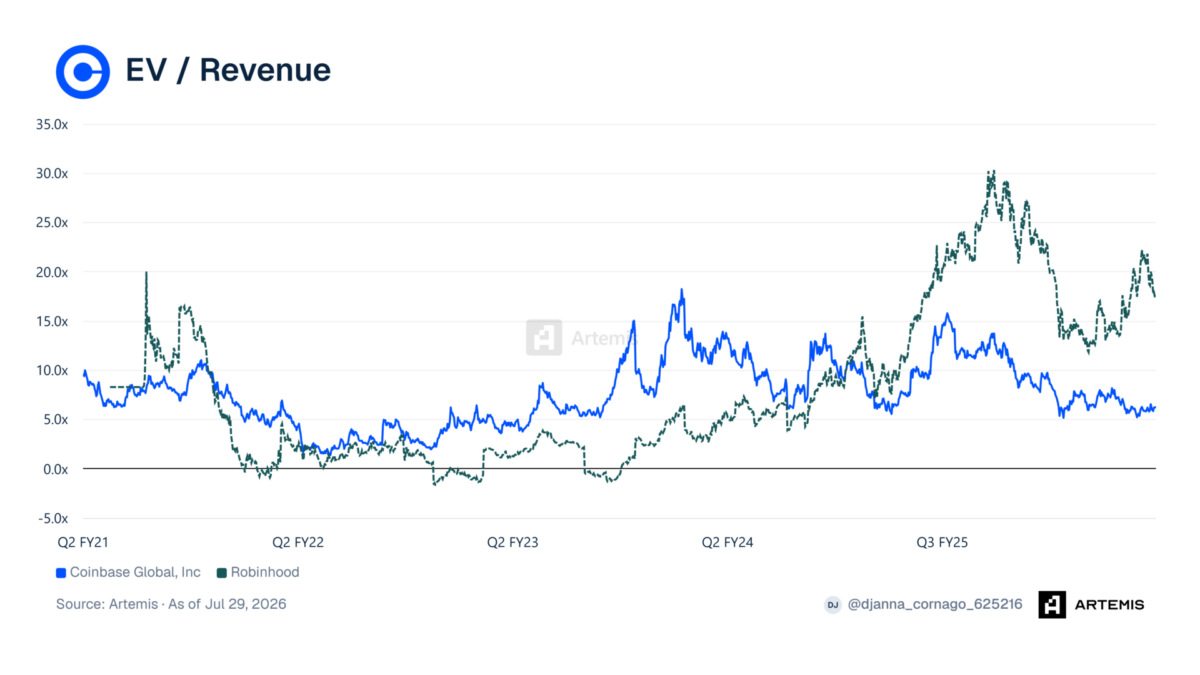
This distinction was further emphasized following downgrades of Coinbase by a number of analysts, with Mizuho analyst Dan Dolev suggesting that Robinhood could become the first "hyperscale player" in the brokerage sector.

Why the Retail Trading Downturn Matters Beyond Just Two Stocks

Cryptocurrency markets surged sharply after Donald Trump's election victory in late 2024, then fell as retail investor activity declined.

Robinhood appears to have adapted better to the changes. Data from Artemis showed that Robinhood's quarterly trading volume grew from about $261 billion in early 2024 to over $704 billion in Q1 2026. Coinbase also showed improvement: total trading volume increased from about $185 billion to around $517 billion over the same period, although more slowly than Robinhood.
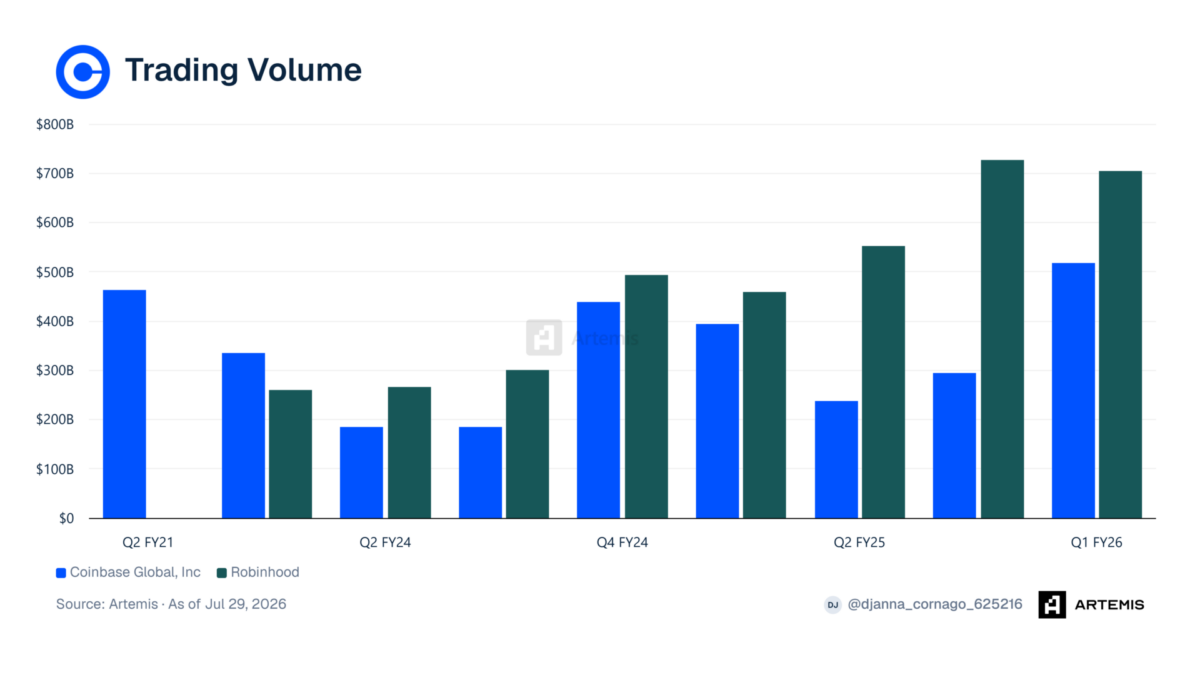
The difference indicates that Robinhood has gained a larger share of the retail trading business. However, investors will assess not only trading volumes but also whether these achievements can translate into sustainable profits.

Both companies have invested significant resources in the area of tokenized stocks and believe that their bet on blockchain technology will pave the way for integrating traditional financial instruments with cryptocurrencies. This strategy points to a broader movement towards creating other, more long-term revenue sources beyond transaction fees.

Coinbase's Stablecoin Processing System Faces New Competitors

Coinbase appears to have successfully reduced its reliance on fees from trading operations in recent years.

According to Artemis data, subscription and services revenue grew from about $103 million in mid-2021 to nearly $747 million by Q3 2025. Stablecoin revenue also increased significantly, rising from approximately $77 million at the end of 2022 to over $364 million, before slightly declining this year.
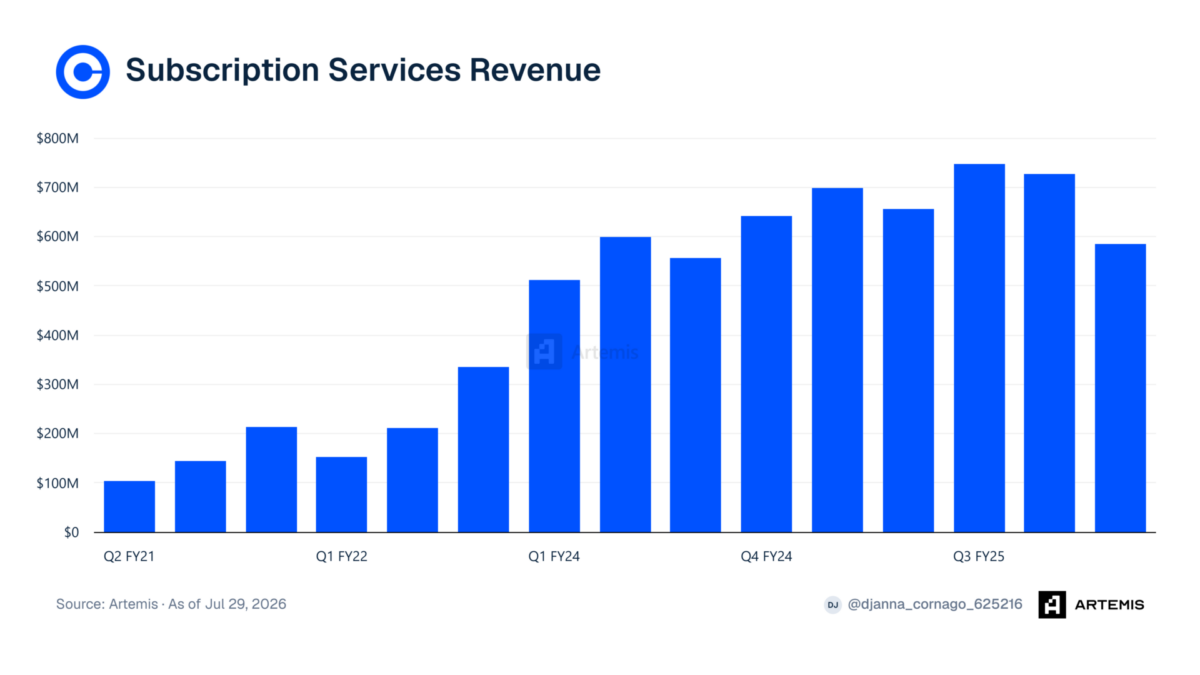
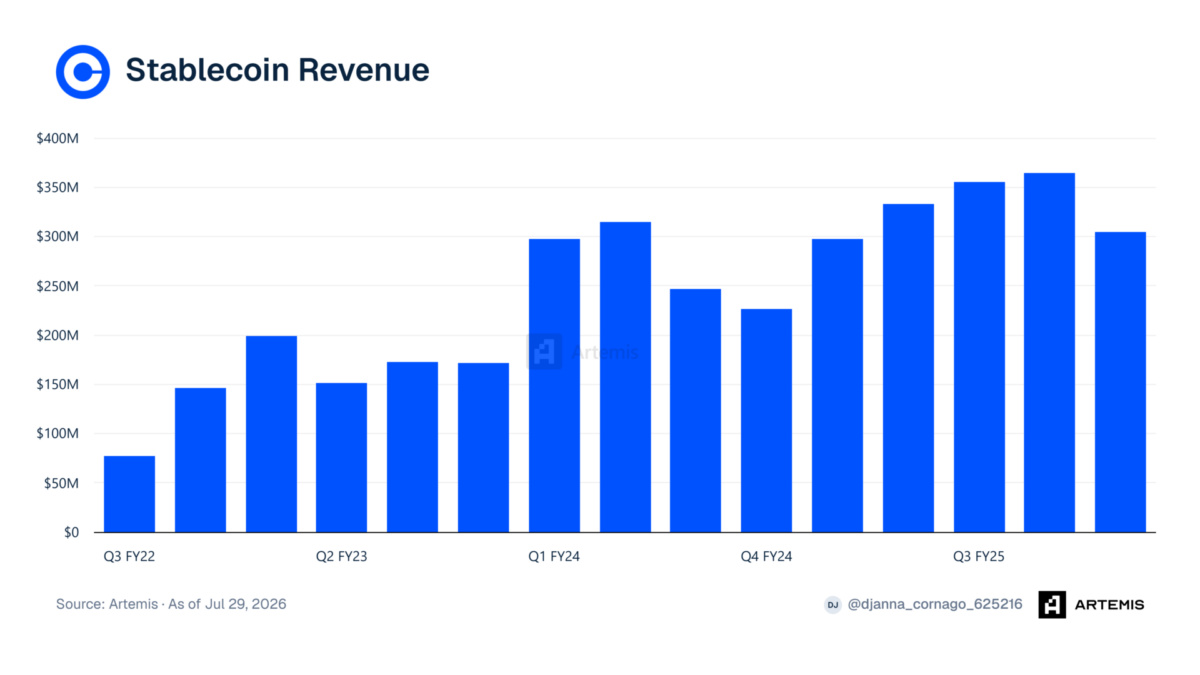
These segments have mitigated the impact of declining trading activity, and client assets on the exchange have remained above bear market lows despite recent fluctuations.

However, there is a concentration risk. In its Q1 shareholder letter, Coinbase reported that over half of its subscription and services revenue is linked to USDC. This segment may face pressure as both banks and major payment processors launch new dollar-backed stablecoins.

CEO Brian Armstrong has also refocused Coinbase's goals on financial infrastructure after realizing that the company's previous attempts to create a social network using Base were unsuccessful.

Robinhood's Global Expansion

The Robinhood company is pursuing many similar initiatives but is scaling them through its consumer platform.

Earlier this month, the company announced the launch of Robinhood Chain, an Arbitrum-based layer-2 blockchain, as well as the tokenization of U.S. company stocks for clients in over 120 countries. Robinhood claims to have nearly 28 million customers conducting business in 38 countries.

CEO Vlad Tenev called tokenization a potential "supercycle" for capital markets, reflecting growing institutional interest in blockchain-based settlements and digital securities.

However, Robinhood is not as dependent on cryptocurrencies as Coinbase. Digital assets account for only about 12% of the company's revenue, while brokerage services, options trading, prediction markets, and other products provide additional income streams.

Such diversification helps explain why investors continue to value Robinhood higher than Coinbase, despite both companies having roughly similar revenue.

end-content

Perguntas relacionadas

QWhat are the key differences in market perception between Coinbase and Robinhood, and how is this reflected in their valuation metrics?

AInvestors perceive Robinhood more as a diversified fintech company, while Coinbase is viewed primarily as a cryptocurrency trading entity. This is reflected in Robinhood's historically higher enterprise value to revenue ratio compared to Coinbase.

QHow have the trading volumes of Coinbase and Robinhood changed between early 2024 and Q1 2026, and what does this trend suggest?

ARobinhood's quarterly trading volume grew from approximately $261 billion in early 2024 to over $704 billion in Q1 2026. Coinbase's total trading volume increased from about $185 billion to around $517 billion over the same period. The trend suggests Robinhood has been capturing a larger share of the retail trading business.

QWhat strategic shift has Coinbase made regarding its revenue streams, and what are the key non-trading revenue segments it has developed?

ACoinbase has successfully reduced its reliance on trading fees by developing other revenue streams. Key non-trading segments include 'Subscription & Services' revenue (growing from ~$103M in mid-2021 to nearly $747M in Q3 2025) and stablecoin revenue (increasing from ~$77M in late 2022 to over $364M).

QWhat major risk to Coinbase's revenue diversification is highlighted in the article, particularly concerning its 'Subscription & Services' income?

AA major risk is concentration. More than half of Coinbase's 'Subscription & Services' revenue is linked to USDC. This segment could face pressure as banks and large payment processors launch new dollar-backed stablecoins, increasing competition.

QHow does Robinhood's business model and recent strategic initiatives differ from Coinbase's, particularly in terms of diversification and expansion?

ARobinhood is more diversified, with digital assets constituting only about 12% of its revenue, supplemented by brokerage, options trading, prediction markets, and other products. Recent initiatives include launching the 'Robinhood Chain' (an Arbitrum-based L2 blockchain) and tokenizing U.S. stocks for clients in over 120 countries, reflecting a focus on global consumer platform expansion and blockchain-based financial infrastructure.

Leituras Relacionadas

In Conversation with Ray Dalio: We Are Currently in an AI Bubble, with 1% of My Portfolio in Bitcoin

Ray Dalio, founder of Bridgewater Associates, warns in an interview that the current AI boom shows classic bubble characteristics, which could lead to significant economic downturns as seen in past cycles like 1929 or 2000. He explains that speculative enthusiasm, fueled by debt and overvaluation, often precedes a crash when rising rates or taxation force asset sales, causing widespread losses and recession. Dalio also outlines his "Big Cycle" theory, describing an approximate 80-year pattern where widening wealth gaps, massive government deficits, and shifting geopolitical power (like China's rise) create internal conflict and global instability. He emphasizes that we are in a late-cycle, transitional phase where traditional powers like the US and UK face decline. For personal wealth protection, Dalio advises diversification beyond cash into assets like stocks, bonds, real estate, and particularly gold, which he prefers over Bitcoin. While he holds about 1% of his portfolio in Bitcoin as a non-printable hard asset, he views gold as more secure from technological or governmental threats. Regarding AI's impact, Dalio believes it will disproportionately benefit capital owners, worsening inequality by replacing both physical and cognitive labor. He suggests that human intuition and emotional intelligence, combined with AI, will be key for future workers. On taxation, Dalio argues that wealth taxes are impractical and risk triggering asset sell-offs, reducing productive investment. He points to the UK as a cautionary example of debt, low productivity, and political strife. Geopolitically, Dalio foresees a more regionalized world, with the US showing weakness in prolonged conflicts like with Iran, akin to past imperial declines. The ideal outcome, he suggests, is coexisting powerful blocs (e.g., Americas, China-Asia Pacific) without major war.

marsbitHá 1h

In Conversation with Ray Dalio: We Are Currently in an AI Bubble, with 1% of My Portfolio in Bitcoin

marsbitHá 1h

Daily 7.2 Trillion KRW: Foreign Capital's Record Net Buying on Friday! Wall Street Says Headwinds for Korean Stock Fund Flows Have Subsided

South Korean stock market sees a dramatic shift in fund flows. On July 31, foreign investors made a record net purchase of approximately KRW 7.2 trillion in KOSPI stocks, marking a fundamental reversal from the persistent large-scale net outflows seen in previous months. This contributed to a significant narrowing of foreign net selling in July to KRW 9.8 trillion, down sharply from KRW 48.4 trillion in June and KRW 44.5 trillion in May. Simultaneously, domestic institutional pressure eased. South Korean pension funds and asset managers turned to a net buying position in July, purchasing KRW 1.0 trillion worth of KOSPI shares, contrasting with net sales in May and June. Market volatility is expected to be dampened by new financial regulations. Effective July 31, the Financial Services Commission tightened access for retail investors to single-stock leveraged ETFs by raising the minimum cash deposit requirement. Trading volumes for these products subsequently dropped to about 50% of their monthly average. Citigroup Research maintains its year-end KOSPI target of 10,000 points. The firm cites several supportive factors: the substantial easing of headwinds from capital outflows, a robust fundamental outlook for the semiconductor sector, historically low market valuations, strong economic fundamentals, and the potential for policy support from financial authorities if needed.

marsbitHá 1h

Daily 7.2 Trillion KRW: Foreign Capital's Record Net Buying on Friday! Wall Street Says Headwinds for Korean Stock Fund Flows Have Subsided

marsbitHá 1h

Thanks to Dice Rolls, Bitcoin Keys Are Stored Offline, But Not Everyone Will Do It

The article discusses using dice rolls to generate secure Bitcoin wallet seeds, providing entropy independent of potentially flawed hardware random number generators. It explains that each fair dice roll offers about 2.585 bits of entropy, with around 50 rolls needed for a standard 12-word seed phrase and 99+ recommended for higher security. This method gained attention after a vulnerability was revealed in some Coldcard hardware wallets, where a faulty firmware RNG (dating back to 2021) compromised generated keys. The analysis notes that while a dice-generated main seed was safe from this specific flaw, other Coldcard functions (like creating paper wallets, backup keys, or passwords) could still be vulnerable if they used the defective RNG. The piece argues that while dice-based entropy is technically robust, the manual process is error-prone, tedious, and unrealistic for most new users, who might make mistakes in recording or inputting rolls. It concludes that while manual entropy generation should remain an option for advanced users, the long-term goal is to develop reliable, user-friendly hardware and software that securely generates randomness without requiring specialized knowledge. Coldcard users are advised to check their firmware version and replace any secondary secrets (like paper wallet keys) created with vulnerable devices, while also considering multi-signature setups with devices from different manufacturers for added security.

cryptonews.ruHá 7h

Thanks to Dice Rolls, Bitcoin Keys Are Stored Offline, But Not Everyone Will Do It

cryptonews.ruHá 7h

Trading

Spot
活动图片




