Institutions and On-Chain Capital Are Bullish on CXMT's Continued Surge, Except for South Koreans

Odaily星球日报Publicado em 2026-07-27Última atualização em 2026-07-27

Resumo

Changxin Technology, China's leading memory chip manufacturer, made its debut on the STAR Market, closing up 465.8% with a market cap of 3.28 trillion yuan. Its record-breaking first day included over 140 billion yuan in turnover. Market opinions on its future trajectory diverge. Nomura issued a "buy" rating with a 116 yuan target (implying ~1239.5% upside), citing rapid growth projections, expansion into HBM, and the "crown jewel" status of its DRAM business. Northeast Securities offered a more conservative 10-15x PE valuation range, implying significant but lower upside. While the stock's surge reflects optimism, analysis suggests Changxin's current capacity remains below giants like Samsung and SK Hynix. U.S. equipment export restrictions may limit near-term expansion, and the company is not yet competitive in the high-margin HBM segment crucial for AI. On-chain data from Hyperliquid showed pre-listing positioning was net long by wallets tagged to the U.S., Hong Kong, and mainland China, while Korean-tagged wallets were heavily net short. Other bullish factors noted include a low initial float (6.63%), the ongoing memory "super cycle," and the stock's unique status as a domestic industry leader. Founder Zhu Yiming's plan to distribute 40% of his increased wealth to employees may also slow share sales. Multiple ETF issuers warned that fund net asset values might deviate from displayed reference values on the first day due to the large gap between Changxin's IPO price a...

Original|Odaily Planet Daily(@OdailyChina)

Author|Wenser(@wenser 2010 )
The esteemed "China's top storage stock," CXMT (ChangXin Memory Technologies), finally landed on the STAR Market today, closing up 465.8% on its debut, with a full-day turnover exceeding 140 billion yuan and a total market capitalization reaching 3.28 trillion yuan.

Simultaneously, it broke multiple thresholds on its first trading day, setting several A-share historical records including "first tech stock with an opening market cap exceeding 3 trillion yuan," "top market cap on the STAR Market," "first stock with a single-day turnover breaking 100 billion yuan," and "first IPO with over 100 billion turnover combined with a >50% turnover rate."

With the market performance on its debut day settled, the next question arises—can CXMT's stock price continue to rise? What is its target price? Currently, the market still holds some divergence on this matter.

Heated Debate on CXMT's Future Price Direction: Nomura Bullish to 116 Yuan, Northeast Securities Gives 10-15x PE Judgment

As the currently "world's fourth, China's first" storage giant, CXMT's market position is unquestionable.

According to data disclosed in CXMT's IPO press release, the company expects revenue of 110-120 billion yuan for the first half of 2026, a year-on-year increase of 612.53% to 677.31%; it expects net profit attributable to shareholders of 50-57 billion yuan, a year-on-year increase of 2244.03% to 2544.19%. In light of this, many institutions have given their own judgments on its future prospects.

Viewpoint One: Nomura Securities Gives a Buy Rating, Bullish to 116 Yuan, Market Cap Exceeds 7.7 Trillion RMB

This morning, international investment bank Nomura Securities issued a report, giving CXMT a "buy" rating with a target price of 116 yuan, corresponding to a 20x P/E ratio, implying an upside of 1239.5%. This valuation is double that of US storage giant Micron (MU), meaning CXMT's stock price would rise about 13.4 times from its IPO price, corresponding to a market cap of approximately 7.76 trillion yuan.

Notably, in the report title, Nomura likened the industrial value of CXMT's DRAM chips to "the jewel in the crown of China." According to its model projections, CXMT's revenue will rapidly increase from 61.8 billion yuan in 2025 to 290.7 billion yuan in 2026, 560.8 billion yuan in 2027, and 773.3 billion yuan in 2028; Nomura also expects CXMT's net profit attributable to shareholders to climb from less than 1.9 billion yuan to 130.3 billion yuan in 2026, 277.2 billion yuan in 2027, and 393.1 billion yuan in 2028. The compound annual growth rates for these two indicators are projected at 63% for revenue and 74% for net profit.
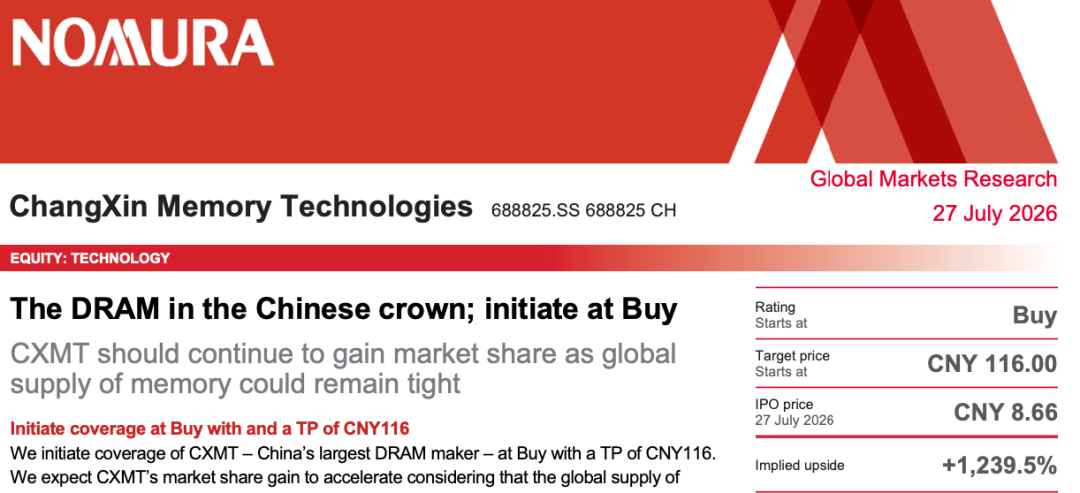
It is worth noting that Nomura's judgment, which is nearly 2.4 times the current market cap, is not unfounded. It is based on a comprehensive assessment of dimensions such as capacity expansion, technology upgrades, and price increases, and is also related to factors such as CXMT's current product mix, the storage super-cycle, and the subsequent use of IPO proceeds. For more on the underlying logic, recommended reading: "Thirteen Times Bullish on CXMT?"

According to information from CXMT's IPO prospectus, out of the 57.9 billion yuan raised, 7.5 billion yuan will be used for technology upgrade and transformation of the mass production line for memory wafer manufacturing, 13 billion yuan will be used for core DRAM memory process technology upgrades, and 9 billion yuan will be used for forward-looking technology research and development. The market generally believes the final 9 billion yuan will be allocated to HBM (High Bandwidth Memory) direction R&D, which is the core business of current memory giants like SK Hynix and Micron—AI chip high-bandwidth memory.

In other words, CXMT is not content with its current mainline DRAM business but is also striving to expand into high-profit, high-demand sectors like HBM.

Viewpoint Two: Northeast Securities Judges Valuation Range Converges to 3.2-5.7 Trillion RMB

Compared to the extremely optimistic Nomura, Northeast Securities offers a relatively conservative bullish range, but it still implies over 42% upside from the current market cap.

To provide a reasonable valuation for CXMT, Northeast Securities gives a market cap reference from the following three aspects:

  • Market Share Relative Valuation Perspective: Using US stocks as a valuation reference, by comparing and analyzing the market shares of Micron Technology, SK Hynix, Samsung Electronics, SanDisk, etc., in the DRAM and NAND markets, and splitting their market caps by different businesses, considering CXMT's future market share, the target market cap is 3.49 trillion yuan.
  • Profitability Breakdown Perspective: By decomposing CXMT's historical revenue and cost structure, using price and capacity as core variables to forecast profits for this year and next, with 2027 net profit attributable to shareholders at 284.8 billion yuan, a 10—15x P/E ratio corresponds to a target market cap of 2.85—4.27 trillion yuan.
  • Market Cap Per Unit Capacity Perspective: Calculating the market cap per unit capacity for overseas listed storage companies in the DRAM business and using this as a basis, a target market cap of 3.22—3.99 trillion yuan is calculated.

For detailed calculations and reasoning, recommended reading: "A-Share's New 'Stock King' is Born, How to Reasonably Value CXMT?"

Viewpoint Three: Multiple ETF Funds Warn ETF NAV May Deviate from IOPV on CXMT's Debut Day

This morning, prior to CXMT's listing, ETF fund managers such as ChinaAMC and Harvest Fund issued announcements warning that some of their ETFs participated in the IPO subscription for CXMT and valued it at the issue price. However, the ETF's Indicative Optimized Portfolio Value (IOPV) only includes CXMT's issue price and does not reflect its market price fluctuations. Therefore, on CXMT's debut day, the IOPV of these ETFs may differ from the actual net asset value per fund share, and investors are advised to pay attention to related investment risks.

In this regard, an ETF fund manager explained that currently, ETF participation in IPOs is generally done together with active equity funds. The IOPV for ETFs is strictly calculated based on the PCF (Portfolio Composition File) list, and restricted shares like new stocks not yet included as constituents are not counted. CXMT's sharp rise on its debut will cause the actual net asset value per share of ETFs that participated in the IPO to be slightly higher than the IOPV, creating a deviation. In such cases, potential arbitrage strategies could include buying the ETF while hedging with derivatives, retaining only the excess exposure from the deviation.

In simpler terms, the IOPV (reference net value) seen by investors is calculated based on CXMT's issue price of 8.66 yuan, but the fund's actual NAV is calculated based on the market price. Therefore, the IOPV severely "undervalues" the fund's true worth, appearing as a discount. Essentially, this is because CXMT's opening price surged, but there's a lag in the display on investment systems, aiming to prevent investors from buying ETF funds at inflated prices due to market volatility and incurring losses.

Viewpoint Four: Analyst Believes CXMT's Listing Surge Still Hard to Change Global DRAM Shortage Situation

Today, Milk Road AI analyst Melvin posted an analysis on CXMT's stock price surge.

He stated that in less than a year, CXMT's global DRAM market share increased from less than 4% to about 7.7%-8%, with Q1 revenue this year growing 719% year-on-year to 50.8 billion yuan. This growth primarily benefited from Samsung, SK Hynix, and Micron shifting more capacity to AI server storage (especially HBM), creating a supply gap in the traditional DDR5, LPDDR5 market, which CXMT filled by addressing mid-to-low-end DRAM demand.

However, CXMT's current capacity is far from sufficient to meet global demand. Its current monthly wafer capacity is about 290,000-320,000 pieces, lower than Samsung's approximately 630,000 pieces and SK Hynix's about 500,000 pieces. Furthermore, U.S. export restrictions on advanced lithography equipment are limiting the pace of CXMT's further expansion.

He believes that CXMT will find it difficult to enter the HBM market in the short term and therefore will not change the supply-demand dynamics of AI storage. Samsung, SK Hynix, and Micron will likely maintain their advantage in high-margin products like HBM, server DRAM, and LPDDR5X, and the global storage shortage cycle may persist.

In simpler terms, the analyst believes that CXMT's listing surge will not directly translate into a linear increase in market share or a massive surge in storage industry supply, offering a relatively neutral expectation for market cap and price performance from a rational perspective.

Viewpoint Five: On-Chain Sentiment Divided, US & China Addresses Bullish, South Korean Addresses Bearish

Apart from institutions and analysts, the pre-listing long-short divergence for CXMT on-chain is also quite distinct.

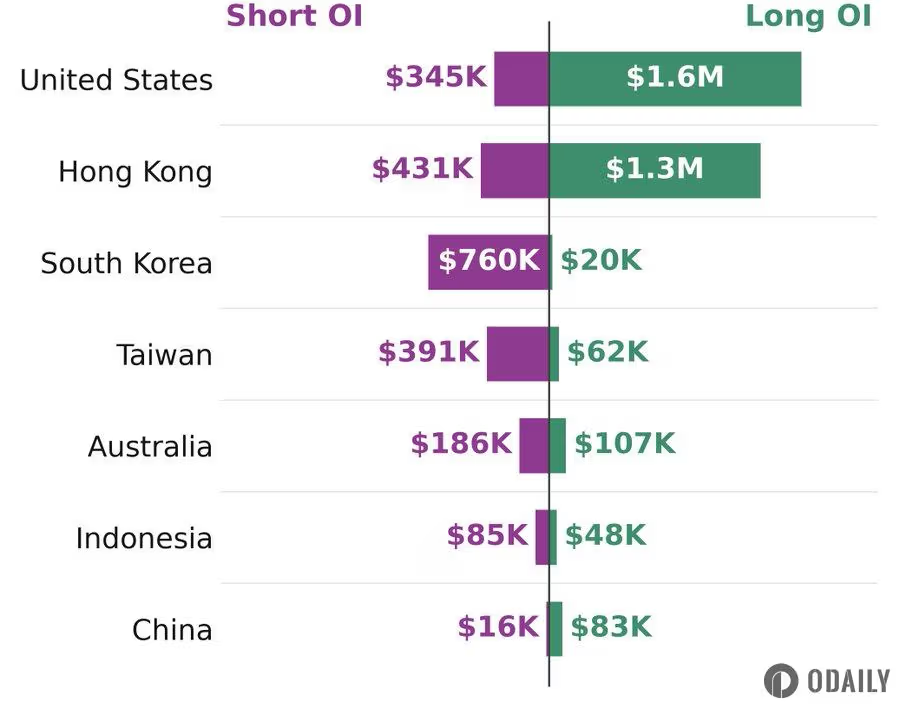
According to HyperInsight monitoring, on the eve of CXMT's listing, wallets attributable to CXMT on Hyperliquid showed: US, Hong Kong, and Mainland China wallets were overall bullish, while South Korean-labeled wallets became the main shorting force in this sample.

Among them, South Korean wallets held about $760,000 in short positions, a scale approximately 38 times that of their long positions; Taiwan-labeled wallets were also slightly bearish, with a net short of about $329,000.

On the long side:

  • US-labeled wallets held $1.6 million in long positions and $345,000 in short positions, net long about $1.255 million;
  • Hong Kong-labeled wallets held $1.3 million in long positions and $431,000 in short positions, net long about $869,000;
  • Mainland China-labeled wallets held only $83,000 in long positions and $16,000 in short positions, net long about $67,000.

Assuming the $760,000 in short positions from South Korean wallets were all opened before the opening bell at a unified price of $6.48 with no subsequent adjustments and all at 1x leverage, the theoretical floating loss on these short positions would be about $48,500, a loss rate of approximately 6.4%. Combined with today's closing data, the long side returned home with full pockets.
Viewpoint Six: CXMT's Upside Expected to Last Several Days, Low Float High Market Cap to Continue Fueling FOMO

Aside from the above information, mainstream views within the crypto market still maintain some confidence in CXMT's subsequent upward trend.

Their main points include:

First, the current freely tradable shares of CXMT account for only 6.63%, highly similar to the initial performance of SpaceX (SPCX) post-listing;

Second, the memory super-cycle remains the main theme in capital markets. Coupled with memory manufacturers like SK Hynix, Samsung Electronics, and Micron Technology continuing to expand production, advance chip partnerships, and build new factories, and with analysts expecting SK Hynix's Q2 earnings to far exceed market expectations, industry tailwinds directly fuel bullish sentiment for CXMT;

Third, CXMT's unique status as the "domestic storage industry leader" makes it a highly watched speculative target within the A-share market and even across multiple capital markets. Combined with the previous "A-share premium effect," a 15-20x P/E ratio expectation is not unrealistic;

Fourth, despite "rumored internal memos" claiming brokerages have banned hype around CXMT, market performance shows institutions maintain some restraint while still paying close attention. This suggests institutional buying interest for CXMT still exists, thereby storing some momentum for future gains.

Finally, as an aside, according to the Bloomberg Billionaires Index, since CXMT's listing, the wealth of its founder Zhu Yiming's family has surged nearly 300%, reaching $13.9 billion. Currently, he is reportedly preparing to distribute 40% of this as bonuses to employees. This move might emulate SK Hynix's practice of distributing 10% of its annual net profit to all employees and may also, to some extent, delay the pace of equity monetization.

Recommended Reading

More Accurate Than Brokers? TradeXYZ Pre-Priced CXMT

Criptomoedas em alta

Perguntas relacionadas

QWhat were the key reasons for CXMT's strong debut and record-breaking performance on its first trading day?

AChangxin Memory Technologies (CXMT) had a strong debut due to its position as a leading domestic memory chip maker, significant year-on-year growth in projected revenue and net profit, and massive market interest. It set records including becoming the first tech stock to open with a market cap exceeding 3 trillion RMB, the highest market cap on the STAR Market, the first stock with single-day turnover exceeding 100 billion RMB, and the first new stock to combine 100 billion RMB turnover with over 50% turnover rate.

QWhat are the differing target price and valuation outlooks for CXMT from Nomura Securities and Northeast Securities?

ANomura Securities is extremely bullish, giving CXMT a 'Buy' rating with a target price of 116 RMB (implying a 1239.5% gain from the IPO price) and a market cap of approximately 7.76 trillion RMB, based on a 20x P/E ratio. In contrast, Northeast Securities provides a more conservative valuation range of 3.2 to 5.7 trillion RMB, using methods like relative market share valuation, profitability analysis (10-15x P/E on 2027 profits), and unit capacity valuation.

QAccording to the Milk Road AI analyst, why won't CXMT's listing immediately solve the global DRAM shortage?

AThe analyst states that while CXMT has grown its DRAM market share, its current monthly wafer capacity (290k-320k) is still much lower than competitors like Samsung (630k) and SK Hynix (500k). Furthermore, U.S. restrictions on advanced lithography equipment limit its expansion speed. Crucially, CXMT is not yet in the high-margin HBM (High Bandwidth Memory) market, which is dominated by Samsung, SK Hynix, and Micron for AI servers. Therefore, CXMT's growth primarily fills gaps in mid-to-low-end DRAM, not the high-end segments driving the shortage.

QHow did on-chain wallet activity on Hyperliquid show a geographical split in sentiment towards CXMT before its IPO?

AOn-chain data from Hyperliquid showed a clear geographical split in sentiment. Wallets tagged to the United States, Hong Kong (China), and mainland China were predominantly long (net buyers). In contrast, wallets tagged to South Korea were the main short-sellers in the sample, holding about $760k in short positions—38 times the size of their long positions. Wallets tagged to Taiwan (China) also showed a net short position.

QWhat are some of the arguments within the crypto market for why CXMT's price rise might continue?

ACrypto market participants are optimistic for several reasons: 1) Low free float (only 6.63% of shares), similar to SpaceX's (SPCX) early performance, which can amplify price moves. 2) The ongoing memory 'super cycle' and strong industry fundamentals, with peers like SK Hynix expecting strong earnings. 3) CXMT's unique status as the 'domestic memory leader' could command an 'A-share premium' with P/E ratios of 15-20x seen as realistic. 4) Despite rumors of broker restrictions on speculation, institutional interest remains high, suggesting potential for continued buying support.

Leituras Relacionadas

US Calls for Restrictions on Sports Prediction Markets

The National Football League (NFL) has urged the U.S. Commodity Futures Trading Commission (CFTC) to tighten rules for prediction markets on sports events. In a July letter, the NFL argued that current proposals fail to adequately protect the integrity of games and market participants. Key demands include banning contracts on events easily manipulated by individuals (e.g., a kicker missing a field goal), clarifying definitions to prevent gambling-like contracts, and explicitly prohibiting trading based on non-public insider information. The league also called for restricted person lists, a ban on margin trading, advertising limits, stronger user protections, and a minimum age of 21. This push coincides with an ongoing jurisdictional dispute between the CFTC and several states. The CFTC claims exclusive federal oversight, classifying event contracts as swaps, while states argue these platforms violate local gambling laws. Recent legal actions in Michigan and Minnesota highlight the conflict, with a federal court temporarily blocking Minnesota from applying a new law to CFTC-registered platforms like Kalshi and Polymarket. Meanwhile, prediction markets are experiencing significant growth. In June, driven by events like the World Cup, Kalshi's trading volume exceeded $31 billion (85% from sports contracts), while Polymarket's global platform hit a monthly record of $10.8 billion. However, platforms face legal challenges, such as lawsuits from Kentucky accusing them of operating unlicensed sports betting disguised as prediction markets.

cryptonews.ruHá 7m

US Calls for Restrictions on Sports Prediction Markets

cryptonews.ruHá 7m

Peskov Says Russia Is Among Top Five Leaders in AI Race. What Do Global Rankings Say?

On July 27, 2026, Kremlin spokesman Dmitry Peskov stated that Russia remains among the top five countries in the global AI development race. He acknowledged Russian models still lag behind leading U.S. counterparts but claimed they have reached a "very high level," aiming to close the gap with "superhuman efforts." He highlighted the differing approaches of Russia's GigaChat, built from scratch, and Yandex, which initially used foreign technology. However, this claim is not supported by major international AI rankings. Stanford University's Global AI Vibrancy Tool (2024-25) ranks Russia 28th out of 36 countries. The top five are the U.S., China, India, South Korea, and the UK. The Stanford AI Index Report 2026 does not mention Russia's position, focusing instead on U.S. and Chinese leadership across various metrics like investments and model performance. In benchmarks, GigaChat ranks 25th on the Russian-language LM Arena. While it passed a financial analyst exam in December 2025, its business usage costs are reportedly tens to hundreds of times higher than China's DeepSeek. In related developments, President Putin signed a law on July 26, 2026, establishing a legal framework for sovereign AI models and granting developers access to state data. Previously, Russia joined 28 other nations, including China, to establish the World AI Cooperation Organization (WAICO) in Shanghai. The article notes that rankings vary due to different criteria, such as research, investment, infrastructure, or responsible AI governance. While Russian authorities are bolstering AI through legislation and international cooperation, independent analyses suggest the country faces significant challenges, including a hardware deficit for training models, which legal frameworks alone cannot resolve.

cryptonews.ruHá 7m

Peskov Says Russia Is Among Top Five Leaders in AI Race. What Do Global Rankings Say?

cryptonews.ruHá 7m

From Sand to Chips: Hefei's Semiconductor Alchemy

From Sand to Chips: Hefei's Semiconductor "Alchemy" On July 27, 2026, a memory chip maker from Hefei made history by surpassing the market capitalization of Industrial and Commercial Bank of China on its Shanghai Stock Exchange debut. This marks the culmination of Hefei's two-decade industrial transformation, often summarized in three strategic leaps: "Screen, Chip, Vehicle." The journey began in 2008 with a bold investment in BOE, establishing China's first 6th-generation LCD panel line. The second leap was the "Project 506" in 2016, which gave birth to ChangXin Memory Technologies (CXMT). With initial backing of 14.4 billion RMB from Hefei's state-owned investment platform, CXMT aimed to break into the global DRAM market, then over 95% controlled by three overseas giants. CXMT achieved a breakthrough in 2019 by producing China's first 8GB DDR4 DRAM chip, employing "generational leapfrog" R&D to catch up. After years of significant losses, the company turned profitable in 2025. A dramatic surge followed in 2026, driven by AI-driven demand and full capacity utilization, propelling CXMT to become the world's fourth-largest DRAM manufacturer. CXMT's success is not isolated. It anchors a dense, localized semiconductor ecosystem in Hefei. Within its vicinity are numerous supporting companies for equipment, materials, and packaging & testing. This cluster has fueled the regional economy, with Hefei's integrated circuit industry output growing over sevenfold between 2016 and 2025. The ripple effects extend beyond high-tech, revitalizing local communities with new businesses and services catering to the influx of workers. For individuals, Hefei offers competitive tech salaries at a significantly lower cost of living compared to major coastal cities, along with improved amenities and shorter commutes. Hefei's story demonstrates two decades of focused, long-term industrial policy, transforming the city from a provincial capital into a trillion-RMB GDP "Double Ten-Thousand" city (10 million people, 1 trillion RMB GDP). It shows how persistence in strategic sectors—turning sand into chips—can redefine a city's economic destiny.

marsbitHá 37m

From Sand to Chips: Hefei's Semiconductor Alchemy

marsbitHá 37m

Trading

Spot

Artigos em Destaque

O que é $S$

Compreender o SPERO: Uma Visão Abrangente Introdução ao SPERO À medida que o panorama da inovação continua a evoluir, o surgimento de tecnologias web3 e projetos de criptomoeda desempenha um papel fundamental na formação do futuro digital. Um projeto que tem atraído atenção neste campo dinâmico é o SPERO, denotado como SPERO,$$s$. Este artigo tem como objetivo reunir e apresentar informações detalhadas sobre o SPERO, para ajudar entusiastas e investidores a compreender as suas bases, objetivos e inovações nos domínios web3 e cripto. O que é o SPERO,$$s$? O SPERO,$$s$ é um projeto único dentro do espaço cripto que procura aproveitar os princípios da descentralização e da tecnologia blockchain para criar um ecossistema que promove o envolvimento, a utilidade e a inclusão financeira. O projeto é concebido para facilitar interações peer-to-peer de novas maneiras, proporcionando aos utilizadores soluções e serviços financeiros inovadores. No seu núcleo, o SPERO,$$s$ visa capacitar indivíduos ao fornecer ferramentas e plataformas que melhoram a experiência do utilizador no espaço das criptomoedas. Isso inclui a possibilidade de métodos de transação mais flexíveis, a promoção de iniciativas impulsionadas pela comunidade e a criação de caminhos para oportunidades financeiras através de aplicações descentralizadas (dApps). A visão subjacente do SPERO,$$s$ gira em torno da inclusão, visando fechar lacunas dentro das finanças tradicionais enquanto aproveita os benefícios da tecnologia blockchain. Quem é o Criador do SPERO,$$s$? A identidade do criador do SPERO,$$s$ permanece algo obscura, uma vez que existem recursos publicamente disponíveis limitados que fornecem informações detalhadas sobre o(s) seu(s) fundador(es). Esta falta de transparência pode resultar do compromisso do projeto com a descentralização—uma ética que muitos projetos web3 partilham, priorizando contribuições coletivas em vez de reconhecimento individual. Ao centrar as discussões em torno da comunidade e dos seus objetivos coletivos, o SPERO,$$s$ incorpora a essência do empoderamento sem destacar indivíduos específicos. Assim, compreender a ética e a missão do SPERO é mais importante do que identificar um criador singular. Quem são os Investidores do SPERO,$$s$? O SPERO,$$s$ é apoiado por uma diversidade de investidores que vão desde capitalistas de risco a investidores-anjo dedicados a promover a inovação no setor cripto. O foco desses investidores geralmente alinha-se com a missão do SPERO—priorizando projetos que prometem avanço tecnológico social, inclusão financeira e governança descentralizada. Essas fundações de investidores estão tipicamente interessadas em projetos que não apenas oferecem produtos inovadores, mas que também contribuem positivamente para a comunidade blockchain e os seus ecossistemas. O apoio desses investidores reforça o SPERO,$$s$ como um concorrente notável no domínio em rápida evolução dos projetos cripto. Como Funciona o SPERO,$$s$? O SPERO,$$s$ emprega uma estrutura multifacetada que o distingue de projetos de criptomoeda convencionais. Aqui estão algumas das características-chave que sublinham a sua singularidade e inovação: Governança Descentralizada: O SPERO,$$s$ integra modelos de governança descentralizada, capacitando os utilizadores a participar ativamente nos processos de tomada de decisão sobre o futuro do projeto. Esta abordagem promove um sentido de propriedade e responsabilidade entre os membros da comunidade. Utilidade do Token: O SPERO,$$s$ utiliza o seu próprio token de criptomoeda, concebido para servir várias funções dentro do ecossistema. Esses tokens permitem transações, recompensas e a facilitação de serviços oferecidos na plataforma, melhorando o envolvimento e a utilidade gerais. Arquitetura em Camadas: A arquitetura técnica do SPERO,$$s$ suporta modularidade e escalabilidade, permitindo a integração contínua de funcionalidades e aplicações adicionais à medida que o projeto evolui. Esta adaptabilidade é fundamental para manter a relevância no panorama cripto em constante mudança. Envolvimento da Comunidade: O projeto enfatiza iniciativas impulsionadas pela comunidade, empregando mecanismos que incentivam a colaboração e o feedback. Ao nutrir uma comunidade forte, o SPERO,$$s$ pode melhor atender às necessidades dos utilizadores e adaptar-se às tendências do mercado. Foco na Inclusão: Ao oferecer taxas de transação baixas e interfaces amigáveis, o SPERO,$$s$ visa atrair uma base de utilizadores diversificada, incluindo indivíduos que anteriormente podem não ter participado no espaço cripto. Este compromisso com a inclusão alinha-se com a sua missão abrangente de empoderamento através da acessibilidade. Cronologia do SPERO,$$s$ Compreender a história de um projeto fornece insights cruciais sobre a sua trajetória de desenvolvimento e marcos. Abaixo está uma cronologia sugerida que mapeia eventos significativos na evolução do SPERO,$$s$: Fase de Conceituação e Ideação: As ideias iniciais que formam a base do SPERO,$$s$ foram concebidas, alinhando-se de perto com os princípios de descentralização e foco na comunidade dentro da indústria blockchain. Lançamento do Whitepaper do Projeto: Após a fase conceitual, um whitepaper abrangente detalhando a visão, os objetivos e a infraestrutura tecnológica do SPERO,$$s$ foi lançado para atrair o interesse e o feedback da comunidade. Construção da Comunidade e Primeiros Envolvimentos: Esforços ativos de divulgação foram feitos para construir uma comunidade de primeiros adotantes e investidores potenciais, facilitando discussões em torno dos objetivos do projeto e angariando apoio. Evento de Geração de Tokens: O SPERO,$$s$ realizou um evento de geração de tokens (TGE) para distribuir os seus tokens nativos a apoiantes iniciais e estabelecer liquidez inicial dentro do ecossistema. Lançamento da dApp Inicial: A primeira aplicação descentralizada (dApp) associada ao SPERO,$$s$ foi lançada, permitindo que os utilizadores interagissem com as funcionalidades principais da plataforma. Desenvolvimento Contínuo e Parcerias: Atualizações e melhorias contínuas nas ofertas do projeto, incluindo parcerias estratégicas com outros players no espaço blockchain, moldaram o SPERO,$$s$ em um jogador competitivo e em evolução no mercado cripto. Conclusão O SPERO,$$s$ é um testemunho do potencial do web3 e das criptomoedas para revolucionar os sistemas financeiros e capacitar indivíduos. Com um compromisso com a governança descentralizada, o envolvimento da comunidade e funcionalidades inovadoras, abre caminho para um panorama financeiro mais inclusivo. Como em qualquer investimento no espaço cripto em rápida evolução, potenciais investidores e utilizadores são incentivados a pesquisar minuciosamente e a envolver-se de forma ponderada com os desenvolvimentos em curso dentro do SPERO,$$s$. O projeto demonstra o espírito inovador da indústria cripto, convidando a uma exploração mais aprofundada das suas inúmeras possibilidades. Embora a jornada do SPERO,$$s$ ainda esteja a desenrolar-se, os seus princípios fundamentais podem, de facto, influenciar o futuro de como interagimos com a tecnologia, as finanças e uns com os outros em ecossistemas digitais interconectados.

126 Visualizações TotaisPublicado em {updateTime}Atualizado em 2024.12.17

O que é $S$

O que é AGENT S

Agent S: O Futuro da Interação Autónoma no Web3 Introdução No panorama em constante evolução do Web3 e das criptomoedas, as inovações estão constantemente a redefinir a forma como os indivíduos interagem com plataformas digitais. Um projeto pioneiro, o Agent S, promete revolucionar a interação humano-computador através do seu framework aberto e agente. Ao abrir caminho para interações autónomas, o Agent S visa simplificar tarefas complexas, oferecendo aplicações transformadoras em inteligência artificial (IA). Esta exploração detalhada irá aprofundar-se nas complexidades do projeto, nas suas características únicas e nas implicações para o domínio das criptomoedas. O que é o Agent S? O Agent S é um framework aberto e agente, especificamente concebido para abordar três desafios fundamentais na automação de tarefas computacionais: Aquisição de Conhecimento Específico de Domínio: O framework aprende inteligentemente a partir de várias fontes de conhecimento externas e experiências internas. Esta abordagem dupla capacita-o a construir um rico repositório de conhecimento específico de domínio, melhorando o seu desempenho na execução de tarefas. Planeamento ao Longo de Longos Horizontes de Tarefas: O Agent S emprega planeamento hierárquico aumentado por experiência, uma abordagem estratégica que facilita a decomposição e execução eficientes de tarefas intrincadas. Esta característica melhora significativamente a sua capacidade de gerir múltiplas subtarefas de forma eficiente e eficaz. Gestão de Interfaces Dinâmicas e Não Uniformes: O projeto introduz a Interface Agente-Computador (ACI), uma solução inovadora que melhora a interação entre agentes e utilizadores. Utilizando Modelos de Linguagem Multimodais de Grande Escala (MLLMs), o Agent S pode navegar e manipular diversas interfaces gráficas de utilizador de forma fluida. Através destas características pioneiras, o Agent S fornece um framework robusto que aborda as complexidades envolvidas na automação da interação humana com máquinas, preparando o terreno para uma infinidade de aplicações em IA e além. Quem é o Criador do Agent S? Embora o conceito de Agent S seja fundamentalmente inovador, informações específicas sobre o seu criador permanecem elusivas. O criador é atualmente desconhecido, o que destaca ou o estágio nascente do projeto ou a escolha estratégica de manter os membros fundadores em anonimato. Independentemente da anonimidade, o foco permanece nas capacidades e no potencial do framework. Quem são os Investidores do Agent S? Como o Agent S é relativamente novo no ecossistema criptográfico, informações detalhadas sobre os seus investidores e financiadores não estão explicitamente documentadas. A falta de informações disponíveis publicamente sobre as fundações de investimento ou organizações que apoiam o projeto levanta questões sobre a sua estrutura de financiamento e roteiro de desenvolvimento. Compreender o apoio é crucial para avaliar a sustentabilidade do projeto e o seu impacto potencial no mercado. Como Funciona o Agent S? No núcleo do Agent S reside uma tecnologia de ponta que lhe permite funcionar eficazmente em diversos ambientes. O seu modelo operacional é construído em torno de várias características-chave: Interação Humano-Computador Semelhante: O framework oferece planeamento avançado em IA, esforçando-se para tornar as interações com computadores mais intuitivas. Ao imitar o comportamento humano na execução de tarefas, promete elevar as experiências dos utilizadores. Memória Narrativa: Utilizada para aproveitar experiências de alto nível, o Agent S utiliza memória narrativa para acompanhar os históricos de tarefas, melhorando assim os seus processos de tomada de decisão. Memória Episódica: Esta característica fornece aos utilizadores orientações passo a passo, permitindo que o framework ofereça suporte contextual à medida que as tarefas se desenrolam. Suporte para OpenACI: Com a capacidade de funcionar localmente, o Agent S permite que os utilizadores mantenham o controlo sobre as suas interações e fluxos de trabalho, alinhando-se com a ética descentralizada do Web3. Fácil Integração com APIs Externas: A sua versatilidade e compatibilidade com várias plataformas de IA garantem que o Agent S possa integrar-se perfeitamente em ecossistemas tecnológicos existentes, tornando-o uma escolha apelativa para desenvolvedores e organizações. Estas funcionalidades contribuem coletivamente para a posição única do Agent S no espaço cripto, à medida que automatiza tarefas complexas e em múltiplos passos com mínima intervenção humana. À medida que o projeto evolui, as suas potenciais aplicações no Web3 podem redefinir a forma como as interações digitais se desenrolam. Cronologia do Agent S O desenvolvimento e os marcos do Agent S podem ser encapsulados numa cronologia que destaca os seus eventos significativos: 27 de Setembro de 2024: O conceito de Agent S foi lançado num artigo de pesquisa abrangente intitulado “Um Framework Agente Aberto que Usa Computadores como um Humano”, mostrando a base para o projeto. 10 de Outubro de 2024: O artigo de pesquisa foi disponibilizado publicamente no arXiv, oferecendo uma exploração aprofundada do framework e da sua avaliação de desempenho com base no benchmark OSWorld. 12 de Outubro de 2024: Uma apresentação em vídeo foi lançada, proporcionando uma visão visual das capacidades e características do Agent S, envolvendo ainda mais potenciais utilizadores e investidores. Estes marcos na cronologia não apenas ilustram o progresso do Agent S, mas também indicam o seu compromisso com a transparência e o envolvimento da comunidade. Pontos-Chave Sobre o Agent S À medida que o framework Agent S continua a evoluir, várias características-chave destacam-se, sublinhando a sua natureza inovadora e potencial: Framework Inovador: Concebido para proporcionar um uso intuitivo de computadores semelhante à interação humana, o Agent S traz uma abordagem nova à automação de tarefas. Interação Autónoma: A capacidade de interagir autonomamente com computadores através de GUI significa um avanço em direção a soluções computacionais mais inteligentes e eficientes. Automação de Tarefas Complexas: Com a sua metodologia robusta, pode automatizar tarefas complexas e em múltiplos passos, tornando os processos mais rápidos e menos propensos a erros. Melhoria Contínua: Os mecanismos de aprendizagem permitem que o Agent S melhore a partir de experiências passadas, aprimorando continuamente o seu desempenho e eficácia. Versatilidade: A sua adaptabilidade em diferentes ambientes operacionais, como OSWorld e WindowsAgentArena, garante que pode servir uma ampla gama de aplicações. À medida que o Agent S se posiciona no panorama do Web3 e das criptomoedas, o seu potencial para melhorar as capacidades de interação e automatizar processos significa um avanço significativo nas tecnologias de IA. Através do seu framework inovador, o Agent S exemplifica o futuro das interações digitais, prometendo uma experiência mais fluida e eficiente para os utilizadores em diversas indústrias. Conclusão O Agent S representa um ousado avanço na união da IA e do Web3, com a capacidade de redefinir a forma como interagimos com a tecnologia. Embora ainda esteja nas suas fases iniciais, as possibilidades para a sua aplicação são vastas e cativantes. Através do seu framework abrangente que aborda desafios críticos, o Agent S visa trazer interações autónomas para o primeiro plano da experiência digital. À medida que avançamos mais profundamente nos domínios das criptomoedas e da descentralização, projetos como o Agent S desempenharão, sem dúvida, um papel crucial na formação do futuro da tecnologia e da colaboração humano-computador.

744 Visualizações TotaisPublicado em {updateTime}Atualizado em 2025.01.14

O que é AGENT S

Como comprar S

Bem-vindo à HTX.com!Tornámos a compra de Sonic (S) simples e conveniente.Segue o nosso guia passo a passo para iniciar a tua jornada no mundo das criptos.Passo 1: cria a tua conta HTXUtiliza o teu e-mail ou número de telefone para te inscreveres numa conta gratuita na HTX.Desfruta de um processo de inscrição sem complicações e desbloqueia todas as funcionalidades.Obter a minha contaPasso 2: vai para Comprar Cripto e escolhe o teu método de pagamentoCartão de crédito/débito: usa o teu visa ou mastercard para comprar Sonic (S) instantaneamente.Saldo: usa os fundos da tua conta HTX para transacionar sem problemas.Terceiros: adicionamos métodos de pagamento populares, como Google Pay e Apple Pay, para aumentar a conveniência.P2P: transaciona diretamente com outros utilizadores na HTX.Mercado de balcão (OTC): oferecemos serviços personalizados e taxas de câmbio competitivas para os traders.Passo 3: armazena teu Sonic (S)Depois de comprar o teu Sonic (S), armazena-o na tua conta HTX.Alternativamente, podes enviá-lo para outro lugar através de transferência blockchain ou usá-lo para transacionar outras criptomoedas.Passo 4: transaciona Sonic (S)Transaciona facilmente Sonic (S) no mercado à vista da HTX.Acede simplesmente à tua conta, seleciona o teu par de trading, executa as tuas transações e monitoriza em tempo real.Oferecemos uma experiência de fácil utilização tanto para principiantes como para traders experientes.

1.3k Visualizações TotaisPublicado em {updateTime}Atualizado em 2026.06.02

Como comprar S

Discussões

Bem-vindo à Comunidade HTX. Aqui, pode manter-se informado sobre os mais recentes desenvolvimentos da plataforma e obter acesso a análises profissionais de mercado. As opiniões dos utilizadores sobre o preço de S (S) são apresentadas abaixo.

活动图片