Analysis of the Latest Portfolio Adjustment by the 'Version Prodigy' of US Stocks: 20% Position Possibly Invested in Anthropic, $9 Billion Short on NVIDIA, Ammunition Aimed at Power and Memory Sectors

marsbitPublicado em 2026-06-18Última atualização em 2026-06-18

Resumo

Leopold Aschenbrenner, a prominent AI investor, is shifting his strategy. While maintaining a significant ~$9B short position on NVIDIA, ASML, and Oracle, he is directing capital towards deeper AI infrastructure and model assets. Key areas include power, memory, data center networking, and a reported ~20% allocation to private AI company Anthropic. The analysis suggests this is not a signal of an AI bubble bursting, but a rotation within the infrastructure stack. The focus is moving from crowded "picks and shovels" plays like semiconductors to physical bottlenecks: power supply, data center construction, and materials like copper and fiber optics for connectivity. NVIDIA's recent $25B debt raise, despite strong cash reserves, is seen as a potential sign of changing financing dynamics in the sector. The long-term conviction remains in foundational infrastructure—particularly energy—which is viewed as a essential demand driver regardless of AI cyclicality.

Compiled & Edited: Deep Tide TechFlow

Speakers: Josh Kale, Anthropic AI Marketing; Ejaaz Ahamadeen, Former Coinbase Product Manager

Podcast Source: Limitless Podcast

Original Title: Leopold Aschenbrenner says "No More Stocks!"

Broadcast Date: June 17, 2026

Key Takeaways

Considered one of the world's most aggressive AI investors, Leopold Aschenbrenner, while maintaining a nominal short position of approximately $9 billion in public markets against NVIDIA, ASML, and Oracle, is shifting capital toward deeper AI infrastructure and model assets like power, memory, data center networking, and Anthropic. The two hosts believe this does not signal an AI bubble burst, but rather a rotation signal in infrastructure trades shifting from "chip-first" to "energy, network, and physical data center construction first," especially as NVIDIA just completed a $25 billion bond financing and Anthropic's valuation has been pushed higher, amplifying the market implications of this judgment.

Highlights Summary

Leopold's Core Trading Logic

  • "The classic 'selling shovels' trade in AI has become too crowded, and Leopold's recent position changes signal exactly that."
  • "His judgment isn't that AI infrastructure has peaked, but that certain layers within the infrastructure stack, especially semiconductors and traditional hot stocks, have become overly crowded."
  • "If the question becomes where the money will flow next, there are two answers. The first, most direct one, is flowing to the next real infrastructure bottlenecks: power, memory, and data center networking. The second answer is that mysterious investment exposed just weeks ago."
  • "He's essentially always betting on highly infrastructure-oriented things, investing in both these optical companies and power-related companies."
  • "If he's cautious on NVIDIA, then money will flow to power, memory, and such places; meanwhile, he also wants to invest directly in the 'mine' itself, rather than just buying more 'shovels.' Anthropic is his most favored 'mine.'"

Signals Released by NVIDIA's Financing

  • "The question isn't whether NVIDIA will continue to make money, but why a company with extremely high profit margins and already massive cash reserves would borrow an additional $25 billion externally."
  • "If a company simultaneously conducts massive stock buybacks and drastically increases dividends in the same month while also borrowing money, it's clearly not borrowing because it needs cash. A more reasonable explanation is that it's cheap capital, and the financing model for this AI rally is undergoing a subtle shift."

The Next Wave of AI Infrastructure Dividends

  • "The real bottlenecks are no longer just GPUs, but power, memory, data center networking, and the ability to actually build these things."
  • "You can't build data centers fast enough, expand memory chip capacity sufficiently, or instantly scale up power grids and related infrastructure, no matter how much money you raise. There aren't enough people on the ground, and regulations, approvals, and procedures are hindering progress."
  • "Whoever can build data centers will take the profits."

Optical Modules, Copper, and Fiber Optics

  • "As GPU scales grow larger, copper wires get hotter, energy loss increases, and efficiency deteriorates significantly. Fiber optics will become the next upgrade direction in this scenario."
  • "In very high-bandwidth, short-distance transmission scenarios, copper is almost the only material everyone truly wants to use. Only when it becomes unsuitable, like when distances are too long or heat is too high, do you switch to fiber optics. So the market demand for a copper-fiber combination is very strong right now."
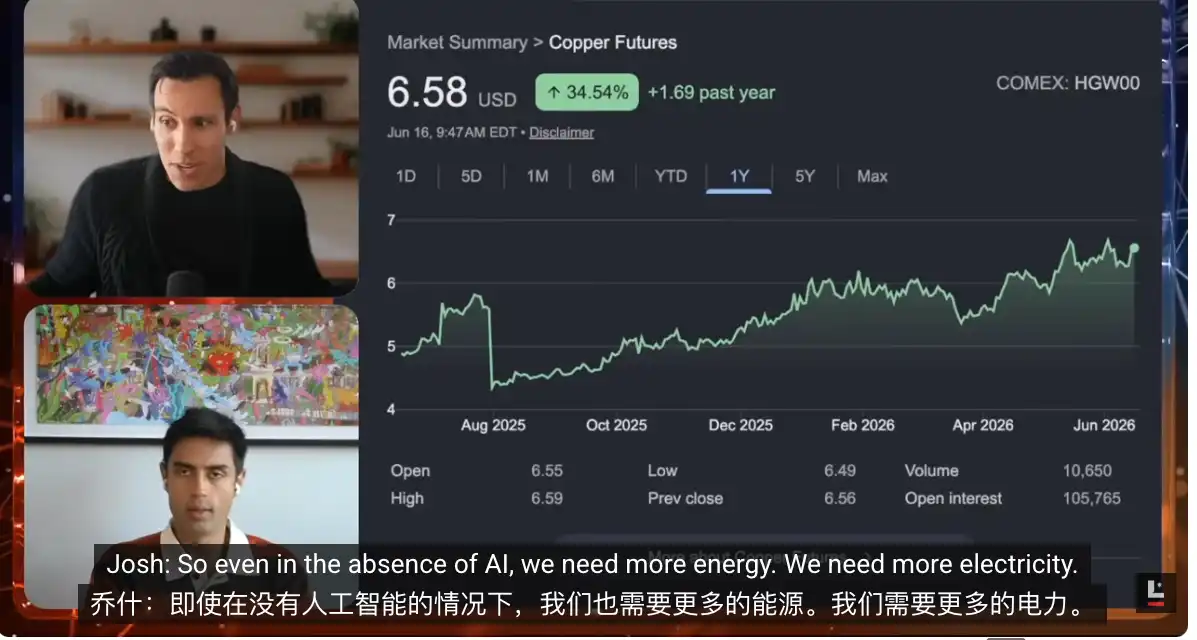
  • "Copper futures have been performing strongly lately, essentially because everyone needs it. It's the most critical foundational material for short-distance, high-bandwidth transmission, and fiber optics is the next step."
  • "Copper remains the most critical material for short-distance, high-bandwidth transmission, but once distances lengthen and heat becomes too high, a switch to fiber optics is mandatory."
  • "The next wave of money will land on those infrastructure companies that don't sound particularly sexy."

Why Energy is the Safest Bet

  • "I've always been bullish on energy because even if AI demand slows, energy itself remains a global necessity, and this demand will only increase."
  • "The single trend that will continue to rise regardless of the scenario is our demand for energy, electricity, and power. These are the companies I'm most willing to go long on."
  • "The companies I most want to follow are those that Jensen is investing in and that also intersect with Leopold's logic. So the stock I'm closest to following right now is Marvell."
  • "The best long-term positions aren't necessarily the hottest chip companies, but the power infrastructure companies that are unavoidable under any macro scenario."

Leopold's AI Investment Portfolio

Josh Kale:

Leopold Aschenbrenner, this 24-year-old specializing in AI investments, is now almost regarded by the market as the world's strongest AI investor. Rumors suggest his fund's nominal position size now exceeds $20 billion. When we looked at Ejaaz's post a month ago, the fund size was only $13.7 billion, essentially doubling every quarter.

This time we've obtained several significant new changes in his recent investment moves. Last episode we discussed his portfolio, and the most surprising point then was that he was actually shorting a company almost everyone knows: NVIDIA, the world's highest market cap, hottest AI stock. Many couldn't understand why he established a short position exceeding $9 billion against such a company.

Now we have a new clue that might explain this. NVIDIA is actually raising capital, and through debt issuance. On the surface, this seems illogical. Why would a company as massive and highly profitable as NVIDIA need an additional $25 billion in cash it just completed raising? Today, we want to discuss, in conjunction with Leopold's portfolio, why he's making so much money, what he's looking at next, and what NVIDIA's financing really means.

Ejaaz Ahamadeen:

First, some background. Leopold Aschenbrenner was a former OpenAI researcher who raised a fund about a year and a half to two years ago. The initial size wasn't large; I recall it was around $200 million. But from his latest 13F, the fund's public holdings are now valued at $13.7 billion.

Naturally, the market wants to know which positions he's holding, what his core investment logic is, and where his next big trade will land. To understand this, we must know that until about a month ago, Leopold was very bullish on the entire AI sector, especially the "selling shovels" logic, meaning GPU and upstream hardware suppliers like NVIDIA.

But about a month ago, the market discovered he wasn't that bullish on the semiconductor line. He's still bullish on real bottleneck areas like memory and power, and probably also on new-style cloud providers, but he's surprisingly not bullish on the world's most valuable company, NVIDIA. More specifically, he has a total bearish position of about $9 billion against companies seen as core AI infrastructure beneficiaries: NVIDIA, ASML, Oracle, and others.

The Logic Behind Shorting NVIDIA

Ejaaz Ahamadeen:

When this came out, many people started worrying, thinking the AI bubble might be about to burst. On the surface, NVIDIA's GPUs are still selling like hotcakes, demand shows no clear sign of weakening, so what's the real issue?

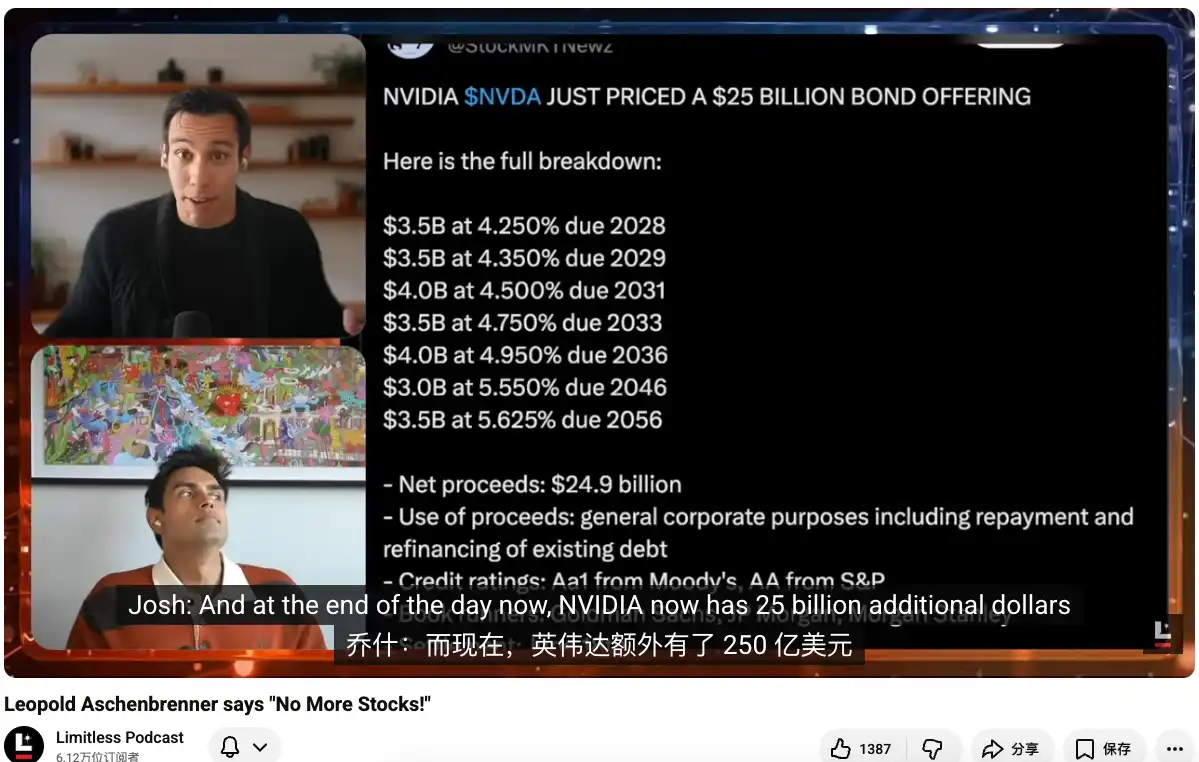
Later, we uncovered several new clues, the most important being that NVIDIA just raised $25 billion externally through a bond offering. This means it's not just using its own cash but adding external leverage. So the question arises: Why would the world's most profitable, highest-margin, strongest-cash-flow company borrow an additional $25 billion from outside?
Josh Kale:

And they initially planned to raise only $20 billion but ended up expanding to $25 billion, with subscriptions over three times oversubscribed. Last episode when discussing this portfolio, we said not to worry about a bubble yet because these companies, despite huge capital expenditures, have high enough revenues to theoretically support expansion with their own balance sheets.

But this is NVIDIA's first significant off-balance-sheet financing since 2021, instead of directly using its cash reserves. I recall it has about $12+ billion in cash on hand. Putting all this together creates a strange tension: on one side, Leopold is shorting, and on the other, NVIDIA appears to have infinite cash and profits yet still issues debt. What's really happening?

Breaking Down NVIDIA's Bond Financing

Josh Kale: Ejaaz, could you break down this deal itself? Because this isn't ordinary financing; it's a bond issuance. Essentially, NVIDIA's balance sheet now has an additional $25 billion, and the interest rates appear to be very low.

Ejaaz Ahamadeen:

I'll present both explanations. NVIDIA originally had about $13.7 billion in cash, meaning it could have simply spent its own money. So why raise external capital? The simplest analogy is buying a house. Many people choose a mortgage even if they have the full amount in cash because they can use their own capital elsewhere, and if the borrowing cost is low enough, it's more economical.

The interest rate environment hasn't been friendly in recent years, but if you're NVIDIA, one of the world's most valuable and sought-after companies, you can borrow under very favorable terms. This $25 billion bond offering has maturities ranging from 2 to 30 years and can be considered very cheap money, with rates close to US Treasury yields.

Moreover, the offering was oversubscribed by about 4 times. In other words, there was $85 billion in market demand for this $25 billion offering. NVIDIA could practically pick its investors. If we look solely at the official explanation, NVIDIA stated it's primarily for financial management, to repay and refinance some existing debt. Google did something very similar weeks ago and also in February this year. So you can certainly accept this explanation as financial optimization.

But another side is hard to ignore: Over the past month and a half, NVIDIA, Amazon, Google, and several other hyperscale cloud providers have all been adding external financing. Some through debt, others through equity sales. Leopold's view might not be entirely baseless. Could this be a sign of the bubble starting to soften, the house of cards beginning to wobble? However, if you look solely at the financial structure, it doesn't clearly point to danger yet.

Josh Kale:

I see it similarly. Shorting NVIDIA with $9 billion is a massive position. But during our research, we noticed something else: on May 18, NVIDIA's board authorized an additional $80 billion in share buybacks and increased the dividend from $0.01 to $0.25 per share, a 25x increase.

If a company simultaneously conducts massive stock buybacks and drastically increases dividends in the same month while also borrowing money, it's clearly not borrowing because it needs cash. A more reasonable explanation is that it's cheap capital, and the financing model for this AI rally is undergoing a subtle shift. Everyone wants to participate in these capital operations, and NVIDIA also realizes that raising debt is even cheaper than other financing methods, so they simply did it. At least for now, NVIDIA itself is still doing very well.

Why He Adjusted His Portfolio

Josh Kale: This leads back to another question. What exactly is Leopold thinking? Why has his judgment changed? The stock chart you showed earlier also indicates NVIDIA's recent performance hasn't been particularly strong, but it's not terrible either. It's still the world's largest company nearing a $5 trillion market cap, down only about 7% in a month, which is nothing amid the surge in other AI stocks.
Ejaaz Ahamadeen:

I don't think NVIDIA will disappear. Its GPUs, including the CPU product line launched weeks ago, I believe will perform very well. AI product demand is currently exponentially oversupplied, and the primary machine supplier capable of meeting this demand is still mainly NVIDIA.

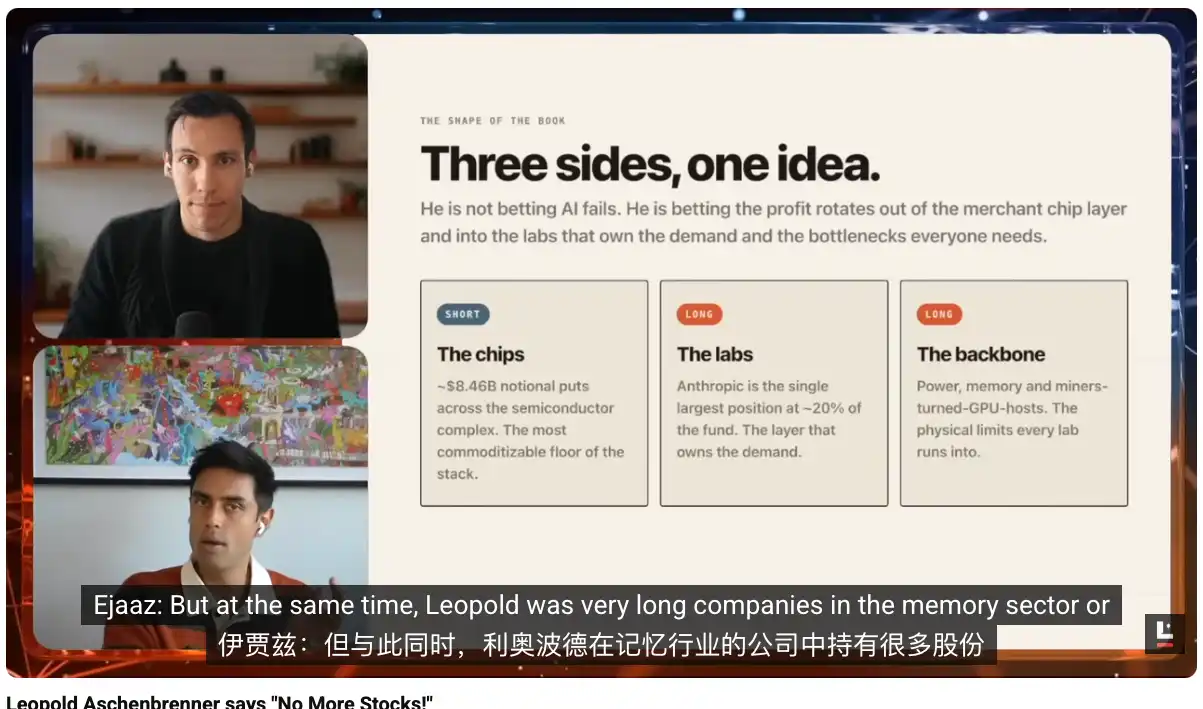
But I do believe the classic 'selling shovels' trade in AI has become too crowded, and Leopold's recent position changes signal exactly that. Looking at his recent 13F, his bearish positions are clearly skewed against the semiconductor line, like NVIDIA, ASML, Oracle, and other infrastructure-level companies.

Yet simultaneously, he holds heavy positions in memory, power, and new-style cloud directions. This indicates his judgment isn't that AI infrastructure has peaked, but that certain layers within the infrastructure stack, especially semiconductors and traditional hot stocks, have become overly crowded.

If the question becomes where the money will flow next, there are two answers. The first is most direct: flowing to the next real infrastructure bottlenecks: power, memory, data center networking. The second answer is that mysterious investment exposed just weeks ago.

The Unexpectedly Exposed Anthropic Position

Josh Kale:

This is what surprised me the most. I only learned about it from you yesterday, and my first reaction was disbelief. Could it be that Leopold's fund, 'Situational Awareness,' actually has 20% allocated to Anthropic equity? Current rumors suggest this company accounts for about one-fifth of Leopold's fund. The Wall Street Journal and several other media outlets report this, and sources very close to the transaction have confirmed it.

This became a completely unexpected card in his portfolio. Because 13F only discloses public market holdings, not private equity, and Anthropic is precisely a large chunk of non-public equity. This is also why people started understanding why outsiders estimate his portfolio valuation at $20 billion.
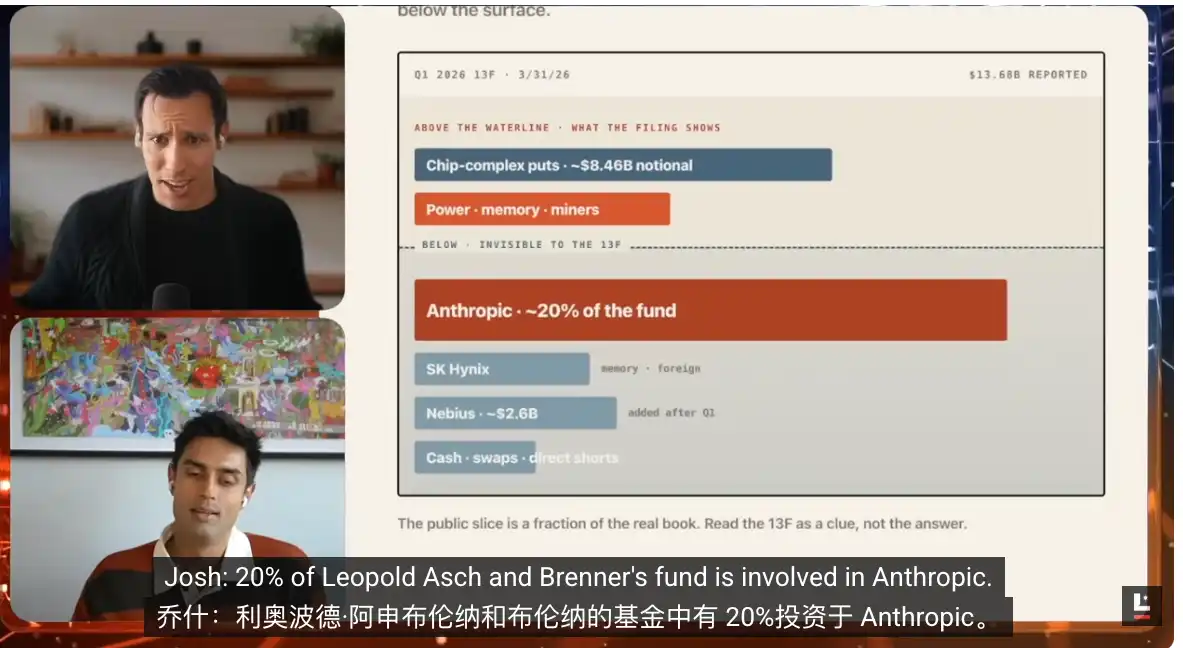
If 20% of the fund is in Anthropic, and he likely invested in early 2025, the return on Anthropic over that year has felt like seven years. This change significantly revises our understanding of his entire investment portfolio.

Ejaaz Ahamadeen:

Yes. His initial investment in Anthropic via private channels or the fund was around March 2025, when Anthropic was valued at about $60 billion. Now, according to the latest valuation round, it's been priced at $96.5 billion.

That's nearly a 15x gain. Using the calculation shown in today's episode, his latest 13F disclosed liquid portfolio value is $13.7 billion. If we add the Anthropic portion reported by the Wall Street Journal, roughly an additional $7 billion, the total fund management size reaches $20 billion.

How exaggerated is this? Bill Ackman, a top investor with three to four decades in the market, his Pershing Capital is also around $20 billion. Leopold has been in this game for only a year and a half, he's 24 years old, and has virtually no real investment experience to speak of.

Yet he's made some astonishingly accurate calls. The crazy part is he wrote it all down in advance. When he launched the fund a year and a half ago, he published a 65-page AI essay, 'Situational Awareness,' almost completely laying out the entire logic, including how capital would rotate from semiconductors and certain infrastructure layers to other bottleneck constraints. The market is now playing out along this line. It's truly remarkable.

The Next Wave of Infrastructure Rally

Ejaaz Ahamadeen:

So this also tells me where the next money will flow. If he's cautious on NVIDIA, then money will go to power, memory, and such places; meanwhile, he also wants to invest directly in the 'mine' itself, rather than just buying more 'shovels.' Anthropic is his most favored 'mine.'

Josh Kale:

This indeed looks like a new trend, and again, he's ahead of the curve. Over the past 12 months, everyone has been searching for AI's bottlenecks: rare earth metals, memory, RAM, etc., the market chased all these themes. Those judgments weren't wrong because that wave did happen.

But now, valuations for areas seen as bottlenecks are gradually rationalizing. The market has a better understanding of these companies' business models, market sizes, and future revenues, so much of the value is already priced in. In the next round, we're more concerned about where the subsequent money will continue to flow.

The direction you mentioned—land, power, server racks, physical infrastructure—seems correct. Because if we think about what's truly most important for AI, the answer increasingly seems to be physical construction capability. Look at xAI, or more accurately, SpaceX, which is now public. Its core revenue isn't rockets themselves but AI infrastructure construction.
Look at its recent deals with Anthropic and Google; the value brought surpasses the sum of Starlink, Starship, and the entire satellite business. There's clearly immense demand and value here. So the question becomes, who can actually build these things?

SpaceX is clearly one answer. Last night after-hours, its stock price reached $230, corresponding to roughly a $3.1 trillion valuation. We'll do a dedicated episode on SpaceX this week because its recent move is insane. It just completed the acquisition of Cursor, now valued at $3 trillion. Elon Musk earned more in a single day than Warren Buffett did in his entire career.

Who Will Capture the Next Round of Dividends

Josh Kale: Our concern is which companies are best at this hardware infrastructure, at developing 'machines that make machines.' Combining Leopold's direction with the broader trend, we think money will flow here next. So Ejaaz, in reality, which companies will this rotation land on?

Ejaaz Ahamadeen:

Many will be those infrastructure companies that don't sound particularly sexy. A name frequently mentioned recently is Marvell. Weeks ago at the Computex conference in Taiwan, Jensen Huang directly stated on stage that this would be the next trillion-dollar company.

And just three months before he made that statement, NVIDIA had invested $1.5 billion in Marvell. I'm starting to lose track of whether this counts as insider trading or market manipulation because after he said that, the stock rose another 70%.

I think it's easy now to directly conclude that AI infrastructure has peaked. But if you compare it to historical financial crises, like 2008, that smell of high leverage, financial engineering, and systemic manipulation hasn't fully appeared this round.

Two key differences exist. First, the products these companies make today are truly being bought by someone. Neither the dot-com bubble nor the financial crisis had such solid real demand. Second, constrained by physical laws, we can't infinitely add leverage now because the entire system is bottlenecked by human labor and construction capacity.

You can't build data centers fast enough, expand memory chip capacity sufficiently, or instantly scale up power grids and related infrastructure, no matter how much money you raise. There aren't enough people on the ground, and regulations, approvals, and procedures are hindering progress.

So I actually think this gives investors an advantage. Since you already know the hottest chip and shovel-selling trades are too crowded, then money will next flow to power, data networking (companies like Astera Labs), and other related areas. What you really need to think about is when these contracts will materialize, when these fabs will actually be built, when SpaceX rockets will launch AI satellites, even when we can start using solar power to train AI models.

The timeline determines the betting rhythm. At least that's the framework I'm using for my own investments (not investment advice). I see it this way because over the past year and a half, we've witnessed how money flowed from broad AI stocks to semiconductor and infrastructure trades.

Josh Kale:

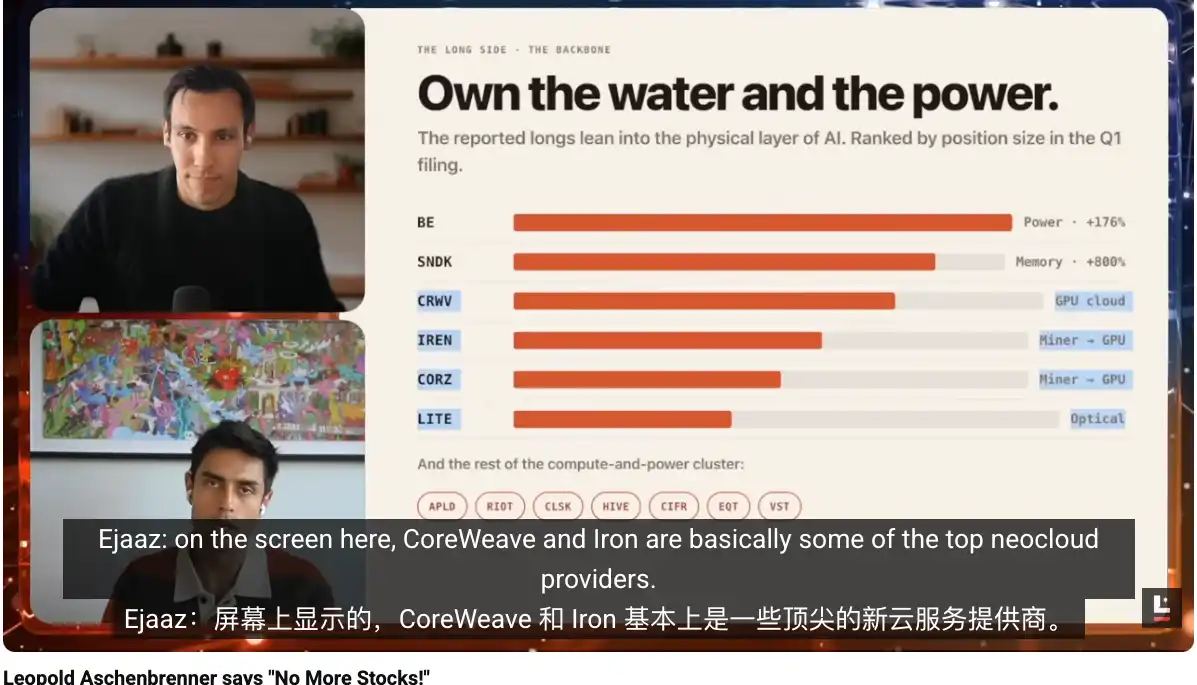
If you continue looking at this portfolio chart, you'll see this story is clearly written into his holding structure. By category, what's his largest allocation? Power and energy. Followed by memory, then cloud and GPU miners—the most tangible infrastructure.

He wants to hold new-style cloud providers like CoreWeave and also those miners who've pivoted to cloud compute. What he wants to own is this physical infrastructure because he believes this is the real bottleneck. As you mentioned, there are many finer details, like actual construction, hardware manufacturing, and data center building itself, all extremely difficult.

If we ask where the biggest bottleneck is, even permitting and approvals might be part of it. Who's solving these problems? SpaceX wants to move data centers to space; Tesla wants to use humanoid robots to solve labor issues. But both are far off. In the short to medium term, there are vast white-space opportunities, and this is precisely what Leopold is betting on.

The Advantages of Optical Modules and Fiber Optics

Josh Kale: I also want to add a detail we didn't elaborate on before. For those who want to dig deeper and find more alpha, many of his clues lie within optics and lower-level tech stacks. Ejaaz, you've been researching this lately; could you explain his thinking?

Ejaaz Ahamadeen:

If you look at the positions on his screen, CoreWeave and Iron are essentially top-tier new-style cloud service providers. Simply put, they're somewhat like Amazon Web Services, but AWS provides cloud services to internet companies, whereas these companies provide ready-made GPU infrastructure to AI companies.

They handle setting up GPUs, networking, deployment, so AI companies don't need to worry about underlying infrastructure and can directly train models and access compute. CoreWeave and Iron have been among his largest concentrated positions since he established them and have delivered the highest returns.

Notably, he still holds these two companies as major positions today. This also indicates another point: in his view, this trade is far from over. Furthermore, he privately invested in Core Scientific, a company that can help unlock CoreWeave's infrastructure supply capacity. In a sense, he added another layer of leverage to CoreWeave.

Beyond these, look at companies like Coherent and Lumentum; they are essentially fiber optic and optical connectivity suppliers. To explain in the simplest terms, semiconductors and GPUs need to communicate with each other. Traditionally, this relied heavily on copper wires. The problem is, as GPU scales grow larger, copper wires get hotter, energy loss increases, and efficiency deteriorates significantly. Fiber optics become the next upgrade direction in this scenario. It enables faster data transmission, higher cost efficiency, and allows companies providing inference and training compute to earn more. So you'll notice he's always betting on highly infrastructure-oriented things, investing in both these optical companies and power-related companies. It might not sound sexy, but in my view, this is where money is genuinely flowing now.

Josh Kale:

The copper aspect is also interesting to me because I recently realized how crucial it is for short-distance data transmission. In many high-bandwidth, short-distance transmission scenarios, copper is almost the only material everyone truly wants to use. Only when it becomes unsuitable, like when distances are too long or heat is too high, do you switch to fiber optics. So market demand for a copper-fiber combination is very strong right now, which is why observing the copper trade is interesting. Copper futures have been performing strongly lately, essentially because everyone needs it. It's the most critical foundational material for short-distance, high-bandwidth transmission, and fiber optics is the next step.

Thinking at an even more fundamental level, the materials theme has always been interesting. The most foundational layer beneath all layers is essentially what raw materials are most core for achieving intelligence. Copper is one, lithium is another, and many more. We really should do a dedicated episode on materials. Perhaps Leopold hasn't reached that layer yet, and we might spot the next rotation first.

Josh Kale:

If we go all the way down the stack, we could even look at copper mines to see how these things are made. But returning to the core judgment, I believe the next rotation indeed shifts from what seem like smaller bottlenecks to the truly hard things: hardware and large-scale data center construction.

Whoever can build data centers will take the profits. We've already seen how much money SpaceX makes due to massive data center demand. Whoever can deploy more data centers faster, provide sufficient power and GPUs, will earn the most money. This is essentially what Leopold is betting on now.

Is a Bubble Emerging?

Josh Kale: The summary is we don't think we've entered the bubble-bursting phase yet. Leopold's positions resemble rotation more than a full-scale retreat. So, should we still follow his lead?

Ejaaz Ahamadeen:

I admit, when I first saw his 13F, my initial reaction was disbelief that this guy was shorting the world's most valuable company with demand booked until 2029. But now, seeing this financing, I'm starting to think if NVIDIA continues adding external debt, or possibly even sells equity in the future, if this trend persists, then Leopold might be right again.

If that's the case, his fund could eventually surpass the world's top traders and best investment funds. He's been winning consistently; it's hard not to be impressed.

Josh Kale:

However, another important point: his life experience has almost always been about going long; he's never truly been tested by a large-scale sell-off. We mentioned Bill Ackman earlier; achieving 30x returns and surviving 30 years in the market are two different things.

If he can sustain this growth and also learn when to hit the sell button, manage risk, use hedging to protect himself, that would be even more formidable. We're already seeing glimpses of this capability. That $9 billion short position isn't $9 billion in cash directly shorting; it's achieved through options and leverage, not a one-to-one naked short. Regardless, this is very worth observing.

Energy is the Core Bet

Josh Kale: If you had to pick one stock from his entire portfolio you'd most want to buy, which would it be?

My own answer is energy stocks. I've always been bullish on energy because even if AI demand slows, energy itself remains a global necessity, and this demand will only increase. Even completely ignoring AI, we need more energy, more electricity. Companies like Bloom Energy, which can enhance power supply and delivery, excite me most because they're the most hedge-like bets. The single trend that will continue to rise regardless of the scenario is our demand for energy, electricity, and power. These are the companies I'm most willing to go long on.

Ejaaz Ahamadeen:

My answer is a bit of a cheat. The companies I most want to follow are those that Jensen is investing in and that also intersect with Leopold's logic. The stock I'm closest to following right now is Marvell. It's not a publicly disclosed holding of Leopold's, but it aligns very well with his bets on fiber optics and power, and Jensen has already invested $1.5 billion in it.
I've observed a phenomenon: whenever Jensen invests in a company through NVIDIA, whether it's Intel, CoreWeave, or others, they've basically kept rising afterward. So my current position is roughly here. I also hold some CoreWeave myself because both Jensen and Leopold are extremely bullish on it.

Josh Kale:

Marvell is up 270% over the past 6 months. This might truly be a good rule of thumb: when influential people like Jensen, or even figures with massive influence like Trump, publicly say to buy a certain stock, often you should really take a serious look.

History has repeatedly proven that such signals often have significant realization potential. Whether Intel or Marvell, these cases show that, on one hand, they indeed understand what they're talking about, and on the other, they have the ability to influence these companies' outcomes. So this rally has been truly insane.

I hope it continues. From the current perspective, it likely will. At least we're still leaning bullish, still optimistic, and will continue making judgments daily as things evolve.

Josh Kale: Any final thoughts you'd like to add regarding the update on Leopold's investment portfolio?

Ejaaz Ahamadeen:

I'd actually like to hear from those who are skeptical. If after listening to our analysis, you think we're completely wrong or have misunderstood something, please point it out directly.

Yesterday, I stared at NVIDIA's $25 billion financing news for a long time, initially looking to criticize it. But if we look solely at the financial logic, it does make sense. Why not borrow this almost risk-free cheap money? Using others' money for expansion is clearly more rational than selling your own equity because you retain more future profits.

Criptomoedas em alta

Perguntas relacionadas

QWhat is the core trading logic behind Leopold Aschenbrenner's recent portfolio shift, particularly his large short position on NVIDIA?

ALeopold's logic is that the classic 'shovel-selling' AI infrastructure trade, particularly in crowded areas like semiconductors (e.g., NVIDIA, ASML), is becoming overvalued and congested. He is not calling a top for AI infrastructure overall, but believes capital is rotating from these hot sectors towards the next true bottlenecks: power, memory, and data center networking. He also seeks direct exposure to the 'ore' itself (like Anthropic) rather than just the 'shovels.'

QWhat signal might NVIDIA's recent $25 billion bond issuance be sending, according to the discussion?

AThe fact that NVIDIA, a highly profitable company with massive cash reserves, is raising significant external debt suggests a potential shift in the AI funding cycle. The hosts argue it likely represents NVIDIA securing very cheap capital to fund growth, but its occurrence alongside massive stock buybacks and dividend increases raises questions. It could be a sign of financial engineering becoming more prominent, which might support Leopold's cautious stance, though it doesn't necessarily indicate immediate financial distress for NVIDIA.

QAccording to the article, what are considered the next major bottlenecks and investment opportunities in the AI infrastructure stack?

AThe next wave of bottlenecks and opportunities is seen in physical, ground-level infrastructure constraints. Key areas include: 1) Power/Energy generation and distribution, 2) Memory chip supply, 3) Data center construction and networking (especially fiber optics for longer distances/high heat, while copper remains crucial for short-range), and 4) The actual capability to build and deploy data centers at scale, which is limited by manpower, permits, and construction logistics.

QWhat is the significance of Leopold Aschenbrenner's reported ~20% investment in Anthropic?

AThis private investment in Anthropic, not visible in public 13F filings, significantly recontextualizes his portfolio. It shows he is not just betting on AI infrastructure ('shovels') but is also taking a massive, direct position in a leading AI model company ('the ore'). The investment, made around early 2025, has reportedly seen enormous appreciation, contributing heavily to the estimated growth of his fund's total assets under management to around $20 billion and demonstrating his conviction in owning foundational AI assets.

QWhy do the hosts view investments in the energy/power sector as particularly compelling within the AI thematic?

AEnergy is viewed as a core, resilient, and non-cyclical bet within the AI boom. Even if AI-specific demand were to slow, the global demand for electricity and power is a secular, one-way trend that is only increasing. Companies that enhance power generation, distribution, and efficiency (like Bloom Energy) are seen as excellent long-term holdings that benefit from the AI boom but are also insulated from it, acting as a form of hedge while capturing a fundamental growth trend.

Leituras Relacionadas

Gate Research Institute: ETF Outflows Suppress Risk Appetite, Two-Way System Navigates Weak Market

Gate Institute Research Report: May 2026 Crypto Market Review & Strategy Analysis In May 2026, the crypto market shifted from an early-month rally to a mid-month correction, concluding with low-volatility consolidation. BTC, ETH, and SOL peaked in early May before declining. The primary market dynamic was a divergence between weakening spot ETF inflows and persistently high leverage-driven perpetual trading volume. A dual-direction moving average cluster breakout strategy outperformed, returning +2.11% for an equally-weighted BTC/ETH/SOL portfolio. This contrasted with a -6.09% return for buy-and-hold and -3.65% for a long-only version of the strategy. Profits were primarily generated from short positions on ETH and SOL during the mid-to-late May downtrend, demonstrating the month's suitability for two-way trend trading. Market structure evolved in three phases: an initial surge (May 1-6), a failure and reversal (starting May 7), and low-volatility compression (May 22 onward). While stablecoin supply remained stable, significant outflows from mainstream BTC and ETH ETFs created selling pressure. Concurrently, high correlation with the S&P 500 (~0.6) and stronger performance from AI equities like Nvidia highlighted crypto's position as a high-beta risk asset within a broader risk-budget framework, lacking independent momentum. The successful strategy employed a 4-hour chart system using a cluster of six moving averages (EMA6,12,24 & SMA6,12,24). A breakout signal was triggered after the cluster width compressed below 2.2%. Trades were managed with a 2.5% fixed stop-loss, a 3:1 Risk/Reward (7.5%) take-profit, and an EMA12-based exit rule to control losses from false breakouts. The strategy's low win rate but high payoff from a few large trend moves was effective in May's conditions. The report concludes that for June, a disciplined, bidirectional approach remains superior to subjective directional bets. The framework should adapt signal weighting based on BTC's position relative to key EMAs, ETF flow trends, and the relative strength of the Nasdaq, prioritizing risk management and trend preservation.

marsbitHá 21m

Gate Research Institute: ETF Outflows Suppress Risk Appetite, Two-Way System Navigates Weak Market

marsbitHá 21m

Anthropic CEO's Latest Interview: On Technological Explosion, Safety Red Lines, and the Civilization Contract

Interview with Anthropic CEO Dario Amodei covers the intense pressures and ethical dilemmas of leading AI development. He describes the experience as "exponential growth," feeling constant acceleration akin to relativistic time dilation. The discussion delves into his departure from OpenAI, rooted in a fundamental loss of trust and divergent values rather than mere technical disagreements. Amodei emphasizes Anthropic's enterprise-focused business model, arguing it aligns better with safety and responsible deployment than consumer-facing, ad-driven models. He addresses critical issues like AI's impact on employment, advocating for proactive macroeconomic policies and a shift towards "doing more with the same resources" to avoid widespread job displacement. On safety and governance, he details Anthropic's cautious approach, including delaying the release of the powerful "Mythos" model due to its advanced cyber capabilities. He stresses the need for "human-in-the-loop" principles in military applications, setting red lines against autonomous weapons and mass surveillance. Amodei calls for industry collaboration among trustworthy actors to establish standards and advocates for a balanced regulatory framework with checks and balances, such as Anthropic's Long-term Benefit Trust, rather than corporate or government monopoly over the technology. He expresses geopolitical concerns, particularly regarding China, and a belief that AI should bolster liberal democracies. While acknowledging a non-zero risk of civilizational catastrophe from advanced AI, he asserts Anthropic's actions are aimed at significantly reducing that probability. The interview concludes with Amodei arguing that trust must be earned through concrete actions, like sacrificing commercial gain for safety, to distinguish Anthropic in a Silicon Valley landscape he criticizes for eroded public trust.

marsbitHá 25m

Anthropic CEO's Latest Interview: On Technological Explosion, Safety Red Lines, and the Civilization Contract

marsbitHá 25m

The Brutal Truth Behind CARDS' $535M FDV: Only $43M in Net Revenue and Halved Profit Margins

The article titled "The Brutal Truth Behind CARDS' $535 Million FDV: Only $43 Million Net Revenue, Profit Margins Halved" provides a critical analysis of Collector Crypt (CC), a platform combining physical collectible cards with NFTs in a gacha-style system. Key findings include: * CC has generated $635 million in total user deposits. However, 90.6% ($576 million) is instantly returned to users via automatic card buybacks, resulting in only $43 million in net platform revenue (6.7% retention). * Activity is highly concentrated among dozens of high-frequency wallets, with an average of only ~420 daily active players. * There is minimal secondary market activity for the cards (under $5 million total), indicating the platform functions more as a gambling casino than a collector's marketplace. eBay sales as a percentage of gacha volume have declined for six consecutive quarters. * Despite a tripling in transaction volume, net profit margins have been halved from 11.2% to 5.8% as activity shifts to higher-priced card packs with lower margins. * Value captured by the CARDS token is minimal: only $140,000 (from burns and recent buybacks), representing just 3.4% of CC's cumulative net revenue. In contrast, wallets linked to operational infrastructure have off-ramped $45.7 million in USDC. * The token's ~$535 million Fully Diluted Valuation (FDV) represents a 7.3x multiple of annualized net revenue. Only 20.5% of the token supply is floating, with 72% allocated to insiders and locked until November 2027. The conclusion is that CC has found product-market fit as a high-speed gambling platform for a niche user base, not as a growing collector economy. The token currently captures a negligible share of the platform's revenue.

Foresight NewsHá 50m

The Brutal Truth Behind CARDS' $535M FDV: Only $43M in Net Revenue and Halved Profit Margins

Foresight NewsHá 50m

Trading

Spot
Futuros

Artigos em Destaque

O que é GROK AI

Grok AI: Revolucionar a Tecnologia Conversacional na Era Web3 Introdução No panorama em rápida evolução da inteligência artificial, a Grok AI destaca-se como um projeto notável que liga os domínios da tecnologia avançada e da interação com o utilizador. Desenvolvida pela xAI, uma empresa liderada pelo renomado empreendedor Elon Musk, a Grok AI procura redefinir a forma como interagimos com a inteligência artificial. À medida que o movimento Web3 continua a florescer, a Grok AI visa aproveitar o poder da IA conversacional para responder a consultas complexas, proporcionando aos utilizadores uma experiência que é não apenas informativa, mas também divertida. O que é a Grok AI? A Grok AI é um sofisticado chatbot de IA conversacional projetado para interagir com os utilizadores de forma dinâmica. Ao contrário de muitos sistemas de IA tradicionais, a Grok AI abraça uma gama mais ampla de perguntas, incluindo aquelas tipicamente consideradas inadequadas ou fora das respostas padrão. Os principais objetivos do projeto incluem: Raciocínio Fiável: A Grok AI enfatiza o raciocínio de senso comum para fornecer respostas lógicas com base na compreensão contextual. Supervisão Escalável: A integração de assistência de ferramentas garante que as interações dos utilizadores sejam monitorizadas e otimizadas para qualidade. Verificação Formal: A segurança é primordial; a Grok AI incorpora métodos de verificação formal para aumentar a fiabilidade das suas saídas. Compreensão de Longo Contexto: O modelo de IA destaca-se na retenção e recordação de um extenso histórico de conversas, facilitando discussões significativas e contextualizadas. Robustez Adversarial: Ao focar na melhoria das suas defesas contra entradas manipuladas ou maliciosas, a Grok AI visa manter a integridade das interações dos utilizadores. Em essência, a Grok AI não é apenas um dispositivo de recuperação de informações; é um parceiro conversacional imersivo que incentiva um diálogo dinâmico. Criador da Grok AI A mente por trás da Grok AI não é outra senão Elon Musk, um indivíduo sinónimo de inovação em vários campos, incluindo automóvel, viagens espaciais e tecnologia. Sob a égide da xAI, uma empresa focada em avançar a tecnologia de IA de maneiras benéficas, a visão de Musk visa reformular a compreensão das interações com a IA. A liderança e a ética fundacional são profundamente influenciadas pelo compromisso de Musk em ultrapassar os limites tecnológicos. Investidores da Grok AI Embora os detalhes específicos sobre os investidores que apoiam a Grok AI permaneçam limitados, é reconhecido publicamente que a xAI, a incubadora do projeto, é fundada e apoiada principalmente pelo próprio Elon Musk. As anteriores empreitadas e participações de Musk fornecem um forte apoio, reforçando ainda mais a credibilidade e o potencial de crescimento da Grok AI. No entanto, até agora, informações sobre fundações ou organizações de investimento adicionais que apoiam a Grok AI não estão prontamente acessíveis, marcando uma área para exploração futura potencial. Como Funciona a Grok AI? A mecânica operacional da Grok AI é tão inovadora quanto a sua estrutura conceptual. O projeto integra várias tecnologias de ponta que facilitam as suas funcionalidades únicas: Infraestrutura Robusta: A Grok AI é construída utilizando Kubernetes para orquestração de contêineres, Rust para desempenho e segurança, e JAX para computação numérica de alto desempenho. Este trio assegura que o chatbot opere de forma eficiente, escale eficazmente e sirva os utilizadores prontamente. Acesso a Conhecimento em Tempo Real: Uma das características distintivas da Grok AI é a sua capacidade de aceder a dados em tempo real através da plataforma X—anteriormente conhecida como Twitter. Esta capacidade concede à IA acesso às informações mais recentes, permitindo-lhe fornecer respostas e recomendações oportunas que outros modelos de IA poderiam perder. Dois Modos de Interação: A Grok AI oferece aos utilizadores a escolha entre “Modo Divertido” e “Modo Regular”. O Modo Divertido permite um estilo de interação mais lúdico e humorístico, enquanto o Modo Regular foca em fornecer respostas precisas e exatas. Esta versatilidade assegura uma experiência adaptada que atende a várias preferências dos utilizadores. Em essência, a Grok AI combina desempenho com envolvimento, criando uma experiência que é tanto enriquecedora quanto divertida. Cronologia da Grok AI A jornada da Grok AI é marcada por marcos fundamentais que refletem as suas fases de desenvolvimento e implementação: Desenvolvimento Inicial: A fase fundamental da Grok AI ocorreu ao longo de aproximadamente dois meses, durante os quais o treinamento inicial e o ajuste do modelo foram realizados. Lançamento Beta do Grok-2: Numa evolução significativa, o beta do Grok-2 foi anunciado. Este lançamento introduziu duas versões do chatbot—Grok-2 e Grok-2 mini—cada uma equipada com capacidades para conversar, programar e raciocinar. Acesso Público: Após o seu desenvolvimento beta, a Grok AI tornou-se disponível para os utilizadores da plataforma X. Aqueles com contas verificadas por um número de telefone e ativas há pelo menos sete dias podem aceder a uma versão limitada, tornando a tecnologia disponível para um público mais amplo. Esta cronologia encapsula o crescimento sistemático da Grok AI desde a sua concepção até ao envolvimento público, enfatizando o seu compromisso com a melhoria contínua e a interação com o utilizador. Principais Características da Grok AI A Grok AI abrange várias características principais que contribuem para a sua identidade inovadora: Integração de Conhecimento em Tempo Real: O acesso a informações atuais e relevantes diferencia a Grok AI de muitos modelos estáticos, permitindo uma experiência de utilizador envolvente e precisa. Estilos de Interação Versáteis: Ao oferecer modos de interação distintos, a Grok AI atende a várias preferências dos utilizadores, convidando à criatividade e personalização na conversa com a IA. Base Tecnológica Avançada: A utilização de Kubernetes, Rust e JAX fornece ao projeto uma estrutura sólida para garantir fiabilidade e desempenho ótimo. Consideração de Discurso Ético: A inclusão de uma função de geração de imagens demonstra o espírito inovador do projeto. No entanto, também levanta considerações éticas em torno dos direitos autorais e da representação respeitosa de figuras reconhecíveis—uma discussão em curso dentro da comunidade de IA. Conclusão Como uma entidade pioneira no domínio da IA conversacional, a Grok AI encapsula o potencial para experiências transformadoras do utilizador na era digital. Desenvolvida pela xAI e impulsionada pela abordagem visionária de Elon Musk, a Grok AI integra conhecimento em tempo real com capacidades avançadas de interação. Esforça-se por ultrapassar os limites do que a inteligência artificial pode alcançar, mantendo um foco nas considerações éticas e na segurança do utilizador. A Grok AI não apenas incorpora o avanço tecnológico, mas também representa um novo paradigma de conversas no panorama Web3, prometendo envolver os utilizadores com conhecimento hábil e interação lúdica. À medida que o projeto continua a evoluir, ele permanece como um testemunho do que a interseção da tecnologia, criatividade e interação humana pode alcançar.

482 Visualizações TotaisPublicado em {updateTime}Atualizado em 2024.12.26

O que é GROK AI

O que é ERC AI

Euruka Tech: Uma Visão Geral do $erc ai e as suas Ambições no Web3 Introdução No panorama em rápida evolução da tecnologia blockchain e das aplicações descentralizadas, novos projetos surgem frequentemente, cada um com objetivos e metodologias únicas. Um desses projetos é a Euruka Tech, que opera no vasto domínio das criptomoedas e do Web3. O foco principal da Euruka Tech, particularmente do seu token $erc ai, é apresentar soluções inovadoras concebidas para aproveitar as capacidades crescentes da tecnologia descentralizada. Este artigo tem como objetivo fornecer uma visão abrangente da Euruka Tech, uma exploração das suas metas, funcionalidade, a identidade do seu criador, potenciais investidores e a sua importância no contexto mais amplo do Web3. O que é a Euruka Tech, $erc ai? A Euruka Tech é caracterizada como um projeto que aproveita as ferramentas e funcionalidades oferecidas pelo ambiente Web3, focando na integração da inteligência artificial nas suas operações. Embora os detalhes específicos sobre a estrutura do projeto sejam um tanto elusivos, ele é concebido para melhorar o envolvimento dos utilizadores e automatizar processos no espaço cripto. O projeto visa criar um ecossistema descentralizado que não só facilita transações, mas também incorpora funcionalidades preditivas através da inteligência artificial, daí a designação do seu token, $erc ai. O objetivo é fornecer uma plataforma intuitiva que facilite interações mais inteligentes e um processamento eficiente de transações dentro da crescente esfera do Web3. Quem é o Criador da Euruka Tech, $erc ai? Neste momento, a informação sobre o criador ou a equipa fundadora da Euruka Tech permanece não especificada e algo opaca. Esta ausência de dados levanta preocupações, uma vez que o conhecimento sobre o histórico da equipa é frequentemente essencial para estabelecer credibilidade no setor blockchain. Portanto, categorizamos esta informação como desconhecida até que detalhes concretos sejam disponibilizados no domínio público. Quem são os Investidores da Euruka Tech, $erc ai? De forma semelhante, a identificação de investidores ou organizações de apoio para o projeto Euruka Tech não é prontamente fornecida através da pesquisa disponível. Um aspeto que é crucial para potenciais partes interessadas ou utilizadores que consideram envolver-se com a Euruka Tech é a garantia que vem de parcerias financeiras estabelecidas ou apoio de empresas de investimento respeitáveis. Sem divulgações sobre afiliações de investimento, é difícil tirar conclusões abrangentes sobre a segurança financeira ou a longevidade do projeto. Em linha com a informação encontrada, esta seção também se encontra no estado de desconhecido. Como funciona a Euruka Tech, $erc ai? Apesar da falta de especificações técnicas detalhadas para a Euruka Tech, é essencial considerar as suas ambições inovadoras. O projeto procura aproveitar o poder computacional da inteligência artificial para automatizar e melhorar a experiência do utilizador no ambiente das criptomoedas. Ao integrar IA com tecnologia blockchain, a Euruka Tech visa fornecer funcionalidades como negociações automatizadas, avaliações de risco e interfaces de utilizador personalizadas. A essência inovadora da Euruka Tech reside no seu objetivo de criar uma conexão fluida entre os utilizadores e as vastas possibilidades apresentadas pelas redes descentralizadas. Através da utilização de algoritmos de aprendizagem automática e IA, visa minimizar os desafios enfrentados por utilizadores de primeira viagem e agilizar as experiências transacionais dentro do quadro do Web3. Esta simbiose entre IA e blockchain sublinha a importância do token $erc ai, que se apresenta como uma ponte entre interfaces de utilizador tradicionais e as capacidades avançadas das tecnologias descentralizadas. Cronologia da Euruka Tech, $erc ai Infelizmente, devido à informação limitada disponível sobre a Euruka Tech, não conseguimos apresentar uma cronologia detalhada dos principais desenvolvimentos ou marcos na jornada do projeto. Esta cronologia, tipicamente inestimável para traçar a evolução de um projeto e compreender a sua trajetória de crescimento, não está atualmente disponível. À medida que informações sobre eventos notáveis, parcerias ou adições funcionais se tornem evidentes, atualizações certamente aumentarão a visibilidade da Euruka Tech na esfera cripto. Esclarecimento sobre Outros Projetos “Eureka” É importante abordar que múltiplos projetos e empresas partilham uma nomenclatura semelhante com “Eureka.” A pesquisa identificou iniciativas como um agente de IA da NVIDIA Research, que se concentra em ensinar robôs a realizar tarefas complexas utilizando métodos generativos, bem como a Eureka Labs e a Eureka AI, que melhoram a experiência do utilizador na educação e na análise de serviços ao cliente, respetivamente. No entanto, estes projetos são distintos da Euruka Tech e não devem ser confundidos com os seus objetivos ou funcionalidades. Conclusão A Euruka Tech, juntamente com o seu token $erc ai, representa um jogador promissor, mas atualmente obscuro, dentro do panorama do Web3. Embora os detalhes sobre o seu criador e investidores permaneçam não divulgados, a ambição central de combinar inteligência artificial com tecnologia blockchain destaca-se como um ponto focal de interesse. As abordagens únicas do projeto em promover o envolvimento do utilizador através da automação avançada podem diferenciá-lo à medida que o ecossistema Web3 avança. À medida que o mercado cripto continua a evoluir, as partes interessadas devem manter um olhar atento sobre os avanços em torno da Euruka Tech, uma vez que o desenvolvimento de inovações documentadas, parcerias ou um roteiro definido pode apresentar oportunidades significativas no futuro próximo. Neste momento, aguardamos por insights mais substanciais que possam desvendar o potencial da Euruka Tech e a sua posição no competitivo panorama cripto.

521 Visualizações TotaisPublicado em {updateTime}Atualizado em 2025.01.02

O que é ERC AI

O que é DUOLINGO AI

DUOLINGO AI: Integrar a Aprendizagem de Línguas com Inovação Web3 e IA Numa era em que a tecnologia transforma a educação, a integração da inteligência artificial (IA) e das redes blockchain anuncia uma nova fronteira para a aprendizagem de línguas. Apresentamos DUOLINGO AI e a sua criptomoeda associada, $DUOLINGO AI. Este projeto aspira a unir o poder educativo das principais plataformas de aprendizagem de línguas com os benefícios da tecnologia descentralizada Web3. Este artigo explora os principais aspectos do DUOLINGO AI, analisando os seus objetivos, estrutura tecnológica, desenvolvimento histórico e potencial futuro, mantendo a clareza entre o recurso educativo original e esta iniciativa independente de criptomoeda. Visão Geral do DUOLINGO AI No seu cerne, DUOLINGO AI procura estabelecer um ambiente descentralizado onde os alunos podem ganhar recompensas criptográficas por alcançar marcos educativos em proficiência linguística. Ao aplicar contratos inteligentes, o projeto visa automatizar processos de verificação de habilidades e alocação de tokens, aderindo aos princípios do Web3 que enfatizam a transparência e a propriedade do utilizador. O modelo diverge das abordagens tradicionais de aquisição de línguas ao apoiar-se fortemente numa estrutura de governança orientada pela comunidade, permitindo que os detentores de tokens sugiram melhorias ao conteúdo dos cursos e à distribuição de recompensas. Alguns dos objetivos notáveis do DUOLINGO AI incluem: Aprendizagem Gamificada: O projeto integra conquistas em blockchain e tokens não fungíveis (NFTs) para representar níveis de proficiência linguística, promovendo a motivação através de recompensas digitais envolventes. Criação de Conteúdo Descentralizada: Abre caminhos para educadores e entusiastas de línguas contribuírem com os seus cursos, facilitando um modelo de partilha de receitas que beneficia todos os colaboradores. Personalização Através de IA: Ao empregar modelos avançados de aprendizagem de máquina, o DUOLINGO AI personaliza as lições para se adaptar ao progresso de aprendizagem individual, semelhante às características adaptativas encontradas em plataformas estabelecidas. Criadores do Projeto e Governança A partir de abril de 2025, a equipa por trás do $DUOLINGO AI permanece pseudónima, uma prática frequente no panorama descentralizado das criptomoedas. Esta anonimidade visa promover o crescimento coletivo e o envolvimento das partes interessadas, em vez de se concentrar em desenvolvedores individuais. O contrato inteligente implementado na blockchain Solana indica o endereço da carteira do desenvolvedor, o que significa o compromisso com a transparência em relação às transações, apesar da identidade dos criadores ser desconhecida. De acordo com o seu roteiro, o DUOLINGO AI pretende evoluir para uma Organização Autónoma Descentralizada (DAO). Esta estrutura de governança permite que os detentores de tokens votem em questões críticas, como implementações de funcionalidades e alocação de tesouraria. Este modelo alinha-se com a ética de empoderamento comunitário encontrada em várias aplicações descentralizadas, enfatizando a importância da tomada de decisão coletiva. Investidores e Parcerias Estratégicas Atualmente, não existem investidores institucionais ou capitalistas de risco publicamente identificáveis ligados ao $DUOLINGO AI. Em vez disso, a liquidez do projeto origina-se principalmente de trocas descentralizadas (DEXs), marcando um contraste acentuado com as estratégias de financiamento das empresas tradicionais de tecnologia educacional. Este modelo de base indica uma abordagem orientada pela comunidade, refletindo o compromisso do projeto com a descentralização. No seu whitepaper, o DUOLINGO AI menciona a formação de colaborações com “plataformas de educação blockchain” não especificadas, com o objetivo de enriquecer a sua oferta de cursos. Embora parcerias específicas ainda não tenham sido divulgadas, estes esforços colaborativos sugerem uma estratégia para misturar inovação em blockchain com iniciativas educativas, expandindo o acesso e o envolvimento dos utilizadores em diversas vias de aprendizagem. Arquitetura Tecnológica Integração de IA O DUOLINGO AI incorpora dois componentes principais impulsionados por IA para melhorar as suas ofertas educativas: Motor de Aprendizagem Adaptativa: Este motor sofisticado aprende a partir das interações dos utilizadores, semelhante a modelos proprietários de grandes plataformas educativas. Ele ajusta dinamicamente a dificuldade das lições para abordar desafios específicos dos alunos, reforçando áreas fracas através de exercícios direcionados. Agentes Conversacionais: Ao empregar chatbots alimentados por GPT-4, o DUOLINGO AI oferece uma plataforma para os utilizadores se envolverem em conversas simuladas, promovendo uma experiência de aprendizagem de línguas mais interativa e prática. Infraestrutura Blockchain Construído na blockchain Solana, o $DUOLINGO AI utiliza uma estrutura tecnológica abrangente que inclui: Contratos Inteligentes de Verificação de Habilidades: Esta funcionalidade atribui automaticamente tokens aos utilizadores que passam com sucesso em testes de proficiência, reforçando a estrutura de incentivos para resultados de aprendizagem genuínos. Emblemas NFT: Estes tokens digitais significam vários marcos que os alunos alcançam, como completar uma seção do seu curso ou dominar habilidades específicas, permitindo-lhes negociar ou exibir as suas conquistas digitalmente. Governança DAO: Membros da comunidade com tokens podem participar na governança votando em propostas-chave, facilitando uma cultura participativa que incentiva a inovação nas ofertas de cursos e funcionalidades da plataforma. Cronologia Histórica 2022–2023: Conceituação O trabalho preliminar para o DUOLINGO AI começa com a criação de um whitepaper, destacando a sinergia entre os avanços em IA na aprendizagem de línguas e o potencial descentralizado da tecnologia blockchain. 2024: Lançamento Beta Um lançamento beta limitado introduz ofertas em línguas populares, recompensando os primeiros utilizadores com incentivos em tokens como parte da estratégia de envolvimento comunitário do projeto. 2025: Transição para DAO Em abril, ocorre um lançamento completo da mainnet com a circulação de tokens, promovendo discussões comunitárias sobre possíveis expansões para línguas asiáticas e outros desenvolvimentos de cursos. Desafios e Direções Futuras Obstáculos Técnicos Apesar dos seus objetivos ambiciosos, o DUOLINGO AI enfrenta desafios significativos. A escalabilidade continua a ser uma preocupação constante, particularmente no equilíbrio dos custos associados ao processamento de IA e à manutenção de uma rede descentralizada responsiva. Além disso, garantir a criação e moderação de conteúdo de qualidade num ambiente descentralizado apresenta complexidades na manutenção dos padrões educativos. Oportunidades Estratégicas Olhando para o futuro, o DUOLINGO AI tem o potencial de aproveitar parcerias de micro-certificação com instituições académicas, proporcionando validações verificadas em blockchain das habilidades linguísticas. Além disso, a expansão cross-chain poderia permitir que o projeto acedesse a bases de utilizadores mais amplas e a ecossistemas de blockchain adicionais, melhorando a sua interoperabilidade e alcance. Conclusão DUOLINGO AI representa uma fusão inovadora de inteligência artificial e tecnologia blockchain, apresentando uma alternativa focada na comunidade aos sistemas tradicionais de aprendizagem de línguas. Embora o seu desenvolvimento pseudónimo e o modelo económico emergente tragam certos riscos, o compromisso do projeto com a aprendizagem gamificada, educação personalizada e governança descentralizada ilumina um caminho a seguir para a tecnologia educativa no domínio do Web3. À medida que a IA continua a avançar e o ecossistema blockchain evolui, iniciativas como o DUOLINGO AI poderão redefinir a forma como os utilizadores interagem com a educação linguística, empoderando comunidades e recompensando o envolvimento através de mecanismos de aprendizagem inovadores.

451 Visualizações TotaisPublicado em {updateTime}Atualizado em 2025.04.11

O que é DUOLINGO AI

Discussões

Bem-vindo à Comunidade HTX. Aqui, pode manter-se informado sobre os mais recentes desenvolvimentos da plataforma e obter acesso a análises profissionais de mercado. As opiniões dos utilizadores sobre o preço de AI (AI) são apresentadas abaixo.

活动图片