Uncovering the "Research God" Behind Citrini: Consistently Top-Ranked on Substack, One Report Evaporated Trillions from the U.S. Stock Market

Odaily星球日报Publicado em 2026-06-18Última atualização em 2026-06-18

Resumo

"Citrini Research, an independent investment research firm led by founder James van Geelen, has gained significant influence, consistently ranking #1 in Substack's finance category with nearly 250,000 subscribers. Despite a non-financial background with dual degrees in biology and psychology from UCLA and experience as an emergency medical technician, Geelen founded Citrini after selling a healthcare startup. The firm is known for its 'second-order thinking' approach, focusing on long-term macro trends like AI, geopolitics, and energy. A February report titled 'The 2028 Global Intelligence Crisis,' co-authored with former traditional finance analyst Alap Shah, triggered a sell-off in U.S. software stocks, significantly impacting markets and wiping hundreds of billions in market value. Citrini's research has also covered field reports from conflict zones like the Strait of Hormuz and insights into semiconductor supply chains. The firm completed a $5.05 million seed round in late 2025. Its investment philosophy emphasizes narrative-driven analysis and actionable insights, positioning itself as a bridge highlighting the growing intersection of crypto platforms and traditional finance."

Original|Odaily Planet Daily(@OdailyChina)

Author|Wenser(@wenser2010 )
In this bull run of the U.S. stock market, apart from the "White-Haired Stock God" Serenity who is active in the public discourse as an individual, another independent research firm named Citrini has also garnered significant attention—consistently ranking first in the finance category on Substack, with nearly 250,000 subscribers.

In February of this year, Citrini's report "The 2028 Global Intelligence Crisis" once triggered a "sell-off in U.S. software stocks" and intensified panic psychology around Silicon Valley's unemployment wave. In April, the "Strait of Hormuz Research Report" written on-site by Citrini analyst Analyst#3 sparked strong reactions from the public, peeling back the layers of mystery shrouding the reality of this critical conflict point with first-hand experiences. Most recently, Citrini's semiconductor analyst Jukan accurately highlighted the importance of the copper foil industry within the AI and semiconductor sectors, driving a new wave of investment enthusiasm.

Standing behind this research firm, however, is a founder without a formal finance background: James van Geelen. Holding a dual degree in Biology and Psychology from UCLA, he has worked as an EMT, founded a healthcare company, and entered the investment world mid-career, now referred to as the "Research God." This issue of Odaily Planet Daily will uncover James's legendary cross-industry journey.

Citrini Founder: A Narrative Master Under "Second-Order Thinking"

Mentioning Citrini, people in the crypto space might have first noticed this research account perhaps due to a post he made in May this year, just before Cerebras (CBRS) went public, mentioning "fund managers conducting price discovery in advance on Trade.xyz (on the Hyperliquid ecosystem)." This tweet was later reposted and confirmed by Trade.xyz founder Shokun.

Citrini: The "Traditional Financial Circle Whistleblower" for Hyperliquid and Trade.xyz

It's no exaggeration to say that as a research account that once published the hot topic "2028 Global Intelligence Crisis," Citrini's radiating influence on the traditional financial circle is evident.

Its high affirmation of the Hyperliquid ecosystem and Trade.xyz's role in pre-market stock pricing has also genuinely brought crypto market RWA platforms, pre-market stock contract platforms, and on-chain stock trading platforms into more people's view, to some extent fueling this year's "U.S. stock RWA asset frenzy."
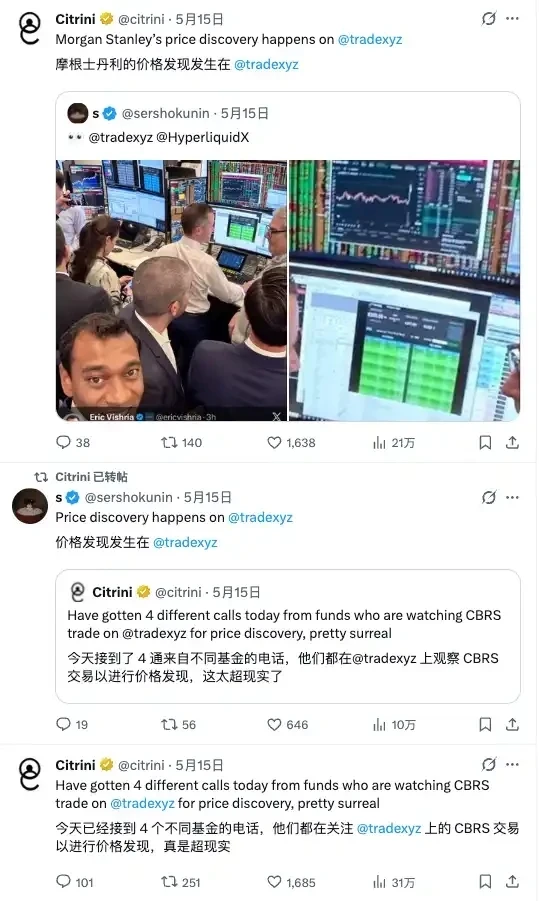
In a sense, Citrini can be considered a bellwether sending "warning signals" to the traditional financial circle—using accurate information to warn traditional financial markets that previously unnoticed crypto players are setting their sights on the "big cake" of traditional finance like barbarians.

Behind Citrini is a founder who believes in "second-order thinking" and "long-termism"—James van Geelen.

Multiple Labels: Dual Degrees in Biology & Psychology, Medical Emergency Practitioner, "AI Panic Whistleblower"

Thirty-three-year-old James van Geelen (hereinafter referred to as Geelen) perhaps never imagined that a single "hot post about AI" could trigger the rapid evaporation of hundreds of billions of dollars in market value from the U.S. stock market; earlier, his professional resume wasn't even remotely related to AI.

Public information shows that Geelen graduated from the prestigious U.S. university UCLA, earning dual degrees in Biology and Psychology during his studies; he also worked as an Emergency Medical Technician and Paramedic in downtown Los Angeles. His elite education and medical emergency background forged his character—pursuing efficiency and excelling at planning. As he himself says, "If you don't have a plan, you're going to have a bad time." Additionally, he claims to be a "genius musician," though without any notable works to show for it.

According to Geelen's original plan, he should have become a doctor saving lives, but by a twist of fate, he instead embarked on an entrepreneurial path: first founding a healthcare company and selling it to a private equity fund, thereby successfully breaking free from the "prestigious school-job-professional manager" cycle; then founding the current Citrini.

Another noteworthy point, as he personally mentioned in a 2023 Odd Lots podcast, is that he also co-founded one of Connecticut's earliest medical marijuana dispensaries. From this perspective, he is far from the "proper doctor" perceived by ordinary people as following a set routine or even being stubborn.

In 2018, after securing some startup capital, Geelen began his personal investment career under the name Citrinitas Capital, capturing early opportunities in areas like AI (e.g., NVIDIA) and GLP-1 weight-loss drugs (e.g., Ozempic/Wegovy).

In 2023, Geelen formally founded Citrini Research, dedicated to "cross-asset, multi-dimensional thinking for investment analysis," providing in-depth reports on thematic stock investing and global macro trading. It rapidly grew to become a top creator in the finance field on the Substack platform. (Odaily Planet Daily Note: It operates on both individual and institutional subscription models.)

On May 31, 2023, the model investment portfolio Citrindex, based on personal research, was officially launched with an annual subscription fee of $1250. According to statistics, this investment portfolio has achieved cumulative returns exceeding 200%, often outperforming the S&P 500 on a monthly basis.

In March 2024, he boldly predicted Trump would win the election; in July 2025, amid the turmoil surrounding former Fed Chair Powell's departure, he loudly advised his over 50,000 subscribers to "buy two-year U.S. Treasuries and short ten-year U.S. Treasuries" to hedge policy risks.

In December 2025, according to PitchBook information, Citrini completed approximately $5.05 million in seed funding, with only about 10 employees, and the company remains privately held.

Then, in February of this year, he co-authored with traditional finance veteran Alap Shah the report that shook the U.S. stock market: "The 2028 Global Intelligence Crisis." Although he repeatedly emphasized the report was merely a "thought experiment," a scenario assumption rather than predictive analysis, the phenomena it mentioned—such as "large-scale white-collar unemployment, declining consumer spending, economic contraction (Ghost GDP)"—still sparked panic and concern in the capital market, leading to sharp declines in delivery, payment, and software stocks. Among them, IBM's stock price on February 23 recorded its largest single-day drop since 2025; American Express and Blackstone Group both fell over 8%, the entire software stock sector dropped nearly 5%, and stocks like DoorDash, Uber, Mastercard, Visa, Capital One, and Apollo Global Management Inc. once fell by 3%. Multiple U.S. stock sectors were swept into the selling wave, with the Dow Jones index at one point falling over 800 points. Alap Shah later publicly stated that his investment stance was "talking bearish but going long," meaning shorting companies they believed would be disrupted by AI while holding semiconductor tech stocks benefiting from AI.

It's no exaggeration to say that Citrini's one report directly caused the U.S. stock market to "bleed profusely" at one point, evaporating hundreds of billions of dollars in market value overnight, prompting follow-up reports from overseas media like Bloomberg and The Wall Street Journal.

On April 6 this year, Citrini team "Analyst #3" (code name Analyst#3) personally went to the critical flashpoint in the U.S.-Iran conflict—the Strait of Hormuz—for research, disclosing many little-known first-hand observations. They revealed the specific operational mode of Iran's "toll station" set up in the strait and presented a series of counter-intuitive conclusions, such as: Regardless of how the situation develops, shipping volume through the strait will gradually increase; Iran does not wish to close the Strait of Hormuz. First, strait shipping volume will continue to rise. Second, a diplomatic-style "toll station," surprisingly, the passage order in the strait is actually very regulated. Third, the paradoxical nature of escalation; even if ground operations commence, shipping volume through the strait may still continue to increase. Fourth, a restructuring of the landscape, not a winner-takes-all showdown. This conflict is not a simple "two-sided confrontation" but a multi-party game. Geographical disputes within great power competition are also key subjects within Citrini's "research range."

When asked why he named the company "citrinitas," Geelen replied: "The naming inspiration comes from the financial titan George Soros's book 'The Alchemy of Finance.' This is actually a stage in alchemy, but what most people don't know is that in this transitional stage, lead begins to transform into gold but hasn't completely become gold yet." This is also his favorite time to "make a difference"—seeing the birth of "gold" before others notice the change in lead.

Investment Style: Second-Order Thinking, Narrative-Driven, Reverse Scenario Analysis

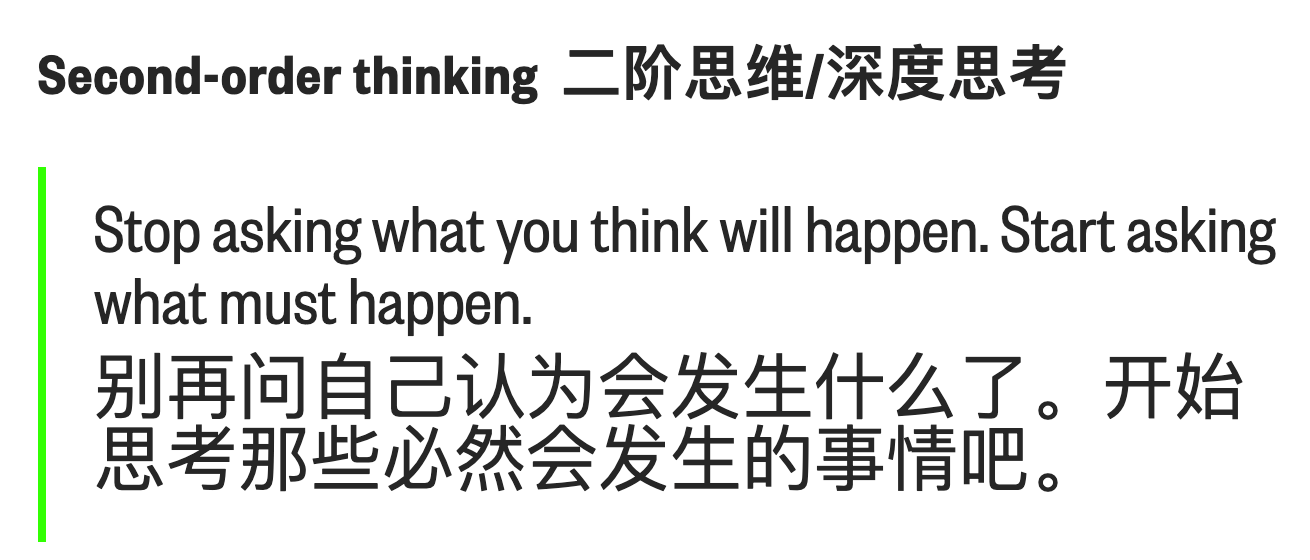
As for Citrini's investment style, thanks to its cross-industry experience and multiple labels, it highly advocates "second-order thinking."

As Geelen himself says: "Most investors only focus on the ball itself, but I focus more on where the ball is going to bounce next."
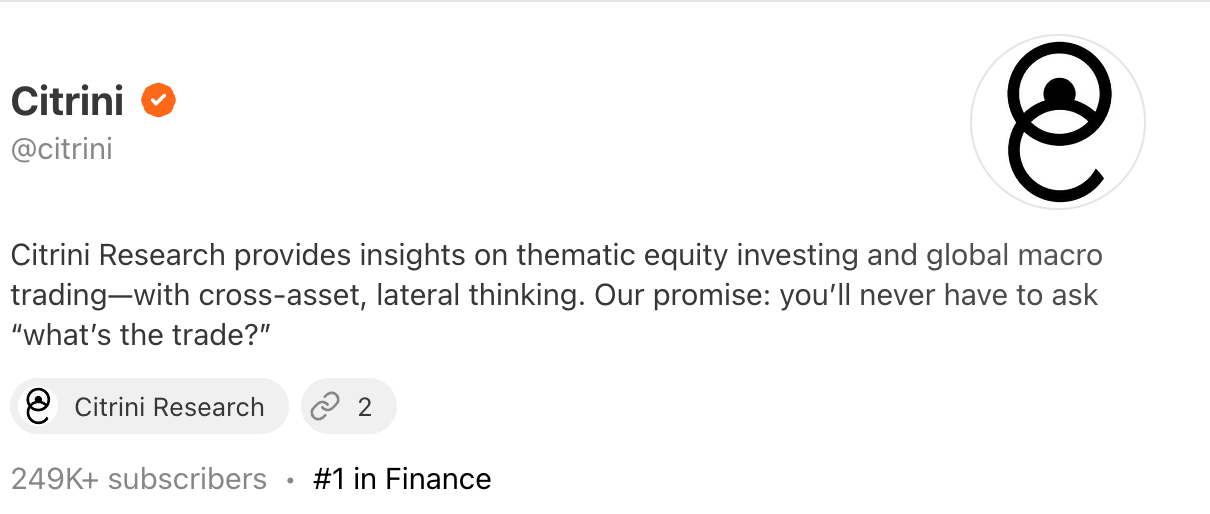
Judging from Citrini's past content and public information, this research firm focuses on long-term "super trends," such as AI, robotics, energy demand, fiscal policy, geopolitics, modern warfare, etc. Additionally, the institution is committed to providing actionable "bundled investment references" and tactical macro trade ideas, with analysis leaning towards long-term structural changes rather than short-term trading. In its Substack homepage bio, we can see its emphasis on practicality, stating: "You (the reader) won't have to ask 'what's the trade?' anymore."
Furthermore, Citrini often uses "scenario assumptions" to help readers understand second-/third-order effects. Geelen once mentioned: "Don't just think about what you think will happen. Instead, think about things that are bound to happen. How will the market's reaction change the reality? What secondary effects will there be? What are the obstacles to keeping a certain trend going? And where will capital flow to overcome these obstacles?" Previously, he boldly bought overnight funding rate call options during the Silicon Valley Bank collapse in March 2023, easily reaping nearly 50x returns; last December, before the U.S. launched military action in Venezuela, he shared insights on investment opportunities in Venezuelan sovereign bonds.

This year, Citrini has successively absorbed several independent analysts, including macro analyst Nick Reece, South Korean semiconductor industry analyst @jukan05, and AI chip industry analyst @zephyr_z9, to some extent filling gaps in understanding industry details, technical processes, and sector trend changes.Currently, the research institution still maintains a founder-driven + anonymous elite team collaboration production model.


Criptomoedas em alta

Perguntas relacionadas

QWho is the founder of Citrini Research and what is his academic background?

AThe founder of Citrini Research is James van Geelen. He holds dual degrees in Biology and Psychology from UCLA.

QWhat major event in February was triggered by a Citrini report, and what was its impact on the stock market?

AIn February, Citrini's report titled 'The 2028 Global Intelligence Crisis' triggered a panic-driven sell-off in U.S. software stocks. It led to massive market losses, including IBM's worst single-day drop in 2025, significant declines for companies like American Express and Blackstone, a nearly 5% drop in the software sector, and a temporary evaporation of hundreds of billions of dollars in market value.

QHow did Citrini contribute to the visibility of platforms like Trade.xyz in the traditional finance sector?

ACitrini highlighted how fund managers were using platforms like Trade.xyz on the Hyperliquid ecosystem for price discovery ahead of stock listings, such as before Cerebras (CBRS) went public. This acknowledgment brought crypto-based RWA platforms, pre-market trading platforms, and on-chain stock trading into the view of traditional finance circles.

QWhat is the origin of the name 'Citrini', and what does it symbolize according to the founder?

AThe name 'Citrini' (from Citrinitas) is inspired by George Soros's book 'The Alchemy of Finance'. It refers to a stage in alchemy where lead begins to transform into gold but has not fully completed the process. James van Geelen sees it as representing the moment of potential and transition that he seeks to identify in markets before others do.

QWhat is James van Geelen's core investment philosophy, often described as 'second-order thinking'?

AJames van Geelen's core investment philosophy is 'second-order thinking'. This means looking beyond the immediate event or trend (the 'ball') to anticipate its subsequent effects and consequences ('where the ball will bounce next'). It involves considering long-term structural changes, secondary impacts, and how market reactions will alter reality.

Leituras Relacionadas

WeChat AI Card Hands-On Guide: Has the AI Shopping Era Arrived?

**"WeChat AI Card" Practical Test Guide: Has the Era of AI Shopping Arrived?** WeChat has officially launched the "AI Exclusive Card," a feature integrated into its Workbuddy AI assistant. This card is designed to handle payments for AI-initiated purchases. Our hands-on test reveals it's not yet a tool for fully autonomous AI shopping, but rather a controlled payment layer for AI agents. The AI Card functions as an isolated sub-wallet within WeChat Pay. Users must bind the card and transfer funds into it from their main wallet. Crucially, every transaction requires explicit user confirmation via smartphone scan; AI cannot spend autonomously. Currently accessible through the Workbuddy agent, the card targets specific digital consumption scenarios: purchasing paid content (reports, data), calling paid APIs/tools, and subscribing to services. Its design prioritizes security and control by separating funds and mandating approval for each payment. We tested a real-world scenario: ordering bubble tea via Workbuddy using a "Meituan Life Assistant" skill. The process encountered multiple hurdles: high "skill" usage costs (exceeding daily free credits), and most importantly, while a payment was successfully initiated, the AI purchased an incorrect product (a mismatched group-buy coupon instead of the desired drink). This highlights the current limitation: the **AI Card only solves the payment step**. The broader challenge lies in the **AI agent's execution chain**—accurately understanding intent, navigating third-party platforms, selecting the right product, and ensuring proper fulfillment. The payment succeeded, but the purchase failed to meet the user's need. In conclusion, the WeChat AI Exclusive Card is a cautious, early-step experiment in AI commerce. It provides a secure, user-controlled payment method for agent interactions but is not yet capable of reliable, end-to-end complex purchases. For now, it's best used for low-value, low-risk digital services with careful user verification at each step. The vision of AI handling complete shopping tasks remains a work in progress.

marsbitHá 21m

WeChat AI Card Hands-On Guide: Has the AI Shopping Era Arrived?

marsbitHá 21m

Deconstructing Notion's Growth: From a Note-taking Tool to 100 Million Users—How Notion Built a Triple Growth Flywheel Through Product, Templates, and Community

Notion's growth from a niche note-taking tool to a platform with 100 million users is powered by three interconnected flywheels: Product-Led Growth (PLG), a Template Economy, and Community-Driven Growth. First, Notion's PLG strategy relies on a highly flexible, "plastic" product that users can adapt to countless personal and team workflows. Its freemium model lowers the barrier to entry, while features like page sharing and collaboration drive organic, usage-based viral growth as users naturally invite others. Second, the Template Economy solves the "blank page" problem. Templates, created by both Notion and its community, transform abstract product capabilities into concrete, copyable solutions for specific scenarios (e.g., project management, content calendars). This dramatically lowers activation costs for new users and fuels SEO-driven discovery. Third, a vibrant Community acts as a distributed growth engine. Users and official Ambassadors create tutorials, share use cases, and host local events. This community not only educates users but also fosters a sense of identity around pursuing "better ways of working," strengthening loyalty and enabling global, low-cost expansion. Together, these flywheels create a self-reinforcing ecosystem: a great product attracts users who create templates and community content, which in turn attracts more users and deepens engagement. This system allowed Notion to scale from individuals to teams and enterprises through a bottom-up adoption path. Looking ahead, AI integration promises to accelerate these flywheels further by making templates smarter and the platform a potential AI-native work operating system. Ultimately, Notion's defensible advantage is not just its features, but this deeply entrenched network of user assets, creators, and community trust.

marsbitHá 22m

Deconstructing Notion's Growth: From a Note-taking Tool to 100 Million Users—How Notion Built a Triple Growth Flywheel Through Product, Templates, and Community

marsbitHá 22m

$10 Billion, Qualcomm to Acquire Chip Legend Jim Keller's Company

Global mobile chip giant Qualcomm is in advanced talks to acquire AI chip startup Tenstorrent in a deal valued between $8-10 billion, according to media reports. This potential acquisition would be one of the largest in the AI chip sector in recent years. Tenstorrent, led by legendary chip architect Jim Keller, has gained prominence for its RISC-V architecture and AI accelerator designs. The move highlights Qualcomm's strategic push to diversify beyond its core smartphone chip business. As the smartphone market matures, Qualcomm is aggressively targeting growth in automotive, data center, and cloud AI. Acquiring Tenstorrent would allow Qualcomm to rapidly enter the high-end AI computing market, bypassing lengthy in-house development cycles. Tenstorrent's cost-effective system architecture, which avoids expensive HBM memory and relies on standard Ethernet for clustering, offers a potential alternative to Nvidia's costly solutions. Furthermore, Tenstorrent's high-performance RISC-V CPU technology and its focus on the automotive and edge computing segments align with Qualcomm's strategic goals, including its "Snapdragon Digital Chassis" platform. Despite the strategic rationale, the high valuation has sparked some investor caution. The successful integration of Tenstorrent's open-source culture and independent team into Qualcomm's organization, along with the commercialization of its technology, remains a key challenge.

marsbitHá 1h

$10 Billion, Qualcomm to Acquire Chip Legend Jim Keller's Company

marsbitHá 1h

Trading

Spot
Futuros

Artigos em Destaque

Como comprar ONE

Bem-vindo à HTX.com!Tornámos a compra de Harmony (ONE) simples e conveniente.Segue o nosso guia passo a passo para iniciar a tua jornada no mundo das criptos.Passo 1: cria a tua conta HTXUtiliza o teu e-mail ou número de telefone para te inscreveres numa conta gratuita na HTX.Desfruta de um processo de inscrição sem complicações e desbloqueia todas as funcionalidades.Obter a minha contaPasso 2: vai para Comprar Cripto e escolhe o teu método de pagamentoCartão de crédito/débito: usa o teu visa ou mastercard para comprar Harmony (ONE) instantaneamente.Saldo: usa os fundos da tua conta HTX para transacionar sem problemas.Terceiros: adicionamos métodos de pagamento populares, como Google Pay e Apple Pay, para aumentar a conveniência.P2P: transaciona diretamente com outros utilizadores na HTX.Mercado de balcão (OTC): oferecemos serviços personalizados e taxas de câmbio competitivas para os traders.Passo 3: armazena teu Harmony (ONE)Depois de comprar o teu Harmony (ONE), armazena-o na tua conta HTX.Alternativamente, podes enviá-lo para outro lugar através de transferência blockchain ou usá-lo para transacionar outras criptomoedas.Passo 4: transaciona Harmony (ONE)Transaciona facilmente Harmony (ONE) no mercado à vista da HTX.Acede simplesmente à tua conta, seleciona o teu par de trading, executa as tuas transações e monitoriza em tempo real.Oferecemos uma experiência de fácil utilização tanto para principiantes como para traders experientes.

314 Visualizações TotaisPublicado em {updateTime}Atualizado em 2026.06.02

Como comprar ONE

Discussões

Bem-vindo à Comunidade HTX. Aqui, pode manter-se informado sobre os mais recentes desenvolvimentos da plataforma e obter acesso a análises profissionais de mercado. As opiniões dos utilizadores sobre o preço de ONE (ONE) são apresentadas abaixo.

活动图片