When Crypto Meets the World Cup: CoinW and Modrić's Art of "Navigating Cycles"

Foresight NewsPublicado em 2026-06-17Última atualização em 2026-06-17

Resumo

When Encryption Meets the World Cup: CoinW and Modrić's "Transcending Cycles" Philosophy In the context of the 2026 FIFA World Cup and its massive global audience, the crypto exchange CoinW announced football legend Luka Modrić as its global brand ambassador. This move is framed not merely as a marketing tactic, but as a strategic experiment in user profile migration. It targets mature, financially stable football fans—particularly in Europe, Southeast Asia, and Latin America—who traditionally have low crypto awareness but value trusted, time-tested authority figures like Modrić. The article draws parallels between Modrić's enduring, disciplined career—marked by consistency and success at the highest level over two decades—and CoinW's own development path. Founded in 2017 during a volatile industry period, CoinW focused on building robust infrastructure and risk management. It weathered the 2022 industry crisis without major security incidents, subsequently earning recognition like "Europe's Most Trusted Exchange" and growing to over 20 million registered users. This "long-termism" is translated into user-centric products. CoinW Academy lowers the initial knowledge barrier. Its integrated ecosystem (CoinW, GemW, DeriW, PropW) and the recent launch of a TradFi section—offering perpetual contracts on traditional assets like stocks, gold, and oil—aim to create a unified platform for diverse assets. For the World Cup, CoinW launched the "We Are The Game" campaign, collaboratin...


Author:angelilu,Foresight News


The 2026 FIFA World Cup kicked off in the US, Canada, and Mexico. With global cumulative viewership projected to exceed 50 billion, marketing budgets are flowing towards every billboard, jersey, and pop-up ad slot. The crypto industry is among them, spending increasingly generously.


But beyond the numbers, a question rarely addressed head-on is: who is attracted after the money is spent?


The true value of sports sponsorship for the crypto industry is not just logo exposure. A more accurate description is an experiment in user profile migration. The global football audience, especially the core viewership in Europe, Southeast Asia, and Latin America, possesses stable disposable income and a natural interest in data and probability, but traditionally has very low awareness of crypto assets. This demographic is highly sensitive to "trustworthy authoritative endorsements" – the ambassadors they trust are not names made famous by hype, but those repeatedly validated by time.


On April 9, 2026, CoinW announced Luka Modrić as its global brand ambassador.
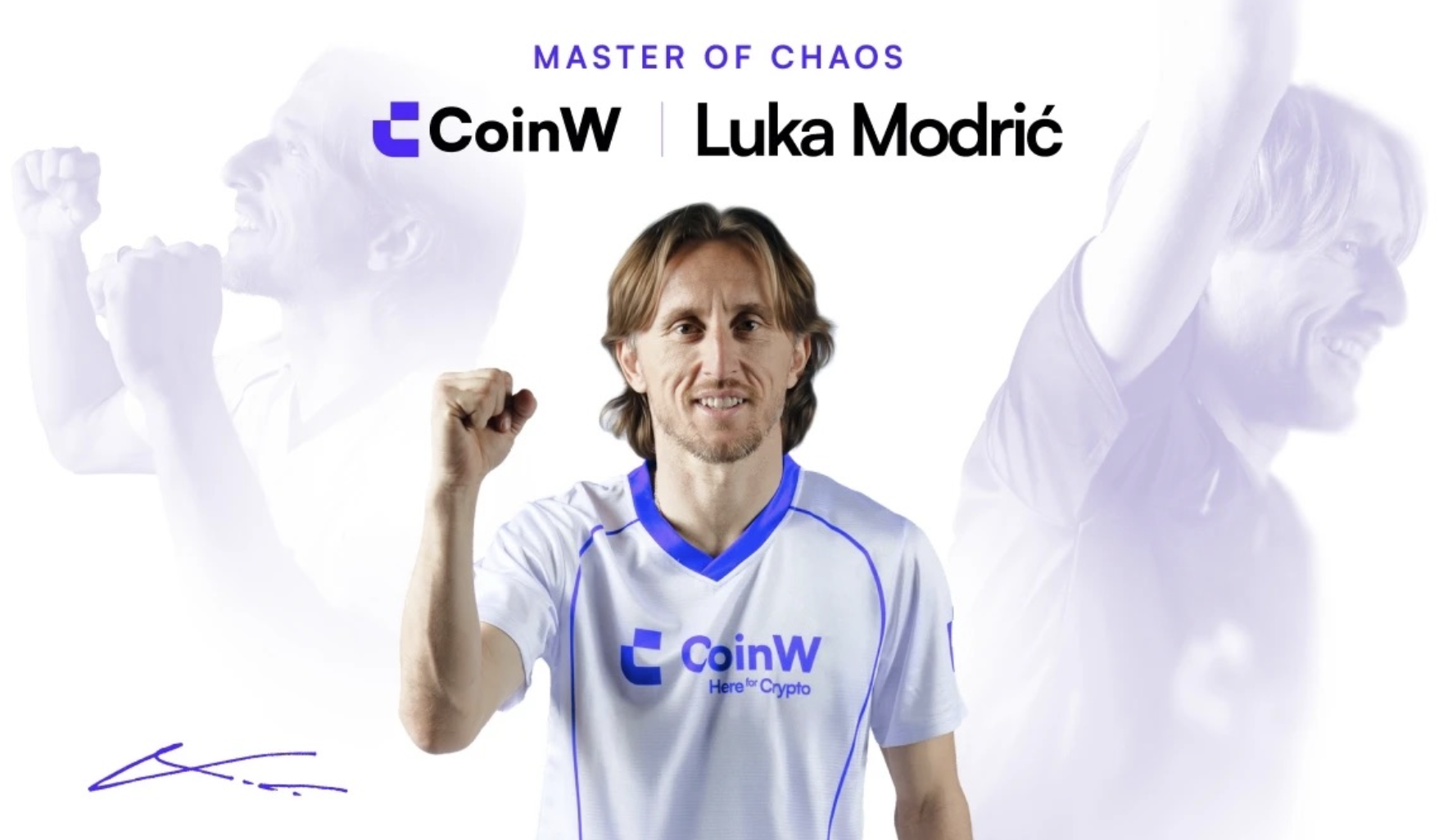


Truly valuable cross-industry collaborations are not just about traffic stacking, but about precise user profile switching – taking people who "know who Modrić is" to the next step of "being willing to understand what CoinW is."


Modrić is almost irreplaceable in this dimension: his fanbase is not young, impulsive star-chasers, but mature fans who have watched his ups and downs over two decades. Once trust is established with such an audience, the conversion path is longer and the retention rate is higher.


The One Who Masters Rhythm Amidst Chaos


CoinW's global brand ambassador, Luka Modrić, will once again take to the World Cup stage as captain of the Croatian national team. At 41, he is still running at the highest level.


Modrić might seem "misaligned" with the crypto industry at first glance. He never creates headlines, nor does he possess explosive flair, but he has slowly accumulated over two decades, waiting for time to prove his worth.


Luka Modrić was not highly regarded when he joined Real Madrid in 2012. But at the 2018 World Cup, he led Croatia to the final, winning the Best Player award. By the end of that same year, he broke Messi and Ronaldo's decade-long monopoly on the Ballon d'Or. During his 13 years at Real Madrid, he won 6 Champions League titles and 28 major trophies.


In the summer of 2024, he parted ways with Real Madrid after 13 years of service. In July 2025, the 40-year-old signed with AC Milan as a free agent, seen as a romantic experiment about the final chapter of a career. The reality was simpler: he played, and he delivered. In the 2025-26 season, Modrić made 34 appearances for Milan, starting 32 times, contributing 2 goals and 3 assists, and creating 51 chances. These numbers do not belong to a veteran burning his last embers, but to a man who still knows exactly what he's doing.


CoinW's trajectory shares a similar quality. Founded in 2017, during the most turbulent early years of the industry when projects came and went like smoke and exchanges opened and closed, CoinW chose to focus its energy on building infrastructure and risk management systems – a multi-layered security architecture, strict internal control mechanisms, and a product logic centered on user asset protection. In an industry that emphasized rapid expansion, this choice seemed exceptionally quiet.


In 2022, the entire crypto industry experienced a systemic crisis. Several leading institutions collapsed one after another, user assets evaporated, and industry trust plummeted to its lowest point. CoinW was not on that list of collapses. The platform maintained uninterrupted service, and according to its disclosed internal records, no major security incidents occurred. This was more important than any growth data.


As the industry's narrative shifted from growth to trust, compliance and transparency gradually became core benchmarks for trading platform competitiveness. CoinW continued to deepen its global expansion, actively participating in industry development in key markets. At the Next Block Expo Europe summit in Warsaw, CoinW was awarded "Europe's Most Trusted Exchange." Currently, the platform has surpassed 20 million global registered users, with a daily trading volume exceeding $5 billion (as of October 2025).


Behind these numbers is not an instant burst from short-term growth, but long-term accumulation formed through maintaining strategic focus and continuous investment in product and infrastructure development across multiple market cycles.


Modrić and CoinW share a common underlying color: not being crushed by cycles, but being tested by time.


Following the official announcement of the ambassadorship, CoinW Chief Strategy Officer Nassar Al Achkar stated: "We chose Modrić not just for his achievements, but for the spiritual power his journey embodies. In an environment full of competition and uncertainty, he has always maintained focus and composure, not swayed by external noise, nor changing direction due to short-term gains or losses. Long-termism, calm restraint, and a born-to-win mentality. These qualities have shaped Modrić's football career and are highly aligned with the developmental logic of CoinW's journey.


Amidst the industry's fluctuations and cycle changes, we have always believed that true competitiveness does not come from chasing short-term trends, but from sustained investment in long-term value. Therefore, we choose to focus our attention on what truly matters: continuously improving product capabilities, enhancing user experience, and earning user trust through long-term building."


How Rhythm Translates into Product


Long-termism is not a slogan; it needs to be translated into tangible things users can perceive.


For an athlete, this manifests as a training system and continuous evolution. The 51 chances Modrić created in the AC Milan season are not flashes of genius, but judgment accumulated year after year.


For a trading platform, this translation takes another form: dismantling barriers to entry, layer by layer.


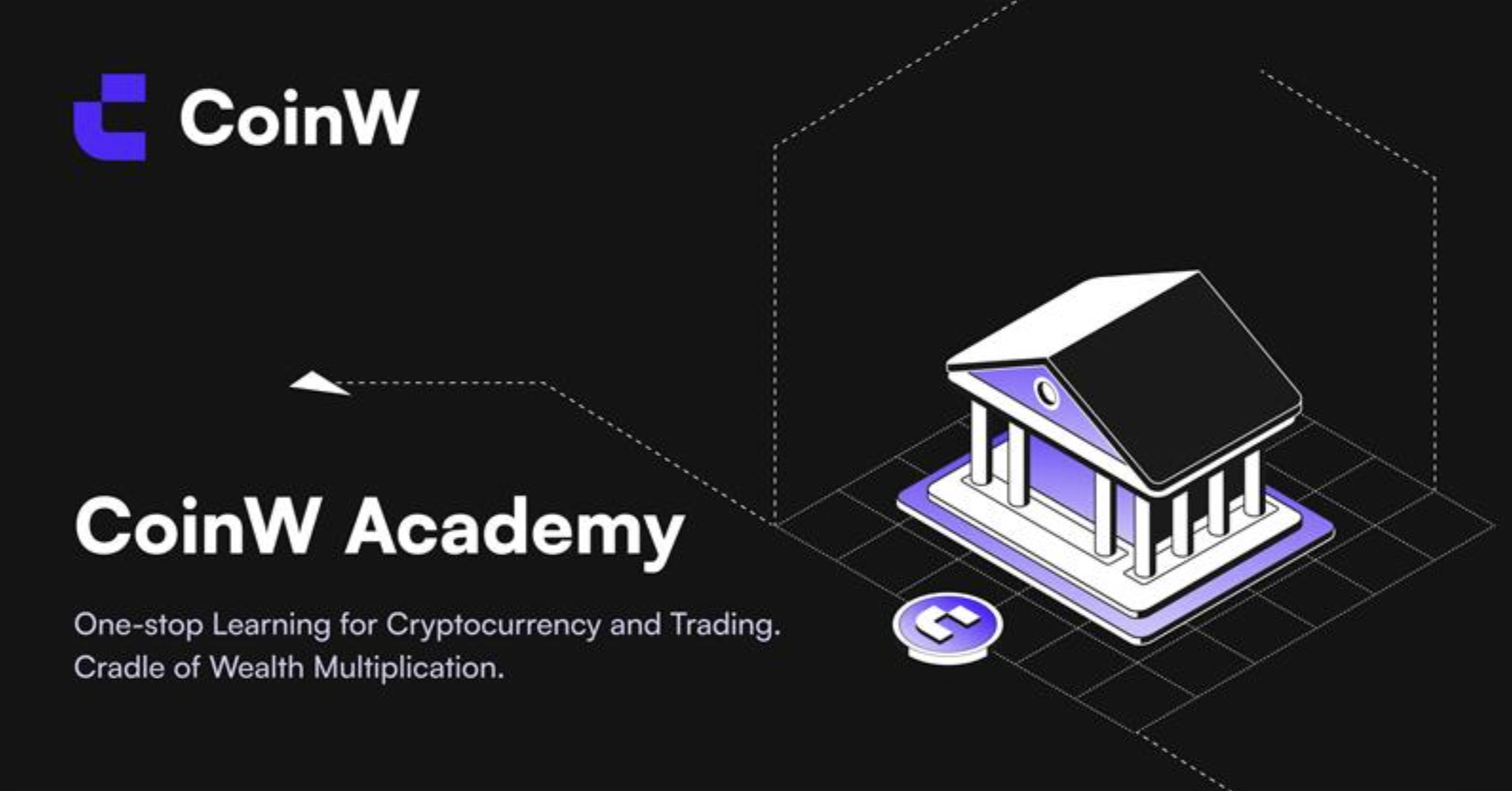
The first layer is the cognitive barrier. New users facing a world dense with unfamiliar terminology and logic often close the page before they even understand "what is on-chain." CoinW Academy uses tiered, free content covering the complete path from blockchain basics to derivatives trading logic, helping users move from "understanding what this is" to "knowing how to operate." It doesn't appear in any profit data, but it determines how many people can truly enter.


The second layer is the asset boundary. CoinW continuously improves its infrastructure and conducts deep integration at the ecosystem level: the four product ecosystems of CoinW, GemW, DeriW, and PropW are interconnected. Centered around a unified account and strategy engine, they build comprehensive trading capabilities covering multi-category assets, transitioning the user experience from fragmentation to integration.


In June of this year, CoinW officially launched the TradFi Zone. This is a directional product upgrade: integrating traditional assets like gold, crude oil, commodities, and US stocks – including Apple, Google, NVIDIA, as well as recent market attention-grabbers OpenAI and SpaceX – into the platform in the form of perpetual contracts. Currently offering over 60 trading pairs, it provides 7x24 trading, USDT instant settlement, and flexible leverage mechanisms.
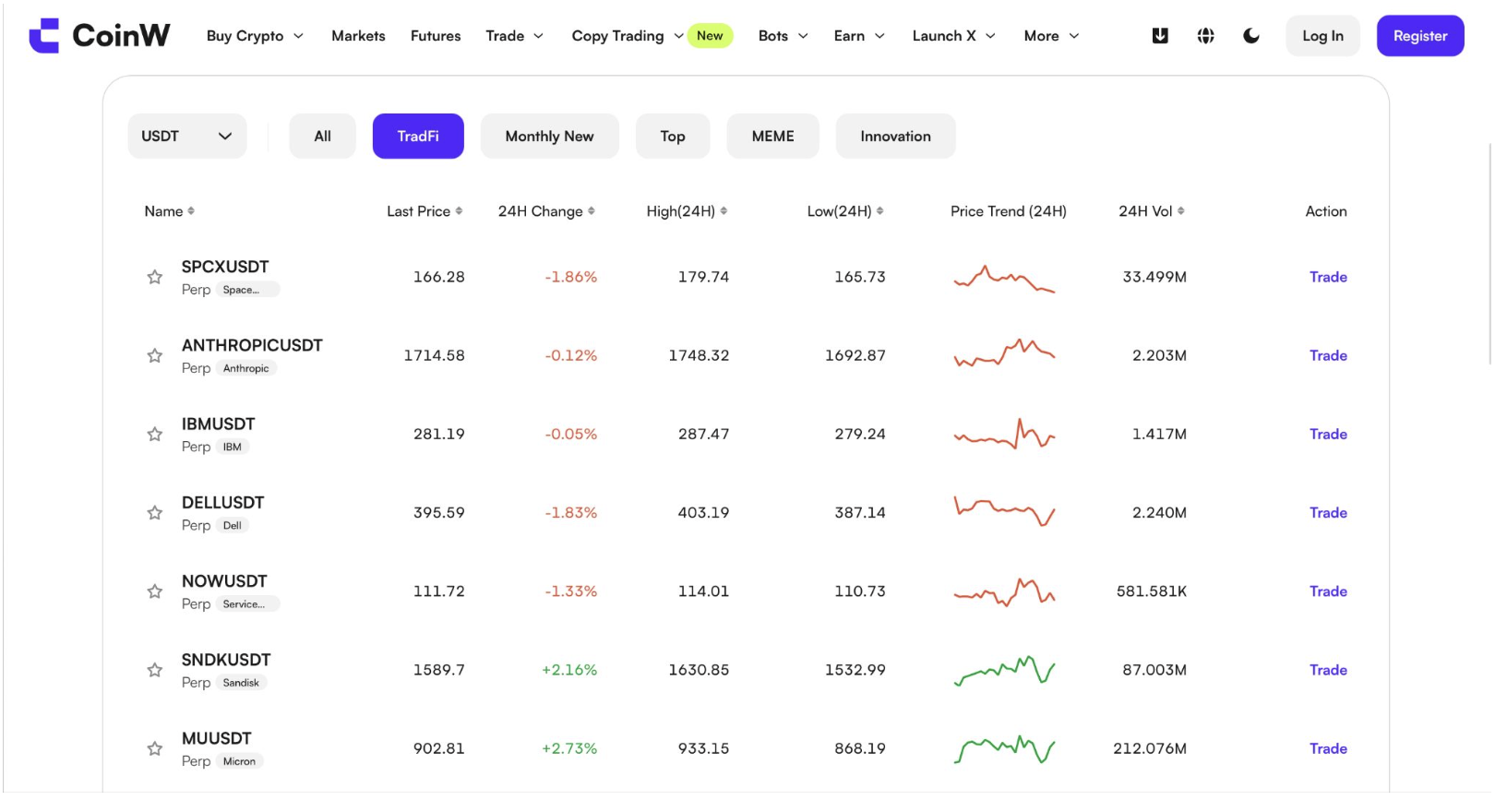


Unlike previously scattered commodity contracts, the TradFi Zone is a unified cross-market entry point. A user holding a Bitcoin position can trade the rise and fall of NVIDIA within the same account. This multi-asset integration is both a product logic and a declaration about "how broad the boundaries of crypto assets should be."


"The launch of CoinW TradFi is a milestone," said Nassar Al Achkar. "Our goal is not just to offer traditional assets, but to build a comprehensive financial platform – integrating high-impact trading varieties, a professional content ecosystem, and AI-driven intelligent tools, allowing users to connect with broader global market opportunities within one trusted platform."


The third layer is the participation barrier, a direction CoinW is focusing on during the World Cup.


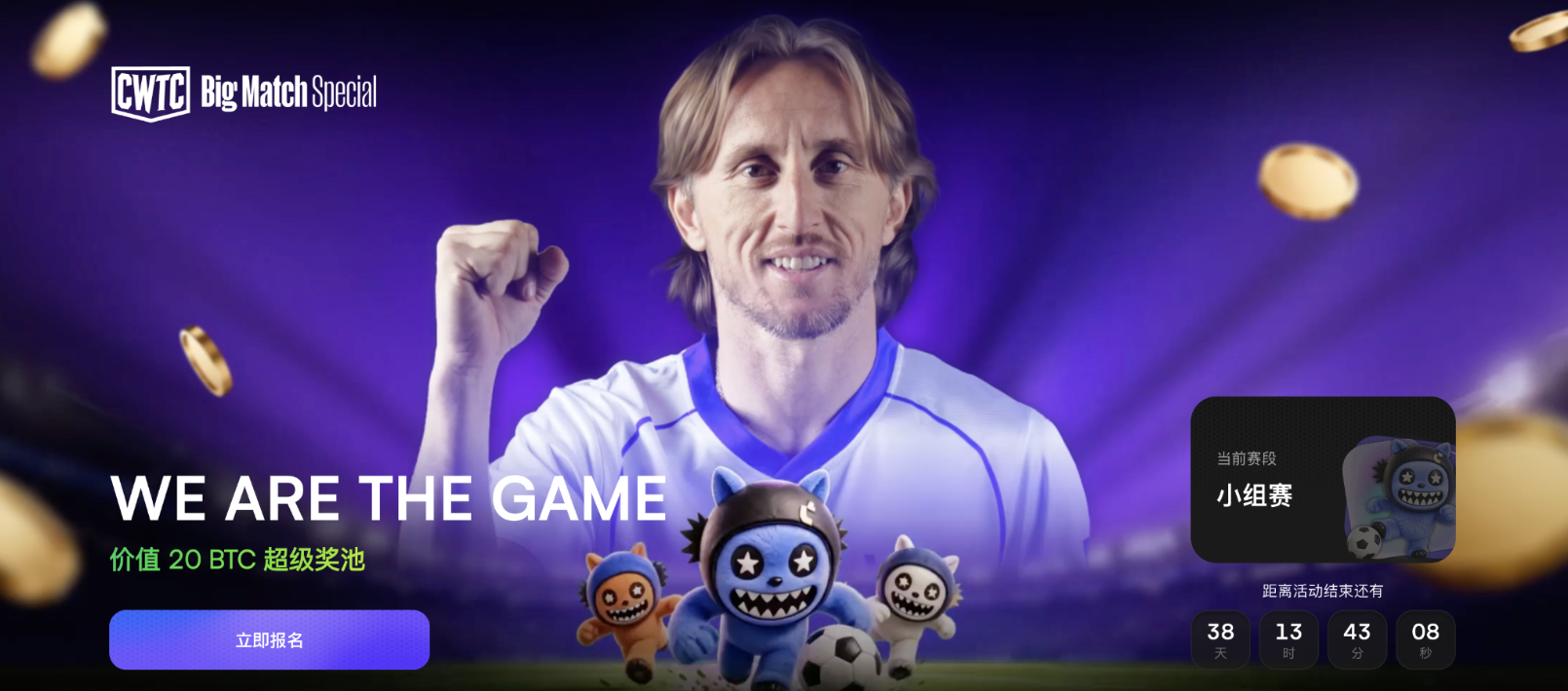
On June 10, 2026, CoinW launched "CWTC Big Match Special: We Are The Game." What's most special about the World Cup isn't just who lifts the trophy, but the fact that billions of people focus on the same match at the same time, sharing the same emotions, regardless of their time zone – this sense of collective presence is the most irreplicable narrative container in human history. "We Are The Game" borrows precisely this logic: transforming spectators in the stands into participants on the field, making trading not a spectator's game but a competitive arena where everyone can participate.


But to truly achieve "everyone's participation," the first step is to remove those invisible barriers. CoinW partnered with payment infrastructure provider Alchemy Pay, starting from the deposit process: a limited-time "0 fee" deposit promotion to alleviate Web2 users' concerns about deposit/withdrawal fees; aligning with the "US-Canada-Mexico" World Cup theme, actively opening local payment channels in Latin America, allowing users to complete deposits using their most familiar local payment methods in a more convenient and lower-fee manner without relying on credit cards.


Whether it's fans in the stands or ordinary users in front of screens, whether newcomers to crypto or seasoned veterans, as more and more people can easily enter, "We Are The Game" can truly become a sport for all.


Time Knows the Answer


The story of the crypto industry has long been a story about those already present: early adopters, institutional investors, quant teams, on-chain veterans. Yet the ordinary people standing at the doorway – those studying Modrić's data analytics, following World Cup odds, with spare funds but zero knowledge of crypto assets – are the silent majority in the industry's narrative. Their concerns are not technical, but a more fundamental issue of trust: Is this place safe? Does anyone really care if I can figure this out?


CoinW's sports initiatives – Official Regional Cryptocurrency Exchange Partner of LALIGA, Web3 Partner of the East Asian Football Federation, Modrić ambassadorship, World Cup campaign activities – are not targeting the same group already present, but that group still standing outside. Lowering cognitive barriers, providing transparent asset protection mechanisms, making traditional financial assets an option in crypto accounts, creating a sense of participation during the world's largest shared cultural moment – these decisions together form a converging path towards a broader user base.


Disclaimer: This article is for brand campaign information sharing only and does not constitute any investment advice or trading invitation. Digital asset trading carries high risks, and users are solely responsible for their own financial decisions. Service content may vary depending on the jurisdiction and is not available in all regions. The US stock-type assets provided by the platform are perpetual contracts tracking the price performance of the underlying assets, not the underlying stocks or securities themselves, and do not represent equity holdings in the related listed companies. The listed companies mentioned in the article are independent third parties and have no affiliation or cooperative relationship with CoinW.

Perguntas relacionadas

QWho did CoinW announce as their global brand ambassador on April 9, 2026, and why is this partnership considered strategic?

ACoinW announced Luka Modrić as their global brand ambassador. This partnership is strategic because Modrić appeals to a mature, financially stable global football audience with a high level of trust in his authority—a demographic traditionally less familiar with crypto assets. This allows CoinW to migrate the user profile from 'knowing Modrić' to 'being willing to learn about CoinW', targeting users with potentially higher long-term retention and trust.

QWhat key qualities do Luka Modrić and CoinW share, according to the article?

AAccording to the article, Luka Modrić and CoinW share the core qualities of long-termism, resilience through market/sporting cycles, and being validated by time. Both focus on steady, foundational growth (infrastructure, risk management for CoinW; skill, discipline for Modrić) rather than chasing short-term hype or explosive bursts, enabling them to endure crises and build lasting trust.

QWhat are the three main 'thresholds' or barriers to entry that CoinW's products aim to break down for new users?

ACoinW's products aim to break down three main thresholds: 1. **Cognitive Threshold**: Through CoinW Academy's free, tiered educational content. 2. **Asset Boundary Threshold**: Through integrating multiple product ecosystems (CoinW, GemW, DeriW, PropW) and launching the TradFi zone for traditional assets. 3. **Participation Threshold**: Through events like 'We Are The Game' during the World Cup and simplifying on-ramps with partners like Alchemy Pay, including zero-fee deposit periods.

QWhat is the significance of CoinW launching its 'TradFi' zone in June 2026?

AThe launch of CoinW's 'TradFi' zone is a significant product upgrade that integrates traditional financial assets (like gold, oil, stocks of Apple, Google, NVIDIA) as perpetual contracts into the platform. It represents a directional shift towards creating a comprehensive financial platform, allowing users to trade both crypto and traditional assets within a single account. This breaks down the asset boundary and is a declaration about expanding the scope of crypto asset platforms.

QHow does CoinW's World Cup 2026 campaign 'CWTC Big Match Special: We Are The Game' aim to engage users?

ACoinW's 'We Are The Game' campaign aims to leverage the massive collective engagement of the World Cup to transform spectators into participants. It seeks to make trading feel like an accessible,全民运动 (mass-participation sport) rather than a spectator activity. Key tactics include creating a shared event narrative, offering zero-fee crypto deposits via Alchemy Pay, and integrating local payment channels in Latin America to lower the practical barriers to entry for new users during the tournament.

Leituras Relacionadas

Gate Research Institute: Analysis of Chart Patterns and Breakout Trading Strategies

Gate Research Institute: Chart Pattern Analysis and Breakout Trading Strategies Chart patterns are crucial tools in technical analysis for observing market supply and demand shifts, trend continuations, and reversals. This analysis involves a comprehensive evaluation of trend, volume, support/resistance, time cycles, and breakout validity, not just rote pattern recognition. Patterns are broadly categorized into reversal patterns (e.g., Double Tops/Bottoms, Head and Shoulders) and continuation patterns (e.g., Flags, Triangles, Rectangles). An effective breakout, key for trading, requires clear support/resistance, prolonged consolidation, a prevailing trend backdrop, and volume confirmation. However, breakouts are not guaranteed, as false breakouts are common. Risk must be managed through position sizing, stop-loss orders, pullback confirmations, and profit-taking in stages. Key pattern types discussed include: * **Rectangle Patterns:** Indicate market indecision within parallel support and resistance, with breakouts projecting a move equal to the pattern's width. * **Flag & Pennant Patterns:** Short-term continuation patterns following sharp price moves ("flagpoles"). * **Triangle Patterns:** Symmetrical, Ascending (bullish bias), and Descending (bearish bias) triangles, representing consolidation before a directional move. * **Head and Shoulders Patterns:** Major reversal patterns signaling trend exhaustion. The article details breakout trading strategies, defining valid breakouts by price closing beyond a key level with increased volume and minimal immediate re-entry into the prior range. It contrasts range trading with breakout trading and outlines entry methods (immediate entry, pullback entry, scaling in), stop-loss placement (based on pattern failure), and profit-taking techniques (target-based, structure-based, trend-following). It further classifies breakout outcomes: 1. **Valid Breakouts:** Strong, sustained moves in the breakout direction. 2. **Pullback Breakouts:** Price breaks out, retests the breakout level as support/resistance, then resumes the trend—offering a lower-risk entry. 3. **False Breakouts:** Price briefly breaches a level but quickly reverses back into the prior range, a common risk managed by strict stop-losses. Key validation tools for breakouts include volume analysis, the principle of support/resistance role reversal, and momentum indicators like ATR, Moving Averages, Bollinger Bands, and RSI. In conclusion, while chart patterns and breakout analysis provide a structured framework, their effectiveness relies on multiple confirming factors—trend context, volume, and proper risk management. They should be integrated into a broader trading system rather than used as standalone signals.

marsbitHá 4m

Gate Research Institute: Analysis of Chart Patterns and Breakout Trading Strategies

marsbitHá 4m

Joseph Chalom: Ethereum is Becoming the "Settlement Layer of Trust" for Global Finance

In a speech titled "The Industrialization of Trust," Sharplink CEO Joseph Chalom (former BlackRock digital assets head) discussed the future transformation of global finance. Drawing from 20 years at BlackRock, where he led the launch of Bitcoin/ETH ETFs and tokenized funds, Chalom highlighted the immense hidden costs of establishing trust in traditional finance—estimated at over $9.3 trillion annually in the US alone due to fragmented systems, multi-day settlements, and countless reconciliations. He argued that Ethereum is emerging as the global financial "settlement layer for trust," with its robust, decentralized infrastructure securing over $300 billion in on-chain assets and most stablecoins and tokenized assets. The future, he stated, will be driven by three accelerating pillars: stablecoins (evolving beyond crypto gateways to become efficient cross-border payment rails), tokenized assets (enabling 24/7 trading and reshaping capital markets), and DeFi (providing automated, accessible financial services). A potential game-changer, Chalom added, is the fourth pillar: "Agentic Finance," where AI agents autonomously execute programmable financial transactions via smart contracts and stablecoins. He envisions individuals soon having AI-powered "CFOs in their pockets" to optimize idle capital and manage tokenized portfolios. This shift, facilitated by Ethereum's trustless settlement, could multiply on-chain transaction volume 1000x within a year, moving finance toward a seamless, digitized future.

marsbitHá 4m

Joseph Chalom: Ethereum is Becoming the "Settlement Layer of Trust" for Global Finance

marsbitHá 4m

STRC Severely Unpegged, What Risks Is the Market Pricing In?

The article analyzes the recent significant de-pegging of Strategy's perpetual preferred stock, STRC, whose price fell to approximately $89, far below its $100 face value. This discount has pushed its simple yield to around 12.9%, creating a paradox. The stock was designed as a high-yield instrument trading near par, and Strategy maintains an 11.5% annual dividend, even recently switching to semi-monthly payments to support the price. The author explores several reasons why the high yield hasn't attracted enough buying pressure to restore the par value. A key factor is potential reverse deleveraging from carry trades, where leveraged investors may be forced to sell due to margin calls as the price falls, creating a self-reinforcing downward spiral. Additionally, the tokenization and integration of STRC into DeFi protocols (like Apyx, Saturn, Pendle) have introduced faster, more transparent, and potentially more volatile price adjustment mechanisms through leverage and yield-splitting products. The emergence of a competing product, Strive's SATA, offering a 13% yield with daily dividends, has also changed the yield benchmark, challenging STRC's unique high-yield narrative. Furthermore, the market is questioning the distinction between Strategy's substantial Bitcoin reserves, which provide long-term balance sheet coverage, and the certainty of stable near-term cash flow for dividends. Ultimately, the price dip represents a stress test for this type of BTC-backed, high-yield financing tool. The future path of STRC depends on whether Strategy acts to reinforce the $100 peg (e.g., by adjusting dividends), whether DeFi-related leverage unwinds further, and how investors ultimately price the risks of leverage, competition, and cash flow uncertainty against the offered yield.

marsbitHá 15m

STRC Severely Unpegged, What Risks Is the Market Pricing In?

marsbitHá 15m

LIT Token Hits Six-Month High: How Long Can the Buyback Flywheel Keep Burning Fuel?

The LIT token of decentralized perpetual exchange Lighter surged to a six-month high above $1.90 on June 18th, with a market cap of $425 million. After a price correction earlier this year, the recent rebound is attributed to its core "buyback flywheel" mechanism. All protocol fee revenue is used for programmatic, hourly market buybacks of LIT. Since its TGE in December 2025, approximately 15 million LIT (6% of circulating supply) has been repurchased for around $21 million. Additional price support comes from the LLP (Lighter Liquidity Pool), where providers must stake LIT worth 10% of their deposited USDC, locking significant token supply. However, challenges persist. Trading volume has declined amidst a sluggish market, with total volume at $1.68 trillion, significantly lower than leading competitor Hyperliquid's $4.37 trillion. While Lighter focuses on perpetual contracts, RWA, and Pre-IPO markets, Hyperliquid has expanded into prediction markets and boasts a U.S. spot ETF, attracting institutional investment and influencer endorsements like from Arthur Hayes. In contrast, LIT currently lacks similar high-profile backing. With 75% of LIT's total 1 billion supply still locked (team and investor tokens begin a 3-year linear unlock in December 2026), there is no immediate unlock selling pressure. The token's future performance hinges on sustaining trading volume growth, successful product iteration, and executing its transparent buyback strategy against a dominant competitor.

Foresight NewsHá 35m

LIT Token Hits Six-Month High: How Long Can the Buyback Flywheel Keep Burning Fuel?

Foresight NewsHá 35m

Trading

Spot
Futuros
活动图片