Ethereum Q1 Report: On-chain Activity Hits Record High, Tokenized Assets Lead the Industry

marsbitPublicado em 2026-06-19Última atualização em 2026-06-19

Resumo

Ethereum Q1 2026 Report: On-chain activity hits record high, tokenized assets lead the industry. In Q1 2026, Ethereum's network experienced a unique divergence: on-chain activity soared while USD-denominated metrics declined. Monthly active users reached 13.2 million, transactions hit 200.4 million, and TPS averaged 25.78, all setting new highs. However, total value locked (TVL) fell 11.0% to $316.2B, DEX volume dropped 24.0% to $134.5B, and ETH's fully diluted market cap fell 30.3% to $290B. A key driver was the Blob Parameter Fork (BPO#2) in January, which increased data capacity and caused a sharp 47.9% drop in layer-1 transaction fees despite higher usage. Etherean's tokenized asset market cap reached $203.4B, up 42.9% year-over-year. While stablecoins ($178.9B) saw a slight dip, tokenized funds ($19.4B, +73.1% YoY), commodities ($4.7B, +325.9% YoY), and stocks ($365.1M) grew strongly. Ethereum dominates cross-chain comparisons, holding 71% of TVL, 79.2% of active loans, 61.8% of stablecoins, and 73% of tokenized funds among top chains. The report highlights a "Jevons Paradox" scenario: network expansion reduces per-transaction costs but unleashes latent demand, driving long-term growth. Ethereum's strategy mirrors Amazon's early focus on scale over profit. Its open, neutral foundation is seen as critical for institutional adoption, as evidenced by growing activity from firms like BlackRock and JPMorgan. The roadmap targets further scalability, aiming for thousands of ...

Author:Token Terminal

Translation:Saoirse,Foresight News

Ethereum is the core underlying settlement network for on-chain assets, relying on ETH to pay transaction fees and secure the network through staking. Traditional finance suffers from slow settlement, numerous intermediaries, and high counterparty risks, whereas tokenized assets and stablecoins offer on-chain solutions. As relevant regulations mature from 2025 to 2026, institutional deployment of on-chain business formally meets implementation conditions.

Various stablecoins, tokenized funds, commodities, and on-chain stocks are issued and settled on Ethereum, with layer-2 networks diverting transactions before ultimately returning to layer-1 for validation, allowing ETH to continuously accumulate value. By market capitalization, Ethereum remains the world's largest platform for tokenized assets, jointly operated by the Ethereum Foundation and the developer community. Teams like Etherealize specialize in connecting with traditional financial institutions, driving institutional capital inflow. In Q1 2026, the Ethereum ecosystem presented a divergent trend, analyzed in detail below using complete data from Token Terminal.

The market in Q1 2026 displayed a distinct two-sided dynamic: On-chain usage scale reached a historical high—monthly active users, total transaction volume, and throughput all set new records; however, dollar-denominated asset scale and fee metrics contracted simultaneously, with fully diluted market cap, total value locked (TVL), trading volume, and two types of fee data all declining sequentially. Key events this quarter profoundly shaped this unique market condition:

In January, the second round of the Fusaka upgrade cycle, the Blob Parameter Fork (BPO#2), was implemented, significantly enhancing data storage capacity.

In February, the ERC-8004 standard launched on mainnet, becoming the universal standard for AI agent identity and credit ratings.

The Ethereum Foundation finalized the three core goals for the 2026 protocol: scaling, optimizing user experience, and strengthening layer-1 foundational security.

In March, the Institutional Ethereum Forum was held, with participation enthusiasm from traditional financial institutions notably increasing.

Q1 2026 Key Metrics Overview

Ecosystem Total Value Locked: $316.2 billion (QoQ -11.0%, YoY +22.8%)

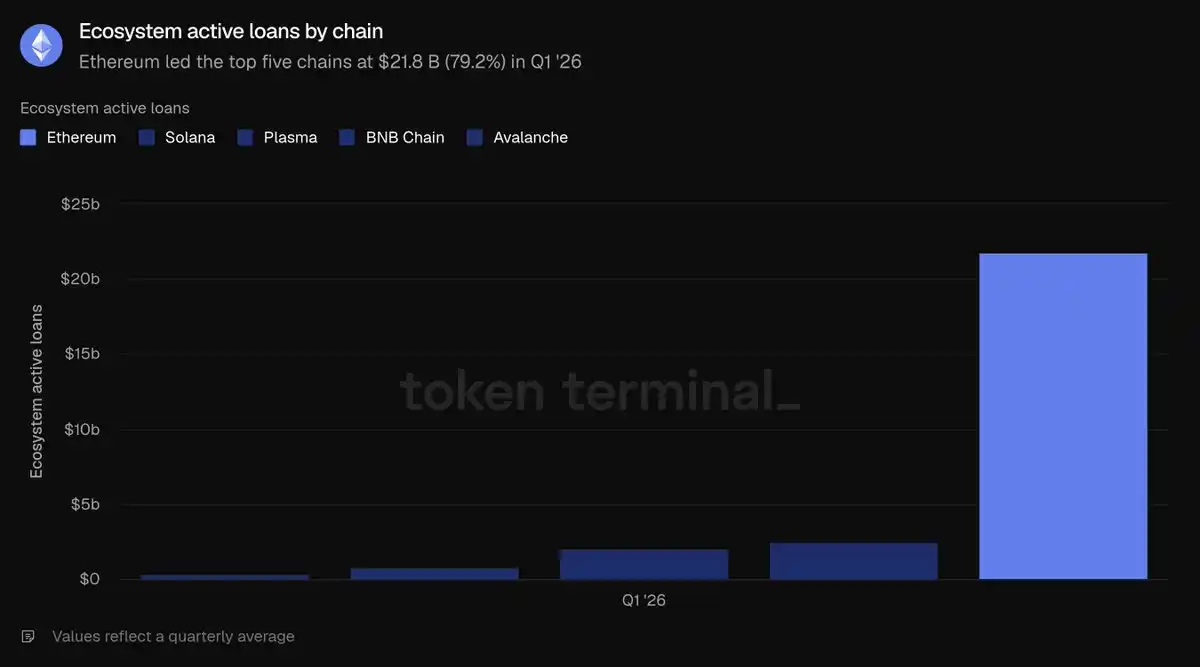
Ecosystem Outstanding Active Loans: $21.8 billion (QoQ -16.6%, YoY +39.0%)

Ecosystem Decentralized Exchange Total Volume: $134.5 billion (QoQ -24.0%, YoY -31.2%)

Full Ecosystem Application Fee Revenue: $2.0 billion (QoQ -16.9%, YoY -7.8%)

On-chain Tokenized Asset Total Market Cap: $203.4 billion (QoQ -0.7%, YoY +42.9%)

Stablecoins: $178.9 billion (QoQ -2.3%, YoY +37.6%)

Tokenized Funds: $19.4 billion (QoQ +4.9%, YoY +73.1%)

Tokenized Commodities: $4.7 billion (QoQ +60.0%, YoY +325.9%)

Tokenized Stocks: $365.1 million (QoQ +16.5%)

Monthly Active User Addresses: 13.2 million (QoQ +53.5%, YoY +85.9%)

Layer-1 Total Transactions: 200.4 million (QoQ +38.0%, YoY +81.5%)

Average Transactions Per Second (TPS): 25.78 (QoQ +41.2%, YoY +81.7%)

Layer-1 Mainnet Transaction Fee Revenue: $39.9 million (QoQ -47.9%, YoY -81.9%)

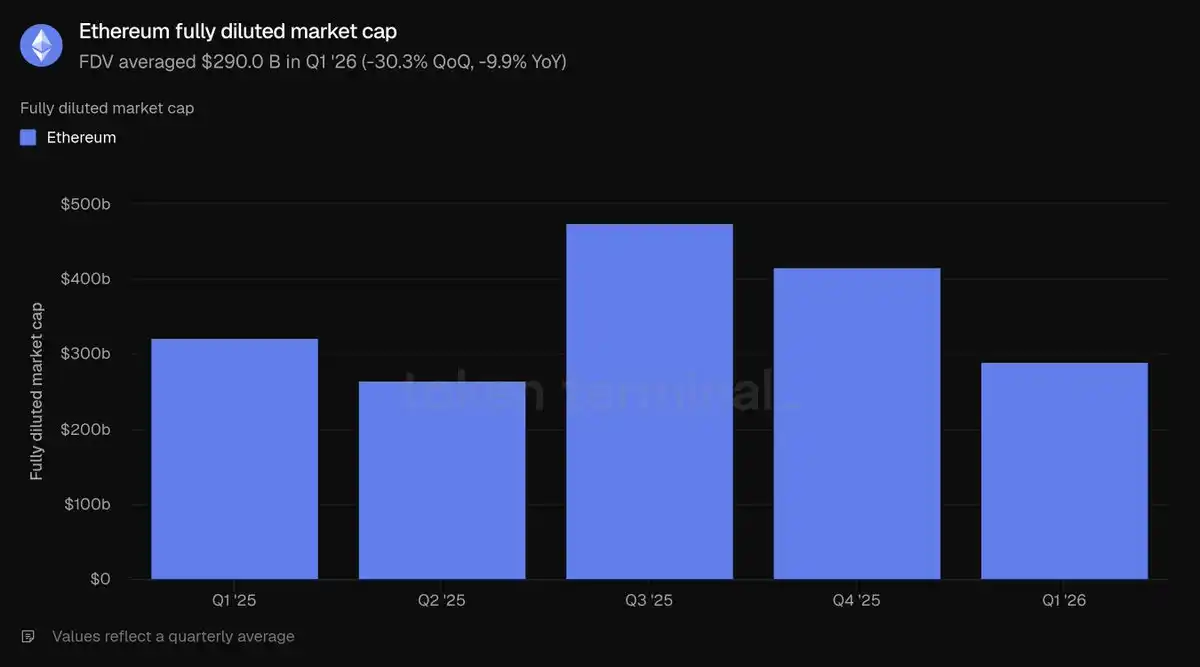
ETH Fully Diluted Market Cap: $290.0 billion (QoQ -30.3%, YoY -9.9%)

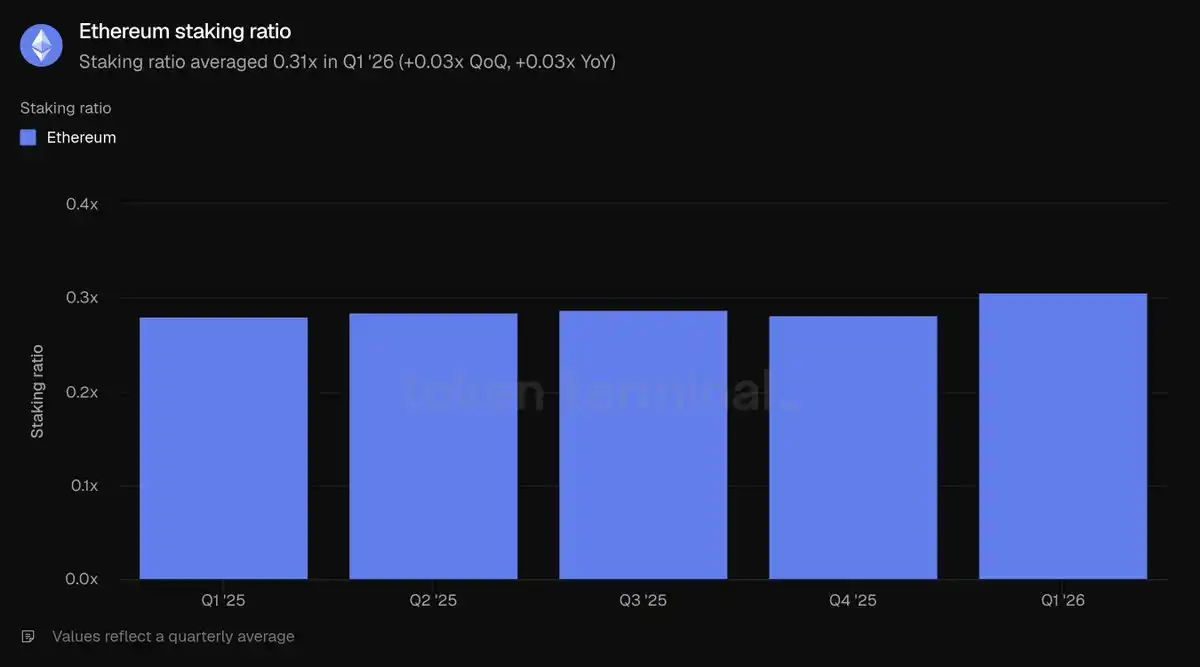
ETH Staking Ratio: 0.31 (Increased 0.03 QoQ and YoY)

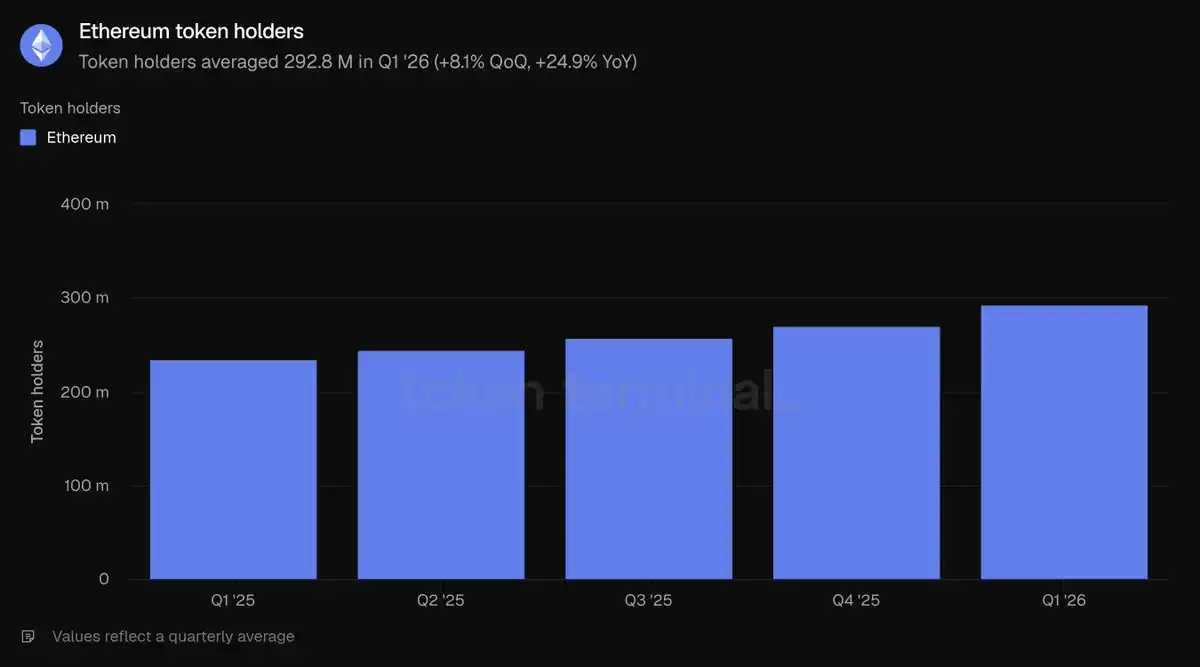
Total ETH Holding Addresses: 292.8 million (QoQ +8.1%, YoY +24.9%)

Note: This report's statistical scope includes only the Ethereum Layer-1 mainnet; layer-2 networks are considered independent blockchains, and their data is not included in Ethereum statistics.

Overall Ecosystem Development

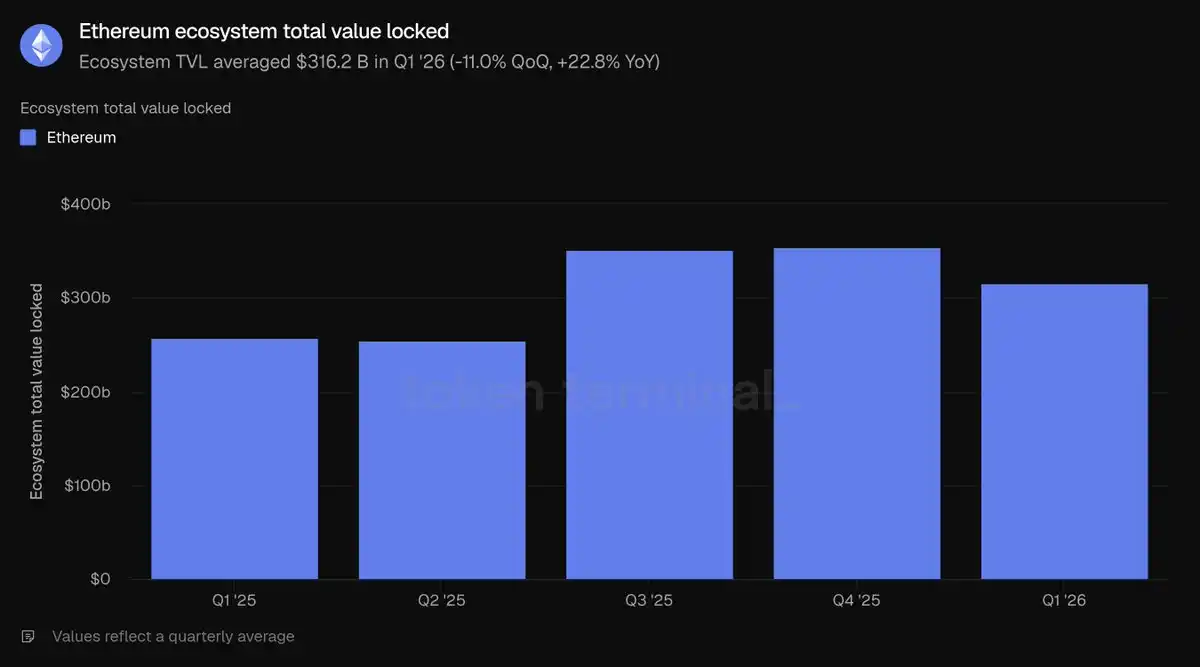
Total Value Locked refers to the total USD value of assets deposited into various on-chain applications, a leading indicator for revenue-generating activities like lending, trading, and staking; here it represents the on-chain, user-withdrawable funds settled across the entire Ethereum ecosystem. In Q1 2026, the average TVL for the Ethereum ecosystem reached $316.2 billion, down 11.0% quarter-over-quarter but up 22.8% year-over-year. The sequential contraction stemmed from a general price correction in crypto assets, while the substantial year-over-year growth demonstrates a real expansion in ecosystem scale compared to the same period last year.
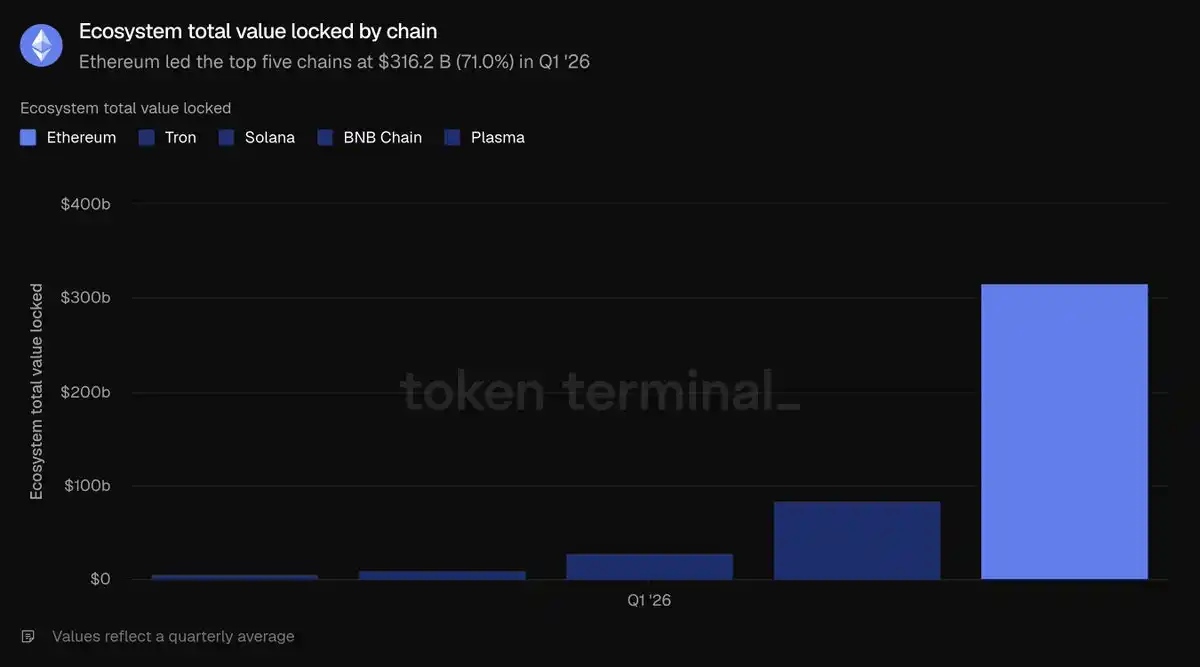
Among the top five blockchains by TVL, Ethereum leads by a wide margin: $316.2 billion far exceeds the sum of Tron ($84.5B), Solana ($28.8B), BNB Chain ($10.3B), and Plasma ($5.7B), accounting for 71% of the total TVL across these five chains. Funds are concentrated in two major sectors: the liquid staking sector led by Lido, and the lending sector centered around Aave; restaking protocols like EigenLayer and ether.fi, as well as synthetic dollar platforms like Ethena and Sky, also hold significant capital. High concentration of funds is Ethereum's most prominent structural advantage.
The Active Loans metric represents the scale of deposits that are lent out and generate interest income, directly reflecting lending business revenue; here it is the total outstanding borrowing across all Ethereum lending applications. In Q1, the average active loan scale in the ecosystem was $21.8 billion, down 16.6% QoQ but up 39.0% YoY. The contraction in loan balances alongside TVL reflects a cooling overall market risk appetite, but the scale remains significantly higher than the same period last year.
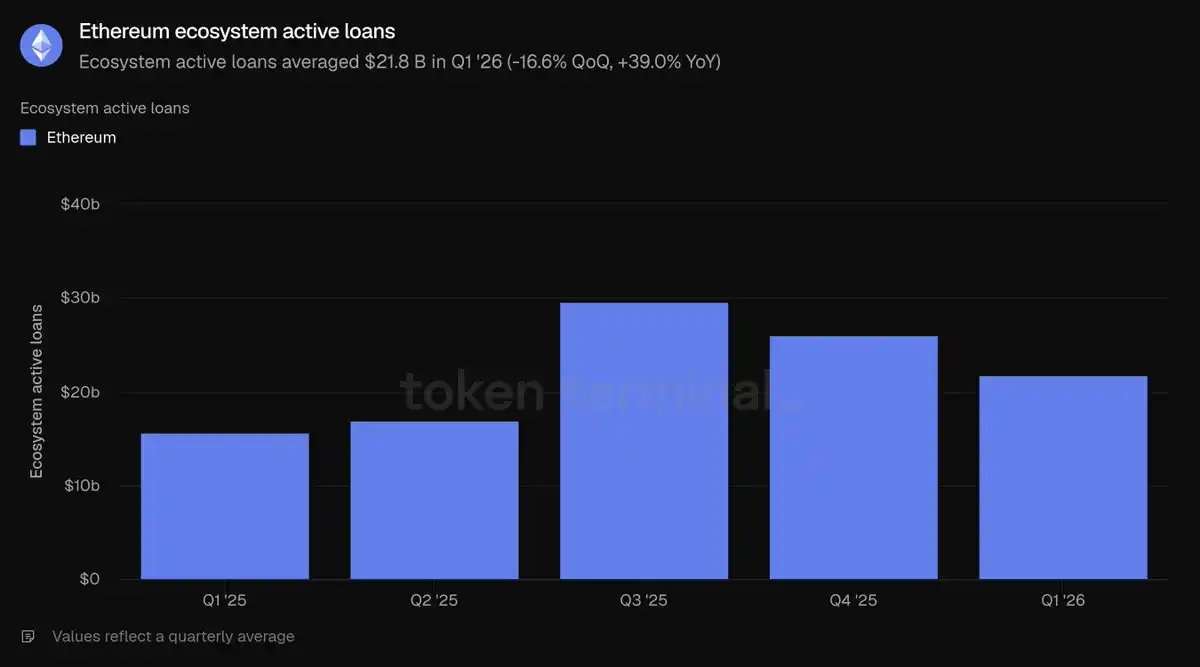
Ethereum's lending market is concentrated in a few pools, with Aave dominating: its active loan scale at quarter-end was approximately $13.5 billion, capturing the vast majority of the ecosystem's share; followed by Morpho (~$1.9B), Spark under Sky (~$1.0B), and Maple (~$840M). The contraction this quarter was primarily driven by Aave, as declining crypto asset prices led to cooler borrowing demand, with its total loan volume shrinking by about 24%. Comparing the top five chains, Ethereum's $21.8 billion in active loans significantly leads Solana ($2.5B), Plasma ($2.1B), BNB Chain ($760.8M), and Avalanche ($392.4M), accounting for 79.2% of the total lending volume across these five chains, making this the sector where Ethereum holds its highest share among the measured sectors.
Decentralized Exchange Volume refers to the total transaction value completed on on-chain spot exchanges; traders pay fees during transactions, making volume highly correlated with platform revenue. This data aggregates all DEX trading within the Ethereum ecosystem. In Q1, total ecosystem trading volume was $134.5 billion, down 24% QoQ and 31.2% YoY. The decline in trading volume was steeper than the contraction in TVL, confirming a significant reduction in market risk appetite during this quarter's asset downtrend.
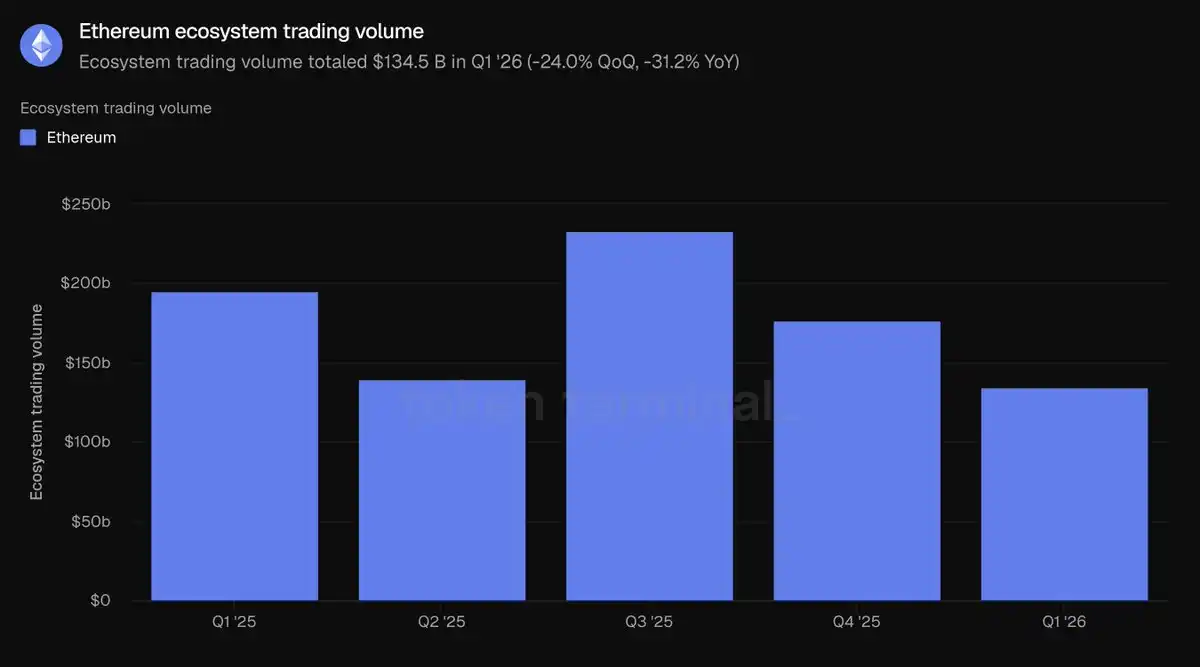
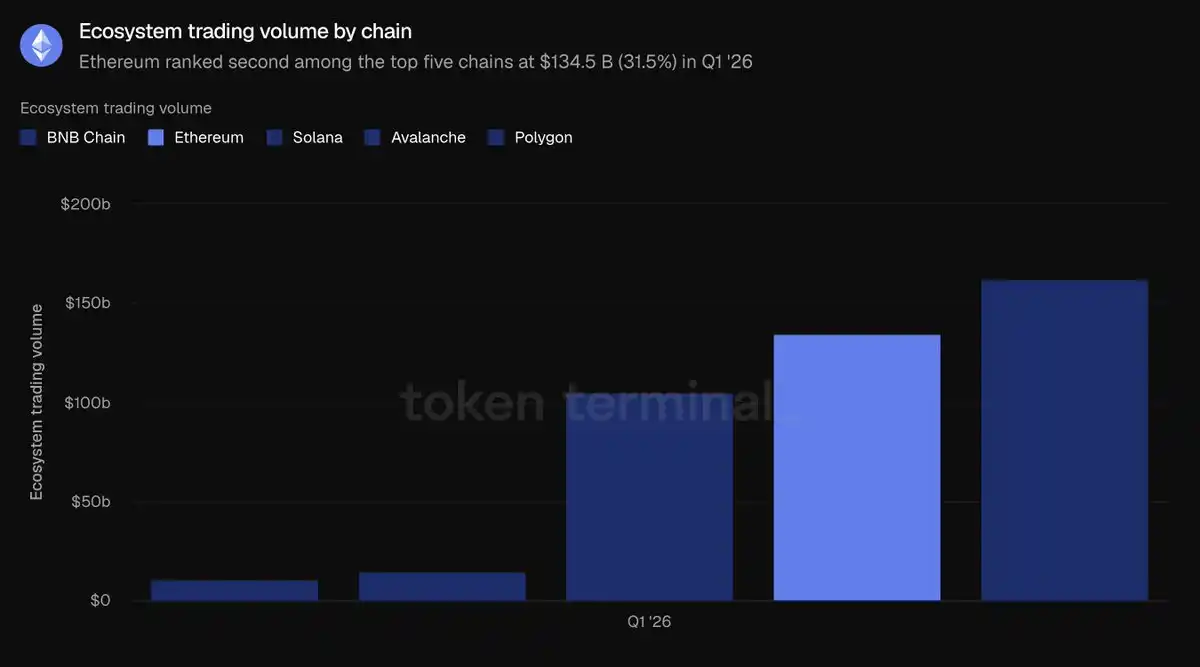
Ethereum DEX trading flow is highly concentrated among leading platforms: Uniswap's Q1 volume was approximately $85.5 billion, accounting for two-thirds of the ecosystem total; followed by Curve (~$22.1B) and CoW Swap (~$12.4B). Trading volume is the only metric where Ethereum does not top the five major chains: BNB Chain's total volume of $162.5 billion exceeded Ethereum's $134.5 billion, followed closely by Solana ($104.9B), with Avalanche ($14.5B) and Polygon ($10.7B) ranking lower. Ethereum's volume constitutes 31.5% of the total across the five chains, second to BNB Chain's 38%.
Ecosystem Fees refer to all fees generated by users using various applications, including borrower interest and trader transaction fees, directly reflecting the economic value created by the ecosystem; this sums all application fees across Ethereum. In Q1, total ecosystem fees amounted to $2.0 billion, down 16.9% QoQ and 7.8% YoY, declining alongside reduced trading and lending activity.
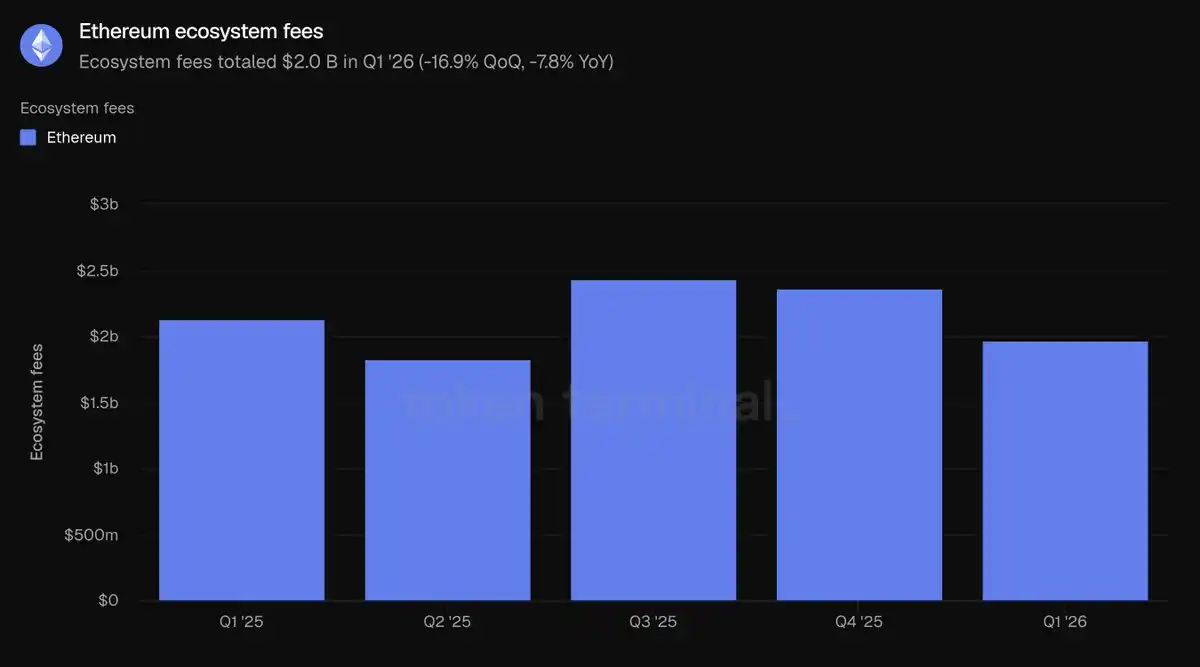
Ethereum's $2.0 billion in ecosystem fees far surpasses Tron ($599.3M), Solana ($532.5M), BNB Chain ($231.9M), and Polygon ($38.8M), accounting for 58.4% of the total fees across the top five chains. Even with the Q1 decline, Ethereum remains the number one source of application fees in the industry. Summarizing all indicators in this section: Ethereum leads the industry in TVL, lending scale, and ecosystem fees, trailing only in DEX volume behind BNB Chain.
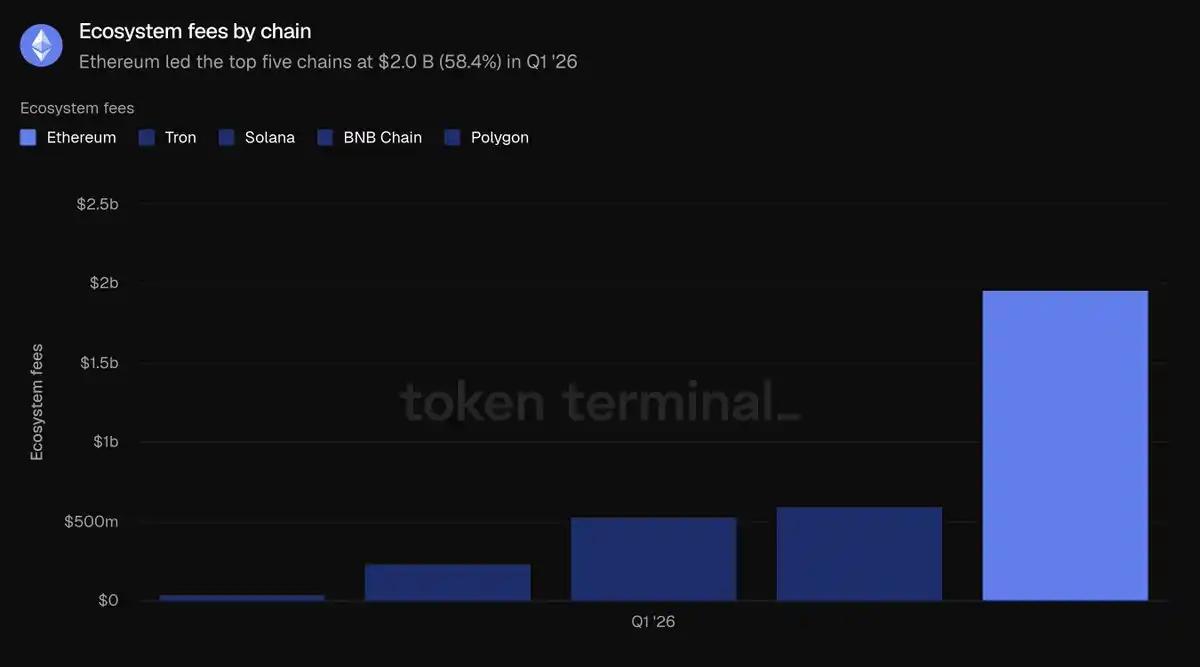
Tokenized Assets Sector

Circulating Asset Total Market Cap refers to the total value of on-chain tokenized assets, calculated as circulating supply multiplied by the daily closing price; for stablecoins, it's the total circulation, for tokenized funds, it's the on-chain assets under management, and for tokenized stocks, it's the total value of issued on-chain shares. This section only counts assets issued on Ethereum.

In Q1, the average total market cap of Ethereum tokenized assets was $203.4 billion, essentially flat QoQ (only down 0.7%), but up significantly by 42.9% YoY. Stablecoins accounted for 87.9% of the total, with the remaining share divided among tokenized funds, commodities, and stocks.
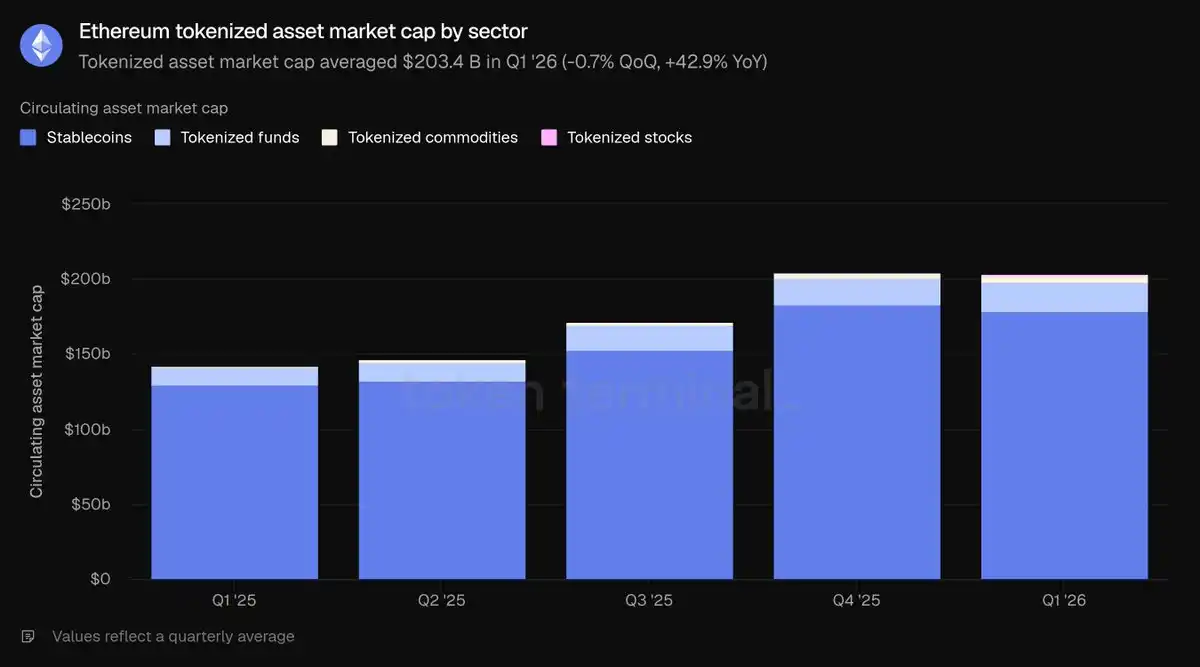
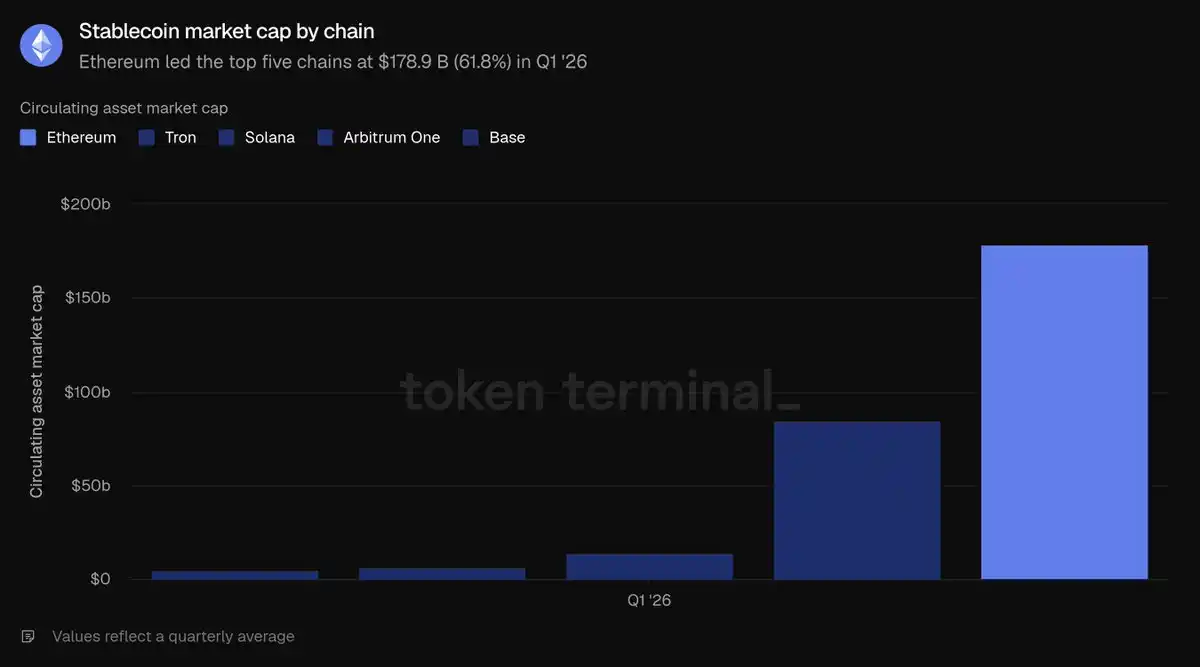
Stablecoins

In Q1, the average Ethereum stablecoin scale was $178.9 billion, down slightly by 2.3% QoQ but up 37.6% YoY, making it the only tokenized sub-sector to contract sequentially this quarter. The market is dominated by two major issuers: at quarter-end, Tether USDT ($94.1B) and Circle USDC ($54.5B) combined held the vast majority of Ethereum stablecoin market cap; other leading products include Sky USDS ($12.4B), Ethena USDe ($5.9B), and PayPal PYUSD ($2.9B); new compliant tokens like Ripple's RLUSD ($1.1B) have also launched. Comparing the top five chains, Ethereum's $178.9 billion stablecoin scale leads Tron ($84.5B), Solana ($14.5B), Arbitrum One ($6.8B), and Base ($4.7B), accounting for 61.8% of the total stablecoin value across these five chains.
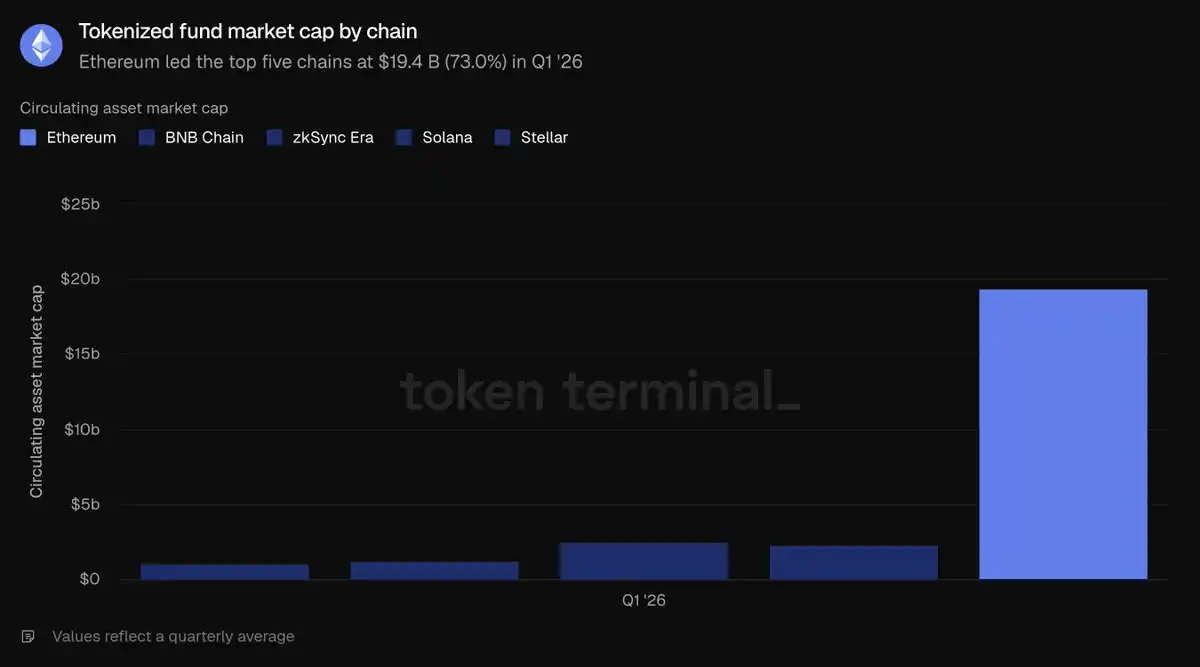
Tokenized Funds

In Q1, the average scale of Ethereum tokenized funds was $19.4 billion, up 4.9% QoQ and surging 73.1% YoY. This sector divides into two main types:

Yield-generating on-chain USD products (largest by scale): Sky sUSDS (~$6.4B) and Ethena sUSDe (~$3.5B);

Traditional finance compliant funds (core vehicles for institutional narrative): BlackRock BUIDL (issued via Securitize, ~$1.0B), WisdomTree Government Money Fund (~$815M), Superstate USTB (~$620M), with Ondo OUSG (~$320M) following closely. Comparing the top five chains, Ethereum's $19.4 billion in tokenized funds significantly leads ZKsync Era ($2.5B), BNB Chain ($2.3B), Solana ($1.3B), and Stellar ($1.1B), accounting for 73% of the total, making this Ethereum's second most dominant tokenized asset sector.
Tokenized Commodities

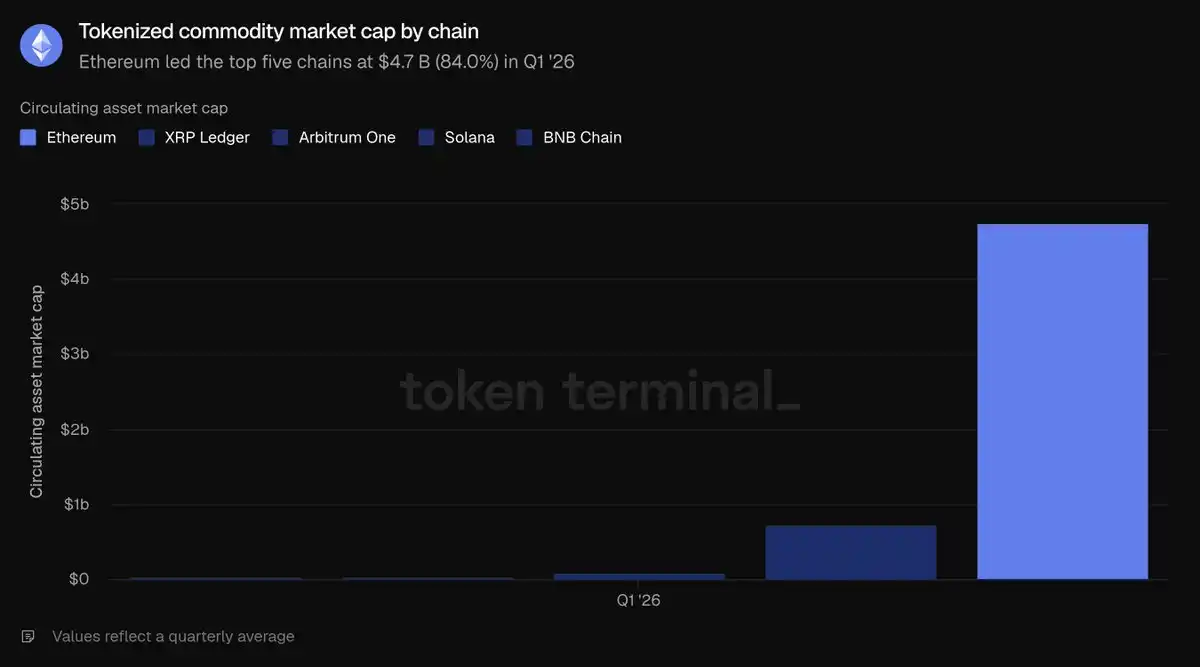
In Q1, the average scale of Ethereum tokenized commodities was $4.7 billion, up 60% QoQ and soaring 325.9% YoY, making it the fastest-growing tokenized category. This sector is almost entirely composed of on-chain gold: Tether Gold XAUT (~$2.6B) and Paxos Gold PAXG (~$2.4B) together account for nearly all of the sector's share. Comparing the five relevant public chains, Ethereum's $4.7 billion scale far exceeds Ripple ($736.6M), Arbitrum One ($95.9M), BNB Chain ($38.4M), and Solana ($29.8M), accounting for 84% of the total, making this Ethereum's most dominant sub-sector.
Tokenized Stocks

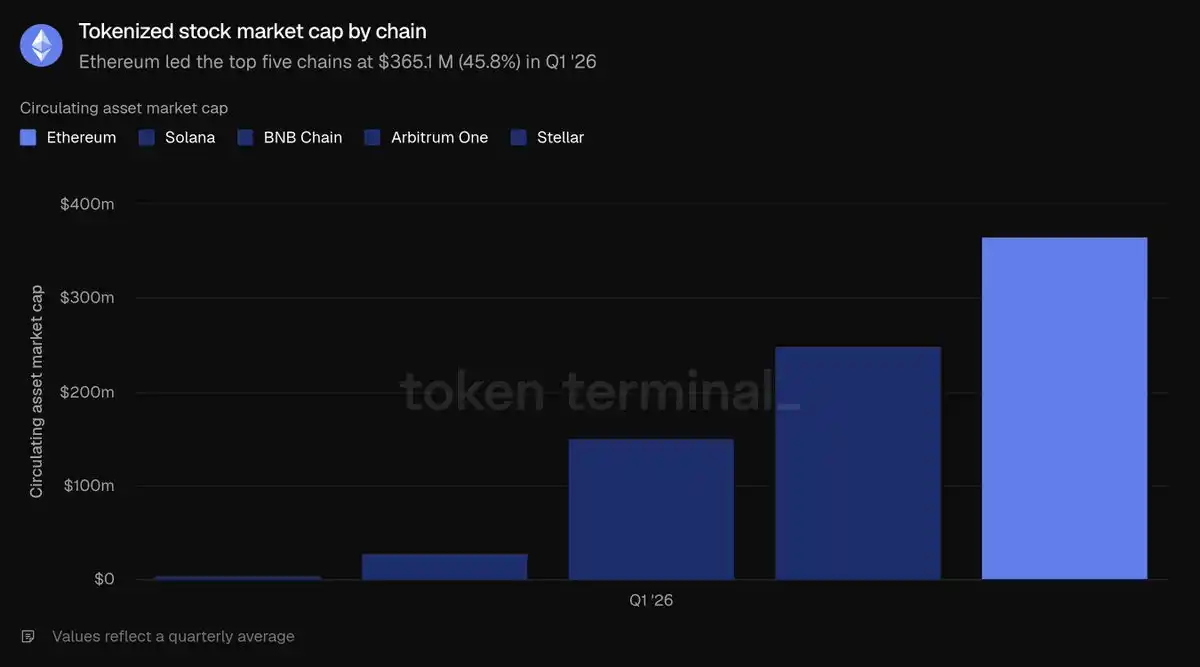
Tokenized stocks are the smallest sub-category. In Q1, the average Ethereum scale was $365.1 million, nearly zero a year ago, up 16.5% QoQ. This sector is almost entirely monopolized by Ondo Finance, which issues S&P 500, Nasdaq 100 broad-based indices, and dozens of individual stock tokens on-chain, constituting the vast majority of Ethereum's tokenized stock market cap. Comparing the top five chains, Ethereum's $365.1M slightly leads Solana ($249.0M), BNB Chain ($150.5M), Arbitrum One ($29.0M), and Stellar ($4.2M), but only accounts for 45.8% of the total tokenized stock value across these five chains, making it the only tokenized asset sector where Ethereum does not hold an absolute majority share.
Summarizing the tokenized assets sector: Q1 saw a slight decline in stablecoin supply, but Ethereum's monopoly positions in tokenized funds and commodities were further solidified.

On-chain Usage Activity

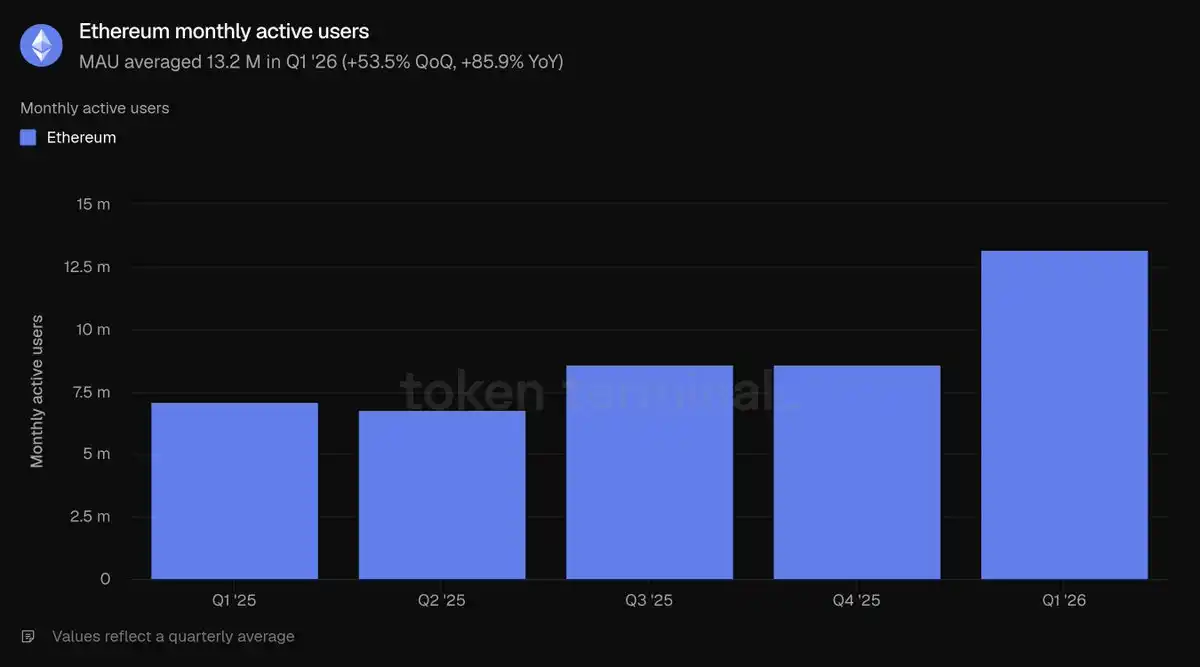
Monthly Active Users are defined as unique addresses that generate revenue-generating on-chain transactions each month; this metric only counts interaction addresses on the Ethereum Layer-1 mainnet. In Q1, the average monthly active users were 13.2 million, surging 53.5% QoQ and up 85.9% YoY, setting a historical record and ending the slow growth trend of previous quarters, with user growth accelerating significantly.
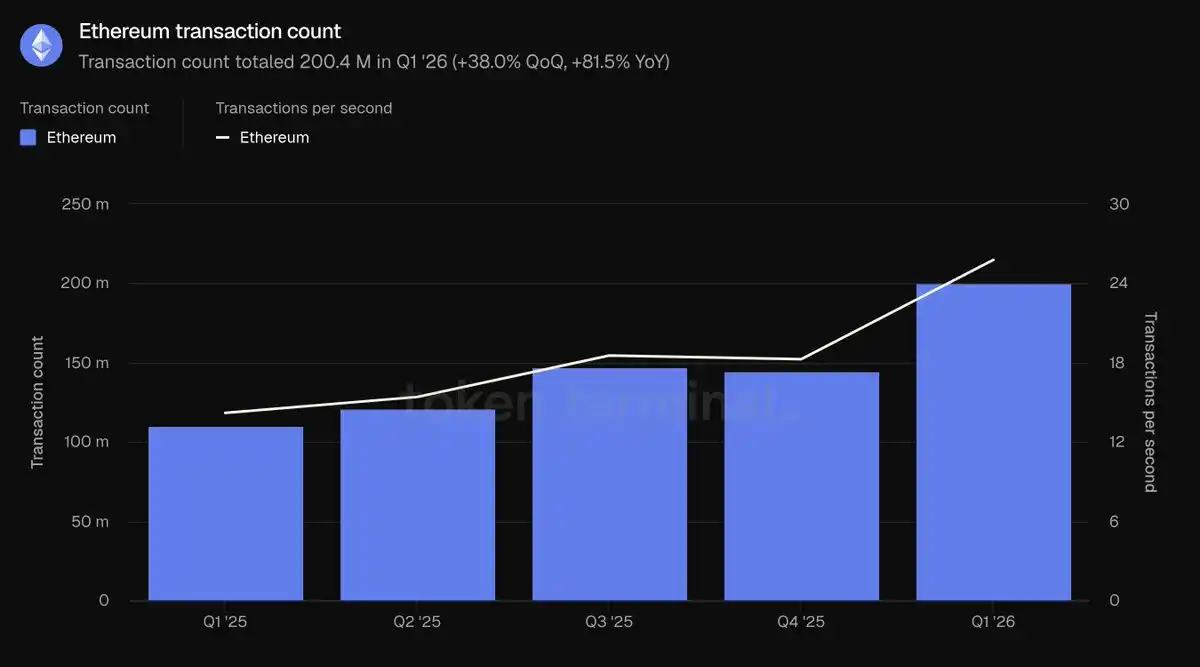
Total Transaction Volume refers to the number of transactions written to and confirmed on the blockchain, reflecting user engagement; Transactions Per Second (TPS) is the average confirmation rate during the period, measuring the network's real-time capacity. Both metrics are for the Ethereum Layer-1 mainnet only. In Q1, layer-1 total transactions were 200.4 million, up 38% QoQ and 81.5% YoY; average TPS increased to 25.78, up 41.2% QoQ. Both data points set new historical highs, proving that user growth has translated into real on-chain business activity increments.
Fees here specifically refer to the base network cost users pay to initiate transactions on Ethereum Layer-1, distinguished from the full ecosystem application fees in section two. In Q1, layer-1 total transaction fees were $39.9 million, plummeting 47.9% QoQ and down sharply 81.9% YoY. Rising activity paired with drastically falling fees is the quarter's core data paradox: transaction volume increased 38%, yet total fees fell by nearly half. The core reason is that Blob scaling significantly increased block storage capacity, making block space more abundant and thus significantly reducing the cost per transaction.
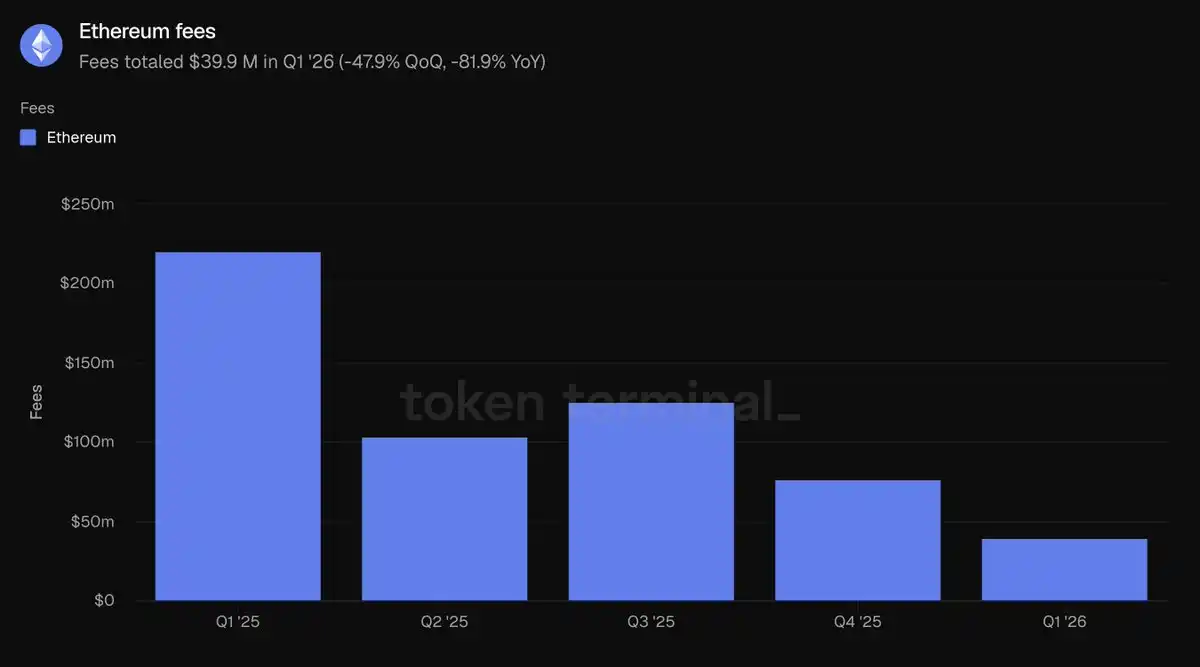
The core conclusion of this section is that scaling benefits have materialized: users and transaction counts have simultaneously hit record highs, while overall network usage costs have declined. When network throughput expansion outpaces the growth rate of market transaction demand, it results in the characteristic "activity up, fees down."

Native Token ETH Fundamentals

Fully Diluted Market Cap calculation: ETH token price × total supply under the current tokenomics model (including circulating, locked, unlocked, and to-be-issued tokens). In Q1, ETH's average fully diluted market cap was $290.0 billion, down sharply 30.3% QoQ and 9.9% YoY. This is the largest sequential decline among all valuation metrics in the report and the core factor driving the decline in USD-denominated asset scale across the ecosystem.
Staking Ratio: The total value of ETH staked to secure the Proof-of-Stake network, divided by ETH's overall market cap; 0.31 indicates approximately 31% of ETH's market cap is participating in staking. In Q1, the average staking ratio was 0.31, higher than 0.28 in the previous quarter and the same period last year. Despite ETH's overall market cap correcting significantly, the proportion of tokens participating in network security staking increased, indicating stable long-term staking intentions among users even during price downturns.
Token Holder Metric: The total number of unique wallet addresses holding ETH. In Q1, the average number of ETH holding addresses was 292.8 million, up 8.1% QoQ and 24.9% YoY, marking a steady increase for five consecutive quarters. Against the backdrop of a continuously declining fully diluted market cap, the expansion of holding addresses represents a further dispersion of the ETH holder base, with ordinary users' willingness to acquire not cooling with short-term market trends.
Etherealize Team Commentary and Analysis

The quarter's core paradox: Ethereum's Layer-1 mainnet on-chain usage scale hit a historical high, yet network transaction fees declined simultaneously. Ethereum proactively advances network scaling, willingly sacrificing short-term fee revenue. The long-term logic is: cheaper block space will unleash a massive wave of latent market demand, ultimately driving long-term growth in overall network revenue.

Data from Token Terminal's "Ethereum Q1 2026 Report" proves this long-term logic is being realized: on a YoY basis, monthly active users grew 85.9%, total transaction volume rose 81.5%, and network throughput increased 81.7%. This is a typical manifestation of the Jevons Paradox. The team predicts that the long-term increase in total network transaction demand will fully offset the short-term revenue loss from lower per-transaction fees. Drawing an analogy to the semiconductor industry: When Gordon Moore proposed Moore's Law in 1975, industry revenue was limited. Today, industry revenue has grown by several orders of magnitude. Scaling benefits are not yet fully realized: The Glamsterdam upgrade scheduled for Q3 plans to increase the gas limit more than threefold; Ethereum's long-term roadmap envisions achieving tens of thousands of TPS by 2029, building a high-speed Layer-1 blockchain with second-level finality.

The team agrees with BlackRock CEO Larry Fink's view from December last year: The current stage of the tokenization industry is equivalent to the internet in 1996—when Amazon's online book sales were only $16 million. At that time, the market generally believed Amazon was merely surviving on the internet bubble, a continuously loss-making online bookstore. But Jeff Bezos predicted the internet would completely reshape retail, abandoning short-term profits to fully build network effects and scale advantages. Ethereum is now making the same trade-off to solidify its position as the global financial settlement layer.

The development of the internet offers another crucial insight: Open, permissionless networks will ultimately triumph over closed, private networks. In 1995, Bill Gates predicted in "The Road Ahead" that digital commerce would rely on corporate proprietary private networks, "information superhighways," not the open internet. At the time, Microsoft built MSN, and services like America Online, CompuServe, and Prodigy operated closed walled gardens, boasting millions of paying users; France's Minitel terminal system even had more users globally than the entire internet until late 1996. Yet all these closed systems ultimately failed. No major legitimate corporation is willing to build its business on a network controlled by a competitor; more crucially, no single company can perpetually keep pace with the innovation speed of a permissionless, open ecosystem. History repeatedly confirms this pattern: Linux overtaking proprietary Unix systems, the open web replacing corporate intranets, Wikipedia superseding the Encyclopædia Britannica. In each transformation's early stages, proprietary products hold an initial advantage due to more refined features, ample marketing, and business resources. But once the open ecosystem accumulates sufficient development tools, developers, and neutral, trustworthy attributes, the first-mover advantage rapidly erodes.

This industry pattern is now replaying in financial infrastructure, as all data in this report demonstrates that Ethereum has crossed the ecosystem critical point: it holds dominant market share in all core sectors. Institutions choosing Ethereum for tokenized finance is not based on ideological preference, but because ecosystem liquidity, composability, and mature institutional use cases are concentrated here. Report data shows: Ethereum holds 79.2% of DeFi active lending, 61.8% of stablecoins, 73% of tokenized funds, and 84% of tokenized commodities market share among the top five chains. Each new class of tokenized assets further deepens ecosystem liquidity, continuously attracting more institutions. A neutral, unbiased foundation is the only stable equilibrium solution for the industry—major financial institutions will never uniformly choose a competitor's private chain for asset settlement. Moreover, institutions are gradually realizing that private interactions, access restrictions, KYC compliance, and asset transfer controls can all be implemented via privacy-preserving computational environments and permissioned token standards on top of Ethereum, while fully accessing the public network's vast liquidity; conversely, closed private chains cannot tap into the open ecosystem's massive liquidity and diverse applications.

Following the quarter-end, institutional deployment has accelerated further, with multiple significant developments in May alone: Asset Management: BlackRock filed for two additional tokenized funds; JPMorgan issued its second Ethereum on-chain money market fund, JLTXX; Fidelity International launched the Moody's AAA-rated dollar liquidity fund FILQ, launched as an ERC-20 token. Stablecoin Sector: The Japanese Blockchain Association's yen-pegged stablecoin EJPY is set to deploy on Ethereum; a European alliance of 12 major banks (including BNP Paribas, ING, UniCredit, BBVA, etc.) is preparing a compliant Euro stablecoin.

The internet seemed distant in 1990, but by 2005 it had become a societal necessity. If Fink's assessment of the tokenization industry's development stage is accurate, the next few years may be the most opportune period in Ethereum's development history. The team's previous "Efficient Money" report posited a core view: Network fees establish an intrinsic value floor for ETH; the long-term optimistic logic is that, with more robust monetary properties, ETH has the potential to absorb the premium from the combined monetary storage value of gold and Bitcoin, exceeding $30 trillion. Ethereum can establish industry leadership without relying on high transaction fees.

Criptomoedas em alta

Leituras Relacionadas

Conversation with Investor Zheng Di: MicroStrategy's Coin Sale Experiment, AI Economy, and Opportunities in US Stocks

Frontier tech investor Zheng "Didier" Di discusses the recent Bitcoin price drop, the financial strategy shift at MicroStrategy, the AI-driven surge in U.S. stocks, and the evolving role of crypto exchanges. Didier posits that the recent BTC decline stems less from macro factors or ETF outflows, and more from market repricing due to MicroStrategy's new financial structure. Following a wave of preferred stock and debt issuance (STRC, STRZ, etc.), MicroStrategy must now manage cash flow to pay dividends, potentially leading to a market expectation of sustained, small-scale BTC sales to maintain its "per-share bitcoin neutral" principle. Didier views this as a financial "experiment" testing market capacity for such recurring sell pressure, which, while creating near-term structural headwinds, likely avoids a true "death spiral" absent major new external shocks. Shifting to AI, Didier argues that tokens are becoming the new form of labor, with AI models and compute (tokenized inputs) increasingly replacing human roles in execution and middle-management. This drives enterprise efficiency and higher margins, fueling the sustained rally in U.S. semiconductor, data center, and infrastructure stocks. He foresees an emerging "machine economy" where automated agents transact and collaborate on-chain. Regarding crypto exchanges offering U.S. equities, Didier sees this as a natural evolution. With few crypto-native assets generating lasting value, exchanges are pivoting towards real-world assets (RWAs) like stocks and bonds. This doesn't necessarily cannibalize crypto but reflects a maturing industry focusing on blockchain's core utilities: decentralized choice and efficient settlement. He notes that trading logic for crypto natives doesn't need to drastically change, as meme-driven and fundamentalist strategies find analogs in U.S. markets. The "1011 event" (likely referring to a major market crash) severely damaged crypto market liquidity, marking a probable end to the altcoin speculative cycle, with capital flowing towards the deeper liquidity of U.S. markets. For the macro outlook, Didier is cautious about near-term market pressure from potential mega-IPOs (e.g., SpaceX) and the U.S. midterm elections, which could bring more regulatory scrutiny. Long-term, he remains bullish on AI's productivity gains and its convergence with blockchain/Web3, predicting a shift from speculative frenzy to a more institutionalized, industrial phase for the crypto sector.

marsbitHá 26m

Conversation with Investor Zheng Di: MicroStrategy's Coin Sale Experiment, AI Economy, and Opportunities in US Stocks

marsbitHá 26m

Playnance’s $GCOIN Lists on KoinBX Amid Rapid Growth in India

Playnance's native token, $GCOIN, has been listed on the cryptocurrency exchange KoinBX as of June 18. This move aims to enhance accessibility for its rapidly growing community, particularly in India, where the blockchain-powered Web3 iGaming ecosystem has gained significant traction. Over 130 partners in Playnance's "Be the Boss" program have built communities engaging thousands of active players in the region. The "Be the Boss" model allows participants to create and manage their own gaming communities, earning rewards tied to community activity. CEO Pini Peter noted India's high engagement, with community leaders successfully building player networks. One partner, Dr. Nicolas, reported earning over $57,000 through the program in recent months, highlighting both the financial rewards and the opportunity to grow an engaged community. $GCOIN serves as the ecosystem's core utility token, incentivizing participation and aligning the interests of players and community leaders ("Bosses"). The listing on KoinBX is part of Playnance's strategy to expand globally, increasing the token's utility and accessibility by combining community ownership, gamified engagement, and blockchain-based incentives. Founded in 2020, Playnance is a Web3 iGaming infrastructure company focused on creating live, non-custodial, on-chain products to onboard mainstream users. It currently processes approximately one million transactions daily, aiming to simplify the user experience while maintaining full on-chain transparency.

TheNewsCryptoHá 1h

Playnance’s $GCOIN Lists on KoinBX Amid Rapid Growth in India

TheNewsCryptoHá 1h

STRC Hits Historic Low, Saylor's Perpetual Motion Machine Grinds to a Halt

STRC, the perpetual preferred stock issued by MicroStrategy to fund its Bitcoin purchases, hit a historic low of $85.32, a 17% discount to its $100 par value. Designed as a "digital credit engine" to trade stably near par and enable continuous share issuance for buying Bitcoin, its plunge signals a breakdown in this model. Three key factors drove the decline: 1. Bitcoin's price fell over 50% from its peak, trading around $63,000 amid hawkish Fed signals. 2. MicroStrategy's cash reserves were depleted after a $1.5 billion convertible note repayment, slashing the dividend coverage for STRC's 11.5% yield to ~7 months. The company then sold 32 BTC to cover dividends—Michael Saylor's first Bitcoin sale since 2022—damaging the "never sell" narrative. 3. A competing Bitcoin-backed preferred stock, Strive's SATA, offers a higher yield (~13%) and daily dividends, drawing investors away from STRC. The drop triggers a negative cycle: STRC below par halts ATM share issuances, cutting off a key funding source for Bitcoin buys and potentially forcing more BTC sales for dividends, further eroding confidence. While Saylor argues the model is mathematically sound—needing only 2.3% annual Bitcoin growth to sustain itself—the market is testing the resilience of the leveraged Bitcoin treasury strategy in a bear market. The STRC price now reflects rising skepticism about this financial machinery's durability during downturns.

marsbitHá 1h

STRC Hits Historic Low, Saylor's Perpetual Motion Machine Grinds to a Halt

marsbitHá 1h

A Guide to Grayscale’s ‘Bottom Fishing’: Using Cash Flow to Assess Cryptocurrency Value

**Title:** Grayscale's Guide to Bottom-Fishing: Valuing Cryptoassets Using Cash Flows **Summary:** This report by Grayscale Research presents a fundamental valuation framework for cryptocurrency assets, moving beyond pure speculation to analyze those with underlying cash flows. It distinguishes between "commodity-like" assets (e.g., Bitcoin) and "cash-flow" assets, primarily within DeFi. Using the leading decentralized lending protocol Aave as a case study, the analysis applies traditional financial methodologies like Discounted Cash Flow (DCF) and Price-to-Earnings (P/E) multiples. Key findings indicate that AAVE tokens are currently undervalued. Despite recent challenges, the protocol's strong revenue growth, ~50% net profit margin, and diversified treasury support a fundamental valuation range of $80-$100 per token (compared to a ~$75 market price at the time of writing). In a base-case scenario driven by stablecoin adoption and regulatory clarity, the fair value could rise to around $175 within a year. The report emphasizes that protocol success does not automatically translate to token value. It critically examines the "value capture" mechanisms—such as buybacks, burns, and staking rewards—that channel protocol profits to token holders. Furthermore, it addresses the legal and governance complexities of Decentralized Autonomous Organizations (DAOs), noting their difference from traditional corporate equity but highlighting how robust, transparent governance can align protocol economics with holder interests. The conclusion is that the crypto market is maturing, with capital increasingly flowing towards projects with demonstrable fundamentals, real adoption, and disciplined capital allocation, creating opportunities for value-based investors.

marsbitHá 2h

A Guide to Grayscale’s ‘Bottom Fishing’: Using Cash Flow to Assess Cryptocurrency Value

marsbitHá 2h

Trading

Spot
Futuros

Artigos em Destaque

O que é ETH 2.0

ETH 2.0: Uma Nova Era para o Ethereum Introdução ETH 2.0, amplamente conhecido como Ethereum 2.0, marca uma atualização monumental à blockchain do Ethereum. Esta transição não é meramente uma mudança estética; visa melhorar fundamentalmente a escalabilidade, segurança e sustentabilidade da rede. Com uma mudança do mecanismo de consenso em Proof of Work (PoW), intensivo em energia, para um Proof of Stake (PoS) mais eficiente, o ETH 2.0 promete uma abordagem transformadora ao ecossistema blockchain. O que é ETH 2.0? ETH 2.0 é um conjunto de atualizações distintas e interconectadas focadas na otimização das capacidades e desempenho do Ethereum. Esta reformulação foi projetada para abordar desafios críticos que o mecanismo atual do Ethereum enfrentou, particularmente em relação à velocidade das transações e à congestão da rede. Objetivos do ETH 2.0 Os principais objetivos do ETH 2.0 giram em torno da melhoria de três aspectos centrais: Escalabilidade: Com o objetivo de melhorar significativamente o número de transações que a rede pode manejar por segundo, o ETH 2.0 procura ultrapassar a limitação atual de aproximadamente 15 transações por segundo, alcançando potencialmente milhares. Segurança: Medidas de segurança melhoradas são integrais ao ETH 2.0, especialmente através da resistência aprimorada contra ciberataques e da preservação do ethos descentralizado do Ethereum. Sustentabilidade: O novo mecanismo PoS foi projetado não apenas para melhorar a eficiência, mas também para reduzir drasticamente o consumo de energia, alinhando a estrutura operacional do Ethereum com considerações ambientais. Quem é o Criador do ETH 2.0? A criação do ETH 2.0 pode ser atribuída à Ethereum Foundation. Esta organização sem fins lucrativos, que desempenha um papel crucial no apoio ao desenvolvimento do Ethereum, é liderada pelo co-fundador notável Vitalik Buterin. A sua visão de um Ethereum mais escalável e sustentável tem sido a força motriz por trás desta atualização, envolvendo contribuições de uma comunidade global de desenvolvedores e entusiastas dedicados a melhorar o protocolo. Quem são os Investidores do ETH 2.0? Embora os detalhes sobre os investidores do ETH 2.0 não tenham sido tornados públicos, é sabido que a Ethereum Foundation recebe apoio de várias organizações e indivíduos no espaço da blockchain e tecnologia. Esses parceiros incluem firmas de capital de risco, empresas de tecnologia e organizações filantrópicas que compartilham um interesse mútuo em apoiar o desenvolvimento de tecnologias descentralizadas e infraestrutura de blockchain. Como Funciona o ETH 2.0? ETH 2.0 é notável por introduzir uma série de características chave que o diferenciam do seu predecessor. Proof of Stake (PoS) A transição para um mecanismo de consenso PoS é uma das mudanças de destaque do ETH 2.0. Ao contrário do PoW, que depende da mineração intensiva em energia para a verificação de transações, o PoS permite que os utilizadores validem transações e criem novos blocos de acordo com a quantidade de ETH que apostam na rede. Isso leva a uma maior eficiência energética, reduzindo o consumo em aproximadamente 99,95%, tornando o Ethereum 2.0 uma alternativa consideravelmente mais ecológica. Shard Chains As shard chains são outra inovação crítica do ETH 2.0. Estas cadeias menores operam em paralelo com a cadeia principal do Ethereum, permitindo que várias transações sejam processadas simultaneamente. Esta abordagem melhora a capacidade geral da rede, abordando preocupações de escalabilidade que têm atormentado o Ethereum. Beacon Chain No coração do ETH 2.0 está a Beacon Chain, que coordena a rede e gere o protocolo PoS. Ela atua como uma espécie de organizador: supervisiona os validadores, garante que as shards permaneçam conectadas à rede e monitora a saúde geral do ecossistema blockchain. Linha do Tempo do ETH 2.0 A jornada do ETH 2.0 tem sido marcada por vários marcos chave que traçam a evolução desta atualização significativa: Dezembro de 2020: O lançamento da Beacon Chain marcou a introdução do PoS, preparando o caminho para a migração para o ETH 2.0. Setembro de 2022: A conclusão de “The Merge” representa um momento crucial em que a rede Ethereum fez a transição com sucesso de um quadro PoW para um PoS, anunciando uma nova era para o Ethereum. 2023: O lançamento esperado das shard chains visa melhorar ainda mais a escalabilidade da rede Ethereum, solidificando o ETH 2.0 como uma plataforma robusta para aplicações e serviços descentralizados. Características Chave e Benefícios Escalabilidade Melhorada Uma das vantagens mais significativas do ETH 2.0 é a sua escalabilidade melhorada. A combinação de PoS e shard chains permite que a rede expanda a sua capacidade, permitindo que acomode um volume de transações muito maior em comparação com o sistema legado. Eficiência Energética A implementação do PoS representa um enorme passo em direção à eficiência energética na tecnologia blockchain. Ao reduzir drasticamente o consumo de energia, o ETH 2.0 não só reduz os custos operacionais, mas também se alinha mais estreitamente com os objetivos globais de sustentabilidade. Segurança Aprimorada Os mecanismos atualizados do ETH 2.0 contribuem para uma segurança melhorada em toda a rede. O uso do PoS, juntamente com medidas de controle inovadoras estabelecidas através das shard chains e da Beacon Chain, assegura um maior grau de proteção contra potenciais ameaças. Custos Mais Baixos para os Utilizadores À medida que a escalabilidade melhora, os efeitos sobre os custos de transação também serão evidentes. Aumentada a capacidade e reduzida a congestão, espera-se que isso se traduza em taxas mais baixas para os utilizadores, tornando o Ethereum mais acessível para transações do dia a dia. Conclusão ETH 2.0 marca uma evolução significativa no ecossistema da blockchain do Ethereum. Ao abordar questões fundamentais como a escalabilidade, o consumo de energia, a eficiência das transações e a segurança geral, a importância desta atualização não pode ser subestimada. A transição para o Proof of Stake, a introdução das shard chains e o trabalho fundamental da Beacon Chain são indicativos de um futuro em que o Ethereum pode atender à crescente demanda do mercado descentralizado. Em uma indústria movida pela inovação e progresso, o ETH 2.0 representa um testemunho das capacidades da tecnologia blockchain em pavimentar o caminho para uma economia digital mais sustentável e eficiente.

102 Visualizações TotaisPublicado em {updateTime}Atualizado em 2024.12.03

O que é ETH 2.0

O que é ETH 3.0

ETH3.0 e $eth 3.0: Uma Análise Profunda do Futuro do Ethereum Introdução No ambiente em rápida evolução da criptomoeda e da tecnologia blockchain, o ETH3.0, frequentemente denotado como $eth 3.0, emergiu como um tema de considerável interesse e especulação. O termo abrange dois conceitos principais que merecem esclarecimento: Ethereum 3.0: Esta representa uma potencial atualização futura destinada a aumentar as capacidades da atual blockchain do Ethereum, focando especialmente na melhoria da escalabilidade e desempenho. ETH3.0 Meme Token: Este distinto projeto de criptomoeda procura aproveitar a blockchain do Ethereum na criação de um ecossistema centrado em memes, promovendo o envolvimento na comunidade de criptomoedas. Compreender esses aspectos do ETH3.0 é essencial não apenas para entusiastas de criptomoedas, mas também para aqueles que observam as tendências tecnológicas mais amplas no espaço digital. O que é ETH3.0? Ethereum 3.0 Ethereum 3.0 é promovido como uma atualização proposta para a rede Ethereum já estabelecida, que tem sido a espinha dorsal de muitas aplicações descentralizadas (dApps) e contratos inteligentes desde a sua criação. As melhorias vislumbradas concentram-se principalmente na escalabilidade—integrando tecnologias avançadas como sharding e provas de conhecimento zero (zk-proofs). Essas inovações tecnológicas visam facilitar um número sem precedentes de transações por segundo (TPS), potencialmente alcançando milhões, abordando assim uma das limitações mais significativas enfrentadas pela tecnologia blockchain atual. A melhoria não é meramente técnica, mas também estratégica; visa preparar a rede Ethereum para uma adoção generalizada e utilidade em um futuro marcado por uma maior demanda por soluções descentralizadas. ETH3.0 Meme Token Em contraste com o Ethereum 3.0, o ETH3.0 Meme Token aventura-se por um domínio mais leve e divertido, combinando a cultura dos memes da internet com a dinâmica das criptomoedas. Este projeto permite que os usuários comprem, vendam e negociem memes na blockchain do Ethereum, proporcionando uma plataforma que fomenta o envolvimento da comunidade através da criatividade e interesses compartilhados. O ETH3.0 Meme Token visa demonstrar como a tecnologia blockchain pode interseccionar com a cultura digital, criando casos de uso que são tanto divertidos quanto financeiramente viáveis. Quem é o Criador do ETH3.0? Ethereum 3.0 A iniciativa em direção ao Ethereum 3.0 é impulsionada principalmente por um consórcio de desenvolvedores e pesquisadores dentro da comunidade Ethereum, notavelmente incluindo Justin Drake. Conhecido por suas percepções e contribuições para a evolução do Ethereum, Drake tem sido uma figura proeminente nas discussões sobre a transição do Ethereum para uma nova camada de consenso, referida como “Beam Chain”. Esta abordagem colaborativa ao desenvolvimento significa que o Ethereum 3.0 não é fruto de um único criador, mas sim uma manifestação da engenhosidade coletiva focada no avanço da tecnologia blockchain. ETH3.0 Meme Token Os detalhes sobre o criador do ETH3.0 Meme Token são atualmente indetectáveis. A natureza dos tokens de meme frequentemente leva a uma estrutura mais descentralizada e impulsionada pela comunidade, o que poderia explicar a falta de atribuição específica. Isso alinha-se com a ethos da comunidade de criptomoedas mais ampla, onde a inovação geralmente surge de esforços colaborativos em vez de esforços individuais. Quem são os Investidores do ETH3.0? Ethereum 3.0 O apoio ao Ethereum 3.0 provém principalmente da Fundação Ethereum, juntamente com uma comunidade entusiástica de desenvolvedores e investidores. Esta associação fundacional proporciona um grau significativo de legitimidade e melhora as perspectivas de uma implementação bem-sucedida, uma vez que aproveita a confiança e credibilidade construída ao longo de anos de operações de rede. Em um clima em rápida mudança no mundo das criptomoedas, o apoio da comunidade desempenha um papel crucial no impulso ao desenvolvimento e adoção, posicionando o Ethereum 3.0 como um sério candidato a futuros avanços na blockchain. ETH3.0 Meme Token Embora as fontes atualmente disponíveis não forneçam informações explícitas sobre as fundações ou organizações de investimento que apoiam o ETH3.0 Meme Token, é indicativo do modelo típico de financiamento para tokens de meme, que frequentemente depende de apoio base e engajamento da comunidade. Os investidores em tais projetos costumam consistir em indivíduos motivados pelo potencial de inovação impulsionada pela comunidade e pelo espírito de cooperação encontrado dentro da comunidade cripto. Como Funciona o ETH3.0? Ethereum 3.0 As características distintivas do Ethereum 3.0 residem em sua proposta de implementação de sharding e tecnologia zk-proof. Sharding é um método de partição da blockchain em partes menores e gerenciáveis ou “shards”, que podem processar transações simultaneamente em vez de sequencialmente. Esta descentralização do processamento ajuda a prevenir congestionamentos e garante que a rede permaneça responsiva mesmo sob carga pesada. A tecnologia de prova de conhecimento zero (zk-proof) contribui com outra camada de sofisticação ao permitir a validação de transações sem revelar os dados subjacentes envolvidos. Este aspecto não apenas melhora a privacidade, mas também aumenta a eficiência geral da rede. Há também conversas sobre a incorporação de uma Máquina Virtual Ethereum de conhecimento zero (zkEVM) nesta atualização, amplificando ainda mais as capacidades e utilidade da rede. ETH3.0 Meme Token O ETH3.0 Meme Token distingue-se ao capitalizar sobre a popularidade da cultura dos memes. Estabelece um mercado para que os usuários participem da negociação de memes, não apenas para entretenimento, mas também para potencial ganho econômico. Ao integrar recursos como staking, provisão de liquidez e mecanismos de governança, o projeto fomenta um ambiente que incentiva a interação e participação da comunidade. Ao oferecer uma mistura única de entretenimento e oportunidade econômica, o ETH3.0 Meme Token visa atrair um público diversificado, variando de entusiastas de criptomoedas a conhecedores casuais de memes. Cronologia do ETH3.0 Ethereum 3.0 11 de novembro de 2024: Justin Drake sugere a próxima atualização do ETH 3.0, centrada nas melhorias de escalabilidade. Este anúncio sinaliza o início de discussões formais sobre a futura arquitetura do Ethereum. 12 de novembro de 2024: A proposta antecipada para Ethereum 3.0 deve ser revelada no Devcon em Bangkok, preparando o cenário para um feedback mais amplo da comunidade e potenciais próximos passos no desenvolvimento. ETH3.0 Meme Token 21 de março de 2024: O ETH3.0 Meme Token é oficialmente listado no CoinMarketCap, marcando sua entrada no domínio público das criptomoedas e aumentando a visibilidade de seu ecossistema baseado em memes. Pontos Chave Em conclusão, Ethereum 3.0 representa uma evolução significativa dentro da rede Ethereum, focando em superar limitações quanto à escalabilidade e desempenho através de tecnologias avançadas. As atualizações propostas refletem uma abordagem proativa às futuras demandas e usabilidade. Por outro lado, o ETH3.0 Meme Token encapsula a essência da cultura impulsionada pela comunidade no espaço das criptomoedas, aproveitando a cultura dos memes para criar plataformas envolventes que incentivam a criatividade e participação dos usuários. Compreender os distintos propósitos e funcionalidades do ETH3.0 e $eth 3.0 é fundamental para qualquer pessoa interessada nos desenvolvimentos contínuos dentro do espaço cripto. Com ambas as iniciativas a pavimentar caminhos únicos, elas sublinham coletivamente a natureza dinâmica e multifacetada da inovação em blockchain.

106 Visualizações TotaisPublicado em {updateTime}Atualizado em 2024.12.03

O que é ETH 3.0

Como comprar ETH

Bem-vindo à HTX.com!Tornámos a compra de Ethereum (ETH) simples e conveniente.Segue o nosso guia passo a passo para iniciar a tua jornada no mundo das criptos.Passo 1: cria a tua conta HTXUtiliza o teu e-mail ou número de telefone para te inscreveres numa conta gratuita na HTX.Desfruta de um processo de inscrição sem complicações e desbloqueia todas as funcionalidades.Obter a minha contaPasso 2: vai para Comprar Cripto e escolhe o teu método de pagamentoCartão de crédito/débito: usa o teu visa ou mastercard para comprar Ethereum (ETH) instantaneamente.Saldo: usa os fundos da tua conta HTX para transacionar sem problemas.Terceiros: adicionamos métodos de pagamento populares, como Google Pay e Apple Pay, para aumentar a conveniência.P2P: transaciona diretamente com outros utilizadores na HTX.Mercado de balcão (OTC): oferecemos serviços personalizados e taxas de câmbio competitivas para os traders.Passo 3: armazena teu Ethereum (ETH)Depois de comprar o teu Ethereum (ETH), armazena-o na tua conta HTX.Alternativamente, podes enviá-lo para outro lugar através de transferência blockchain ou usá-lo para transacionar outras criptomoedas.Passo 4: transaciona Ethereum (ETH)Transaciona facilmente Ethereum (ETH) no mercado à vista da HTX.Acede simplesmente à tua conta, seleciona o teu par de trading, executa as tuas transações e monitoriza em tempo real.Oferecemos uma experiência de fácil utilização tanto para principiantes como para traders experientes.

3.2k Visualizações TotaisPublicado em {updateTime}Atualizado em 2026.06.02

Como comprar ETH

Discussões

Bem-vindo à Comunidade HTX. Aqui, pode manter-se informado sobre os mais recentes desenvolvimentos da plataforma e obter acesso a análises profissionais de mercado. As opiniões dos utilizadores sobre o preço de ETH (ETH) são apresentadas abaixo.

活动图片