A History of Technological Evolution Powered by Electricity: Aluminum, Bitcoin, and AI

marsbitPublicado em 2026-05-26Última atualização em 2026-05-26

Resumo

The journey from the Rockdale aluminum smelter in Texas to space-based data centers illustrates a core economic principle: whoever controls the cheapest electricity dictates the use of computing power. The evolution is clear. Old industrial sites with pre-existing, high-capacity power grids are being repurposed. In Rockdale, a former Alcoa plant now houses vast Bitcoin mining rigs, which are increasingly being replaced by AMD chips for AI training. The logic is purely financial: while smelting aluminum yields $0.17–0.27 per kWh and Bitcoin mining $0.05–0.11, AI inference on H100 GPUs generates $1.27–3.67 per kWh. Recent deals confirm the rush for power infrastructure. Riot Platforms leases space to AMD; TeraWulf bought an old Kentucky aluminum plant for its grid; NYDIG secured a New York site for its cheap hydropower to mine Bitcoin. As AI giants like Anthropic, Microsoft, Google, and Amazon aggressively expand, they now directly compete with crypto miners for the same industrial power resources, often outbidding them. This has led to a decline in Bitcoin's global hash rate and a wave of miner conversions to AI data centers. This "digital resource curse" extends globally. Gulf nations, long offering subsidized power to attract heavy industry like aluminum, are now pivoting to become AI and cloud computing hubs—exporting computational power instead of physical commodities. Similarly, Bhutan halted its sovereign Bitcoin mining to sell hydropower directly to India for a stead...

Written by: Thejaswini M A

Compiled by: Luffy, Foresight News

Drive about an hour northeast from Austin, Texas, past barbecue joints and barren scrubland, and you'll arrive in Rockdale, Texas. If you roll down the window before the town's outline comes into view, you'll hear a steady roar, like the rumble of a jet engine idling on the tarmac.

Rockdale, built around an old aluminum smelter, now hosts North America's largest concentration of Bitcoin mining operations, with industry leaders like Riot Platforms and Bitdeer having set up shop there. Investigations by The New York Times and Al Jazeera have long documented this soundscape: tens of thousands of mining rigs paired with industrial fans running at full throttle to prevent equipment from overheating and shutting down in the Texas heat.

Follow the roar into the former plant of Alcoa, a symbol of 20th-century heavy industry. No trace of aluminum production remains in the vast industrial yard. Inside a massive metal warehouse, countless thick copper cables and industrial server racks are arranged in grids. Computer equipment is fully submerged in churning synthetic coolant.

Originally used for Bitcoin mining, the equipment here is now being gradually replaced with AMD chips, transitioning to handle artificial intelligence model training workloads.

Forget debating whether AI is a bubble or Bitcoin is in terminal decline. This industrial succession is just a surface manifestation. The companies securing leases for these sites see it clearly: the true core asset is the electrical infrastructure. This is now an industry-wide consensus.

If you're still wondering why, the underlying logic stems from the disparity in revenue per kilowatt-hour of electricity (calculated at real-time London Metal Exchange prices):

  • Aluminum Smelting: Each kWh can generate $0.17–$0.27 in gross revenue.
  • Bitcoin Mining: At current rates, each kWh yields only $0.05–$0.11.
  • Running AI Inference Tasks on H100 GPUs: Each kWh yields a whopping $1.27–$3.67.
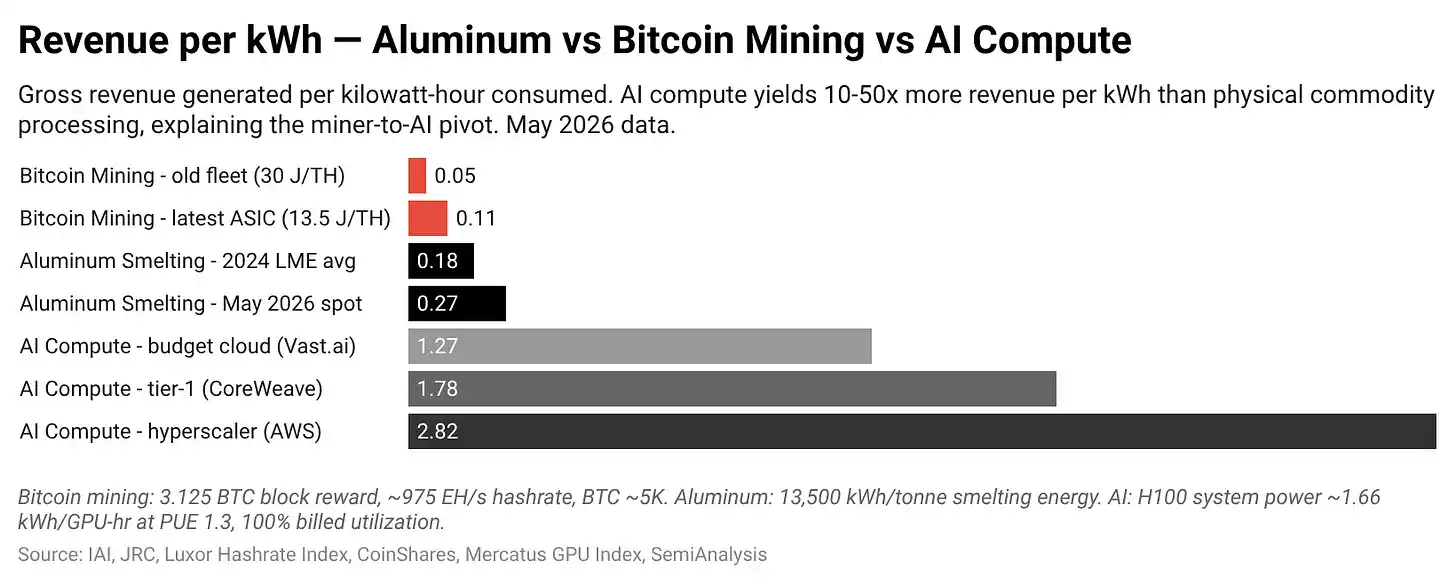
When electricity was cheap, producing aluminum made sense. As margins in the aluminum industry were squeezed, Bitcoin mining became the new use case for low-cost power. By 2026, with Bitcoin prices depressed, AI workloads have become the unequivocally better choice.

Three recent transactions vividly illustrate the industry-wide scramble for power resources, whether for cryptocurrency mining or AI compute.

Riot, with its large site in Rockdale, hasn't limited itself to Bitcoin mining. It has leased part of its space and power to chip giant AMD for building an AI data center. Simply by subleasing electricity and space, the company stands to earn hundreds of millions of dollars.

TeraWulf has embarked on a major expansion, spending $200 million to acquire the century-old Century Aluminum plant in Hawesville, Kentucky. The core reason for choosing this location is the plant's existing, robust high-capacity electrical infrastructure. The company plans to dismantle the old production equipment and build a large-scale data center campus leveraging the ready-made power grid.

NYDIG set its sights on the former Massena East industrial site in New York State. The site had been idle for years but offers direct access to 435 megawatts of cheap hydroelectric power from the St. Lawrence River. While peers pivot to AI, NYDIG secured this location solely to lock in low-cost hydropower to continue its Bitcoin mining operations. The industry has long since stopped building sites from scratch; it now competes for existing power hubs.

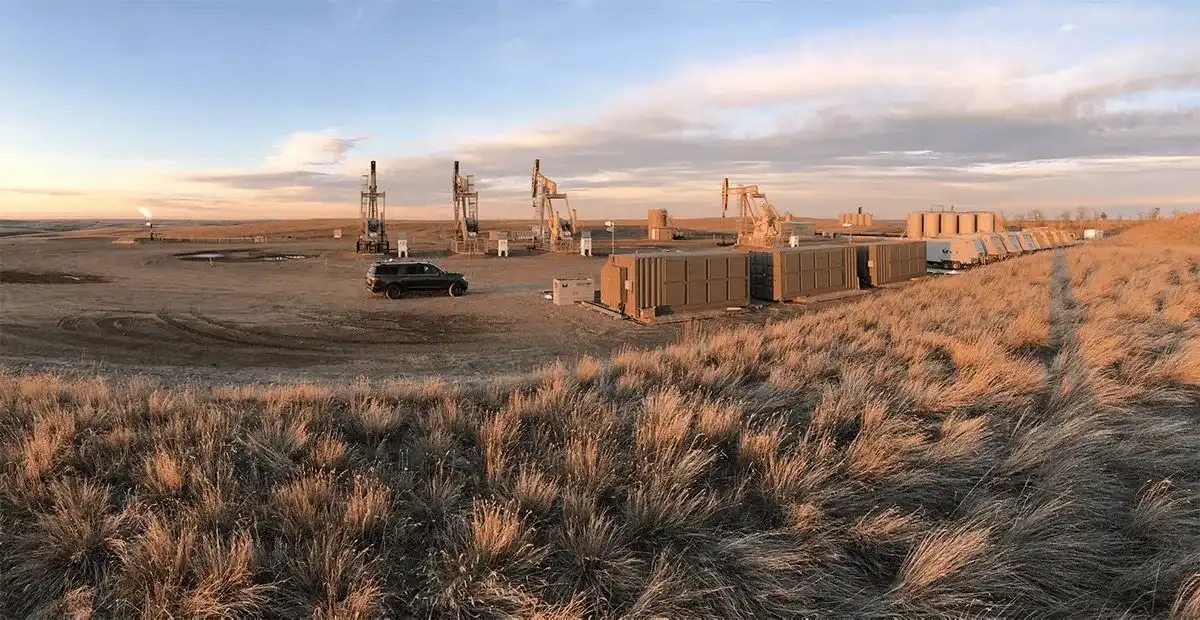
Over the past two decades, Bitcoin miners have roamed the globe in search of cheap power: at remote hydroelectric dams in Washington state, at flare gas sites in North Dakota's oil fields, in clusters of old industrial grids in upstate New York. The industry has honed a mature set of supporting capabilities: 24/7 high-load power management, industrial-grade cooling solutions, long-term, low-cost power contracts.

The rising AI firms happen to need these ready-made resources and have deeper pockets.
Anthropic is aggressively locking down power resources. Microsoft, Google, and Amazon are also on a data center construction spree, with power infrastructure buildout struggling to keep pace with new facility deployment. The three tech giants are now directly competing with Bitcoin miners for the same pool of industrial power resources. Where miners once competed against each other for power, they now find themselves at a disadvantage against the tech titans.

Data from early 2026 confirms the industry's predicament. Bitcoin's global network hash rate declined for the first time in six years. While the current cost to mine a single Bitcoin is around $88,000, for most of May this year, the price has hovered around $77,000. Miners operating at standard electricity rates are losing money on every coin they produce.

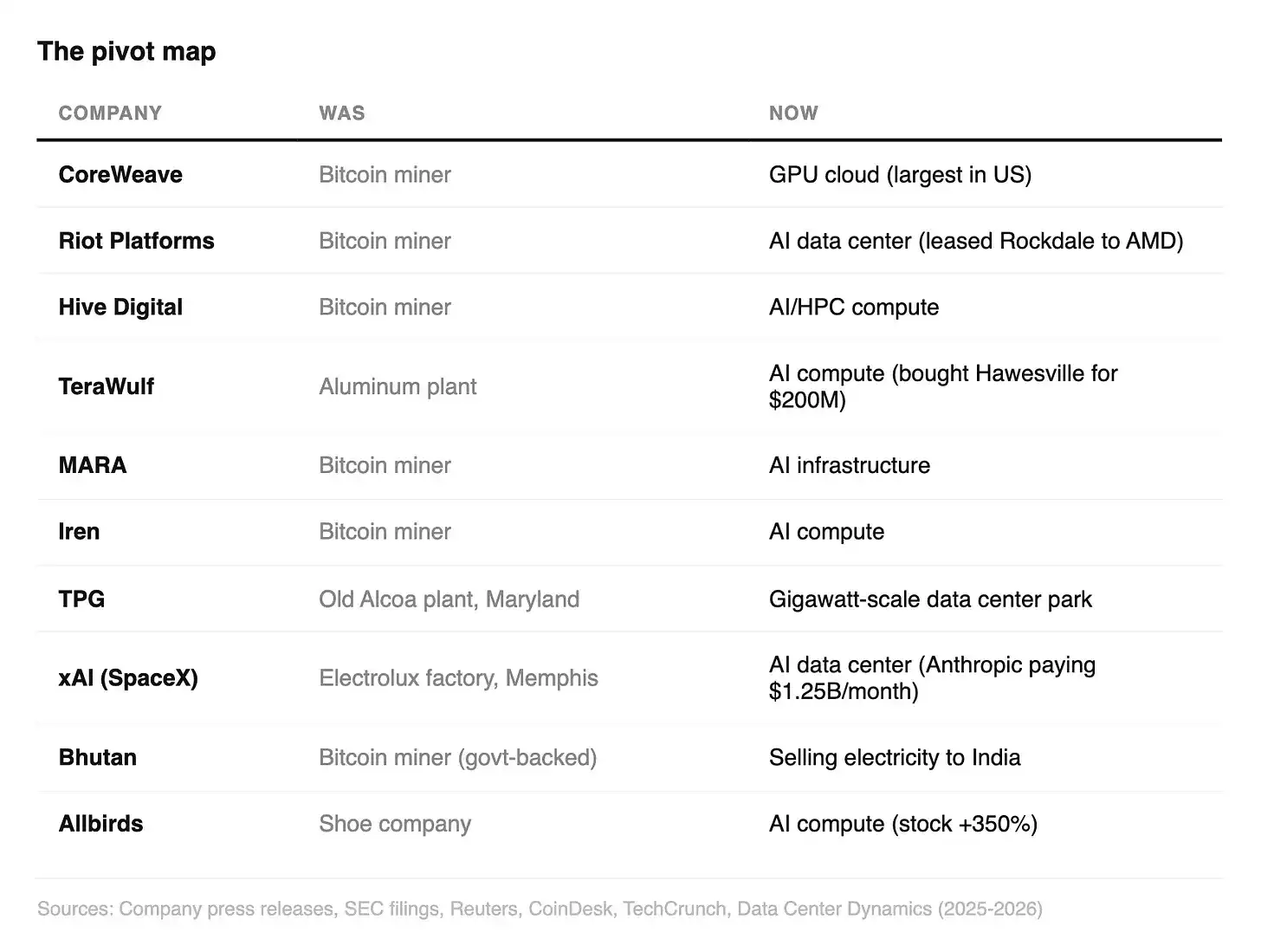
A collective pivot has followed. Companies like Hive, Hut 8, TeraWulf, and Iren are dismantling mining rigs and converting facilities into AI server rooms. CoreWeave has completely exited crypto mining, fully transitioning to AI cloud services. MARA acquired a French tech company to shift its business focus. Those positioned as "power operators," holding valuable electricity resources, are surviving. Miners solely focused on the crypto space are in crisis.
Energy analysts have dubbed this phenomenon the "digital resource curse": nations and companies are increasingly realizing that simply controlling cheap electricity yields higher returns than developing new technologies themselves.

The Gulf States grasped this logic early. For the past six decades, they have maintained ultra-low electricity tariffs: Kuwait has kept residential rates stable at $0.007 per kWh since 1966; in Abu Dhabi, the combined cost of production and delivery is about $0.087 per kWh, but it's sold to residents for just $0.014. Low-cost power was originally a tool for industrial policy, attracting energy-intensive industries like aluminum smelting, petrochemicals, and steel to the desert.
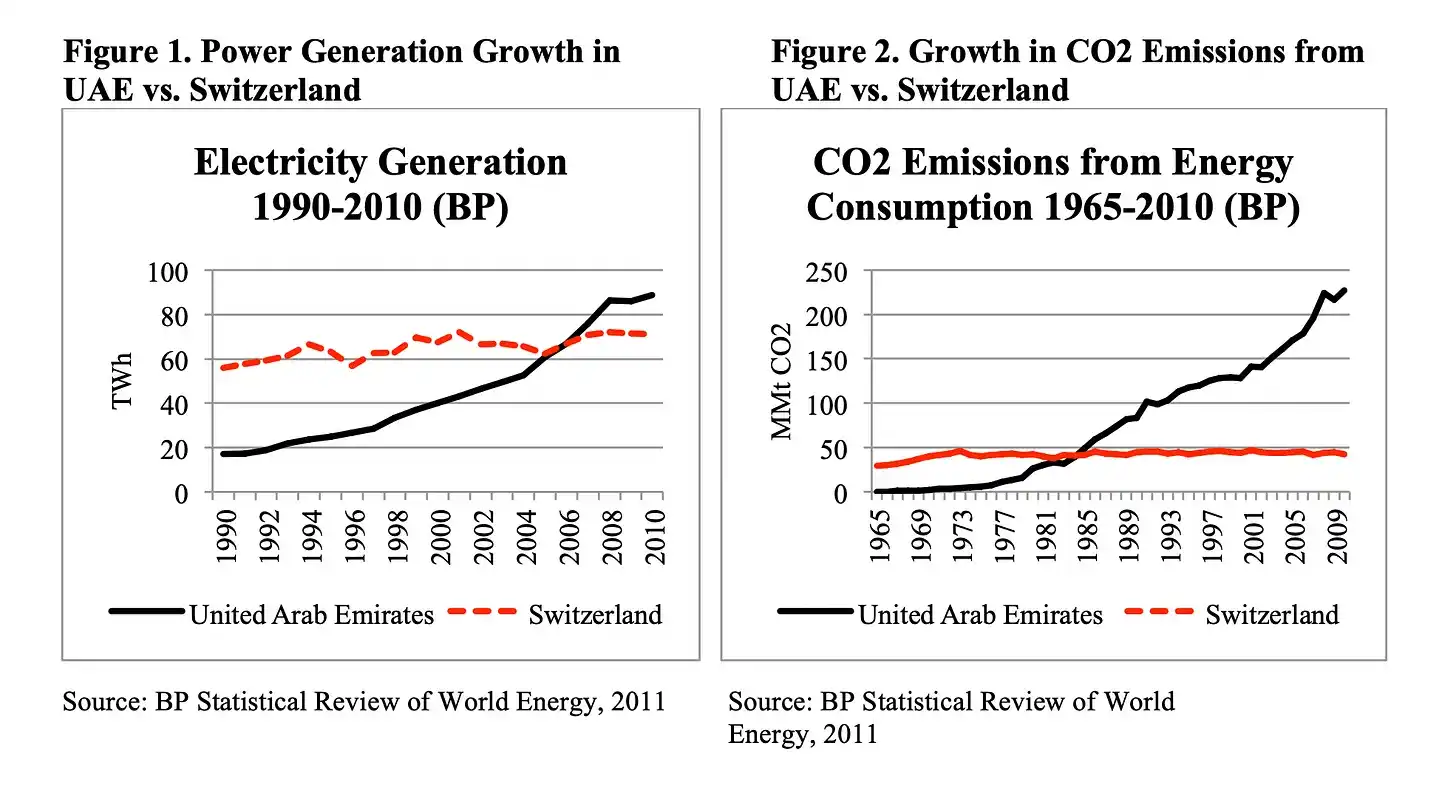
Today, that same cheap power that once supported heavy industry has found a new user: the data center. Saudi Arabia has established a sovereign AI investment agency, HUMAIN, investing tens of billions in tech infrastructure. The UAE is building a 5-gigawatt AI park, attracting companies like OpenAI, Oracle, and Nvidia. The grid that once powered aluminum smelters now powers AI compute. The planned NEOM Oxagon, originally conceived as a floating industrial city, has been repurposed into a $5 billion AI data center cluster powered by wind and solar.

The Carnegie Endowment for International Peace noted: Cloud computing has become the Gulf's "new aluminum." Instead of exporting physical commodities, the region is now converting fossil fuels and solar energy into compute power and exporting it via the internet.

It's not just the Middle East. Bhutan's case is equally telling.

Bhutan once possessed some of the world's cheapest hydropower. Its state-backed Bitcoin mining project was once hailed as a model of sovereign mining, holding a peak of 13,000 BTC. That has now dwindled to 3,100 BTC, and mining operations ceased over a year ago. The country's hydropower is now sold directly to the Indian grid.

The calculus mirrors that of the old American aluminum plant: Is Bitcoin mining still the best use of our electricity? When the answer was yes, Bhutan mined. When selling power to India offered a more stable return without the volatility risk of cryptocurrency, the power flowed to its neighbor.

Similarly, Starcloud raised $200 million to plan an orbital solar-powered data center. They recently trained the first AI model in space using H100 GPUs and are seeking approval to launch 88,000 satellites. While the project retains a Bitcoin mining operation, it is only a secondary component: the in-orbit solar panels generate continuous power, and when the AI compute queue is idle, the surplus electricity is used for crypto mining.

Low Earth orbit offers unique advantages for power generation: constant sunlight, no land use, and the cold of space negates the need for extensive cooling equipment. Over the past two decades, launch costs have fallen by 95%.

SpaceX is also deeply involved in the power-and-compute calculus. According to its latest IPO filing, the company's Colossus 1 data center in Memphis, Tennessee, has its entire compute capacity exclusively leased by Anthropic under a contract running until May 2029, valued at over $40 billion. This single deal alone brings SpaceX $1.25 billion in monthly revenue. This data center was also converted from an old appliance factory, mirroring the transformation model seen in Rockdale's aluminum plant.

Amidst all this industrial churn, perhaps the most unexpected pivot is that of Allbirds. The sustainable shoe brand, once valued at $4 billion, saw its stock price plummet 98% as the consumer brand bubble burst. With its core business struggling, the company, armed with cash and a public listing, decisively pivoted entirely to operating AI compute infrastructure. Its stock price subsequently surged 350%. The market voted: operating servers and trading in power/compute is far more profitable today than the traditional consumer sector.

Meanwhile, crypto projects like Bittensor, Render, and Akash are charting a different path: not building large, centralized facilities, but aggregating the world's distributed, idle compute.

Bittensor has built a compute marketplace where, underpinned by a fixed-supply token system, various AI models compete to provide answers; the project also halved its daily token issuance in December 2025. Render incentivizes users to share idle GPU resources for AI tasks. Akash rents out cloud compute, claiming prices up to 85% lower than Amazon Web Services.

This distributed compute model is gaining attention. At Nvidia's GTC conference in 2026, CEO Jensen Huang compared Bittensor to the classic internet project Folding@home. The latter was born from the idea of leveraging idle home computers worldwide, making dormant devices productive; Bittensor uses crypto tokens as an incentive to aggregate the compute of idle gaming PCs and old mining rigs.

Looking at the big picture, from the roar of industrial fans in Rockdale to sun-chasing satellites in orbit, a massive reconfiguration around physical assets is underway. For the companies involved, the only rule is to chase profit margins. I predict that a decade from now, these compute facilities may once again be emptied and repurposed for the next generation of emerging industries. The underground electrical transmission lines, however, will remain unchanged from beginning to end.

Whoever controls the cheapest electricity decides what the compute is used for. This logic has already played out in Texas, Bhutan, and Abu Dhabi. And 250 miles above the Earth's surface, it will hold true as well.


Perguntas relacionadas

QWhat is the core reason behind the industrial transformation from aluminum smelting to Bitcoin mining and then to AI data centers at sites like the one in Rockdale, Texas?

AThe core reason is the pursuit of maximizing revenue per kilowatt-hour of electricity consumed. The decision is driven by comparing the gross revenue each activity generates from the same unit of power: aluminum smelting ($0.17–0.27/kWh), Bitcoin mining ($0.05–0.11/kWh), and AI inference tasks using H100 GPUs ($1.27–3.67/kWh). As profitability shifts, businesses repurpose infrastructure to host the most lucrative power-consuming operation.

QHow are Bitcoin miners being outcompeted in the race for cheap electricity resources according to the article?

ABitcoin miners are being outcompeted by well-funded AI companies and tech giants like Microsoft, Google, and Amazon. These AI-focused firms have stronger capital and are aggressively securing the same industrial-scale, low-cost power resources and data center sites that miners previously relied on. This competition has contributed to a decline in Bitcoin's global hash rate as miners struggle with profitability against higher electricity bidders.

QWhat is the 'digital resource curse' mentioned in the article, and how is it exemplified by Gulf states?

AThe 'digital resource curse' refers to the phenomenon where countries or companies find that simply controlling cheap electricity resources yields higher returns than developing new technologies. Gulf states like Kuwait and Abu Dhabi exemplify this by using long-standing, heavily subsidized low electricity prices—initially to attract energy-intensive industries like aluminum and chemicals—to now pivot and attract massive AI data center investments, effectively exporting compute power instead of physical commodities.

QWhat alternative, decentralized model for providing AI compute is highlighted in the article, and which projects represent it?

AThe article highlights a decentralized model that aggregates globally distributed, idle computing power instead of building large centralized data centers. This model is represented by crypto projects like Bittensor (which creates a marketplace for AI models to compete), Render (which shares idle GPU resources for AI tasks), and Akash (which offers decentralized cloud computing at lower costs). Nvidia's CEO compared Bittensor to the classic distributed computing project Folding@home.

QWhat broader principle does the article conclude governs the evolution of power-intensive industries from aluminum to AI?

AThe article concludes that the fundamental principle is that whoever controls the cheapest electricity determines the use of compute power. Industries—whether aluminum smelting, Bitcoin mining, or AI training—will continuously migrate to and repurpose infrastructure based on where they can achieve the highest profit per unit of electricity. The physical power grid remains constant, while the operations it supports evolve to follow the highest monetary return.

Leituras Relacionadas

CEO's Unexpected Passing: Will ONDO's 'Tokenization Narrative' Change?

Ondo Finance, a leading project in the RWA (Real World Assets) and tokenization space, faces a significant challenge following the unexpected passing of its founder and CEO, Nathan Allman. Known for his traditional finance background and pivotal role in shaping Ondo's strategy, Allman was central to its evolution from a DeFi structured yield platform to a key player tokenizing assets like US treasuries, stocks, and ETFs. The company announced that President Ian De Bode, a former McKinsey partner with deep experience in digital assets and corporate strategy, will assume the CEO role. The leadership transition presents a critical test for Ondo. While Allman's vision and execution were instrumental in establishing its "tokenization narrative," the project's medium to long-term trajectory will depend on the existing team's ability to maintain business continuity. Analysts note short-term concerns regarding vision continuity, institutional partnerships, and market sentiment for the ONDO token. However, Ondo has built a substantial product suite (OUSG, USDY, Ondo Global Markets) and a management team with strong traditional finance credentials. De Bode's background in strategy and execution may align well with the next phase of RWA growth, which focuses heavily on compliance, scaling, and institutional adoption. Ultimately, the event shifts focus to whether Ondo is a founder-driven story or a sustainable financial infrastructure. Its future as a "first tokenization asset" will be determined by the new leadership's success in delivering product growth, asset scaling, and real-world demand, rather than narrative alone.

marsbitHá 40m

CEO's Unexpected Passing: Will ONDO's 'Tokenization Narrative' Change?

marsbitHá 40m

Trading

Spot
Futuros

Artigos em Destaque

O que é BITCOIN

Compreender o HarryPotterObamaSonic10Inu (ERC-20) e a Sua Posição no Espaço Cripto Nos últimos anos, o mercado de criptomoedas assistiu a um aumento na popularidade das moedas meme, cativando não apenas os traders, mas também aqueles que procuram envolvimento comunitário e valor de entretenimento. Entre estes tokens únicos está o HarryPotterObamaSonic10Inu (ERC-20), um projeto intrigante que mistura referências culturais no tecido das criptomoedas. Este artigo explora os principais aspetos do HarryPotterObamaSonic10Inu, examinando os seus mecanismos, a sua ética orientada pela comunidade e o seu envolvimento com o vasto panorama cripto. O que é o HarryPotterObamaSonic10Inu (ERC-20)? Como o nome sugere, o HarryPotterObamaSonic10Inu é uma moeda meme construída na blockchain Ethereum, classificada sob o padrão ERC-20. Ao contrário das criptomoedas tradicionais, que podem enfatizar a utilidade prática ou o potencial de investimento, este token prospera no valor de entretenimento e na força da sua comunidade. O projeto visa promover um ambiente onde utilizadores envolvidos possam reunir-se, partilhar ideias e participar em atividades inspiradas por diversos fenómenos culturais. Uma característica notável do HarryPotterObamaSonic10Inu é a zero taxa sobre transações. Este elemento atraente visa encorajar a negociação e o envolvimento da comunidade, isento de encargos adicionais que podem desencorajar os traders de pequena escala. A oferta total da moeda está fixada em mil milhões de tokens, uma cifra que marca a sua intenção de manter uma circulação substancial dentro da comunidade. Criador do HarryPotterObamaSonic10Inu (ERC-20) As origens do HarryPotterObamaSonic10Inu estão um pouco envoltas em mistério; os detalhes sobre o criador permanecem desconhecidos. O desenvolvimento deste token carece de uma equipa identificável ou de um plano explícito, o que não é raro no setor das moedas meme. Em vez disso, o projeto surgiu de forma orgânica, com o seu progresso a depender fortemente do entusiasmo e da participação da sua comunidade. Investidores do HarryPotterObamaSonic10Inu (ERC-20) No que diz respeito a investimentos externos e apoios, o HarryPotterObamaSonic10Inu também permanece ambíguo. O token não lista quaisquer fundações de investimento conhecidas ou apoio organizacional significativo. Em vez disso, o “sangue vital” do projeto é a sua comunidade de base, que informa o seu crescimento e sustentabilidade através da ação coletiva e do envolvimento no espaço cripto. Como Funciona o HarryPotterObamaSonic10Inu (ERC-20)? Como uma moeda meme, o HarryPotterObamaSonic10Inu opera principalmente fora dos quadros tradicionais que muitas vezes governam o valor dos ativos. Existem vários aspetos distintivos que definem como o projeto funciona: Transações Sem Taxas: Sem taxas sobre transações, os utilizadores podem comprar e vender o token livremente, sem a preocupação de custos ocultos. Envolvimento da Comunidade: O projeto prospera na interação da comunidade, aproveitando plataformas de redes sociais para criar entusiasmo e facilitar a participação. Discussões, partilha de conteúdo e envolvimento são elementos cruciais que ajudam a expandir o seu alcance e a fomentar a lealdade entre os apoiantes. Sem Utilidade Prática: Deve ser notado que o HarryPotterObamaSonic10Inu não oferece utilidade concreta dentro do ecossistema financeiro. Em vez disso, é classificado como um token principalmente para entretenimento e atividades comunitárias. Referência Cultural: O token incorpora de forma inteligente elementos da cultura popular para atrair interesse, conectando-se tanto com entusiastas de memes como com seguidores de criptomoedas. HarryPotterObamaSonic10Inu exemplifica como as moedas meme operam de forma diferente de projetos de criptomoedas mais tradicionais, entrando no mercado como construções sociais inovadoras em vez de ativos utilitários. Linha do Tempo do HarryPotterObamaSonic10Inu (ERC-20) A história do HarryPotterObamaSonic10Inu é marcada por vários marcos notáveis: Criação: O token surgiu de um meme viral, capturando a imaginação de muitos entusiastas de criptomoedas. Datas específicas de criação não estão disponíveis, sublinhando a sua ascensão orgânica. Listagem em Exchanges: O HarryPotterObamaSonic10Inu conseguiu entrar em várias exchanges, permitindo um acesso e negociação mais fáceis pela comunidade. Iniciativas de Envolvimento da Comunidade: Atividades contínuas direcionadas a melhorar a interação comunitária, incluindo concursos, campanhas em redes sociais e geração de conteúdo por fãs e defensores. Planos de Expansão Futura: O roteiro do projeto inclui o lançamento de uma coleção de NFTs, mercadorias e um site de eCommerce relacionado aos seus temas culturais, envolvendo ainda mais a comunidade e tentando adicionar mais dimensões ao seu ecossistema. Pontos-Chave sobre o HarryPotterObamaSonic10Inu (ERC-20) Natureza Orientada pela Comunidade: O projeto prioriza a contribuição coletiva e a criatividade, assegurando que o envolvimento dos utilizadores está na vanguarda do seu desenvolvimento. Classificação como Moeda Meme: Representa o epítome da criptomoeda baseada em entretenimento, destacando-se dos veículos de investimento tradicionais. Sem Afiliação Direta com o Bitcoin: Apesar da semelhança no nome do ticker, o HarryPotterObamaSonic10Inu é distinto e não tem qualquer relação com o Bitcoin ou outras criptomoedas estabelecidas. Foco na Colaboração: O HarryPotterObamaSonic10Inu é projetado para criar um espaço de colaboração e partilha de histórias entre os seus detentores, proporcionando uma via para a criatividade e o fortalecimento da comunidade. Perspectivas Futuras: A ambição de expandir além da sua premissa inicial para NFTs e mercadorias delineia um caminho para o projeto potencialmente entrar em avenidas mais mainstream dentro da cultura digital. À medida que as moedas meme continuam a capturar a imaginação da comunidade cripto, HarryPotterObamaSonic10Inu (ERC-20) destaca-se devido aos seus laços culturais e abordagem centrada na comunidade. Embora possa não se encaixar no molde típico de um token orientado para utilidade, a sua essência reside na alegria e camaradagem fomentadas entre os seus apoiantes, destacando a natureza em evolução das criptomoedas em uma era cada vez mais digital. À medida que o projeto continua a desenvolver-se, será importante observar como as dinâmicas comunitárias influenciam a sua trajetória no panorama em constante mudança da tecnologia blockchain.

1.5k Visualizações TotaisPublicado em {updateTime}Atualizado em 2024.12.03

O que é BITCOIN

Como comprar BTC

Bem-vindo à HTX.com!Tornámos a compra de Bitcoin (BTC) simples e conveniente.Segue o nosso guia passo a passo para iniciar a tua jornada no mundo das criptos.Passo 1: cria a tua conta HTXUtiliza o teu e-mail ou número de telefone para te inscreveres numa conta gratuita na HTX.Desfruta de um processo de inscrição sem complicações e desbloqueia todas as funcionalidades.Obter a minha contaPasso 2: vai para Comprar Cripto e escolhe o teu método de pagamentoCartão de crédito/débito: usa o teu visa ou mastercard para comprar Bitcoin (BTC) instantaneamente.Saldo: usa os fundos da tua conta HTX para transacionar sem problemas.Terceiros: adicionamos métodos de pagamento populares, como Google Pay e Apple Pay, para aumentar a conveniência.P2P: transaciona diretamente com outros utilizadores na HTX.Mercado de balcão (OTC): oferecemos serviços personalizados e taxas de câmbio competitivas para os traders.Passo 3: armazena teu Bitcoin (BTC)Depois de comprar o teu Bitcoin (BTC), armazena-o na tua conta HTX.Alternativamente, podes enviá-lo para outro lugar através de transferência blockchain ou usá-lo para transacionar outras criptomoedas.Passo 4: transaciona Bitcoin (BTC)Transaciona facilmente Bitcoin (BTC) no mercado à vista da HTX.Acede simplesmente à tua conta, seleciona o teu par de trading, executa as tuas transações e monitoriza em tempo real.Oferecemos uma experiência de fácil utilização tanto para principiantes como para traders experientes.

4.0k Visualizações TotaisPublicado em {updateTime}Atualizado em 2025.03.21

Como comprar BTC

O que é $BITCOIN

OURO DIGITAL ($BITCOIN): Uma Análise Abrangente Introdução ao OURO DIGITAL ($BITCOIN) OURO DIGITAL ($BITCOIN) é um projeto baseado em blockchain que opera na rede Solana, com o objetivo de combinar as características dos metais preciosos tradicionais com a inovação das tecnologias descentralizadas. Embora partilhe um nome com o Bitcoin, frequentemente referido como “ouro digital” devido à sua percepção como uma reserva de valor, o OURO DIGITAL é um token separado projetado para criar um ecossistema único dentro da paisagem Web3. O seu objetivo é posicionar-se como um ativo digital alternativo viável, embora os detalhes sobre as suas aplicações e funcionalidades ainda estejam em desenvolvimento. O que é o OURO DIGITAL ($BITCOIN)? OURO DIGITAL ($BITCOIN) é um token de criptomoeda explicitamente projetado para uso na blockchain Solana. Em contraste com o Bitcoin, que fornece um papel amplamente reconhecido como armazenamento de valor, este token parece focar em aplicações e características mais amplas. Aspectos notáveis incluem: Infraestrutura Blockchain: O token é construído na blockchain Solana, conhecida pela sua capacidade de lidar com transações de alta velocidade e baixo custo. Dinâmicas de Oferta: O OURO DIGITAL tem um fornecimento máximo limitado a 100 quatrilhões de tokens (100P $BITCOIN), embora os detalhes sobre o seu fornecimento circulante ainda não tenham sido divulgados. Utilidade: Embora as funcionalidades precisas não estejam explicitamente delineadas, existem indicações de que o token poderia ser utilizado para várias aplicações, potencialmente envolvendo aplicações descentralizadas (dApps) ou estratégias de tokenização de ativos. Quem é o Criador do OURO DIGITAL ($BITCOIN)? Neste momento, a identidade dos criadores e da equipa de desenvolvimento por trás do OURO DIGITAL ($BITCOIN) permanece desconhecida. Esta situação é típica entre muitos projetos inovadores no espaço da blockchain, particularmente aqueles alinhados com finanças descentralizadas e fenómenos de moedas meme. Embora tal anonimato possa fomentar uma cultura orientada pela comunidade, intensifica as preocupações sobre governança e responsabilidade. Quem são os Investidores do OURO DIGITAL ($BITCOIN)? As informações disponíveis indicam que o OURO DIGITAL ($BITCOIN) não tem apoiantes institucionais conhecidos ou investimentos proeminentes de capital de risco. O projeto parece operar num modelo peer-to-peer focado no apoio e adoção da comunidade, em vez de rotas de financiamento tradicionais. A sua atividade e liquidez estão principalmente situadas em exchanges descentralizadas (DEXs), como a PumpSwap, em vez de plataformas de negociação centralizadas estabelecidas, destacando ainda mais a sua abordagem de base. Como Funciona o OURO DIGITAL ($BITCOIN) A mecânica operacional do OURO DIGITAL ($BITCOIN) pode ser elaborada com base no seu design de blockchain e nas características da rede: Mecanismo de Consenso: Ao aproveitar o exclusivo proof-of-history (PoH) da Solana combinado com um modelo de proof-of-stake (PoS), o projeto assegura uma validação eficiente das transações, contribuindo para o alto desempenho da rede. Tokenomics: Embora mecanismos deflacionários específicos não tenham sido extensivamente detalhados, o vasto fornecimento máximo de tokens implica que pode atender a microtransações ou casos de uso de nicho que ainda estão por definir. Interoperabilidade: Existe o potencial para integração com o ecossistema mais amplo da Solana, incluindo várias plataformas de finanças descentralizadas (DeFi). No entanto, os detalhes sobre integrações específicas permanecem não especificados. Cronologia de Eventos Chave Aqui está uma cronologia que destaca marcos significativos relacionados ao OURO DIGITAL ($BITCOIN): 2023: O lançamento inicial do token ocorre na blockchain Solana, marcado pelo seu endereço de contrato. 2024: O OURO DIGITAL ganha visibilidade ao tornar-se disponível para negociação em exchanges descentralizadas como a PumpSwap, permitindo que os utilizadores o negociem contra SOL. 2025: O projeto testemunha atividade de negociação esporádica e potencial interesse em envolvimentos liderados pela comunidade, embora não tenham sido documentadas parcerias ou avanços técnicos notáveis até ao momento. Análise Crítica Forças Escalabilidade: A infraestrutura subjacente da Solana suporta altos volumes de transações, o que pode aumentar a utilidade do $BITCOIN em vários cenários de transação. Acessibilidade: O potencial preço de negociação baixo por token pode atrair investidores de retalho, facilitando uma participação mais ampla devido a oportunidades de propriedade fracionada. Riscos Falta de Transparência: A ausência de apoiantes, desenvolvedores ou um processo de auditoria publicamente conhecidos pode gerar ceticismo em relação à sustentabilidade e confiabilidade do projeto. Volatilidade do Mercado: A atividade de negociação depende fortemente do comportamento especulativo, o que pode resultar em volatilidade significativa dos preços e incerteza para os investidores. Conclusão O OURO DIGITAL ($BITCOIN) surge como um projeto intrigante, mas ambíguo, dentro do ecossistema em rápida evolução da Solana. Embora tente aproveitar a narrativa do “ouro digital”, a sua divergência do papel estabelecido do Bitcoin como reserva de valor sublinha a necessidade de uma diferenciação mais clara da sua utilidade pretendida e estrutura de governança. A aceitação e adoção futuras dependerão provavelmente da abordagem da atual opacidade e da definição mais explícita das suas estratégias operacionais e económicas. Nota: Este relatório abrange informações sintetizadas disponíveis até outubro de 2023, e desenvolvimentos podem ter ocorrido além do período de pesquisa.

92 Visualizações TotaisPublicado em {updateTime}Atualizado em 2025.05.13

O que é $BITCOIN

Discussões

Bem-vindo à Comunidade HTX. Aqui, pode manter-se informado sobre os mais recentes desenvolvimentos da plataforma e obter acesso a análises profissionais de mercado. As opiniões dos utilizadores sobre o preço de BTC (BTC) são apresentadas abaixo.

活动图片