From Pump.fun to Collector Crypt: Has Solana's Revenue Throne Changed Hands?

链捕手Publicado em 2026-07-02Última atualização em 2026-07-02

Resumo

From Pump.fun to Collector Crypt: Is Solana’s Revenue Throne Changing Hands? Solana’s on-chain narrative is expanding from meme coins to tokenized trading cards. Previously, Pump.fun dominated consumer revenue on Solana. However, starting in Q2 2026, Pump.fun's quarterly revenue growth slowed, while Collector Crypt shows a stronger recent growth trajectory. Data indicates Pump.fun's Q1 revenue was $108.3M, dropping 36.1% to $69.2M in Q2 so far. Conversely, Collector Crypt's revenue grew 108.8%, from $12.3M in Q1 to $25.8M in Q2 to date, with recent weekly revenue hitting $5.1M. While Pump.fun remains larger in scale, Collector Crypt demonstrates stronger short-term momentum. Collector Crypt's model involves custodying graded physical trading cards, minting corresponding NFTs on Solana, and selling randomized packs. Revenue comes from pack sales, secondary market fees, and royalties. Its profitability, estimated around 4-5%, stems from bulk card purchases at a discount and a buyback system for users. However, a full-scale reversal in rankings hasn't occurred. Year-to-date, Pump.fun's revenue is ~$177.5M (with its ecosystem at ~$466.5M), vastly exceeding Collector Crypt's ~$38.1M. The shift is more about narrative and recent growth dynamics than total historical volume. Pump.fun relies on speculative token launches, while Collector Crypt focuses on collectibility, scarcity, and real-world asset backing. This highlights a broadening of Solana's consumer revenue sources beyo...

Author: Chloe, ChainCatcher

The narrative on Solana is expanding from meme coins to tokenized trading cards. In the past, Pump.fun was almost the representative application for consumer-side revenue on Solana; but entering the second quarter of 2026, Pump.fun's quarterly revenue began to slow down, while Collector Crypt delivered a stronger recent growth curve.

DefiLlama data shows that Pump.fun's revenue in Q1 was $108.3 million, which has dropped to $69.2 million so far in Q2, a decrease of 36.1% compared to the previous quarter. During the same period, Collector Crypt's revenue curve has clearly trended upward.

Collector Crypt's revenue in Q1 was $12.3 million, rising to $25.8 million so far in Q2, a growth of 108.8%; its recent weekly revenue reached $5.1 million, accounting for about 38% of its 30-day total revenue of nearly $13.5 million. This set of data shows that Pump.fun still has a larger scale, but Collector Crypt is gaining stronger short-term growth momentum.
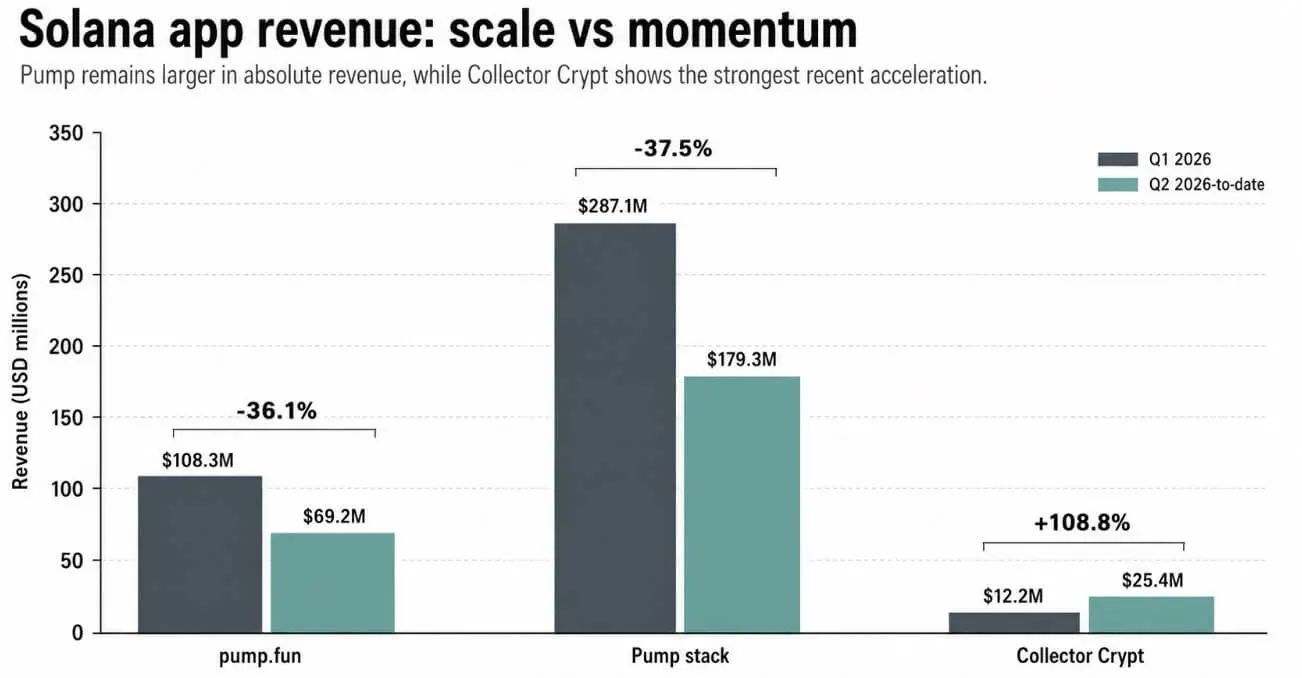
Summarizing the data, perhaps it's not that Pump.fun has lost scalable growth, but rather that the sources of consumer fees on Solana are beginning to diversify. The meme coin sector remains vast, but tokenized trading cards, random card packs, physical redemption, and on-chain secondary markets are becoming another consumer scenario capable of generating real fees, real transactions, and truly retaining users.

Are Collector Crypt's Profit Sources Stable?

The core operational model of Collector Crypt is to hold physical graded trading cards in custody and mint corresponding NFTs on Solana. Users who purchase random card packs receive digital cards linked to real physical cards; they can then choose to hold the NFT, sell it on-chain, sell it back to the platform, or redeem the physical card.

Collector Crypt's revenue mainly comes from random card pack sales, secondary market transaction fees, and royalties; when calculating revenue, it also deducts buyback costs incurred when users sell cards back to the platform. Furthermore, Collector Crypt purchases trading cards in bulk, acquiring inventory at discounts of about 5% to 15%; after users open packs, if they don't want to keep the cards, they can sell them back to the platform at a price roughly 7% to 15% below market value.

This allows Collector Crypt to retain an operating profit margin of about 4% to 5%. According to estimates, for a $1,000 card pack, Collector Crypt's comprehensive profit margin is about 5.14%; after deducting incentive costs such as user rewards, the net profit margin is about 4.44%.

This model has garnered attention because it's not just about selling on-chain pictures, but about connecting on-chain transactions with real-world collectibles. Collector Crypt surpassed $1 billion in cumulative trading volume in May 2026; the platform opened over 215,000 tokenized trading card packs in a single week, and more than 30% of users have redeemed physical cards.

Solana's Revenue Ranking Has Not Fully Reversed

However, Collector Crypt has not truly replaced Pump.fun in terms of total volume. So far in 2026, Pump.fun's revenue is about $177.5 million, and the overall Pump ecosystem revenue is about $466.5 million; in comparison, Collector Crypt's 2026 revenue is about $38.1 million. In cumulative revenue, Pump.fun exceeds $1 billion, the overall Pump ecosystem is about $1.18 billion, while Collector Crypt is about $58.4 million.
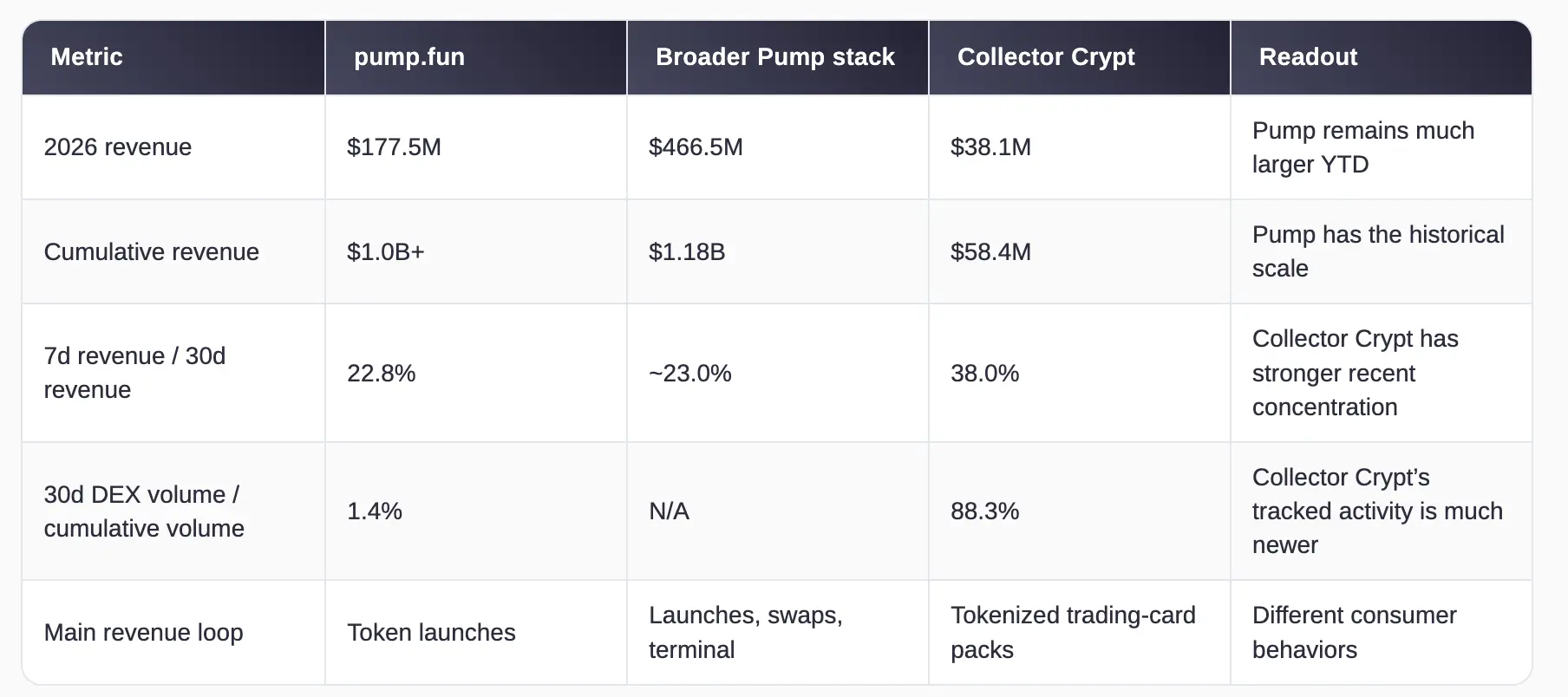
Therefore, the so-called "change of hands on the revenue throne" more accurately describes a narrative shift in recent revenue momentum and daily revenue rankings, rather than a complete reversal in historical cumulative scale.

Pump.fun's model relies on a speculative token-issuance cycle: users continuously issue new tokens, trade on early price curves, then some tokens enter public markets, generating fees at various stages. Collector Crypt's model is another type of consumer cycle: users buy random card packs, receive on-chain vouchers corresponding to physical collectibles, and then engage in on-chain trading, instant sell-back, or physical redemption. Both can generate fees, trading volume, and market attention, but they attract users for different reasons.

Pump.fun leans more towards attention, volatility, and early meme coin positions; Collector Crypt leans more towards collecting, scarcity, gamified experience, and real-world asset anchoring. This is also where the focus of the discussion about Solana's consumer applications is changing: revenue is no longer just from meme coin issuance, but can also come from collectible consumption closer to real-world assets.

Conclusion

Finally, the sustainability of Collector Crypt's revenue first depends on whether demand for random card packs can be maintained. If pack demand remains strong, Collector Crypt's 30-day revenue may continue to approach that of Pump.fun; if demand for random card packs cools, the recent high concentration of Collector Crypt's revenue could turn from a growth signal into a risk.

Additionally, the second growth variable for Collector Crypt is whether it can expand from Pokémon cards to sports cards and other collectibles. Data indicates that Pokémon cards currently dominate Collector Crypt's monthly trading volume; but at physical card shows, sports cards and Pokémon card sales are roughly split 50/50, while on-chain sports cards currently only account for 3% to 4% of Collector Crypt's $88 million monthly trading volume.

The third variable for Collector Crypt is regulatory pressure. If multiple jurisdictions begin to scrutinize the random card pack mechanism using a "loot box regulatory framework," it could slow Collector Crypt's growth.

Therefore, barring changes in the macro environment, Pump.fun will likely remain the larger revenue engine, while Collector Crypt will continue to appear at the top of Solana application revenue rankings. In this scenario, consumer application revenue on Solana will no longer rely solely on meme coin issuance but will gradually diffuse into more consumer scenarios.

The key change for Solana is not that Pump.fun has been completely replaced, but that the consumer revenue structure has broadened. Pump.fun proved that meme coin issuance can become a highly revenue-generating consumer application on Solana; Collector Crypt proves that tokenized physical collectibles can also form real revenue, real transactions, and real user behavior.


Criptomoedas em alta

Perguntas relacionadas

QAccording to the article, what is the main difference between Pump.fun's and Collector Crypt's revenue models?

APump.fun's revenue model relies on a speculative cycle of new token issuance and early-stage trading on bonding curves, attracting users with attention, volatility, and early memecoin access. Collector Crypt's revenue model is based on a consumption cycle: users buy randomized card packs containing tokenized, real-world graded trading cards, and then engage in on-chain trading, instant buybacks, or physical redemption, focusing on collection, scarcity, gamification, and real-world asset backing.

QWhat specific reasons does the article give for Collector Crypt's recent stronger growth in revenue compared to Pump.fun?

AThe article attributes Collector Crypt's stronger recent revenue growth to its unique offering of randomized packs linked to real-world collectible trading cards, creating a 'real fee, real transaction, and real user retention' scenario. This has provided stronger short-term growth momentum, evidenced by a 108.8% increase in Q2 revenue year-over-year and recent weekly revenue accounting for 38% of its 30-day total.

QWhat are the three key variables or challenges mentioned that could affect the sustainability of Collector Crypt's growth?

AThe three key variables are: 1) Sustained demand for randomized card packs, 2) The ability to expand from Pokémon cards to other collectibles like sports cards, and 3) Potential regulatory pressure as jurisdictions may scrutinize the 'randomized pack' mechanism under 'blind box' regulatory frameworks.

QBased on the DefiLlama data cited, how do the cumulative revenues of Pump.fun and Collector Crypt compare historically?

AHistorically, Pump.fun holds a significantly larger cumulative revenue. The article states Pump.fun's cumulative revenue exceeds $1 billion, and the broader Pump ecosystem is around $1.18 billion. In contrast, Collector Crypt's cumulative revenue is approximately $58.4 million. Therefore, the shift in 'revenue throne' refers to recent momentum, not a total historical reversal.

QWhat is the article's final conclusion regarding the broader change in Solana's consumer application landscape, beyond just the competition between these two protocols?

AThe article concludes that the key change on Solana is not Pump.fun being replaced, but a broadening of the consumer application revenue structure. While Pump.fun proved memecoin issuance could generate high revenue, Collector Crypt demonstrates that tokenized physical collectibles can also create real revenue, transactions, and user engagement, indicating a diffusion of revenue sources into more diverse consumer scenarios.

Leituras Relacionadas

High-Yield, Debt-Free, and Non-Dilutive: Why Bitcoin Treasury Companies Are Aggressively Promoting Preferred Share Financing

Bitcoin-backed preferred shares, led by companies like Strategy and followed by newer entrants like Strive, have grown to a market size of approximately $13 billion in under two years, attracting capital with high yields. A 2026 report from BitcoinTreasuries.net and Apyx projects this segment could grow from nearly 1% to 3-5% of the global $1.3 trillion preferred share market by 2030, with long-term potential reaching 10%. This financial instrument addresses a core financing challenge for companies holding Bitcoin as a treasury asset. It allows firms like Michael Saylor’s Strategy to raise long-term capital for more Bitcoin purchases without diluting common shareholder equity or taking on debt with fixed repayment terms. Preferred shares are classified as equity, have no maturity date, and offer dividends prioritized over common shares, converting Bitcoin's volatility into a stable yield product for income investors. Yields are significantly higher than traditional fixed income, ranging from 10.8% to 15.2% for top issuers. Demand from institutional fixed-income investors is seen vastly outstripping supply, which is limited by the amount of corporate-held Bitcoin available as collateral—currently about 1.26 million BTC ($83 billion), with Strategy holding 67%. A key safety feature is the high collateral coverage ratio of 3.8x to 4.5x, meaning each dollar of preferred equity is backed by $3.8-$4.5 in Bitcoin. Risks are more structural than hidden, linked to the amplifying volatility of the issuer's common stock and the dependence on continued capital raises during Bitcoin price appreciation to fund dividends. Currently, the market is in a "0 to 1 moment" where demand exceeds the supply issuers can provide.

Foresight NewsHá 43m

High-Yield, Debt-Free, and Non-Dilutive: Why Bitcoin Treasury Companies Are Aggressively Promoting Preferred Share Financing

Foresight NewsHá 43m

Trading

Spot

Artigos em Destaque

O que é MEME 2.0

Memecoin 2.0: A Ascensão do $MEME 2.0 no Mundo das Criptomoedas Introdução No panorama em constante evolução das criptomoedas, um novo concorrente surgiu. Memecoin 2.0, simbolizado como $MEME 2.0, eleva o conceito de moedas meme a um novo nível emocionante. Como um subproduto do Memecoin original, este projeto capturou a atenção da comunidade crypto ao mudar o foco de incentivos financeiros típicos para uma experiência envolvente e divertida. Operando na blockchain Ethereum, Memecoin 2.0 redefine audaciosamente o envolvimento da comunidade na esfera crypto. O que é Memecoin 2.0, $MEME 2.0? No seu cerne, Memecoin 2.0 é um projeto de criptomoeda que prioriza o espírito comunitário e a diversão associada à cultura meme. Ao contrário das criptomoedas convencionais, que se concentram em casos de uso práticos e benefícios tangíveis, Memecoin 2.0 distingue-se ao abraçar o lado mais leve da moeda digital. O projeto existe sem promessas de utilidade, um roteiro estruturado ou retornos financeiros, focando em vez disso em fomentar uma comunidade vibrante centrada em memes e no prazer partilhado. Ao fazer isso, aproveita a crescente tendência da cultura meme no espaço online, tornando-se num jogador único no mundo dos ativos digitais. Criador do Memecoin 2.0, $MEME 2.0 Apesar de extensa pesquisa sobre as origens do Memecoin 2.0, a identidade explícita do seu criador continua desconhecida. Esta anonimidade não é incomum na comunidade crypto, onde muitos projetos são liderados por indivíduos ou grupos que preferem ficar nos bastidores. A falta de informações publicamente disponíveis sobre o criador pode ser vista como um movimento estratégico, colocando os holofotes no envolvimento da comunidade em vez de na notoriedade individual dentro do espaço. Investidores do Memecoin 2.0, $MEME 2.0 As informações sobre os investidores ou o financiamento do Memecoin 2.0 são escassas. Esta ausência de detalhes pode sugerir que o projeto é autofinanciado ou que o seu foco na comunidade, em vez de estruturas de investimento tradicionais, atraiu um tipo diferente de apoiador. Como o mundo das moedas memes geralmente envolve mais envolvimento de base do que investimento institucional, esta abordagem alinha-se ao ethos de projetos orientados pela comunidade. Como Funciona o Memecoin 2.0, $MEME 2.0? O Memecoin 2.0 opera inteiramente na blockchain Ethereum, aproveitando as suas robustas características de segurança e escalabilidade. Ao aproveitar os pontos fortes da Ethereum, o Memecoin 2.0 pode oferecer um ambiente seguro para interações dos utilizadores enquanto assegura que as transações são eficientes e custo-efetivas. Uma das características únicas do Memecoin 2.0 reside na sua estrutura orientada pela comunidade. O valor e a popularidade do token $MEME 2.0 derivam da participação ativa dos seus utilizadores, em vez de uma utilidade inerente. Este design reforça o foco do projeto no aspecto de entretenimento das criptomoedas, implicando que o riso e o envolvimento da comunidade são as verdadeiras moedas que impulsionam o seu sucesso. Além disso, o projeto insere-se no ecossistema mais amplo das moedas meme, onde o valor de cada moeda meme oscila com base na cultura, nas tendências e no envolvimento da comunidade, em vez de nos princípios económicos tradicionais. Linhas do Tempo do Memecoin 2.0, $MEME 2.0 Para melhor entender a evolução e os marcos do Memecoin 2.0, aqui está uma linha do tempo que destaca eventos significativos na sua história: 2024: O início do Memecoin 2.0 é reconhecido como um desdobramento do Memecoin original, estabelecendo-se dentro do contexto próspero das moedas meme enquanto opera na blockchain Ethereum. 13 de Julho de 2024: O Memecoin 2.0 posiciona-se oficialmente como uma moeda meme centrada na comunidade na rede Ethereum, enfatizando a sua abordagem centrada no entretenimento que convida os utilizadores a participar e envolver-se no seu crescimento. Pontos Chave Sobre o Memecoin 2.0, $MEME 2.0 Várias características críticas definem o Memecoin 2.0: Abordagem Centrada na Comunidade: A missão primária do Memecoin 2.0 é criar uma experiência comunitária divertida e envolvente, capitalizando o prazer coletivo derivado da cultura meme. Construído na Ethereum: Operar na blockchain Ethereum fornece ao projeto uma infraestrutura essencial que garante segurança e escalabilidade. Falta de Utilidade ou Roteiro: Numa notável divergência das criptomoedas tradicionais, o Memecoin 2.0 não promete quaisquer características utilitárias ou retornos financeiros, reafirmando o seu compromisso com o envolvimento da comunidade e a participação social. Foco na Cultura Meme: Ao abraçar os aspectos humorísticos e culturais do fenómeno meme, o Memecoin 2.0 fornece uma plataforma para que os utilizadores se envolvam com a crypto offline e online. Contexto Adicional: A Importância das Moedas Meme As moedas meme emergiram como uma classe distinta de criptomoeda, frequentemente impulsionadas pelo humor e por uma abordagem leve ao comércio. Estas moedas geralmente carecem de utilidade significativa ou roteiros de desenvolvimento, atraindo os utilizadores com a promessa de diversão, interação comunitária e relevância cultural. No panorama do ecossistema crypto mais amplo, as moedas meme revive a importância do envolvimento da comunidade, resistindo contra abordagens exclusivamente orientadas para o lucro. Projetos como o Memecoin 2.0 inauguram uma era em que o entretenimento pode harmonizar-se com aspirações financeiras, transformando a blockchain numa plataforma para criatividade e interação social. Conclusão O Memecoin 2.0, ou $MEME 2.0, representa uma nova onda de criptomoeda que prioriza o envolvimento da comunidade em detrimento de estruturas financeiras rígidas. Com um foco no humor e na interação social, capitaliza a fascinação em torno da cultura meme. Ao operar na blockchain Ethereum, o Memecoin 2.0 aproveita as capacidades da tecnologia, enquanto mantém um compromisso firme com o valor de entretenimento da moeda digital. À medida que o espaço em torno das criptomoedas continua a evoluir, o Memecoin 2.0 serve como um testemunho da ideia de que o futuro dos ativos digitais pode muito bem depender de experiências partilhadas, risadas e conexões comunitárias sólidas. No mundo imprevisível da crypto, talvez a alegria possa ser tão valiosa quanto o ganho financeiro tradicional.

44 Visualizações TotaisPublicado em {updateTime}Atualizado em 2024.12.03

O que é MEME 2.0

Como comprar MEME

Bem-vindo à HTX.com!Tornámos a compra de Memeland (MEME) simples e conveniente.Segue o nosso guia passo a passo para iniciar a tua jornada no mundo das criptos.Passo 1: cria a tua conta HTXUtiliza o teu e-mail ou número de telefone para te inscreveres numa conta gratuita na HTX.Desfruta de um processo de inscrição sem complicações e desbloqueia todas as funcionalidades.Obter a minha contaPasso 2: vai para Comprar Cripto e escolhe o teu método de pagamentoCartão de crédito/débito: usa o teu visa ou mastercard para comprar Memeland (MEME) instantaneamente.Saldo: usa os fundos da tua conta HTX para transacionar sem problemas.Terceiros: adicionamos métodos de pagamento populares, como Google Pay e Apple Pay, para aumentar a conveniência.P2P: transaciona diretamente com outros utilizadores na HTX.Mercado de balcão (OTC): oferecemos serviços personalizados e taxas de câmbio competitivas para os traders.Passo 3: armazena teu Memeland (MEME)Depois de comprar o teu Memeland (MEME), armazena-o na tua conta HTX.Alternativamente, podes enviá-lo para outro lugar através de transferência blockchain ou usá-lo para transacionar outras criptomoedas.Passo 4: transaciona Memeland (MEME)Transaciona facilmente Memeland (MEME) no mercado à vista da HTX.Acede simplesmente à tua conta, seleciona o teu par de trading, executa as tuas transações e monitoriza em tempo real.Oferecemos uma experiência de fácil utilização tanto para principiantes como para traders experientes.

287 Visualizações TotaisPublicado em {updateTime}Atualizado em 2026.06.02

Como comprar MEME

Discussões

Bem-vindo à Comunidade HTX. Aqui, pode manter-se informado sobre os mais recentes desenvolvimentos da plataforma e obter acesso a análises profissionais de mercado. As opiniões dos utilizadores sobre o preço de MEME (MEME) são apresentadas abaixo.

活动图片