ENS Governance Restructuring Approved: Foundation Formalized, Finally Able to Pursue .ens Top-Level Domain

marsbitPublicado em 2026-08-13Última atualização em 2026-08-13

Resumo

ENS token holders have approved the "Next Era of the ENS DAO" proposal, formally establishing the ENS Foundation as a legal entity. This enables the Foundation to represent ENS in institutional matters such as pursuing the .ens top-level domain with ICANN, engaging with standard-setting bodies like IETF and W3C, participating in regulatory discussions, defending trademarks, and hiring dedicated staff. The new structure clarifies roles: ENS Labs focuses on core protocol development (like ENSv2), the DAO retains control over protocol contracts and treasury (holding 54.6% of ENS tokens), and the Foundation handles off-chain, institutional representation. The five-member inaugural Foundation Board, appointed and overseen by token holders, includes an Executive Director and independent directors. This governance upgrade aims to strengthen ENS's role as credibly neutral, publicly governed internet infrastructure for the long term.

Author: ENS Foundation

Compiled by: Deep Tide TechFlow

Deep Tide Introduction: ENS token holders have approved a governance proposal, formally establishing the Foundation as a legal entity capable of representing ENS in regulatory matters, standards organizations, and top-level domain negotiations. This addresses a long-standing weakness of the DAO, which previously lacked the ability to handle institutional affairs, while preserving token holders' ultimate control over the protocol and the Foundation's personnel. For those focused on ENS's infrastructure status and governance boundaries, this is a crucial step.

ENS token holders have approved the "Next Era for the ENS DAO" proposal, and the relevant executable content has been completed on-chain. The ENS Foundation is now a fully operational organization with a full-time Executive Director, staff, and a five-member board of directors. This article explains the motivation behind this structure, what the Foundation can now do, and how it allows token holders to retain control over the protocol and the Foundation itself.

Why ENS Needs an Institution-Facing Foundation

Over the past decade, ENS has evolved into core infrastructure: hosting millions of domain names, integrated across wallets, applications, and L2s, with other systems relying on it for resolution. ENS has also engaged with policymakers and institutions like ICANN, which are responsible for coordinating the stable and secure operation of internet naming infrastructure. In 2021, the core team at ENS Labs launched the ENS DAO to safeguard the protocol. Specifically, the DAO placed the protocol's core contracts, pricing, and treasury under the control of token holders. These funds are used to finance public goods, service providers, and community projects within the ecosystem.

By itself, the DAO lacks the legal and operational capacity to act in many of the arenas this infrastructure now needs to represent. It cannot advocate for recognition and management rights of the .ens top-level domain at ICANN. It cannot sign agreements required to participate in standards work at IETF and W3C, cannot hire full-time employees, cannot enforce trademark rights against phishing campaigns impersonating ENS, cannot respond to legal proceedings, and cannot represent ENS in regulatory discussions concerning decentralized naming.

For years, some of this work went undone, while some informally fell to ENS Labs. ENS Labs is an engineering organization never authorized to act as the protocol's representative at the institutional level. Naming policies are being shaped within ICANN, standards bodies, and global regulatory discussions. Until now, ENS has lacked a formal entity to represent it in these settings.

The Foundation is that entity. Specifically, it can now:

  • Represent ENS where naming standards are made. The Foundation can actively participate in ICANN, IETF, W3C, and related forums; pursue recognition and management rights for the .ens top-level domain; and coordinate with the SEAL and DNS infrastructure communities.
  • Engage in policy work. As a legal entity, the Foundation can directly meet with regulators and legislators to discuss issues affecting ENS and decentralized naming.
  • Hold and defend the brand. ENS's trademarks, brand assets, and other intellectual property will be consolidated within the Foundation, enabling it to take action against scams and impersonation.
  • Hire people accountable to the mission. The Foundation can hire full-time staff to manage operations, grants, and endowment fund management, supervised by a board of directors appointed and removable by token holders.
  • Act as the protocol's institutional counterparty. Courts, registries, standards organizations, and other entities will have a clear entity to engage with on behalf of ENS.

This also clarifies the role of ENS Labs. Previously, Labs implicitly shouldered some institutional work while also focusing on core tasks like developing the protocol and applications and supporting the integration of ENS standards across the crypto ecosystem. With the Foundation operational, Labs can focus on product and engineering work, including ENSv2 and the infrastructure supporting the protocol.

Three Institutions, One Protocol

This vote creates a system where the different parts of ENS reinforce each other. ENS Labs, the ENS Foundation, and the broader community and token holders (including service providers and public goods beneficiaries) acting through the ENS DAO are all aligned around one thing: protecting and expanding the ENS protocol for decades to come.

To be clear, under the new proposal, the assets of the endowment fund, funded by .eth domain registration fee revenue, remain in place, and related transactions are now subject to a 9-day timelock, during which the ENS Security Council can cancel any transactions exceeding the Foundation's mandate. The Foundation will only spend according to a public, board-approved budget and will provide transparent reporting through annual audited financial statements and quarterly grant updates.

The ENS tokens held by the DAO (54.6% of the total ENS supply) remain untouched, continuing to be held by the DAO under the full control of token holders, with one approved exception: a one-time transfer of 1 million ENS tokens to the Foundation, exclusively for employee compensation under a public framework.

Furthermore, the ENS Foundation and ENS Labs are separate legal and operational entities, each with its own management and board. The Foundation does not own Labs. Labs has no governance rights over the Foundation, the endowment fund, the DAO-held ENS tokens, or the protocol. Its only presence in Foundation governance is the founder's seat among the five board seats, which will recuse itself from decisions involving funding support for ENS Labs.
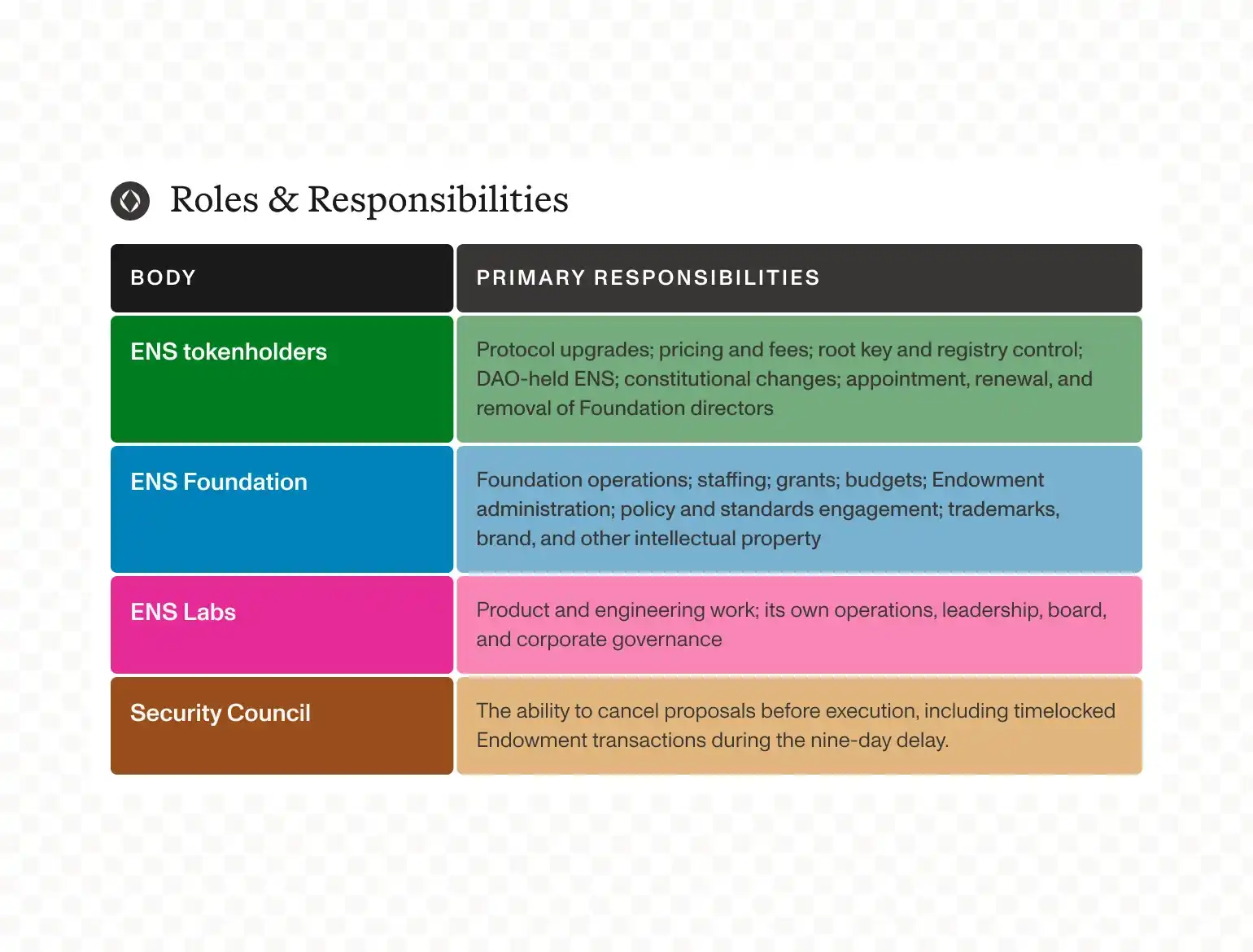
ENS Labs continues to lead core development of the ENS protocol, which is governed by token holders. Token holders also oversee the institutions representing them, including through the power to appoint or remove Foundation directors. The Foundation handles the off-chain work necessary to support the protocol, with its board responsible for overseeing operations and ensuring sustainable funding for ecosystem contributors, including ENS Labs. ENS Labs, the DAO, and the Foundation play different but complementary roles, aligned around the long-term stewardship of ENS. This symbiotic relationship makes ENS stronger while helping the on-chain protocol remain credibly neutral.

Foundation Board of Directors

The inaugural five-member board of the Foundation consists of:

  • Alexander Urbelis, Executive Director. Career spans cybersecurity law, DNS threat intelligence, and policy: former General Counsel & Chief Information Security Officer at ENS Labs, former Chief Information Security Officer at the NFL, former Chief Compliance Officer at Richemont.
  • Nick Johnson, Director. Founder of ENS, CEO of ENS Labs, previously at the Ethereum Foundation and Google.
  • Kartik Talwar, Independent Director. General Partner at A.Capital Ventures, Co-founder of ETHGlobal.
  • Brett Sun, Independent Director. Co-founder of Prelude, previously led technical work at Aragon, including early ENS integration AragonID.
  • Anthony Leutenegger, Independent Director. CEO of Aragon, a key ENS integrator, and also a delegate for Lido and Morpho.

Independent directors serve two-year terms, renewable by token holders. Each director brings distinct experience needed by ENS in this first term.

What Happens Next

Existing commitments will continue according to their agreed terms: stewards, active funding streams, grants, and current term commitments will persist. The Foundation will work with relevant parties to develop transition plans for grant programs, SPP3, and the current working group structure. Foundation positions will be publicly posted as staffing needs become clear.

With the proposal executed, the Foundation can begin fulfilling its approved operational, financial, policy, and institutional responsibilities. ENS Labs will continue to operate under its own management and governance, building ENSv2 and the products and infrastructure supporting the ENS protocol, while token holders retain control over protocol decisions and oversight of Foundation directors.

ENS aims to demonstrate that critical internet infrastructure can be credibly neutral, publicly governed, and outlast any single company. The complete governance record can be viewed in the executable proposal, on-chain votes, and execution transactions.

Criptomoedas em alta

Perguntas relacionadas

QWhat is the primary purpose of establishing the ENS Foundation as a legal entity?

ATo formally represent the ENS protocol in institutional settings, enabling it to engage in regulatory discussions, standard-setting organizations (like ICANN, IETF, W3C), and negotiate for the .ens top-level domain, which the DAO itself lacked the legal and operational capacity to do.

QHow does the new governance structure ensure that ENS token holders retain ultimate control over the protocol and the Foundation?

AToken holders control the core protocol contracts, treasury, and pricing via the DAO. They also have the power to appoint or remove the Foundation's Board of Directors. A 9-day timelock and the ENS Security Committee provide oversight for treasury transactions, and the Foundation must operate under a publicly approved budget with transparent financial reporting.

QWhat specific new capabilities does the ENS Foundation gain that the ENS DAO or ENS Labs could not previously perform?

AThe Foundation can now: 1) Actively participate in standard-setting bodies like ICANN to pursue the .ens TLD. 2) Engage directly with regulators and policymakers. 3) Hold and defend ENS trademarks and intellectual property against scams. 4) Hire full-time employees for operations and grant management. 5) Serve as a legal counterparty for courts, registries, and other institutions.

QWhat is the relationship between the ENS Foundation, ENS Labs, and the ENS DAO according to the new proposal?

AThey are three independent but complementary entities aligned around protecting and extending the ENS protocol. ENS Labs focuses on core protocol development (like ENSv2). The ENS DAO, governed by token holders, controls the protocol and treasury. The Foundation handles off-chain institutional representation and operations, overseen by a Board appointed by the DAO. The Foundation does not own or govern Labs.

QHow are the assets of the ENS DAO's endowment fund managed under the new structure, and what safeguards are in place?

AThe endowment fund, funded by .eth registration fees, remains under DAO control. Transactions now require a 9-day timelock, during which the ENS Security Committee can cancel any transaction deemed outside the Foundation's mandate. The Foundation spends only according to its publicly approved budget and undergoes annual audits and quarterly reporting.

Leituras Relacionadas

Securitize's First Post-IPO Financial Report Bombshell: Is the 'Compliant Tokenization' Narrative Failing to Sell?

Securitize, a tokenization platform, released its first earnings report since going public in July 2026, revealing disappointing Q2 results. Revenue fell 5% year-over-year to $14.43 million, missing estimates, while the net loss widened significantly to $21.68 million. Despite achieving record tokenized assets under management of $4.3 billion and a 147% surge in platform trading volume, overall assets under administration declined by 20%. The company's stock (SECZ) dropped over 20% in after-hours trading following the report. The article highlights a key concern: Securitize's revenue declined despite substantial trading growth, suggesting either compressed fees or an unclear business model. While Securitize maintains its focus on regulatory compliance—securing key partnerships with entities like Computershare and NYSE, and obtaining an SEC investment advisor registration—its tangible progress in the new tokenized stock business has been slow. Apart from tokenizing its own stock (SECZ) upon listing, it has not launched other tokenized equities. Analysts note that SECZ's high on-chain market capitalization is misleading, as it resulted from a one-time distribution to shareholders rather than organic investor demand. The market's patience is waning as investors prioritize real business metrics like market share and user adoption over the "compliant tokenization" narrative. Securitize's market value has fallen 36% from its debut, reflecting growing concerns over its shrinking revenue and the delayed execution of its tokenized stock initiatives.

Odaily星球日报Há 4m

Securitize's First Post-IPO Financial Report Bombshell: Is the 'Compliant Tokenization' Narrative Failing to Sell?

Odaily星球日报Há 4m

Why Every Investor Needs to Pay Attention to the Federal Reserve

Why Every Investor Should Follow the Federal Reserve Key developments on August 12, 2026, demonstrate how crucial the Fed is. Following the CPI report that matched expectations, markets instantly repriced stocks, bonds, and currencies, adjusting the probability of a September Fed rate hike. The Federal Reserve controls the federal funds rate, the anchor for all borrowing costs. Its "dual mandate" is to maintain stable prices and maximum employment. The current policy rate is 3.50%-3.75% after a series of cuts from 2024-2025. Understanding Fed actions is vital for your portfolio: - **Rate Hikes:** Slow the economy to fight inflation. They pressure growth/tech stocks (due to higher discount rates) and lower bond prices but can initially benefit banks. - **Rate Cuts:** Stimulate the economy. They typically boost growth stocks and bond prices while lowering borrowing costs for consumers and businesses. - **Holding Steady:** Still impactful. Current restrictive policy, with positive real interest rates, continues to weigh on the economy. Market-moving signals now come more from economic data than official guidance. A key change is new Fed Chair Kevin Warsh, who has reduced forward guidance, making each data release (CPI, PCE, jobs reports, GDP) more critical for predicting Fed moves. In this environment, investors should track key reports, compare data to market expectations, and understand what is already "priced in." The focus now is on the September 15-16 FOMC meeting. The August CPI (due Sep 11) and jobs report (Sep 5) will be decisive. Ultimately, interest rates are a powerful, continuous force on all assets. Learning to interpret the data that drives Fed policy is an essential skill for navigating today's markets.

marsbitHá 8m

Why Every Investor Needs to Pay Attention to the Federal Reserve

marsbitHá 8m

MicroStrategy Sells BTC Without a Price Drop, Is STRC's Rebound Truly Good News?

The cryptocurrency market is currently experiencing extreme quiet, with BTC weekly trading volume at its lowest since 2023 and implied volatility hitting bottom. Liquidity is thin, as evidenced by a muted price reaction to CPI data. The market's primary issue is a lack of active participants, not just news. Options data shows traders are pricing in higher short-term downside risks. Market makers' gamma positioning suggests a critical support zone between $61,000 and $60,000; a break below could accelerate a downturn. Two developments are being interpreted bullishly: MicroStrategy (MSTR) selling a small portion of its BTC without causing a price crash, and the rebound of its preferred shares (STRC) from lows near $73 to over $95. However, an alternative bearish interpretation exists. The low liquidity means large entities cannot exit sizable positions easily. A STRK recovery towards $100 could provide the buying pressure these sellers need to finally offload BTC, making the apparent利好 (positive news) actually improve selling conditions. STRC faces a structural ceiling at $100 because MSTR has signaled it will issue new shares around that price, capping upside and inviting short sellers. While recent buybacks boosted the price, they haven't solved this core problem. If STRK cannot sustainably break $100, concerns will grow about MSTR needing to sell BTC for funding. Finally, the Bitfinex Long positions indicator, which typically moves inversely to BTC price, has become ineffective and flat-lined near multi-year lows, offering no directional signal. Large traders are not accumulating on dips as they once did.

marsbitHá 9m

MicroStrategy Sells BTC Without a Price Drop, Is STRC's Rebound Truly Good News?

marsbitHá 9m

Silicon Valley Tech Giants No Longer Need Ethicists

Silicon Valley tech giants are once again sidelining ethicists. Chloé Bakalar, OpenAI's dedicated AI Ethics Lead, left the company in July, a departure emblematic of a broader trend where ethics teams are being disbanded or marginalized in the race for AI dominance. Bakalar's career highlights the tensions between ethical governance and commercial speed. She first made her mark at Meta (formerly Facebook), where she pioneered "embedded ethics," developing tools like checklists to translate abstract principles like fairness and transparency into concrete engineering steps. Her framework aimed to embed ethical considerations throughout a product’s lifecycle—from initial design and data handling to user interaction and deployment. However, this approach faced significant internal resistance. At Meta, her Responsible AI team was eventually disbanded as the company prioritized rapid development, especially in the generative AI race with OpenAI. Bakalar then joined OpenAI in 2025, hoping to influence cutting-edge model development directly. Yet, as the company's sole dedicated ethicist, she reportedly struggled with limited influence and resources amidst intense commercial pressures, leading to her departure after roughly a year. Her exit is not isolated. Similar patterns have emerged across Silicon Valley, with ethics and safety teams at Twitter (post-Musk acquisition) and OpenAI's own "superalignment" team being dissolved. These departures reveal five core, unresolved tensions: 1) the fatal conflict between commercialization speed and ethical caution; 2) the role mismatch where ethicists have prestige but little real decision-making power; 3) the dilution of responsibility when ethics is decentralized as "everyone's job"; 4) the inevitable "translation loss" when complex philosophical values are reduced to quantifiable engineering metrics; and 5) the fundamental clash between academic independence and corporate secrecy. Bakalar’s trajectory suggests that embedding meaningful ethical oversight within hyper-competitive tech companies is profoundly difficult. Lasting change may require external regulatory pressure, like the EU's AI Act, or a fundamental reimagining of the ethicist's role from an internal auditor to a cross-disciplinary builder with genuine authority.

marsbitHá 38m

Silicon Valley Tech Giants No Longer Need Ethicists

marsbitHá 38m

Trading

Spot

Artigos em Destaque

Como comprar ENS

Bem-vindo à HTX.com!Tornámos a compra de Ethereum Name Service (ENS) simples e conveniente.Segue o nosso guia passo a passo para iniciar a tua jornada no mundo das criptos.Passo 1: cria a tua conta HTXUtiliza o teu e-mail ou número de telefone para te inscreveres numa conta gratuita na HTX.Desfruta de um processo de inscrição sem complicações e desbloqueia todas as funcionalidades.Obter a minha contaPasso 2: vai para Comprar Cripto e escolhe o teu método de pagamentoCartão de crédito/débito: usa o teu visa ou mastercard para comprar Ethereum Name Service (ENS) instantaneamente.Saldo: usa os fundos da tua conta HTX para transacionar sem problemas.Terceiros: adicionamos métodos de pagamento populares, como Google Pay e Apple Pay, para aumentar a conveniência.P2P: transaciona diretamente com outros utilizadores na HTX.Mercado de balcão (OTC): oferecemos serviços personalizados e taxas de câmbio competitivas para os traders.Passo 3: armazena teu Ethereum Name Service (ENS)Depois de comprar o teu Ethereum Name Service (ENS), armazena-o na tua conta HTX.Alternativamente, podes enviá-lo para outro lugar através de transferência blockchain ou usá-lo para transacionar outras criptomoedas.Passo 4: transaciona Ethereum Name Service (ENS)Transaciona facilmente Ethereum Name Service (ENS) no mercado à vista da HTX.Acede simplesmente à tua conta, seleciona o teu par de trading, executa as tuas transações e monitoriza em tempo real.Oferecemos uma experiência de fácil utilização tanto para principiantes como para traders experientes.

357 Visualizações TotaisPublicado em {updateTime}Atualizado em 2026.06.02

Como comprar ENS

Discussões

Bem-vindo à Comunidade HTX. Aqui, pode manter-se informado sobre os mais recentes desenvolvimentos da plataforma e obter acesso a análises profissionais de mercado. As opiniões dos utilizadores sobre o preço de ENS (ENS) são apresentadas abaixo.

活动图片