Coinbase and Ripple CEOs Join CFTC Advisory Panel Overseeing Digital Assets

TheNewsCryptoPublicado em 2026-02-13Última atualização em 2026-02-13

Resumo

The U.S. Commodity Futures Trading Commission (CFTC) has formed a new advisory committee focused on digital assets, appointing key industry leaders including Coinbase CEO Brian Armstrong and Ripple CEO Brad Garlinghouse. The committee, established under the Digital Commodities Consumer Protection Act, will provide expertise on regulatory and market developments. It includes representatives from crypto exchanges, stablecoin issuers, derivatives desks, and blockchain firms. The group will meet at least four times in 2026 to address issues like compliance, risk management, market transparency, and regulatory coordination. Their input will help shape future CFTC rules and oversight approaches for digital asset markets.

The United States Commodity Futures Trading Commission announced appointments to a new committee that would provide advice on regulatory and industry developments regarding digital assets. Coinbase CEO Brian Armstrong confirmed his position as a member of the committee representing crypto exchange interests. The advisory committee also has Ripple CEO Brad Garlinghouse as a member, offering information from a prominent payments blockchain company. The committee has various members representing companies in digital assets, finance, and blockchain technology. The committee also has members from a company that issues a stablecoin and a derivatives desk manager.

CFTC Chairman Rostin Behnam stated the committee would assist in helping regulators grasp the intricacies of the digital market. The members would contribute their expertise and knowledge from the digital asset marketplace. This advisory committee would meet at least four times in 2026 to discuss the problems regulators face in their work. The CFTC formed the committee through the Digital Commodities Consumer Protection Act’s powers. They would concentrate their focus on market issues such as compliance and risk management.
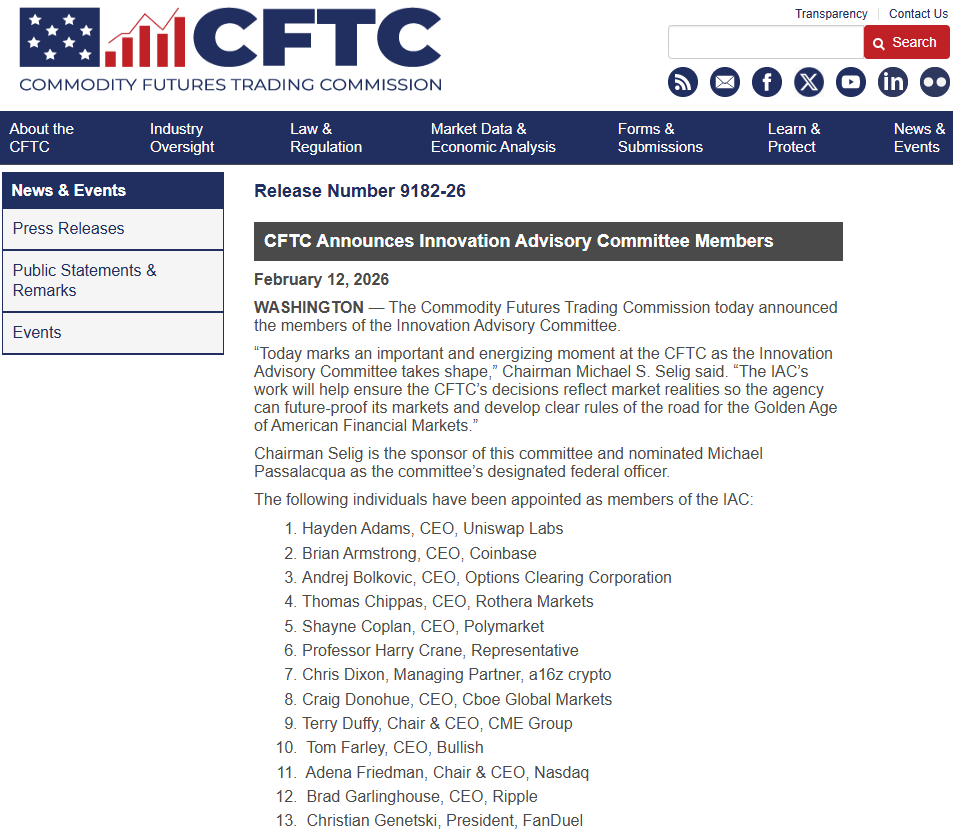
The committee has executives from companies such as Paxos, Cumberland, Galaxy Digital, among other companies. A representative of the stablecoin issuer has knowledge of liquidity and a framework for redemption. The diversity of the group is evident since there is knowledge on trading platforms, derivatives exchanges, and blockchain operations. The members of the CFTC’s advisory panel are compliance experts and know legal issues. The committee has experts from fintech and blockchain-based think tanks. The experts know derivatives exchanges, clearing operations, and blockchain operations.

Committee Aims and Regulatory Role

The Advisory Group will review options for enhancing digital asset markets under U.S. laws. The members will be able to review the risk issues faced by participants in the digital markets, whether retail or institutional. The members will also give opinions on compliance issues faced and law enforcement. The panel may also discuss transparency issues in digital markets in the U.S. The issue of coordination between U.S. regulatory authorities may also come up.

The committee members may assist the CFTC in oversight roles for new technologies. These could involve data infrastructures and market settlement systems. The contributions from the members to the CFTC may shape the proposals for future rules set forth by the agency.

Highlighted Crypto News:

U.S. Bankers Urge OCC to Slow Crypto Trust Bank Charters

TagsBlockchainBrad GarlinghouseCFTCCoinbaseCryptocurrencyexchangePaxosRipple

Perguntas relacionadas

QWho are the two prominent CEOs appointed to the CFTC's new advisory committee for digital assets?

ACoinbase CEO Brian Armstrong and Ripple CEO Brad Garlinghouse.

QWhat is the primary purpose of the CFTC's newly formed advisory committee?

ATo provide advice on regulatory and industry developments regarding digital assets and assist regulators in grasping the intricacies of the digital market.

QHow many times is the advisory committee scheduled to meet in 2026?

AAt least four times.

QWhich act granted the CFTC the power to form this digital assets advisory committee?

AThe Digital Commodities Consumer Protection Act.

QBesides crypto exchanges, what other types of companies are represented on the committee?

AA stablecoin issuer, a derivatives desk manager, fintech companies, blockchain-based think tanks, and companies like Paxos, Cumberland, and Galaxy Digital.

Leituras Relacionadas

A $280 Million Lesson! The 2026 DeFi Security Guide to Avoiding Pitfalls

"DeFi Security Lessons from a $280M Hack: A 2026 Guide to Avoiding Pitfalls" The rapid growth of DeFi has turned it from a niche interest into a mainstream pursuit for high yields. However, this comes with significant risks, highlighted by a major attack on Solana's Drift Protocol in April 2026, resulting in losses between $220-$285 million. This event underscores that in DeFi, users bear full responsibility for their assets. Most losses occur during normal operations through common vulnerabilities: 1. **Excessive Token Approvals**: Granting unlimited contract permissions can lead to complete asset drainage. 2. **Phishing Websites**: Fake sites mimic legitimate projects to steal wallet credentials. 3. **Contract Exploits**: Code vulnerabilities allow hackers to legally drain funds. 4. **Rug Pulls**: Malicious projects withdraw liquidity, causing tokens to crash. The guide outlines five essential pre-interaction checks: 1. **Contract Security**: Verify contracts are open-source and audited by firms like CertiK. Avoid unaudited or newly deployed contracts. 2. **Authorization Management**: Avoid unlimited approvals; use minimal permissions and regularly revoke unused allowances via tools like revoke.cash. 3. **Official Access Points**: Bookmark official sites from trusted sources (e.g., project Twitter/Discord) to avoid phishing scams, which cause over 60% of losses. 4. **Abnormal Yields**: Extreme APYs (e.g., stablecoins >20%) often signal scams. Compare rates to established protocols like Aave. 5. **Asset Segregation**: Use a multi-wallet system (hot, DeFi, cold) to isolate assets and prevent total loss from a single breach. Additional risks include insider threats from developers or employees with privileged access. Psychological biases (e.g., FOMO) and AI-powered phishing make users susceptible. Core principles: never grant unlimited approvals, avoid unknown links, and diversify investments. Security is not optional but a fundamental requirement in DeFi.

marsbitHá 1h

A $280 Million Lesson! The 2026 DeFi Security Guide to Avoiding Pitfalls

marsbitHá 1h

Trading

Spot
Futuros
活动图片