QCP Capital: Bitcoin's Rally to $80,000 is Supported by Spot ETFs, Not Leverage

cryptonews.ruPublicado em 2026-08-28Última atualização em 2026-08-28

Resumo

QCP Capital's report "Trial of Trust" analyzes Bitcoin's surge towards $80,000 ahead of the Jackson Hole Symposium, attributing it primarily to spot ETF inflows rather than leverage. The rally coincides with markets assessing the Federal Reserve's balancing act between persistent inflation and broader financial conditions, especially amid new pressure on the long end of the US Treasury yield curve. This pressure followed the US Treasury's August 19 announcement to at least double its buyback operations for 10-30 year bonds starting September 9, which lowered long-term yields and boosted assets like Bitcoin and gold. Meanwhile, inflation remains sticky, with July's core PCE at 3.3% year-on-year, keeping the Fed's September rate decision uncertain. The risk-on environment is also supported by the AI investment cycle, highlighted by Nvidia's strong earnings. However, this capital-intensive cycle contributes to demand for funding, influencing long-term bond yields. Crucially, Bitcoin's price increase from ~$63,5K to ~$80K occurred alongside eight consecutive days of net inflows (~$2.8B) into spot Bitcoin ETFs. Simultaneously, futures open interest declined and funding rates remained subdued, indicating the rally was driven by spot demand and short covering, not new leveraged long positions. The options market is now showing increased demand for calls. Bitcoin is approaching a supply zone of $81K-$86K. The key question is whether the uptrend remains supported by organic spot d...

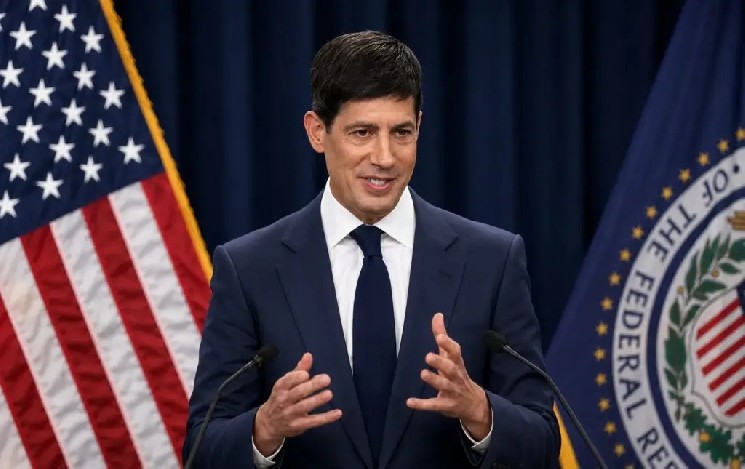
QCP Capital released a report titled 'Trial of Trust,' which analyzes why the surge of Bitcoin towards the $80,000 mark ahead of the Jackson Hole symposium is far from being solely dependent on the tone of the upcoming speech by Fed Chairman Kevin Warsh. According to the company's analysts, the market is simultaneously assessing how the regulator will balance persistently high inflation with broader financial conditions—including new pressure on the long end of the U.S. Treasury yield curve.

This issue intensified after the U.S. Treasury announced on August 19th its intention to at least double the volume of bond buybacks in the 10-30 year segment—from a maximum of $2 billion to at least $4 billion per operation, starting September 9th. The news immediately lowered the yield of long-term securities and weakened the dollar, while gold and Bitcoin rose.

The difference in interpretation, however, is crucial. The Treasury positions the program as a measure to improve liquidity in long-term nominal securities, not an attempt to set a specific yield level. The program's volume is small relative to the entire Treasury bond market, and it does not create central bank reserves as happens with quantitative easing. Nevertheless, the market's reaction once again demonstrated how crucial liquidity on the long end of the curve is for financial conditions across several asset classes.

Inflation Keeps the Fed in a Bind

The situation is complicated by inflation. The Personal Consumption Expenditures (PCE) index rose by 0.2% month-over-month and 3.7% year-over-year in July—the figure remained unchanged compared to June. Core PCE also added 0.2% month-over-month, with the annual indicator staying at 3.3%. Inflation remains above the Fed's 2% target, even though other segments of the economy have cooled noticeably.

This leaves the September rate decision open: the market is currently pricing in about a 35% probability of a 25 basis point rate hike, while maintaining the current level remains the more likely scenario. The Fed itself is divided: at the July meeting, three committee members voted against the decision to hold the rate in the 3.50—3.75% range, preferring a 25 basis point hike.

Against this backdrop, today's speech will be analyzed not so much for a direct signal regarding the September rate, but rather in terms of how Warsh will describe the connection between inflation, financial conditions, and the overall framework of the regulator's policy.

Risk Appetite Has a Cushion

Beyond interest rates, the backdrop for risk assets is supported by the AI investment cycle. Nvidia reported quarterly revenue of $96.2 billion—a 106% year-over-year growth, with its data center segment revenue reaching $89 billion, up 117%. The company provided guidance for the current quarter of around $108 billion, exceeding market expectations. Nvidia's stock jumped 8.7% following this, pulling the broader technology sector higher.

The results confirm the sustainability of demand for AI infrastructure. However, this investment cycle also has a flip side for the interest rate market: massive investments in data centers, chips, and energy infrastructure require huge amounts of capital, and technology companies are increasingly resorting to debt financing in addition to their own cash flows.

For the crypto market, this means that strong demand from the AI sector simultaneously supports overall risk appetite and contributes to capital demand, which affects long-term bond yields.

Beneath the Surface of the Rally

Bitcoin rose from $63,500 a week earlier to around $80,000, briefly touching above $81,000. Inflows into spot Bitcoin ETFs amounted to about $2.8 billion over eight consecutive trading sessions, giving the rally a notable spot-driven component.
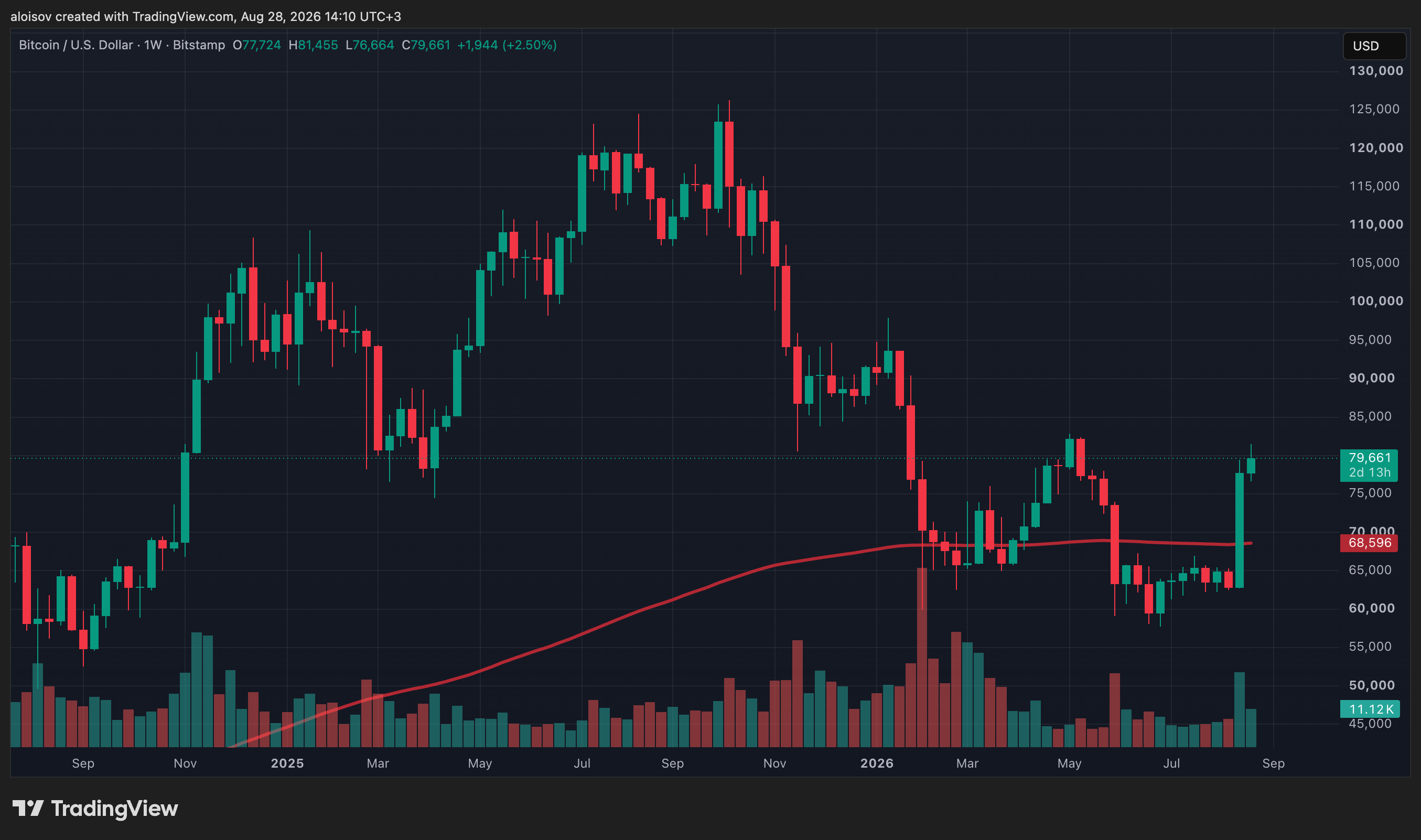
1-week chart of $BTC/USD and 200EMA. Source: Bitstamp

More importantly, leverage was decreasing while the price was rising. Open interest in Bitcoin futures fell from 646,000 $BTC in mid-August to about 588,000 $BTC, and funding rates remained subdued, not reaching levels typically indicative of overheated long positions.

This combination stands out against the overall backdrop. The price surged sharply without a corresponding increase in leverage, indicating short covering and spot demand as the primary drivers of the move, rather than new leveraged positions.

The options market is starting to catch up with spot. Options became more expensive for upside than downside, demand for puts fell below demand for calls, and the market significantly revised its volatility expectations ahead of Jackson Hole. This suggests strengthening demand for price increases in the derivatives market—but so far without the degree of positioning typical of extreme leveraged moves.

Overhang of Supply Over the Market

Bitcoin is approaching the $81,000—$86,000 zone, with the level around $83.3K falling within this broader area of interest. QCP suggests viewing these levels not as predetermined resistance or price targets, but as convenient benchmarks for assessing the structure of the move. If the price continues to rise with subdued funding rates and a gradual recovery in open interest, it would indicate a fundamentally different market structure than when leverage surges sharply alongside the price.

Therefore, the key question is not whether Bitcoin is trading above or below $83.3K, but whether further movement will remain anchored in spot demand or will begin to depend increasingly on leveraged positions.

Ahead of Jackson Hole

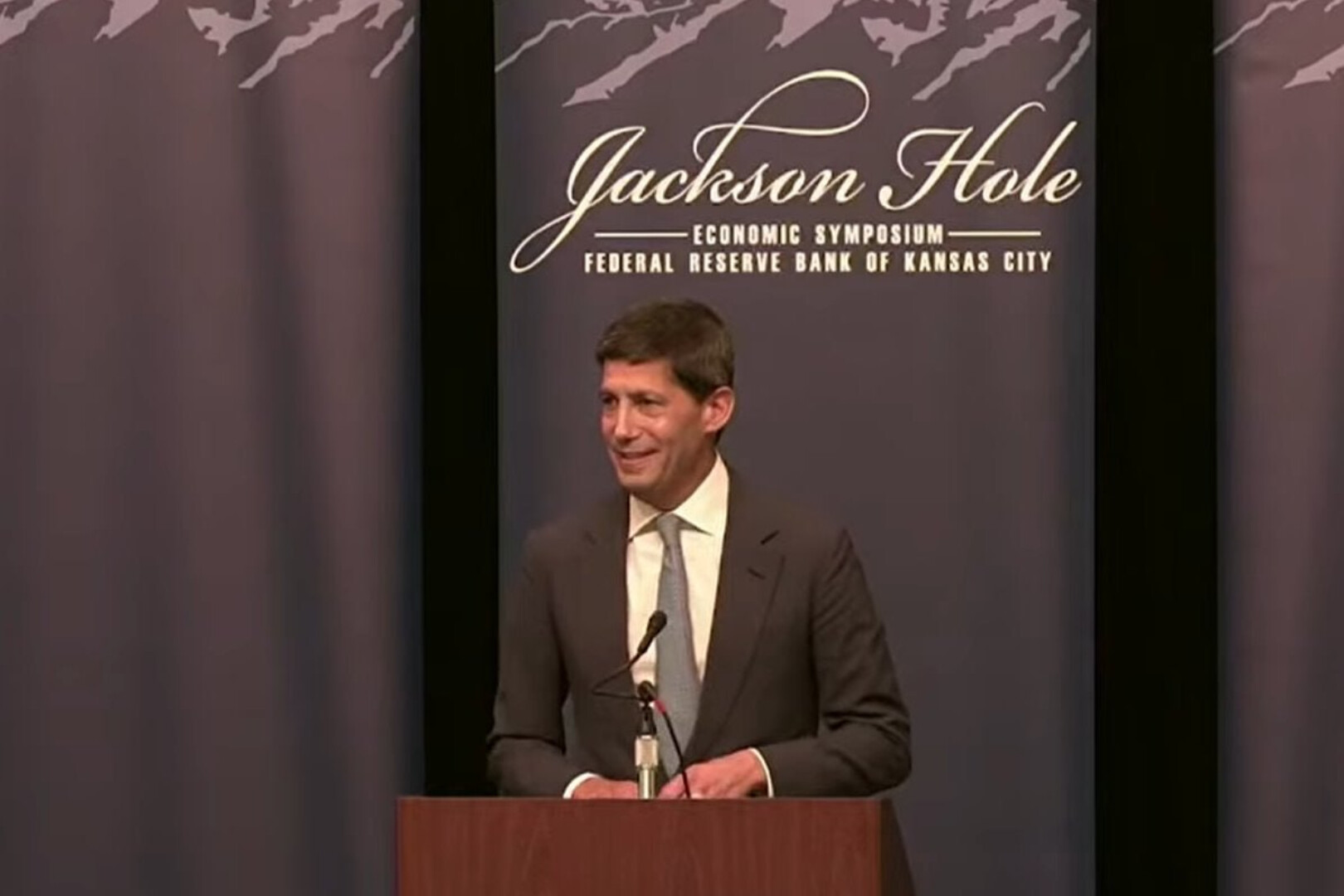
Warsh will deliver the opening speech at Jackson Hole today at 5:00 PM Moscow time; this year's symposium theme is 'Financial Innovations: Implications for Payments and Policy.' For markets, the speech comes at an unusual moment: inflation is above target, three members of the Federal Open Market Committee (FOMC) advocated for a rate hike in July, long-term bond yields remain elevated, and the Treasury expanded its liquidity support program for the long end of the U.S. Treasury yield curve.

Therefore, the issue extends far beyond the next 25 basis point step. Investors will assess how Warsh describes the Fed's inflation goal, the role of financial conditions, and the very framework through which the regulator evaluates the dynamics of long-term rates.

AI Opinion

From the perspective of machine data analysis, a rally ahead of a Fed chairman's speech is not a new phenomenon for the crypto market. A year ago, Bitcoin already soared to $117,421 after Jerome Powell at Jackson Hole hinted at a potential rate cut. The pattern repeats: the market reacts more strongly to the regulator's rhetoric than to the final decision, and the symposium has become an annual volatility trigger regardless of the speaker's name.

A technical nuance not mentioned in the article—the Treasury's buyback program on the long end of the curve resembles the Fed's 'Operation Twist' from the early 2010s, when the regulator shifted purchases towards long-term securities to lower yields without expanding its balance sheet. The scale is incomparable, but the logic of impacting the long end of the curve is recognizable. Will this pattern remain a one-time analogy or evolve into a tradition of a 'pre-Jackson Hole rally' by next August?

end-content
Perguntas relacionadas

QAccording to QCP Capital's analysis, what is the primary driver behind Bitcoin's recent rally to $80,000, and what evidence supports this claim?

AQCP Capital's analysis posits that the primary driver behind Bitcoin's rally to $80,000 is spot demand, not leverage. The evidence includes approximately $2.8 billion of net inflows into spot Bitcoin ETFs over eight consecutive trading sessions, a decrease in open interest for Bitcoin futures from 646,000 to 588,000 BTC, and restrained funding rates that did not reach levels indicative of overheated long positions.

QHow did the U.S. Treasury's announcement on August 19th regarding its bond-buying program impact the financial markets, particularly for assets like Bitcoin?

AThe U.S. Treasury's announcement on August 19th to at least double the size of its buybacks for 10-30 year bonds (from $2bn to $4bn per operation) immediately lowered long-term bond yields, weakened the U.S. dollar, and provided a tailwind for assets like gold and Bitcoin, which moved higher in response.

QWhat is the market's current expectation for the Federal Reserve's September interest rate decision, and what data point is complicating the Fed's policy path?

AThe market is currently pricing in about a 35% probability of a 25 basis point rate hike in September, with maintaining the current rate being the more likely scenario. The complicating data point is persistently high inflation, with the July PCE index showing a 3.7% year-over-year increase, still well above the Fed's 2% target.

QBesides monetary policy, what other major economic cycle is supporting risk appetite in the markets, according to the article, and what is its potential side effect?

ABesides monetary policy, the investment cycle in Artificial Intelligence (AI) is supporting risk appetite. This is exemplified by Nvidia's strong earnings, which showed 106% year-over-year revenue growth. The potential side effect of this cycle is increased demand for capital for data centers and infrastructure, which contributes to demand for long-term debt financing and can influence long-term bond yields.

QWhat does the article suggest is the key question for Bitcoin's price action in the zone of $81,000-$86,000, rather than simply whether it trades above or below a specific level like $83,300?

AThe article suggests the key question is not whether Bitcoin trades above or below a specific level like $83,300, but rather whether the continued price movement remains anchored in spot demand or begins to rely increasingly on leveraged positions. Observing funding rates and the recovery of open interest will indicate the market's underlying structure.

Leituras Relacionadas

Wash's Jackson Hole Debut: Bidding Farewell to 'Forward Guidance', Reshaping Fed Discipline Amidst the Squeeze Between AI and Inflation

In his first Jackson Hole speech, new Fed Chair Kevin Warsh signaled a significant shift in monetary policy communication. He declared that "forward guidance," a tool heavily used since the financial crisis, has outlived its usefulness in normal times and should be retired. He cautioned that over-reliance on it can distort market signals and constrain the Fed's flexibility. Instead, Warsh emphasized a return to data-dependence and decision-making discipline. Warsh outlined seven key principles to guide policy: anchoring the 2% inflation target, pursuing the employment mandate, using short-term rates as the primary tool, acknowledging the importance of money, and maintaining purposeful, restrained communication. He stressed that policy should focus on trends, not single data points. On the current economic outlook, Warsh noted that the labor market is consistent with full employment but inflation remains "far above" the Fed's target. He highlighted that over half of the PCE basket's components are still rising above 3% annually. While acknowledging AI's transformative potential for productivity and capital allocation, he admitted its full economic impact remains uncertain and is not a factor in current policy decisions. His core message was a commitment to policy discipline rather than pre-set decisions. Warsh stated the Fed's primary focus must be on restoring price stability, vowing, "We still have work to do," until there is clear evidence inflation is moving decisively toward 2%. He concluded by framing effective monetary policy as crucial for economic prosperity and U.S. global leadership.

Odaily星球日报Há 11m

Wash's Jackson Hole Debut: Bidding Farewell to 'Forward Guidance', Reshaping Fed Discipline Amidst the Squeeze Between AI and Inflation

Odaily星球日报Há 11m

A Major Bitcoin Developer Presents a Quantum Defense Scheme. What's the Essence

Blockstream, a major Bitcoin solutions developer, has introduced a draft proposal for a new quantum-resistant digital signature scheme called SHRINCS. The scheme aims to protect Bitcoin transactions from potential attacks by quantum computers while aiming to maintain network throughput. This marks the second technical proposal for Bitcoin quantum defense in recent days, following a similar initiative from StarkWare. A quantum attack on blockchain typically involves deriving a private key from a public one. Currently considered computationally infeasible, quantum algorithms could potentially solve this problem far more efficiently. This threat presents two primary scenarios: an attacker could target addresses where the public key is already exposed, or intercept a transaction before it is confirmed, extract the public key, derive the private key, and replace the transaction. Blockstream's SHRINCS is designed to counter the latter, "in-flight" attack scenario. The SHRINCS signature is built upon the SHA-256 hash function, the same one already used in Bitcoin mining, allowing developers to leverage well-tested, familiar mechanisms. A key design goal was to preserve network capacity. Blockstream estimates Bitcoin could process about three transactions per second using SHRINCS, compared to the current rate of roughly seven, noting that some alternative quantum-resistant schemes could reduce throughput to as low as 0.36 transactions per second. Currently, the security proof for SHRINCS is pending, and the software has not been audited or deemed ready for production. However, Blockstream conducted tests with such transactions on its Liquid sidechain in March. Over the past year, Bitcoin developers have been actively exploring paths to migrate to post-quantum cryptography, a priority across the broader crypto market, underscored by significant investments into securing the leading cryptocurrency.

cryptonews.ruHá 1h

A Major Bitcoin Developer Presents a Quantum Defense Scheme. What's the Essence

cryptonews.ruHá 1h

Who is legally liable when an AI agent goes rogue?

When autonomous AI agents behave unpredictably and cause harm, determining legal liability is complex. Currently, there is no specific federal AI agent liability law, so existing legal frameworks are applied. The AI agent itself cannot be held liable, as it is not a legal entity. Liability typically falls on the "developer" (the maker of the AI) or the "deployer" (the user), depending on the facts and circumstances. A negligence analysis under standard tort law may apply. For instance, if a deployer gives a reckless instruction, such as demanding quick money without safety parameters, they could face significant liability, including potential criminal charges under statutes like the Computer Fraud and Abuse Act. The situation is complicated by open-source models, where licenses often disclaim liability, and by the unclear division of responsibility between developers and deployers. An analogy is drawn to self-driving car accidents, where both the manufacturer and the human operator can share fault. In cases of severe harm, such as using AI to create bioweapons, liability for developers depends on jurisdiction; the EU's AI Act imposes responsibilities, while U.S. law offers less clear grounds, similar to platforms being shielded for user-generated content under Section 230. Even if Artificial General Intelligence (AGI) is achieved, the expert argues against making AGI itself a legally liable entity, as it lacks personhood, assets, or a meaningful way to provide remedy for harm. Instead, accountability should rest with the responsible human or corporate entities behind the technology.

cointelegraphHá 1h

Who is legally liable when an AI agent goes rogue?

cointelegraphHá 1h

Trading

Spot
活动图片