Clarity Act Outlook: No Yield, No Payment

marsbitPublicado em 2026-05-19Última atualização em 2026-05-19

Resumo

"Clear Act Outlook: No Yield, No Payment" analyzes the evolving U.S. regulatory landscape for stablecoins, focusing on the interplay between the proposed "Clarity Act" and the existing "Genius Act." The article argues that the Genius Act successfully fostered "payment stablecoins" by permitting tokenized assets like U.S. Treasuries as reserves. This created a structured market where stablecoin issuers (like USDC) must hold these reserves, often purchased as Tokenized Money Market Funds (TMMFs) from giants like BlackRock. These TMMFs are primarily B2B products, ensuring user-facing stablecoins remain non-interest-bearing and used primarily for payments. The upcoming Clarity Act is seen as the next phase, aiming to restrict passive yield on stablecoins. Its goal is to dismantle the arbitrage advantage of offshore stablecoins like USDT by redirecting Treasury demand towards compliant, U.S.-sanctioned TMMFs. For on-chain and compliant offshore dollars, this creates new pressure: they must spur adoption and utility to generate yield, as simple Treasury staking may be restricted. This indirectly promotes dollar circulation and sustained Treasury purchases. Ultimately, the analysis posits that U.S. regulation seeks to create a new dollar distribution model. By separating payment function from yield generation and anchoring both to U.S. debt instruments, it aims to embed the dollar and Treasury demand into the global crypto economy, managing yields through sanctioned intermediarie...

Author: Zuo Ye

The Clarity Act is progressing smoothly, with multiple benefits expected mid-year for stablecoins, tokenization, and DeFi development. However, prohibiting passive yield on stablecoins will also cast some uncertainty over the on-chain outlook.

This is not unwarranted anxiety. From ETFs, DAT, to Wall Street's attempts at RWA, the battle for crypto pricing power continues. Compliance often means accepting established frameworks, snuffing out grassroots innovation in the name of stability.

ETFs sacrifice BTCFi, DAT creates systemic crises, RWA rejects existing public chains.

On the surface, the Clarity Act compresses the arbitrage space for offshore dollar stablecoins like $USDT. But in reality, by separating and recombining payment and yield, the US is experimenting with a new model for dollar circulation beyond gold, oil, and credit.

The story of payment stablecoins is basically over; the chapter of yield-bearing stablecoins is about to begin.

Surround on Three Sides, Payment Stablecoins

Setting my heart on money learning pleasure more than Thee.

There has always been a question: How exactly does the Genius Act facilitate the "payment stablecoin" narrative to become reality?

As Wall Street giants lay the groundwork for tokenization on the eve of the Clarity Act's passage, this confusion intensifies. Yes, you heard right—they are laying the groundwork for tokenization business to enable stablecoin yield.

  • On May 8th, besides BUILD, BlackRock plans to launch two new TMMFs (Tokenized Money Market Funds): BSTBL and BRSRV.
  • On May 13th, besides MONY, JPMorgan Chase launched a second TMMF, JLTXX.

Moreover, BlackRock explicitly stated that the new products aim to meet the growing needs of stablecoin issuers, while JPMorgan also emphasized compliance with relevant qualification requirements of the Genius Act.

Examining the text closely, the Genius Act indeed adds provisions for tokenization, allowing tokenized forms of US Treasuries and dollars to serve as stablecoin reserve assets.

This doesn't explain the relationship between stablecoins, tokenization, and payment. We need to explore further.

Under the Genius Act, stablecoin issuance licenses are allocated to the OCC's federal charter bank mechanism. Such banks cannot take deposits, require full reserves, and must not encroach on commercial bank lending business.

In this scenario, policy creates market demand. Stablecoin issuers either build their own reserves—like USDT and USDC frantically buying US Treasuries, surpassing many sovereign nations—or directly purchase RWA assets like TMMFs. This is crucial for stablecoins like USDS/sUSDS that rely on profit-sharing to attract users.

  1. It avoids the complex process of subscribing to and redeeming US Treasuries.
  2. On-chain profit-sharing and real-time yield generation better align with user habits.

According to data from @ElectricCapital, 98% of BlackRock's BUIDL shares were subscribed to by various yield-bearing stablecoin issuers.

And, most ingeniously, retail investors cannot directly purchase tokenized products. Policy shapes the market structure; this is the secret of how the Genius Act creates "payment stablecoins."

An act cannot solely rely on coercive power to make market participants comply; otherwise, USDT wouldn't have remained underground for so many years. Only by following market trends can it achieve significant results with minimal effort.
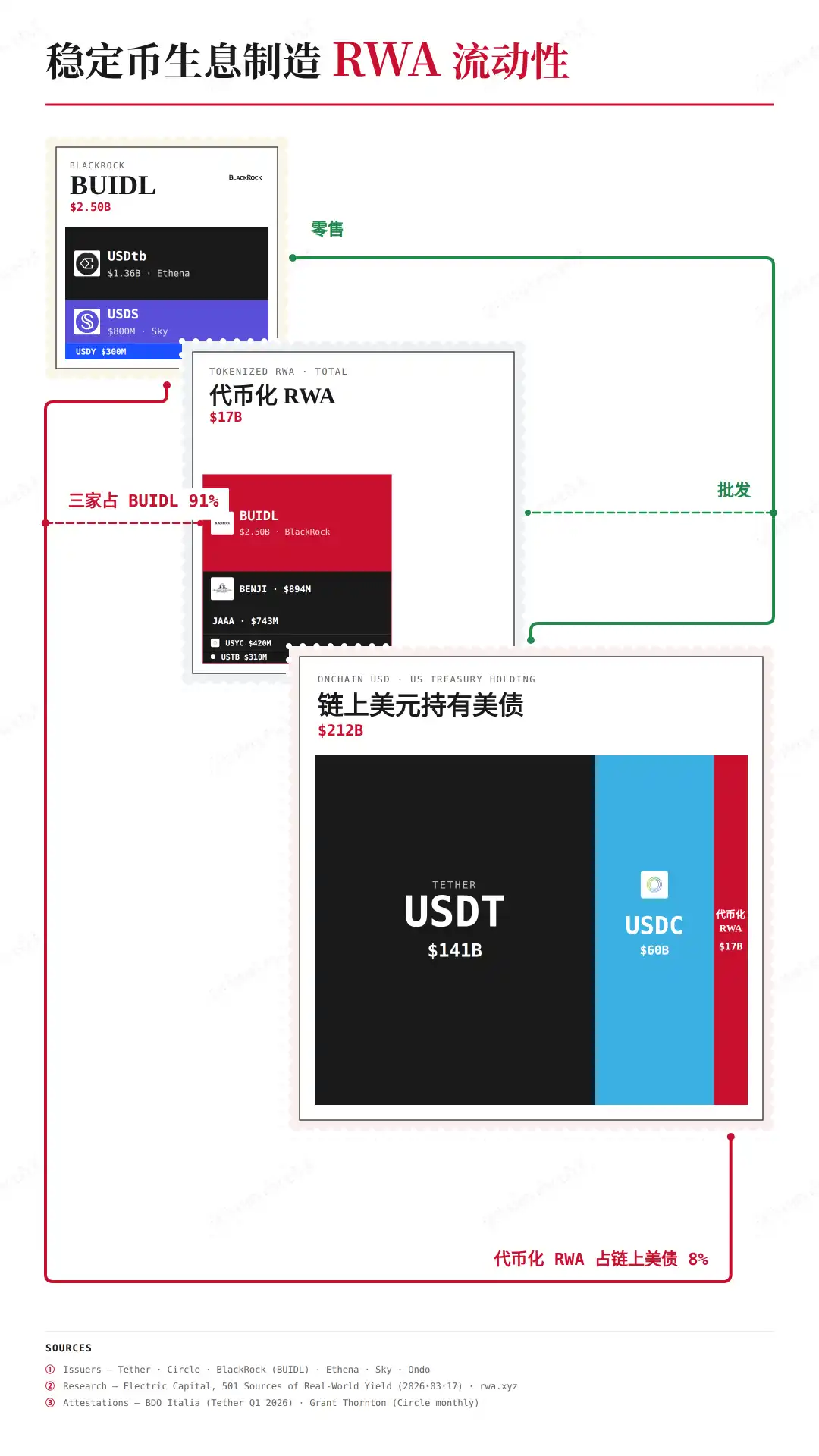
Caption: TMMF Supporting Payment Stablecoins

Data Source: @ElectricCapital

BlackRock's tokenized products, while circulating on-chain, cannot be purchased "permissionlessly" and still require compliance with KYC, accredited investor checks, etc., essentially targeting B2B sales.

You cannot monitor decentralized individual transactions, just as the US government cannot monitor the circulation of physical dollar cash. However, monitoring a few giants is much simpler.

By recognizing tokenized assets, the US cleverly constructs a feasible framework among stablecoin issuers, Wall Street giants, and regulators. The stablecoins users receive can only be used for payment because they cannot generate yield.

A single Genius Act binds stablecoins and tokenization together. This also answers the earlier confusion: it makes stablecoins the retail endpoint layer for US Treasuries.

The previous dollar relied on the commercial banking credit mechanism; the future dollar will rely on the intermediary role of tokenization companies.

Arbitrage Space, Yield-Bearing Stablecoins

Caring for worldly things more than God.

If the Genius Act's recognition of tokenization created payment stablecoins, then the Clarity Act's restrictions on tokenization guide the development of yield-bearing stablecoins.

The importance of yield-bearing lies not in the banking sector's fear of deposit outflows—JPMorgan has difficulty opening accounts, Coinbase has difficulty making money.

Consider this: Under the Clarity Act, if users choose to stake for yield, ideally, the stablecoin issuer's interest can only come from US Treasury products.

But this raises new questions. Issuers of on-chain stablecoins like Sky/Ethena, in a sense, don't need an OCC bank license first. Therefore, new arrangements are needed for yield, especially DeFi yield.

Excessive regulatory costs are the essential reason for Congress's "lenient" arrangements for DeFi development. Beyond that, the dollar needs stablecoins as a distribution channel.
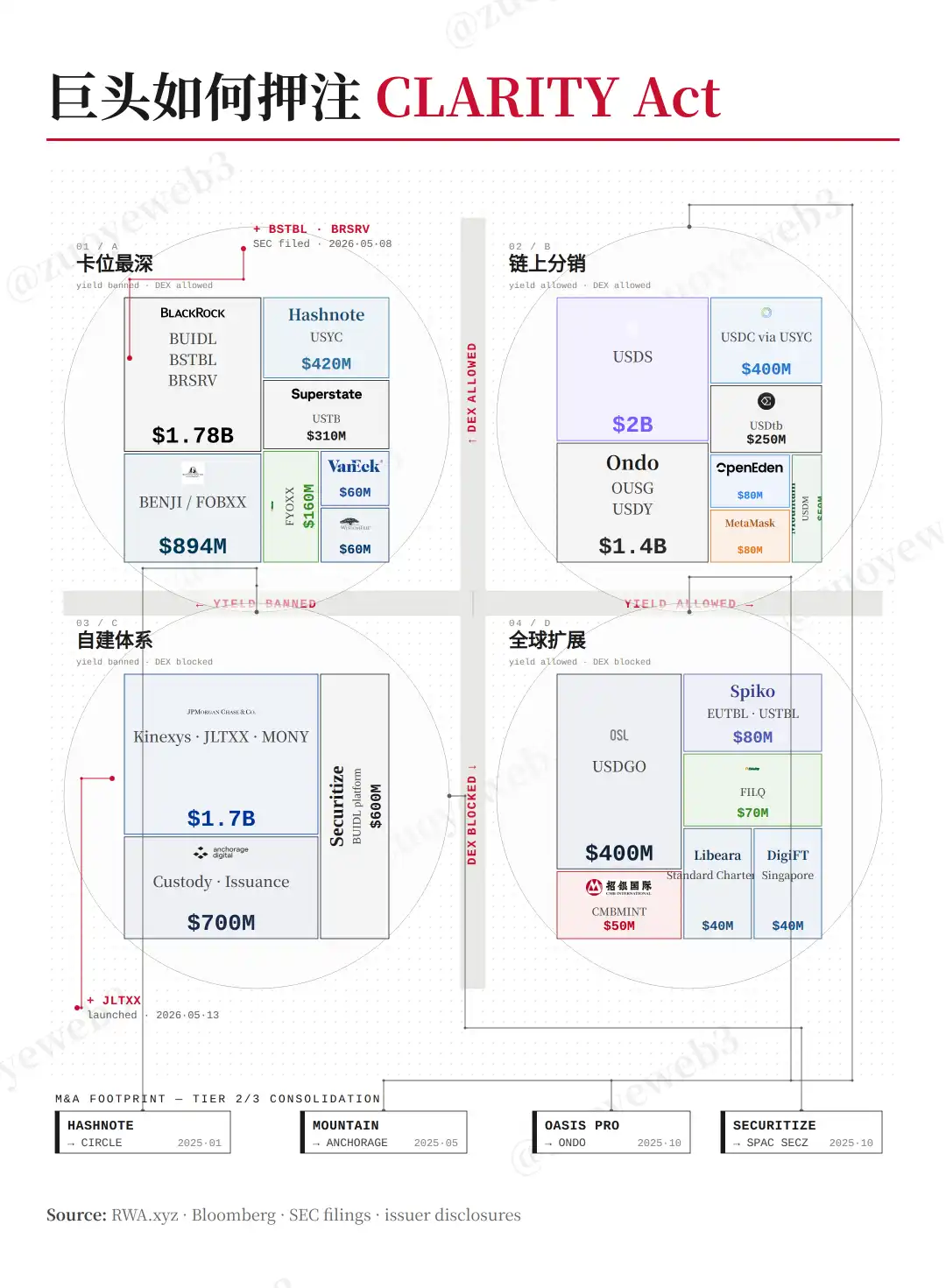
Caption: Giants Rushing into the Clarity Act

Image Source: @zuoyeweb3

This distribution is divided into two major categories: first, the B2B customer acquisition path among giants; second, on-chain and cross-regional C2C arbitrage issuance.

Among giants, the bet is on the strictness of the "ban on passive yield," which also changes the intermediary role. If DeFi is also restricted, consortium chain models may revive; if relatively relaxed, deeper cooperation with on-chain stablecoins is possible.

Furthermore, the giants' intermediary model is hard to bypass. Ondo and others choose to serve as the retail distribution layer for giants, while OSL and others choose the overseas compliant dollar stablecoin track.

Extending further, Sky's inclusion of diversified "RWAs" in USDS reserves is essentially leveraged arbitrage, quietly switching from full reserves to fractional reserves.

A mainstream demand emerging next: How to increase stablecoin yields based on US Treasuries? This requires more complex financial engineering designs, which is where various DeFi yield strategies come into play.

It can be seen that the yield mechanism targets offshore dollar stablecoins like $USDT, aiming to replace their position as Treasury buyers with BlackRock's TMMFs.

For on-chain dollars and compliant offshore dollars, new arbitrage spaces will emerge. They cannot stably earn scaled US Treasury yields and must continuously promote utilization growth, indirectly promoting dollar circulation and stable Treasury purchases.

In this process of tightening and loosening, users will be incentivized to use stablecoins because holding them leads to devaluation. The interest generated from usage flows back into the US financial system because the underlying asset is US Treasuries.

This is the true purpose of the Clarity Act: to create individual demand for the dollar on a global scale. Stablecoin issuance requires US Treasuries, stablecoin yield requires US Treasuries, ultimately completing the cycle.

Conclusion

To transcend the limitations of sovereign states, one must rely on rigid demand like payment.

But to promote the adoption of stablecoins, one must rely on direct mechanisms like yield.

The focus of both the Genius Act and the Clarity Act lies in the intertwining of stablecoins and yield. Because DeFi and cross-regional arbitrage cannot be fully controlled, Wall Street is needed as an intermediary to manage yields. This also gives us reassurance: Regardless of whether the Clarity Act passes on schedule, arbitrage mechanisms never sleep.


Perguntas relacionadas

QWhat is the main purpose of the 'Clarity Act' and the 'Genius Act' as discussed in the article regarding stablecoins?

AThe main purpose of these acts, particularly the 'Clarity Act', is to regulate stablecoins by separating their payment function from interest-bearing capabilities. This is designed to make U.S. dollar stablecoins a retail layer for U.S. Treasuries, creating a global demand loop where stablecoin issuance and usage ultimately cycle back to support the U.S. financial system and Treasury purchases.

QAccording to the article, how do Wall Street giants like BlackRock and JPMorgan Chase fit into the new regulatory framework for stablecoins?

AWall Street giants are positioning themselves as intermediaries by launching tokenized money market funds (TMMFs), like BlackRock's BSTBL/BRSRV and JPMorgan's JLTXX. These TMMFs serve as compliant, KYC-gated reserve assets for stablecoin issuers, replacing their direct purchases of U.S. Treasuries. This creates a controlled B2B market structure that aligns with the regulatory goals of the 'Genius Act'.

QWhat is the significance of prohibiting passive yield on payment stablecoins under the 'Clarity Act'?

AProhibiting passive yield on payment stablecoins aims to force users to spend or utilize the stablecoins for transactions rather than holding them as savings. Any interest generated must come from underlying U.S. Treasury products, channeling profits back to the U.S. financial system. This policy targets offshore stablecoins like USDT, aiming to replace their role as Treasury buyers with compliant products like Wall Street's TMMFs.

QWhat new arbitrage opportunities might emerge for on-chain and offshore compliant dollar stablecoins under the proposed regulations?

ANew arbitrage opportunities will arise as these stablecoins cannot earn scalable yields from U.S. Treasuries directly. To remain competitive, they must innovate by increasing their utilization rates and developing complex financial engineering strategies within DeFi to generate higher returns. This indirectly promotes greater dollar circulation and stable demand for U.S. Treasuries.

QHow does the article view the role of DeFi in relation to the upcoming 'Clarity Act' regulations?

AThe article suggests that due to high regulatory costs, Congress may provide a relatively 'lenient' arrangement for DeFi development. DeFi's role will be crucial in designing complex yield strategies that go beyond simple U.S. Treasury backing, helping compliant stablecoins generate competitive returns. However, if regulations strictly limit DeFi's passive yield mechanisms, it could lead to a revival of consortium chain models as an alternative.

Leituras Relacionadas

Global Long-Term Bonds Break Down: The Fiscal Illusion of the Low-Interest Era is Collapsing

Global long-term bonds are experiencing a widespread breakdown, as the fiscal illusion of the low-interest-rate era collapses. Sovereign yields are hitting multi-year highs in the US, UK, Japan, and France, signaling a market repricing driven by a common reality: unsustainable debt and deficits outpacing economic growth, compounded by renewed inflationary pressures from energy shocks. The direct trigger is the blockade of the Strait of Hormuz, which has pushed oil prices higher and reignited inflation fears. This squeezes central bank policy space, with expectations shifting from future rate cuts to potential hikes. The core "fiscal Ponzi scheme" is becoming evident—governments rely on new debt to service existing obligations, but as growth lags and borrowing costs rise, investors demand higher yields. Key developments include the US 30-year yield surpassing 5% for the first time since 2007, with tepid auction demand; Japan's 30-year yield reaching 4%, threatening its long-standing low-rate financial system; and political paralysis in the UK and France making meaningful fiscal consolidation unlikely. The marginal buyer for US debt is also shifting from foreign central banks to more price-sensitive private investors. While debt managers may adjust issuance, fundamental drivers—deteriorating fiscal paths, persistent inflation, and constrained central banks—remain. The market is conclusively repricing the end of the low-interest-rate financing model for highly indebted developed economies.

marsbitHá 17m

Global Long-Term Bonds Break Down: The Fiscal Illusion of the Low-Interest Era is Collapsing

marsbitHá 17m

Following the KelpDAO Hack: $40 Billion in Assets Flee LayerZero, Chainlink Emerges as the Primary 'Beneficiary'

Following a major security breach in April where KelpDAO's bridge using LayerZero was attacked for approximately $292 million, a significant shift is underway in the cross-chain infrastructure landscape. An estimated $40 billion in assets is in the process of migrating or has already migrated from LayerZero to Chainlink's Cross-Chain Interoperability Protocol (CCIP). The attack exploited a single-point-of-failure vulnerability due to KelpDAO's 1-of-1 validator configuration within the LayerZero network. Attackers corrupted RPC nodes and used DDoS attacks to force the system to rely on compromised nodes, allowing fraudulent messages. While LayerZero acknowledged a serious error in allowing its validator network to service high-value transactions with such a configuration, the incident highlighted critical security risks. This triggered a rapid migration wave. Starting with KelpDAO on May 6th, several major protocols—including Solv Protocol, Re, Tydro, Kraken, and Lombard—announced switching their cross-chain infrastructure exclusively to Chainlink CCIP. The combined value of these migrations is estimated to be around $40 billion. This movement followed earlier major adoptions by Coinbase (in late 2025) and Circle (in early 2024). Market sentiment reflected this shift, with LINK's price showing relative stability while ZRO (LayerZero's token) declined significantly. Data indicates a net outflow of approximately $20.1 billion from the LayerZero network over 30 days. The migration is largely driven by perceived security differences. Chainlink CCIP employs a decentralized oracle network as its default consensus layer, featuring multiple independent node operators, a separate Risk Management Network, and built-in safeguards like rate limits. In contrast, LayerZero's highly modular architecture offers flexibility but places more responsibility on application developers to configure security settings, a risk underscored by the KelpDAO incident. LayerZero has since apologized for its communication handling post-attack and stated the protocol itself was not compromised, but rather its Labs DVN's internal RPC was poisoned. An official post-mortem report with external security partners is forthcoming.

marsbitHá 1h

Following the KelpDAO Hack: $40 Billion in Assets Flee LayerZero, Chainlink Emerges as the Primary 'Beneficiary'

marsbitHá 1h

Trading

Spot
Futuros
活动图片