Crypto Criminals In Crosshairs As Chainalysis Partners With South Korean Police

bitcoinistPublicado em 2026-06-11Última atualização em 2026-06-11

Resumo

South Korea's national police have partnered with blockchain analytics firm Chainalysis to strengthen their investigative capabilities against crypto-related crimes. The agreement, formalized through a memorandum of understanding, provides Korean investigators with access to specialized training and certification programs. This collaboration aims to build institutional expertise for tackling a broad spectrum of virtual asset crimes, including money laundering and state-sponsored hacking. The move follows the recent creation of a dedicated multi-agency task force to eradicate crypto-based money laundering. While North Korea-linked crypto theft, which saw massive losses in 2025, is a significant concern, officials emphasize the partnership is designed to enhance overall investigative capacity for handling complex, cross-border crypto crime cases.

South Korea’s national police launched a special multi-agency task force just weeks ago to go after crypto-based money laundering. Now they have a new partner in that fight.

Building Investigative Muscle

Blockchain analytics firm Chainalysis signed a memorandum of understanding with the Korean National Police Agency on Wednesday, a deal aimed at strengthening the KNPA’s ability to investigate virtual asset crimes.

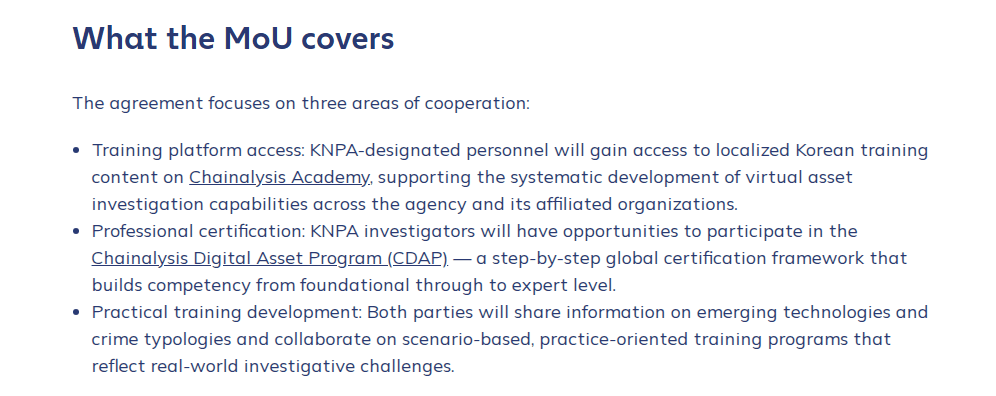
The agreement will give South Korean investigators access to personalized training content, professional certification programs, and hands-on practical instruction developed by Chainalysis.

The partnership comes at a time when North Korea-linked crypto theft has been surging. Data shows that in 2025, hackers tied to the DPRK were responsible for $2 billion in crypto losses — a 51% jump from the year before, according to research from CrowdStrike.

By April of this year, theft attributed to North Korea had already reached close to $580 million, with attacks on Kelp DAO and the Drift Protocol among the largest incidents.

South Korea’s police have been described as being at the forefront of confronting those state-level threats. But Chainalysis country director Ryan Kwon said the MoU is built around a wider purpose than targeting any single adversary.

A Wider Mandate

“While North Korean-driven attacks are understandably a national security focus, this partnership isn’t designed around a single threat,” Kwon said. “It’s fundamentally about building institutional capability.”

Chainalysis has worked alongside South Korean law enforcement before. In September last year, police in Seoul dismantled an international hacking ring that had stolen roughly $30 million.
Source: Chainalysis

The investigation started in South Korea and eventually led authorities to Thailand, with Chainalysis playing a supporting role throughout.

The newly signed agreement builds on that existing relationship. According to Chainalysis, Korean investigators need global visibility into how illicit funds move across blockchains to handle these cases effectively — and that cross-border reach is part of what the training is designed to provide.

BTCUSD trading at $62,044 on the 24-hour chart: TradingView

Casting The Net On Crypto Crime

The MoU follows the May launch of the Money Laundering Eradication Task Force, a multi-agency unit under South Korea’s Economic Crime Investigation Division created specifically to go after crypto-based financial crimes.

The back-to-back moves suggest a deliberate push by South Korean authorities to sharpen their tools against a growing range of threats — from state-sponsored hackers to scams targeting ordinary investors.

Chainalysis said the goal is not just to chase individual cases but to leave the KNPA better equipped long after any single investigation wraps up.

Featured image from Getty Images, chart from TradingView

Perguntas relacionadas

QWhat is the main purpose of the Memorandum of Understanding signed between Chainalysis and the Korean National Police Agency?

AThe main purpose is to strengthen the KNPA's ability to investigate virtual asset crimes by providing personalized training content, professional certification programs, and hands-on practical instruction developed by Chainalysis.

QAccording to the article, what was the estimated value of crypto losses attributed to North Korea-linked hackers in 2025?

AAccording to research from CrowdStrike, North Korea-linked hackers were responsible for an estimated $2 billion in crypto losses in 2025.

QWhat recent initiative by South Korean authorities does the Chainalysis MoU follow, and what is its focus?

AThe MoU follows the May launch of the Money Laundering Eradication Task Force, a multi-agency unit created specifically to go after crypto-based financial crimes.

QWhat does Chainalysis country director Ryan Kwon say is the fundamental goal of the partnership with the KNPA?

ARyan Kwon states that the partnership is fundamentally about building institutional capability within the KNPA, rather than being designed solely around targeting a single threat like North Korean-driven attacks.

QHow did Chainalysis previously assist South Korean law enforcement, as mentioned in the article?

AChainalysis played a supporting role in an investigation where Seoul police dismantled an international hacking ring that had stolen roughly $30 million, with the investigation starting in South Korea and leading to Thailand.

Leituras Relacionadas

Raising Interest Rates Is Not a Tech Killer, EPS Is: A Strategy for Discarding the Weak and Retaining the Strong After the AI Theme's Sharp Decline

**Summary: Rising Interest Rates Are Not the Killer of Tech; EPS Is: The "Keep the Strong, Ditch the Weak" Strategy After the AI Theme Plunge** The author argues that the sharp sell-off in tech and AI-related stocks, triggered by a strong US jobs report that heightened Fed rate hike fears, represents a "pullback to pick up passengers" rather than a "car crash." The true end of a tech bull market is not determined by an extra 25 basis point hike, but by industry overcapacity and the disproval of earnings per share (EPS) expectations. Historical analysis shows that during past rate hike cycles, the Nasdaq-100 often outperformed, provided EPS growth remained strong. The current phase is seen as a shift from a "broad narrative-driven rally" to a "focused verification stage" for AI. The investment strategy should be to "keep the strong, ditch the weak." * **Retain exposure** to high-conviction AI infrastructure leaders with clear order visibility, stable margins, strong cash flow, and upward EPS revisions (e.g., AI servers, advanced packaging, optical modules, key cloud suppliers). * **Reduce exposure** to high-beta, narrative-driven stocks with unclear profit paths (e.g., some quantum computing, space, or speculative chip stocks), especially on rebounds. Valuation concerns should focus on whether earnings can catch up to high multiples, not on high P/E alone. Crowded positioning signals a concentration into quality assets, not necessarily a market top. The upcoming Q2 earnings season will be a key validation point. The core principle is to hold stocks with proven EPS, while using macro events (CPI data, central bank meetings) to manage timing and risk.

marsbitHá 1h

Raising Interest Rates Is Not a Tech Killer, EPS Is: A Strategy for Discarding the Weak and Retaining the Strong After the AI Theme's Sharp Decline

marsbitHá 1h

Trading

Spot
Futuros
活动图片