Stablecoin usage in Venezuela likely to keep expanding amid economic instability

cointelegraphPublicado em 2025-12-14Última atualização em 2025-12-14

Resumo

Venezuela's economic instability and hyperinflation are driving increased reliance on stablecoins, particularly USDT, as essential tools for daily transactions and as a store of value. According to TRM Labs, nearly a decade of economic crisis, sanctions, and failing traditional infrastructure has made crypto adoption a necessity. Peer-to-peer platforms and crypto-to-fiat conversions are critical in a low-banking environment, with over 38% of Venezuelan crypto site visits going to a major P2P service. Despite regulatory uncertainty, stablecoins are primarily used for payroll, remittances, and commerce rather than speculation. Venezuela ranks 9th globally in crypto adoption when adjusted for population size.

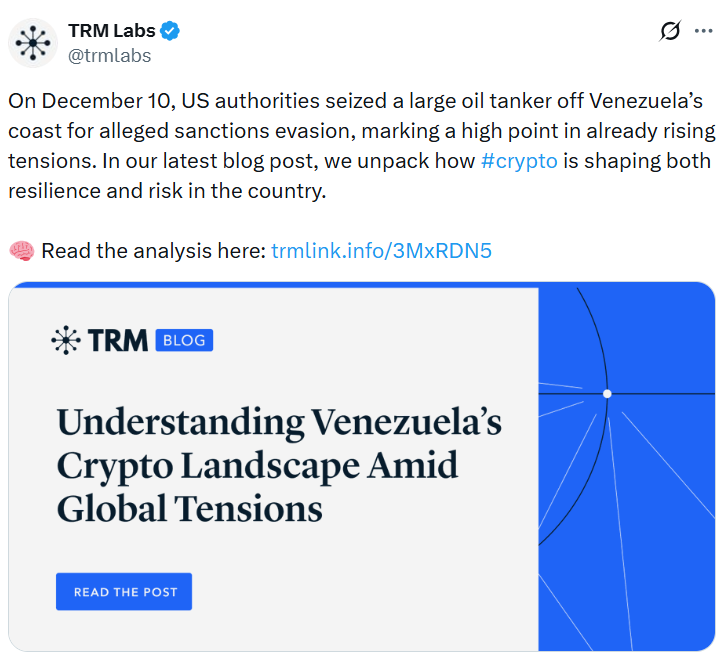
Venezuelans are already heavily reliant on blockchain technology for banking after suffering through a decade of economic pressures; however, usage is likely to keep growing if conditions worsen in the South American country, blockchain intelligence firm TRM Labs says.

As regional and geopolitical tensions continue to rise, driven in part by US-Venezuela tensions, the TRM Labs team predicted in a report on Thursday that macroeconomic instability and the bolívar’s continued devaluation will likely sustain demand for stablecoins as both a store of value and a medium of exchange.

At the same time, regulatory ambiguity and continued uncertainty surrounding the country’s crypto regulator, SUNACRIP’s, authority and enforcement capacity, and eroding trust in traditional banking infrastructure could prolong the population’s dependence and drive more usage.

“Absent a material shift in Venezuela’s macroeconomic conditions or the emergence of cohesive regulatory oversight, the role of digital assets — particularly stablecoins — is poised to expand.”
Source: TRM Labs

Venezuela is 18th globally for crypto adoption, the Chainalysis 2025 Crypto Adoption Index report found, but its rank increased to 9th when adjusted for population size.

Peer-to-peer transactions a key service for Venezuelans

Peer-to-peer (P2P), transfers made from one person to another through an intermediary, along with USDT (USDT) to-fiat conversions, have emerged as key services Venezuelans are using in the absence of reliable domestic banking channels, according to TRM Labs.

The blockchain intelligence firm tracked Venezuelan IP addresses and found that more than 38% of site visits were to a lone global platform that offers P2P trading functionality, which underscores its “role in facilitating crypto access in Venezuela’s low-banking environment.”

“A significant share of crypto-to-fiat activity is facilitated through platforms supporting informal settlement rails — even amid reports of intermittent service disruptions.”

Related: Venezuela blocks Binance, X amid presidential election dispute

“Local platforms also play a key role, particularly those offering mobile wallets and bank integrations suited to domestic users,” the team added.

Venezuela’s crypto industry created out of desperate necessity

Venezuela’s crypto ecosystem is ultimately the product of nearly a decade of economic collapse, international sanctions pressure, and state experimentation with digital financial alternatives, the TRM Labs team said.

Stablecoins, especially USDT, play a central role in household and commercial transactions in Venezuela, and despite compliance and sanction evasion concerns, stablecoins remain “overwhelmingly driven by necessity rather than speculation or criminal intent.”

“For most Venezuelans, stablecoins now operate as a substitute for retail banking — facilitating payroll, family remittances, vendor payments, and cross-border purchases in the absence of consistent domestic financial services.”

Magazine: Quantum attacking Bitcoin would be a waste of time: Kevin O’Leary
Leituras Relacionadas

I Tested with $10,000: Zero Wear, 8% APY, and Earn Points (Full Tutorial + Screenshots Included)

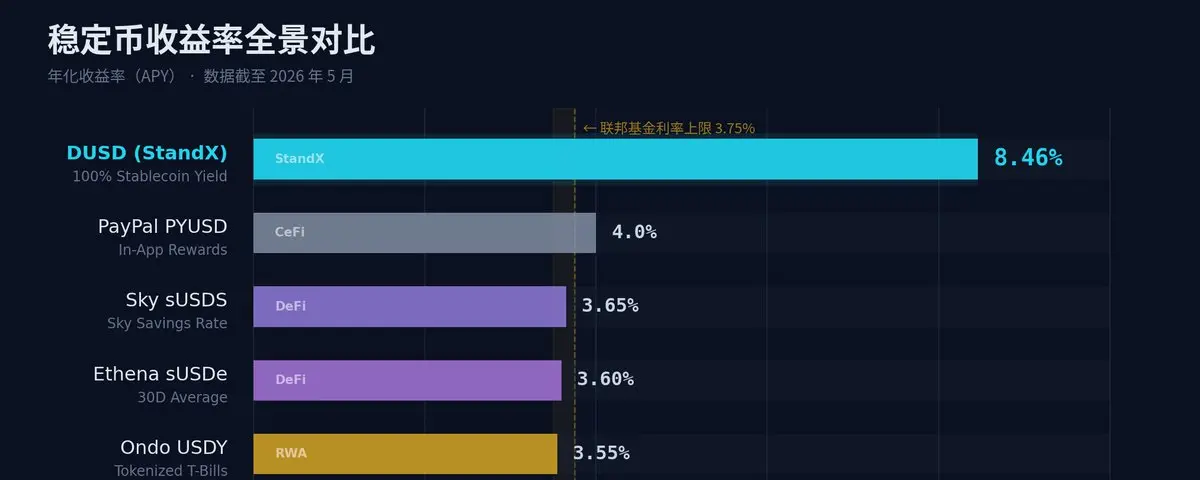
**Title:** My $10,000 Real-World Test: Zero Wear-and-Tear, ~8% APY, Plus Earning Points (Full Guide + Screenshots Included) **Summary:** This article details a personal experiment with $10,000 on the StandX platform to verify its advertised ~8% APY for its stablecoin, DUSD, while earning trading points. The author created two accounts, each depositing $5,000 worth of DUSD, and used StandX's unique "Block Trade" feature to open perfectly offsetting long and short BTC positions (2x leverage each). This neutralized directional market risk. **Key Results (Over 8 Days):** * **Total Profit:** $16.91 (~7.8% annualized). * **Zero Net Directional P&L:** BTC price movements canceled out. * **Zero Wear-and-Tear:** No losses from fees, slippage, or gas from frequent trading. * **Points Earned:** 380+ trading points. **Source of the ~8.46% APY:** The yield is composed of three layers, all paid in DUSD (real USD value, not governance tokens): 1. **DUSD Base (~1.27%):** Derived from funding rates (similar to Ethena's USDe). 2. **SIP-2 Position Boost (~2.27%):** A protocol revenue-sharing mechanism. Users providing liquidity (via open positions) earn a share of platform trading fees. Leverage acts as a multiplier on this yield. 3. **SIP-3 Universal Fee Share (~4.92%):** A portion of all platform trading fees is distributed to *every* DUSD holder, regardless of whether they trade. **Sustainability Claim:** The author argues this yield is more sustainable than pure funding-rate models (e.g., Ethena) because over 7% of it comes from transaction fees (SIP-2 + SIP-3), which are less dependent on market cycles. **Step-by-Step Strategy:** A concise 3-step guide is provided for replicating the zero-risk strategy using two wallets and StandX's Block Trade to create matched long/short positions. **Risk Disclosures:** The article notes standard DeFi risks: smart contract vulnerability and yield fluctuation (Base yield varies with funding rates; SIP-2/3 yields depend on platform trading volume). **Author's Note:** The author discloses their role in Growth at StandX. The piece is presented as personal testing and analysis, not investment advice.

链捕手Há 3m

I Tested with $10,000: Zero Wear, 8% APY, and Earn Points (Full Tutorial + Screenshots Included)

链捕手Há 3m

Senior Analyst Dialogue: What Powell's Departure and Warsh's Appointment Mean for Crypto?

The podcast episode "Powell Is Out, Warsh Is In: What It Means for Crypto" features an analysis by Noelle Acheson on the macro-economic landscape and its implications for crypto. Key discussion points include: * **Equity-Bond Divergence:** Acheson highlights a significant and growing disconnect between stock and bond markets. While bond yields rise globally, signaling tighter financial conditions, equities are driven by AI-related hype and speculation, reminiscent of the 1999 dot-com bubble. * **'Bliss Trade' and Systemic Fragility:** The discussion explores the concept of a structural, cross-party government expectation to provide fiscal support ("Bliss Trade"), which underpins risk asset valuations and carries its own systemic vulnerabilities. * **Inflation Outlook:** Acheson argues that inflation is not meaningfully declining, citing core CPI stagnation and attributing the trend to de-globalization, tariffs, and geopolitical tensions like the Strait of Hormuz crisis. * **Powell's Legacy:** Powell's tenure receives mixed marks. While his defense of Fed independence is noted, he is also criticized for overseeing the "de-banking" of crypto firms in 2023 and initially misjudging inflation. * **Outlook for Warsh:** Expectations for the incoming Fed Chair, Kevin Warsh, are measured. While he may aim to reduce Fed balance sheet size and forward guidance, market realities and the FOMC will likely constrain his ability to enact significant policy shifts, particularly rate cuts. * **Crypto as a Macro Asset:** Bitcoin's role is framed as a hedge against currency debasement, benefiting from expectations of monetary stimulus. However, its maturation as a macro asset means it now competes with other high-volatility investments like AI stocks, potentially limiting near-term price catalysts. * **Market Structure & Tokenization:** The potential Clarity Act is seen as more beneficial for assets like Ethereum than Bitcoin, which already has relative regulatory clarity. Concerns are raised about "innovation exemptions" for tokenization if they enable third-party derivatives that encourage pure speculation over capital formation. In conclusion, the analysis suggests crypto markets lack a near-term positive catalyst and are caught between competing macro narratives, with significant underlying fragilities in traditional markets.

marsbitHá 14m

Senior Analyst Dialogue: What Powell's Departure and Warsh's Appointment Mean for Crypto?

marsbitHá 14m

Wall Street Giants Vie for GPU Futures, Crypto Market Already in Early Skirmish

Wall Street giants CME and ICE are racing to launch GPU futures, marking a pivotal shift as computing power transforms from a critical IT resource into a tradable financial asset. In mid-May, both exchanges announced plans for futures contracts tied to GPU compute pricing indices, aiming to establish a benchmark and provide hedging tools for the volatile, trillion-dollar AI compute market. ICE partnered with data provider Ornn for a broad index covering enterprise and consumer GPUs, while CME teamed with Silicon Data to focus on an H100 leasing index with cash settlement. This push for financialization addresses a key industry pain point: the lack of risk management tools in a market dominated by a few cloud providers, where prices are opaque and highly unstable. Proponents argue futures will help large cloud operators and AI labs lock in costs and manage investment risk. However, challenges remain, including the intangible nature of compute, high market concentration, and the potential for leveraged speculation to exacerbate price swings and resource inequality. Notably, the crypto market has moved faster. Platforms like Architect Financial have already launched perpetual contracts tied to compute indices, leveraging DeFi's agility to create a parallel, global market. As Wall Street awaits regulatory approval, the race to define and control the pricing of "21st-century oil" is accelerating both in traditional and decentralized finance.

marsbitHá 2h

Wall Street Giants Vie for GPU Futures, Crypto Market Already in Early Skirmish

marsbitHá 2h

Trading

Spot
Futuros
活动图片