Fantasy's Closing Notes: After Two and a Half Years of Trial and Error in SocialFi, What Have We Learned?

marsbitPublicado em 2026-05-21Última atualização em 2026-05-21

Resumo

"Fantasy Shutdown Notes: Two and a Half Years of SocialFi Trial, What Have We Learned?" Fantasy, a SocialFi/crypto card game, is shutting down. The team is refunding 100% of investments to angel/seed round backers, as operational costs were fully covered by revenue. Over 2.5 years, the project returned approximately $20M to its community. The core reason for failure was building crypto economics on a foundation not designed for it. Traditional card games (Magic, Pokémon) succeed by prioritizing gameplay; financial value is a secondary outcome. Crypto card games invert this, attracting speculators first, not genuine players. This financialization trapped the team into managing a financial instrument instead of developing a game. This is a sector-wide issue. Embedding tokenomics into social products or creator-fan relationships often attracts short-term traders over genuine users, undermining the core value. The article also critiques premature token launches. Most tokens fail because they're issued before product-market fit is proven, diverting team and community focus to price speculation instead of building. Successful examples like Hyperliquid or Jupiter built sustainable businesses first. Fantasy's journey highlights key crypto pitfalls: the distorting effect of upfront financialization in gaming/social apps, and the dangers of launching tokens too early. The team hopes sharing these lessons helps future builders avoid the same traps.

Written by: kipit

Compiled by: Luffy, Foresight News

TL;DR

  • All angel round and seed round investors will receive a full refund of principal and interest, with all invested funds returned via the original payment method.
  • Fantasy has been self-sustaining through revenue for two and a half years, returning approximately $20 million to the community in total.
  • The core lesson learned over these two and a half years is: If a product prioritizes economic benefits above all else, it attracts speculators first, not users. This principle applies not only to card-based blockchain games but is also a fundamental reason why most social token and early-stage token projects struggle.

The decision to shut down Fantasy was not made impulsively. We spent months exploring all possible directions, consulting people we trust, seriously discussing pivots, and ultimately reached a consensus: we do not have enough conviction to continue. Therefore, we chose to responsibly end this journey and let it conclude gracefully.

This article is a retrospective note: what we built, why we failed, and the new understandings we gained about social products, cryptocurrencies, and tokens during this process. We are not the first team to explore this space, and we certainly won't be the last. If this experience can help future builders avoid the pitfalls we encountered, then this entrepreneurial exploration will have been worthwhile.

The Product We Built

For two and a half years, Fantasy has been self-sustaining through its own revenue. Although the project raised $5.6 million in funding led by Dragonfly, the team never utilized any of the investment funds for operations. Very few projects in the crypto space can claim this, and we take great pride in it.

The core reward data is straightforward:

  • Distributed 2,665 ETH (approximately $8 million) to regular players.
  • Distributed 1,078 ETH (approximately $3.2 million) to top influencers/creators.
  • Leveraging the Blast ecosystem, distributed a total of $12.2 million in ecosystem incentives to all players and influencers.
  • Including Blast rewards, 86% of players ultimately achieved profitability.

Overall, the amount Fantasy returned to the community far exceeded the revenue it generated from the community, which is the project's most valuable achievement.

We built one of the most viral and sticky products within the social crypto space. We introduced novel mechanisms: industry mindshare scoring, a social graph prediction market, and a lightweight, free-to-play model.

We consistently maintained a rapid iteration and efficient product launch pace. Even so, we still failed to break through the development bottleneck.

The Core Reason for Fantasy's Failure

There is only one core reason for our failure: We attempted to build cryptocurrency on a foundation that was not originally designed for cryptocurrency.

Trading card games (TCGs) themselves have a mature business logic. Magic: The Gathering, Pokémon, and Yu-Gi-Oh! are globally popular, enduring top-tier entertainment IPs. Players are passionate about card collection, trading, and battles, representing a massive user base.

However, all crypto card games have ultimately failed—from TopShot and Sorare to us today. This is no coincidence but stems from a structural flaw in the sector.

The core logic of traditional top-tier card games is to create the game first, with ancillary products coming second. Players acquire cards primarily to experience the fun of gameplay. The financial premium attached to cards is a natural byproduct after the gameplay matures and the community ecosystem grows, not the primary reason users join.

Crypto card games completely invert this logic: cards first become financial speculation instruments, with gameplay fun becoming secondary. They attract not game-loving players but a speculative crowd hoping to profit from card trading. The demands of these two groups are fundamentally different.

Once a project is fully financialized from birth, all subsequent operational decisions become constrained: unable to freely optimize gameplay as any rule change directly affects card prices; hesitant to launch new game modes for fear of triggering community interest redistribution. In the end, the team stops focusing on polishing the game content and is forced to become financial portfolio managers. This is precisely the industry predicament we were stuck in.

We recognized this problem early on and tried our utmost to break free. We launched Arena mode to lower the asset ownership barrier, built lightweight traffic channels, opened free-to-play entry, and even removed the NFT asset system to pivot entirely to a social prediction market. Every adjustment aimed to return to the初心 of "game first," but we ultimately failed to reverse the overall decline.

The waning of the Blast ecosystem further exacerbated our difficulties. Back then, Blast was unprecedentedly hot, with a large influx of users joining Fantasy solely to chase the rumored massive ecosystem airdrops. In the first month after the mainnet launch, revenue directly hit its historical peak, accounting for 70% of the project's total lifetime revenue.

Starting at the peak meant all subsequent operations were mired in a downward trend. The team could no longer steadily plan for long-term growth but was forced to passively deal with the decline in traffic and hype after the frenzy subsided.

Financialization Completely Changes the User Base

This industry-wide ailment is prevalent throughout the crypto space. Social tokens were initially created to reshape the connection between creators and fans, yet nearly all related attempts have failed. The reason is the same: genuine fans follow creators because they resonate with their work, ideas, and community atmosphere, not purely for profit.

Once the price fluctuations of a token are inserted between fans and the content they love, the pure emotional connection is fundamentally altered. The most active participants in the community become short-term traders rather than loyal fans.

This is not a minor issue but the core impediment hindering the sector's development.

The crypto industry excels at designing incentive mechanisms and building consensus among participants—this is its core strength. However, a common misconception exists in the industry: simply and crudely overlaying financial attributes onto traditional internet products, games, or social communities can upgrade the business model.

The reality is恰恰相反. Overlaying financial attributes completely changes the essence of a product and, in most cases, fundamentally削弱 its original core value.

Attempting to replicate crypto products and achieve scale by relying on traditional internet ecosystems simply doesn't work. Financial attributes are always just an add-on; they directly reshape the user base structure and the reasons users join.

In-Depth Thoughts on Sector Tokens

This logic applies not only to end products but also to crypto startups themselves.

Our team never issued a project native token, even though we considered it multiple times. The reason is simple: issuing a token before the project achieves substantial development milestones is irresponsible in itself. 95% of tokens in the market see their prices decline after launch. Knowing this outcome yet still issuing tokens to "cut leeks" is behavior we firmly oppose.

Looking at various token issuance projects in this market cycle, I am increasingly convinced that the token issuance mechanisms of most projects themselves have serious flaws.

It is inherently wrong for a project to casually issue tokens in a stage where there is no mature product or stable market demand. Previously, I thought traditional financial regulations were overly strict. Now, I fully understand their underlying logic: strict regulation protects ordinary investors from early-stage projects lacking commercial viability. The crypto industry skips this risk screening layer, and the entire sector is paying the price.

Issuing tokens before validating product-market fit is all harm and no benefit for a project. Post-issuance, the team's attention shifts entirely to token price fluctuations, ordinary users only watch market movements, no one focuses on product development, and the project completely stagnates.

Even a quality project like Across Protocol, with real revenue and steady growth, has publicly admitted that the negative impact of issuing tokens far outweighs the actual value—a conclusion worth pondering for the entire industry.

The few robust token projects in this cycle are exceptions, not the norm: projects like Hyperliquid, Pump, Jupiter all first built mature business systems, achieved stable revenue, used platform profits for token buybacks and value accrual, and only issued tokens after possessing solid strength and genuine底气.

The Decentralized Physical Infrastructure (DePIN) sector is one of the few structural exceptions, but many early DePIN projects launched with inflated valuations that wouldn't hold up in today's market, and the sector still lacks a recognized long-term success benchmark case.

Similar to financialized card games, projects issuing tokens too early easily fall into a vicious cycle. High market financial expectations attached post-launch severely restrict a startup's flexibility to experiment and explore the right development path.

Full Refund to Investors

All angel round and seed round investors in Fantasy will receive a 100% full refund, with the exact amount invested returned via the original method.

Our ability to do this stems from the project's self-sustaining operations; we never used external investment funds. The initial investment was based on the belief that the project had the potential to grow into a high-quality, billion-dollar enterprise. Since the project is now unlikely to achieve that goal, and we lack sufficient conviction, we cannot use these funds to pursue a pivot we ourselves are not confident in.

We deeply value the trust given by our investors and will never消耗 that trust on盲目尝试 we ourselves don't believe in.

To the Platform Creators

Our sincere thanks to all of you! At a time when the project's business model was unproven, you were willing to join and build using your own reputation and influence. You cumulatively earned over $3.2 million on the platform. We hope this回报 is worthy of the trust you initially placed in us.

To the Entire Community

Every community member made Fantasy what it was. All the impressive data achievements mentioned above were made possible by your tremendous support. We once strived to build the most fun social game in the crypto space, and for a time, we succeeded. Thank you for your daily companionship, actively building decks, and participating in tournaments.

We deeply regret not meeting everyone's ultimate expectations. We understand the disappointment and regret, and we accept this outcome with坦荡.

If anyone still believes in the billion-dollar business idea潜藏 behind Fantasy, feel free to give it a try. The entire sector's opportunities are open and barrier-free. We are willing to share all our practical experience and lessons learned without reservation.

We encountered numerous difficult industry barriers. Future builders need not repeat these mistakes firsthand. Perhaps a completely new development approach, avoiding our detours, can create a better product than ours.

Writing this retrospective is not a formal farewell but an effort to leave behind practical reference material for future entrepreneurs.

Currently, crypto card games have a天然 development ceiling; social products prioritizing financial attributes will inevitably attract speculators, making it hard to凝聚 core fans; issuing tokens prematurely, detached from actual product落地 needs, often hinders project development.

These are not just the困境 of our single project but widespread痛点 across the entire crypto industry. These challenges are not unsolvable, but they cannot be addressed by一味复刻 outdated models.

We are not the first to try, and we certainly won't be the last. The most precious trait of the crypto industry is its willingness to boldly explore and experiment. Entrepreneurial exploration inherently involves success and failure, but every attempt holds unique value.

Finally, thank you once again to everyone who trusted and supported us.

Perguntas relacionadas

QWhat is the core reason for Fantasy's failure according to the article?

AFantasy failed because it tried to build crypto on a foundation not designed for it. It inverted the logic of successful traditional trading card games by making the cards primarily financial speculation instruments first, with the game's fun being secondary. This attracted speculators instead of genuine players, trapping the team in managing a financial scheme rather than developing compelling gameplay.

QWhat key lesson does the article share about launching tokens in crypto projects?

AThe key lesson is that launching a token too early, before achieving product-market fit and a stable business model, is usually detrimental. It shifts the team's and community's focus to token price speculation, stifles the project's ability to experiment and pivot, and often results in long-term price decline, harming the project's development and users.

QHow did the team handle the funds from their angel and seed round investors?

AThe team is refunding 100% of the principal investment to all angel and seed round investors. They were able to do this because the project was self-sustaining through its own revenue for its entire two-and-a-half-year lifespan, and they never used any of the invested capital for operations.

QWhat negative impact did adding a financial layer to social or gaming products have, according to the article?

AAdding a financial layer fundamentally changes the product's nature and user base. It attracts speculators instead of genuine users or fans. For social tokens, it replaces the emotional connection between creators and fans with profit-seeking. For games, it makes cards financial assets first, which constrains gameplay development and turns the team into financial managers, ultimately weakening the product's core value.

QWhat was a significant external factor that contributed to Fantasy's struggle after an initial surge?

AThe hype and subsequent cooling of the Blast ecosystem was a significant factor. A massive influx of users joined Fantasy primarily to farm the rumored large Blast airdrop, leading to record revenue in the first month. However, this created an 'all-time high' start, making subsequent operations appear as a decline as these speculative users left, trapping the team in a passive cycle of managing decreasing hype and revenue.

Leituras Relacionadas

Top 10 Promising Emerging Hyperliquid Native Protocols to Watch

Title: A Review of 10 Emerging Native Protocols on Hyperliquid Hyperliquid is evolving beyond perpetual contracts into a comprehensive on-chain financial stack. This article highlights 10 key native protocols driving this growth: 1. **Monetrix**: A yield-optimizing protocol akin to Ethena, aggregating funding rates, HLP rewards, maker rebates, and HIP-3 into a single stablecoin yield. 2. **ROSETTA**: An automated stablecoin yield router, allocating USDC across top protocols (e.g., Felix, Aave, HLP) for optimal returns, factoring in gas and slippage. 3. **papertrade.xyz**: A fair-launched perpetuals protocol offering up to 1000x leverage, no funding rates, no slippage, and fully on-chain, oracle-based execution. 4. **alt.fun**: A launchpad where tokens are paired with leveraged perpetual positions (2x-5x), linking token price to trading activity and underlying position performance. 5. **Ventuals**: Pre-IPO perpetual contracts (built on HIP-3) allowing up to 10x leveraged speculation on valuations of private companies like SpaceX and Stripe. 6. **Liminal**: A delta-neutral yield protocol that captures funding rates via automated short positions and uses generated xTokens (xBTC, etc.) as DeFi collateral. 7. **Melt**: Brings tokenized stocks, commodities, and RWAs to Hyperliquid spot markets, enabling 24/7 trading alongside crypto assets. 8. **Chainsight**: An oracle and data infrastructure protocol providing low-latency (<3s) price feeds, volatility indices, and risk metrics for novel derivatives. 9. **rip.xyz**: Tokenized vault strategies on HyperEVM; its flagship rHYPURR offers liquidity and fractional exposure to a Hypurr NFT basket, priced hourly via NAV. 10. **Markets**: A perpetuals exchange (by Kinetiq) for trading stocks, forex, commodities, bonds, and crypto with up to 50x leverage, using USDH collateral and Kaiko oracles. These protocols form the foundational layer for generating real yield, liquidity, and innovative financial products natively on Hyperliquid.

marsbitHá 1m

Top 10 Promising Emerging Hyperliquid Native Protocols to Watch

marsbitHá 1m

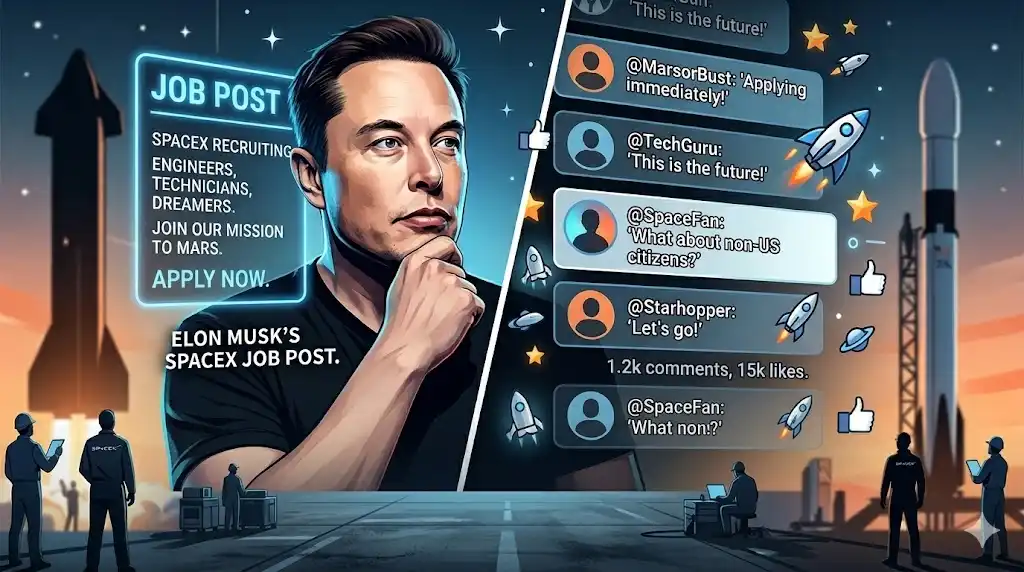
Musk Posted a Recruitment Ad for SpaceX, and After Reading the Comments Section, I Understood

On May 20th, SpaceX filed for a landmark IPO with a $1.75 trillion valuation. Shortly after, Elon Musk posted a recruitment call on X, seeking "world-class engineers and physicists" for SpaceX. The application process was starkly simple: email with three bullet points proving "exceptional ability," with real, complex projects as a plus. Musk promised to review qualifying emails himself. The post garnered millions of views and thousands of replies, revealing a spectrum of responses. Most comments, including a highly-upvoted humorous one listing absurd "skills," merely listed credentials or experiences in a conventional, non-differentiating way. This highlighted a key insight: a traditional resume listing degrees and skills often fails to demonstrate true exceptionalism. Effective self-presentation requires "performance efficiency." A standout reply came from an OpenAI engineering lead, who simply stated "codex." This demonstrated that for those who have built significant, recognized products, the product itself becomes the ultimate resume. The article argues that in the AI era, any tangible, shareable output—a tool, research, or online project—serves as a living, self-evident credential more powerful than a list of attributes. However, a twist emerged when applicants found the provided email address non-functional, leading to speculation that the post might also serve as an IPO publicity stunt, projecting an image of aggressive talent acquisition to investors. Ultimately, the episode served as a microcosm: some participate through performance, others through proof of work, while some question the reality of the stage itself. It underscores the enduring challenge of defining and demonstrating value in an age of abundant, yet often superficial, content.

marsbitHá 1h

Musk Posted a Recruitment Ad for SpaceX, and After Reading the Comments Section, I Understood

marsbitHá 1h

Cutting Off OpenAI, Anthropic Acquires the Tool Provider Used by a Quarter of Global Developers

Anthropic has acquired Stainless, a developer tool company that automatically generated official SDKs (Software Development Kits) for AI giants including OpenAI, Anthropic, Meta, and Cloudflare. The deal, reportedly valued at around $300 million, marks a strategic shift for Anthropic as it builds its "AI agent" infrastructure. Stainless acted as a "translator," converting complex API specifications into ready-to-use code libraries for developers. Its tools indirectly reached about a quarter of professional software developers globally. Following the acquisition, Stainless will shut down its public products and its team will join Anthropic to focus on internal platform development, notably for the Claude Platform. Existing SDKs remain with their respective client companies but will no longer receive updates from Stainless. This move is part of Anthropic's broader 18-month strategy to assemble a complete "agent stack." The stack consists of the Claude model at its core, the newly acquired Stainless for standardized API interfaces, and the Model Context Protocol (MCP), an open standard for connecting agents to external tools and data. This contrasts with OpenAI's focus on model generations and consumer-scale compute. Anthropic believes an agent's ultimate utility depends on its ability to connect to external systems. By internalizing the SDK layer and promoting MCP as a connection standard, Anthropic aims to lock in long-term ecosystem advantages and create path dependency, moving beyond the transient lead provided by any single model generation.

marsbitHá 1h

Cutting Off OpenAI, Anthropic Acquires the Tool Provider Used by a Quarter of Global Developers

marsbitHá 1h

Trading

Spot
Futuros

Artigos em Destaque

O que é $S$

Compreender o SPERO: Uma Visão Abrangente Introdução ao SPERO À medida que o panorama da inovação continua a evoluir, o surgimento de tecnologias web3 e projetos de criptomoeda desempenha um papel fundamental na formação do futuro digital. Um projeto que tem atraído atenção neste campo dinâmico é o SPERO, denotado como SPERO,$$s$. Este artigo tem como objetivo reunir e apresentar informações detalhadas sobre o SPERO, para ajudar entusiastas e investidores a compreender as suas bases, objetivos e inovações nos domínios web3 e cripto. O que é o SPERO,$$s$? O SPERO,$$s$ é um projeto único dentro do espaço cripto que procura aproveitar os princípios da descentralização e da tecnologia blockchain para criar um ecossistema que promove o envolvimento, a utilidade e a inclusão financeira. O projeto é concebido para facilitar interações peer-to-peer de novas maneiras, proporcionando aos utilizadores soluções e serviços financeiros inovadores. No seu núcleo, o SPERO,$$s$ visa capacitar indivíduos ao fornecer ferramentas e plataformas que melhoram a experiência do utilizador no espaço das criptomoedas. Isso inclui a possibilidade de métodos de transação mais flexíveis, a promoção de iniciativas impulsionadas pela comunidade e a criação de caminhos para oportunidades financeiras através de aplicações descentralizadas (dApps). A visão subjacente do SPERO,$$s$ gira em torno da inclusão, visando fechar lacunas dentro das finanças tradicionais enquanto aproveita os benefícios da tecnologia blockchain. Quem é o Criador do SPERO,$$s$? A identidade do criador do SPERO,$$s$ permanece algo obscura, uma vez que existem recursos publicamente disponíveis limitados que fornecem informações detalhadas sobre o(s) seu(s) fundador(es). Esta falta de transparência pode resultar do compromisso do projeto com a descentralização—uma ética que muitos projetos web3 partilham, priorizando contribuições coletivas em vez de reconhecimento individual. Ao centrar as discussões em torno da comunidade e dos seus objetivos coletivos, o SPERO,$$s$ incorpora a essência do empoderamento sem destacar indivíduos específicos. Assim, compreender a ética e a missão do SPERO é mais importante do que identificar um criador singular. Quem são os Investidores do SPERO,$$s$? O SPERO,$$s$ é apoiado por uma diversidade de investidores que vão desde capitalistas de risco a investidores-anjo dedicados a promover a inovação no setor cripto. O foco desses investidores geralmente alinha-se com a missão do SPERO—priorizando projetos que prometem avanço tecnológico social, inclusão financeira e governança descentralizada. Essas fundações de investidores estão tipicamente interessadas em projetos que não apenas oferecem produtos inovadores, mas que também contribuem positivamente para a comunidade blockchain e os seus ecossistemas. O apoio desses investidores reforça o SPERO,$$s$ como um concorrente notável no domínio em rápida evolução dos projetos cripto. Como Funciona o SPERO,$$s$? O SPERO,$$s$ emprega uma estrutura multifacetada que o distingue de projetos de criptomoeda convencionais. Aqui estão algumas das características-chave que sublinham a sua singularidade e inovação: Governança Descentralizada: O SPERO,$$s$ integra modelos de governança descentralizada, capacitando os utilizadores a participar ativamente nos processos de tomada de decisão sobre o futuro do projeto. Esta abordagem promove um sentido de propriedade e responsabilidade entre os membros da comunidade. Utilidade do Token: O SPERO,$$s$ utiliza o seu próprio token de criptomoeda, concebido para servir várias funções dentro do ecossistema. Esses tokens permitem transações, recompensas e a facilitação de serviços oferecidos na plataforma, melhorando o envolvimento e a utilidade gerais. Arquitetura em Camadas: A arquitetura técnica do SPERO,$$s$ suporta modularidade e escalabilidade, permitindo a integração contínua de funcionalidades e aplicações adicionais à medida que o projeto evolui. Esta adaptabilidade é fundamental para manter a relevância no panorama cripto em constante mudança. Envolvimento da Comunidade: O projeto enfatiza iniciativas impulsionadas pela comunidade, empregando mecanismos que incentivam a colaboração e o feedback. Ao nutrir uma comunidade forte, o SPERO,$$s$ pode melhor atender às necessidades dos utilizadores e adaptar-se às tendências do mercado. Foco na Inclusão: Ao oferecer taxas de transação baixas e interfaces amigáveis, o SPERO,$$s$ visa atrair uma base de utilizadores diversificada, incluindo indivíduos que anteriormente podem não ter participado no espaço cripto. Este compromisso com a inclusão alinha-se com a sua missão abrangente de empoderamento através da acessibilidade. Cronologia do SPERO,$$s$ Compreender a história de um projeto fornece insights cruciais sobre a sua trajetória de desenvolvimento e marcos. Abaixo está uma cronologia sugerida que mapeia eventos significativos na evolução do SPERO,$$s$: Fase de Conceituação e Ideação: As ideias iniciais que formam a base do SPERO,$$s$ foram concebidas, alinhando-se de perto com os princípios de descentralização e foco na comunidade dentro da indústria blockchain. Lançamento do Whitepaper do Projeto: Após a fase conceitual, um whitepaper abrangente detalhando a visão, os objetivos e a infraestrutura tecnológica do SPERO,$$s$ foi lançado para atrair o interesse e o feedback da comunidade. Construção da Comunidade e Primeiros Envolvimentos: Esforços ativos de divulgação foram feitos para construir uma comunidade de primeiros adotantes e investidores potenciais, facilitando discussões em torno dos objetivos do projeto e angariando apoio. Evento de Geração de Tokens: O SPERO,$$s$ realizou um evento de geração de tokens (TGE) para distribuir os seus tokens nativos a apoiantes iniciais e estabelecer liquidez inicial dentro do ecossistema. Lançamento da dApp Inicial: A primeira aplicação descentralizada (dApp) associada ao SPERO,$$s$ foi lançada, permitindo que os utilizadores interagissem com as funcionalidades principais da plataforma. Desenvolvimento Contínuo e Parcerias: Atualizações e melhorias contínuas nas ofertas do projeto, incluindo parcerias estratégicas com outros players no espaço blockchain, moldaram o SPERO,$$s$ em um jogador competitivo e em evolução no mercado cripto. Conclusão O SPERO,$$s$ é um testemunho do potencial do web3 e das criptomoedas para revolucionar os sistemas financeiros e capacitar indivíduos. Com um compromisso com a governança descentralizada, o envolvimento da comunidade e funcionalidades inovadoras, abre caminho para um panorama financeiro mais inclusivo. Como em qualquer investimento no espaço cripto em rápida evolução, potenciais investidores e utilizadores são incentivados a pesquisar minuciosamente e a envolver-se de forma ponderada com os desenvolvimentos em curso dentro do SPERO,$$s$. O projeto demonstra o espírito inovador da indústria cripto, convidando a uma exploração mais aprofundada das suas inúmeras possibilidades. Embora a jornada do SPERO,$$s$ ainda esteja a desenrolar-se, os seus princípios fundamentais podem, de facto, influenciar o futuro de como interagimos com a tecnologia, as finanças e uns com os outros em ecossistemas digitais interconectados.

69 Visualizações TotaisPublicado em {updateTime}Atualizado em 2024.12.17

O que é $S$

O que é AGENT S

Agent S: O Futuro da Interação Autónoma no Web3 Introdução No panorama em constante evolução do Web3 e das criptomoedas, as inovações estão constantemente a redefinir a forma como os indivíduos interagem com plataformas digitais. Um projeto pioneiro, o Agent S, promete revolucionar a interação humano-computador através do seu framework aberto e agente. Ao abrir caminho para interações autónomas, o Agent S visa simplificar tarefas complexas, oferecendo aplicações transformadoras em inteligência artificial (IA). Esta exploração detalhada irá aprofundar-se nas complexidades do projeto, nas suas características únicas e nas implicações para o domínio das criptomoedas. O que é o Agent S? O Agent S é um framework aberto e agente, especificamente concebido para abordar três desafios fundamentais na automação de tarefas computacionais: Aquisição de Conhecimento Específico de Domínio: O framework aprende inteligentemente a partir de várias fontes de conhecimento externas e experiências internas. Esta abordagem dupla capacita-o a construir um rico repositório de conhecimento específico de domínio, melhorando o seu desempenho na execução de tarefas. Planeamento ao Longo de Longos Horizontes de Tarefas: O Agent S emprega planeamento hierárquico aumentado por experiência, uma abordagem estratégica que facilita a decomposição e execução eficientes de tarefas intrincadas. Esta característica melhora significativamente a sua capacidade de gerir múltiplas subtarefas de forma eficiente e eficaz. Gestão de Interfaces Dinâmicas e Não Uniformes: O projeto introduz a Interface Agente-Computador (ACI), uma solução inovadora que melhora a interação entre agentes e utilizadores. Utilizando Modelos de Linguagem Multimodais de Grande Escala (MLLMs), o Agent S pode navegar e manipular diversas interfaces gráficas de utilizador de forma fluida. Através destas características pioneiras, o Agent S fornece um framework robusto que aborda as complexidades envolvidas na automação da interação humana com máquinas, preparando o terreno para uma infinidade de aplicações em IA e além. Quem é o Criador do Agent S? Embora o conceito de Agent S seja fundamentalmente inovador, informações específicas sobre o seu criador permanecem elusivas. O criador é atualmente desconhecido, o que destaca ou o estágio nascente do projeto ou a escolha estratégica de manter os membros fundadores em anonimato. Independentemente da anonimidade, o foco permanece nas capacidades e no potencial do framework. Quem são os Investidores do Agent S? Como o Agent S é relativamente novo no ecossistema criptográfico, informações detalhadas sobre os seus investidores e financiadores não estão explicitamente documentadas. A falta de informações disponíveis publicamente sobre as fundações de investimento ou organizações que apoiam o projeto levanta questões sobre a sua estrutura de financiamento e roteiro de desenvolvimento. Compreender o apoio é crucial para avaliar a sustentabilidade do projeto e o seu impacto potencial no mercado. Como Funciona o Agent S? No núcleo do Agent S reside uma tecnologia de ponta que lhe permite funcionar eficazmente em diversos ambientes. O seu modelo operacional é construído em torno de várias características-chave: Interação Humano-Computador Semelhante: O framework oferece planeamento avançado em IA, esforçando-se para tornar as interações com computadores mais intuitivas. Ao imitar o comportamento humano na execução de tarefas, promete elevar as experiências dos utilizadores. Memória Narrativa: Utilizada para aproveitar experiências de alto nível, o Agent S utiliza memória narrativa para acompanhar os históricos de tarefas, melhorando assim os seus processos de tomada de decisão. Memória Episódica: Esta característica fornece aos utilizadores orientações passo a passo, permitindo que o framework ofereça suporte contextual à medida que as tarefas se desenrolam. Suporte para OpenACI: Com a capacidade de funcionar localmente, o Agent S permite que os utilizadores mantenham o controlo sobre as suas interações e fluxos de trabalho, alinhando-se com a ética descentralizada do Web3. Fácil Integração com APIs Externas: A sua versatilidade e compatibilidade com várias plataformas de IA garantem que o Agent S possa integrar-se perfeitamente em ecossistemas tecnológicos existentes, tornando-o uma escolha apelativa para desenvolvedores e organizações. Estas funcionalidades contribuem coletivamente para a posição única do Agent S no espaço cripto, à medida que automatiza tarefas complexas e em múltiplos passos com mínima intervenção humana. À medida que o projeto evolui, as suas potenciais aplicações no Web3 podem redefinir a forma como as interações digitais se desenrolam. Cronologia do Agent S O desenvolvimento e os marcos do Agent S podem ser encapsulados numa cronologia que destaca os seus eventos significativos: 27 de Setembro de 2024: O conceito de Agent S foi lançado num artigo de pesquisa abrangente intitulado “Um Framework Agente Aberto que Usa Computadores como um Humano”, mostrando a base para o projeto. 10 de Outubro de 2024: O artigo de pesquisa foi disponibilizado publicamente no arXiv, oferecendo uma exploração aprofundada do framework e da sua avaliação de desempenho com base no benchmark OSWorld. 12 de Outubro de 2024: Uma apresentação em vídeo foi lançada, proporcionando uma visão visual das capacidades e características do Agent S, envolvendo ainda mais potenciais utilizadores e investidores. Estes marcos na cronologia não apenas ilustram o progresso do Agent S, mas também indicam o seu compromisso com a transparência e o envolvimento da comunidade. Pontos-Chave Sobre o Agent S À medida que o framework Agent S continua a evoluir, várias características-chave destacam-se, sublinhando a sua natureza inovadora e potencial: Framework Inovador: Concebido para proporcionar um uso intuitivo de computadores semelhante à interação humana, o Agent S traz uma abordagem nova à automação de tarefas. Interação Autónoma: A capacidade de interagir autonomamente com computadores através de GUI significa um avanço em direção a soluções computacionais mais inteligentes e eficientes. Automação de Tarefas Complexas: Com a sua metodologia robusta, pode automatizar tarefas complexas e em múltiplos passos, tornando os processos mais rápidos e menos propensos a erros. Melhoria Contínua: Os mecanismos de aprendizagem permitem que o Agent S melhore a partir de experiências passadas, aprimorando continuamente o seu desempenho e eficácia. Versatilidade: A sua adaptabilidade em diferentes ambientes operacionais, como OSWorld e WindowsAgentArena, garante que pode servir uma ampla gama de aplicações. À medida que o Agent S se posiciona no panorama do Web3 e das criptomoedas, o seu potencial para melhorar as capacidades de interação e automatizar processos significa um avanço significativo nas tecnologias de IA. Através do seu framework inovador, o Agent S exemplifica o futuro das interações digitais, prometendo uma experiência mais fluida e eficiente para os utilizadores em diversas indústrias. Conclusão O Agent S representa um ousado avanço na união da IA e do Web3, com a capacidade de redefinir a forma como interagimos com a tecnologia. Embora ainda esteja nas suas fases iniciais, as possibilidades para a sua aplicação são vastas e cativantes. Através do seu framework abrangente que aborda desafios críticos, o Agent S visa trazer interações autónomas para o primeiro plano da experiência digital. À medida que avançamos mais profundamente nos domínios das criptomoedas e da descentralização, projetos como o Agent S desempenharão, sem dúvida, um papel crucial na formação do futuro da tecnologia e da colaboração humano-computador.

643 Visualizações TotaisPublicado em {updateTime}Atualizado em 2025.01.14

O que é AGENT S

Como comprar S

Bem-vindo à HTX.com!Tornámos a compra de Sonic (S) simples e conveniente.Segue o nosso guia passo a passo para iniciar a tua jornada no mundo das criptos.Passo 1: cria a tua conta HTXUtiliza o teu e-mail ou número de telefone para te inscreveres numa conta gratuita na HTX.Desfruta de um processo de inscrição sem complicações e desbloqueia todas as funcionalidades.Obter a minha contaPasso 2: vai para Comprar Cripto e escolhe o teu método de pagamentoCartão de crédito/débito: usa o teu visa ou mastercard para comprar Sonic (S) instantaneamente.Saldo: usa os fundos da tua conta HTX para transacionar sem problemas.Terceiros: adicionamos métodos de pagamento populares, como Google Pay e Apple Pay, para aumentar a conveniência.P2P: transaciona diretamente com outros utilizadores na HTX.Mercado de balcão (OTC): oferecemos serviços personalizados e taxas de câmbio competitivas para os traders.Passo 3: armazena teu Sonic (S)Depois de comprar o teu Sonic (S), armazena-o na tua conta HTX.Alternativamente, podes enviá-lo para outro lugar através de transferência blockchain ou usá-lo para transacionar outras criptomoedas.Passo 4: transaciona Sonic (S)Transaciona facilmente Sonic (S) no mercado à vista da HTX.Acede simplesmente à tua conta, seleciona o teu par de trading, executa as tuas transações e monitoriza em tempo real.Oferecemos uma experiência de fácil utilização tanto para principiantes como para traders experientes.

1.2k Visualizações TotaisPublicado em {updateTime}Atualizado em 2025.03.21

Como comprar S

Discussões

Bem-vindo à Comunidade HTX. Aqui, pode manter-se informado sobre os mais recentes desenvolvimentos da plataforma e obter acesso a análises profissionais de mercado. As opiniões dos utilizadores sobre o preço de S (S) são apresentadas abaixo.

活动图片